



Abstract
Knowledge and learning assessment is a popular topic. In existing models for constructing the knowledge structure of an individual, it is often considered whether an individual has mastered the skills to solve the corresponding item. However, the relationship between the number of skills an individual has mastered and the item is ignored. It is not reasonable to explain the phenomenon that individuals solve the same item but have different knowledge structures behind it. This paper introduces the concept of skill inclusion degree and constructs the variable precision α-models to delineate knowledge structures. The skill inclusion degree takes into account an individual’s mastery of the number of skills assigned to each item. Firstly, the concept of the skill inclusion degree is given, and some of its properties are discussed. Then, the variable precision α-model is constructed. Moreover, the relationship between knowledge structures delineated via the variable precision α-models by a skill map is studied, and the algorithm of knowledge structures delineated via these models by a skill map is designed. Finally, the experimental results on a real dataset demonstrate the feasibility and effectiveness of the proposed algorithm.
Keywords
Introduction
With the development of information technology, more and more researchers has been paid attention to the study of human cognition. At present, a complete set of theories is urgently needed for research. There is no doubt that knowledge space theory (KST) is what we need. KST provides a valuable and effective mathematical psychological framework for evaluating cognitive levels and further learning of individuals [9, 17]. In recent years, KST has been successfully applied in ALEKS (Assessment and Learning in Knowledge Space) [6, 17]. In addition, it has been applied in clinical diagnosis [3, 41], and adaptive evaluation [1, 37]. Since the proposal of KST, the question of how to accurately construct the knowledge state and knowledge structure of an individual has attracted the attention of many researchers. Some researchers have made contributions in this area, such as the expert inquiry method [15, 25], data-driven approaches, and so on [13, 41]. The introduction of basic local independent model enriches the content of KST and constructs the probabilistic knowledge structure [17, 42]. Inspired by the concepts of skill and ability in the cognitive diagnostic model [8, 18], some researchers have extended KST to competence based-knowledge space theory (Cb-KST) [2, 36]. Heller et al. investigated the association between the cognitive diagnostic model and KST [21]. Numerous studies have been done to construct knowledge structure through the relationship between items and skills [7, 22].
The relation between items and skills is expressed as a skill map. It provides the possibility of cognitive interpretation for the item-solving process. In KST, a skill map assigns a subset of skills to each item. Individual learning skills are closely related to concept-cognitive learning [39, 49]. From the perspective of cognition, skill learning is a process of concept-cognitive renewal. In concept learning, basic granules are used as the basic knowledge with which more complicated granules could be obtained by using a certain learning strategy [46]. During skill learning, we can solve more items by using acquired skills and renew the original knowledge system of individuals.
There are two common models of a skill map in KST. One is the disjunctive model, which needs at least one of several skills required for the mastery of item q. The other is the conjunctive model, which claims all the skills attached to the item q are required for mastery of q. The knowledge space and simple closure space are delineated via the disjunctive and conjunctive models by a skill map [7, 17]. Sun et al. extended the skill map to a fuzzy skill map and discussed the construction of knowledge structure by a fuzzy skill map [38]. Zhou et al. studied fuzzy knowledge structure delineated by a skill map, and discussed the skills assessment and the learning paths [50].
The above researches have greatly promoted the development of KST. However, the disjunctive and conjunctive models of a skill map fail to consider whether the number of skills attached to item q has been mastered by the individual will affect the knowledge structure. The knowledge structure of these two models may not conform to the actual knowledge structure of the individual, and thus cannot truly reflect the individual’s cognitive level. Therefore, it is necessary to study the number of skills attached to item q that have been mastered by the individual, which is the motivation for this paper.
In practical application, an item may have different solutions, and sometimes several items may be solved by the same solution. The solutions here refer to the knowledge points (i.e. skills) investigated by a certain item. Here is an example. Suppose the item set is Q = {q1, q2, q3} and the skill set is S = {+ , - , × , ÷}, where
q1: A bus with a speed of 45km/h takes 12h to travel from A to B. What is the distance from A to B? Solution: S
AB
= 45 × 12 = 540 (km) .
q2: Given that volleyball is $90. How much would someone have to pay if they wanted to buy three volleyballs? Solution 1: 90 + 90 + 90 = $270 . Solution 2: 90 × 3 = $270 .
q3: Please do some arithmetic with the non-repeating numbers in 2, 3, 5, 16 such that the value is 8. Solution 1: 3 + 5 =8 . Solution 2: 16 ÷ 2 =8 . Solution 3: 16 - 3 -5 = 8 .
Let the skill of student A be T
A
= {+ , ÷} and the skill of student B be T
B
= {+}. Then, the proportions of students A and B mastering the skills assigned to q1, q2, and q3 are
This problem becomes even more acute when repeated evaluations are performed on the two individuals on different occasions with the objective of monitoring knowledge levels. Thus, skill inclusion degree, as a special case of fuzzy inclusion measure [4], is the basis for the development of the theoretical work proposed in this paper. It is the proportion of skills required for an item q that is possessed by an individual with a skill set T. In fact, different individuals have different skills, so they may have different skill inclusion degrees in the same item. The main contribution of this paper is that the skill inclusion degree is proposed, and the variable precision α-model for constructing knowledge structure is given. The presented variable precision α-model can reasonably explain the phenomenon that different individuals have different knowledge structures behind solving the same items. As mentioned in the previous example, the variable precision α-model can be used in adaptive learning systems [27, 43] and become a new mechanism for evaluating individual learning.
This paper is structured as follows. In Section 2, some basic concepts of KST are reviewed. In Section 3, the concept of skill inclusion degree is given and some properties of it are discussed. In Section 4, the variable precision α-models of a skill map are specified and the relationships between the knowledge structures delineated via these models by a skill map are studied. Moreover, the algorithm for constructing knowledge structures is designed and the flaw chart for generating the knowledge structure graphs is provided. In Section 5, an experimental analysis is carried out on a dataset to verify the validity and feasibility of the designed algorithm. In Section 6, this paper is summarized.
For ease of reading and understanding, the notations of this paper are listed in Table 1.
Description of notations
Description of notations
In this section, we will review some notions from order theory and KST. For a brief introduction to order theory, we refer to [12]. For a detailed description and background of KST, we refer to [9, 17]. This paper is discussed in an ideal situation (without careless errors or lucky guesses). Q, S and 2 S represent the nonempty finite item set, the nonempty finite skill set and power set of S, respectively.
A quasi order (Q, ≾) is a reflexive (i.e., q ≾ q, for q ∈ Q) and transitive (i.e., if p ≾ q and q ≾ r, then p ≾ r, for p, q, r ∈ Q) relation. A quasi order satisfying antisymmetry (i.e., if p ≾ q and q ≾ p, then p = q, for p, q ∈ Q) is a partial order.
Knowledge state is the core concept of KST. In a nonempty finite item set Q, a knowledge state K ⊆ Q is represented as the item set that an individual can correctly answer in ideal conditions. The knowledge structure is an important tool to evaluate the individual cognitive level, which is denoted by a pair
When the family
A skill map is a triple (Q, S, τ), where Q is a nonempty item set, S is a nonempty skill set, and τ is a mapping from Q to 2 S ∖ {∅}. For any q ∈ Q, the subset τ (q) of S will be referred to as the skill set assigned to q (by the skill map τ).
Let (Q, S, τ) be a skill map and T ⊆ S, we say that K = {q ∈ Q ∣ τ (q) ∩ T ≠ ∅} is the knowledge state delineated via the disjunctive model by T, and K = {q ∈ Q ∣ τ (q) ⊆ T} is the knowledge state delineated via the conjunctive model by T. The knowledge space and simple closure space delineated respectively via the disjunctive and conjunctive models by the same skill map are dual one to the other.
The skill inclusion degrees
In this section, to analyze the number of skills attached to an item that an individual has mastered, the concept of skill inclusion degree is given and some properties are discussed.
For convenience, D (T/τ (q)) is denoted as
The skill set S is a finite set, and each item has a finite number of skills. Skills in the skill set are discrete, and the solution of each item requires a combination of different skills. Discrete values rather than continuous values are used to evaluate the solution of items.
Therefore, some finite and discrete values are used to assess the knowledge level of individuals.
(i) If T =∅, then
(ii) If τ (q) ⊆ T, then
(iii) If τ (q)∩ T ≠ ∅ and τ (q) ⊈ T, then
A table of skill inclusion degrees
Notice that the skill subsets are represented as sequences in a skill inclusion degrees table, which we will refer to subsequently.
From Table 2, we can see
In particular, if T1∩ T2 = ∅, then
(i) For q ∈ Q, T ⊆ S,
(ii) For q ∈ Q, T ⊆ S,
For instance, in Table 2, for any q ∈ Q, we have
As a convenience, the skill inclusion degree set of τ is denoted by D (τ) = {β1, β2, ⋯ , β n } , where 0 = β1 < β2 < ⋯ < β n = 1 and β i + βn-i+1 = 1.
(i) For q
i
∈ Q (i = 1, 2, ⋯ , m), |D (τ
q
i
) | is even if and only if
(ii) For any q
i
∈ Q (i = 1, 2, ⋯ , m), if |D (τ
q
i
) | is even, then
(iii) For some q
i
∈ Q (i = 1, 2, ⋯ , m), if |D (τ
q
i
) | is odd, then
a) If |D (τ
q
i
) | is even, by γ
j
+ γp-j+1 = 1 (j = 1, ⋯ , p) , when
b) Similarly, it is easy to prove that |D (τ
q
i
) | is odd if and only if
(ii) For each q
i
∈ Q, if |D (τ
q
i
) | is even, by (i), then
(iii) If there exists q
i
∈ Q such that |D (τ
q
i
) | is odd, that means
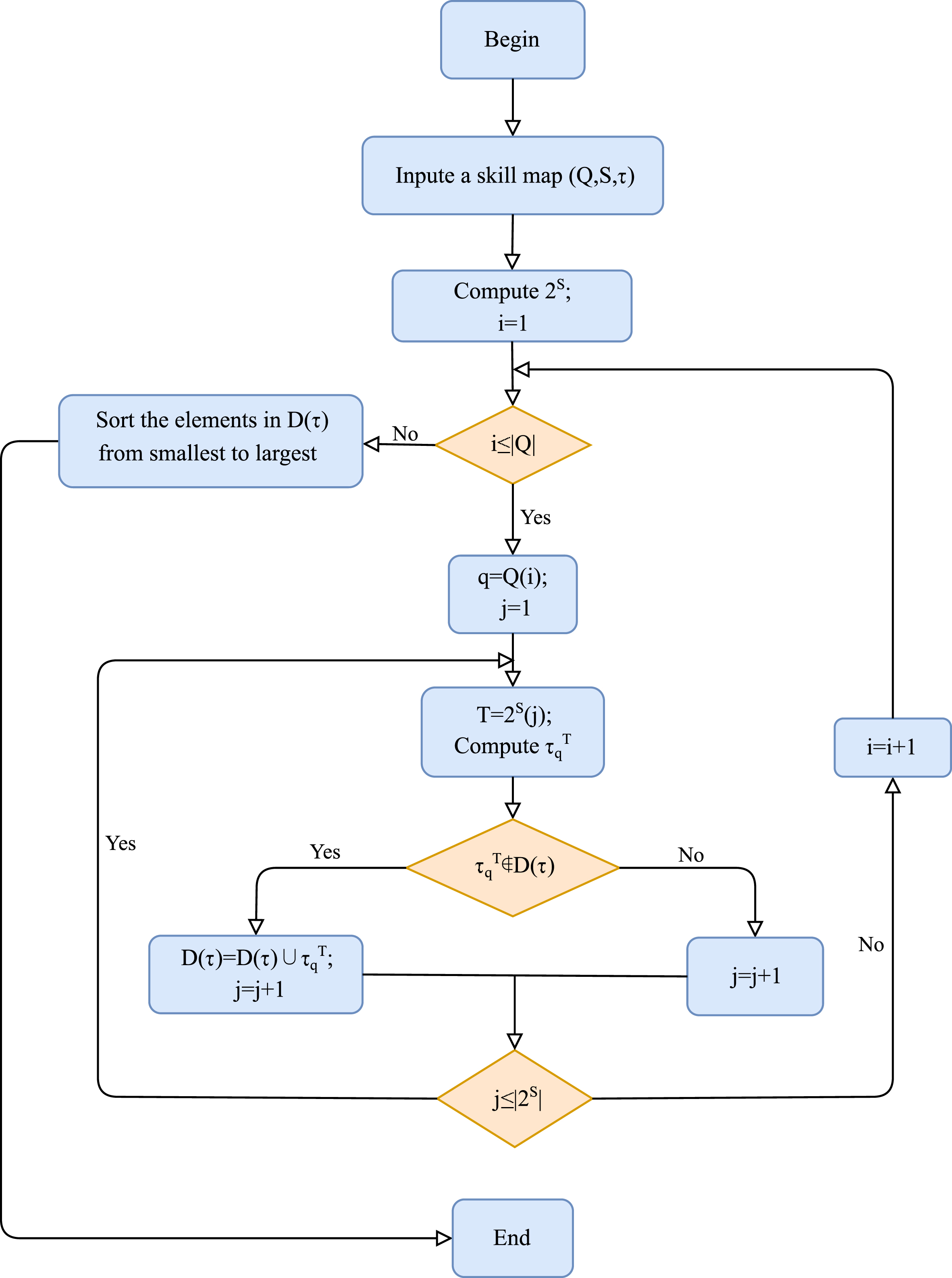
A flowchart for obtaining the skill inclusion degree set D (τ) of a skill map.
Algorithm 1
An algorithm to calculate the skill inclusion degree set D (τ) of τ.
1: D (τ)← ∅;
2: Compute 2 S , where 2 S is the power set of S;
3:
4:
5: Compute skill inclusion degree
6:
7:
8:
9:
10:
11: Sort the elements in D (τ) from smallest to largest.
Return D (τ)
Currently, different approaches are used to study the knowledge and learning assessment of individuals. Minn [29] provided adaptive learning content to learners in an educational setting through artificial intelligent techniques. Lázaro-Cantabrana [28] et al. constructed an assessment tool to assess teacher digital competence. Pusung [34] controlled student prior knowledge to understand the impact of learning patterns and task assessment on scientific achievement. In this section, the variable precision α-models are defined based on the skill inclusion degree in order to assess the knowledge mastery of individuals more comprehensively. These models determine the individual’s knowledge state by analyzing the number of skills he has mastered assigned to each item.
A table of knowledge states
From Table 3, when
When
In this example, it can be checked that when
In D (τ) = {β1, β2, ⋯ , β n }, it is easy to obtain that the knowledge structures can delineate via the variable precision α-models by a skill map except for β1. So we have the following conclusion.
(i) For α ∈ (β1, β2], the knowledge structure
(ii) For α ∈ (βn-1, β
n
], the knowledge structure
For
Let
(ii) In the same way, let
Let
It can be found that
In fact, for α = βj+1 (j = 2, ⋯ , n - 2), the knowledge structures
A table of skill inclusion degrees
By Table 4, we can get the skill inclusion degree set of τ as
Obviously, the knowledge structures
In KST, the knowledge structures delineated via the disjunctive and conjunctive models by the same skill map are dual one to the other [17]. In Theorem 2, we know that for a skill inclusion degree set of τ, the knowledge structure
More generally, the knowledge structures
We find that the knowledge structures delineated via the variable precision α-models by a skill map always have a minimal knowledge structure. Note that ‘minimal’ here refers to the minimal inclusion of knowledge states between knowledge structures. The relations between knowledge structures will be given by the following definitions.
The relations ≾ and ≾∗ will be referred to as the knowledge structure order on
The knowledge structures delineated via the variable precision α-models by any skill map always have the order relations in Definitions 4 and 5. According to the dual property of knowledge structures in Theorem 3, we can get the following theorem.
On the other hand, according to Theorem 3, we know that
The time complexity of Algorithm 2 is analyzed below. The items number, the skills number, and the cardinality of skill inclusion degree set are represented by |Q| = m, |S| = n, and |D (τ) |, respectively.
For Algorithm 2, the time complexity for calculating the skill inclusion degree set in step 2 is O (m × 2 n ). The time complexity for constructing the knowledge structures in steps 3-12 is O (|D (τ) |×2 n ). Thus, the time complexity of Algorithm 2 is O (|D (τ) | × m × 22n).
Algorithm 2
An algorithm for constructing knowledge all structures
1:
2: Calculate D (τ) by Algorithm 1;
3:
4: if α ≠ D (τ) (1)
5:
6: do Compute
7:
8:
9:
10: Sort the elements in
11:
12:
13: Return
Figure 2 is a flowchart for generating the knowledge structure graphs by constructing adjacency lists.
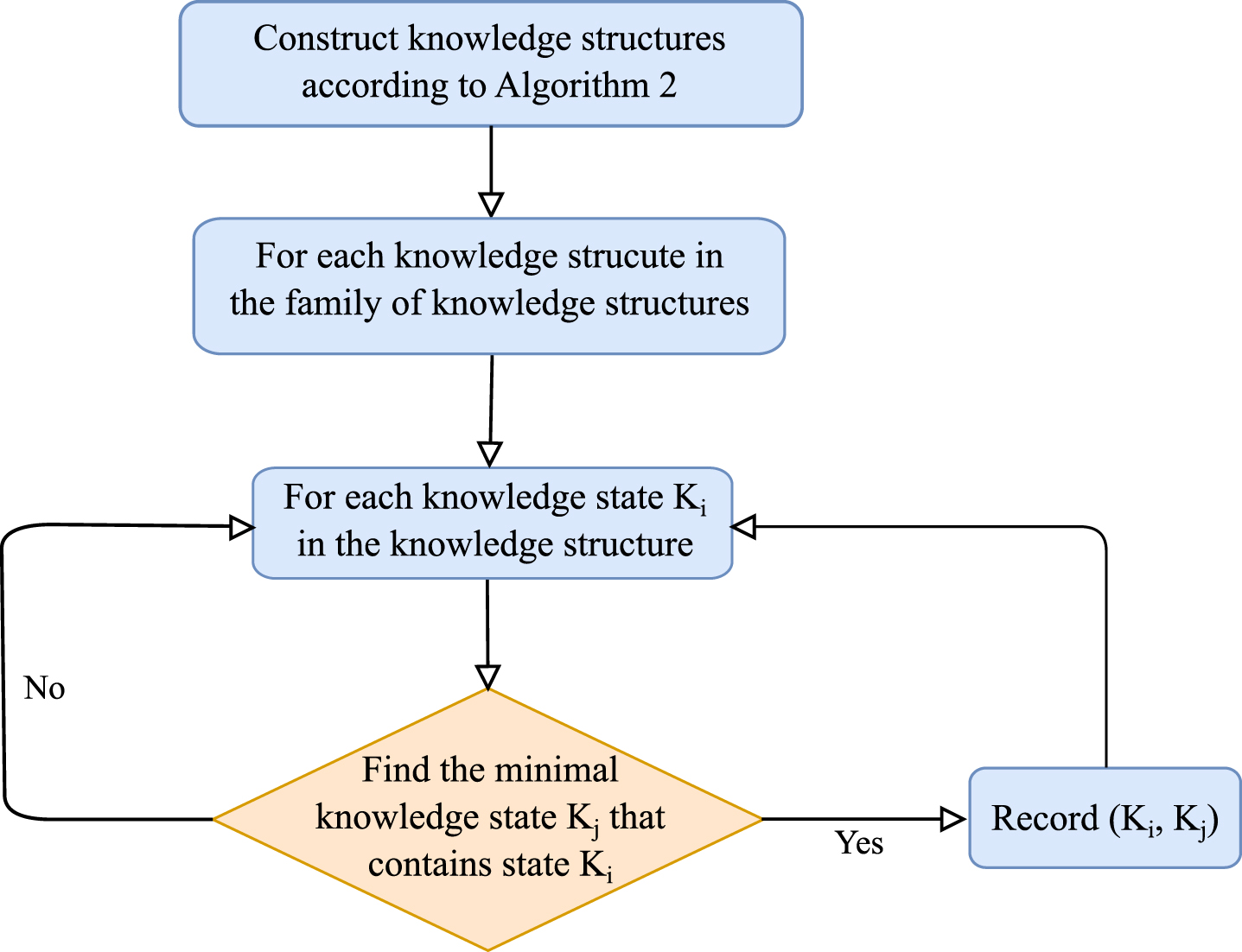
A flowchart for generating the knowledge structure graphs.
Then, the adjacency lists based on the above knowledge structures are shown in Tables 5-8.
A adjacency list of
A adjacency list of
A adjacency list of
A adjacency list of
The knowledge structure graphs are generated according to the adjacency lists, as shown in Figure 3. In this figure, the position of each knowledge states in knowledge structure
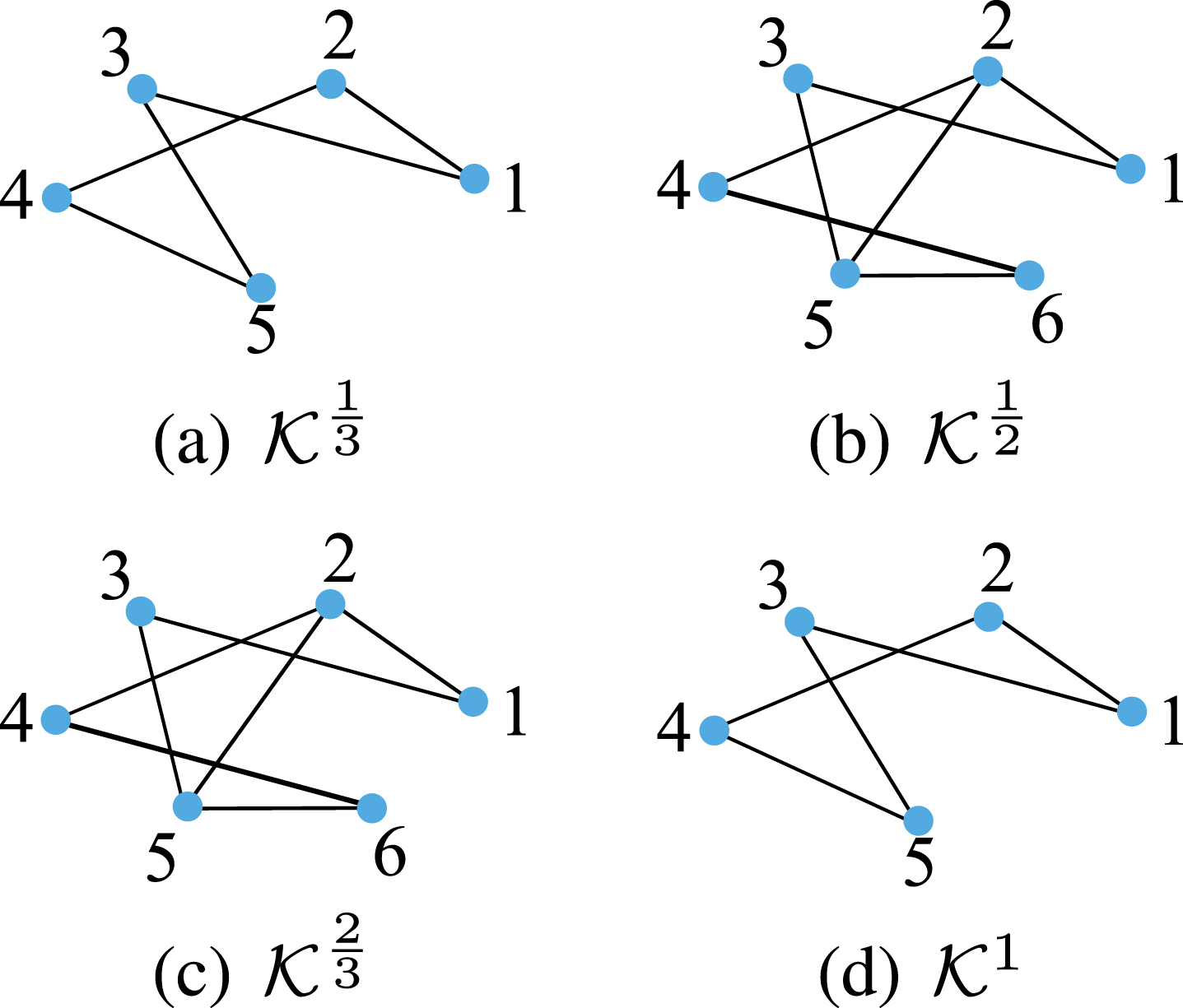
The graph of knowledge structures
To verify the feasibility and effectiveness of the proposed algorithm, we conduct an analysis of a dataset.
The experimental running environment is carried out on a Windows 7 operating system, Inter(R) Core(TM) i7-6700 CPU @3.40GHz and 8GB RAM. All experiments are implemented by Matlab(R2016a) and RStudio(1.1.463).
A dataset (COVID-19 Surveillance) is selected from UCI machine learning repository. The original dataset of COVID-19 Surveillance is shown in Table 9. To make the dataset suitable for the problems discussed in this paper, we discretize it. In this dataset, rows are treated as items and columns as skills corresponding to items. Since no classification is required, the last column is removed. In Table 9, “+" refers to that an item can be solved by a certain skill, and “-" indicates that an item cannot be solved by some skill. Thus, a skill map (Q, S, τ) can be obtained according to Table 9, as shown in Table 10. The skill map comprises 7 skills and 14 items.
The original dataset of COVID-19 Surveillance
The original dataset of COVID-19 Surveillance
A table of skill map (Q, S, τ)
According to the algorithm proposed in this paper, all skill inclusion degrees of a skill map (Q, S, τ) are calculated, and some skill inclusion degrees are shown in Table 11. Then the skill inclusion degree set of τ is
A table of partial skill inclusion degrees
A description of the experimental results
In Table 12, VP-α denotes the variable precision α-models.
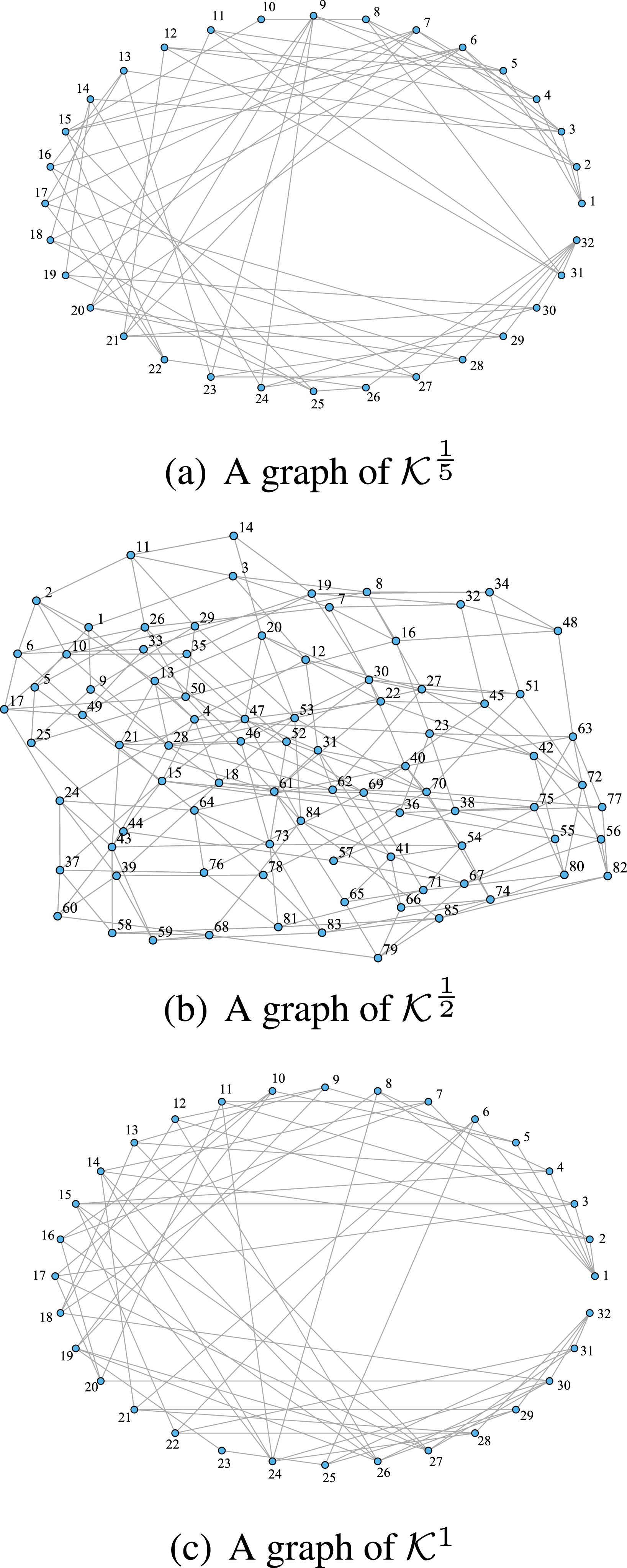
The graph of knowledge structures
In Figure 4, the nodes denote the knowledge states, the smallest node 1 represents ∅. The largest nodes 32 in Figure 4(a) and Figure 4(c) denote the complete set Q, and node 85 in Figure 4(b) also denote the complete set Q. An edge connecting two nodes indicates that the larger node contains the smaller one. In Figure 4(b), there are many different nodes connected to node 1. It shows that an individual fail to solve any items at the beginning and can reach the knowledge state of different nodes after learning. On this basis, an individual can eventually solve all the items through continuous learning. Moreover, from Figure 4, we find that there are more learning paths in subgraph (b), which indicates that the variable precision α-model will have more learning schemes for different individuals to choose. Therefore, in practical life, the variable precision α-model is more suitable for assessing the learning of most people.
From Table 12 and Figure 4, it is clear that the variable precision α-models include the disjunction and conjunctive models. Furthermore, some knowledge structures can be delineated via the variable precision α-models but cannot be delineated via the disjunctive and conjunctive models by a skill map. That is, the same skill map can delineate different knowledge structures by analyzing the number of skills an individual has mastered in solving items. This fully reflects the advantages of the model proposed in this paper.
To delineate a more reasonable knowledge structure, the concept of skill inclusion degree has been introduced and the variable precision α-models for delineating the knowledge structures have been constructed in this paper. Different from previous models, the variable precision α-models have taken into account the number of skills that attached to each item. This provides a reasonable explanation for the phenomenon that different individuals have different knowledge structures behind solving the same item. By using skill inclusion degree set D (τ) to segment α ∈ (0, 1], different knowledge structures are delineated via the variable precision α-models by a skill map. In addition, an algorithm for constructing knowledge structures has been designed, and the process of generating knowledge structure graphs has been illustrated with a flowchart. Experimental results have demonstrated the feasibility and effectiveness of the proposed algorithm.
Some of the advantages and disadvantages of this paper are described as follows.
Advantages: The variable precision α-model is more suitable to assess the knowledge level of different individuals than the disjunctive and conjunctive models. The concept of skill inclusion degree is introduced, and the conditions of delineated knowledge structure are segmented effectively, so that the knowledge structure is closer to the real knowledge structure of individual. If each knowledge structure is used as an evaluation scheme, the variable precision α-model provides more schemes for evaluating individual knowledge level.
Disadvantages: The model proposed in this paper needs to traverse all subsets of skill, which is limited to a large body of knowledge.
The more skills individuals have, the more items they will solve [38]. Individuals may change their own knowledge state when they learn skills. However, the knowledge state of individuals may not change as they learn and master more skills, because they may learn the same skills repeatedly. Zhou et al. [48] studied the one-to-one correspondence between individual ability level and performance level. Based on skill function, Yang et al. [44] discussed the construction of knowledge structures and the skill subset reduction. Mahapatra et al. [33] introduced RSM index for link prediction to obtain more nodes. This method may be combined with KST to predict individual knowledge. The decomposition method of m-polar fuzzy threshold graph by Mahapatra et al. is interesting [31, 32]. In further work, we will compare our methods and try to consider the two together, as well as we will continue to study skills reduction and learning path selection [45, 47].
Footnotes
Acknowledgments
This work is supported by the National Natural Science Foundation of China (No. 11871259 and 12271191) and Natural Science Foundation of Fujian Province (No. 2020J02043, 2022J01306 and 2022J05169).