



Abstract
In order to improve the accuracy of cloud manufacturing service recommendation results, improve recommendation efficiency and user satisfaction, a cloud manufacturing service recommendation model based on GA-ACO and carbon emission hierarchy is proposed. According to the concept of cloud manufacturing, a cloud manufacturing platform including resource layer, service layer, operation layer and application layer is constructed, and then a cloud manufacturing service quality perception model is established; genetic algorithm is used to realize cloud manufacturing service selection, and ACO algorithm is used to optimize cloud manufacturing service portfolio; According to the selection and combination results of the constructed cloud manufacturing platform and cloud manufacturing service, taking the carbon emission field as an example, a hierarchical hierarchical model is constructed, and this model is used to further construct a cloud manufacturing service recommendation model from coarse to fine, from global to local; Identify user demand scenarios and implement cloud manufacturing service recommendations. The experimental results show that the recommendation results of the proposed method have high accuracy and efficiency, and can be recognized by most users.
Keywords
Introduction
Cloud manufacturing is a new service-oriented networked manufacturing model derived from the cloud computing model. It has the characteristics of service-oriented, high efficiency, and low consumption, it is a hot research topic in the field of advanced manufacturing in recent years [1, 2]. According to the whole life cycle of cloud manufacturing services, cloud services include service description, service composition, service matching, service recommendation and other stages. The purpose of service recommendation is to solve the problem that users can efficiently and accurately obtain resources that meet their needs from massive data. However, the current service recommendation in the manufacturing field has not achieved the expected effect. How to improve the accuracy of service recommendation in the cloud manufacturing environment is an urgent problem to be solved [3, 4].
Reference [5] proposes a cloud manufacturing service recommendation model based on scene recognition. First, the original service composition is described and the function information is reconstructed; Then, based on the obtained scenario comprehensive description, the application scenarios of service composition are clustered, and a weighted service library is established for each scenario; Finally, by identifying the scene category of the user’s needs, the service recommendation is carried out with the help of each scene weighted service library. The experimental results show that this method has a great improvement in the recommendation effect, but there is still the problem of low accuracy of the recommendation results. Reference [6] proposes a service recommendation scheme suitable for business process customization environment. The scheme first uses clustering algorithm to solve the problem of new users, then optimizes collaborative filtering to improve the diversity of recommendation results, and then builds a content filter. Remove “pseudo-neighbors” to improve the recommendation quality, and finally recommend the obtained candidate services to users. Experimental studies have confirmed that this method can not only solve the problem of new users, but also improve the diversity and quality of recommendation results, but the recommendation efficiency needs to be further improved. Reference [7] proposes a cloud service recommendation method based on QoS prediction and constraint hierarchy model. The model divides QoS constraints into hard constraint layers that must be satisfied and soft constraint layers that can be deviated according to the importance of QoS constraints to user business. The model can effectively solve the over constraint problem and realize cloud service recommendation. Experiments verify the feasibility and effectiveness of this method, but its recommendation quality can not meet the needs of users.
In order to improve the recommendation quality of cloud manufacturing service, reduce recommendation time, and improve recommendation accuracy, a cloud manufacturing service recommendation model based on GA-ACO and carbon emission hierarchy is proposed.
Analysis of cloud manufacturing services
Basic concepts of cloud manufacturing
Cloud manufacturing is a user-oriented, integrated and intelligent new manufacturing model. Different from the traditional manufacturing model, it integrates cloud computing technology, Internet of Things technology, information security technology, manufacturing digital technology and other information technologies to make manufacturing Industrial informatization, after virtualizing various manufacturing resources and manufacturing capabilities according to certain standard specifications, all manufacturing resources and manufacturing capabilities are concentrated in the cloud resource pool, and unified management and operation are carried out by the cloud manufacturing platform. The required services can be obtained through the cloud manufacturing platform.
Figure 1 is a conceptual model of cloud manufacturing. As shown in Fig. 1, there are three main roles in cloud manufacturing: cloud manufacturing platform manager, service provider and service demander. The service provider is at the forefront of the entire manufacturing life cycle. It provides the required manufacturing capacity and manufacturing resources for the manufacturing service, which is a necessary prerequisite for the smooth progress of the manufacturing task. The main responsibility of the cloud manufacturing platform administrator is to manage and maintain various resource capabilities provided by service providers, virtualize and store them in the cloud resource pool, and then receive specific requirements from service users and select the most matching services for them. resource. Service users express their manufacturing needs to the cloud manufacturing platform, and pay the corresponding fees after obtaining manufacturing services. The cloud manufacturing platform is essentially a “porter” of manufacturing resources, which is to achieve “centralized use of resources in different regions” and “centralized resources are distributed to different places for use”. However, this kind of “handling” is not the handling of things in real life, but all resources are virtualized to form cloud resources after certain standard specifications. The “handling” here refers to the use of users in different regions on the cloud manufacturing platform. Manufacturing resources in the same region, users in the same region use manufacturing resources in different regions.
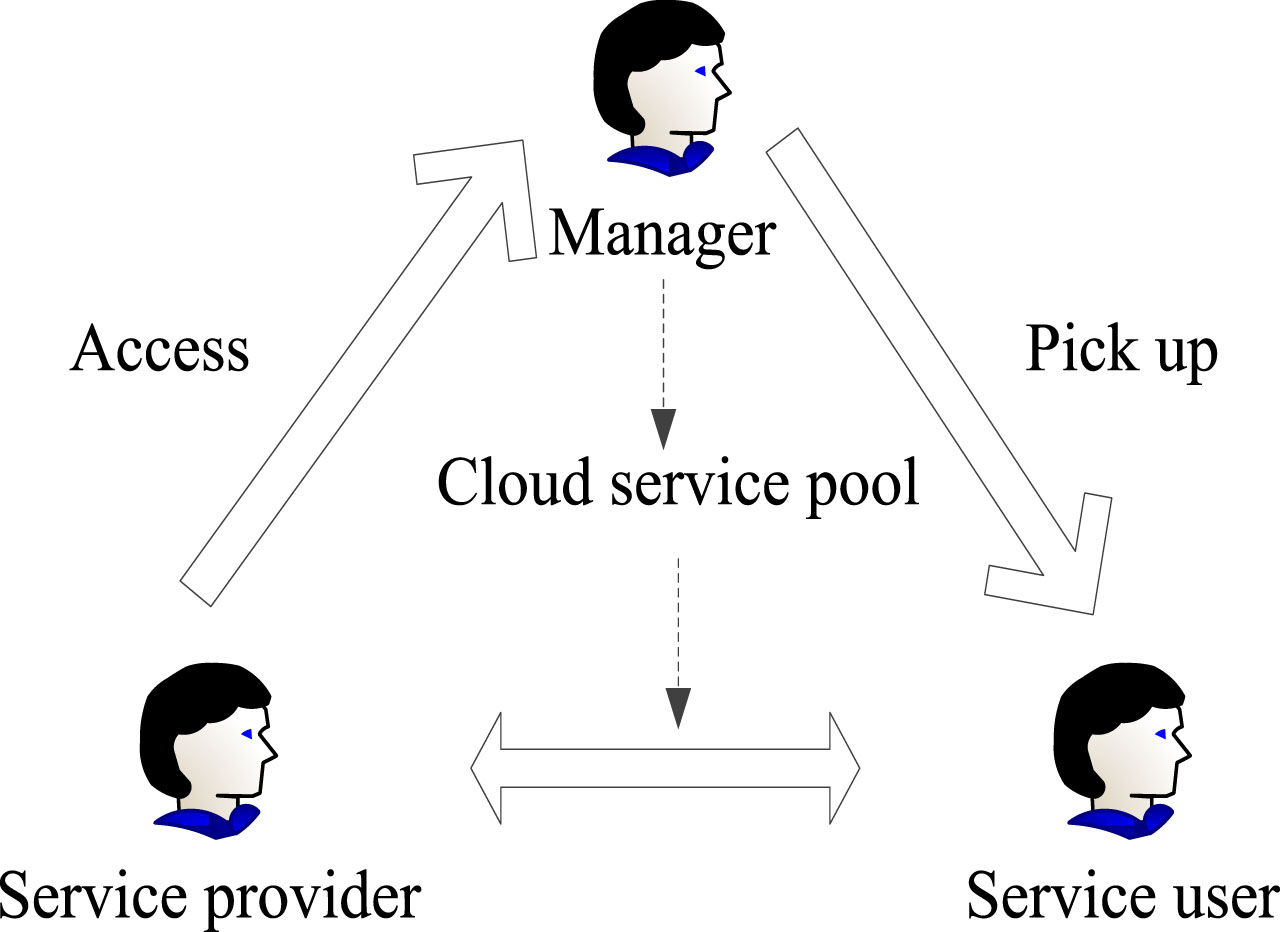
Schematic diagram of cloud manufacturing conceptual model.
Cloud manufacturing platforms have important functions in service matching and inter-enterprise manufacturing service transactions. The structural framework of the cloud manufacturing platform can be divided into four layers, namely resource layer, service layer, operation layer and application layer. Resource layer: The description, status, location and other information of various online and offline resources are stored in the cloud manufacturing platform through the Internet of Things technology. This layer involves the problem of service resource description. If the current service description has not been uniformly defined, it needs to be described in terms of semantics, attributes, ontology and service formalization. Service layer: This layer is the core layer of the cloud manufacturing platform, providing various core technical support, and is responsible for the release, management, search, recommendation and other tasks of cloud services. Most of its related technologies are the key to cloud manufacturing. components of technology. Operation layer: Complex manufacturing tasks can be divided into several sub-tasks, and the requirements of each sub-task are divided and conquered to ensure that the operation tasks are effectively solved, and the platform provides the matching results of recommended services. Application layer: The internal structure of cloud manufacturing is encapsulated, and the external interface is provided for users to participate in and use. For users, they only need to obtain the results from the cloud platform according to their own needs, and do not need to consider the problems involved in the recommendation process.
In a cloud manufacturing platform, the flexible operation of service providers, operators, and customers is crucial. The service provider registers various manufacturing resources involved in the manufacturing process into the cloud manufacturing platform. Customers send requests to the platform according to their actual needs. After receiving the service demand information proposed by users, the service operator will select the most suitable service resources from the resource library registered by the provider and recommend them to customers. Through efficient screening of massive information service resources, it can improve the dispersion of manufacturing resources and improve the service efficiency of the manufacturing industry. The goal of screening is to ensure that the provider provides the service that is optimal or closest to the user’s needs, and fulfills the needs of both the provider and the customer.
Service recommendation is an important direction of cloud manufacturing research. Among the massive service resources, the service that best matches the needs of users is selected. Therefore, the result of service recommendation can also be regarded as the result of service matching. Efficiently and accurately providing users with services that meet their needs is an important difference between cloud manufacturing platforms and traditional network resource services. The accuracy of recommendation results and user satisfaction directly affect the efficiency of the entire manufacturing task and subsequent collaborative manufacturing process. Therefore, it is an inevitable trend to solve the traditional service problems to comprehensively improve the service recommendation efficiency of the cloud manufacturing platform and reduce the time cost.
Cloud manufacturing service quality perception model
Cloud manufacturing is a public service platform that uses information technology to build shared manufacturing resources. All kinds of related companies can act as service providers to virtualize and package their own manufacturing resources and release them to the cloud manufacturing platform to form a manufacturing cloud pool for service use. Users can use it on demand to realize “centralized resources and decentralized services”. Manufacturing resources include design resources, simulation resources, production resources, test resources, integration resources, capability resources and management resources. Among them, management resources include comprehensive evaluation information of resources, and feedback cloud manufacturing service quality (QoS) through user evaluation. Therefore, there are many different types of cloud manufacturing services. For the sake of simplicity, this article divides cloud manufacturing services into hardware cloud services and software cloud services. Hardware cloud services specifically refer to cloud services that require production and manufacturing equipment, and the rest are software. cloud service.
At present, different standards and research organizations have different definitions of service quality, but the definition of QoS in international standard ISO8402 better reflects the characteristics of QoS, that is, QoS is composed of some non functional attributes, including service price, service execution time, service availability, service reliability, etc., which not only reflects the physical meaning of the service quality provided by service providers, but also reflects the needs of users. Since the possibility of some service providers providing false registration information or malicious evaluation behavior cannot be ruled out in cloud manufacturing, there is a trust problem in the transaction between service suppliers and buyers. Therefore, the service integrity parameter needs to be introduced into the QoS information. This paper argues that the more credible the function provided by a service, the higher the average evaluation of service consumers, the more objective the evaluation of other services, and the higher the integrity. Therefore, this paper presents the following QoS perception model for cloud manufacturing services:
The QoS of cloud manufacturing service S can be modeled as:
Among them: w c represents the price of cloud service. If S is a hardware cloud service, the price includes the outsourcing price and transportation cost of the service. Let the current average outsourcing quotation of a single product be c r , and the average transportation cost per kilometer of a single product be c x , then w c = c r + c x ; If S is a software cloud service, w c represents the cost of using the service S.
w t represents the time interval from when service S is invoked until the response is obtained, which represents the timeliness of the cloud service execution request. The physical operations corresponding to different types of cloud services in the cloud manufacturing environment are very different. If S is a hardware cloud service, the task product’s If the processing time is t p and the transportation time is t u , then w t = t p + t u ; If S is a software cloud service, t q represents the computing time of the service, and the delay time from when the calling command is issued to when S starts to execute is t d , then w t = t q + t d . The above sampling and measurement methods of time and price are significantly different from traditional services, which fully consider the business context of cloud services serving product manufacturing.
w
r
represents to the reliability of services, which refers to the ability of cloud services to operate normally within a complete time interval; w
a
represents to the availability of services, and refers to the probability of normal operation of a service; w
h
represents to the integrity of the service, which refers to the average evaluation of users on the degree of service compliance with the agreement after the event. Suppose that service S is called n times during the time period of (T0, T1), the number of normal responses is n
z
, the failure-free time is t
z
, and the evaluation given by each user is e
i
, then:
Genetic algorithm (GA) is a computational model that simulates the biological evolution process of genetic selection and natural elimination. It is a population-based global optimization search algorithm. The population evolves continuously through selection, crossover and mutation, and finally converges to obtain an optimized solution. This algorithm is often used in the optimization calculation of complex systems [8, 9]. In this paper, genetic algorithm is used to solve the problem of cloud manufacturing service selection, and an improved coding method is used to design an adaptive function based on the Qos model proposed in this paper, and crossover and mutation are carried out through adaptive rules.
Relational matrix coding
The coding of resource-task chromosome relationship matrix adopts the idea of adjacency matrix in graph theory, and designs a coding method that can not only reflect the combination relationship of cloud manufacturing resources and services, but also reflect cloud manufacturing task path information. The genetic algorithm coding method for cloud manufacturing service selection is as follows:
Among them: i = 1, 2, . . . , 5; j = 1, 2, . . . , 5.
The positions on the main diagonal of the matrix represent loci, and the fixation corresponds to the task in the cloud manufacturing service. It can be seen from this that the locus is the element on the main diagonal of the matrix, representing the tasks of the workflow in the cloud manufacturing service combination; the chromosome is the specific representation of the task arrangement on the main diagonal of the matrix, representing a combination scheme of the combined service; the population It is part of the set of combined service solutions; the crossover and mutation operations only operate on the task bits on the main diagonal of the matrix. Then the position matrix encoding of α
ij
is as follows:
In specific encodings, the main diagonal of the matrix is replaced by specific numerical values.
Users generally put forward QoS requirements or restrictions on the choice of cloud manufacturing services. The penalty function method is a general method to deal with restricted optimization problems. The penalty function method is used to combine the constraints and the objective function to form the fitness function fit. For cloud manufacturing service selection, a penalty function is constructed using the attribute set related to time, cost and service as constraints. Its fitness function fit is:
(1) Select
Using the roulette selection method, first calculate the fitness sum
(2) Cross
Using the uniform crossover operation, let C1 and C2 be two parent individuals to be crossed, and randomly generate two 0 1 masks of the same length as the parent individual (the segment in the mask indicates which parent individual provides the variable value to the new individual)).
(3) Variation
The uniform mutation operation is adopted, and the uniform mutation rate is taken as 0.1, which can increase as the number of items increases.
The selection of cloud manufacturing services is realized through genetic algorithm, which provides the basis for cloud manufacturing service combination.
Cloud manufacturing service portfolio
According to the selection of cloud manufacturing services based on GA, a combination analysis of cloud manufacturing services is further carried out. Algorithms in the service combination need to be selected according to different scenarios. In addition, the search range of the algorithm must be expanded to prevent the algorithm from falling into the local optimum and find the global minimum value, that is, the global optimal execution path. In addition to obtaining the optimal service combination, it is also necessary to improve the efficiency and complete the optimization of the cloud manufacturing service combination in a shorter period of time as much as possible. It can be seen that the selection of intelligent optimization algorithm is a very critical step in the optimization of cloud manufacturing service combination. In this paper, ACO algorithm [10, 11] is selected as the cloud manufacturing service combination optimization algorithm. The following is a detailed analysis of the cloud manufacturing service combination steps.
The cloud manufacturing service demander initiates task requests to the cloud manufacturing platform according to their own manufacturing tasks, and the cloud manufacturing platform divides the requirements proposed by users into single tasks and complex tasks according to the granularity of the tasks. For complex tasks, the platform will decompose complex tasks into multiple atomic subtasks according to certain specifications. Find cloud manufacturing resources that meet the requirements, and build a cloud manufacturing service composition model, as shown in Fig. 2.
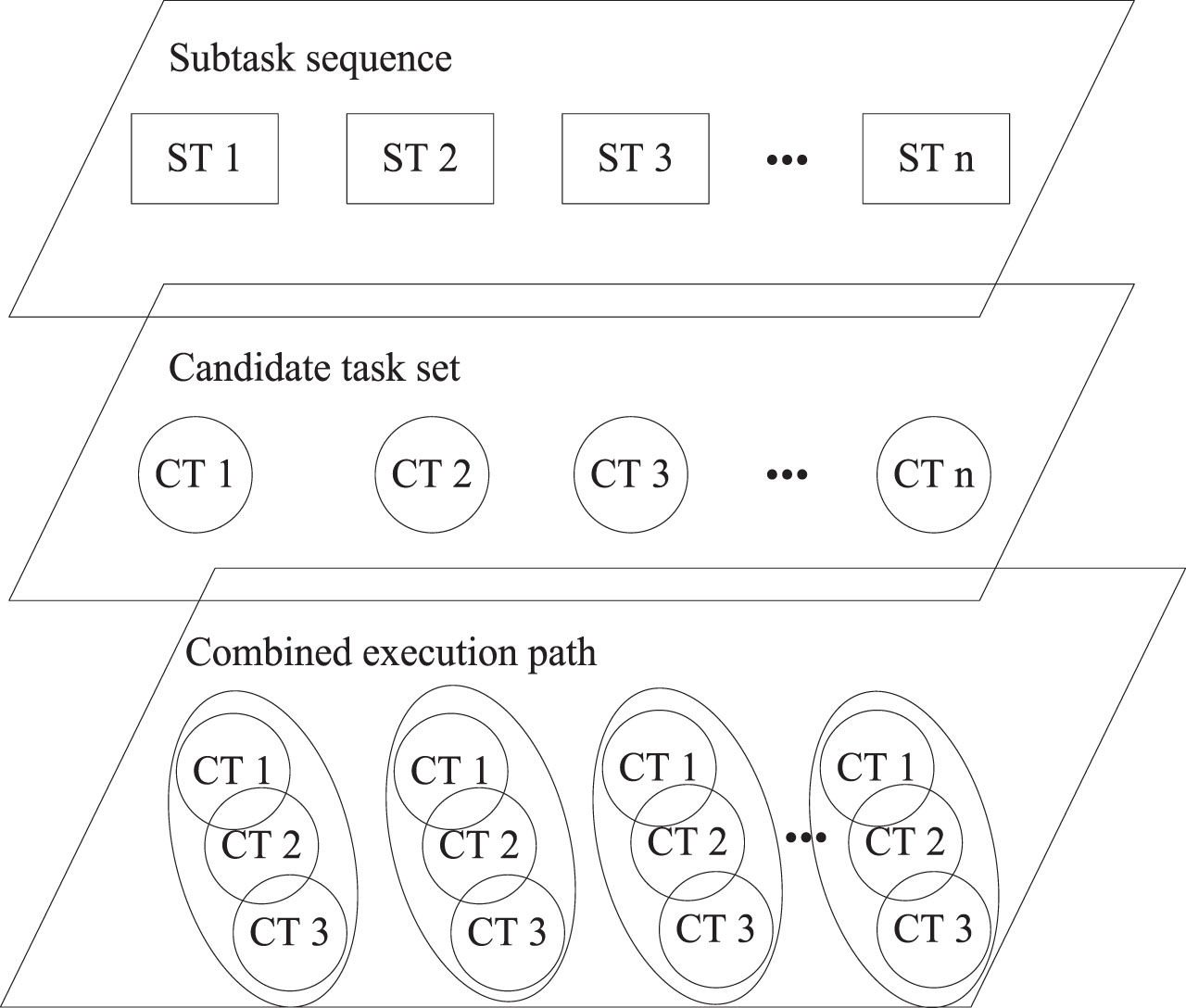
Cloud manufacturing service composition model.
Step 1: Based on formula (1), establish an appropriate QoS evaluation model for specific tasks:
Among them: R (p i ) represents the objective function value, the smaller R (p i ) is, the better the evaluation result is; w1, w2, w3, w4 and w5 respectively represent the weights of w c , w t , w r , w a and w h , which can be set according to the user’s preference, but must satisfy w1 + w2 + w3 + w4 + w5.
Step 2: Initialize the ACO algorithm parameters, set the pheromone on each path as ɛ ij = A, where A is a constant and the number of iterations is M = 0, and set the lower information heuristic factor as θ low , the higher expected heuristic factor as σ high , and the higher pheromone volatilization coefficient as γ high .
Step 3: Set the number of iterations M = M + 1, the number of ants k = k + 1, and place m ants in the starting position.
Step 4: The conventional ant selects the next hop node according to formula (9):
Among them: φ ij (t) and ϑ ij (t) represent the residual amount of pheromone and the amount of heuristic information, respectively; ζ1 and ζ2 represent the information heuristic factor and the expectation heuristic factor, respectively. The larger the information heuristic factor is, the faster the algorithm converges, but it is easy to converge prematurely and fall into a local optimum.
At the same time, according to the roulette mechanism, it is converted into a special ant search with a small probability P
f
, and the special ant selects the next hop according to formula (10):
Among them: r
m
represents the total number of nodes allowed to be selected by the ant next hop;
Until the last node is searched, the QoS evaluation function value of this path is calculated, and both the path and the objective function value are stored in the matrix.
Step 5: Determine whether the number of ants is greater than the maximum value, if so, go to the next step, otherwise return to step 3.
Step 6: Select the optimal path in this cycle, if the objective function value is smaller, replace the original historical optimal path, otherwise do not replace.
Step 7: Perform pheromone update according to formula (11) and formula (12):
Among them: τ represents the volatility coefficient of the pheromone on the path, and its purpose is to prevent the pheromone from accumulating continuously, so that the algorithm falls into the local optimum and misses the optimum solution. The value range of τ is [0, 1), then 1 - τ represents the residual pheromone coefficient on the path. Δɛ
ij
(t) represents the increment of pheromone on the path after each search is completed, and at the beginning of stage Δɛ
ij
(t) = 0,
Step 8: Determine whether the number of iterations is greater than the maximum number of iterations Mmax, if it is greater than the next step, otherwise return to step 3.
Step 9: Repeat steps 3 to 7, calculate the QoS value of each search, and calculate the variance δ2 of the objective function value.
Step 10: Compare the variance δ2 with the set variance
Step 11: The cloud manufacturing service demander selects appropriate cloud manufacturing resources for manufacturing and production tasks according to the output results. After the task is completed, the user pays the corresponding fee to the cloud manufacturing platform, and the cloud manufacturing platform pays a certain rental fee to the cloud manufacturing resource provider. In addition, users evaluate and feedback each cloud manufacturing resource used, which provides a certain basis for subsequent cloud manufacturing service recommendations.
According to the selection and combination results of the cloud manufacturing platform and cloud manufacturing service constructed above, the cloud manufacturing service recommendation method is studied.
Hierarchical hierarchical modeling
Taking the carbon emission field as an example, a hierarchical hierarchical model is constructed, and the model is used to further construct a cloud manufacturing service recommendation model from coarse to fine, from global to local. The hierarchical hierarchical model has branch and nested hierarchical structure. Different branches correspond to different classifications. The higher the level, the more overall information can be reflected, and the lower the level, the more detailed information. The advantage of establishing a hierarchical model is that it can switch between different levels and quickly obtain relevant information at each level, so as to seek the optimal solution and reduce the complexity of cloud manufacturing service recommendation.
A hierarchical hierarchical model of carbon emissions can be formed through domain division and upper-level spatial information extraction:
(1) Domain division
The division of the universe of discourse is realized by the function decomposition tree mapping. The total function of a complex product is generally composed of several sub-functions. Each sub-function is used as the basis to divide the universe of discourse. In this way, the functions are subdivided in turn, and then the discourse division of the hierarchical structure can be obtained.
(2) Extraction of upper layer spatial information
The extraction of upper-level spatial information can be divided into two types: structured and unstructured domains of discourse. The former is generally obtained by taking the statistical values of the lower-level spatial information or obtained by simple summation, while the latter is based on the structure of the universe and organizes the information in a structured manner. The information of the layer space forms the properties of the new universe.
According to the above three links, a hierarchical hierarchical model is constructed, as shown in formula (13):
Using this model, the design perspective can be flexibly converted to various layers of the product, and carbon emission information at various granularities can be quickly obtained, which can provide a reference for cloud manufacturing service recommendation.
Based on the cloud manufacturing platform established above, this paper builds a cloud manufacturing service system. The cloud manufacturing service system mainly includes four types of entities, namely manufacturing service provider, manufacturing service, developer and service combination. Manufacturing service providers publish their own manufacturing resources and capabilities to the cloud manufacturing service system in the form of manufacturing services. Each manufacturing service usually includes the service name, service label, service creation time, service description, etc., where the service description is the description text written by the service provider when the service is published, and usually includes an introduction to the functional characteristics of the service. In the system, developers specifically refer to people who create service portfolios by screening manufacturing services to meet complex manufacturing needs [12, 13]. In the actual system, the developer can be the management and operator of the service system, the user or customer of the third party, or the manufacturing service provider. No distinction is made within the scope of this paper, and they are all called developers or users.. Service portfolio refers to the whole set created by the developer to assemble multiple manufacturing services to jointly meet a certain individualized manufacturing requirement. Each service composition usually includes the service composition name, service composition label, service composition creation time, service composition containing service list, service composition description, etc., where the service composition description is the description text written by the developer when the service composition is created, which usually contains an introduction to the application background and design goals of service composition [14].
This paper defines the cloud manufacturing service system as S′ ={ s d , s n , s f , s h }, which s d represents the cloud manufacturing service set, s n represents the number of manufacturing services in the cloud manufacturing service system; s f represents the description written by the service provider for the service, and s h represents the set of service combinations.
The following is a service recommendation based on the previous cloud computing service processing results. First, the user inputs a piece of manufacturing requirement q in the form of natural language, hoping that the cloud manufacturing platform will recommend a series of services for him to create a service combination to meet his individual manufacturing needs. The description text of the requirement is represented as a word set Q ={ q1, q2, . . . , q
m
}, the LDA topic model [15–17] is used to describe the requirement, and the vectorization and topic features of the requirement q are extracted, and the obtained topic vector is called the user requirement topic vector. Then, in order to identify the scenarios of user needs, the JS divergence tool is used to measure the similarity between the theme vector of user needs and the description vector of each scene. Denote the JS divergence of user demand topic vector and scene description vector as JS (κ
q
, χ
q
), and its specific expression is:
Among them: κ q represents the user demand topic vector; χ q represents the scene description vector. The smaller the value of JS (κ q , χ q ) is, the higher the similarity between the user demand theme vector κ q and the scene description vector χ q is.
The above steps realize the scene recognition of user needs. The following uses the similarity between the user demand scene and each scene and the weighted service library of each scene to calculate the recommendation score of each service s
i
in the cloud manufacturing platform:
Among them: L (s i ) represents the indicative function; G (s i ) represents the recommendation score of service s i , the higher the value, the better the service s i can meet the user’s needs.
Calculate the recommendation scores of all services s i in the cloud manufacturing platform, sort all services in descending order of recommendation scores, and generate a list of recommended services to output to the user. So far, the cloud manufacturing service recommendation is completed.
Experimental design
In order to verify the rationality and practicability of the cloud manufacturing service recommendation model based on GA-ACO and carbon emission hierarchies proposed in this paper, with the help of cloud computing platform, the prototype of cloud manufacturing service test platform is designed, and Tomcat 7.0 is selected as the server. Using MySQL5.0 and Sybase15.0 as the database and its design tools, the cloud manufacturing platform service is called by the commonly used distributed application software mpi-BLAST simulation computer node. Because the description and definition of cloud manufacturing services are highly autonomous and diverse, there is currently a lack of a public service benchmark library recognized by most scholars as a standard test set. Therefore, the cloud manufacturing service recommendation effect test uses automatic The generated test data is simulated and tested. The cloud manufacturing service test platform built in this paper includes 100 cloud manufacturing services for testing.The number of experiments was 12.The number of users is 100.
In the experimental environment constructed above, the proposed method, reference [5] method and reference [6] method are compared from the three perspectives of accuracy of recommendation results, recommendation efficiency and user satisfaction, and the service recommendation test results are obtained.
Analysis of results
(1) The accuracy of the recommended results
In order to verify the service recommendation ability of the proposed method, the accuracy of the recommendation results is used as the test index to carry out experimental research. The experimental test results are shown in Fig. 3:
It can be seen from Fig. 3 that in multiple experiments,The accuracy of the proposed method is up to 90%, the accuracy of the proposed method is higher than that of the reference [5] method and the reference [6] method, indicating that the proposed method has better recommendation effect. This is because the proposed method uses genetic algorithm to select cloud manufacturing services before service recommendation, and uses ACO algorithm to optimize cloud manufacturing service combination, thus improving the accuracy of recommendation results.
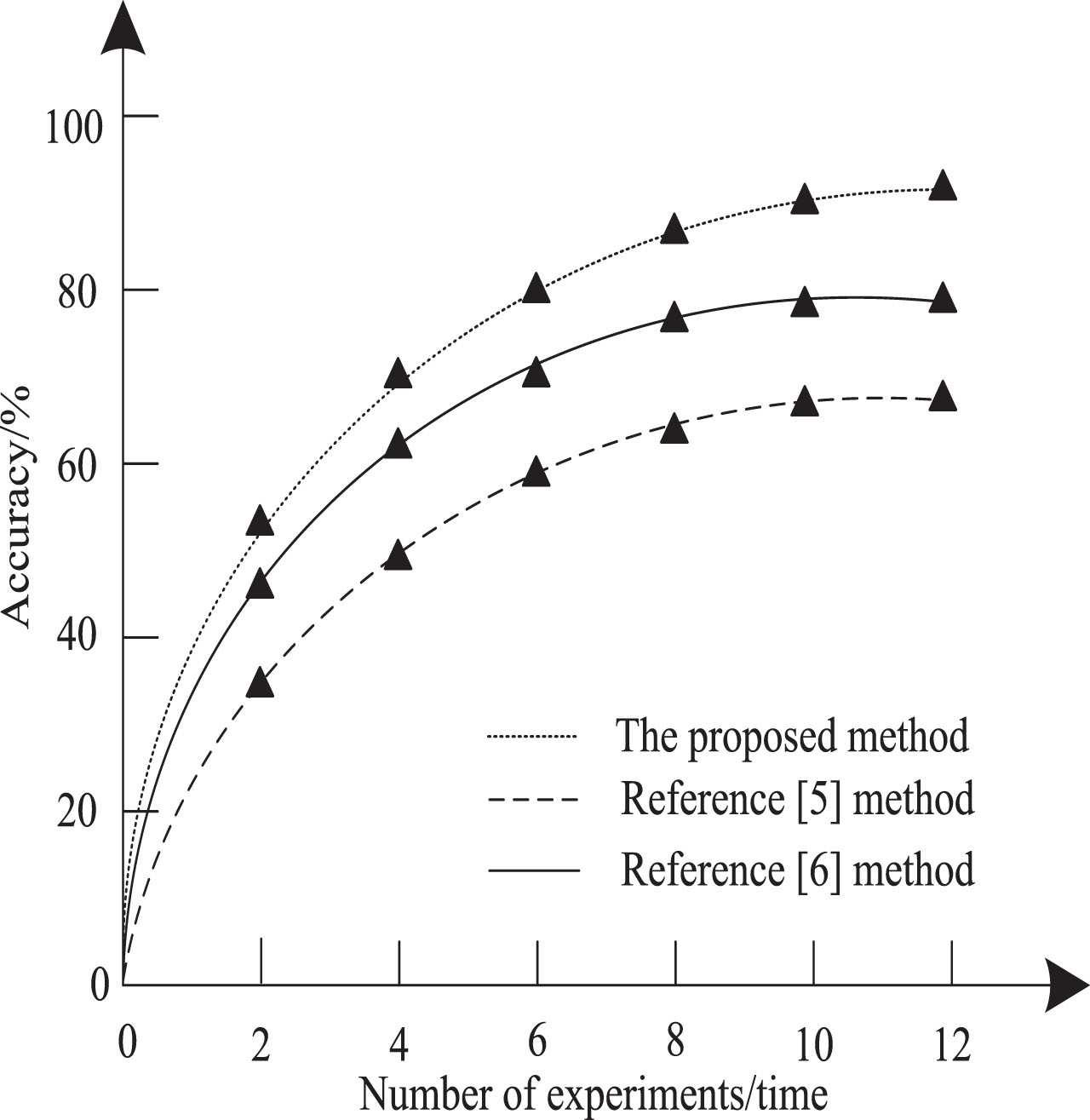
Recommendation results accuracy test results.
(2) Recommendation efficiency
In order to verify the service recommendation efficiency of the proposed method, the recommendation time is used as the test index to carry out experimental research. The longer the recommendation time, the lower the efficiency of the method. On the contrary, the shorter the recommended time, the higher the efficiency of the method. The detailed experimental test results are shown in Table 1:
Recommended efficiency test results
It can be seen from Table 1 that the number of experiments is proportional to the recommended time. With the increase of the number of experiments, the recommended time used by the proposed method, the method in reference [5] and the method in reference [6] increases continuously. Under the same number of experiments, the recommended time used by the proposed method is lower than the recommended time of the reference [5] method and the reference [6] method. The minimum and maximum recommendation time of the proposed method are 3.7 s and 7.0 s respectively. By comparison, it can be seen that the proposed method can complete the cloud manufacturing service recommendation at a faster speed and has higher efficiency.This is because this method uses genetic algorithm to select cloud manufacturing services, and uses ant colony algorithm to optimize cloud manufacturing service portfolio; According to the results of the selection and combination of cloud manufacturing platform and cloud manufacturing services, taking the carbon emission field as an example, a hierarchical model is built, and the model is used to further build a cloud manufacturing service recommendation model from coarse to fine, from global to local;
(3) User satisfaction
Based on the above analysis, in order to further verify the application effect of the proposed method, taking user satisfaction as the experimental indicator, 100 users were selected to score different methods, and the user satisfaction results of different methods were obtained as shown in Table 2. Among them, the user satisfaction is based on the user’s score, and the higher the score, the higher the user satisfaction.
User satisfaction test results
Analysis of Table 2 shows that with the increase of the number of users, the user satisfaction score results of different methods decrease accordingly. When the number of users is 60, the user satisfaction of the reference [5] method is 85.2 points, the user satisfaction of the reference [6] method is 76.3 points, and the user satisfaction of the proposed method is 92.6 points. It can be seen that the proposed method has higher user satisfaction.This is because this method identifies user demand scenarios and implements cloud manufacturing service recommendations. Improve the accuracy of cloud manufacturing service recommendation results, and improve recommendation efficiency and user satisfaction.
In order to improve the accuracy of cloud manufacturing service recommendation results, improve the recommendation efficiency and user satisfaction as the research purpose, a cloud manufacturing service recommendation model based on GA-ACO and carbon emission hierarchy is proposed. Build cloud manufacturing platform and cloud manufacturing service quality perception model according to cloud manufacturing concept; Adopt genetic algorithm and ACO algorithm to realize cloud manufacturing service selection and service combination optimization; build a hierarchical hierarchical model, and use this model to further build a cloud manufacturing service recommendation model from coarse to fine, from global to local, to achieve cloud manufacturing service recommendation. The experimental results show that compared with the traditional method, the proposed method has higher accuracy and efficiency of recommendation results, and higher user satisfaction, indicating that it has certain application value.