



Abstract
Collusion between governments and enterprises has occurred in many economies around the world in the context of government investment projects and tenders. Not only is collusion an illegal act, but it may also lead to learning and imitation by non-colluding parties. Therefore, to control collusion and ensure the quality of government investment projects, investigating the spread of collusion in the bidding process of such projects is important. This study presents a simulation of the diffusion process of collusion among multiple entities through NetLogo, drawing on a contagious disease model. The effectiveness of the hypothesised control tools is validated through the changing trend of collusion in bidding in China. The findings provide a new approach to controlling collusion based on the perspective of the proliferation of bidding behaviour and have some reference value for the government to formulate policies.
Keywords
Introduction
The application of the bidding model in China has greatly contributed to the standardisation of relevant government procurement and construction fields [1]. However, with the widespread use of the bidding model in the government investment field, some enterprises choose to collude with the government and regulatory bodies to obtain projects to derive excessive profits, which can affect the quality of government investment projects and the government’s image [2]. Therefore, dealing with illegal collusion in the bidding process to achieve standardised control has become an urgent problem to be solved.
Collusion exists at all stages of social development and manifests in different ways at different stages [3]. However, current research on collusion is mostly focused on the field of public administration, and on the causes at the individual level and the influencing factors and impacts when choosing to collude [4–6]. Studies have also mostly analysed the causes of collusion and bid-rigging through game methods, with fewer case studies [7–12]. Only Wang et al. and Ma et al. analysed effective control measures for collusion based on cases [13, 14].

Tender collusion trials 2010–2021.
The analysis of existing studies reveals that collusion sites are more frequently found in the bidding process of government investment projects, and there are also many studies on the reasons for their emergence and the factors that influence each subject when making decisions. However, few researchers have examined the diffusion paths of collusion among subjects or how to control collusion by controlling the diffusion paths. At the same time, the emergence of collusion cases is influenced by the social bidding environment and the mainstream group choice of bidding subjects, while the choice of colluding subjects will, to a certain extent, influence the behaviour of non-colluding subjects [15].
According to a search of the relevant judgements on the website of the Chinese Judicial Documents using the keywords ‘bidding’, ‘collusion’, and ‘government’, in recent years, the number of cases in which government and enterprises colluded in the field of bidding and tendering has been increasing year by year. The number of trials of bid-rigging conspiracies from 2010 to 2021 is illustrated in Fig. 1.
In the current situation, where laws and regulations are relatively sound and penalties for collusion are tightening, more companies still choose to engage in collusive behaviour. At the same time, the creation of collusion has a damaging effect on the standardised environment of the bidding market. As a business model, collusive behaviour by some enterprises, once they are able to reap excessive profits, can spread and cause surrounding enterprises to follow suit. Therefore, it is of great practical importance to examine the diffusion paths and influencing factors of collusion in government-involved bidding projects.
Collusion cases in China have been growing relatively fast in recent years, but the growth rate has gradually stabilised. However, the explanatory power of this study remains extremely limited in practice. The impact of government penalties and changes in the business environment on the spread of collusion in bidding is not yet fully understood, and no single theory can fully explain the systematic patterns and operational mechanisms of the spread of collusion in bidding.
Therefore, the following three main research areas are identified from existing studies that deserve further expansion: From the perspective of the research on vertical collusion in tendering, the existing research is still in the development stage, and few studies above the core of the current relevant research, which currently focuses on corruption networks, behavioural manifestations, and influencing factors [16–18]. There is a relative lack of research findings on systemic back-end issues, such as behavioural diffusion mechanisms and diffusion possibilities. From the perspective of the diffusion of commercial behaviours, collusion as a business behaviour, relevant research models can be divided into macro and micro studies. Of these, macro models focus on the analysis of the overall diffusion rate. Micro models analyse the possibility of the relevant behaviours being accepted and the evolution of the diffusion process from the perspective of potential individual decisions. However, research on the diffusion and evolution of collusive behaviour in the bidding process has long been neglected, and there is a lack of research on the influence of the collusion process and realistic conditions. Under the increasingly strict supervision of the government bidding process, what causes the alienation of enterprises and government officials in charge and through what path such behaviour spreads remains to be solved.
This study extends this research by undertaking two main areas of work to address the three abovementioned areas. Based on the concept of contagion models, NetLogo modelling was used to conduct an analytical study from micro-individual to macro-level system studies. The results reveal that the greater the number of initial conspirators, the longer the duration of the contagion, the longer it takes to reach equilibrium, and the greater the number of groups that choose to conspire. Furthermore, the strength of government control is not completely linearly related to the speed of diffusion, and attention should be paid to controlling the strength of control. The generation of alienation behaviour caused by the diffusion of conspiracy strategies and the role of influencing factors have a certain delay, and the role of such factors is not manifested in the choice of subjects in real time. On this basis, the development process of collusion in Chinese government investment projects is used as a case study, and the development process is analysed at the macro level, which corresponds to the conclusions of the simulation.
This study has the following significance:
Theoretical significance: It enriches the theoretical research on the proliferation of collusion in government project bidding between the market and government authorities and expands the research perspective on collusion in bidding.
Practical significance: This study provides insights for the government to formulate policies to control the collusive behaviour of government-enterprise collusion. By investigating the diffusion chain of collusion, the government can target key points in the transmission chain to achieve efficient control of collusion and solve problem at its root.
The concept of the contagion model is introduced into the process of diffusion of collusive behavior in bidding for government investment projects, achieving innovation in the scope of application. At the same time, the analysis of diffusion behavior using Netlogo takes more account of the stochastic nature of the research topic than traditional game theory analysis methods, and the conclusions drawn are more generalizable.
The rest of this paper is organised as follows. Section 2 analyses the applicability of the contagion model to examining the impact of the diffusion of collusion strategies and alienation behaviour in government bidding projects. In sections 3, we propose reasonable hypotheses to investigate the mechanism of collusion diffusion and presents hypotheses. Sections 5 and 6 are based on NetLogo simulation analysis and a case study for China, respectively. Finally, in section 7, conclusions are presented based on the analysis results.
Applicability of infectious disease models to the study of the spread of collusive and alienation behaviour
The contagion model is a microscopic diffusion model and relevant studies have produced numerous valuable results [19–21]. However, these studies are less likely to address the diffusion of collusive tendering practices. The diffusion of bid collusion has the general characteristics of commercial and technological diffusion and bears some resemblance to the transmission process of infectious diseases. ‘Pathogens’. In the case of bid collusion, this type refers to companies that adopt collusive behaviour. Its presence can lead neighbouring groups with a high willingness to collude to imitate this behaviour, leading to a change in market culture and the involvement of firms in collusive and corrupt behaviour. Collusion is ‘contagious’ in that vertical collusion, which in most cases generates excessive profits for the firms and individuals involved, can lead non-colluding firms to emulate the strategies of those that adopt collusive strategies. Penalties for collusion are ‘ immune-time-limited’. In the infectious disease model, individuals who have been vaccinated or recovered from an infection are immune to the ‘virus’, but immunity is time limited. That is, individuals who have been vaccinated or have recovered can be reinfected after a certain period of time has elapsed. The same applies to collusion. Regular education by competent authorities, increased penalties for collusion, and special remedial efforts can better prevent collusion and prevent companies from following collusion strategies. However, education and punishment cannot completely eliminate the occurrence of collusion, and companies that have received punishment will continue to adopt collusion strategies after a certain period. Different types of people have different ‘infection rates’. There are different rates of infection in different age groups, even for the same virus. This is also true for companies at different stages of development and sizes. Owing to their own development and expansion needs, small- and medium-sized companies are more likely to choose a collusion strategy. However, for large enterprises, due to their size, the cost of collusion is higher when it is discovered. As a result, they are more likely to choose non-collusive strategies. The overall affluence of the study group affects the speed of the spread of the virus. For companies involved in bidding, if they are well developed and have sufficient cash flow, they are more likely to choose a compliance strategy. The affluent group is set as the competent government department, the moderately affluent group as medium and large enterprises, and the poor group as small enterprises. This is also consistent with the fact that in government-business collusion, there is usually not a strong willingness to cooperate (corruption) on the part of the government, but there is a strong willingness to collude on the part of SMEs.
Correspondence between the infectious disease model and the subject of proliferation of collusive tendering behaviour
Correspondence between the infectious disease model and the subject of proliferation of collusive tendering behaviour
Concepts related to the spread of infectious disease models and collusive tendering behaviour
The key concepts from the contagion model were transferred to the diffusion of bidding collusion as shown in Tables 1 2.
Explanation of parameters: Infection rate: In the current research and as previously reported on collusion in government investment projects, evolutionary games are mostly used to analyse the behaviour of each bidding entity [13, 28]. That is, researchers argue that in the process of bidding collusion, if collusive behaviour can yield more benefits, it may be passed on and learned from each other among groups. In this study, the infection rate is used to represent the probability of a non-colluding subject changing to a colluding subject when they discover collusion. Recovery rate: The recovery rate refers to the rate at which colluding subjects abandon collusive behaviour in favour of non-collusive behaviour in the face of government control, receipt of penalties, or education. Researchers such as Oke et al. have identified fines, supervision, and administrative penalties as the main measures to induce a shift from colluding to non-colluding subjects [24, 31]. Mortality rate: Mortality refers to the demise of a business as a result of penalties for collusive behaviour or its own mismanagement. Vaccination rates and Isolation rate: These two parameters represent the willingness of the government to take control measures when collusion by companies is detected and the receptiveness of companies to these measures [24–26]. Affluence: According to existing research, low profitability and willingness to collude are important causes of collusion; wealthier companies, whose greater market share allows them to maintain a competitive advantage without having to implement a collusion strategy, also have lower willingness to collude in most cases [13, 32]. Therefore, this study uses this indicator to classify firms at different profit margins to provide a more realistic picture of the market environment. Age Group: In the process of disease transmission, different age groups have different resistance. This is also the case for the transmission of collusive behaviour, where subjects of different age groups face different levels of acceptance of such behaviour. That is, the same subject in different age groups may have a different willingness and propensity to collude. Therefore, this indicator is used in this study to reflect the differences in the propensity to collude among the same subjects [22, 27]. Testing cycle and Waiting time for testing: These refer to the probability of strict regulation by oversight bodies such as the government and the time lag between the discovery of collusion and the enforcement of punitive measures, respectively. It means that these two indicators reflect the strength of the oversight of collusion by the relevant body [14, 30]. Duration: During the transmission of an infectious disease, the infection is only transmissible for a certain period of time. This is also true in collusion, where the potential for the spread of collusion decreases over time. Therefore, in this study, it is assumed that collusion can produce diffusion only for a certain period of time [6, 14].
The diffusion system of collusion in bidding consists of four subjects: the subject of collusion, potential influencer, the immune, and recipient. There are three types of colluders: high-income (government authorities and contractors), middle-income (companies with good business conditions), and low-income (companies with poor business conditions). The initial conspirators substitute the conspiracy into the system and influence the potential imitators. Some of the latter accept the behaviour and become newly infected, while some reject it. Becoming immune, the immune are still likely to accept the collusive behaviour in their next decision. Competent authorities and the issuer are also involved in collusion in the project, but the probability of participation is small compared with other subjects. The competent parts can manage the spread of collusion by formulating relevant laws and regulations and regularly educating on the behaviour. Companies with better business conditions are more receptive to punishment and education; however, regardless of their business conditions, they may still choose to engage in collusive behaviour after receiving punishment and education. The rate and time of contagion are dynamic variables in the spread of collusion. As previously mentioned, the rate of contagion determines the probability that a non-colluding group is exposed to the collusion and then transforms into a colluding group, whereas the time of contagion in turn implies the time of the spread of the collusion (i.e. the likelihood that a non-colluding group will be exposed). Therefore, the indicators influence the rate of transmission of collusion. In this example, it is assumed that the subjects’ decisions are all in favour of the compliance strategy; that is, firms prefer the non-collusion strategy when the difference in benefits is small.
Hypothesis setting
Infection rate and duration
The rate of transmission is the central variable in the study of diffusion. It determines the speed of the behavioural response and degree of dynamic development of individuals. Duration affects system equilibrium through the rate of contagion and is the implicit variable of the system. The contagion rate and duration act in the same way, and their interaction affects the outcome when the system is in equilibrium. The number of different groups in the system is regulated by a combination of indicators. The higher the contagion rate, the more firms choose a collusion strategy. The higher the proportion of takers in the system and the lower the proportion of rejecters, the greater the impact of collusive behaviour on society. In summary, this study formulated the following hypotheses.
Epidemic prevention efforts, testing cycles, protection effectiveness, and infection rates
The more effort government departments put into preventing collusion, the less likely it is to spread. A higher level of protection efficiency can effectively reduce the number of people infected, that is, it can effectively reduce the spread of collusion. The level of epidemic prevention efforts and the effectiveness of protection can influence the proportion of infected people.
When government protection efforts are high, the rate of transmission can be effectively controlled and the number of infected people can be reduced to some extent.
The higher the protection efficiency, the easier it is for the system to reach equilibrium, which can effectively reduce the proportion of infected people and control the spread of collusion. In summary, the following hypotheses are formulated.
Vaccination, isolation, and infection rates
In the process of infectious disease control, vaccination can be effective in tackling the spread of infectious diseases. This study draws on this concept and defines it as the probability that, following a government policy, firms are willing to accept the policy and voluntarily change their behaviour to non-collusive behaviour. Vaccination rates reflect the extent to which government authorities are effective in their efforts to control collusive behaviour and publicise punitive measures. Vaccination rates have an impact on the efficiency of transmission. In summary, this study formulates the following hypotheses.
Initially infected individuals
Under normal circumstances, government departments, as issuers of government projects, also have some regulatory responsibility for collusion. Government departments are less willing to engage in collusion and less likely to be infected by it. Therefore, the more initially infected individuals in the government sector, the higher the rate of transinfection. Furthermore, there is also a greater likelihood that the non-colluding group will be exposed to the spread out collusion, that is, the greater the likelihood that the former will be influenced by the latter. Thus, an increase in the initial colluding group may increase the cycle of evolution to some extent. In summary, the following hypotheses are proposed.
Method and materials
Method description
According to Wang Yan et al., the study of business models using simulation technology yields better results. As a type of business decision, collusion can be better studied using simulation methods to control environmental conditions that are difficult to manipulate in reality and achieve a shift from micro to macro research. NetLogo software was used to simulate the diffusion process of collusion strategies in companies and governments and among companies. The initial values and times of the parameters in the system have no practical significance, and this study only investigates the trends of their changes. To simplify the model, this study assumes that all decision makers tend to choose non-collusive strategies when conditions allow. The contact rate and collusion barrier are combined in the contagion rate calculation.
Simulation analysis
Influence of transmission rate and duration
We have inserted simulation diagrams of the initial cases in both Figs. 2–Figs. 6 for the convenience of observation and comparison, which will not be pointed out later in the text. Collusive behaviour is more attractive to firms because it can capture excess returns over non-collusive strategies. To test the effect of contagion rate and duration on equilibrium time, an initial contagion rate of 50% and a duration of 14 is set. The simulation results are illustrated in Figs. 2(a) 2(b).
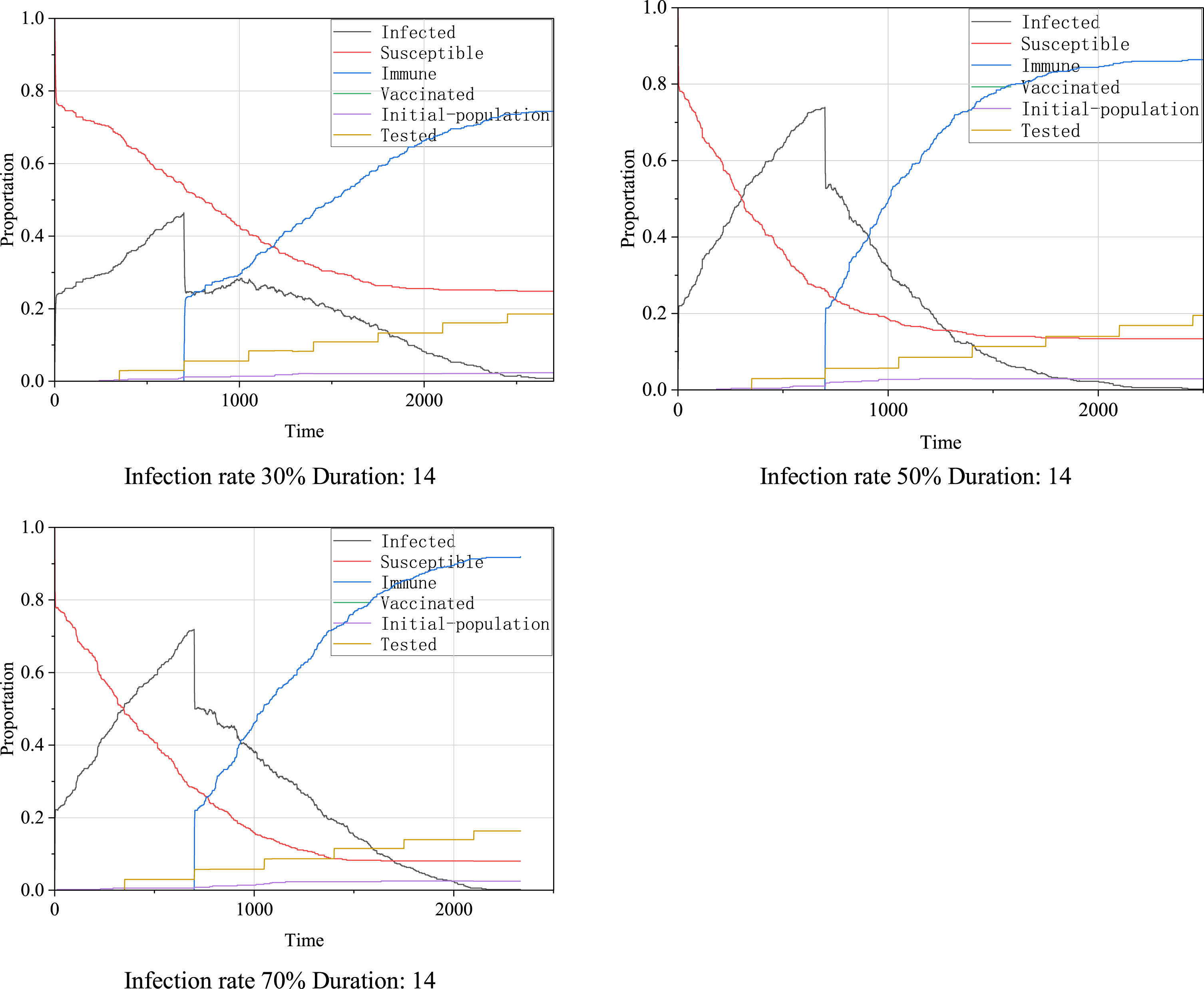
(a). Simulation results of the effect of transmission rate.
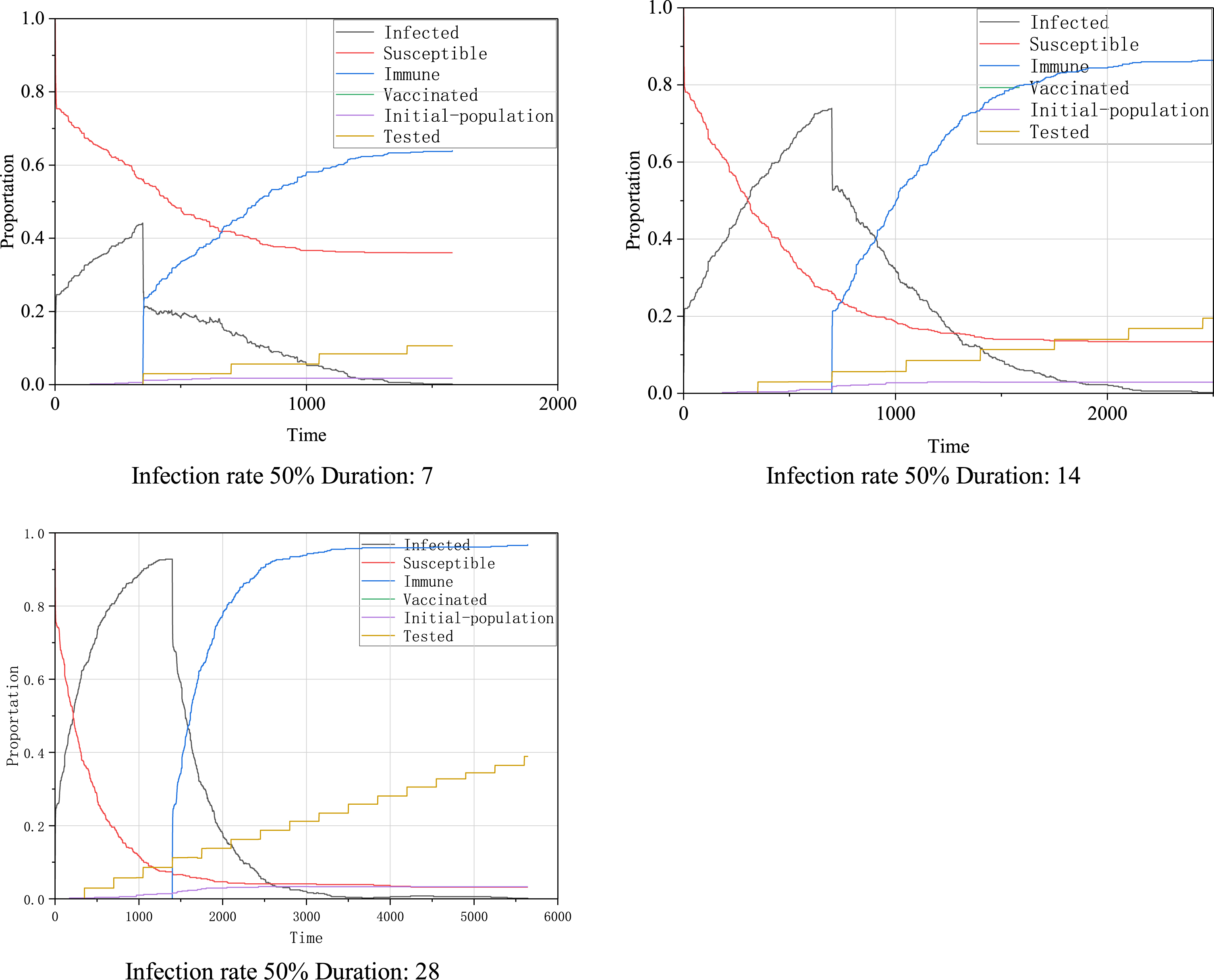
(b). Simulation results for the effect of infection duration.
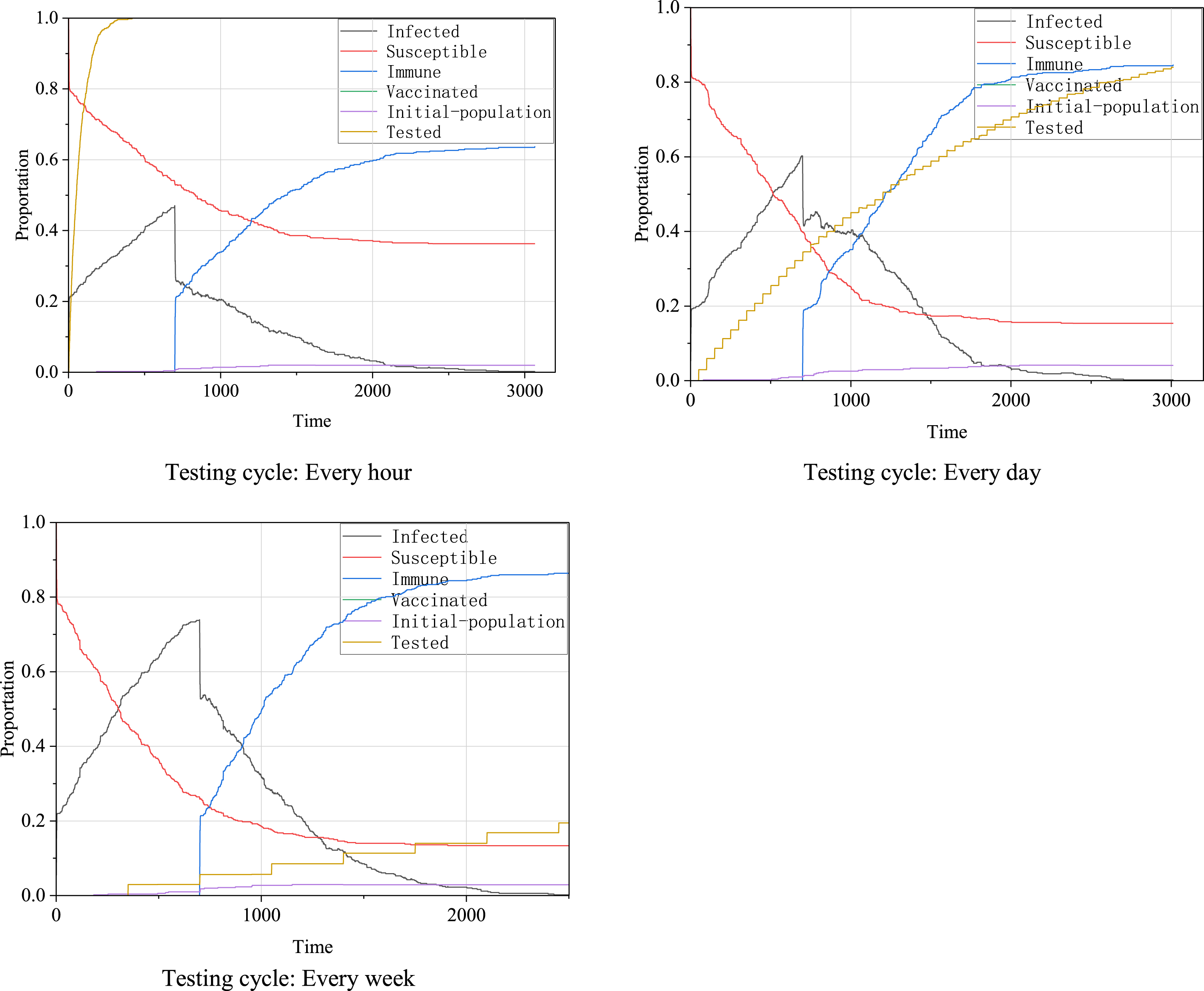
Simulation results for detection impact graph.

Simulation results for detection impact graph.
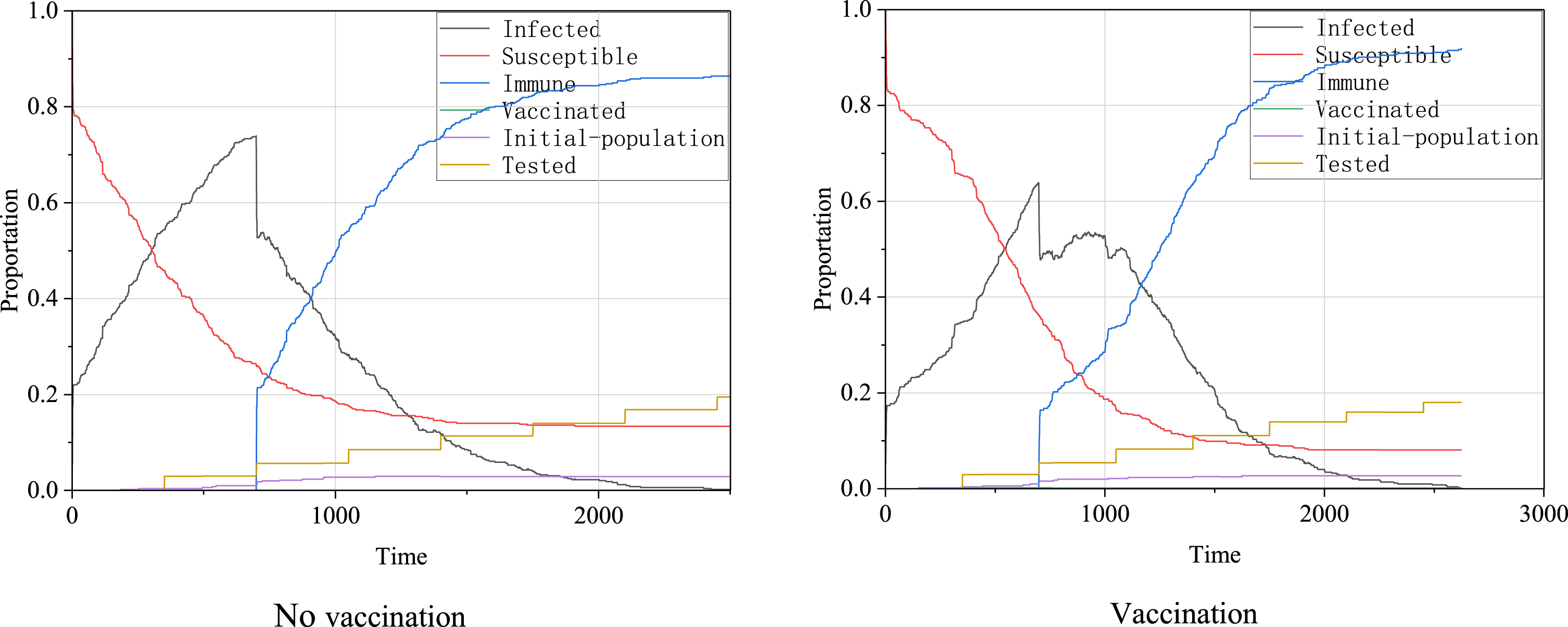
Simulation results of the effect of the degree of vaccination on the degree of vaccination.
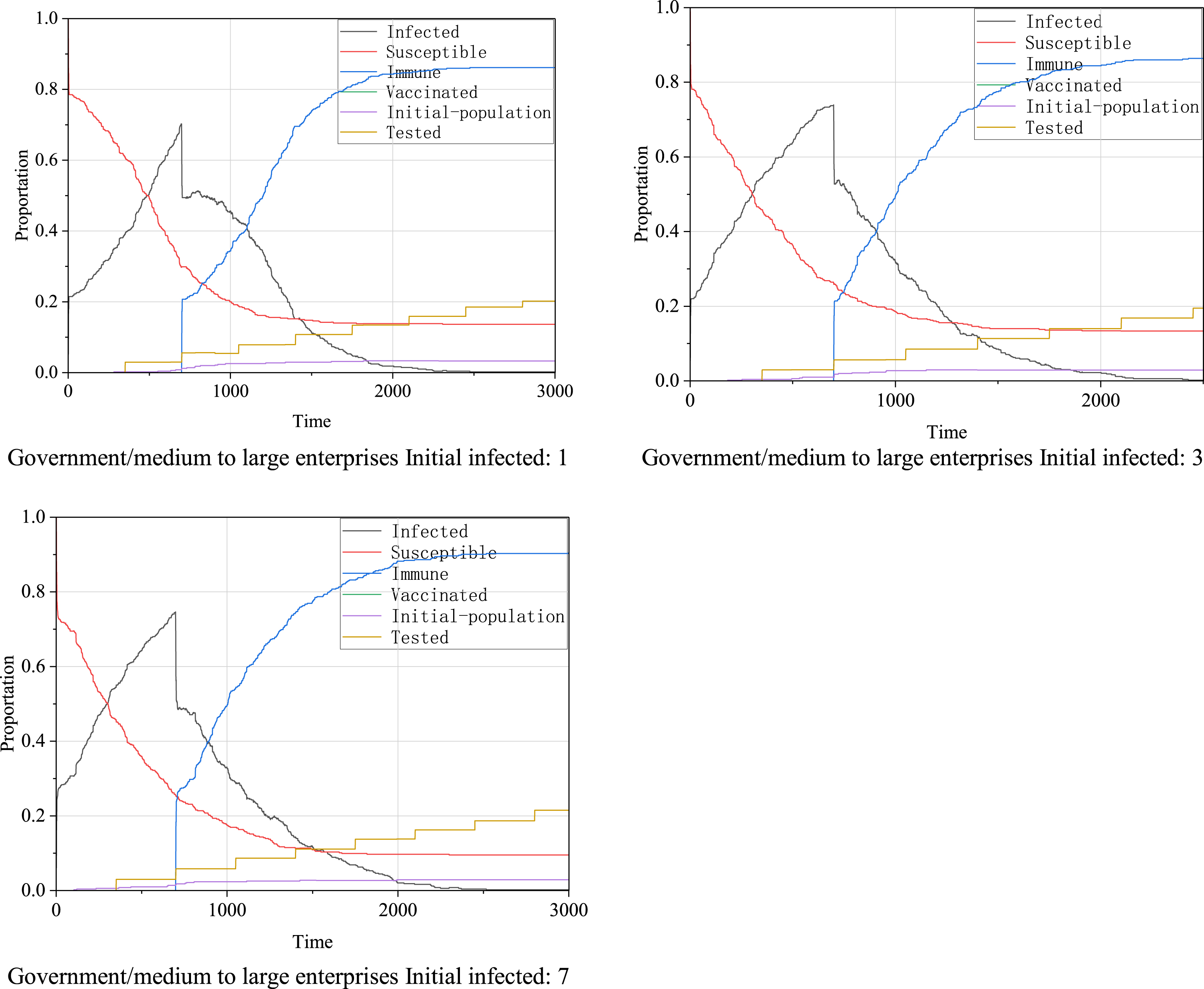
Simulation results graph of the impact of initial government/medium and large enterprises infections.
As shown in Fig. 2(a), as the infection rate continues to rise, the highest value reached by the enterprises involved in the collusion gradually increases, and the number of immune persons is positively correlated as the evolution stabilises. At the same time, from Fig. 2(b), the number of infected persons also rises more sharply as the duration of contagion increases. The greater the benefit that colluders gain from collusive events and the longer the profit lasts, the greater the proportion of the total population that mimics collusive behaviour and the more difficult it is to reach equilibrium. Figure 2 also implies that if collusion in the bidding process is not controlled and information that collusion can be more profitable is allowed to spread among firms, more firms will tend to choose collusive strategies.
The simulation results also suggest that controlling the excess profits gained from collusion in government bidding projects and the dissemination of the profits that can be gained from collusion can effectively prevent the creation of alienating behaviour by government and firms. The simulation results are the same as Hypothesis 1.
The simulation results are illustrated in Figs. 3 4.
According to Fig. 4, the proportion of enterprises involved in collusion decreases significantly as the detection period decreases. However, the equilibrium time exhibits a trend of first increasing and then decreasing, which means that the intensity of control is not linearly related to the effectiveness of control. Although too strict control can bring about a lower number of colluders, it does not bring about the best results, and may indirectly lead to some enterprises being forced to choose collusion strategies due to the need for enterprise survival. In the governance of collusion, management should be controlled to achieve maximum effectiveness.
Figure 4 indicates that as the efficiency of protection increases, the number of groups involved in collusion is at a lower level and the number of ‘immunees’ rises faster. The equilibrium time also increases significantly with the increase in efficiency. The efficiency of protection reflects the adaptability of control policies and the effectiveness of management. Therefore, in the process of policy development, it is important for the government to take the adaptability and feasibility of policy implementation into account. To improve the effectiveness of control and reduce the emergence of collusion between government and enterprises, the establishment of a clean and efficient control mechanism and control team is of greater value in preventing the alienation of government departments and corporate behaviour. The simulation results are the same as Hypothesis 2.
Impact of vaccination rates
The vaccination rate reflects the government’s efforts to educate about collusion and companies’ willingness to accept it. The simulation reveals that after vaccination, the evolution time and number of infected people dropped significantly, revealing that government education on collusion can block the transmission path of collusion. The simulation results verified Hypothesis 3.
Impact of initial infection in government and medium to large enterprises on collusion control
According to Fig. 6, the evolution time increases significantly with the increase of the initial infected in the government, but the increase displays a fast and then slow trend, and after reaching a certain level, the influence on the spread of collusion decreases. Therefore, for collusion control and blocking the path of spread, the government should increase its own supervision and enhance the control of staff with interests in bidding projects. The increase in the number of initially infected persons in medium and large enterprises does not have a significant impact on the evolution time. Owing to their large size and profitability, medium and large enterprises can still obtain enough projects even without engaging in collusion. However, participation may lead to damage to the credibility of the enterprise, so there is less willingness to engage in collusion. In the process of control, the speed of the spread of the collusion strategy is reduced by increasing the control of small and medium-sized projects and enterprises. The simulation results are similar to those of Hypothesis 4.
Analysis of cases
To improve the external validity of the simulation results, this study reflects the diffusion path and situation of government-enterprise collusion in the bidding process through the changes of collusion cases in such process. It also analyses the evolutionary trends of collusion in Chinese government investment projects and compares the actual case change trends with the simulation results to form a comparative analysis of the simulation results. The analysis reveals that the trend of the actual cases is similar to the simulation results, with the collusion behaviour undergoing a process of ‘rapid growth –rapid growth –gradual decline’. The case information is obtained from website reports and related literature.
Government-business collusion: The inevitable product of a fast-growing unregulated market
Emergence of tender collusion in China’s government tendering sector and the initial proliferation of alienating behaviour
Corruption occurs most frequently in government bidding projects. In the early stages of development of such projects in China, there was a long period of regulatory gap. The Law of the People’s Republic of China on Bidding and Tendering was formally implemented in 2000; however, the Law of the People’s Republic of China on Government Procurement did not come into force until June 2002. From 1997 to 2005, a total of 15 officials at the departmental level and above were convicted of bidding corruption offences nationwide. Due to the absence of relevant means of supervision, for a long period of time during the implementation of government tenders, there were no clear laws to clearly regulate the government, corporate behaviour, and to promptly control collusion, and the fluke mentality of some companies indirectly contributed to the proliferation of collusion.
In the early stages of the development of government bidding projects, the emergence of government projects in the market greatly mobilised social capital and promoted the development of the market economy. However, the absence of a relevant control and punishment system has allowed many enterprises to gain high profits through government and corporate collusion and bribery. Owing to the delayed nature of policymaking and case adjudication, a search using the terms ‘bidding’, ‘construction’, and ‘administrative cases’ yielded the results presented in Fig. 7. During the period of continuous improvement of laws and regulations, the number of cases was at a high growth rate from 2006 to 2017, then slowed and reached a maximum of 793 cases in 2019. As of September 2021, there were only 141 new cases, which is much lower than the level in the previous period. The change in the number of relevant cases is illustrated in Fig. 7.
To a certain extent, the trend of cases reflects the proliferation of political and corporate collusion in the market. The change in cases is basically consistent with the simulation results. In the initial stage, the number of people involved in collusion grows rapidly, but with the increasing control and regulation of the market, the number involved in collusion gradually decreases and will equalise in the future. At this stage, due to the drive for profit, it is in a period of accelerated collusion proliferation. The drive for profit and the lack of regulation together drive the proliferation of collusive decision-making by government and enterprises.
Decline of heat under institutional regulation: A lasting proliferation of rationality
In 2015, China introduced the Regulations on the Implementation of the Government Procurement Law of the People’s Republic of China and in 2017, the Measures for the Administration of Bidding and Tendering for Government Procurement Goods and Services were adopted, which further regulated the government procurement process. From Fig. 7, after the continuous improvement of the policy, the phenomenon of collusion between government and enterprises in society has seen a significant decline. However, at present, some enterprises still choose to collude between government and enterprises, while the form of collusion has also changed from the previous bribery of competent officials, such as flexible collusion, for example, industrial land hooking. Although collusion still exists, the content has changed somewhat during this period. Furthermore, although it still involves government-enterprise collusion, the level of compliance with the content has increased. The proliferation of collusion strategies also entered the next stage of evolution: the proliferation of enduring rationality.
Analysis of proliferation patterns
The initial proliferation of government-enterprise collusion in China’s bidding sector began in the post-reform and opening-up phase of economic development. However, after experiencing policy regulation and control, it suddenly cooled down and returned to rationality. The proliferation of government-enterprise collusion in the bidding market requires two conditions: first, as the initial colluders, after choosing government-enterprise collusion, acquire a large number of projects and expand in size, they attract imitations from the recipients, and the proliferation from the initial colluders to the recipients further expands the scale of dissemination and enhances the proliferation of collusion strategies. Second, due to the imbalance between supply and demand in the market, the market cannot provide sufficient projects for all enterprises, making collusion strategies proliferate. The proliferation of collusion between government and enterprises has brought about significant adverse effects on the industry environment of government procurement and bidding in China: (1) the total market volume is insufficient, and enterprises that have obtained projects through collusion strategies need to continue to adopt such strategies to continue their development. (2) Some enterprises that do not want to adopt collusion strategies between government and enterprises are forced to adopt these to obtain projects, further disrupting the healthy development of the market. In the early stages of development, when regulations were not standardised and there was no system in place, collusion was an inevitable product of development.
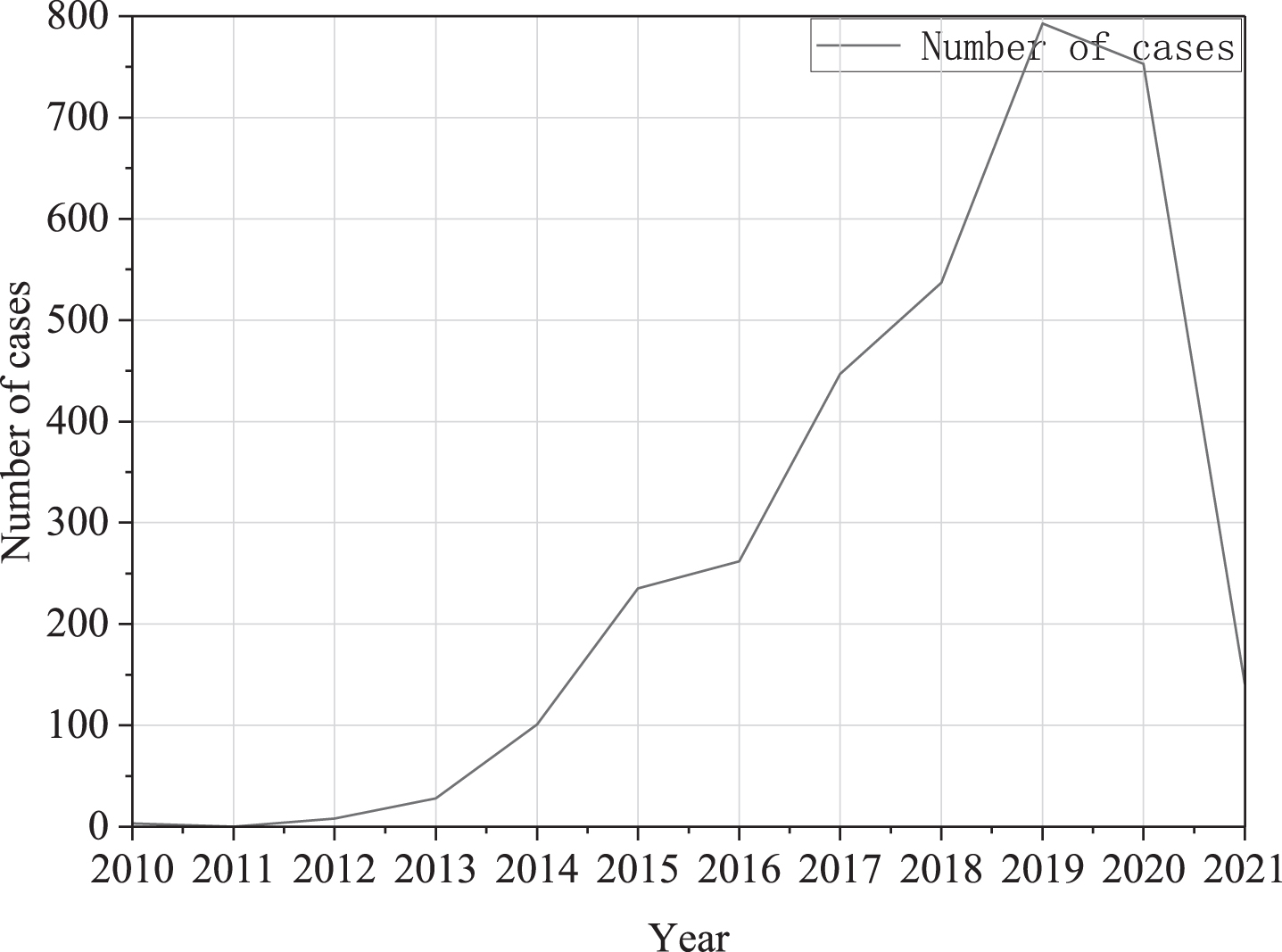
Changes in the number of relevant cases.
As the market continues to be regulated, collusion between government and enterprises in government bidding projects takes on new characteristics. First, with the strict management by the government and law enforcement agencies, and the standardised guidance from industry associations, the spread of collusion strategies is somewhat restrained, and the rejection rate is gradually higher than the acceptance rate. Second, due to the unregulated policy and system in the early stage, the infected parties are not punished, which further triggers the spread of collusion strategies in the whole system, resulting in an increasing and then decreasing trend in the number of infected people in this stage.
Combining the simulation results and the analysis of the administrative cases of collusion in the government bidding field over the past 15 years, the spread path of collusion is influenced by many factors, but there is a certain delay in terms of the effect of these factors. The acceptance and infection rates of the collusion strategy are influenced by the social environment and the strength of regulation; when the collusion strategy can generate greater benefits, the behaviour will occupy a dominant position in the group strategy. When collusion creates greater value, stakeholders are more likely to imitate the strategy and engage in alienation behaviour. However, the creation of alienation behaviour, especially in the case of SMEs, can contribute to the demise of the enterprise.
Using the contagion model, this study investigates the diffusion mechanism of collusion and the causes of alienation behaviour in the government bidding process. First, the applicability of the model is investigated, and the hypotheses of the diffusion mechanism and alienation behaviour are proposed. The hypotheses were simulated and analysed using NetLogo software, and the following research findings were derived. The degree of gain obtained by firms that initially choose collusion strategies affects the rate of diffusion of such strategies in a group. The more people in the group choose collusion strategies to gain additional revenue, the faster the number of remaining potential imitators who choose such strategies increases. The longer the publicity on collusion at the level of public opinion lasts, the more difficult it is for the project to reach equilibrium, and the more government authorities and companies choose the collusion strategy. However, after a certain number of people have opted for collusion, the number decreases at a later stage due to the continuous improvement of policy development and the refusal of some companies to participate in collusion after being punished. This theory better explains the development of administrative cases in the field of government bidding in China over the past 15 years. In the early stage, owing to the lack of supervision and related policies, there was no way to enforce collusion in the bidding process of government projects. As a result, the number of people involved in collusion increased at a faster rate in the early stages, but fewer companies were involved. With the continuous improvement of relevant regulatory policies, the number of enterprises punished for collusion between the government and enterprises rises rapidly. When the equilibrium point is reached, the expected benefits of enterprises choosing the non-collusion strategy are greater than those of choosing collusion, and the spread of collusion among government and enterprises gradually decreases. Some enterprises and individuals who choose the collusion strategy abandon it, thus gaining higher benefits. The adaptability of government policies and the strength of their implementation have a greater impact on the number of people eventually infected and immunised. In the process of the spread of collusion, the existence of appropriate management policies and the applicability and strength of the implementation of these policies affect the emergence of collusion. However, the relationship between the level of enforcement and the number of infections is not entirely linear, and excessive enforcement may lead to a rebellious attitude on the part of the company, which may choose to participate in the collusion or abandon its operations. The initial number of government parties and large enterprises choosing collusion strategies has a strong influence on the equilibrium time of the system and the number of subjects who eventually choose such strategies. This also reflects the influence of the government’s initial integrity and self-monitoring on the speed and equilibrium time of the spread of collusion. As the relevant system is continuously improved, the growth rate of subjects choosing collusive strategies first increases and then decreases, and after the control system is constructed and perfected, there is a significant decrease in the number of enterprises choosing such strategies. The proliferation of collusive behaviour is influenced by multiple factors, and when choosing governance measures in the management process, a comprehensive analysis should be conducted to fully consider the risks and benefits that the adoption of such measures may bring, and the most appropriate management path and means should be selected.
Conclusion
The bidding process for government projects should focus on management methods to regulate collusive behaviour while de-escalating it. The increase in the number of collusive behaviours is correlated with the rapid development of the industry to a certain extent. Although government-enterprise collusion is an alienating behaviour, in the early stages of evolution, the subjects who choose this strategy will gain more, causing the rest of the subjects to imitate it. Therefore, the management process should focus on source management, reduce the space for collusion and arbitrage, encourage healthy and orderly cooperation models, and eliminate government-enterprise collusion. In the process of policy formulation and control, the intensity of regulation should be controlled; excessive regulation is not effective in organising the proliferation of collusive strategies. In the absence of major changes in external conditions, the rapid decline in collusion needs to be guarded against. A rapid decline in collusion may mean the collective demise of the susceptible, failure of firms in the market to survive properly by choosing non-collusive strategies, and rapid deterioration of the market environment. Implications for policymakers: The policy implementation process should focus on the means and methods of implementation, combining practical controls to protect the interests of multiple parties.
This study makes two contributions to the research on the diffusion of collusion in government project bidding processes. First, it enriches the content of related studies by explaining the diffusion process of collusion strategies in government project bidding processes and the factors influencing alienation behaviour from a systematic perspective. Second, the analysis of the factors influencing the diffusion process provides a basis for the government to formulate policies and control collusion.
Limitations: First, the available case data and the overall research on collusion are not sufficient, and there are not enough cases where collusion has been identified and resolved through litigation. Second, the simulation model simplifies the actual situation to a certain extent. Future research can consider the characteristics of collusive decision-making, set more qualifications, and introduce random variables for analysis. This will provide a richer theory for the study of the proliferation of collusion and the causes of alienation behaviour of government and enterprises.
Footnotes
None.
Author contributions
Chongsen Ma: Conceptualisation, methodology, software, resources, data curation, writing—original draft preparation. Liang Ou: validation, formal analysis, investigation, visualisation. Yun Chen: writing—review and editing, supervision, project administration, funding acquisition. All the authors have read and agreed to the published version of the manuscript.
Funding
This research was funded by the National Natural Science Foundation of China (grant number: 71771031).
Institutional review board statement
Not applicable.
Informed consent statement
Not applicable.
Data availability statement
The data that support the findings of this study are available from the corresponding author, upon reasonable request.
Acknowledgments
None.
Conflicts of interest
The authors declare no conflicts of interest.