



Abstract
Security, secrecy, and authenticity problems have arisen as a result of the widespread sharing of medical images in social media. Copyright protection for online photo sharing is becoming a must. In this research, a cutting-edge method for embedding encrypted watermarks into medical images is proposed. The proposed method makes use of fuzzy-based ROI selection and wavelet-transformation to accomplish this. In the first step of the process, a fuzzy search is performed on the original picture to locate relevant places using the center region of interest (RoI) and the radial line along the final intensity. The suggested method takes a digital picture and divides it into 4×4 non-overlapping blocks, with the intent of selecting low information chunks for embedding in order to maximize invisibility. By changing the coefficients, a single watermark bit may be inserted into both the left and right singular SVD matrices. The absence of false positives means the suggested technique can successfully integrate a large amount of data. Watermarks are encrypted using a pseudorandom key before being embedded. Discrete wavelet transform saliency map, block mean method, and cosine functions are used to construct an adaptively-generated pseudo-random key from the cover picture. Images uploaded to social media platforms must have a high degree of invisibility and durability. These watermarking features, however, come with a price. The optimal scaling factor is used to strike a balance between the two in the proposed system. Furthermore, the suggested scheme’s higher performance is confirmed by comparison with the latest state-of-the-art systems.
Introduction
The many social media platforms provide a wonderful opportunity to interact and engage with people on a global scale. It is used extensively in a variety of contexts, including the dissemination of information, social interaction, the collection of news, and decision-making [1]. In social media, the most common form of communication is via the use of digital photos. Users of social media platforms upload and share billions of photographs every single day [2]. When digital photographs are shared on social media platforms, users run the risk of exposing themselves to a number of security risks, including unauthorized access, altering or copying of the image, morphing, and tampering with the image’s content [3]. The use of digital picture watermarking is one of the strategies that shows the greatest promise for resolving these problems [4]. In order to successfully transmit watermarked photos via an internet platform, you need to ensure that you have satisfied all three of the most important criteria for watermarking: imperceptibility, resilience, and embedding capability. The embedding technique that was used to cover up the watermark inside the cover picture is the one that determines how these criteria should be fulfilled [5, 6]. Spatial and spectral strategies are the two primary approaches that may be used to hide the watermark in the cover picture. The great embedding capacity and imperceptibility of spatial approaches are both advantages, but the lack of resilience is a disadvantage [7, 8]. Spectral techniques, on the other hand, have a greater resilience, but they suffer from a poor imperceptibility. Researchers are looking at hybrid transformations in order to reach high levels of imperceptibility and resilience in their work [9, 10]. However, there is a balance to be struck between the three watermarking criteria. By selecting an optimum scaling factor (embedding strength) for the purpose of watermark embedding, one may guarantee that a balance between the aforementioned trade-offs is maintained. Researchers have used approaches called Nature Inspired Metaheuristic Optimization, or NIMO, to maximize scaling factor and, as a result, balance the trade-off between different watermarking needs [11]. In order to successfully hide the watermark inside the cover picture, the embedding strength is determined by the optimal scaling factor. However, developing effective fitness functions for optimization in order to strike a balance between the capacities of exploration and exploitation remains a difficult task [12].
Related work
Spatial, spectral, and hybrid watermarking methods for digital images have all been studied in the previous several decades [13, 14]. The basic goals of any watermarking technique for digital images are to prevent the host image’s quality from degrading too much as a result of the watermark and to show that it can withstand a variety of assaults. Discrete cosine transform (DCT) - Singular value decomposition (SVD) hybrid transforms approaches are used for watermark embedding in the digital picture watermarking systems reported in [15, 16]. In [15], a watermarking system is proposed that does not care about watermark security. Since the embedding scaling factor is selected at random, it may not work well with certain picture modalities. In [16], a blind watermarking system based on an Arnold map is presented as a means of providing security. But it’s defenses against geometric and noise-based assaults are weaker. Similarly, Discrete wavelet Transform-Singular value decomposition hybrid transformations are used for watermark embedding in the techniques suggested in [17–19]. Even if the watermarking, detection, and decryption stages of the technique suggested in [18] are all commutative, the scheme’s overall resilience is inadequate. Using a hyper chaotic map in four dimensions, the authors of [19] encrypt watermarks. Improved fruit fly optimization is proposed for maximizing scaling factors. As a result, this system is more vulnerable to assault. In addition, Integer wavelet Transform-Singular value decomposition hybrid transformations are used for watermark embedding in the digital picture watermarking systems presented in [20, 21]. The false positive error issue of the SVD during picture transmission is addressed by the watermarking approach based on several scaling factors proposed in [22–28]. Watermarking is done using a map that is purposefully messy. In [29], we offer a reliable multi-objective ant colony optimization watermarking approach. In order to insert watermarks, it employs the fundamental component method. When compared to other possible attack vectors, this approach has a lower risk of being exploited. Telemedicine relies on the safe transmission of medical pictures, which is why the watermarking system presented in [30–36] was developed. For encryption purposes, the watermarking system presented in [37, 38] additionally makes use of a secret security key that is adaptively generated from cover and watermark pictures.
The most important contributions made by the proposed strategy are as follows: When the region of interest (ROI) is found using a fuzzy based model, the compactness of partitions is improved by identifying to include the spatial function with the membership function, and to locate the crucial locations along the radial line. Superior watermark protection at a lower than average computational cost. A method known as Random Pixel Position Swapping is used in order to encrypt the watermark such that it conforms to the pseudo-random key. In order to improve watermark security and make it more difficult to detect, encrypted watermarks are inserted into low-information blocks. In embedding, SVD coefficient modification increases imperceptibility and resistance against geometrical, filtering, and noising assaults.
Proposed method
After performing fuzzy ROI identification in the source medical picture, our proposed method continues by performing a second-level wavelet decomposition and SVD on the original image. On the picture containing the watermark, there will be two rounds of discrete wavelet transform (DWT) carried out, with substitution occurring at the first level and permutation occurring at the second level. After a singular value decomposition has been carried out to identify the primary constituent, the singular values of both the original medical image and the watermarked version are then modified accordingly. The image with the watermark is generated by using the inverse wavelet transform. The process of watermarking is shown in graphical form in Fig. 1.
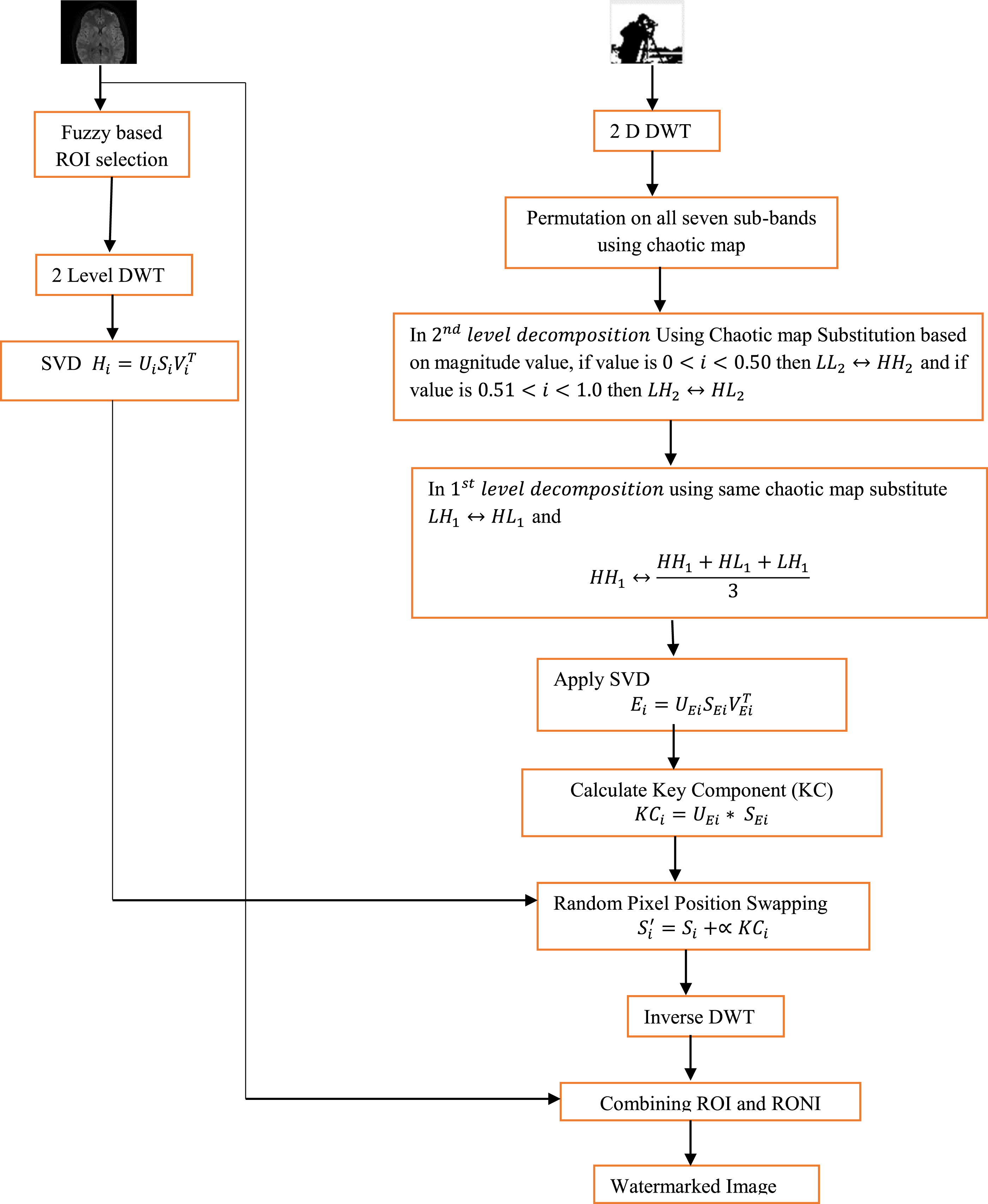
Watermarking process.
If you use ROI areas to include the watermark, will results in leading to an incorrect diagnosis. However, RONI watermarking systems have various problems, including the fact that they can only be implemented if RONI exists, the quantity of information to be encoded depends on the RONI region size, and ROI may not be secured against malicious assaults. In Fig. 2 we see a diagrammatic depiction of the ROI extraction process.

ROI extraction.
In recent years, one of the unsupervised strategies for clustering that goes by the name of Fuzzy C-Means (FCM) clustering [11] has seen a significant rise in its level of use. These promising methods make use of spatial locality [36] in order to cluster data, and they find extensive use in areas such as medical imaging, image segmentation, and remote sensing. The SS FCM method and this technology are both included into our approach in order to produce a new hybrid system. This brand-new approach makes use of the membership value function of the pixels that are next to one another. We may observe a general version of the spatial function represented by Equation 1.
U ij is the initial membership function, and NB (p k ) is the corresponding 5×5 window that is centred on pixel (p k ).
Equation 2 is a representation of the membership function after the spatial function has been added to it.
It is possible to calculate the membership function
Tuning of both the algorithm-specific and the controlling parameters is essential for the success of evolutionary and swarm-based optimization methods. In order to optimise the scaling factor, we employ the fitness function shown in Equation 3
Where PSNR and UACI are metric to calculate imperceptibility whereas NC and BER are matric to evaluate robustness. ω represents the chosen population strength.
IWT (Host image) = [cLL, cHL, cLH, cHH]
Schur(cLL) = [ULL, SLL]
RSVD(ULL) = [ULL, SLL, VLL]
SLL + EF×W final = WSLL
ULL×WSLL×(VLL) T = WSLL
ULL×WSLL×(ULL) T = WLL
inverse IWT (WLL, HL, LH, HH) = Final img
Results and discussions
In order to evaluate the efficacy of the proposed system, simulation tests are carried out in MATLAB 2017b. Images of CT scans, MRI scans, and ultrasound scans (all 512 by 512 pixels in size) together with a single watermark picture (64 by 64 pixels in size) are utilised. Performance is measured in terms of their capacity, complexity, resilience, reversibility, and detectability. An unoptimized MATLAB code model is used to simulate the three ROI-based watermarking strategies. For the sake of a level playing field, we only take into account the processing time during the ROI extraction phase and not during embedding or extraction. Table 2 represents the NPCR and UACI comparison.
Examining the UACI and NPCR outcomes through other encryption techniques
Examining the UACI and NPCR outcomes through other encryption techniques
The watermarking intensity of a picture may be evaluated in two ways: the peak signal-to-noise ratio (PSNR) and the normalized cross correlation (NCC). Table 1 represents the test images used for simulation experiments. It is clear from Table 2 that the watermarking strength of the methods reported in [16] is much lower than that of the proposed approach. Table 3 provides a comparison of PSNR and SSIM across a variety of systems. Table 4 displays the factors considered while comparing different methods.
Test Images
Test Images
PSNR and SSIM Comparison
Comparing PSNR values
Calculation of Signal to Noise Ratio is shown in Equation 4
The correlation coefficient between the initial watermark and the resulting watermark is determined using NCC. This is shown by the equation Equation 5. Table 5 represents the NC comparison between proposed and existing systems.
NC Comparison
We present an approach that combines watermarking and encryption to protect diagnostically processed medical images. Given that the suggested technique achieves a PSNR of around 49.5, it secures watermark information without degrading picture quality. A high embedding rate with little distortion is shown by the proposed approach. As a result, you can be certain that the watermarked picture is of great quality and delivers a substantial payload. The suggested technique has been tested on grayscale photos, but it will eventually be able to handle colour images as well.