



Abstract
Flight performance of unmanned aerial vehicles (UAVs) strongly depends on implemented attitude tracking control. For designing better controllers, nonlinear control design techniques are often opted instead of control design based on linearized models. Uncertainty in nonlinear dynamics estimation may arise due to inaccuracies in aerodynamic derivatives and simplifications/assumptions made during the derivation of nonlinear models. This paper considers attitude tracking control of fixed-wing UAVs having uncertain dynamics and corrupted gyro sensor outputs. An integral chain differentiator (ICD) is used to provide the analytical redundancy to the gyros used to measure the angular rates. Two control design schemes are proposed, a neuro-fuzzy adaptive sliding mode control (NFASMC) and an ICD approximation-based fuzzy adaptive sliding mode control (ICD-FASMC). In NFASMC, the uncertain part of the dynamics is estimated using an adaptive radial basis function neural network. Gyro sensor output errors are estimated in real-time, using ICD based error estimation scheme and used in the control law along with the sensor’s corrupted outputs. In ICD-FASMC, the uncertain dynamics and angular rates of UAV are estimated using the ICD such that the requirement of the gyro sensor outputs for control design is bypassed. The switching gain of the designed controllers is made adaptive using fuzzy logic to mitigate the chattering effect. The stability of the proposed controllers is proved using the Lyapunov approach. The proposed schemes are implemented using a nonlinear simulation of a fixed-wing UAV. Simulation results are presented to show the effectiveness of the proposed techniques.
Introduction
Attitude tracking control is a critical part of the control system design for aircraft and unmanned aerial vehicles (UAVs). UAVs have to follow the commands generated by the guidance system for the desired trajectory tracking. For this, attitude reference command tracking control design must be efficient in the presence of modelling/parametric uncertainties and external disturbances. In addition, any false/corrupted state feedback from the sensors to the control system must be accounted for as it may degrade the control performance. Dynamical models of UAVs are simplified mathematical equations representing the approximation of complex and highly coupled nonlinear dynamics. The aerodynamic derivatives obtained from wind tunnel tests or computational techniques may also contain uncertainties. In UAVs, the available aerodynamic derivatives may not be accurate enough to design a reliable model-based controller. In such cases, we can incorporate real-time approximation strategies into the control design. In this work, we have considered the attitude control design task of fixed-wing UAVs having uncertain/unavailable dynamics and inaccurate/corrupted gyro sensor outputs.
Sliding mode control (SMC) is a well-known control technique having the advantage of robustness against modelling uncertainties, parametric variations and external disturbances [1, 2]. SMC has been applied extensively to control uncertain nonlinear systems, including aerospace systems. In contrast to other nonlinear control schemes, such as dynamic inversion, feedback linearization and backstepping, SMC does not require a precise mathematical model of the system [3]. However, the so-called switching control term added to the SMC for robustness, against external disturbances, modelling and parametric uncertainties, is discontinuous. The discontinuous switching control term of the SMC may cause undesirable oscillations/chattering of the control surfaces. An appropriate value of the gain of the switching control term (switching gain) is required to minimize the chattering. In the case of an uncertain dynamic system, the switching gain value can be low if we estimate the system dynamics accurately enough and use it in the control law. However, to cancel the effect of the bounded external disturbances, the switching gain must be increased according to the upper bound of the external disturbance. Instead of selecting a conservative high switching gain value, adaptive techniques can be incorporated in the SMC to adaptively tune the switching gain to maintain the control performance and minimize the chattering effect.
Several techniques exist for the online estimation of uncertain dynamics of nonlinear systems. Among them, artificial neural networks (ANNs) [4–8], fuzzy logic [9–11] and differentiator-based approximation techniques [12–15] provide good results. These techniques can be incorporated into the SMC to reduce/eliminate the dependency of the control design on the analytical calculations of the system dynamics. ANNs have excellent nonlinear function approximation capabilities due to their quick online learning and network parameters self-adaptation [5, 16]. A type of ANN, radial basis functions neural network (RBFNN), is good at avoiding local minima and has a simple structure with quick learning abilities [17, 18]. Learning refers to the auto-adjustment of the network parameters through some adaptation laws such that the network output converges to the desired value.
Using the system outputs, differentiators can estimate the higher-order system states for use in the control design [13]. These estimations of the higher-order system states can also be used to estimate the uncertain dynamics of the system [15]. In case of a high degree of uncertainty or unavailability of the system dynamics, higher-order differentiator-based approximations of the system dynamics can be incorporated into the SMC [14, 19]. Moreover, the angular rates of the dynamic system which are usually measured using the gyro sensors can be accurately estimated using the differentiator technique. Thus, differentiators can provide analytical redundancy to the gyros such that any gyro output errors can be approximated and isolated [20, 21].
Fuzzy logic is an effective method to mitigate the chattering associated with the SMC [22, 23]. Fuzzy models can be developed using the process inputs and outputs without the requirement of the exact dynamic model [24, 25]. A Fuzzy logic system (FLS) can be designed for nonlinear control when the exact mathematical relationship between inputs and outputs of the process is unknown. Fuzzy logic can be used to approximate the uncertain dynamics or/and adaptively tune the switching control gain to mitigate the chattering associated with the SMC [22, 26]. In [26], based on FLS, an adaptive compensation FTC is designed for nonlinear Markov jump systems subject to mismatched uncertainty and simultaneous multiplicative and additive actuator faults. The FLS is used to approximate the nonlinear functions. Whereas in [22], FLS is used to tune the switching gain of the SMC.
This paper considers the attitude tracking control of fixed-wing UAVs under uncertainty (including modelling and parametric)/unavailability of the system dynamics and corrupted gyro sensor outputs. Two control schemes are proposed and their control performance is presented. In the first scheme, a neuro-fuzzy adaptive SMC (NFASMC) is designed. ICD is used to estimate and isolate the sensor output errors. A new sliding surface based on erroneous gyro sensor output and the estimated values of the sensor output error from the ICD-based error estimation scheme is proposed. The control law is designed using both the corrupt sensor output and the error estimate from the ICD-based error estimation scheme. The uncertain part of the system dynamics is estimated using the RBFNN, where the adaptive law for the RBFNN is derived using the Lyapunov theory. The switching gain of the controller is made adaptive using a fuzzy logic system (FLS) to mitigate the chattering effect of the SMC. The innovative combination of the ANN, SMC, fuzzy logic and the ICD-based gyro sensor output error estimation in NFASMC provides excellent tracking performance in the presence of gyro sensor output errors. The uncertain dynamics does not affect the controller performance as it is estimated using the adaptive RBFNN and the chattering effect of the SMC is mitigated by the FLS. The second control scheme, ICD approximation-based fuzzy adaptive SMC (ICD-FASMC), uses ICD to approximate the unknown system dynamics and the higher-order system states required for the control design. The switching gain of the proposed ICD-FASMC is also made adaptive using the fuzzy logic system (FLS). Chattering associated with the conservative high values of switching gains is eliminated using the adaptive gain strategy. The ICD-FASMC can be used when the UAV is susceptible to gyro sensor output errors. It does not require the gyro sensor outputs, as the angular rates are computed by the ICD. The exact dynamics of the system is also not required as it is estimated using the ICD output. For indirect use of the ICD-FASMC, the system can be switched from any nominal controller to the ICD-FASMC when the sensor output error from the ICD-based error estimation scheme crosses some predefined threshold. The proposed control schemes are implemented using a nonlinear simulation of a fixed-wing UAV.
The main features of this work are summarized as Efficient and robust attitude control schemes, applicable to nonlinear systems in general and fixed-wing UAVs in particular, are proposed that provide excellent tracking performance. The proposed control schemes do not require a precise mathematical model and dynamic parameters as the uncertain dynamics is approximated in real-time and used in the control laws. In both the proposed control schemes, gyro sensor output errors are taken care of. In NFASMC, ICD is used to estimate the sensor output error and the control is designed using the values of sensor error estimates and the erroneous sensor output. In ICD-FASMC, the controller is designed using the estimated values of the gyro sensor output using the ICD so that the erroneous output from the gyro sensor is not required for the control design. The gain of the switching part of the controllers is made adaptive to mitigate the chattering effects of the SMC. A FLS is designed which takes the sliding surface as the input and gives the required value of the switching gain as the output to be used in the proposed control laws.
The remaining paper is organized as
Section 2 of the paper includes UAV nonlinear dynamics and the problem formulation. Section 3 describes the design and stability analysis of the two proposed control schemes. Simulation results are presented and discussed in section 4. Finally, section 5 concludes the paper.
UAV nonlinear dynamics and problem formulation
In this section, first a general formulation of the nonlinear dynamics of fixed-wing UAVs is presented and then the control problem addressed in this work is formulated.
UAV nonlinear dynamics
Taking the assumption of the flat earth, six degrees of freedom (6-DOF) general nonlinear equations for UAV dynamics in body-axis are listed in (1) [27].
In (1), u, v and w represent the UAV velocities along x, y and z axis respectively.
Attitude tracking control of a UAV refers to the control logic implemented to regulate the attitude angles (φ, θ and ψ). The guidance system generates the desired attitude angles (φ
d
, θ
d
and ψ
d
) required to keep the UAV on the desired path. The attitude tracking control generates the required control surface deflections such that the attitude angles follow the desired angles. In this work, the problem of attitude tracking control is addressed for a UAV having uncertain/unavailable dynamics and corrupted gyro sensor output. The attitude control can be designed by using the relations for
Where, Sensor output errors E
s
(t) are assumed to be unknown but bounded. The external disturbances d(t) are bounded such that ∥d(t) ∥ ⩽ D .
For the uncertain non-linear system (2), we present the design and stability analysis of two different control schemes in this section. A neuro-fuzzy adaptive SMC (NFASMC) and an ICD approximation based fuzzy adaptive SMC (ICD-FASMC) are presented. Following two paragraphs describe the work flow for the design of the proposed control schemes.
ICD is used in the design process of NFASMC to provide the analytical redundancy to the gyro sensors. The error in the sensor output is estimated by using the ICD and the gyro sensor output. The NFASMC is designed using erroneous output of the gyro sensors and the real-time error estimate. Further, the switching gain of the control is made adaptive using a fuzzy logic system (FLS). For the stated procedure, design of the ICD is described in the Section 3.1, Section 3.2 describes the design and stability analysis of the NFASMC and Section 3.3 describes the FLS used for switching gain adaptation.
For the design of the ICD-FASMC, the requirement of gyro sensor output for the control design are bypassed by using the ICD based approximation of the attitude rates in the development of the controller. For the proposed ICD-FASMC, ICD described in Section 3.1 and the switching gain adaptation procedure described in Section 3.3 are used. The design and stability analysis of the ICD-FASMC is described in Section 3.4.
Integral chain differentiator
ICD can be used to estimate the unknown system states. Using the system’s outputs (y = x1), the higher order unknown states (x2, x3, . . . , x n ) can be acquired by using the ICD. Following lemma provides the illustration of estimation procedure for the unknown higher order system states using the ICD.
Where, ɛ > 0 is the perturbation parameter of sufficiently small value. The parameters λ1, λ2, . . . , λn+1 are positive coefficients of Hurwitz polynomial such that sn+1 + λn+1s
n
+ … λ2s + λ1 = 0. Therefore,
For suitable values of λ1, λ2, . . . , λn+1 filtering can be obtained by ICD.
For the nonlinear system (2), f(x) is assumed uncertain/unavailable. The attitude control must ensure the tracking of the desired trajectory x1d = [φ
d
θ
d
ψ
d
] in the presence of external disturbances d(t) and gyro sensor output errors. The uncertain part of the dynamics (f(x)) is estimated using adaptive RBFNN. The adaptive law for RBFNN is derived using the Lyapunov theory. For the estimation of gyro sensor (measuring
The tracking error can be defined as e = x1 - x1d, where e = [e
φ
e
θ
e
ψ
]
T
, and the derivative of the tracking error is
For actual implementation, we propose the use of both the erroneous sensor output
Using the sliding surface (7), the gyro sensor output
For nonlinear system (2), the parameter vectors of the controller (8) can be defined as
u
o
= [u1 u2 u3]
T
= [δa δe δr]
T
and

Architecture of NFASMC.
Approximation of
f
(
x
)
To approximate the unknown/uncertain f(x), RBFNN is used. RBFNN is a three layered feed forward neural network. Number of neurons in each of the three layers are chosen according to the suitability to the problem. The middle layer neurons use radial basis functions (h
j
) as activation functions. The output layer linearly combines the signals from the hidden layer. The RBFNN algorithm is [11]
Where ς
o
is the input to the network.
For the approximation of unknown f(x), the input to the RBFNN is
Submitting (8) into (12) we get
Where,
Using (10) and (11), we can write
We define a suitable Lyapunov function as
Taking the derivative of (15) and using (13) and (14)
We define the adaptive law for the RBFNN as
The RBFNN approximation error ɛ
o
is sufficiently small and limited (ɛ
o
⩽ ɛ
N
), d(t) is bounded with known upper bound (d(t) ⩽ D) and also
The proposed controller (8) for nonlinear system (2) is effectively robust against external disturbances. However, during the sliding phase, chattering phenomena (high frequency oscillations of the control output) appears near the sliding surface. Chattering is a major drawback of the SMC which can damage the control surfaces and can excite the unmodelled dynamics of the system. Mathematically, the sign function in the control law (8), induces chattering due to the frequent switching, while the chattering intensity depends on the gain k of the sign function. There are various methods to address the chattering of the SMC. The most common method is the design of boundary layer or in other words using a saturation function instead of the sign function. However, there is a trade-off between chattering mitigation and the control performances using the saturation function. In this work, we used an adaptive method to mitigate the chattering effect. Using a fuzzy logic system (FLS), the gain of the switching term of the SMC is made adaptive with the sliding surface. The sliding surface is used as the input of the FLS to get the required value of the gain as an output. The FLS architecture is shown in Fig. 2. MATLAB inbuilt fuzzy logic tool is used to create the FLS system. The design steps of the FLS are described as under.
(1) Inputs and outputs selection
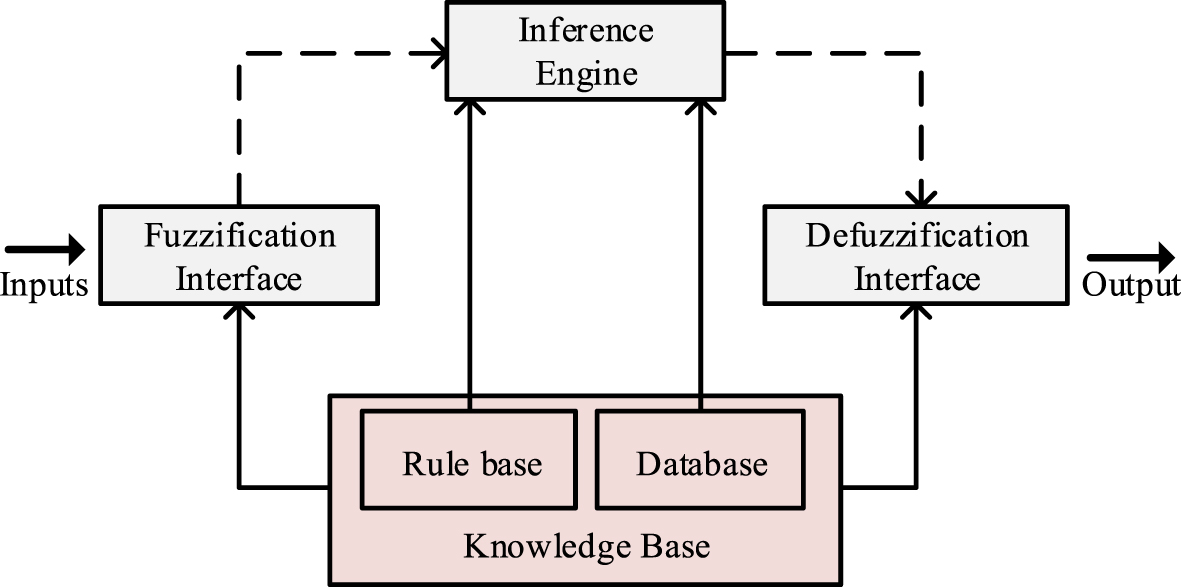
The FLS architecture.
The input of the FLS is selected as the sliding surface S i ∈ S (i = 1, 2, 3). The gain k i ∈ k (i = 1, 2, 3) of the switching control term of the control law (8) is the output of the FLS.
(2) Defining the fuzzy sets
The input and output fuzzy sets of the FLS are defined similarly as [NB, NS, Z, PS, PB]. Where NB, NS, Z, PS and PB are used to denote negative big, negative small, zero, positive small, and positive big respectively. FLS membership functions are chosen as gauss2mf within the MATLAB inbuilt fuzzy logic tool. Gauss2mf is a formed by combining two Gaussian functions such that each function defines the shape of one side of the membership function. The Gaussian function can be defined as
Similarly, the parameter vectors of the output membership functions NB, NS, Z, PS and PB are respectively set as
The input and output membership functions are plotted in Figs. 3 and 4 respectively. Note that the range of input in Fig. 3 corresponds to the designed controller for pitch tracking using NFASMC. The input range has to be adjusted for each controller according to the expected value of the sliding surface variable. The fuzzy logic tool automatically adjusts the membership parameter vectors according to the new input range such that the shape of the membership functions is preserved

FLS input membership functions.

FLS output membership functions.
(3) Fuzzy rules selection
For the designed controller (8), during the sliding motion, whenever the state trajectories deviate from the sliding surface the switching term ksign(S) comes into action and forces the states towards the sliding surface. The purpose here is to make gain k adaptive to minimize the chattering. The FLS is designed based on the fact that if the value of the gain k is adjusted based on the value of S, we can minimize the chattering. For this, the value of gain should be decreased when the states are approaching the sliding surface and it should be increased when the states are moving away from the sliding surface. FLS rules based on the knowledge and experience of experts are formed as “IF-THEN” rules such as if one condition is satisfied then one predefined action has to be taken. The designed fuzzy rules are given as
(4) Defuzzification of the outputs
Defuzzification of the outputs is made by using centroid method within the MATLAB fuzzy logic tool. The FLS thus created is used to adaptively tune the switching gain of the designed sliding mode controllers. The input (sliding surface value) output (adaptive gain) relationship curve is plotted in Fig. 5. It shows that using the proposed FLS the switching gain can be adjusted adaptively according to the value of the sliding surface.

Input output variation of the designed FLS.
Where
In this section we propose an attitude tracking control based on the ICD described in Sec.3.1 for the nonlinear system (2) without the knowledge of the system dynamics and higher order system states. Using the output of the system, the dynamics of the system is approximated using the ICD during the process of the control design. The designed controller does not require the higher order system states from the onboard sensors as they are approximated using the ICD. Hence, any gyro sensor output errors will not impact the performance of the controller. For the nonlinear system (2), let the desired trajectory y
d
= [φ
d
θ
d
ψ
d
]
T
is differentiable up to 2nd order. Then the system (2) based on tracking error dynamics can be written as
Where, e1 = x1 - y
d
and
We choose a bounded controller u o such that |u o | ⩽ l u
Using (5) we can write
To design a trajectory tracking controller based on ICD, we assume that
We define a sliding surface as
Using ICD approximation (5), we have
Taking the derivative of (26), we get
Finally, we have

Architecture of ICD-FASMC.
Where,
Where for nonlinear system (2), the parameter vectors of the controller (32) can be defined as u
o
= [u1 u2 u3]
T
= [δa δe δr]
T
.
The proposed control strategies are implemented in MATLAB/SIMULINK environment using a high-fidelity nonlinear simulation of scaled YAK-54 UAV. The UAV simulation incorporates the UAV dynamics, environmental model and proper actuator models to imitate the actual flight performance. The UAV has been used in several research works [28–30]. Important parameters of the UAV are listed in Table 1 [31]. Small fixed-wing UAVs are normally controlled as bank (roll) to turn. Hence, longitudinal pitch control and lateral roll control are designed and simulated using the proposed control methods in this paper. The aerodynamic and control derivatives of the UAV can be found in [31]. In both the proposed control schemes, ICD is used. The parameters of the ICD used in all the simulations are set as the same with λ1 = 1, λ2 = 3, λ3 = 3, and ɛ = 0.005. For pitch control design using NFASMC, RBFNN consists of two inputs, pitch angle tracking error and the corrected pitch rate as described in Sec. 3.2. Similarly, for roll control design the inputs of the RBFNN are roll angle tracking error and the corrected roll rate. The hidden layer of the RBFNN in both pitch and roll control consists of nine neurons. All the weights of the RBFNN in both cases are initialized with the value of 0.1, bias values as 9 and center values as
UAV Parameters [31]
UAV Parameters [31]

Pitch rate gyro sensor error estimation.

Pitch tracking control performance of NFASMC (θ, q and δe variation).

Pitch tracking control performance of NFASMC (Adaptive gain, S2 and f q (x) variation).

Roll rate gyro sensor error estimation.

Roll tracking control performance of NFASMC (φ, p and δa variation).

Roll tracking control performance of NFASMC (Adaptive gain, S1 and f p (x) variation).
The ICD-FASMC (32) as described in Sec. 3.4 is also implemented and validated as the NFASMC. The unknown/uncertain dynamics of the system in the case of ICD-FASMC is estimated using the ICD described in Section 3.1. ICD is also used to estimate the expected gyro sensor outputs, pitch rate q and roll rate p from the attitude angles θ and φ respectively. Therefore, in the case of the proposed ICD-FASMC, gyro sensor outputs are not required for the control implementation as they are being estimated using the ICD. Moreover, the switching gain of the designed controller (32) is made adaptive using the FLS described in Sec. 3.3 to address the chattering effect of the SMC. The parameters of the ICD are kept the same as described earlier. The gain c2 in pitch control is set as 2 and for roll control c1 is set as 4.5. ICD-FASMC based pitch command tracking control results are shown in Figs. 13 and 14. It is clear from Fig. 13 that the controller provides good convergence and tracking performance without any chattering of the control surface. Figure 14 shows that the switching gain varies adaptively with the sliding surface value and the designed strategy approximates the uncertain f q (x) with good accuracy. Similarly, the ICD-FASMC is implemented and validated for roll command tracking control and the simulation results are shown in Figs. 15 and 16. The roll command tracking control also shows good convergence and tracking performance without chattering owing to the adaptive gain using the FLS.

Pitch tracking control performance of ICD-FASMC (θ, q and δe variation).

Pitch tracking control performance of ICD-FASMC (Adaptive gain, S2 and f q (x) variation).

Roll tracking control performance of ICD-FASMC (φ, p and δa variation).

Roll tracking control performance of ICD-FASMC (Adaptive gain, S1 and f p (x) variation).
Two adaptive control schemes for fixed-wing UAVs with uncertain dynamics and corrupted/erroneous gyro sensor outputs are proposed and implemented in this work. A NFASMC where the sensor output errors are estimated using an ICD as an observer. Uncertain dynamics of the UAV in NFASMC is estimated using an adaptive RBFNN. The control is designed using both the erroneous sensor outputs and the estimate of the sensor output errors provided by the ICD-based error estimation. The gain of the switching part of the NFASMC is made adaptive using a FLS to address the chattering of the SMC. The simulation results for attitude tracking of the UAV in the presence of sensor output errors show the effectiveness of the proposed NFASMC. Another control scheme ICD-FASMC is also proposed, where the requirement of the erroneous gyro sensor outputs is bypassed using ICD to estimate the angular rates of the UAV. The uncertain dynamics of the UAV in ICD-FASMC is estimated within the ICD-based proposed control scheme. Additionally, the gain of the switching term of the ICD-FASMC is also made adaptive using the FLS. The simulation results of the ICD-FASMC also show good convergence and tracking performance with smooth control action. The control problem can be efficiently handled by adopting one of the proposed control strategies. The proposed NFASMC can work well both in the presence and absence of sensor output errors. Moreover, there is no requirement for controller reconfiguration at the onset of the sensor errors. Alternatively, we can use the ICD-FASMC which does not require the gyro sensor outputs. Another scheme can be developed where we can use any good controller in the sensor error-free condition and switch to ICD-FASMC when errors in the gyro sensors are detected using the ICD-based error estimation scheme.
Appendix
I
xx
, I
yy
and I
zz
respectively represent the inertia moments of the UAV about the x, y and z axis. I
xz
is the inertia moment about xz plane. If we define,
The moments about x, y and z body axis are denoted by L M and N respectively.
The aerodynamic forces F
x
, F
y
and F
z
projected into the body x, y and z axis respectively are defined as
The angle of attack is
Lift and drag coefficients, CL and CD respectively, are defined as
Where AR is the aspect ratio. Now, f
p
, f
q
, f
r
and g1, g2, g3, g4, g5 can be calculated as
The UAV parameters, aerodynamic and control derivatives of the UAV (C••) can be found in [31].
Footnotes
Acknowledgment
We are thankful to the editors and reviewers for processing and reviewing this paper.
This work is supported by the Aeronautical Science Foundation of China under Grant No. 20180753005 and Grant No. 201958053003.