In this paper, the problems of expressing and fusing multi-channel uncertain digital information is studied. The concept of a special high-dimensional fuzzy number called multi-level linear fuzzy ellipsoid number is given, and a method of constructing such high dimensional fuzzy number to express multi-channel uncertain digital information is established. Then a calculation formula of the centroid of multistage linear fuzzy ellipsoid number is deduced. And then, as an application example of multi-channel uncertain digital information fusion, a specific example is given to show ranking some objects which are characterized by multi-channel uncertain digital information by using the obtained results and the concept of fuzzy order on high dimensional fuzzy number space.
The representation of information is an important research topic in information fusion and intelligent computing. Fuzzy number is a good tool for representing uncertain or imprecise numerical information. In [29, 31], Wang and Shi et al. suggested using one-dimensional or high-dimensional fuzzy cell number and fuzzy ellipsoid number to express the uncertain or imprecise information, respectively.
The concept of fuzzy numbers was introduced by Chang and Zadeh [3] in 1972. Since then, problems related to the theory and application of fuzzy numbers have been widely studied and rich results have been obtained (see for example [2, 5, 8, 12, 20, 39]). Recently, there has still been a lot of work on the theory and application of fuzzy numbers., see for example, Wang, Lv and Zhu et al. studied the problems of approximation of 1-dimensional multi-knots piecewise linear fuzzy numbers and multi-stage step type fuzzy numbers in [17, 27] and [41], respectively; Wang and Wang proposed the methods of expressing and ranking of uncertain digital information by using multi-knots piecewise linear fuzzy numbers in [33] Pavlačka and Pavlačková studied the properties of the fuzzy weighted average of fuzzy numbers with normalized fuzzy weights in [24]; Mashchenko analyzed the operation of minimization with a fuzzy set of the indices of operands for fuzzy numbers in [19]; Kumar and Khepar et al. gave a broad overview of current techniques in fuzzy numbers and its applications in [15]; Hai and Lv et al. studied the problems of approximation of 2-cell and n-cell numbers in [10] and [18], respectively.
Many scholars have been engaged in or are working on using fuzzy numbers to express uncertain digital information, and have also achieved some good results. For example, Muzzioli and Torricelli set stock price as fuzzy number, presented a new one period model in [21]; Wu used fuzzy numbers to generate pricing boundaries of European options based on Black Scholes formula in [37]; Muzzioli, Reynaerts and Torricelli regarded the stock’s rising factor and falling factor as fuzzy numbers in [22, 23], respectively; Thavaneswaran, Appadoo and Andrĺȩ-Sĺćnchez et al. studied the pricing of European options by fuzzing the maturity price of stocks into trapezoid fuzzy numbers or triangular fuzzy numbers in [1, 25], respectively; in [16], Li and Zeng et al. proposed a new fuzzy regression model based on trapezoidal fuzzy number and least absolute deviation method; following the framework of Klein in [14], Xu and Liu derived a fuzzy binomial tree pricing model by modelling the firm value and default recovery rate as fuzzy numbers in [38]; Chen and Hu et al. considered pricing European call options under a fuzzy environment in [4]; Wang and Shi et al. gave a specific method to solve the fuzzy number coefficients of the random fuzzy number linear regression equation in [30]; Wang and Shi et al. proposed methods of constructing fuzzy cell numbers and fuzzy ellipsoid numbers to express multi-channel uncertain digital information in [29, 31], respectively; Wang and Wang et al. established a method of option pricing in the form of fuzzy number based on fuzzy number binary tree model in [34].
Of course, using fuzzy numbers to express uncertain digital information is not the ultimate purpose. By constructing fuzzy numbers to express uncertain digital information, the space of objects characterized by uncertain digital information can be transformed into a fuzzy number space, and then appropriate aggregation operators can be established in the fuzzy number space to achieve the ultimate purpose of processing the target, such as ranking (see for example [6, 7, 9, 11, 13, 35]), identifying (see for example [26, 29]), classifying (see for example [32, 40]), etc.
In the existing work of using fuzzy numbers and fuzzy number vectors to express single channel and multichannel uncertain or imprecise digital information (quantities), for the convenience of calculations, the fuzzy numbers and fuzzy number vectors used are all basically rectangular fuzzy numbers (interval numbers), triangular fuzzy numbers and trapezoidal fuzzy numbers and high dimensional fuzzy numbers with the components of rectangular fuzzy numbers (interval numbers), triangular fuzzy numbers and trapezoidal. In fact, this can really bring great convenience to the application. However, it is also because the structure of such fuzzy numbers is too simple, using them to express uncertain information will inevitably lose some information, which reduces the rationality and accuracy of the applications.
In this paper, in order to overcome or reduce the defect of losing too much information and increase the rationality and accuracy of expressing uncertain information, we establish a method of constructing multistage Linear fuzzy ellipsoid numbers to to express multi-channel uncertain digital information. In addition, for the convenience of aggregation operations of high-dimensional fuzzy numbers and applications, we also derive the calculation formula of the centroid of multistage Linear fuzzy ellipsoid numbers.
The specific structure of this paper is as follows: In Section 2, we briefly review some basic notions, definitions and results about fuzzy numbers, which will be used in this paper. In Section 3, by a theorem we obtain, we give the definition of r-stage linear fuzzy n-ellipsoid numbers. In Section 4, we establish a method and the specific steps of constructing r-stage linear fuzzy n-ellipsoid numbers to represent multi-channel uncertain digital information, and give an example to show how to use the method to construct such numbers. In Section 5, we derive a calculation formula of the centroid of multistage Linear fuzzy ellipsoid number, and give an example to show how to use the calculation formula to work out the centroid of a multistage Linear fuzzy ellipsoid number. In Section 6, as an example of application in multi-channel uncertain digital information fusion, we give a specific practical example to show how to use the results obtained by us and a fuzzy order on high dimensional fuzzy number space introduced in [36] to rank some objects which are characterized by multi-channel uncertain digital information. in Section 7, we make a conclusion to this paper.
Basic definitions and notations
Let n be a natural number, R be the real number set, R+ be the positive real number set, and Rn be the n-dimensional Euclidean space. A fuzzy subset (for short, a fuzzy set) of Rn is a function u : Rn → [0, 1]. For fuzzy set u and r ∈ (0, 1], the r-level set {x ∈ Rn : u (x) ≥ r} of u is denoted by [u] r, and the closure of support of u is denoted by [u] 0, i.e., .
If u is a normal and fuzzy convex fuzzy set of Rn, u (x) is upper semi-continuous, and [u] 0 is compact, then u is called a n-dimensional fuzzy number, and the collection of all n-dimensional fuzzy numbers is denoted by En.
It is known that if u ∈ En, then for each r ∈ [0, 1] , [u] r is a non-empty compact set of Rn.
If u ∈ En, and for each r ∈ [0, 1] , [u] r is a (closed) n-ellipsoid, i.e., exist with for any i = 1, 2, ⋯ , n, such that (where, can be allowed for some i = 1, 2, ⋯ , n, and r ∈ [0, 1] , the meaning of can be see Remark 1 in [31]), then u is called a fuzzy n-ellipsoid number [31]. And the collection of all (closed) n-ellipsoids is denoted by E (Rn), and the collection of all fuzzy n-ellipsoid numbers is denoted by E (En).
In this paper, we still use the notation in [31]:
So, for u ∈ E (En) and r ∈ [0, 1], [u] r can be denoted as .
Theorem 1. [31] If u ∈ E (En), then for i = 1, 2, ⋯ , n, , are real-valued functions on [0, 1], and satisfy
(1) are non-decreasing and left continuous;
(2) are non-increasing and left continuous;
(3) (it is equivalent to );
(4) , are right continuous at r = 0.
Conversely if ai (r), bi (r), i = 1, 2, ⋯ , n are real-valued functions on [0, 1] which satisfy the (1)-(4) above, then there exists a unique u ∈ E (En) such that
for any r ∈ [0, 1].
Let ui ∈ E (= E1), i = 1, 2, ⋯ , n. The ordered class u1, u2, ⋯ , un is called a n-dimensional fuzzy vector, and denoted as (u1, u2, ⋯ , un). The collection of all n-dimensional fuzzy vectors (i.e. the Cartesian product ) is called the n-dimensional fuzzy vector space, and denoted as (E) n.
By Theorem 3.1 in [28], we see fuzzy n-ellipsoid number and n-dimensional fuzzy vector can represent each other, and the representation is unique, so E (En) and (E) n may be regarded as identity. If (u1, u2, ⋯ , un) ∈ (E) n is the unique representation of u ∈ E (En), then it can be denoted as u = Fe (u1, u2, ⋯ , un).
If u ∈ E and is defined as
then u is called a trapezoid fuzzy number, and denoted as u = F (a, b, c, d), where a, b, c, d ∈ R with a ≤ b ≤ c ≤ d.
Multistage Linear fuzzy ellipsoid numbers
In order to introduce the concept of multistage Linear fuzzy ellipsoid numbers, we first give the following result:
Theorem 2.Let 0 = r0 < r1 < ⋯ < rm-1 < rm = 1, aij, bij ∈ R with ai0 ≤ ai1 ≤ ⋯ ≤ ai(m-1) ≤ aim ≤ bim ≤ bi(m-1) ≤ ⋯ ≤ bi1 ≤ bi0 for any i = 1, 2, ⋯ , n and j = 0, 1, ⋯ , m, and
and
Then there exists a unique u ∈ E (En) such that
for any r ∈ [0, 1].
Proof. For each i = 1, 2, ⋯ , n, it can be directly seen that ai (r) and bi (r) are all left continuous on (0, 1]. Let r′, r″ ∈ [0,
1] with r′ ≤ r″. By 0 = r0 < r1 < ⋯ < rm-1 < rm = 1, it is known that there exist j1, j2 ∈ {ri : j = 1, 2, ⋯ , m} with j1 ≤ j2 such that rj1-1 ≤ r′ ≤ rj1 ≤ j2 ≤ r″ ≤ rj2+1. For each i = 1, 2, ⋯ , n, by the definition of ai (r) and ai0 ≤ ai1 ≤ ⋯ ≤ ai(m-1) ≤ aim, it can be derived that
so ai (r) is non-decreasing on [0, 1]. Similarly, it can be also proved that bi (r) is non-increasing on [0, 1] for i = 1, 2, ⋯ , n. Therefore, ai (r), bi (r), i = 1, 2, ⋯ , n satisfy the conditions (1) and (2) of Theorem 1.
For each i = 1, 2, ⋯ , n, by the definitions of ai (r) and bi (r), it can be get that . So, the condition (3) of Theorem 1 also holds for ai (r), bi (r), i = 1, 2, ⋯ , n.
For each i = 1, 2, ⋯ , n, by the definitions of ai (r) and bi (r), it is obvious that ai (r), bi (r), i = 1, 2, ⋯ , n satisfy the condition (4) of Theorem 1.
Thus, by Theorem 1, the correctness of the conclusion of the Theorem 2 can be seen. The proof of Theorem 2 is completed.
For a m × n matrix A = (aij) m×n, its transpose matrix is denoted as .
Definition 1. Let r = (r0, r1, ⋯ , rm) T with 0 = r0 < r1 < ⋯ < rm-1 < rm = 1. For A = (a1, a2, ⋯ , an) and B = (b1, b2, ⋯ , bn), where ai = (ai0, ai1, ⋯ , aim) T, bi = (bi0, bi1, ⋯ , bim) T with ai0 ≤ ai1 ≤ ⋯ ≤ ai(m-1) ≤ aim ≤ bim ≤ bi(m-1) ≤ ⋯ ≤ bi1 ≤ bi0 (i = 1, 2, ⋯ , n), if ai (r) and bi (r), i = 1, 2, ⋯ , n are respectively defined by Expressions (1) and (2) in Theorem 2, then the unique fuzzy n-ellipsoid number u defined by ai (r), bi (r), i = 1, 2, ⋯ , n (see Theorem 2) is called a r-stage linear fuzzy n-ellipsoid number, and denoted as
in short,
and the collection of all r-stage linear fuzzy n-ellipsoid numbers is denoted by Er-SL (En). And for each such r, a r-stage linear fuzzy n-ellipsoid number is said to be a multistage Linear fuzzy n-ellipsoid number (MSLF-n-ellipsoid number) as m ≥ 2, and the collection of all multistage Linear fuzzy n-ellipsoid numbers is denoted by EMSL (En).
Remark 1. Let u ∈ E (En) with u = (u1, u2, ⋯ , un) (ui ∈ E, i = 1, 2, ⋯ , n). If for i = 1, 2, ⋯ , n, ui is a trapezoid fuzzy number ui = F ( ai, bi, ci, di), then by the definitions of r-stage linear fuzzy n-ellipsoid number and trapezoid fuzzy number, we easily see that u is a r-stage linear fuzzy n-ellipsoid number with .
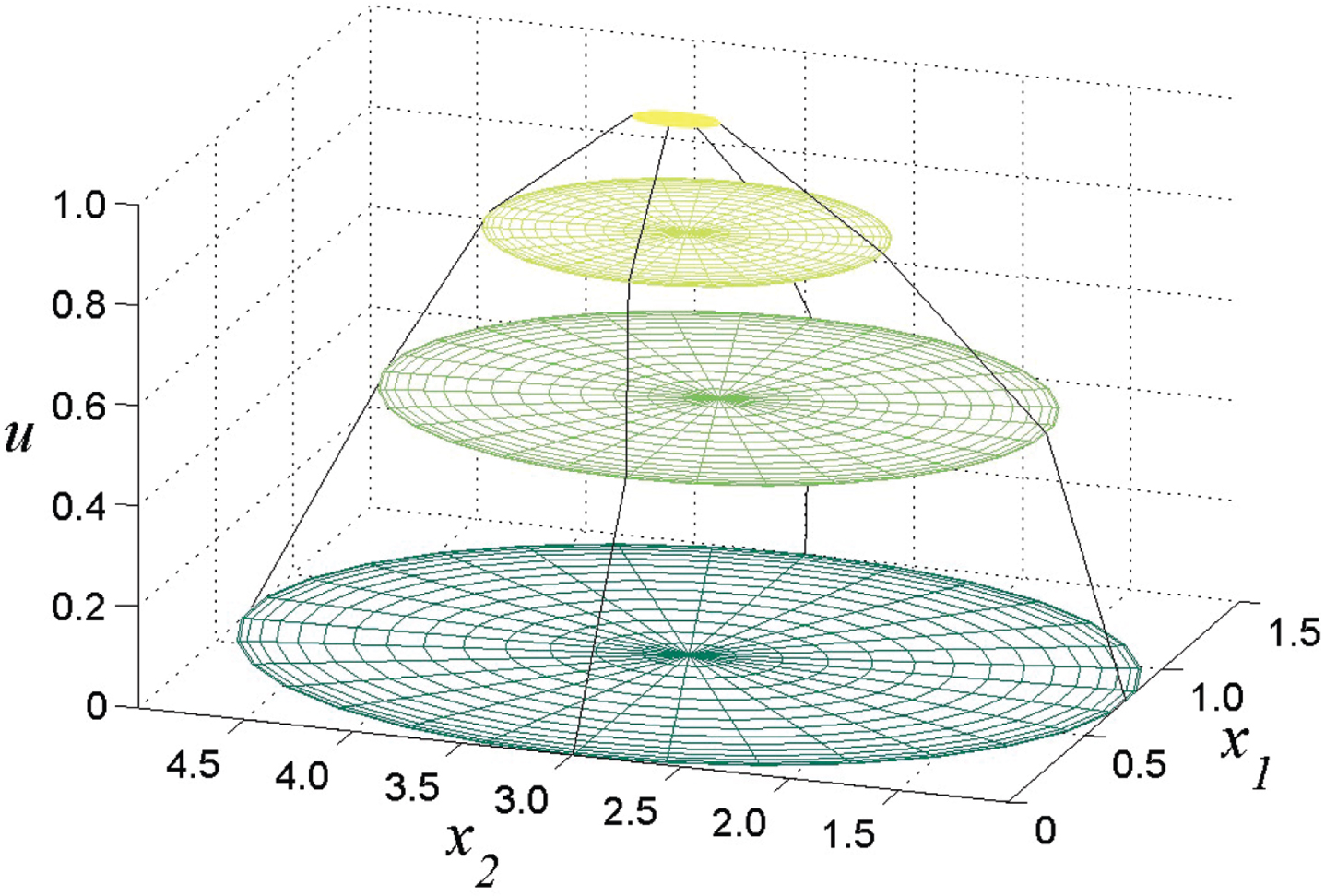
Example 1. Let r = (0, 0.5, 0.8, 1) T, , . Then u = FSLE ( r : A ; B ) is a r-stage linear fuzzy 2-ellipsoid number with r = (0, 0.5, 0.8, 1) T (see Fig. 1).
u = FSLE (r : A ; B).
Construction of multistage linear fuzzy ellipsoid numbers
As mentioned in Introduction, in order to be easy to use, the existing work basically uses rectangular, triangular and trapezoidal fuzzy numbers with very simple structure to express uncertain or imprecise information. In [29, 31], authors set up methods of constructing high dimensional fuzzy cell numbers and fuzzy ellipsoid number with the components of rectangular or triangular or trapezoidal numbers to express multichannel uncertain or imprecise information. When dealing with some multichannel uncertain or imprecise information, such as identification, ranking and classification, if the required accuracy is high, such a construction method will be insufficient in accuracy. In this Section, a construction method of multistage Linear fuzzy ellipsoid numbers will be given, so that more reasonable and objective results as processing multichannel uncertain or imprecise information can be get.
Suppose that a certain object (denoted by O) to be processed is characterized by multiple (denoted by n) uncertain digital quantity features (denoted by O1, O2, ⋯ , On in turn), and the following set of data are the statistical values of the K1, K2, ⋯ , Kn samples for respectively uncertain digital quantity feature O1, O2, ⋯ , On that are arbitrarily taken from the object O:
For any given r = (r0, r1, ⋯ , rm) T with 0 = r0 < r1 < ⋯ < rm-1 < rm = 1 (where m < min {Ki : i = 1, 2, ⋯ , n}), in the following, a method of constructing a r-stage linear fuzzy ellipsoid number to express the object O to be processed is about to be given.
Remark 2. In the process of obtaining the above Data Set (4), the statistical data of corresponding characteristics can come from different samples, and the number of samples to be taken can also be different, that is, it is unnecessary to require K1 = K2 = ⋯ = Kn.
For the convenience of writing, first introduce the following notations.
For each i = 1, 2, ⋯ n, {oij : j = 1, 2, ⋯ , Ki} is denoted by σ (Oi). For any x ∈ R with x > 0, [x] is the integer part of the positive real number x, i.e., the maximum integer not exceeding x. For x ∈ R and l ∈ (0, + ∞), a closed interval with length l is denoted by I (l), and the closed interval with center x and length l is denoted by I (x, l), i.e., . For a finite set A (where, it can be stipulated that the set A can have the same elements), and |A| is used to represent the number of all elements in set A (the same elements are recorded according to the number of repetitions. For example, | {a, b, a} |=3).
Method and Steps
Step 1: For each i = 1, 2, …, n, calculate
Step 2: For each i = 1, 2, ⋯ n, let , and , and find lim = min{ l ∈ R+ : |I (l) ∩ σ (Oi) | = Ni }. Let
and take and .
Step 3: For each i = 1, 2, ⋯ n, find
Let
Take and .
Step 4: For each i = 1, 2, ⋯ n, find
Let
Take and .
⋮
Step k: For each i = 1, 2, ⋯ n, find
Let
Take and .
⋮
Step m+1: For each i = 1, 2, ⋯ n, find
Let
Take and .
Step m+2: For each i = 1, 2, ⋯ n, find
Let
Take and (i.e., ai0 is the coordinate (on first axis) of the intersection of the straight line passing through point (ai1, r1) and point and the first axis, and bi0 is the coordinate (on first axis) of the intersection of the straight line passing through point (bi1, r1) and point and the first axis).
Step m+3: From the constructing of aij and bij (i = 1, 2, ⋯ , n, j = 0, 1, ⋯ , m), it is easy to see that ai0 ≤ ai1 ≤ ⋯ ≤ ai(m-1) ≤ aim ≤ bim ≤ bi(m-1) ≤ ⋯ ≤ bi1 ≤ bi0 for any i = 1, 2, ⋯ , n, so u = FSLE (r : A ; B) is a r-stage linear fuzzy ellipsoid number, and it can be used to express the object O to be processed, where A = (a1, a2, ⋯ , an), B = (b1, b2, ⋯ , bn), ai = (ai0, ai1, ⋯ , aim) T, bi = (bi0, bi1, ⋯ , bim) T.
Example 2. Suppose that the object O to be processed is characterized by 3 uncertain digital quantity features O1, O2, O3, and the following set of data are the statistical values of the K1 = 25, K2 = 20, K3 = 30 samples for respectively uncertain digital quantity feature O1, O2, O3 that are arbitrarily taken from the object O:
In the following, the thing to do is to construct a r-stage linear fuzzy ellipsoid number with r = (r0, r1, r2, r3, r4) T = (0, 0.4, 0.7, 0.9, 1) T to express the object O.
Step 1: By , and , it can be get that μ1 = 15.16, μ2 = 5.05 and μ3 = 81.33, respectively.
Step 2: By (i = 1, 2, 3), it is easy see that N1 = 6, N2 = 5 and N3 = 7. Find
By li4 = min{ l ∈ R+ : |I (l) ∩ σ (Oi) | = Ni } (i = 1, 2, 3), it can be found that l14 = 1.00, l24 = 0.38, l34 = 4.00.
By and = Ni} (i = 1, 2, 3), it can be calculated that , , , , and .
By and (i = 1, 2, 3), it can be get that a14 = 13.00, b14 = 15.66, a24 = 4.86, b24 = 5.89, a34 = 78.00, b34 = 84.00.
Step 3: By li3 = min { l ∈ R+ : I (l) ⊃ [ai4, ai4] , |I (l) ∩σ (Oi) |≥0.9Ni + (1 - 0.9) Ki } (i = 1, 2, 3), it can be found that l13 = 3.20, l23 = 1.56, l33 = 7.40.
By ∩σ (Oi) | ≥ 0.9Ni + 0.1Ki } and I (x, l) ⊃ [ai4, bi4] , |I (x, li3) ∩ σ (Oi) | ≥ 0.9Ni + 0.1Ki } (i = 1, 2, 3), it can be get that , , , , , .
By and (i = 1, 2, 3), it can be get that a13 = 12.80, b13 = 16.00, a23 = 4.68, b23 = 6.24, a33 = 77.70, b33 = 85.10.
Step 4: By li2 = min { l ∈ R+ : I (l) ⊃ [ai3, ai3] , |I (l) ∩σ (Oi) |≥0.7Ni + (1 - 0.7) Ki } (i = 1, 2, 3), it can be found that l12 = 4.86, l22 = 2.50, l32 = 12.60.
By ∩σ (Oi) | ≥ 0.7Ni + 0.3Ki } and I (x, li2) ⊃ [ai3, bi3] , |I (x, li2) ∩ σ (Oi) | ≥ 0.7Ni + 0.3Ki } (i = 1, 2, 3), it can be get that ,, , , ,.
By and (i = 1, 2, 3), it can be obtained that a12 = 12.15, b12 = 17.01,a22 = 3.75, b22 = 6.25, a32 = 75.60,b32 = 88.20.
Step 5: By li1 = min { l ∈ R+ : I (l) ⊃ [ai2, ai2] , |I (l) ∩σ (Oi) |≥0.4Ni + (1 - 0.4) Ki } (i = 1, 2, 3), it can be seen that l11 = 10.00, l21 = 3.26, l31 = 23.00.
By ∩σ (Oi) | ≥ 0.4Ni + 0.6Ki } and I (x, li1) ⊃ [ai2, bi2] , |I (x, li1) ∩ σ (Oi) | ≥ 0.4Ni + 0.6Ki } (i = 1, 2, 3), it can be get that , , , , , .
By and (i = 1, 2, 3), it can be seen that a11 = 10.00, b11 = 20.00, a21 = 3.26, b21 = 6.52, a31 = 69.00, b31 = 92.00.
Step 6: By li0 = min { l ∈ R+ : I (l) ⊃ [ai1, ai1] , |I (l) (i = 1, 2, 3), it can be found that l10 = 13.34, l20 = 4.36, l30 = 30.70.
By ∩σ (Oi) |≥0.2Ni + 0.8Ki } and { I (x, li0) ⊃ [ai1, bi1] , |I (x , li0) ∩ σ (Oi) | ≥ 0.2Ni + 0.8Ki } (i = 1, 2, 3), it can be get that , , , , , .
By and (i = 1, 2, 3), it is easy get that a10 = 3.34, b10 = 20.02, a20 = 1.10, b20 = 6.56, a30 = 53.80, b30 = 92.20.
Step 7: Let
Then the r-stage linear fuzzy ellipsoid numbers u = FSLE (r : A ; B) with r = (0, 0.4, 0.7, 0.9, 1) T can be used to express the object O to be processed.
Calculation of centroid of MSLF-n-ellipsoid numbers
In [36], for general multidimensional fuzzy numbers, authors introduced the centroid concept, which can characterize the fuzzy number more reasonably than the mean for special multi dimensional fuzzy numbers such as fuzzy cell numbers or fuzzy ellipsoid numbers, so that the processing method of multi channel uncertain or imprecise information such as ranking, classifying and recognizing based on the concept of the centroid will be more reasonable than that based on the concept of the mean.
Definition 2. [36] Let u ∈ En. For any i = 1, 2, ⋯ , n, the n-dimensional real number vector (C1 (u) , C2 (u) , ⋯, Cn (u)) is called the centroid of multi dimensional fuzzy number u, and denoted as C (u), i.e., C (u) = (C1 (u) , C2 (u) , ⋯ , Cn (u)), where,
For the convenience of calculation in application, in the following, the calculation formula of centroid for a multistage Linear fuzzy ellipsoid number u is given.
For xi ∈ R, i = 1, 2, ⋯ , n, let .
For x = (x1, x2, ⋯ , xn) ∈ Rn, Let ΣΠ0 (x) =1, and i.e., the sum of all the products of l non repeating numbers in the n numbers x1, ⋯ , xn for each l = 1, ⋯ , n.
Theorem 3.let r = (r0, r1, ⋯ , rm) T with 0 = r0 <r1 < ⋯ < rm-1 < rm = 1, u = FSLE (r : A ; B) ∈ Er-SL (En), where, A = (a1, a2, ⋯ , an), B = (b1, b2, ⋯ , bn), ai = (ai0, ai1, ⋯ , aim) T, bi = (bi0, bi1, ⋯ , bim) T with ai0 ≤ ai1 ≤ ⋯ ≤ ai(m-1) ≤ aim ≤ bim ≤ bi(m-1) ≤ ⋯ ≤ bi1 ≤ bi0 (i = 1, 2, ⋯ , n). Then for any i = 1, 2, ⋯ , n, the ith component Ci (u) of centroid C (u) = (C1 (u) , C2 (u) , ⋯ , Cn (u)) iswhere,
and (k = 1, 2, ⋯ , m).
Proof. For each i = 1, 2, ⋯ , n, by Theorem 2, it is known that as r ∈ [rk-1, rk],
For each i = 1, 2, ⋯ , n and k = 1, 2, ⋯ , m, by the definitions of , it can be obtained that for i = 1, 2, ⋯ , n, , as r ∈ [rk-1, rk], so
Further, it can be obtained that
for i = 1, 2, ⋯ , n and k = 1, 2, ⋯ , m. Then for each k = 1, 2, ⋯ , m, it can be otained (by the definitions of and ) that as r ∈ [rk-1, rk],
and for i = 1, 2, ⋯ , n, k = 1, 2, ⋯ , m,
where, . Therefore, it can be get that
for each i = 1, 2, ⋯ , n. By the definitions of (i = 1, 2, 3) and D*, it is easy seen that
Thus, by Theorem 5.1 in [36], it can be get that
for i = 1, 2, ⋯ , n. The proof of theorem is completed.
Example 3. In Example 1, it can be seen that r = (r0, r1, r2, r3) = (0, 0.5, 0.8, 1), and
For each i = 1, 2 and k = 1, 2, 3, by
it can be worked out that
and and
Further, it can be worked out that
Therefore, by Calculation Formula (9), it is get that
Thus, the centroid of the r-stage linear fuzzy 2-ellipsoid number
is C (u) = (C1 (u) , C2 (u)) = (1.5806, 2.9668).
Applications
In the above two sections, a method to construct multistage Linear fuzzy ellipsoid numbers is established, and the calculation formula of the centroid of multistage Linear fuzzy ellipsoid numbers is given. In this way, the obtained results can be applied to the fusion of multi-channel uncertain digital information, such as ranking, recognition and classification, by constructing aggregation operators in High-dimensional fuzzy number space.
In this section, the problem of ranking uncertain digital information in the specific example given in [36] is taken as an example to show the application of the results obtained in this paper.
Example 4. In Example 6.3 in [36], it is required ranking the four Manufacturing enterprises according to the following four evaluating evidences:
Evidence 1 (denoted by E1): the score of Asset Operating Status of the enterprise;
Evidence 2 (denoted by E2): the score of Product Quality of the enterprise;
Evidence 3 (denoted by E3): the score of Production Capacity of the enterprise;
Evidence 4 (denoted by E4): the score of Environmental Protection Evaluation of the enterprise.
Here, it is assumed that 20 experts are invited to give the corresponding scores (the percentage system is adopted) to each Manufacturing enterprise of the four Manufacturing enterprises for the four evaluating evidences. For example, the following data set is the scores of Manufacturing enterprise :
First: Let r = (r 0, r 1, r 2, r 3, r 4) T = (0, 0.4, 0.7, 0.9, 1) T and N1 = N2 = N3 = N4 = 5. By the method of constructing MSLF-ellipsoid numbers proposed in Section 4 (See also Example 2), the r-stage linear fuzzy 4-ellipsoid number with r = (0, 0.4, 0.7, 0.9, 1) T can be constructed to express Manufacturing enterprise , where
With the same method, uB, uC, uD can be worked out to respectively express Manufacturing enterprises , and . Suppose that , and with r = (0, 0.4, 0.7, 0.9, 1) T and
Second: From Formula (9) (see Example 3),
Third: Taking weight , we can work out the fuzzy order proposed in [36] (Definition 6.1 in [36]) as follows:
so
Thus, a ranking result (from excellent to bad) of the four Manufacturing enterprises can be get: , , , . And it is also seen that the degrees of which is superior to , is superior to and is superior to are 0.8242, 0.6184 and 1, respectively.
In addition, if the level r = 0.6184, r = 0.8242 and r = 1 are taken, the following three dynamic rankings (from excellent to bad) are can obtained which changes with level r for the four Manufacturing enterprises: (1) First: , Second: , Third: , Fourth: as r = 0.6184; (2) First: , Second: and , Third: as r = 0.8242; (3) First: , and , Second: as r = 1.
Remark 3. 1. From the structural point of view, it is obvious that using the fuzzy number constructed here to express multi-channel uncertain or inaccurate information is more objective and reasonable than its components are triangular or trapezoidal fuzzy numbers. 2. Example 4 is just an example. The method of constructing fuzzy numbers given in this paper and other types of aggregation operators can be also used to realize the fusion of multichannel uncertain or inaccurate digital information, such as recognition, classification and clustering.
Conclusion
In this paper, first, a theorem (Theorem 2) was given, by which the concept of r-stage linear fuzzy n-ellipsoid numbers (Definition 1) is defined. Second, a method of constructing r-stage linear fuzzy n-ellipsoid numbers was established to express multi-channel uncertain digital information, and an example (Example 2) was given to show how to use the method to construct such numbers. Third, for the convenience of aggregation operations of high-dimensional fuzzy numbers and applications, the calculation formula (Theorem 3) of the centroid of multistage Linear fuzzy ellipsoid numbers was derived, and an example (Example 3) was given to show how to use the calculation formula to work out the centroid of a multistage Linear fuzzy ellipsoid number. At last, a practical application example (Example 4) was given to show how to use the results obtained and a fuzzy order on high dimensional fuzzy number space introduced in [36] to rank some objects which are characterized by multi-channel uncertain digital information.
It should be noted that our results and existing aggregation operators such as recognition type aggregation operators (see for example, [29, 26]) and classification or cluster type aggregation operators (see for example, [32]) can be also used to identify and classify or cluster multi-channel uncertain or inaccurate digital information.
In addition, compared with fuzzy ellipsoid numbers whose components are trapezoidal or triangular fuzzy numbers, although our method of constructing MSLF-ellipsoid numbers to express multi-channel uncertain digital information has more reasonable and accurate advantages, it also clearly has more complex computational shortcomings. In order to reduce computational complexity, the problem of constructing a multistage platform type ellipsoid numbers to express multi-channel uncertain digital information can be explored in the future.
References
1.
Andrĺȩ-SĺénchezJ., Pricing European options with triangular fuzzy parameters: Assessing alternative triangular approximations in the Spanish stock option market, International Journal of Fuzzy Systems20 (2018), 1624–1643.
2.
ArotariteiD. and IonescuF., Fuzzy Voronoi diagram for dis-joint fuzzy numbers of dimension two, Journal of Intelligent and Fuzzy Systems26 (2014), 1253–1262.
3.
ChangS.S.L. and ZadehL.A., On fuzzy mappings and control, IEEE Trans Syst Man Cybernet2 (1972), 1–34.
4.
ChenH.M., HuC.F. and YehW.C., Considers developing the fuzzy pattern of European call option under the assumption of the stock return being a Gaussian fuzzy number, Soft Computing23(2019), 13351–13374.
5.
CoroianuL., GagolewskiM. and GrzegorzewskiP., Nearest piecewise linear approximation of fuzzy numbers, Fuzzy Sets and Systems233 (2014), 26–51.
6.
DengH., Comparing and ranking fuzzy numbers using ideal solutions, Applied Mathematical Modelling38 (2014), 1638–1646.
7.
EslamipoorR., HajiM.J. and SepehriarA., Proposing a revised method for ranking fuzzy numbers, Journal of Intelligent and Fuzzy Systems25 (2013), 373–378.
8.
GongZ. and HaoY., Fuzzy Laplace transform based on the Henstock integral and its applications in discontinuous fuzzy systems, Fuzzy Sets and Systems358 (2019), 1–28.
9.
GuQ. and XuanZ., A new approach for ranking fuzzy numbers based on possibility theory, Journal of Computational and Applied Mathematics309 (2017), 674–682.
10.
HaiS., GongZ. and ChenZ., Weighted pseudometric approximation of 2-dimensional fuzzy numbers by fuzzy 2-cell prismoid numbers preserving the centroid, Fuzzy Sets and Systems387(2020), 158–178.
11.
HajiM.J., ZareH.K., EslamipoorR. and SepehriarA., A developed distance method for ranking generalized fuzzy numbers, Neural Comput and Applic25 (2014), 727–731.
12.
HongD.H., The law of large numbers and renewal process forT-related weighted fuzzy numbers on Rp, Information Sciences228 (2013), 45–60.
13.
KimJ.D., MoonE.L., JeongE. and HongD.H., Ranking methods for fuzzy numbers: The solution to Brunelli and Mezei’s conjecture, Fuzzy Sets and Systems315 (2017), 109–113.
14.
KleinP., Pricing Black-Scholes options with correlated credit risk, Journal of Banking & Finance20 (1996), 1211–1229.
15.
KumarR., KheparJ. and YadavK., et al, A systematic review on generalized fuzzy numbers and its applications: past, present and future, Archives of Computational Methods in Engineering29 (2022), 5213–5236.
16.
LiJ., ZengW., XieJ. and YinQ., A new fuzzy regression model based on least absoluted eviation, Engineering Applications of Artificial Intelligence52 (2016), 54–64.
17.
LvH. and WangG., Approximations of fuzzy numbers by usingr - s-piecewise linear fuzzy numbers based on weighted metric, Mathematics145 (2022), 1–10.
18.
LvH., WangG. and LiC., Approximations of n-dimensional fuzzy numbers by using α - β-knots piecewise linear fuzzy n-cell numbers, Fuzzy Sets and Systems. https://doi.org/10.1016/j.fss.2023.02.015.
19.
MashchenkoS.O., Minimum of fuzzy numbers with a fuzzy set of operands, Cybernetics and Systems Analysis58 (2022), 210–219.
20.
Moreno-GarciaJ., LinaresL.J., Rodriguez-BenitezL. and CastilloE.D., Fuzzy numbers from raw discrete data using linear regression, Information Sciences233 (2013), 1–14.
21.
MuzzioliS. and TorricelliC., A multiperiod binomial model forpricing options in a vague world, Journal of Economic Dynamicsand Control28 (2004), 861–887.
22.
MuzzioliS. and ReynaertsH., American option pricing with imprecise risk-neutral probabilities, International Journal of Approximate Reasoning49 (2008), 140–147.
23.
MuzzioliS. and TorricelliC., A model for pricing an option with afuzzy payoff, Fuzzy Economic Review5 (2009), 49–61.
24.
PavlaçkaO. and PavlačkováM., On the properties of thefuzzy weighted average of fuzzy numbers with normalized fuzzy weights, Iranian Journal of Fuzzy Systems18 (2021), 1–17.
25.
ThavaneswaranA., AppadooS.S. and FrankJ., Binary option pricing using fuzzy numbers, Applied Mathematics Letters28(2013), 65–72.
26.
WangG. and LiY., The ranking of multi-dimensional uncertain information based on metrics on the fuzzy ellipsoid number space, IEEE Transactions on Fuzzy Systems25 (2017), 614–626.
27.
WangG., ShenC. and WangY., Approximation of fuzzy numbers byusing multi-knots piecewise linear fuzzy numbers, Journal ofIntelligent & Fuzzy Systems39 (2020), 3597–3615.
28.
WangG., ShiP., AgarwalR.K. and ShiY., On fuzzy ellipsoid numbersand membership functions, Journal of Intelligent & FuzzySystems31 (2016), 391–403.
29.
WangG., ShiP. and MessengerP., Representation of uncertain multi-channel digital signal spaces and study of pattern recognition based on metrics and diferrence values on fuzzy n-ell number spaces, IEEE Trans on Fuzzy Systems17 (2009), 421–439.
30.
WangT., ShiP. and WangG., Solving fuzzy regression equation and its approximation for random fuzzy variable and their application, Soft Computing24 (2020), 919–933.
31.
WangG., ShiP., WangB. and ZhangJ., Fuzzy n-ellipsoid numbersand representations of uncertain multi channel digital information, IEEE Trans on Fuzzy Systems22 (2014), 1113–1126.
32.
WangG., ShiP. and WenC., Fuzzy approximation relations on fuzzyn-cell number space and their applications in classification, Information Sciences181 (2011), 3846–3860.
33.
WangG. and WangM., Expressing and ranking of uncertain digital information by using multi-knots piecewise linear fuzzy numbers, International Journal of Fuzzy Systems24 (2022), 3067–3081.
34.
WangG., WangY. and TangJ., Fuzzy option pricing based on fuzzynumber binary tree model, IEEE Trans on Fuzzy Systems30(2022), 3548–3558.
35.
WangG., wangX., QinS. and ZhangG., Dynamic ranking of multi-dimensional uncertain information based on fuzzy order on the fuzzy ellipsoid number space, Journal of Intelligent & Fuzzy Systems36 (2019), 6555–6566.
36.
WangG. and XuY., Calculation of centroid of high dimensional fuzzy number and application, Iranian Journal of Fuzzy Systems18 (2021), 29–44.
37.
WuH.C., Using fuzzy sets theory and Black Scholes formula to generate pricing boundaries of European options, Applied Mathematics and Computation185 (2007), 136–146.
38.
XuW. and LiuG., A binomial tree approach to pricing vulnerable option in a vague world, International Journal of Uncertainty, Fuzziness and Knowledge-Based Systems26 (2018), 143–162.
39.
YangH. and GongZ., Ill-posedness for fuzzy Fredholm integral equations of the first kind and regularization methods, Fuzzy Sets and Systems358 (2019), 132–149.
40.
YazdiH.S., GhasemiGolM. and EffatiS., Hierarchical tree clustering of fuzzy number, Journal of Intelligent & Fuzzy Systems26 (2014), 541–550.
41.
ZhuY., WangG. and LiC., Weighted approximation of fuzzy numbersby using m - n-Step Type Fuzzy Number, (Accepted), Iranian Journal of Fuzzy Systems.