



Abstract
A two dimensional language is a collection of two dimensional words, which are rectangular array of symbols made up of finite alphabets. Fuzzy Petri nets are the generalization of classical Petri nets designed to deal with imprecise and ambiguous data which usually occurs in knowledge based systems, image processing, etc. They have been widely used to represent fuzzy production rules and fuzzy rule-based reasoning. In this paper, a new model called array token fuzzy Petri net to generate two dimensional fuzzy regular languages has been introduced. Array token fuzzy Petri nets are used to deal with impreciseness and uncertainties occurring in two dimensional regular languages. Furthermore, proved that for every two dimensional fuzzy regular grammar there exists an array token fuzzy Petri net that generates the same two dimensional fuzzy regular language and also establish some closure properties of the languages generated by array token fuzzy Petri net.
Introduction
A formal language (one dimensional) is a set of sequence of symbols over some finite alphabet. The advances and applications of formal languages in various fields such as pattern matching, lexical analyzer, syntax, biology, etc., can be found in [1–4]. An extension of one dimensional languages called two dimensional languages (picture languages) were introduced and studied by many researchers [5–10]. A two dimensional language is a collection of two dimensional words (pictures, matrices and arrays). The Siromoney matrix model, introduced in [8] is one of the simplest model to describe picture languages and its extension of array grammars and array automata are extremely useful models for generating two dimensional picture languages among the various classes of two dimensional languages. Also, in [8], the closure properties of matrix languages and its application in generating a wide class of pictures have been studied. The advantages of this model are discussed in [9, 10]. Some of the major and useful devices to generate one dimensional and two dimensional languages are formal grammars (regular, context-free and context-sensitive), Petri nets, L-systems and automata [8, 11–15].
In recent years, there is an increasing interest in studying and analyzing the relation between formal grammars and Petri nets, which are more applicable and effective devices to generate the formal languages. Formal grammars, generally called as grammars, are precise descriptions of formal languages, that is a grammar is a set of rules for rewriting strings to produce a language and the rewriting begins from a start symbol [1, 2]. Petri nets are dynamic graphs with two disjoint sets of nodes namely, places represented by circles and transitions represented by rectangles [15]. The collection of firing sequences of transitions produced by the Petri net is of primary importance in many applications. Among the different varieties of Petri nets structures, one of the Petri net structure called labelled Petri net was introduced in [13]. Their extensions and applications have been studied in many papers [15–17]. In [18], another version of labelled Petri net called string token Petri net has been introduced and studied by representing the labels of transitions with grammar rules and tokens by strings over some alphabet.
Zadeh introduced the concept of fuzzy sets to deal with real life problems having uncertainties, vagueness and imprecise data [19]. In [20], fuzzy Petri nets were introduced to reduce the behaviour of uncertainty problems, which arises in decision making of industrial models. Later, various extensions of fuzzy Petri nets have been initiated and studied [21–23]. In [24], Zadeh and Lee initiated fuzzy languages generated by fuzzy grammars to reduce the vagueness occurring in formal languages. Fuzzy languages have received a lot of attention since the late seventies. The concept of fuzzy languages are used in script recognition, lexical analysis, pattern matching, etc. [25–27]. In [28], the generative tools such as fuzzy L-system, fuzzy grammar and fuzzy Petri nets were discussed and some properties of fuzzy languages have been studied. The fuzzy Petri net introduced in [28] is a labelled fuzzy Petri net where the transitions of Petri net are labelled by symbols over some alphabet associated with their membership values. In [29], a new model called regular string token fuzzy Petri nets has been introduced by labelling the transitions with rewriting rules of fuzzy grammars. Also, studied the relation between fuzzy grammars and fuzzy Petri nets and the closure properties such as union, concatenation, kleene closure, reversal, homomorphism and inverse homomorphism of the languages generated by the regular string token fuzzy Petri nets have been discussed. Recently, two dimensional fuzzy regular languages (2-FRL) generated by two dimensional fuzzy right-linear grammars have been studied in [30], where the basic concepts of fuzzy languages are extended to the picture languages [8]. The equivalence between two dimensional fuzzy right-linear (2-FRLG) grammar and two dimensional fuzzy finite automata have been studied. The closure properties of 2-FRLs have been discussed and also studied the application of 2-FRLG in generation of kolam patterns with fuzzy colors.
Motivated by the above works, in this paper, a new class of fuzzy Petri net called array token fuzzy Petri net is introduced by labelling the transitions of fuzzy Petri net with production rules of two dimensional fuzzy grammar. The properties of fuzzy Petri nets from the aspect of two dimensional fuzzy regular grammars with 2-FRLs are studied.
The organization of this paper is given as follows: The basic notion and definitions of array token Petri net, two dimensional languages and 2-FRL are recalled in Section 2. In Section 3, fuzzy evolution rules and array token fuzzy Petri net are defined. Also, proved that for every two dimensional fuzzy regular language there exists an array token fuzzy Petri net that accepts the same language. The closure properties of 2-FRLs generated by array token fuzzy Petri net are defined and discussed in Section 4. In Section 5, the conclusion and the direction of future studies of this concept has been summarized.
Preliminaries
This section recalls the definitions of array token Petri nets of two dimensional languages and 2-FRLs [12, 30]. The terms and notion of formal languages and formal grammars can be referred from the standard textbooks [1, 2]. The basic definitions and properties of fuzzy languages, fuzzy automata and fuzzy grammars can be recalled from [24, 25].
“
P represents the collection of finite places, T represents the collection of finite transitions, C represents the collection of symbols (colours) and C
AY
represents the collection of all rectangular arrays over the collection C which are considered as tokens, A ⊆ (T × P) ∪ (P × T) represents the collection of arcs, R (t) represents the collection of evolution rules labelled with the transitions in T, M0 represents the initial marking, which is a function defined on P, for p ∈ P, M0 (p) ∈ [C
AY
]
MS
.
V
h
represents the collection of finite horizontal non-terminals, I
h
represents the collection of finite intermediates, S
h
represents the finite fuzzy subset of start symbols from V
h
, P
h
represents the collection of finite fuzzy horizontal production rules of the form α→ρxβ or α→ρx, where ρ ∈ (0, 1] is the grade of membership of the production rules,
i = 1, 2, … , k, in which V
v
i
represents the collection of finite vertical non-terminals such that V
v
i
∩ V
v
j
= ∅ for i ≠ j, I
v
represents the collection of finite terminals, S
i
∈ V
v
i
represents the fuzzy start symbol and P
v
i
represents the collection of finite fuzzy vertical production rules of the form A→σcB or A→σc, A, B ∈ V
v
i
and c ∈ I
v
, where σ ∈ (0, 1] is membership grade of the production rules.
Derivation of a matrix from the given 2-FRLG, the degree of membership of the matrix and the 2-FRL generated by G are given in [30].
Let L M , L M 1 and L M 2 be 2-FRLs over Σ**. Then the Union of L M 1 and L M 2 , the column concatenation (or vertical concatenation) of L M 1 and L M 2 and the column star of L M can be recalled from [30].
The reflection about the base, reflection about the right most vertical, half-turn and conjugate of a given two dimensional word are explained in [9].
For example, if red is a basic color then a “fuzzy red” (say light red) color may be obtained by mixing 0.6 units of red color with 0.4 units of white color.
Array token fuzzy petri nets and two dimensional fuzzy regular languages
In this section, the definition of array token fuzzy Petri net and fuzzy evolution rules are given. Also, given the generation of 2-FRL generated by regular array token fuzzy Petri net. Moreover, it is proven that for every 2-FRL there exists a regular array token fuzzy Petri net.
Reflexive rule: There is no change in the horizontal string. Insertion (left/right) rule: λ→1a, an empty string (λ) is replaced by a string over V. It can be done in either leftmost (represented by λ→1a (l)) or rightmost (represented by λ→1a (r)) side of the string. Deletion (left/right) rule: a→0λ, a string over V is replaced by an empty string. It can be done in either leftmost (represented by a→0λ (l)) or rightmost (a→0λ (r)) side of the string. Substitution rule: X→ρb, ρ ∈ [0, 1], a string over V is replaced by another string over V.
The vertical fuzzy evolution rules for each symbol to generate the array are given below: Reflexive rule: There is no change in the vertical string. Upper insertion rule: A
i
λ→1a (u), an empty symbol (λ) is replaced above by a symbol over V. Lower insertion rule: A
i
λ→1a (l), an empty symbol (λ) is replaced below by a symbol over V. Substitution rule: A
i
λ→ρa
i
(s) represents the substitution of all A
i
with symbols a
i
.
where X, A
i
∈ V, a, b, a
i
∈ V* and λ is the empty string.
P = {p
i
: i = 1, 2, …, n} - the finite collection of places, T = T
h
∪ T
v
, in which T
h
= {t
j
: j isapositiveinteger} is a finite collection of transitions labelled by horizontal fuzzy evolution rules and T
v
= {t
k
: k isapositiveinteger} is a finite collection of tupled transitions, where each transition of every tuple is labelled by the vertical fuzzy evolution rules, V - the finite non-empty collection of symbols consists of terminals represented by lower case letters ({a, b, c, …, z}), non-terminals represented by upper case letters ({A, B, C, …, Z}) and the intermediates are represented by ({S1, S2, …, S
n
}), A ⊆ (T × P) ∪ (P × T) - the collection of arcs (flow relation) and an arc from any p (place) to t (transition) is denoted by p ↦ t (similarly t ↦ p denotes an arc from transition to place). F ⊆ P - the collection of final places, which contains only array of terminals,
M0 : P → (astringover V) - the fuzzy initial marking, M
F
: P → (anarrayofterminalsover V) - the collection of final markings (also called as reachable markings).
where, P∪ T ≠ ∅ and P∩ T = ∅.
(i) A transition (say t) labelled by the horizontal fuzzy evolution rule is called an enabled transition, if the tokens of every input place (say p) of a transition t posses a string, which appears in the left side expression of the horizontal fuzzy evolution rule labelled with t.
A tuple of transitions (say (t1, t2, …, t n )) each labelled by the vertical fuzzy evolution rules is called an enabled transition, if tupled token of every input place (say p) of a transition (t1, t2, …, t n ) posses strings, all of which appears in the left side expression of the vertical fuzzy evolution rules labelled with each transition of (t1, t2, …, t n ).
(ii) A transition t and (t1, t2, …, t n ) can be fired, if they are enabled (depending on whether the event actually takes place).
(iii) The token (say y) is removed from all input place (say p) of a transition (say t) and altered as the string token z in the output place of t, if the enabled transition t is fired. Also, each vertical string (say α
i
: i ranges from 1 to the number of columns in the two dimensional word) in the tupled token is removed from the input place of the tupled transition (say (t1, t2, …, t
n
) and altered as the vertical string
The generation of two dimensional word from the given ATFPN is described as follows:
(i) The horizontal string of intermediates (say δ = S1S2 … S
n
) is generated with the firing of Transitions Labelled By the horizontal fuzzy evolution rules from the fuzzy initial marking (say S) and is represented by
(ii) The horizontal string (S1S2 … S n ) obtained in the place (say p) is considered as tuples S1, S2, …, S n and each element of the tuple is considered as an initial marking in the place p to generate the columns of the two dimensional word.
(iii) Finally, each column of the two dimensional word is generated simultaneously by firing of tupled transitions labelled with the vertical fuzzy evolution rules. The membership value of each column (vertical string of terminals α
i
; i represents the number of columns in the two dimensional word) is obtained by
Note that
The 2-FRL generated by the RATFPN 𝒩 f is the collection of all two dimensional words of terminals generated by the RATFPN 𝒩 f and it is denoted by L M (𝒩 f ).

RATFPN 𝒩 f of Example 3.1.
Consider a 3 × 3 matrix W in L M (𝒩 f ), where the central column is filled by zero and all other entries are filled by one. The generation process of W is shown below:
The membership value of the horizontal string of intermediates δ = S1S2S2 with d (S) =0.6 is
= 0.6.
The membership value of the vertical string α1 = 111 with d (S1) =0.7 is
Similarly for α2 = 000 with d (S2) =0.7 is
Now,
Since, by definition 3.4,
Therefore, d𝒩 f (W) = max {min {0.6, ⋁ (0.4, 0.4)}} = 0.4 > 0.
L M (𝒩 f ) = L M (G).
Construct the Petri Net
V = V
h
∪ I
h
∪ I
v
∪ V
v
i
; i = 1, 2, …, n, M0 is collection of fuzzy initial markings corresponding to each fuzzy start variable S ∈ S
h
of G
h
and S
i
∈ G
v
i
; i = 1, 2, …, n. For each A→ρaB ∈ P
h
put
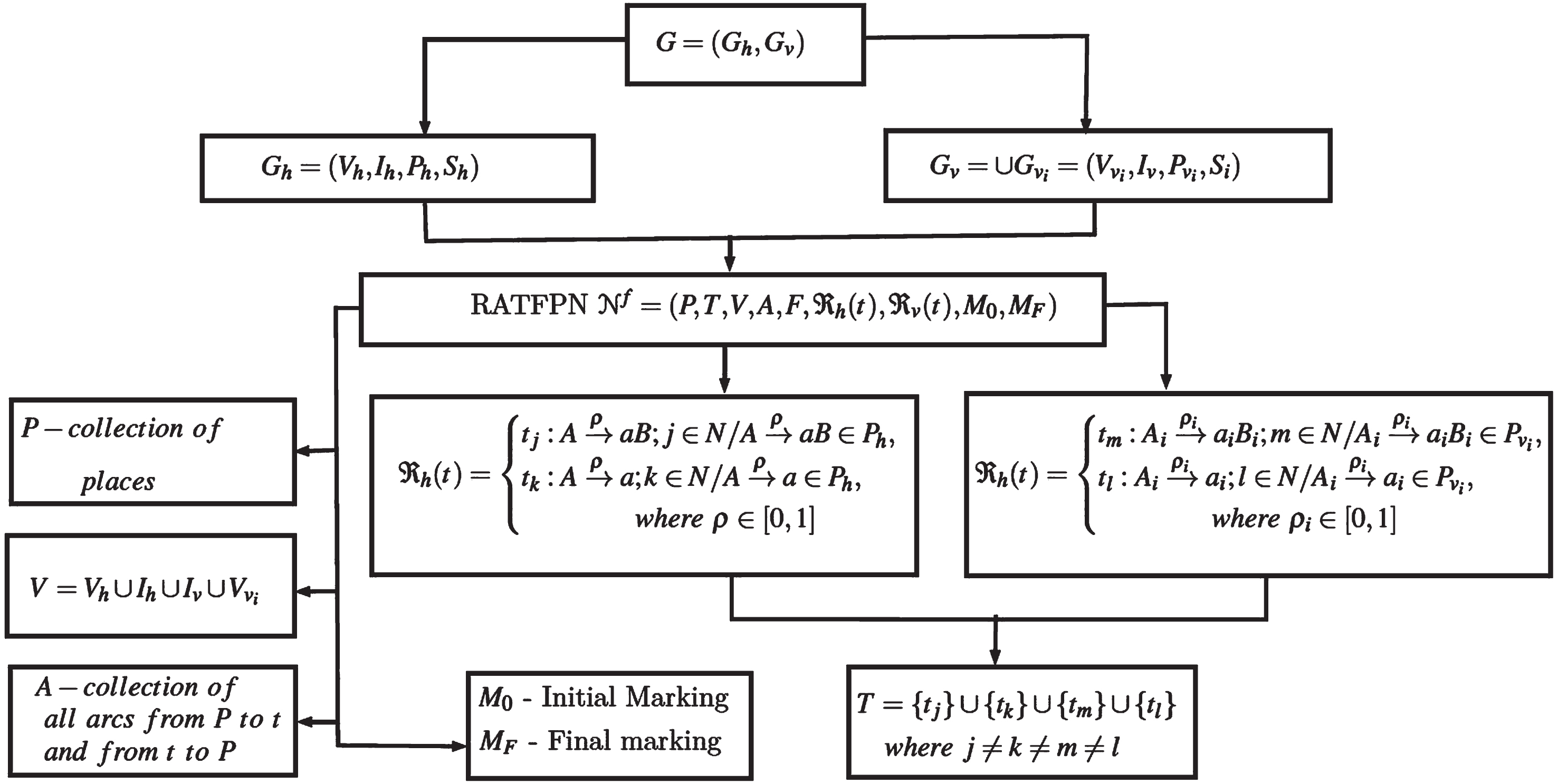
Construction of RATFPN 𝒩 f from 2-FRLG G.
The 2-FRLG G that generates L M (G) is described in Example 5.1 given in [30]. An example of geometric pattern is shown Fig. 3. By Theorem 3.1, let us construct RATFPN 𝒩 f such that

Geometric pattern.
P = {p1, p2, p3, p4, p5},
T = {t1, t2, t3, t4, t5, t6, t7, t8, t9, t10, t11, t12},
V = V h ∪ I h ∪ I v ∪ V v i
= {S0, A, B, S1, S2, a, c, d, e, f, g, C, D, E, F},
A = {Collectionofallarcs},
F = {p5},
For each horizontal fuzzy production rule P
h
of G, the horizontal fuzzy evaluation rules
For each vertical fuzzy production rule P
v
i
of G, the vertical fuzzy evaluation rules
M0 is the collection of fuzzy initial marking obtained from S0, S1 and S2 along with their membership values of G and M F is the final marking in place p5.
The constructed RATFPN 𝒩 f is shown in Fig. 4.

RATFPN 𝒩 f .
In the sense of functional comparison, the evolution rules of RATFPN are in the form of regular fuzzy production rules whereas RATPN has evolution rules of the form of regular production rules.
In this paper, one such functioning of RATFPN has been described in the form of generation of geometric kolam pattern with fuzzy colors, which has been explained detail in Example 3.2. Whereas in RATPN each fuzzy color is treated as different new color and should be given as new inputs to generate the colored patterns. The advantage of RATFPN is to resolve the issues of vagueness occurring in two dimensional regular languages.
In this section, the closure properties of 2-FRLs generated by RATFPNs have been introduced and discussed.
The row star of L
M
is 2-FRL denoted by
(i) The construction of the RATFPN
The same procedure can be extended to 2-FRLs L M 1 , L M 2 , …, L M n .
(ii) The construction of the RAT
The same procedure can be extended to 2-FRLs L M 1 , L M 2 , …, L M n .
(iii) The construction of the RATFPN
The 2-FRL generated by RATFPN is closed under row concatenation and row star can be proved in a similar way.
The half-turn of a 2-FRL L M is denoted by H (L M ) and is defined by H (L M ) = {H (X)/X ∈ L M } . The reflection about the right-most vertical and reflection about the base of the 2-FRL are defined in a similar way.
Let L
M
(𝒩
f
) be the 2-FRL generated by RATFPN
P′ = P; T′ = T; V′ = V; A′ = A; F′ = F;
Hence, if L M is a 2-FRL then its reflection about base R h (L M ) is also a 2-FRL. i.e., The class of 2-FRLs is closed under reflection about the base.
The other closure properties can be similarly proved.
Conclusion
In this paper, the regular array token fuzzy Petri net to generate two dimensional fuzzy regular language has been introduced and established that, for every two dimensional fuzzy regular language there exists array token fuzzy Petri net. Also, exemplified the generation of geometric pattern by regular array token fuzzy Petri net. Some of the closure properties of languages generated by regular array token fuzzy Petri net such as union, column concatenation, column closure and reflection about base, etc., has been discussed. The future work is to extend the array token fuzzy Petri nets to the Chomsky hierarchy of two dimensional fuzzy languages, tetrahedral and hexagonal picture languages. Further, the application of array token fuzzy Petri nets can be carried out in the direction of fuzzy lexical analyzer, image processing and approximate pattern matching.