



Abstract
This paper mainly discusses the extinction and persistent dynamic behavior of infectious diseases with temporary immunity. Considering that the transmission process of infectious diseases is affected by environmental fluctuations, stochastic SIRS models have been proposed, while the outbreak of diseases is sudden and the interference terms that affect disease transmission cannot be qualified as random variables. Liu process is introduced based on uncertainty theory, which is a new branch of mathematics for describing uncertainty phenomena, to describe uncertain disturbances in epidemic transmission. This paper first extends the classic SIRS model from a deterministic framework to an uncertain framework and constructs an uncertain SIRS infectious disease model with constant input and bilinear incidence. Then, by means of Yao-Chen formula, α-path of uncertain SIRS model and the corresponding ordinary differential equations are obtained to introduce the uncertainty threshold function
Introduction
As a major public problem worldwide, the epidemics of infectious diseases in history have brought great disaster to the survival of human beings, national economy and person’s livelihood. Over the past century, the population have suffered from influenza, AIDS, SARS tuberculosis and other infectious diseases that have killed hundreds of millions of people. The sudden outbreak of COVID-19 at the end of 2019 and its worldwide spreading not only affect the health of individuals, but also do great harm to economic and social development. At present, mathematical models have been widely employed in the study of infectious diseases. The most classic disease dynamics model is the Kermack-Mckendrick’s SIR compartmental model [1] (1927) which divided the total population into three compartments: susceptible, infected and recovered, and marked the number of people at time t as S t , I t and R t , respectively. Kermack W. and McKendrick A. [2] (1932) proposed SIS compartmental model and puted forward the “threshold theory" to distinguish between disease prevalent or not. On this basis, Allen L. [3] (1994) proposed some discrete-time SI, SIR, and SIS epidemic models. After that, many scholars have derived various ordinary differential models, such as SEIR model, SEAIR model, SIRI model, and SIRS model. The research work of these typical deterministic epidemic models can be found in the literature [4–8].
In addition to deterministic models, based on the consideration that the spread of disease is subject to stochastic perturbations, stochastic models are established. Gray A. et al. [9] (2011) studied the stationary distribution and ergodicity of a random SIS epidemic model by using Has’ minskii’s ergodicity theory. Ji C. et al. [10] (2012) discussed the stationary distribution and ergodicity of a random multi-group SIR model. Recently, various random SIRS models have been studied. El Fatini M. et al. [11] (2019) considered a stochastic SIRS epidemic model with general incidence and studied its stationary distribution and threshold dynamics. Zhao X. et al. [12] (2020) formulated a stochastic SIRS model and given the sensitivity analysis of the basic reproduction number under different semi-Markov chains. The stochastic epidemic model has been studied deeply in all aspects and has made great achievements.
Nevertheless, at the beginning of epidemic’s outbreak, there are not enough samples to estimate the probabilistic properties of the random model, then some dominate expert’s knowledge is required to assess the belief degree that each event will happen. At this point it is not appropriate to consider the propagation process subject to random perturbations based on probability theory. For dealing with uncertainties, Zadeh L. A. [13] (1965) proposed Fuzzy Sets, where a fuzzy set is defined by its membership function. and then Granular computing have been studied explicitly or implicitly in many fields. The approximation space in rough set theory is important for dealing with uncertainties. Xu, W. et al. [14] (2022) mainly investigated a dynamic approximation update mechanism for multigranulation data from a local viewpoint. Granular computing (GrC) and two-way concept learning (TCL) are influential studies of knowledge processing and cognitive learning. Xu, W. et al. [15] (2022) designed a fuzzy-based progressive learning mechanism within this framework to provide a novel and convenient method for researching two-way learning and concept-cognitive learning under dynamic environments. However, this article deals with the issue of belief degree from the perspective of uncertainty theory, which was established by Liu [16] (2007). Liu introduced an uncertain measure based on normality, duality, subadditivity and product axioms. Liu [17] (2008) introduced a type of differential equation driven by Liu process and then employed the uncertainty theory into various practical field [18, 19]. Chen X. and Liu B. [20] (2010) proposed the existence and uniqueness theorem of solution for the uncertain differential equation. Yao K. and Chen X. [21] (2013) proposed the α-path methods to obtain the numerical solutions of uncertain differential equations. Li Z. et al. [22] (2017) established an uncertain SIS model with the bilinear incidence rate via uncertain differential equations and obtained the analytical solution and the corresponding α-paths of this model. On the basis, Li Z. et al. [23] (2018) further studied uncertain SIS epidemic model with standard incidence and analyzed the extinction and permanence of the disease for a threshold quantity. Furthermore, Li Z. et al. [24] (2018) discussed the comparison with the deterministic, stochastic, and uncertain SIS models. Jia L. et al. [25] (2020) proposed an uncertain SEIAR model and estimated the parameters via moment estimation method to predict the possible numbers of active cases for COVID-19 in China. Liu Z. [26] (2021) studied the cumulative cases of COVID-19 based on the uncertain growth model. Chen X. et al. [27] (2021) proposed an uncertain SIR model to describe the development trend of COVID-19. Given that viruses can mutate over time and human resistance to drugs may increase, the risk of a decrease or even gradual disappearance of immunity is significant. Consequently, studying uncertain SIRS epidemic models is crucial in accurately describing epidemics with temporary immunity and informing effective control strategies.
Our main findings are summarized as follows. Firstly, uncertain processes are utilized to describe the non-deterministic factors in the epidemic transmission process, and an uncertain SIRS epidemic model in non-constant population size with constant inputs for only susceptible persons is established. Secondly, the concept of basic reproduction number is introduced, and the uncertain threshold function is defined to investigate the asymptotic stability of disease extinction and persistence in an uncertain environment.
The rest of this paper is structured as follows. In Section 2, the SIRS model under uncertainty theory is established. Section 3 and Section 4 show the expression of uncertain threshold function
Model formulation
In this section, we give an uncertain SIRS epidemic model with constant input and exponential death, that is, the total population is non-constant, only susceptible persons have constant input. For this model, we divide the population being studied into three categories labeled S, I, and R,respectively. Meanwhile the numbers of individuals in the three groups at the time t are marked by S t , I t and R t , respectively, where S t represents the number of individuals susceptible to the disease, that is, who are not (yet) infected at time t, and I t represents the number of infected who are presumed to be infectious and able to spread the disease by contact with susceptibles, and R t represents the number of individuals who have been infected and then recovered from the possibility of re-infection or transmission of infection. The general SIRS model studied by Muroya Y. et al. [7] (2014) is given by ordinary differential equation as follows:
It can be seen from the Figure 1 that the schematic diagram of SIRS epidemic spreading.
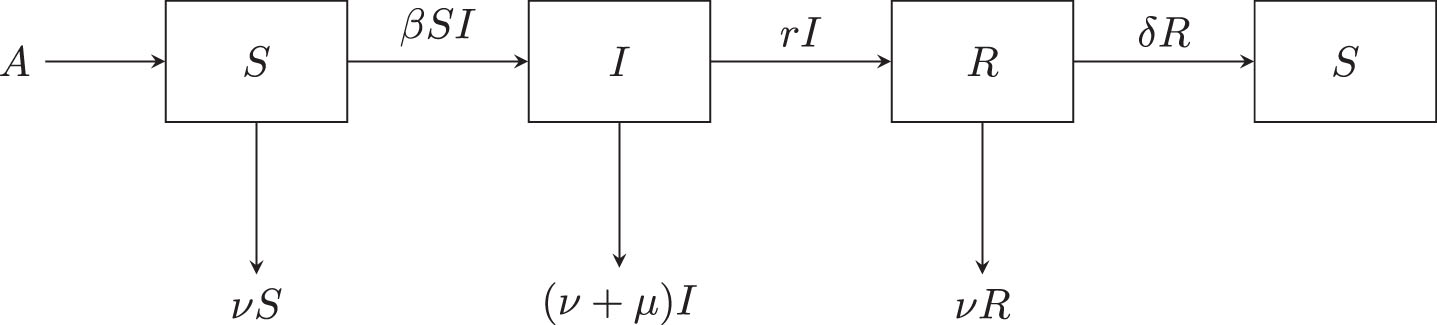
The schematic diagram of SIRS epidemic spreading.
It is based on the following assumptions: Assume that there is entry and exit in the total population so that the total population is non-constant. Let N be the total population, then N = S + I + R. Adding the three equations of the model (1), we obtain that N meets the equation
Assume that the incidence of disease is bilinear βSI; Suppose that only susceptible persons have external input, the rate denoted by A; Suppose that individuals in the same category are in contact with each other, while their status do not change.
In real life, actually, the spread of a pandemic is affected by environmental noise. Based on the deterministic SIRS model, this paper considers that the contact transmission coefficient β will be affected by uncertain factors in the environment during the infectious disease spreading. Due to the influence of human factors such as travel restrictions and isolation policy in the process of disease transmission, the prediction of the stochastic model constructed with random disturbances is not accurate enough. Therefore, Liu process is introduced to depict uncertain factors in the environment and transform the rate β into β
t
with uncertain perturbations that capture variability in transmission. The model (1) is considered to replace the deterministic transmission rate with a uncertain one. This is done by letting
Replace the β in the original deterministic SIRS model with β t and convert it into a system of uncertain differential equations, which is called an uncertain SIRS epidemic model. The resulting uncertain model is introduced as follows:
The basic reproduction number The basic reproduction number If If
Considering the uncertain SIRS epidemic model (2), we plan to introduce Yao-Chen formula [21], which relates uncertain differential equations and ordinary differential equations, to further discuss an uncertain threshold function
The α-path of the uncertain model (2) is defined based on each uncertain differential equation. Yao K. and Chen X. [21] suggested that a solution of an uncertain differential equation is a contour process. Thus, the solutions S
t
, I
t
and R
t
of uncertain differential system (2) are contour processes. The α-path (0 < α <1) of the uncertain model (2) with initial values S0, I0 and R0 correspond to deterministic functions
Consider system (2), we have
Suppose that Suppose that
It is easy to get one of solution of system (5-7), that is the disease-free equilibrium state E0 (A/ν, 0, 0). After that, we try to solve the positive epidemic solution E1 (x*, y*, z*). From the equation (7), we get the expression of z in terms of y:
If
If
In this section, we discusses the dynamics of the system (3) by analyzing the asymptotic behaviors of two steady states.
In the following part, we study the local asymptotic stability near the endemic equilibrium state E1.
Substitute E1 (x*, y*, z*) to the above matrix, then the jacobian matrix at E1 is
Then, the characteristic polynomial associated to J (E1) is given by
According to Routh-Hurwitz criteria [29, 30], we may conclude that since all the eigenvalues of J (E1) have negative real part, the endemic steady state E1 exists and has local asymptotic stability for
Numerical algorithm and some examples
In this section, we perform a computing algorithm to obtain numerical solutions of the uncertain SIRS model (2) on the basis of Euler method and give some examples to illustrate theoretical results proposed in this paper.

Trajectories of
The parameter values used in the numerical Example 1
In the subfigure (a), the solutions of system (3) converge to the disease-free equilibrium state E0 (3, 0, 0) with different initial values, that is, the infection will die out. Here

Trajectories of
The parameter values used in the numerical Example 2
In the left subfigure,

Trajectories of
The values of
In the above figure,
Uncertain differential equation play a significant role in handling dynamic systems in epidemics. This paper concerned an uncertain SIRS epidemic model with bilinear incidence and demography, in which the uncertain disturbance was described by the Liu process. By considering the relationship between different compartments, we first established the uncertain SIRS model. Additionally, under the corresponding α-path, this paper defined an uncertain threshold function
Footnotes
Acknowledgements
This work was funded by the Key Research and Development Plan Project of Xinjiang Uygur Autonomous Region (Grant No. 2021B03003-1) and the National Natural Science Foundation of China (Grant No. 12061072).