



Abstract
The Internet of Things and Quantum Computing raise concerns, as Quantum IoT defines security that exploits quantum security management in IoT. The security of IoT is a significant concern for ensuring secure communications that must be appropriately protected to address key distribution challenges and ensure high security during data transmission. Therefore, in the critical context of IoT environments, secure data aggregation can provide access privileges for accessing network services. "Most data aggregation schemes achieve high computational efficiency; however, the cryptography mechanism faces challenges in finding a solution for the expected security desecration, especially with the advent of quantum computers utilizing public-key cryptosystems despite these limitations. In this paper, the Secure Data Aggregation using Quantum Key Management scheme, named SDA-QKM, employs public-key encryption to enhance the security level of data aggregation. The proposed system introduces traceability and stability checks for the keys to detect adversaries during the data aggregation process, providing efficient security and reducing authentication costs. Here the performance has been evaluated by comparing it with existing competing schemes in terms of data aggregation. The results demonstrate that SDA-QKM offers a robust security analysis against various threats, protecting privacy, authentication, and computation efficiency at a lower computational cost and communication overhead than existing systems.
Introduction
Sensor Networks have emerged as one of the most considerable IoT technologies [1] to enhance smart devices, bringing extensive complexity and overhead to processing data to the IoT system. Instinctively, off-loading the Cloud evaluation responsibilities can smash through the restrictions [2, 3]. The IoT cloud system enables computing and storage responsibilities from the Cloud to edge devices, mostly for data analysis and management, and provides authority for access and processing in IoT systems. The challenge of IoT and Cloud integration is to be solved [4]. In most cases, smart devices and communication in IoT environments are generally unreliable, exposing sensitive data to eavesdroppers and other security issues [5]. The data privacy concern is to execute end-to-end encryption to defend against security. Established protocols are considered to exploit the cryptosystem to initiate communications. most of the Cryptographic mechanisms are RSA [6], Elliptic Curve Cryptography algorithm [7], Diffie-Hellman Key Exchange algorithm [8], which necessitate efficient computation resources, which will cause the take apart of the security analysis based on the complexity of arithmetical functions [9, 10]. Quantum systems can break this complexity. Need to consider the security requirements brought by quantum computers [11]. The robust security clarification, Quantum Key Distribution, might work out the security issues on the condition of quantum keys [12]. So, the IoT systems are protected by Quantum key distribution considering a competent paradigm. Once efficient quantum computers are to be had, asymmetric cryptographic mechanisms regard complexity. The symmetric cryptosystem is not busted by quantum mechanisms needed for the determination of superior keys and classifying the applications and protocols, it requires different cryptographic dexterity forms [13].
IoT security requirements can be determined by end-user or cloud systems. For example, it can deploy End devices at the network edge and collect data from IoT, keep data at the edge or cloud devices, to a certain extent, then routing through a middleware. If there is data from any attacks, the intermediate service can also carry out the authentication to timely filter the vulnerabilities. The end-user cannot distinguish each attribute during the consecutive run of the aggregation process. Providing secure aggregation methods is necessary in IoT networks.
The most crucial challenge arises before data aggregation: ensuring secure communication between IoT and cloud systems. Additionally, while many of the aggregation schemes mentioned above can protect data transmission, they often come at an expensive cost. Simultaneously, with the advent of quantum computers, features such as data integrity and confidentiality cannot be guaranteed. Considering these factors, it is essential to introduce a quantum cryptography scheme to assess security issues in IoT and propose secure data aggregation using quantum key management. The method adopts the One-Time-Pad (OTP) technique [14] and uses quantum cryptography to prevent vulnerabilities. The quantum key distribution in the standard cipher comprehends the secure communication.
In this work, to address the above challenges, the SDA-QKM (Secure Data Aggregation using Quantum Key Management) scheme for IoT systems is proposed, which supports authentication verification during the data aggregation process. In QKM, the data integrity process conserves computational efficiency by using a One-Time-Pad (OTP) mechanism. Hence, it maintains middleware security compatibility at the system level, allowing users to manage keys for access control in services with privileged access. Devices must undergo authentication to ensure that aggregation is performed only by authorized services. The main contributions of the proposed SDA-QKM framework are summarized as follows: The IoT architecture consists of a middleware/Access layer to improve the data aggregation for computation efficiency and their corresponding SDA-QKM framework. The device data needs to be secure enough. The user must have the proper authentication to access the data if a supposed unauthorized user attempts to decrypt the data. In that case, QKM provides encryption with an authorization verifier. The aggregation process Consists of key Generation, verification, aggregation, Tracing and Key Stability checking processes. Secure data aggregation with OTP mechanisms to fix the responsibility for key distribution in the traditional stream cipher to analyze the securing data transmission. Here the session key is generated by QRNG and it is functional to OTP, which improves data privacy. A comprehensive examination is performed, and it is observing the results. The Complete security analysis shows how the proposed SDA-QKM security model can achieve privacy, authentication source, integrity and also prove that quantum cryptography is well suitable for IoT systems. In this work, extensive experiments evaluate the system efficiency in computational cost and communication overheads. This analysis shows that the aggregation services are significantly reduced compared with the traditional secure data aggregation schemes.
This paper remains structured in Section 2, summarizing the related work and getting into the background problem formulation in Section 3. The architecture and the proposed SDA-QKM model are presented in Sections 4 and 5. The Security and performance analysis are demonstrated in Sections 6 and 7, respectively. Finally, the conclusion is given in the Section 8.
Related work
IoT sensing environments pose certain security and privacy risks [15]. Additionally, vulnerabilities may lead to data expenditure, and aggregation can enhance efficiency by reducing the number of packets required for secure transmission. The complexity of authentication has been comprehensively discussed in [16-18].
Cirani et al. [19] The authorization is considered a progressively more Access to resources. Presented by a cryptographic scheme and protocols at network layers. The crypto scheme allows trusted communication by providing privacy protection based on a Public-Key Infrastructure, and introduces a two-step encryption method for handling processing time. Schiffman et. al. [20], the authors present a fine-grained sub-delegation mechanism. The critical challenge is applying these mechanisms to a constrained network. Xi Luo et al. [21] considered resource consumption and intended a transmission protocol concerning the symmetric cryptosystems, which provides lightweight encryptions to keep the data transmissions secure. Symmetric keys created and conserved by the semantic methods and protocols can battle key reorganization and attacks.
Rongxing lu et al. [22]. Contributed to data aggregation methods characterized by combining these cryptographic mechanisms, such as Paillier crypto encryption, CRT theorem, and one-way hashing techniques to track the authentication source, the edge network to the fault-tolerance, and FDI by external attackers. The outcome indicates efficiency in both computational and communication costs. Gerdes et al. [23] presented a DCAF scheme, introducing an authorization server for performing authorization to store a massive amount of information. The delegated tasks are handled by an external entity, aiming to be general and patently IoT integration. Wang, Boneh et al. [24, 25] introduced a secure aggregation scheme to ensure privacy protection, integrity, and authentication of data collected from IoT. Z. Guan et al. [26] contributed to preserving data, aggregation secrecy, and trust by using a pseudonym certificate.
Abdallah et al. [27] proposed a quantum cryptosystem. Secure aggregation involves computation operations that effectively reduce computational costs. M. Badra et al. [28] presented a homomorphic encryption and key management system. It requires resilience against different attacks. It has limited computational resources. Ahsan Saleem et al. [29] presented in privacy-preserving data aggregation (FESDA), OTP-based or pseudonym certificate, the Paillier crypto mechanism, and Hashing techniques used to reduce computations competently and improve FN. and CCs work efficiency. It verifies the integrity and authentication. It is proven and computationally expensive in terms of aggregation. Kursawe et al. [30] presented the crypto mechanism for Diffie-Hellman and the bilinear mapping scheme to generate masking values depending on secret sharing. Erkin Z et al. In [31], using Paillier homomorphism encryption to keep the masking values, a distributed Laplacian perturbation algorithm was offered to create Laplacian noise, high communication, and computational overheads. Rongxing Lu, et al. [32] In EPPA, agreeably the real-time data collection provisions in IoT applications. It uses multi-dimensional data aggregation. Compared with the fixed data aggregation approaches, the Paillier homomorphic crypto algorithm increases the aggregation sequence, reduces the computational cost, and extensively improves efficient communication with high-frequency.
Jithunbi et al. [33] presented a trust evaluation algorithm by applying a genetic algorithm with intelligent rules which helps to evaluate the real trust score of the individual node. Jianbing et al. [34] propose a secure data aggregation system with trapdoor hashing functions and a Paillier cryptosystem; both these methods can resist malicious gateway attacks. Selvakumar et al. [35] presented a verifiable threshold multi-authority access control model for a public cloud storage environment.
IoT systems exhibit significant ambiguity regarding network security. The current standard for IoT does not stipulate any requirements for detecting attacks [36]. Consequently, there is a heightened susceptibility to attacks due to numerous vulnerabilities. This prompts a revision of the feasible key solution for securing IoT through quantum cryptosystems [37]. Cryptosystems leverage standard mathematical functions to create and enhance effective security measures. Utilizing quantum procedures for data transmission ensures unhackable and secure communication [38]. This represents the most crucial advantage exploited by the quantum crypto mechanism. Whenever data is transmitted over a channel from the source to the destination and malicious entity attempts to interrupt the communications and easily detect the intruder in a network [39]. The hierarchical based key management scheme was discussed in [41, 42] which enhances the security of sensor nodes for wireless sensor networks. The recent work on quantum based security for public cloud based IoT systems was discussed in [43-45]. Most commonly they applied a lattice based signature scheme for encrypting the message.
The complete authorization does not do the above-mentioned secure data aggregation methods to the Edge network, and these schemes endure computational efficiency. In IoT, the Middleware desires to spend data each minute from the Sensing environments. Simultaneously, the access credential needs to remove the vulnerabilities during the data transmissions. Moreover, the proposed Authentication Cryptosystem involves managing keys used to QKM, explicitly considering minimizing the effort required by providing a secure communication and authorization structure. A proposed SDA-QKM system to prevent vulnerabilities. It ensures that the aggregation verification process is done by the Quantum key cryptography mechanism which efficiently conserves privacy protection and performs aggregated data from authorized service and user access to the network service.
Problem formulation
This session required the background information of cryptographic primitives, and it involved the following into the SDA-QKM scheme.
Bi-linear mapping
Assume M
a
and M
b
as two product categories that are prime pr, a bi-linear map can be defined as a function, k : M
a
XM
a
→ M
b
and contain the characteristics as follows:
Quantum key cryptosystem
Quantum theory concepts to recognize the key distribution with verifiable security are referred to as the quantum key cryptosystem [10]. The Quantum key Cryptosystem encryption method supports and allows efficient computations of the encrypted data. This scheme considers the following processes, 1. Key Generation, 2. Encryption, 3. Decryption, 4. Key Stability checking, 5. Tracing Model. using QRNG
System architecture
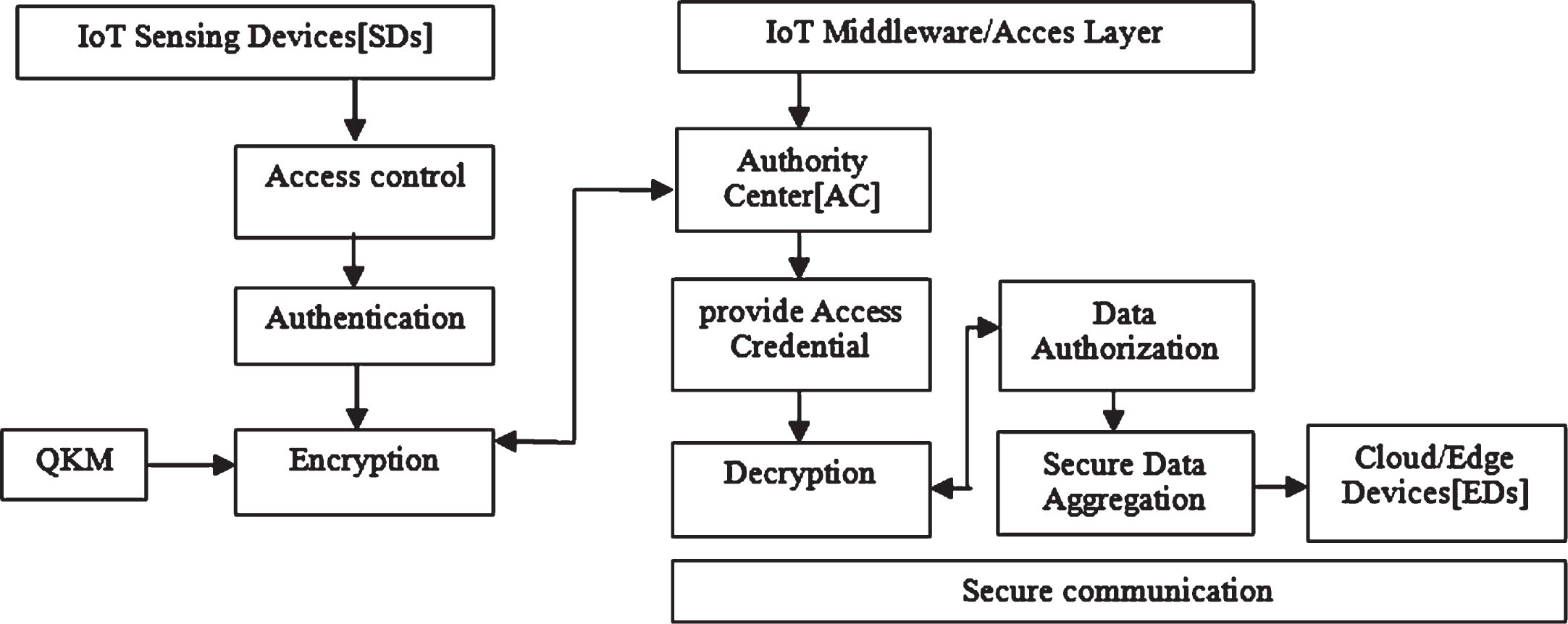
The collected data from Sensing Devices [SDs], is aggregated and forwarded through the access layer. The access control provides authorization for accessing data to have huge computational complexity. IoT middleware needs to manage a secure relationship with trusted devices to be authenticated and authorized in our system model. It needs to enforce authentication with all appliances, enabling verification of data origin and assigning unique identities that reuse security credentials. Suppose that there are numerous Sensing data being transmitted to their respective Edge device. Sensing data ensures transmission between end devices to protect from various security issues. Thus, the secure transmission provides authorized data from IoT devices. The middle layer comprises mutual Authentication between Edge Devices. It provides authorization to grant access rights to specific data resources. Incoming data from the IoT, since the computational capacity, can be pre-processed and aggregated Data is preferred to the enduring Access rights of each sensed data.
The system model is shown in Fig. 1, which has four parts: 1. [SDs] 2. Edge Devices [EDs] 3. Control centre [CC] and 4. Authority Center [AC].
System model.
In this scheme, the expected adversary can exploit an unauthorized source with normal data. However, it will not arbitrarily corrupt data but expose it to private information during the aggregation process. The data transmission between SDs and CC cannot be fully encrypted; an adversary could eavesdrop on insecure communication; and the attacker can exploit the network edges. The adversary can also instigate compromising data transmission. Moreover, we also consider internal and external attacks (FDI) to get confidential information through some adversaries in the communication channels. Therefore, the Edge devices are estimated to reject these forged data and not forward them to the CC. An adversary can instigate the data integrity, and eavesdrop to get valid data. In review, our Adversarial model must convince the privacy concern, source of authentication and integrity.
Security goal
The security goal can be mentioned above in the system models as consisting of the following objectives:
SDA-QKM model
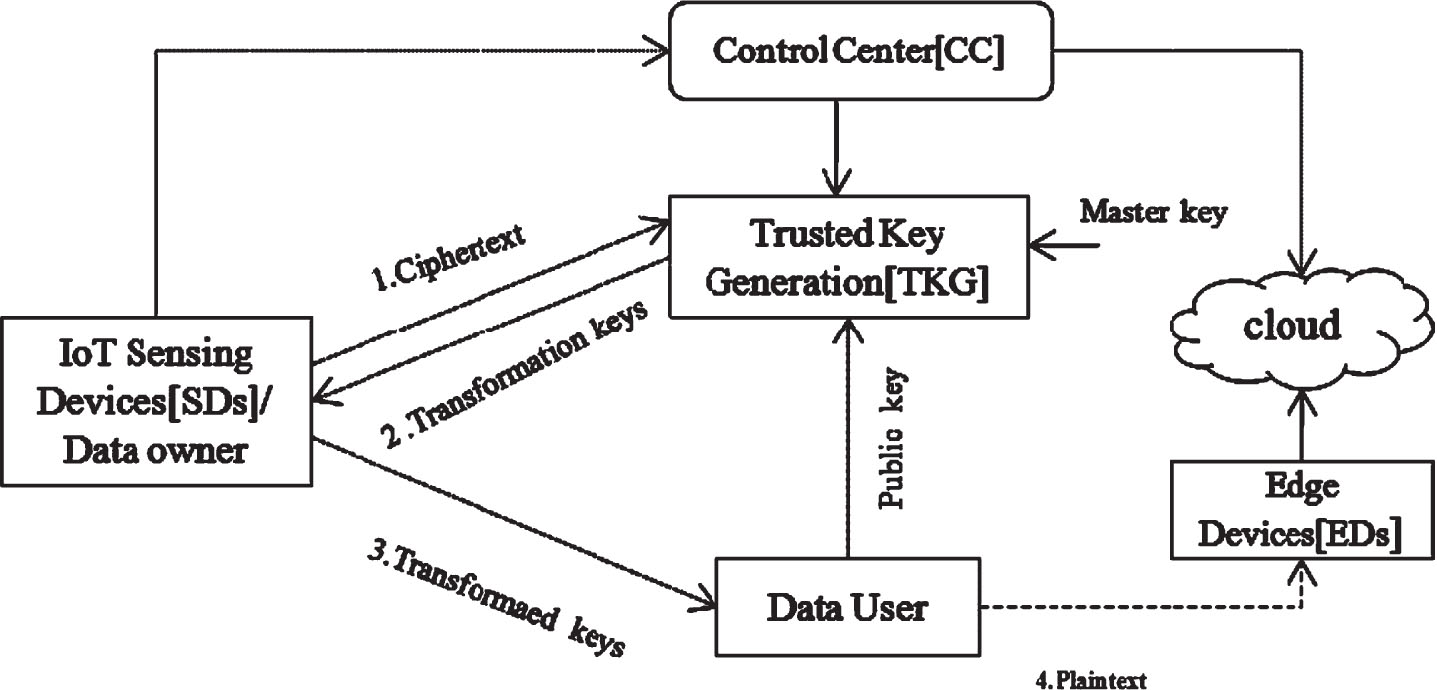
Quantum Key Management system efficiently protects the authorization for accessing data. Encryption and decryption are performed on the data computations. Secure aggregation requires some problems with the Public-key encryption to provide data with private keys to increase security. The attackers affect the sessions, but this is not positioned yet for specific reasons, mostly the high computational cost concerned with encryption and decryption of plain text and cipher texts. A QKM architecture is depicted under an Edge of the Network set up in Fig. 2, involving four parts: 1. [SDs], 2. Trusted Key Generation, 3. Authority Center and 4. Edge Devices.
The Trusted Key Generation is created to keep the transformed keys. The secure communication involving a Master key needs to be shared among all group members and encrypt and authenticate messages. The most commonly used crypto key Management system is Quantum key cryptography encryption. In QKM, the Master key is determined by exchanging public keys of two communication attributes, Authority Center to TKG. Since the public key itself does not provide authentication, a TKG of the master key can provide authentication.
SDA-QKM model.
The Secure data aggregation scheme efficiently conserves the authorization for accessing data and performing computations. The SDA-QKM system consists of the following algorithms: (i) Key Generation, (ii) Encryption and verification to EDs, (iii) Aggregation and verification at EDs, (iv) Decryption and verification at CC.
The above-described SDA-QKM method contains the following phases:
To employ the ensuing game that runs between a simulator and an adversary to define the model of key stability check based on [40]. Once the security parameter 1
φ
is entered, the simulator calls an adversary and returns the public key PU
key
, the ciphertext C, and two different keys KeyStb (PU
key
, SECkey Nid
k
,Q
k
,) → 1
D (PU
key
, C, SECkey Nid
k
,Q
k
,)≠ ⊥
The listing of cryptographic symbols and their descriptions are shown in Table 1.
List of notations
List of notations
The System initialization setup initsetup(ini∂)., CC requests to select system parameters. The authorized security parameters ∂ as the security variable for input and produces public key PU key and the master key MS key as output. The authority for certificate starts the system using the CertAuth algorithm as follows:
Equation (1) considers parameter measures ∂ as inputs and delivers the system master key MS key , public variables PS along with a signature pair and a verifying key (sigk CertAuth , verk CertAuth ) as outputs.
In the SDA-QKM system, authentications are required to be indexed to the Control Center. Then, the authorized attributes are executed once they are completed effectively.
The users userid
ij
(j = 1, 2, . . , k) forward their identification information to the CCCertAuth. After getting the information CertAuth executes the RegUser process as below: The control server selects an identity ID
ED
i
and generates the pairs of public and master key (PUkey
i
, MS
key
i
) for edge server ED
i
( i = 1, 2, . . , s).The control server stores the key pair (IDES
i
, MS
key
i
) and (ID
ES
i
, PUkey
i
, MS
key
i
) in the ED
i
. If the user userid
ij
(j = 1, 2, . . , k) wants to access the edge server ED
i
then the registration process should be done. Now the user selects an identity ID
userid
ij
and creates its public key and master key (PU
key
i
, MS
key
i
), where PU
key
i.j
is the random number and MS
key
ij
= h
PU
key
i.j
. Now ID
userid
ij
obtain the time stamp δ and measures sig
ij
= H (ID
userid
ij
||δ)
PU
key
i.j
and register (ID
userid
ij
, δ, sig
ij
, MS
key
i
) in CC. While receiving the registration request, CC should check the timestamp freshness and check
If it is wrong, the CC rejects else ID
userid
ij
successfully registered and stores (ID
userid
ij
, MS
key
i
) in CC and ED
i
.
The QKM uses a one-time pad (OTP) mechanism, where the session key’s feature has been identified as data security. The kernel of the conventional Quantum Random Number Generator (QRNG) is responsible for the quality of the produced random number. Moreover, it is prone to contain the fault of correlating for a more extended period and could fail in the localized randomness testing. Employed a quantum random number generator based on arriving time for generating a random number to avoid such defects. Session key generation was generated using QRNG. Algorithm 1. shows generate keys for encryption and decryption to users and CC, respectively. Moreover, it encrypts the data consumption and generates an on each encrypted value using QKM.
GenOfKey(PU key , MS key , E): The authorized attribute considers n as the PU key , MS key , attribute set
E as inputs and produces SEC
key
, a secret key for the user as the output. Further, it will send the re-distribution key,
In this process, each userid
ij
(j = 1, 2, … . . k) will encrypt the input message m
ij
and generates its signature and then reports the details to its ED
i
(i = {1, 2, …, s}) . The Quantum key-based cryptographic algorithm utilizes a one-time pad (OTP) mechanism that needs the same length of plaintext, Ciphertext, and the key. In this study, a stream cipher-based algorithm is presented. The plaintext size is broken up into various length sequences, which is the same as the keys’ length. Considering the first bit of the sequence SS
key
||N||r
sk
||r
n
. it generates a permutation matrix and session key SS
key
0
. To ensure enhanced security to authorize identities once establishing the data communication, the key generating model, GenOfKey(PU
key
, MS
key
, E) utilizes a session key SS
key
to update secret L = [l1, l2, …, l
n
], which is the key generated by QRNG is SS
key
= [SS
key
1, SS
key
2, … SS
key
n
]
Hence, every L is utilized to protect against impersonation attacks. The addition of the check code can decrease the communication rejection created by the channel noise. The regular sequence can be broken up into four portions, namely SS
key
, N, r
sk
, r
n
. Employ L to retrieve SS
key
0
′ from N. where N is the authentication sequence generated using XOR of SS
key
and L, which is
If a difference is found among SS
key
′ and SS
key
Evaluate the check code option, and if one error is noted in the stated sequence, the data communication is allowed. Hence, the data communication is authorized if it satisfies the following conditions: If r
sk
complements with key sequence, r
n
will not match but compared to SS
key
, SS
key
′ will contain two varying bits alone where there will not be any fault identified, the key will be placed in N. If r
sk
complements with key sequence, r
sesk
will not match but compared to SS
key
. SS
key
′ will contain one varying bit alone where there will be fault identified, the key will be placed no faults in N. Algorithm 2 performing bilinear pairing encryption uses two permutations and diffusion to make encryption results complicated and decrease the computational costs. Quantum Random Number Generator (QRNG) is responsible for generating the session key SS
key
= [SS
key
1, SS
key
2,...... SS
key
s
]; The plaintext T contains u bit that is broken up into v data bit fragments. If the length of the final sector is lesser than v, the same will be filled up with zero. Build a permutation matrix l as per the ascending order of L. If the starting bit of the variable L is zero, the last permutation matrix FPERM is l and SS
key
0 is one, else the permutation matrix FPERM is l-1 and SS
key
0 is Zero; Perform permutation operation T as per the value of FPERM to get the value of t. Perform encryption operation: if r = 1, then U1 = SS
key
0 ⨂ t1 ⨂ SS
key
1. if r > 1, then U
r
=Ur-1 ⨂ t
r
⨂ SS
key
; Now, perform permutation operation U as per the value of FPERM to get the value of D.
So the Ciphertext C ij = U ij . Then, userid ij obtains the current timestamp t ij , and generates a signature for the Ciphertext ϑ ij = H (ID userid ij ||C ij ||t ij ) MS key ij using its master keyMS key ij . Finally, userid ij reports the message {ID userid ij , t ij , C ij , ϑ ij } to its edge server ED i .
In this process, Each EDs checks the collected data from SDs and reports the aggregated data to AC.
When all the data received from user id ij (j = 1, 2, … . , k), ED i verifies the validity of ID userid ij and checks its timestampδ ij (j = 1, 2, … . , k) freshness. Once the data is discarded, it is identified as a failure.
After that ED
i
performs the verification using batch verification
If this condition is not on hold and any one of the data given by SD ij (j = 1, 2, … . , ; ; k) is not valid, and ED i can find the not valid data by verifying the condition e (ciphertext ij , h) = e (H (ID userid ij ||ciphertext ij ||δ ij ) , PU key ij ) (j = 1, 2, … , k).
On the other hand, when the reported data received from userid
ij
(j = 1, 2, … . , k) valid. Then, ED
i
will do the aggregation of all received data as
Then ED i obtains the current timestamp t i And produce a signature to the aggregated ciphertext t i = H (ID ED i ||η i ||δ i ) MS key i .
Finally, ED i submits the message {ID ED i η i , ciphertext i , δ i } to the CC.
After receiving the data reported from s Edge Devices {ED1, ED2, …, ED
s
} , CC checks the validity of ID
ED
i
. once that identifies of the messages reported by ID
ED
i
If failed, messages will discard the messages. The following steps explain the decryption process: Perform reverse permutation D as per the value of FPERM to get the value of U. Perform decryption operation: if r = 1, thent1 = U1 ⨂ SEC
key
0 ⨂ SEC
key
1. ifr > 1, t
r
= Ur-1 ⨂ U
r
⨂ SEC
key
r
Perform reverse permutation operation t as per the value of FPERM to get the value of T. Cut off the additional zero in the variable T to retrieve the required plaintext result. Then CC performs batch verification This process will reduce the communication and computational cost for CC. If it is not on hold, identified of one message reported by ED
i
(i = 1, 2, … , s) is not valid, and CC can identify the incorrect messages by using e (ϑ
i
, h) = e (H (ID
ED
i
||η
i
||δ
i
) , MS
key
i
) (i = 1, 2, … , s). ud
ij
data user. Else if the data reported by ED
i
(i = 1, 2, … . , s) are all successfully valid. Then, CC will aggregate its received data as
By taking the Master key MS
key
, AC can calculate
Then, CC can recover the plaintext aggregation
KeyStb (PU
key
, SEC
key
) → 0 or 1 The key SEC
key
k
of the user is checked by the trusted Key Generator TKG to control whether it satisfies the states of the key stability check algorithm, the detailed procedures are as follows: verify the key form SEC
key
k
and compare it with and Verify e (L2, g) = e (L1, g
a
) Verify Verify ∃z ∈ E
k
, s.t. e (kz,2, g) = e (U
z
, kz,1) ≠1
The algorithm outputs 1 if the key SEC key k contents the conditions of key stability check, otherwise, it outputs 0.
Trace (PU
key
, SEC
key
)→ N
id
/⊥. TKG takes control in this phase. When the key SEC
key
k
can’t able to succeed in the key stability check KeyStb (PU
key
, SEC
key
) → 0.then the output will be ⊥ else it extracts the information of the user identity N
id
k
using
This section analyzes the security features and presents the defined security requirements mentioned above, with a primary focus on privacy protection, integrity, and source authentication
Privacy protection
This privacy protection process is to keep away from the leakage of userid
ij
data usage and check-in are both conditions of external attack and internal attack. First, while it comes under external attack. it can eavesdrop on the messages sent to ED
i
from userid
ij
and also from ED
i
to CC. If eavesdropping happens from an external attacker for the userid
ij
and its data {ID
userid
ij
, δ
ij
, η
ij
, ϑ
ij
}, where the Ciphertext is η
ij
= U
ij
. However, due to the quantum key cryptography being effectively selected secure for the ciphertext attack, the attacker cannot be able to retrieve the data ud
ij
from userid
ij
without knowing sesk
ij
and MS
key
. Besides, if ED
i
aggregated data {ID
ED
ij
, δ
i
, η
i
, ϑ
i
}, have been eavesdropped by an external attacker, where
So, the proposed method can provide strong privacy while under attacks by external. Second, when an internal attacker tries to access the ED′sor CC′s secret keys and it wants to retrieve the ED′s usage data. If an internal attacker trying to eavesdrop the userid
ij
message {ID
userid
ij
, δ
ij
, η
ij
, ϑ
ij
}, where the Cipher text is η
ij
= U
ij
. Even the attacker retrieves CC′s secret key p, and calculate
Integrity
Data integrity is an essential part of security by ensuring that the data is not damaged during transmission. The guarantee of data integrity for transmitted messages can be provided in our proposed work. Additionally EDs or CC can identify the tampered messages. For the data {ID userid ij , δ ij , η ij , ϑ ij }, received by ED i which was reported by userid ij , ED i will check first about the validity of identity and timestamp freshness, and message integrity by checking if e (ciphertext ij , h) = e (H (ID userid ij ||ciphertext ij ||δ ij ) , PU key ij ) Hold.
As we can see that each part of the message {ID userid ij , δ ij , η ij , ϑ ij } is involved by verifying integrity; any tamper data will not hold. for that reason, the data reported by userid ij able to be verified by ED i . when the data {ID ED ij , δ i , η i , ϑ i } received from ED i , the integrity of the data verified by CC. if the equation e (ϑ i , h) = e (H (ID ED i ||η i ||δ i ) , MS key i ) (i = 1, 2, … , s) is in hold. Any damage in the message will become that the equation is not on clutch then each part of {ID ED ij , δ i , η i , ϑ i }. Thus, the CC can ensure data integrity and the report by EDs.
Authentication
For source authentication, the validity of the message {ID userid ij , δ ij , η ij , ϑ ij } reported by userid ij can be verified by ED i , and {ID ED ij {δ i , η i , ϑ i } reported by ED i can be verified by CC. also, the identity ID userid ij and ID ED i are stored in the message , and {ID ED ij , δ i , η i , ϑ i } respectively. So, the EDi and CC can be sure about the message sources. ED i and CC can identify the not valid messages like from which userid ij and ED i , respectively. also, userid ij and signatures for ED i σ ij = H (ID ED i ||η i ||δ i ) MS key i are produced using the corresponding master keys MS key ij and MS key i , respectively.
Therefore, any adversary without userid ij and ED i cannot forge the correct messages {ID userid ij , δ ij , η ij , ϑ ij }, and {ID ED ij , δ i , η i , ϑ i } to imitate userid ij and ED i , respectively. Thus, the proposed system provides an efficient authentication source for all communications.
Performance evaluation
This session evaluates the performance aspects of the proposed SDA-QKM method in terms of communication and computational complication. As a comparison, consider three cryptographic systems, specifically, EPPA [32], SEDA [34], and LVPDA [35]. The proposed model is demonstrated using the simulation parameters using the 3.26 simulator. Deploys the nodes indiscriminately in smart devices.
The authorized centre is considered as Edge server and control centre. The number of things utilized 10 to 100, the Radio Propagation Model is Two Ray Ground, using COPE Application Layer Type and Yans. Wi-Fi channel model is SURF Traffic model. Simulation time is 1000 secs. The demonstrated results are shown and discussed below. In this scheme, the users are varied to perform communication and computation costs.
The simulation environment, performance metrics and simulation results are presented in this section. The simulation for the proposed model is carried out using Network Simulator (NS-3) and analysis is presented below. We evaluate the performance and validate the effectiveness of the proposed SDA-QKM through this simulation. A comparative study on the metrics, with existing protocols namely EPPA, SEDA, and LVPDA is also presented in the graphs below. The simulation parameters we considered are stated in Table 2.
Simulation parameters
Simulation parameters
In Table 3, we give the notations, operations handled to corresponding time costs with cryptographic functions.
Notations in evaluation
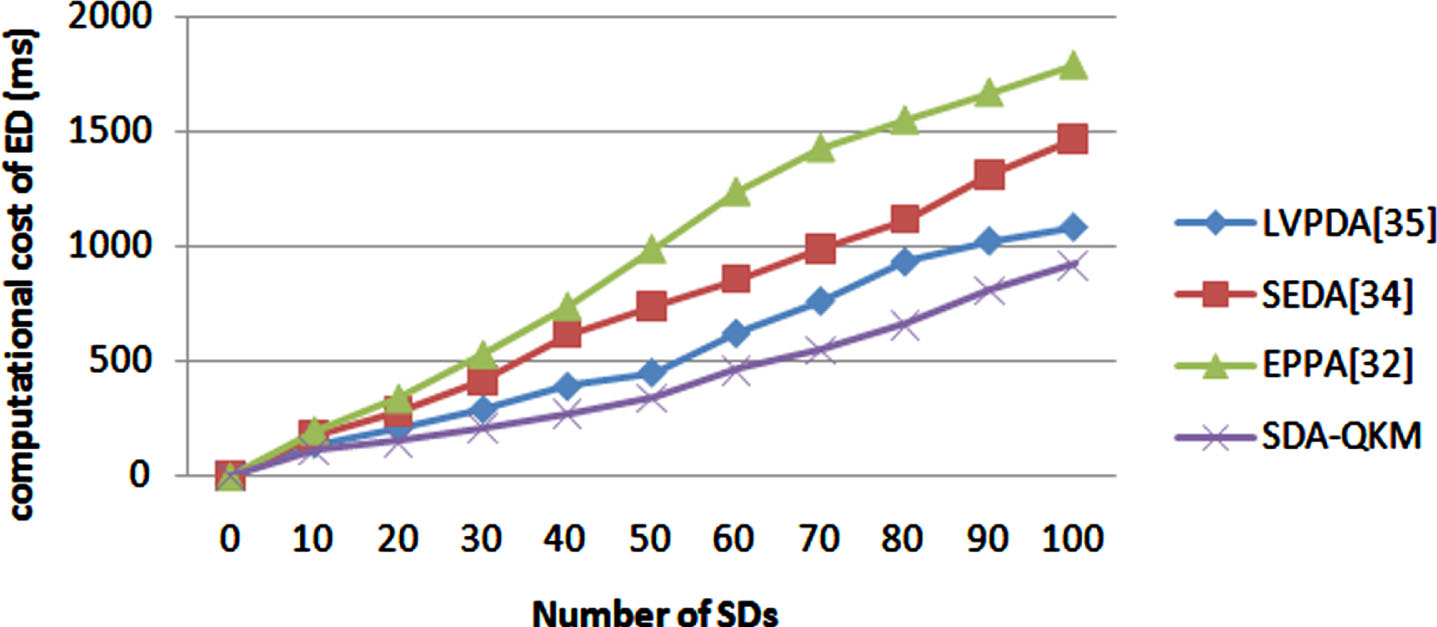
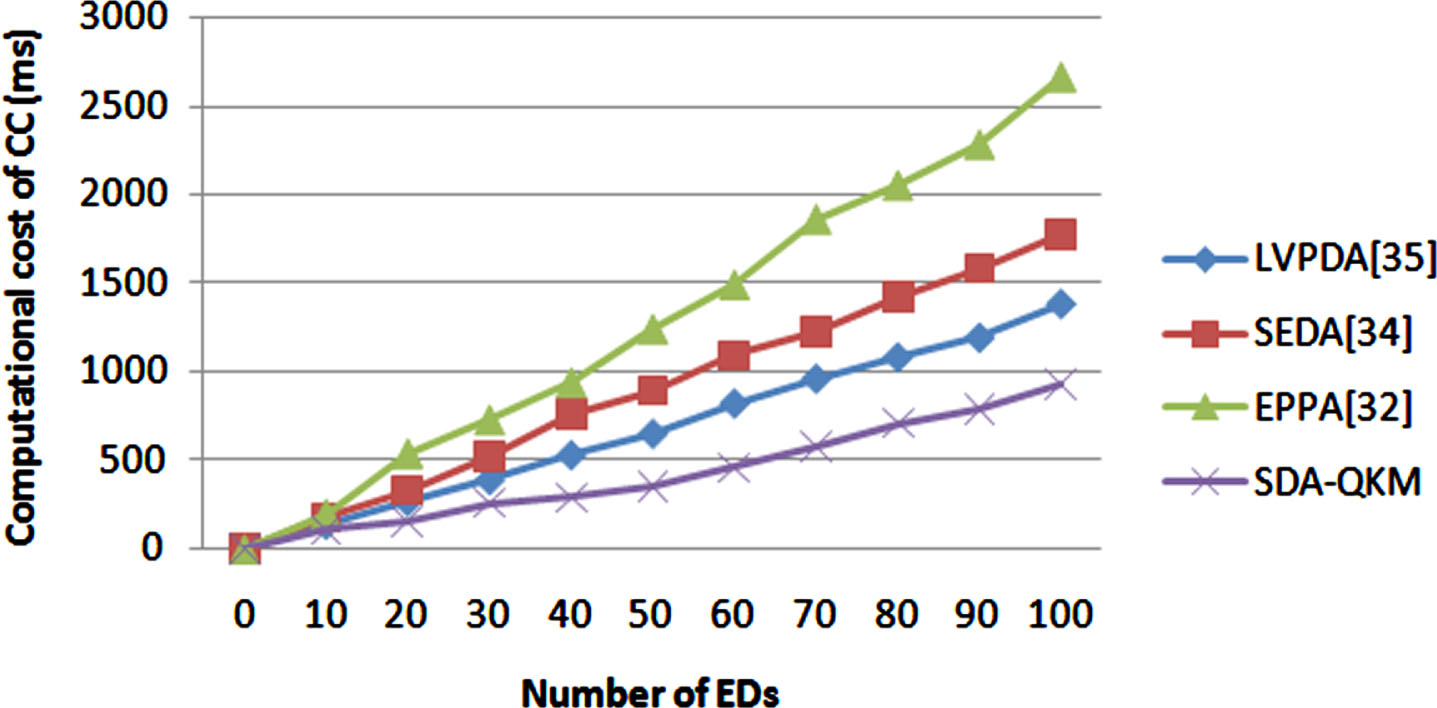
In the SDA-QKM scheme, when the edge devices ED i joins in the network, it needs 2ωe2 to produce the CiphertextC ij and ω mp + ω e to produce the corresponding signature σ ij . Now, the total computation cost of each SD is 2ωe2 + ω mp + ω e = 1.5083 ms. Each ED needs (k + 1) ω p + 2 (k - 1) ω m + kω mp to perform batch verification, ω e + kω m to produce the aggregation of data, and ω mp + ω e for the signature generation σ i . Therefore, the total cost for computing each ED is (ω p + 3ω m + ω mp ) k + ω p - 2ω m + 2ω e = (12.111k + 12.1671) ms. Besides, the CC needs (s + 1) ω p + 2 (s - 1) ω m + sω mp to do the batch verification, (s - 1) ω m for aggregated data, and ω e for calculation of V, now the total computation cost of CC is (ω p + 3ω m + ω mp ) s + ω p - 3ω m + ω e ) = 12.1111s + 11.87 ms.
Computational cost comparison in the ED side.
Table 4 shows that our SDA-QKM scheme consumes less time for cryptographic operations as we have done security analysis above, particularly on the SDs side. Fig.3 shows the result comparison of computational cost with the other three schemes. And we can see that our computational cost is reduced at least 52.07% while compared with EPPA [32], SEDA [34], and LVPDA [35] since in their schemes, time cost rises significantly while the user’s increases. Fig. 4 indicates the results of computational cost between the four methods from the Control Center side. It shows that our proposed SDA-QKM works efficiently, even in the most complex operations.
Computational cost comparison on CC side.
Overall computational cost analysis
In Fig. 5 shows the overall computation cost comparison of our proposed work SDA-QKM with the existing three schemes. It proves that computational cost is much less compared to existing schemes by varying numbers of users. It is due to our data aggregation scheme which saves time during the aggregation process.

Computational cost comparison vs number of users.
In Fig. 6 represents the computational cost for the verification and signature generation process and it shows our proposed work performs better than other existing schemes. Our SDA-QKM scheme was 30% lower than LVPDA [35], EPPA [32], and SEDA [34]. And also compared the aggregation cost which we calculated during the aggregation phase and is showed in Fig. 7. From the above all the results clearly show that our proposed SDA-QKM performs better than the other existing schemes in standings of overall computation, aggregation, verification, and signature.
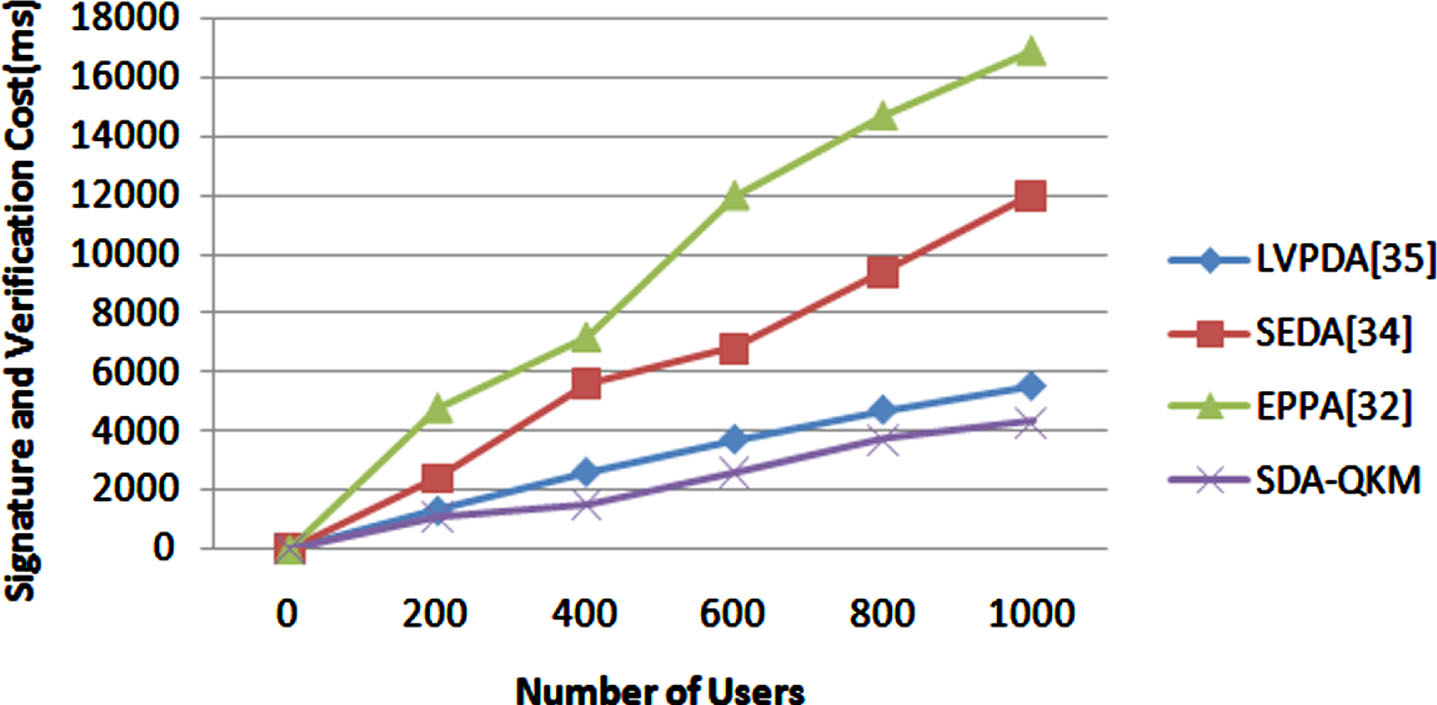
verification and signature cost comparison vs number of users.
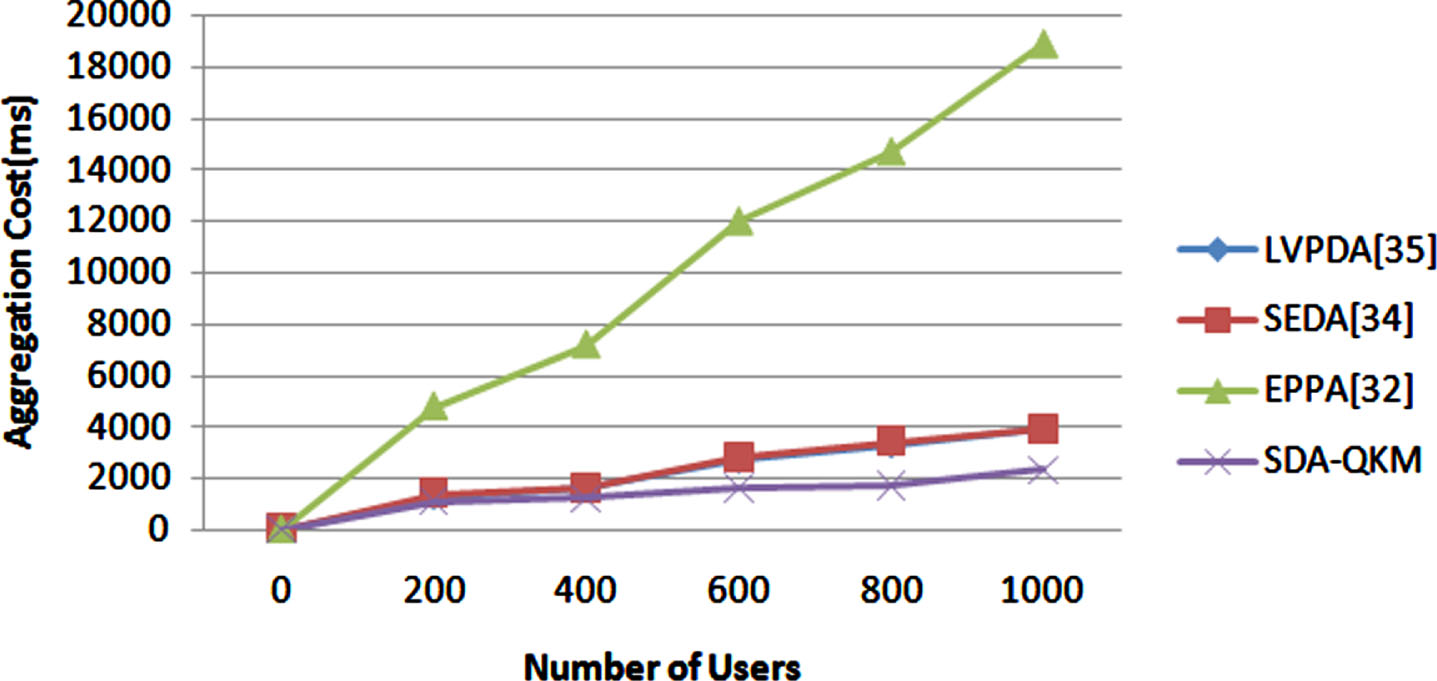
Aggregation cost comparison vs number of users.
The communication overhead calculation of our SDA-QKM system incorporates the communication between SD-to-ED and ED-to-CC which assumes that there are s to ED and each ED contains k, SD in the data aggregation. While coming into the communication between SD-to-ED, each SD produces the individual report for the data and sends it to the ED in the form of {ID userid ij , δ ij , η ij , ϑ ij }, and its communication overhead will be 64+32+1280+1280 = 2656 bits. The ED gathers the complete reports from SD. Users in each time slot. Next part, we measure communication between ED-to-CC.while comes into the aggregation phase of the report; the CC will aggregate the SD′s separate reports and by using that it generates {ID ED ij , δ i , η i , ϑ i }. ED i reports the aggregated message {ID ED ij , δ i , η i , ϑ i }To CC, and the communication overhead is 64+32+1280+1280= 2656 bits/sec. consequently, the communications cost of SD ij and ED i for one session’s, and data aggregation is 2656 bits for both, so one session total communication cost will be 2656sk + 2656s bits.
Furthermore, Table 5 shows the analysis of communication overhead from SD to ED and ED to CC. Fig. 8 and 9, intend the communication overhead in provisions of the SDs and EDs. With a comparison of existing schemes, our proposed system has the minimum total overhead in communication. The two coefficients, which are sk and s, are significantly lesser than the other three schemes, EPPA [32], SEDA [34], and LVPDA [35]. The tangible below rates are 63.4 % and 36% than EPPA, 34.8% and 52.10 % than SEDA and 26.69 and 33.19 % than LVPDA.
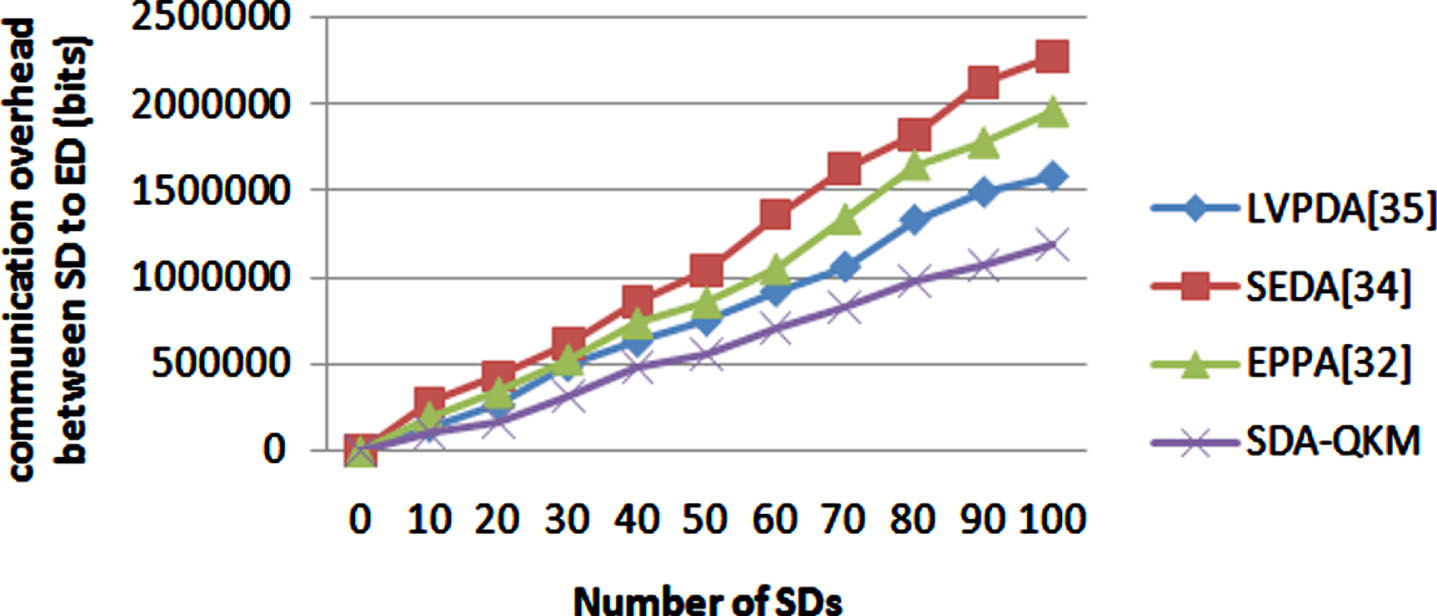
Communication overhead comparison on SD to ED side.
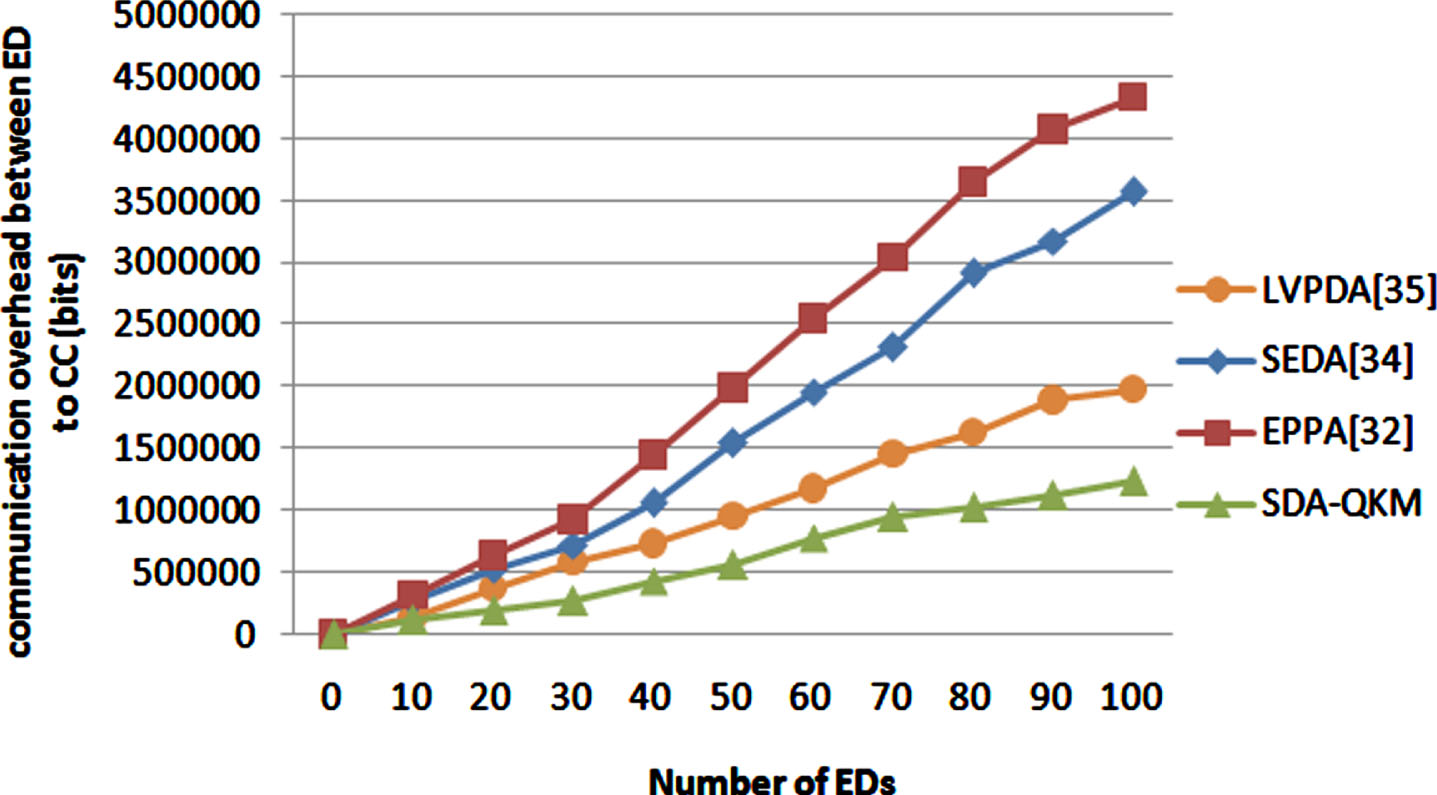
Communication overhead comparison on ED to CC side.
Communication Overhead Analysis between SD to ED and ED to CC
In this work, the Secure Data Aggregation process is simultaneously achieving the source of authentication, integrity, and privacy protection. With the use of QKM, the scheme supports completing the authorization done through the access layer with the concern of secure transmission. The proposed scheme exploits the bilinear homomorphic and Quantum Cryptography system. This section key is a unique aspect of generating quantum key cryptography. The session time is used to determine the random number generation within the time limit, which credits the section key generation. Our performance analysis illustrated that the proposed system provides a computation efficiency of around 40% in computation and communication overhead compared to the existing systems. Our future work, to increase the security requirements added more authoritative adversaries and active attack models.