



Abstract
Topological indices and coindices are numerical invariants that relate to quantitative structure property/activity connections. The purpose of topological indices and coindices were introduced to draw the data related to chemical graphs with respect to adjacent & non adjacent pairs of vertex degrees respectively. These indices equip the researchers with a lot of information related to the properties and structure of the chemical compound. In this article, CoM-polynomials for molecular graph of linear and multiple Anthracene are computed from which eleven degree based topological coindices are derived.
Introduction
An impressive branch of science that talks about the structure and the properties of chemical compound without using any apparatus, is the mathematical chemistry. As the tools applied in this science are all numerical, it is not time and cost consuming. This fascinating branch of science uses topological indices as one of its tools that helps in forseeing the structure and property studies. In computing these indices, generally hydrogen atoms are overlooked.
In this study, a tricyclic aromatic hydrocarbon known as anthracene is studied. An aromatic compound with three fused benzene rings having 14 carbon atoms and 10 hydrogen atoms is anthracene. It is one of the polycyclic aromatic hydrocarbons that finds its applications in the production of dyes, scintillation crystals and in organic semiconductor research. Anthracene is used in insecticides, coating materials, wood preservatives, and UV tracer in conformal coatings of printed wiring boards. It is used in identifying high energy part of photons, electrons, and alpha particles. The emission spectrum of anthracene lies between 400nm and 440nm as it used in radiation therapy dosimetry. Anthracene and its derivatives having hydroxyl group, are used in pharmacology, the science which mainly focusses on the drug reaction. This refers to the derivatives of anthracene being pharmacologically active.
Anthracene is the major source of coal tar which occupies 1.5% in coal tar. A tricyclic aromatic hydrocarbon is on the EPA’s (Environmental protection agents) high priority list of the pollutants. It is found on the surface of drinking water, exhaust emissions, cigarette and cigar smoke, ambient air, and in edible aquatic organisms [1, 2]. Humans are exposed to anthracene through tobacco smoke and intake of contaminated food containing combustion products, as these polycyclic aromatic hydrocarbons are generated by combustion processes. Studies specify that anthracene is noncarcinogenic. It has been found that it is negative in various in vitro and in vivo genotoxicity tests. It is biodegradable in soil in the presence of light.
Fritzache studied on solid hydrocarbons and discovered anthracene in the distillation process of coal tar in the year 1866. He found from the studies that, saturated solutions of anthracene when exposed to sunlight gave crystals which were colorless and it regenerated to anthracene when melted them. The main ingredient for dye is anthroquinone that is obtained from anthracene. Alizarin is a red dye that is produced using anthracene. Even though anthracene is colorless it exhibits florescence blue when exposed to ultraviolet light. Anthracene melts at 218°C and boils at 354°C. It is not soluble in water, but it is soluble in alcohol, benzene, hydro naphthalene, chloroform and disulphide.
A chemical reaction where the electrons of a compound are lost refers to oxidation. Oxidation of anthracene takes place when strong oxidants such as chromic acid or hydrogen peroxide comes into contact with anthracene. In this process, anthraquinone is obtained as by product. Anthraquinone finds its applications in many fields such as, dyes, additive in paper industry to aid the digestion of paper pulp in alkaline processes and in flow batteries as electrolyte. To decontaminate the water containing hydrocarbons, anthracene oxidation is used.
The pairs of adjacent vertices contribute to degree based topological indices. However, non-adjacent pairs of vertices refer to degree based topological coindices for computing few topological properties of graphs. In this work, CoM-polynomials of anthracene are established from which eleven degree based topological coindices are derived. In graph theory, a molecular structure of the chemical compound is assumed as a graph in which the joins of the bonds refer to the vertices and the bonds to the edges. Numerical quantities obtained scientifically from the atomic structure is a topological index/coindex. They refer to the constitution showing the relationship of the structure with various physical and chemical properties.
Applications of anthracene
Anthracence has several applications in drug delivery having significant biological activities against tumor cells. It is very effective in skin related ailments. The structural system of the anthracene nucleus has overlapping with the deoxyribonucleic acid (DNA) base pairs.
Many compounds of anthracene are formed by re-arrangement of molecules of methyl group. 2,7,12-trimethylbenzanthracene was synthesized by Newman et.al. which does not exhibit cancer causing activity, also called carcinogenic activity. As the 1,2,3 and 5 position of 7,12-dimethylbenzanthracene are substituted with methyl group, this compound does not exhibit carcinogenic activity. The substitution of methyl group in different positions yields some compounds that are carcinogenic anthracene-based such as 7-bromomethylbenzanthracene, 7-bromomethyl-12-methylbenzanthracene and 4-chloro-7-bromomethylbenzanthracene. These are tested on mice and found that there was an increase in the risk of tumour development [3].
DNA photo-cleavage is a reaction that slices one of the linkages of covalent sugar-phosphate between nucleotides that forms the sugar phosphate backbone of DNA. This process may be catalyzed chemically, enzymatically or by radiation. Cleavage may be formed by removing the end nucleotide, called exonucleolytic or by splitting the strand, called endonucleolytic. Among many compounds, the derivatives of acridine and anthracene are found to be good DNA photo cleavers while naphthalene and benzene are inactive. Acridine showed copper (II) enhanced photo cleaving at micromolar concentrations while anthracene derivatives of 0.25μm was enough to cleave DNA completely.
DNA in living organisms has very extensive functions and also advantageous in preventing and curing diseases. The studies on binding of small molecules with DNA are significant in the design of new drugs targeted to DNA. The combination of two words reduction and oxidation gives rise to the word redox means reaction with oxygen to form an oxide. Anthracene appended with cyclam rings show high redox activity. It was found that, anthracene is reversibly oxidised and was reported for chemo sensors. Anthracenes are used as antibiotics in the treatment of cancer chemotherapy in the form of anthracyclines. They inhibit DNA and Ribonucleic acid (RNA) synthesis between base pairs of the DNA/RNA strand which retards further growth of cancer cells. Anthracenediones are used in the drugs of anti-tumour [4, 5].
Motivation
A mathematical model of the structure of a drug is expressed as a graph such that, every vertex represents an atom and each edge indicates a chemical bond between these atoms. Assuming G to be a simple graph of a drug, where atom set and chemical bond set are represented by V (G) and E (G) respectively [6, 7].
A topological index is a function that maps molecular structure of a drug to real number. Since four decades, lot of studies have taken place to introduce many important indices and coindices viz., Wiener index, Zagreb indices & coindices, Randic indices & coindices, PI index, eccentric indices and many more to measure various characteristics of drug molecules through Quantitative Structure-Activity/Property/Toxicity Relationship (QSAR/QSPR/QSTR) studies [8–10].
Topological indices and coindices contribute to the pharmaceutical, chemical and nano materials engineering. Topological indices play a major role in contributing to the biological and chemical characteristics of novel drugs to help the medical scientists [11–15].
In this study, Anthracene is focused as it as numerous applications in drugs, DNA cleavage, DNA binding, anti-carcinogenic, chemo sensors and redox activity. It is found that, the presence of Anthracene in antibiotics have warded cancer cells. It is effective in dermatological ailments.
Various work on Anthracene using topological indices based on adjacent pair of vertex degrees have been carried out across the globe. Kulli [16] studied on multiple connectivity of nanostructures such as linear [n]-anthracene, V-anthracene nanotube and nanotori for which various multiplicative degree based indices were computed. Zaheer Ahmed et al. [17] mentioned about three entities such as energy, inertia and nullity in graph theory and computed them for phenylene and anthracene and conclusion were drawn for the same. Zhang et al. [18] computed topological indices of para-line graphs of subdivided graph (para-line graph) of linear-[s] Anthracene and multiple Anthracene. The article focussed on the applications of the indices discussed in the paper. Chemical graphs were studied with the help of para-line graphs which are very important in the field of chemistry. Cheng-Peng Li et al. [19] established closed formulae for M-polynomials of linear chains of benzene, napthalene, and anthracene graphs. Using the polynomial nine degree-based topological indices for these three chains were computed.
This study focuses on coindices for the chemical compound Anthracene based on non-adjacent pair of vertex degrees. For the notations & terminologies used in this study refer [20].
CoM-polynomial
In this work, eleven degree based topological coindices are computed for Anthracene using CoM-polynomial, an extension of M-polynomial [21–25]. CoM-polynomials are computed for non-adjacent pair of atoms/vertices. There have been a lot of studies carried out on coindices of various chemical compounds using specific definition of the respective coindex [26–30]. Here various coindices are computed using a single polynomial, CoM-polynomial.
List of various topological coindices are tabulated in Table 1 using CoM-polynomial
The relation between various topological coindices and CoM-polynomial
The relation between various topological coindices and CoM-polynomial
The following are the notations used in the paper
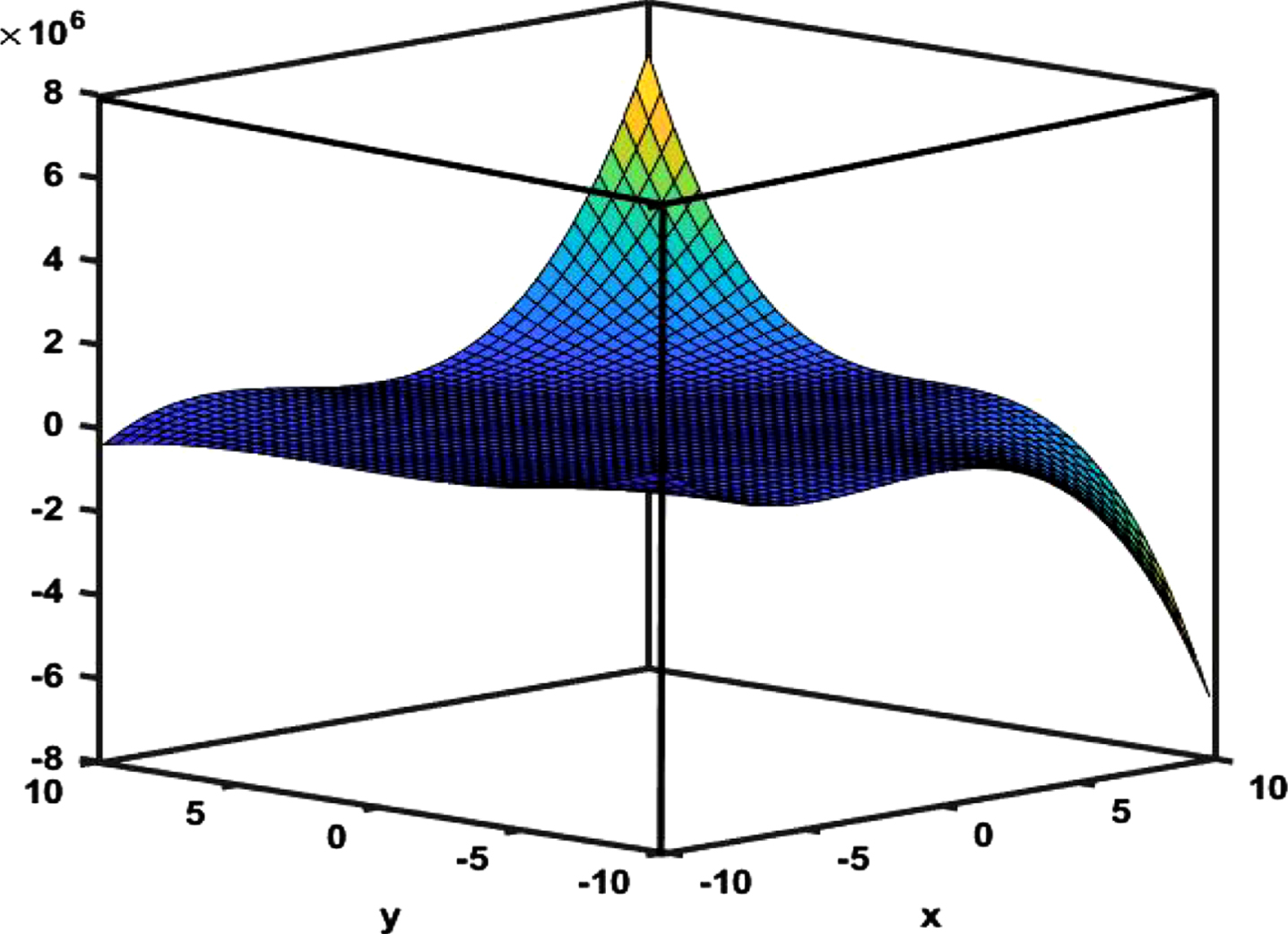
3D plot for CoM-polynomial of linear [n] Anthracene.

The molecular graph of linear [n] Anthracene.
Similarly, vertex set can be categorized into two classes and are as follows.
Using Lemma 4.2, we have
From the CoM-polynomial definition
Using the above results in Table 1, we obtain
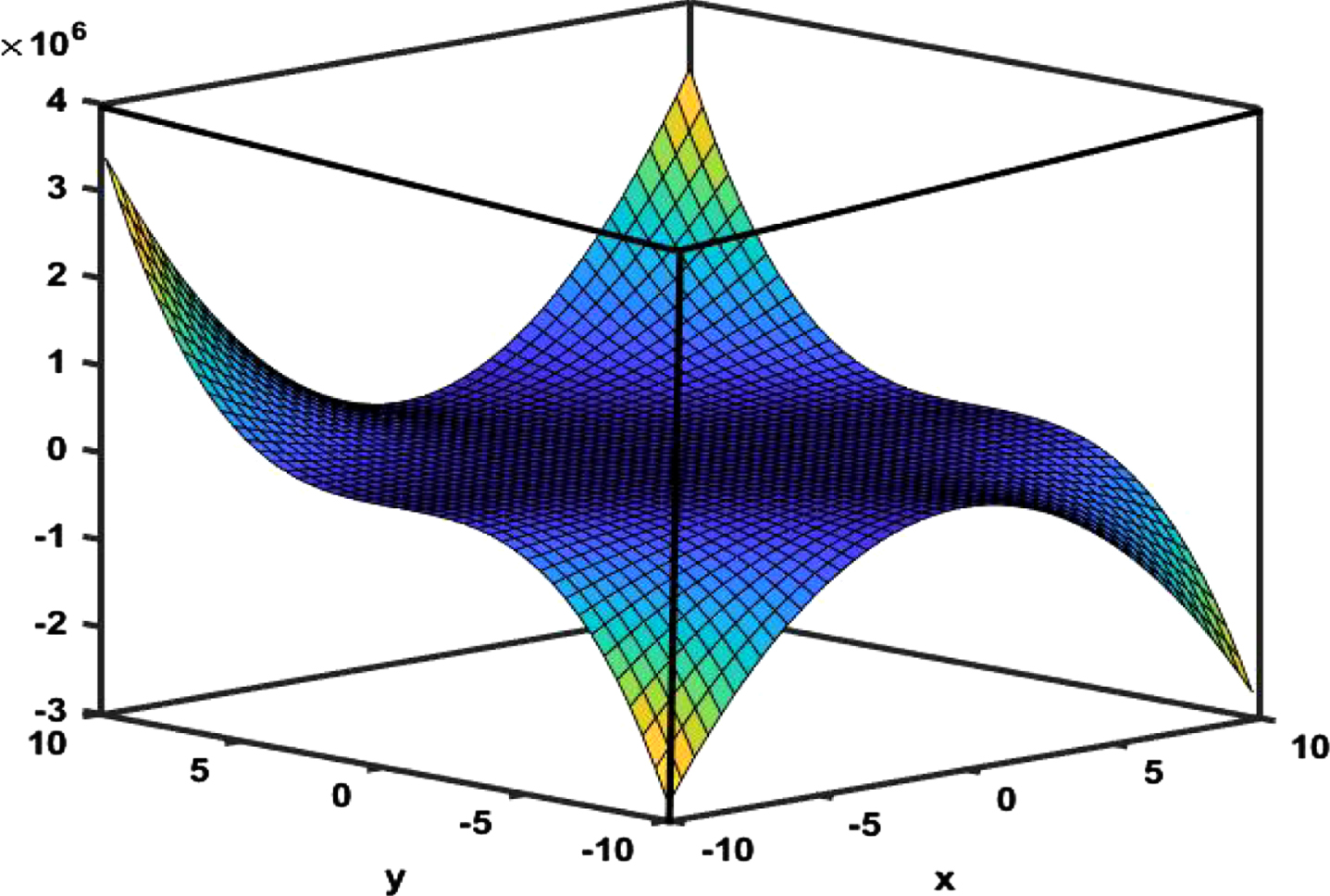
3D plot for CoM-polynomial of multiple Anthracene.
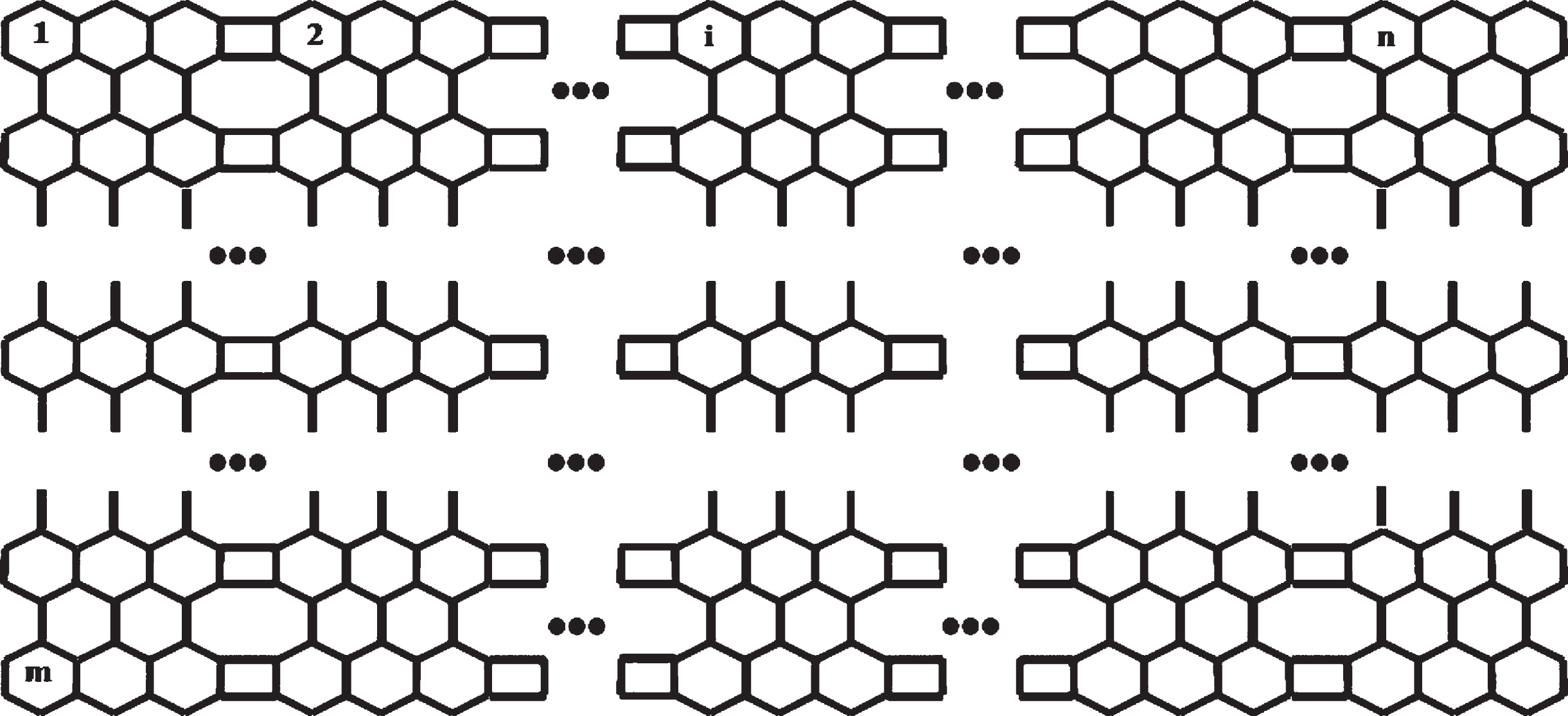
The molecular graph of multiple Anthracene.
Using Theorem 6.1 and Table 1, coindices of the multiple Anthracene are in the following proposition as
Using the above results in Table 1, we obtain
In this section, we compare the values of eleven coindices of anthracene. The comparison of values is shown to understand the behaviour of the coincides for the mentioned compound. It gives the researchers a clear picture about the trend of the indices considered for further studies in the same area.
The comparison of above said coindices is made for Anthracene and is tabulated through the Tables 3 for the values of n & m = n from 1 to 10. It is clear that all the coindices are varying upwards as n & m = n approaches greater value.
Numerical comparison of coindices of linear [n] Anthracene for n = 1 to 10
Numerical comparison of coindices of multiple Anthracene for m = n = 1 to 10
Gutman and Trinajstic introduced the first and the second Zagreb coindices in the studies of total π-electron energy. These measures provide branching of the carbon atom skeleton in determining some properties and bounds of molecular graphs. Forgotten coindex is defined by De et. al., in determining the correlation between log P (logarithm of octanol-water partition coefficient) and the F-coindex values of octane isomers. F-coindex is used to predict the logP values with high precision. Many chemical characteristics of molecules are correlated using Randic indices. Various coindices are studied in this article which can be defined in a similar way to that of its classical degree counter parts.
Conclusion
This work focuses on the study of paranapthalene/Anthracene which has varied applications in pharmaceutical and dye industries. Anthracene plays a crucial role in anti carcinogenicity and dermatological infections. It is used as antibiotics in cancer treatment. The two structural forms of Anthracene considered are linear and multiple for which eleven degree based topological coindices are derived using CoM-polynomial. Numerical comparison of the above said coindices are computed and the observations are summarized. 3D-plots of CoM-polynomials of both the forms of Anthracene are illustrated. As green oil (Anthracene) has numerous applications, this study would be useful for researchers/pharmacists/chemists in further studies about the compound.
Conflict of interest
There are no conflicts of interest among the authors.
Acknowledgment
This work was supported and funded by Gachon University (No. 202110260001).