



Abstract
The reliability of an industrial system plays a significant role in new technological era where everyone is concerned about the performance of associated industry. With the frequent demands of the customers, the job of the production industries becomes more tedious to produce the required products at a high rate. To fulfill the customer’s demand, the initial focus of the industries is to work well without any interruption/failure in the entire production process. In this paper, Reliability, Availability, MTTF, MTTR, MTBF, ENOF is proposed for an industrial system namely “Injection moulding machine”. For this, the membership function for right triangular generalized fuzzy numbers (RTrGFN) is proposed with the certain level of confidence. The real data of the Injection moulding machine is taken to validate the proposed methodology. The input data is extracted from the records/maintenance sheets of several years and found uncertainty due to the loss of any information or human mistakes. The parameters of the system like failure rate and repair time is retrieved. Based on data, AND-OR combination for the system is constructed. The lambda-tau methodology along with RTrGFN and its corresponding arithmetic operations is used for the performance analysis of the considered “Injection moulding machine”. For better understanding the results are discussed with the aid of graphs. Also after seeing the result one can conclude that this methodology is one of the best methodology for the performance analysis of a conventional system. Also authors have added the highlights and future scope of the research work at the end of the manuscript.
Keywords
Introduction
Reliability can be defined according to the perception of individuals in several ways. Reliability is the probability that when the system performs its specified task for a given period of time under defined conditions; the system will work without failure. In everyday life, the reliability plays vital role, like longtime use of computers, television, mobile phones, factories, power stations, thermal plants etc. Zio [35] stated the role of the reliability in scientific era. It is rising in both qualitative and quantitative manner in this growing world. The main objective of this paper was to focus on the addition of reliability to the safety of the system and risk analysis. In past, several authors had contributed towards the evaluation of various performance measures especially in reliability for different industrial systems as well as in other systems using different approaches. The structure system is made up of subparts/components/units/subsystems. Thus each and every subsystem plays an important role for the endurance of any structure system. As long as the human design the systems, their efforts are to design the reliable one. But failure is an unavoidable phenomenon and it leads to either failure of complete system or degradation of the system. Hence every component has the contribution in the entire working of the system to authorize the required level of reliability. Many researchers focused on finding the critical component of the structure system. Mishra [27] proposed the concepts of organization and analysis of the data, fault-tree analysis reliability modeling and its assessment methods, under environmental conditions. Dhiman and Kumar [13] calculated the reliability of the thermal power plant and sensitivity analysis to find out the most sensitive component of the system. Tsarouhas [32] calculated RAM for ice-cream industry to plan the maintenance strategy. It helped to increase the system performance. The author also found the critical components in the system. Emidu et al. [14] calculated the reliability indices for a composite power system by utilizing Monte Carlo simulation. It mainly used the probability distributions to obtain the failure rates and repair times. Choudhary et al. [11] analyzed RAM of the cement plant and found the critical components from reliability point of view and availability point of view. The authors also claimed that the study was useful for deciding the maintenance program. Aggarwal et al. [5] computed RAMD with the help of Markov birth-death process and showed the importance of the method in finding the reliability indices for each component of the system. Chinnaiyan and Somasundaram [10] found the reliability component based system using software simulation method. I showed that when reliability of subpart increases and it leads to increase in the reliability of entire system. Chen et al. [8] designed Phased-mission structures which were displayed by the different conditions like structure phases and workload condition in different phases, environment conditions which may results in the changes in structure behavior. He introduced a new methodology for fuzzy risk examination using generalized fuzzy numbers by taking distinct spreads and distinct heights. The authors calculated the reliability of a system by Binary Decision Diagram (BDD). Fodor and Bede [15] represented the overview of new approaches and compared the methods for closure. Kumar et al. [24] used the Markov method for modeling and obtained reliability and availability for the considered system. In this paper, the authors considered failure rate and repair times followed as exponential distribution. Monte-Carlo simulation was used to find the solution of the model. Levitin et al. [26] proposed an algorithm for calculating the reliability of non-repairable systems in mixed configuration and with common cause failure by using Universal generating function (UGF) and generalized reliability block diagram technique. All these methods are considered as traditional approaches.
In persistence to the study of RAM analysis and examine the other parameters of the complex structures. The future behavior of the system can be predicted with the help of available data. Generally, the data collected from the records are inaccurate and uncertain. The main reason is human errors and many researchers used the extended approach. Zadeh [33] extended the classical sets and introduced fuzzy sets and its membership grades. It was a great contribution in industrial systems. This concept added the logics to traditional approaches. Zimmermann [34] introduced the various arithmetic operations on fuzzy numbers, which can be used for various applications in different fields. Chang et al. [6] proposed vague fault tree method to compute fault interval and vague reliability of the components of the automatic gun system. Chen [7] calculated the reliability of weapon systems by fuzzy arithmetic operations and also used defuzzification method to find the crisp value for the fuzzy result. Dhiman and Garg [12] introduced some upgraded arithmetic operations on generalized trapezoidal fuzzy number with different degree of confidence level to find out the reliability indices and to preserve the flatness of fuzzy numbers. It helped to obtain the better results rather than the results obtained from existing approach. Garg [16] introduced the lambda-tau approach to analyze the performance of the repairable structure system. Petri net model is proposed instead of fault tree. The drawbacks of the existing traditional methods were covered with the help of this methodology. Garg [17] shows the importance of the score function has been presented in the interval-valued intuitionistic fuzzy sets (IVIFSs) and multi criteria decision making (MCDM) in decision making process. The author also presented the sensitivity of decision maker preferences under fuzzy environment. Garg and Ansha [18] used the distribution functions and complementary of studied distribution functions to study the arithmetic operations for two generalized parabolic fuzzy numbers. This gave the advantage over the alpha-cut method and also showed the results with comparison. Kabir et al. [19] proposed a methodology which works for systems with uncertain data. It included intuitionistic fuzzy set theory as well as expert judgment and it was used to calculate the failure probability of temporal fault trees (TFTs). Knezevic and Odoom [20] used Petri nets rather than fault tree methodology to calculate the reliability parameters using fuzzy Lambda-Tau technique under fuzzy environment. Komal [21] focused to analyze the reliability of the system namely compressor house unit (CHU), which is basically a component of coal fired thermal power plant. To carry out this study, the author used different fuzzy numbers/membership functions and T ω -based generalized fuzzy Lambda-Tau (TBGFLT) method. The importance of this methodology was shown with the comparison with traditional methods. Komal et al. [22] showed the importance of reliability, availability and maintainability (RAM) analysis of a complex repairable industrial system. In this paper, genetic algorithms based lambda– tau (GABLT) technique was used by the authors to estimate the RAM by utilizing the uncertain data. The efficiency of this method was shown to improve the system performance. Kundu [25] considered the multi-objective reliability-redundancy allocation problem (MORRAP) of mixed configuration, which was used to compromise the solution of maximum probability of maximum probability and minimize cost of the system. To recoup the impreciseness and accuracy in the data, type-2 fuzzy numbers were used to model the interval reliabilities of the components and defuzzification technique was used to convert the fuzzy values to defuzzify values. Mon and Cheng [28] computed the fuzzy reliability of the system for its components with different membership grades. The authors used the fuzzy distribution functions in place of classical probability. Sharma [29] showed the importance of the fuzzy sets over the classical sets. The failure rates were calculated by sugeno’s fuzzy failure rate evaluation. A vague inference engine was taken to illustrate the methodology and results were compared with standard approaches. Sharma et al. [30] computed the reliability of a series parallel network. In this paper, the reliability of each component was considered as trapezoidal fuzzy number and its arithmetic operations were performed to find the fuzzy reliability of the entire system. Singhal and Sharma [31] analyzed the reliability and availability in transient state and steady state of butter oil processing machine by Markov-process and uncertainty in the data was covered by using generalized fuzzy numbers. Abu Arqub [1] presented the replicating kernel Hilbert space method for obtaining precise and numerical solutions to fuzzy Fredholm-Volterra integrodifferential equations. The results suggest that the current approach and simulated annealing give an effective scheduling mechanism for such fuzzy equations. Kumar and Dhiman [23] offer an application of improved arithmetic operations on trapezoidal fuzzy numbers to extend the dependability from point estimation to interval estimation. It can assist the decision maker in analysing the system’s behaviour and making smart decisions to lessen the likelihood of a mishap. Abu Arqub et al. [2] established and computed a recent characterization theorem with the utilization of a fuzzy strong generalized differentiability form alongside two fractional solutions. In order to combat the behaviour of fuzzy fractional numerical solutions, the conduct of error outside of the reproducing kernel theory is investigated and discussed. Abu Arqub et al. [3] utilized the fuzzy highly generalized differentiability form, a novel fuzzy characterization theorem is created and computed alongside two fuzzy fractional solutions. Beyond the reproducing kernel theory, the attitude of fuzzy fractional numerical solutions, convergence analysis, and error behaviour are investigated and argued. Alshammari et al. [4] presented a method for optimising the approximation solution by minimizing a residual function to obtain an r-level representation with a rapidly convergent series solution. The method’s influence, capacity, and feasibility are demonstrated by evaluating some applications.
It is understood after literature review that failure can’t be ignored and it is the phenomenon that can’t be avoided while analyzing the performance of the system. If the past and present record of the system is available, then, on this basis future behavior of the system can be predicted. But there is uncertainty in the existing records due to the loss of information and human errors. In literature review, many authors discussed the uncertainty with different illustrations. But the case of conventional systems has not been discussed. There exist many repairable industrial systems which has been established many years ago and still in use. The reliability parameters are the key to analyze the performance of the system. This kind of system requires maintenance in regular interval of time. Maintainability is the key for long-run of system and continuous production without any interruption.
The main objective of this paper is to analyze the performance of the conventional system under fuzzy environment. A repairable industrial system namely ‘Injection moulding machine’ is extensively studied. It was observed that system experiences a continuous failure after the initial break-in period or failure stage. But, if the collected data is referred from the state of the conventional structure system, then parameters of the subsystems/components exhibits the continuous failure rates and repair times in one direction after the failure is observed in the system. It motivates to invent a new membership number right triangular generalized fuzzy number (RTrGFN) for uncertain parameters of the system. On this basis, arithmetic operations are regenerated. With the help of these improved arithmetic operations, the performance of the conventional system is calculated under fuzzy environment. This methodology is more practical than the traditional approach. The importance of the proposed work is shown with the help of graphs.
The next section 2 describes the assumptions which are taken initially for the system and notations which are followed in the whole paper. The section 3 is showing the Numerical Illustration. Section 4 gives the proposed methodology and section 5 gives the mathematical formulation of the problem. The section 6 gives the Result and discussion. The section 7 gives the conclusion of the paper. Section 8 gives the future directions.
Assumptions and notations
The following assumptions have been taken for the considered system. The structure system is conventional. The failure rate and breakdown hours are independent to each component. There is no statistically dependent component in the system structure. Every component exhibits continuous failure since the failure observed for the first time. The components of the structure system are repairable. The components are to be assumed in perfectly working state after the repair.
The notations given in Table 1 have used in the present paper.
Notations
Notations
The data is extracted from the Injection moulding machine-SIGMA 50-1 from Polyplastics Company situated in Haryana. It had been installed in year 2000. The record of the maintenance sheet is studied to carry out the required parameters that contain faults, failure rates and repair rates and its types for each major components of the system. The mission time is assumed to be 8640 hrs. (Approximately one year).
System description
Injection moulding machine is used for manufacturing of thermoplastic materials. It helps to give heat to the raw material/plastics and pouring it into the mould cavity by applying pressure at a given temperature without any alteration in the chemical composition. Thus required shape is obtained to set the shape of the material. It is a vast technique in industries. Primarily it is performed on glasses, elastomers and most often on thermoplastic and thermoplastic polymers, but this method is also used in the manufacturing of thermoplastic materials. This method is achieved by heating the raw material/plastics and pouring it into the mould cavity by applying pressure at a given temperature without any alteration in the chemical composition. Thus required shape is provided and cool down to set the shape of the material. The flow diagram of the process is shown in Fig. 1.

Flow diagram of Injection Moulding Machine.
The main parts or subsystems of Injection Moulding Machine are: Electric motor Material Hopper Injection Ram Heating Device(Heaters) Movable pattern A mould cavity Ejectors
All the parts are working in series as shown in Fig. 2 below.
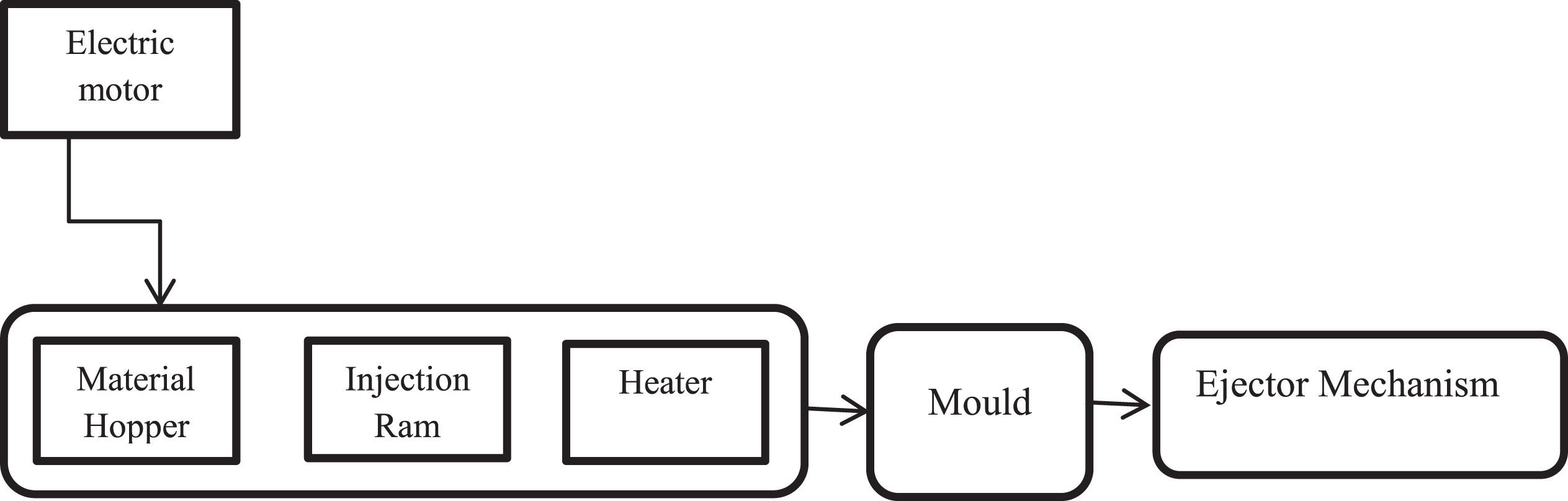
The systematic diagram of Injection moulding structure.
Generally, injection moulding devices work horizontally i.e. in series. The injection moulding system consists of a barrel (a cylindrical pipe). The hopper is positioned at the end of the vessel. The hydraulic ram or revolving screw is mounted within the barrel by the electric motor used to provide power. The heating device (heater) is connected to the barrel used to melt the moulding material that comes down from the hopper. A mould cavity was added to the other side of the barrel. The mould is placed within the mould cavity and a shifting pattern is used in the development process. In addition, the mould consists of copper, aluminum and machine steel.
The life cycle of the various substance moulds is special. It can be selected as per necessity. The use of injection moulding is similar to extrusion which acts as an injection as the name implies. The moulding material/raw material is pumped into the hopper by means of the feeding tool. Before the moulding material goes down to the container (barrel) under the pressure of gravity, the substance is heated beforehand with a circumferential heater on the tube. As the powder of the moulding enters the barrel from the hopper, it begins to melt and the hydraulic ram or spinning screw moves the medium forward into the mould by applying some friction. The liquid plastic substance is poured into the closed mould attached to the other side of the barrel; it is included in this broken mould. The moulding material tends to inject continuously into a rotating screw. Pressure shall refer to the hydraulic system. After injection, the pressure is exerted for some time or held in the same place with some power. Once the entire cycle has been finished, the parts created are then cooled. Then the mould is removed and some ejectors are used to detach the part properly without injury. Upon extracting the portion of the container, it is closed again. This cycle (refer to Fig. 3) is performed very rapidly and automatically.

One Complete cycle of the process.
The parameters of this procedure vary according to the circumstances and specifications.
The cycle time for the production of a single part is generally between 5 and 60 seconds depending on the manufacture of the parts.
The temperature of the moulding medium ranges from 150–350 degrees centigrade.
The injection pressure ranges from 100–150 MPa.
The weight of the components produced by this process is usually between 100 g to 500 g.
The output capacity of injection moulding shall be 12–16 thousand parts per cycle. Block diagram of the structure has been given more closely in Fig. 4 more in which ‘AND gate’ is showing that the structure will carry out its intended function properly without an interruption of a single unit.
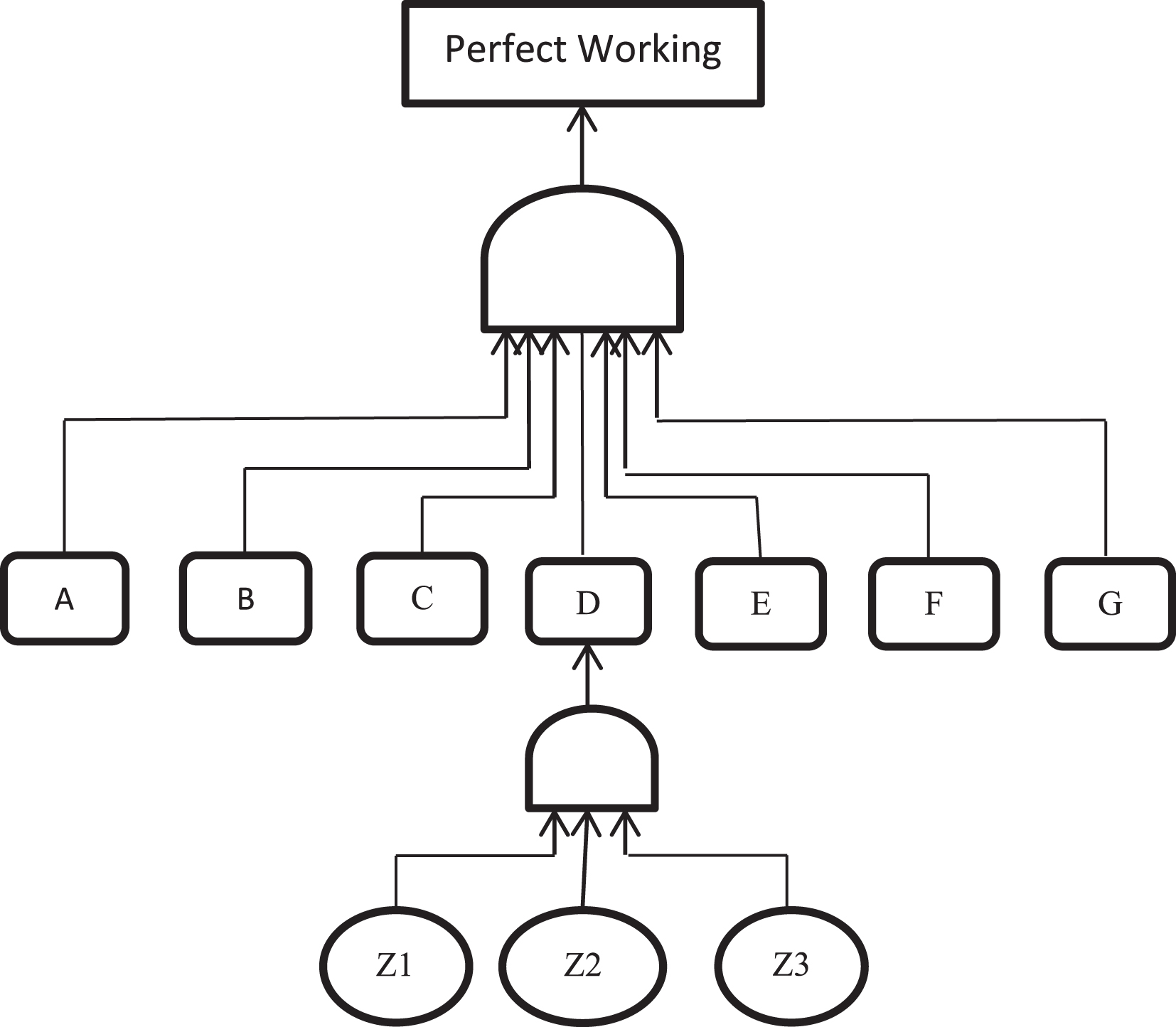
Block Diagram of Injection moulding structure.
Block diagram of the structure has been given a closer look in Fig. 5 in which ‘OR gate’ is showing that the structure may stop to carry out its intended function properly with an interruption due to any one of subparts.

Block Diagram major units of Injection moulding structure.
Right Triangular Generalized Fuzzy Number (RTrGFN) and Alpha-cuts
A fuzzy numbers If x ∈ (- ∞ , f1] ∪ [f2, ∞), If x = f1, If x ∈ [f1, f2], the membership function sharply declines.
The membership function μ A (x) : R → [0, l] is defined as
And pictorial representation of the membership function is represented in Fig. 6.
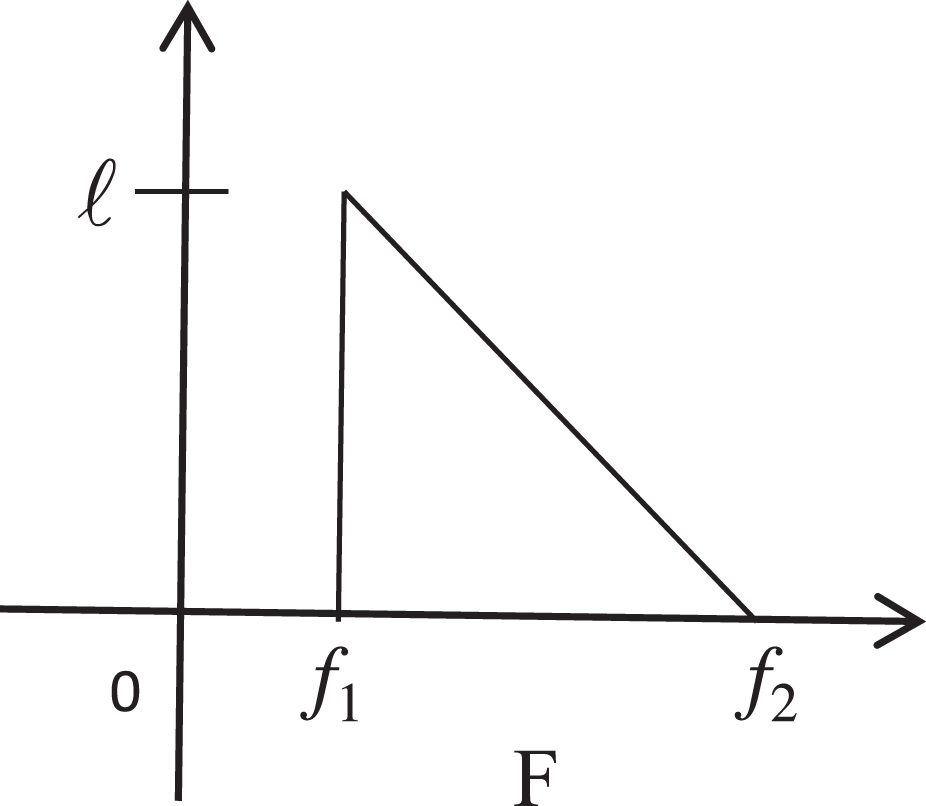
Pictorial representation of Right Triangular Generalized Fuzzy Number (RTrGFN).
The alpha cut is given by the following equation (2) and same is represented in Fig. 7

Pictorial representation of alpha-cut.
The practical use of fuzzified operations is shown to be straightforward, requiring no more computation than in the classical tolerance analysis when dealing with error intervals.
Let F = (f1, f2 ; l
F
) and G = (g1, g2 ; l
G
) be the two right triangular fuzzy numbers. Their membership functions are defined as
Where f1, f2, g1, g2 ∈ R and 0 ⩽ l F , l G ⩽ 1
The right triangular fuzzy numbers can be transformed to right triangular generalized fuzzy numbers as follows.
Scalar multiplication of right triangular generalized fuzzy numbers F = (f1, f2 ; l F ) with confidence level generates a right triangular generalized fuzzy number.
K = kF = (K1, K2 ; l F ) ; k ⩾ 0.
where
where
Addition of two right triangular generalized fuzzy numbers F = (f1, f2 ; l F ) and G = (g1, g2 ; l G ) confidence levels generates a right triangular generalized fuzzy number A = F + G = (A1, A2, A3 ; l) where
Subtraction of two right triangular generalized fuzzy numbers F = (f1, f2 ; l F ) and G = (g1, g2 ; l G ) with two different confidence levels generates a right triangular generalized fuzzy number S = F - G = (S1, S2, S3 ; l) where
Multiplication of two right triangular generalized fuzzy numbers F = (f1, f2 ; l F ) and G = (g1, g2 ; l G ) with two different confidence levels generates a right triangular generalized fuzzy number M = F ⊗ G = (M1, M2, M3 ; l) where
Division of two right triangular generalized fuzzy numbers F = (f1, f2 ; l F ) and G = (g1, g2 ; l G ) with two different confidence levels generates a right triangular generalized fuzzy number D = F/G = (D1, D2, D3 ; l)
where
Complement of a right triangular generalized fuzzy number F = (f1, f2 ; l F ) is
C = (C1, C2 ; l) where
Let F and G are two right triangular generalized fuzzy number on which the operations to be applied. Based upon the satisfaction level, three cases arise and which are discussed in this section.

Two distinct Right Triangular Generalized Fuzzy Number (RTrGFN).
It is the case when level of satisfaction for F and G are equal.
The corresponding membership functions of F and G are given as:
The following arithmetic operations can be carried out:
Let F = (f1, f2 ; l) be any number, then alpha cut of F is given by
Therefore, G = (g1, g2 ; ℓ 2) can be modified as
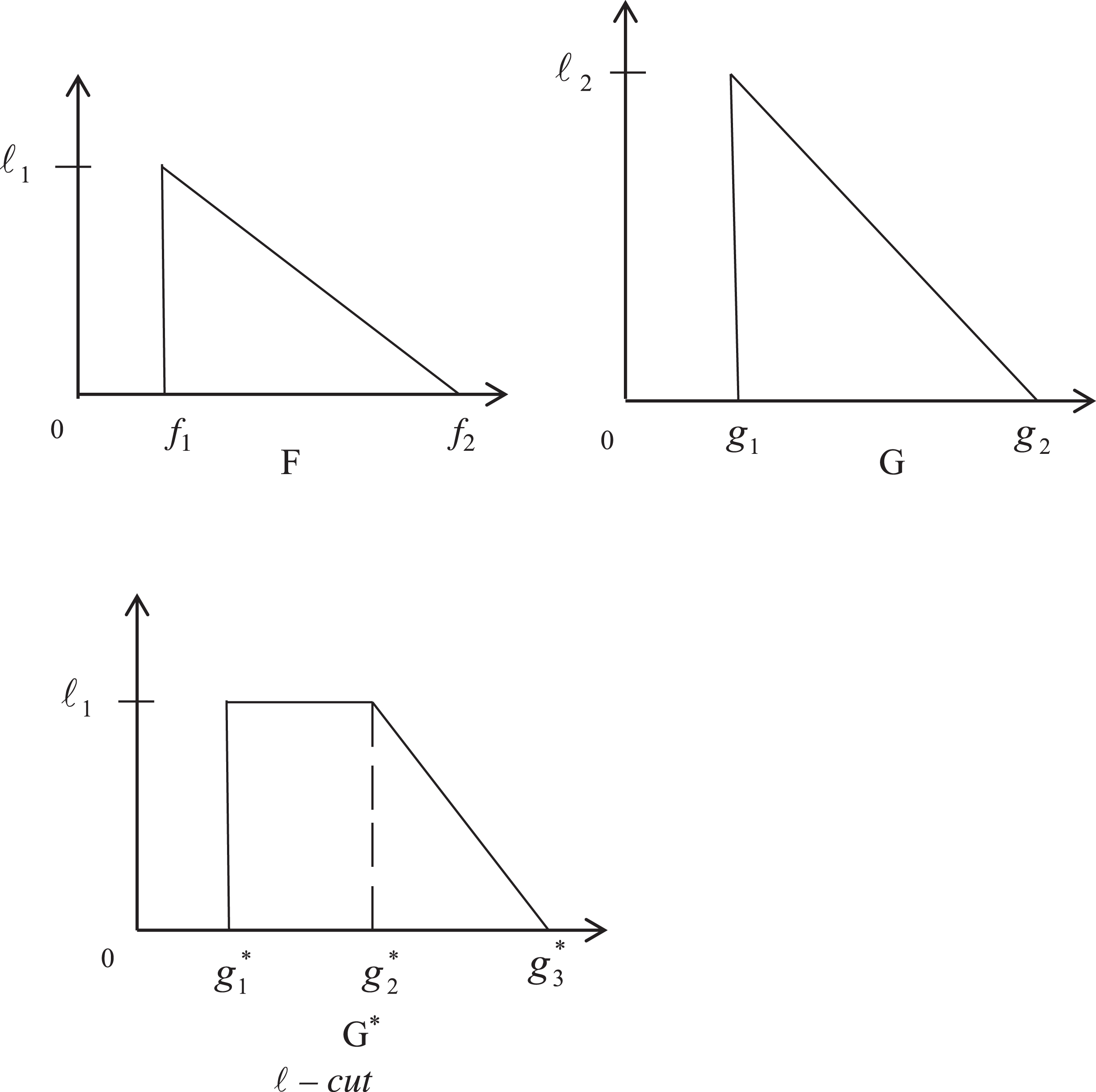
Generalization of G and transformation of G to G*.
Where
Also F can be transformed by using [15] as
After the transformation of F and G as shown in Fig. 9, their membership functions are given by
The following arithmetic operations can be carried out:
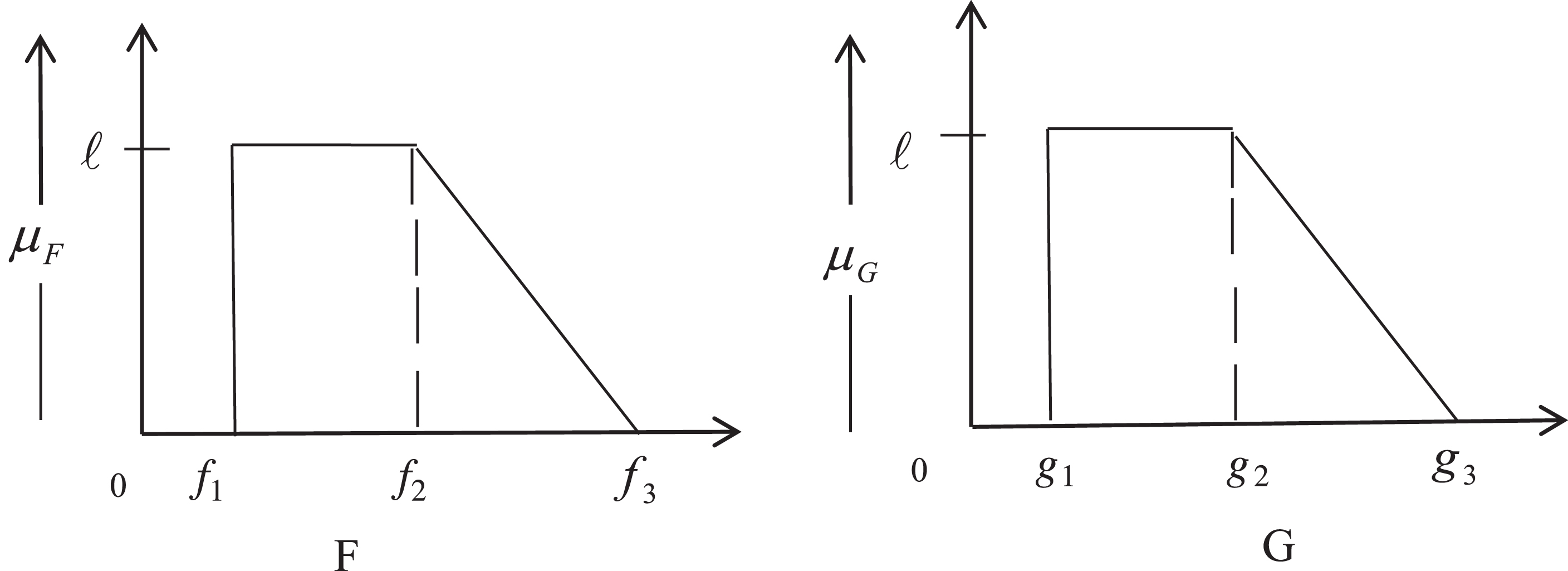
Two transformed generalized fuzzy numbers F and G are obtained after l - cut.
The following arithmetic operations can be carried out:
•
Let F = (f1, f2, f3 ; l) be any number, and then alpha cut of F is given by
Firstly, the data from the record was collected in a tabular form. From the maintenance sheets, the breakdown hours were extracted. The complete record is shown with the help of Table 2.
Data of maintenance sheets records regarding failure rates and repair rates
Data of maintenance sheets records regarding failure rates and repair rates
Fuzzy numerical data can be viewed using real-line fuzzy subsets, defined as fuzzy numbers. Here the failure rate is represented by lambda (λ) and repair time is represented by tau(τ). Take 15% spread on right side for both the parameters as given in Fig. 11. Now the fuzzified values of λ and τ are represented as (λ, λ + 15 %) and (τ, τ + 15 %) respectively.

15% spread of failure rate and repair time.
In the following Table 6, failure rate and repair times are given in right triangular generalized fuzzy numbers up to same level of satisfaction as defined in section 4.2 (Case 2).
Generalizing of data given in Table 3.
Data represented as Right Triangular Fuzzy number (RTrFN)
Data represented as Right Triangular Generalized Fuzzy number (RTrGFN)
The Lambda-Tau methodology is a solution strategy for dealing with repairable systems in the fault tree model. The approach demands redundant-free expressions from the model, which means that the basic events of the model must not be repeated. The basic formulas for failure rate and repair time related with the fault tree model’s logical AND- and OR-gates are derived.
With the help of AND-OR gates in Fig. 5, we can obtain the resultant expressions for the resultant values of failure rates and repair time individually for each parameter by using Table 5.
Basic lambda-tau expressions
Based on the above Table 5, the expressions for the failure rate and repair time of the structure system can be obtained as:
Therefore, based on the above Table 6 and using the arithmetic operations defined in section 4.2 (Case 3), the failure rate and repair time of the structure system can be obtained and shown in Table 7.
Failure rates and Repair time of the major components represented as RTrGFN
Failure rates and Repair time of structure system represented as RTrGFN
Now expressions for reliability parameters are given (Table 8) as
Expressions of Reliability indices
Resultant values of fuzzy reliability parameters are calculated and given in Table 9
Fuzzified values of Reliability indices
The value of each reliability parameter is calculated up to a confidence level 80% which means that authors are 80% confident that the true value of the parameter lies within the given range. The Confidence interval is generally based on standard error of the mean and obtained by multiplying the critical value with standard error. It provides more transparency for readers to better understand the reliability of the parameter values presented in the study. The reliability parameters with alpha-cuts from 0 to 0.8 have been shown in the following Table 10.
Alpha-cuts of reliability parameters
Alpha-cuts of reliability parameters
Here the interval values in the Table 10 have been given with the different satisfaction level. The value of MTTF lies in the interval (77520, 79300) with the confidence level 0.8 and below this confidence level, the lower value of every alpha cut remains same and upper value of alpha cut increases as displayed in Fig. 12. And similarly for other parameters, this nature has been observed. The value of MTTR lies in the interval (0.6838, 1.3679) as displayed in Fig. 13, the value of MTBF lies in the interval (77520, 79300) as displayed in Fig. 14, the value of reliability lies in the interval (0.8945, 0.8968) as displayed in Fig. 15, the value of availability lies in the interval (2.833, 0.9999) as displayed in Fig. 16, the value of ENOF lies in the interval (0.0207, 0.1089) as displayed in Fig. 17 with the confidence level 0.8 and lower value remains unchanged for all confidence level below this. The graphs have clearly followed the effects. The main significance of the these values are that after achieving the required degree of satisfaction, the structure’s reliability and availability drop consistently with increasing time. It remains the same for the Critical interval; with the desired level of satisfaction, and then the graph begins to fall rapidly on \hfilneg \hrule \hrule the right side of the triangle. Eventually these graphs shows that with maximum satisfaction level that is 0.8, the reliability parameters attain the most accurate range values and after that these are accomplishing the range with same lower value in the range of reliability parameters but different highest values which is increasing along with decreasing in level of satisfaction. The range values with 0.8 satisfaction level is taken into consideration for practical results.

MTTF.
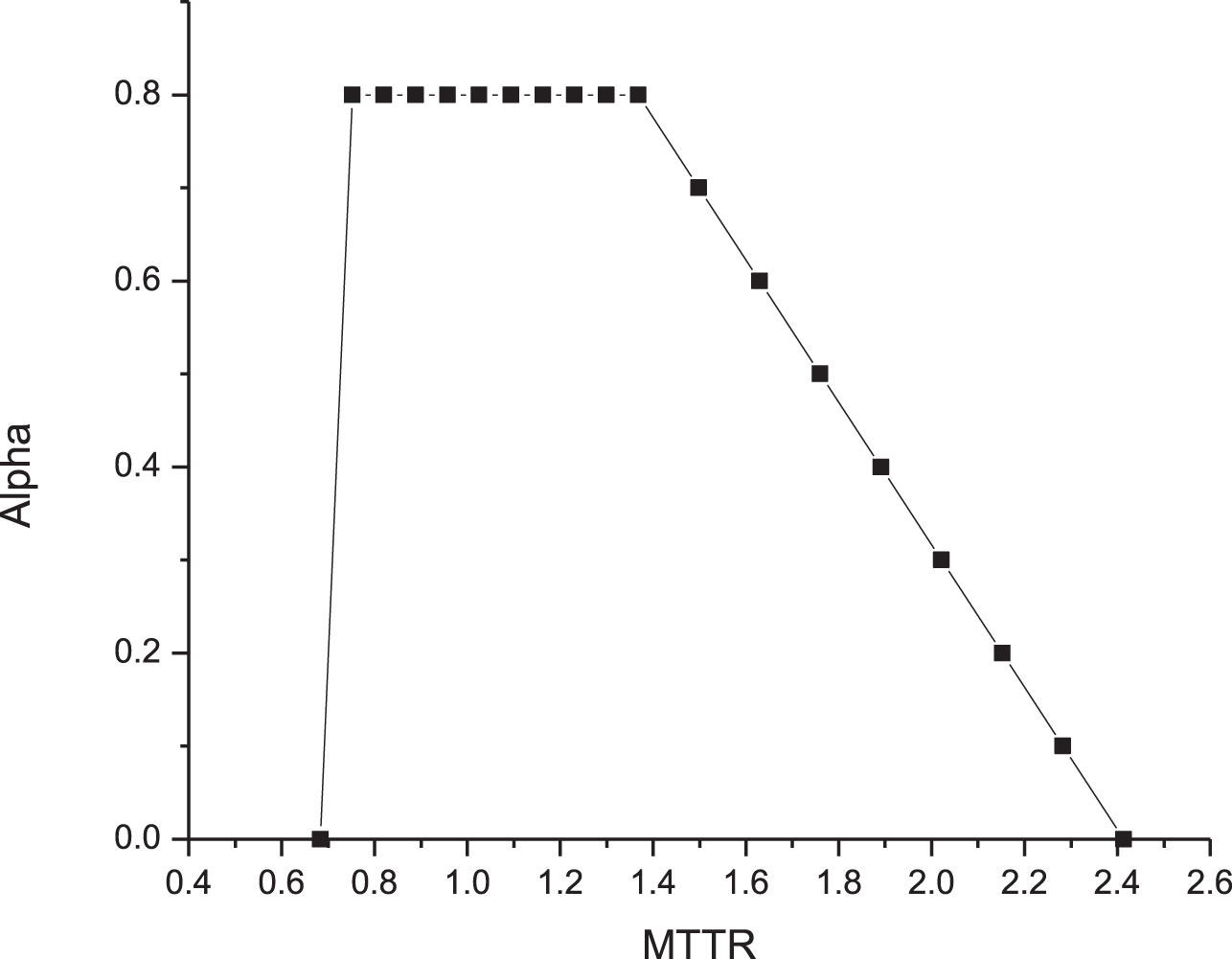
MTTR.
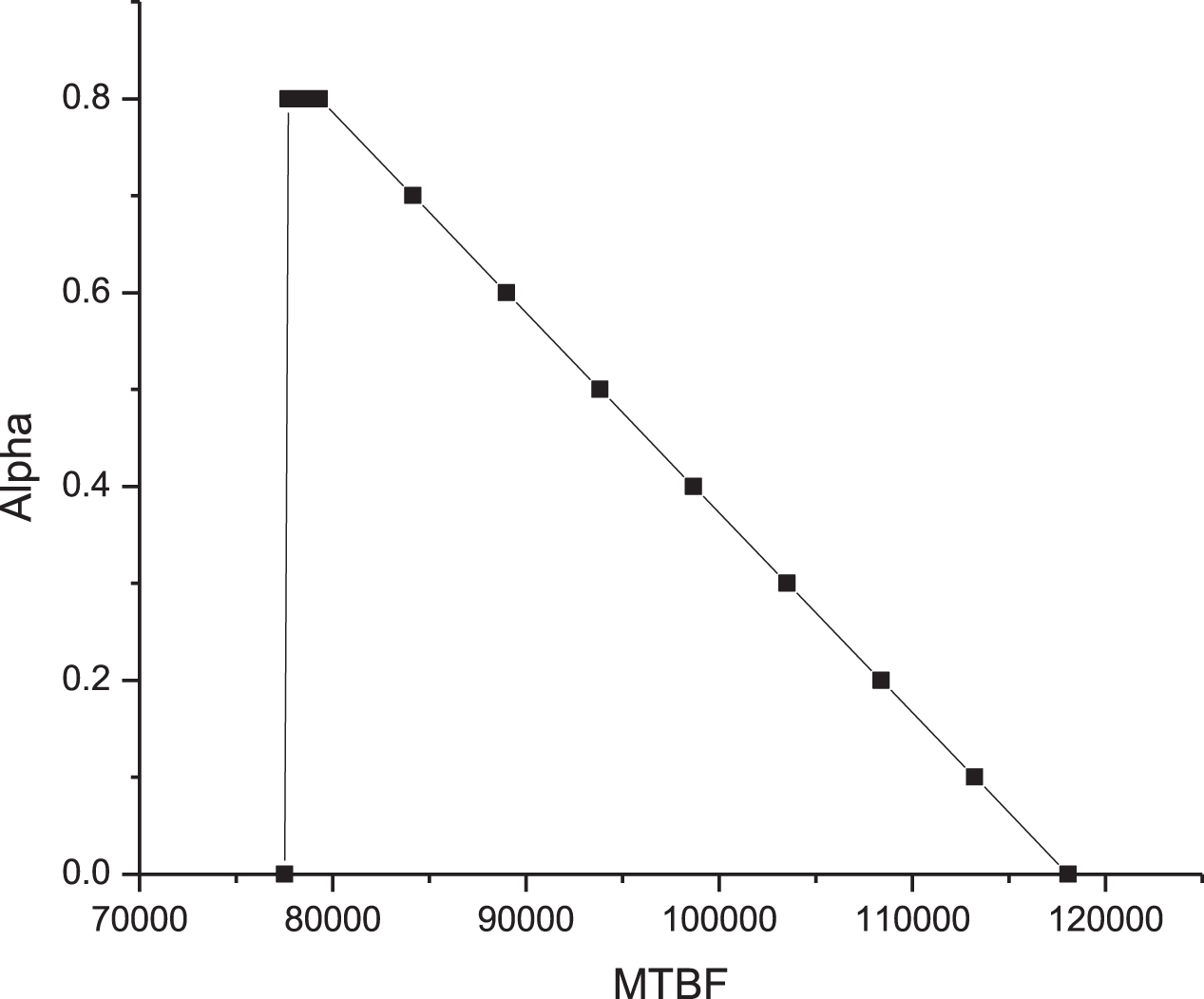
MTBF.
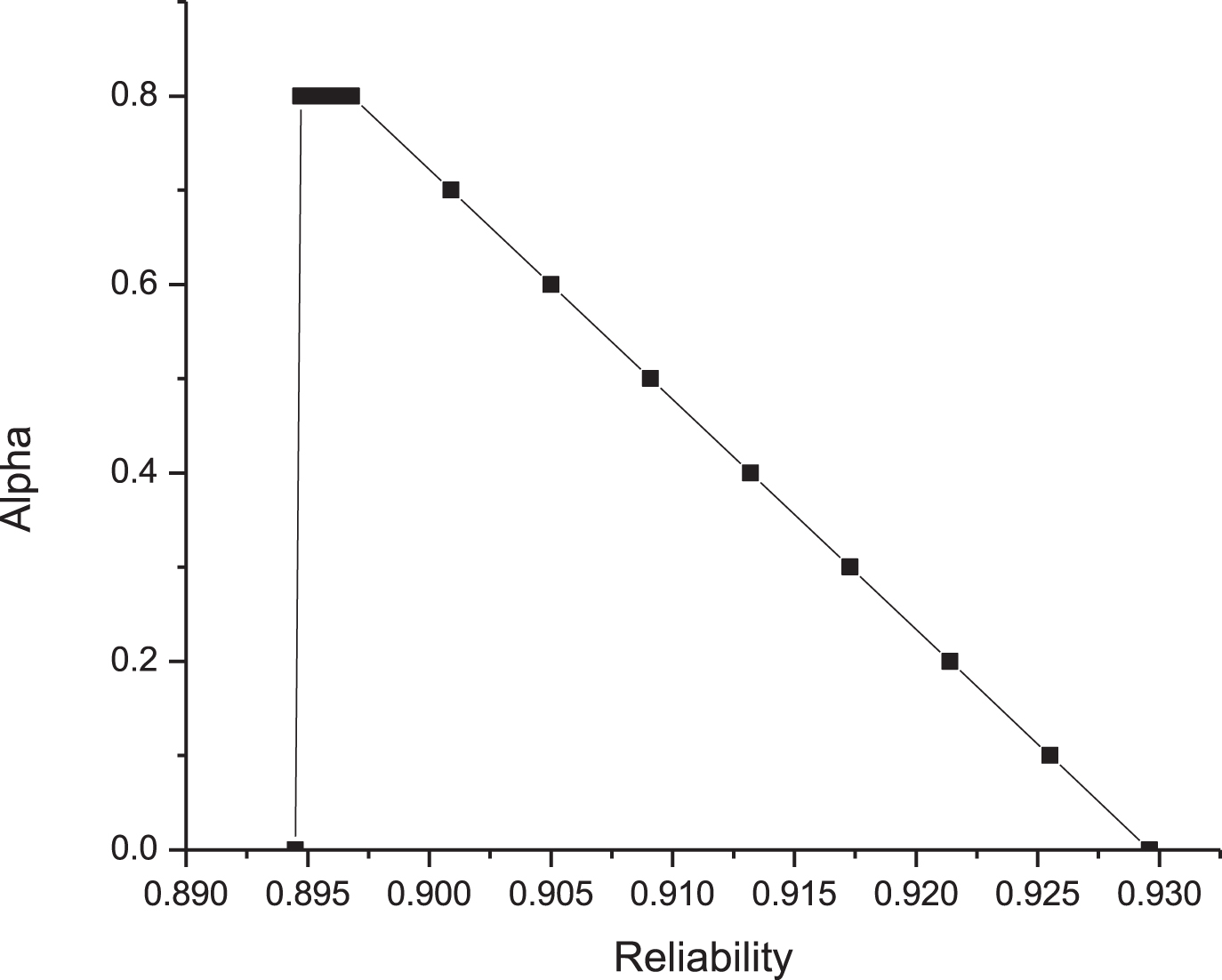
Reliability.
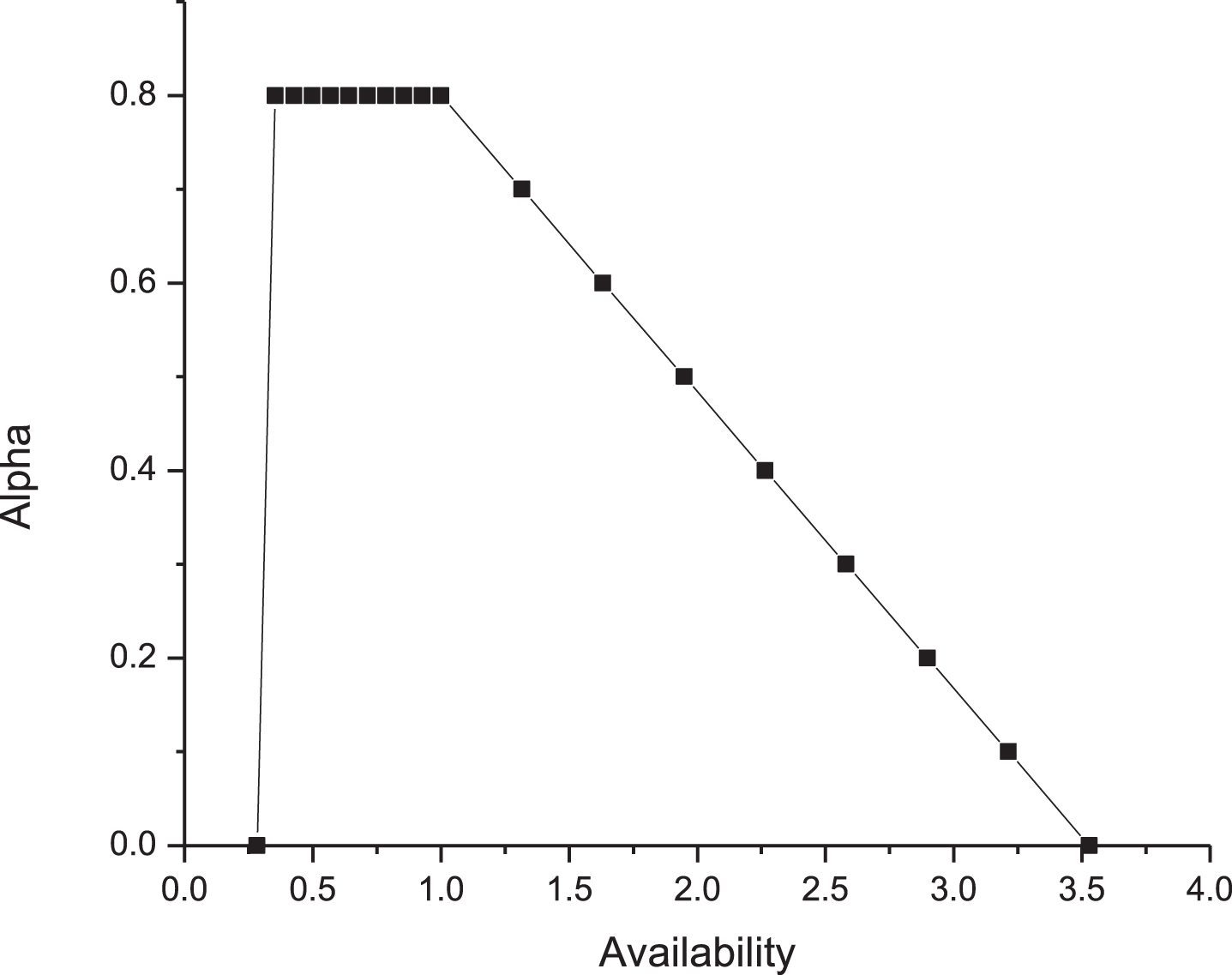
Availability.

ENOF.
Present research reflects the importance of Right Triangular Generalized fuzzy number along with the alpha cuts in context to performance analysis of a conventional industrial structure under the fuzzy environment. The proposed membership function is more convenient to use in practice for this kind of system in which system experiences a continuous failure after the initial break-in period or failure stage. The consequences have been followed by the graphs evidently. After attaining desired level of satisfaction, reliability and availability of the structure decreases uniformly with increase in time. From each graph (Figs. 12–17), one can see that the minimum value of reliability parameter is fix with 80% satisfaction level. It remains same for the Critical interval; with desired level of satisfaction, and then the graph starts falling rapidly on right side of triangle. Basically, it shows that the value of the parameter is increasing with the increase in time. Although, resultant value of each parameter is increasing but its satisfaction level is low. Undoubtedly, performance analysis under fuzzy environment provides more flexibility for making decisions. This experiment helps the plant personal to plan the maintenance of subparts in accordance to attain the reliability and availability of the structure system with highest level of satisfaction that is 80%. So that structure system works for the expected time for disaffected production without any interruption of failure. The next section defines the future directions for the research.
Future direction/research
In future, the working and failure culture of more systems will be focused. The new membership functions will be defined to analyze the system’s future performance based upon the available information.
Footnotes
Acknowledgments
This work is supported by Symbiosis Institute of Technology, Symbiosis International (Deemed University) (SIU), Pune, Maharashtra, India.