



Abstract
A system undergoes a failure process in which the internal degradation and external loads are independent and compete with each other. In the reliability model of competitive failure, the threshold of failure is often a dynamic process that changes with time. Based on this, this paper constructs a model in which the failure threshold is an uncertain Liu process and applies it to the competitive failure reliability process, where soft and hard failure thresholds are modeled by different Liu processes. In the absence of a large amount of failure data, uncertainty theory is used as a tool to analyze the belief reliability and mean time to failure of the system. Taking gas-insulated substation (GIS) as an example, the effect of parameters on belief reliability is analyzed, and the reliability under Liu process threshold and constants threshold is compared, which shows the validity of the prosed model.
Introduction
In practical applications, with the wide application of products, the reliability requirements for products are getting higher and higher. The analysis method of reliability modeling has become an important means of evaluating reliability. In the research of reliability modeling, it can be roughly divided into two categories, repairable systems and non-repairable systems. In the repairable system, once the product fails, it can be repaired [1]. Out of economic considerations, try to pass the strategy of regular inspection and maintenance of the sensor before the product fails to reduce the possibility of failure and improve the reliability of the product [2]. After the repair, the performance of the product is not as good as before the repair, but it can still be used normally [3]. In a non-repairable system, the product must be replaced due to failures caused by wear, aging, and various factors in the environment.
In recent years, there has been a lot of research devoted to non-repairable systems. Once the system fails, it can only be replaced with new components. The main reasons for system failure are internal aging and wear, and external harmful shocks [4–7]. Aging and external shocks may be independent of each other, or they may depend on each other. Failure phenomena caused by internal wear, corrosion, and weathering of a system or component are called soft failures, while failure phenomena caused by excessive external loads or shocks are called hard failures, either of which can cause failures and are called competing failure processes. A certain degree of aging and wear will cause failures, but as time changes, the failure threshold also changes [8, 9]. The threshold is not a fixed value, but a process that changes over time. For example, when human beings get sick, the same virus, as people get older, their resistance to the virus decreases, and the easier it is to get sick. With the longer the use of machines, electronic equipment, etc., the lower the temperature, humidity, and environmental endurance, the easier it is to malfunction.
In engineering practice, there is little or no data on the degradation and failure of equipment or components in the aerospace field. Therefore, the judgment of model uncertainty, parameter uncertainty, measurement error and failure mode mostly rely on experienced experts. Human subjective uncertainty is not suitable for modeling with probability theory. For this reason, domestic and foreign experts and scholars have begun to try to use non-probabilistic methods to deal with reliability assessment and maintenance decision-making where sample data is relatively scarce.
There are many non-probabilistic methods, among which the methods that can be used to analyze subjective cognition mainly include fuzzy theory [10, 11] and uncertainty theory [12]. Although fuzzy theory has been widely used in recent years [10, 13], Liu [14] demonstrated that it is inappropriate to use a fuzzy theory to measure the subjective uncertainty of experts in 2011. Since the possibility measure itself is not duality, this can lead to conflicting conclusions when calculating the possibility of two opposing events, “component functioning” and “component failure". Therefore, fuzzy theory is not suitable for modeling with the subjective uncertainty of experts.
Uncertainty theory satisfies duality, and Liu introduced uncertain processes [15] used to describe time-varying uncertain phenomena, followed by the introduction of Liu processes in 2009 [16]. There have been many fields in the application of uncertainty theory for research, such as uncertainty differential equations, uncertainty risk analysis, uncertainty statistical analysis, uncertainty reliability analysis.
Uncertainty theory is dealing with uncertainty arising from human belief [17]. There have been many scholars using uncertainty theory to study reliability. Hu et al. [18] studied the optimization problem of parallel-series redundant systems with warm standby components according to uncertainty theory. The life and cost of components are considered as uncertain variables, and the weight and volume of components are random variables. Three different models of performance maximization, life maximization and cost minimization are optimized. Gao et al. [19] considered the k-out-of-n system under the uncertainty of human operation, and used uncertain variables to model the weights in the k-out-of-n system, and proposed a concept with uncertain weighted k-out-of-n system, and used the importance measure to show the importance of each component in the uncertain weighted k-out-of-n system. Sheng and Hua [20] believed that each component in an uncertain k-out-of-n system could be in multiple states, and used importance measures to describe the importance of each component in an uncertain multi-state k-out-of-n system, and designed a binary search algorithm to compute component importance measures.
Li et al. [21] studied accelerated degradation experiments based on uncertain Liu processes, and explored the sensitivity of these models to sample number through further comparisons with Wiener process accelerated degradation models (WADM) and Bayesian-WADM, the results show that the degradation model based on Liu process outperforms the other two probability-based models. Liu et al. [22] considered a competing failure process with a mixture of probability theory and uncertainty theory. The results show that under different shock models, the degradation model established by the Wiener process and the degradation model established by the Liu process are different in reliability, which can lead to differences in assessing the reliability and safety characteristics of engineered systems. In the case of less fault data, Zeng et al. [23] proposed the belief reliability metric using uncertainty theory. Since real systems are usually uncertain stochastic systems affected by inherent uncertainty and epistemic uncertainty, existing reliability measures are unreliable. Kang Rui [24] systematically described the theory and method of belief reliability.
In the competitive failure model, Cao et al. [25] believed that in discrete systems, the parameters of the life distribution are uncertain. The parameters in the distribution function are assumed to be uncertain variables, and the reliability in three different redundant series-parallel systems with cold standby, warm standby, and hot standby is investigated. Based on the uncertain form of the distribution function studied in [25] and the uncertain parameters in the distribution function, mutually independent [26] and dependent [27] competing failure systems were modeled separately, and the reliability of the bi-uncertain systems was investigated using uncertainty theory. Shi et al. [26, 27] believed that it is reasonable to model the reliability model of expert experience data using uncertainty theory.
In a GIS system, the manufacturer sets an artificial failure threshold to ensure high reliability and low maintenance cost, and the GIS system is designed according to this threshold. In fact, this pre-given failure threshold varies with the temperature, voltage, and other factors in the operating environment of the GIS system. For example, the hard failure threshold is set at 2950 A, which means that the GIS system will fail if the current is higher than 2950 A. However, after several years of operation, the GIS system will have failed when the current is higher than 2500 A. It means that the threshold of failure is decreasing with time. Shi et al. [8] considered the failure threshold of composite insulators as an uncertain variable taking values on an interval within which the threshold value fluctuates. In fact, the failure threshold of a system, device or component can be affected by humidity, temperature, current, voltage, UV light, etc. in the operating environment and can become progressively smaller or larger over time. The threshold value is an uncertain variable and does not accurately describe the dynamic process of its change.
The dynamic process of the threshold is a continuous process with time, while being disturbed by other uncertainties. Describe the dynamic process can be used Gamma process, Werner process and other stochastic processes, etc., however, Liu process has independent stationary increments, and each sample path is Lipschitz continuous, every increment C (s + t) - C (s) is a normal uncertain variable with expected value 0 and variance t2. The Liu process has these properties that can be used precisely to describe the process of threshold change. The failure threshold change is continuous with time and changes slowly, not sharply. The independent stationary increment and Lipschitz continuity of Liu process meet the change process of threshold, while Gaussian process and Wiener process do not have these properties. Although Wiener process has independent stationary increment, it is not Lipschitz continuous. Therefore, the dynamic change process of the failure threshold is modeled using the Liu process rather than the stochastic process. This paper is to use the uncertainty theory as a tool for modeling the reliability of failure thresholds over time in the case of missing failure data, therefore using an uncertain Liu process to portray the threshold change of failure. The dynamic behavior of the failure threshold is characterized by constructing the uncertain Liu process that the failure threshold changes with time. The model proposed in this paper describes the dynamic process of the failure threshold more accurately than the existing models.
How to describe the changing process of the threshold is an important issue to accurately evaluate the reliability. In this paper, the aging failure behavior of a system is considered. The reasons for failure are mainly two parts: internal wear and external load. They depend on each other and compete with each other, which together lead to the failure of the system. The contributions of this paper are as follows: (1) The dynamic behavior of the failure threshold is constructed by using the uncertain Liu process; (2) The failure behavior of the system is studied based on the uncertainty theory; (3) The proposed model is analyzed and applied in GIS, combined with the failure data of substations surveyed in Norway during 36 years of operation.
The other parts of the article are structured as follows: The second part constructs a competitive failure model with the failure threshold as an uncertain Liu process. Calculations of belief reliability under the extreme shock models using uncertainty theory are presented in the third section. Section 4 takes a GIS as an example and applies the proposed model. The last is the conclusion and future research.
Description of the competitive failure model of Liu process with failure threshold
In the dependent competitive failure model with uncertain failure threshold, there are two main reasons for failure. One is that the internal cumulative degradation amount exceeds the uncertain threshold of soft failure, resulting soft failure. The uncertain harmful load damage to the system exceeds the uncertain threshold of hard failure, resulting hard failure. No matter which one of soft failure and hard failure occurs first, it will cause system failure, as shown in Figs. 1 and 2.
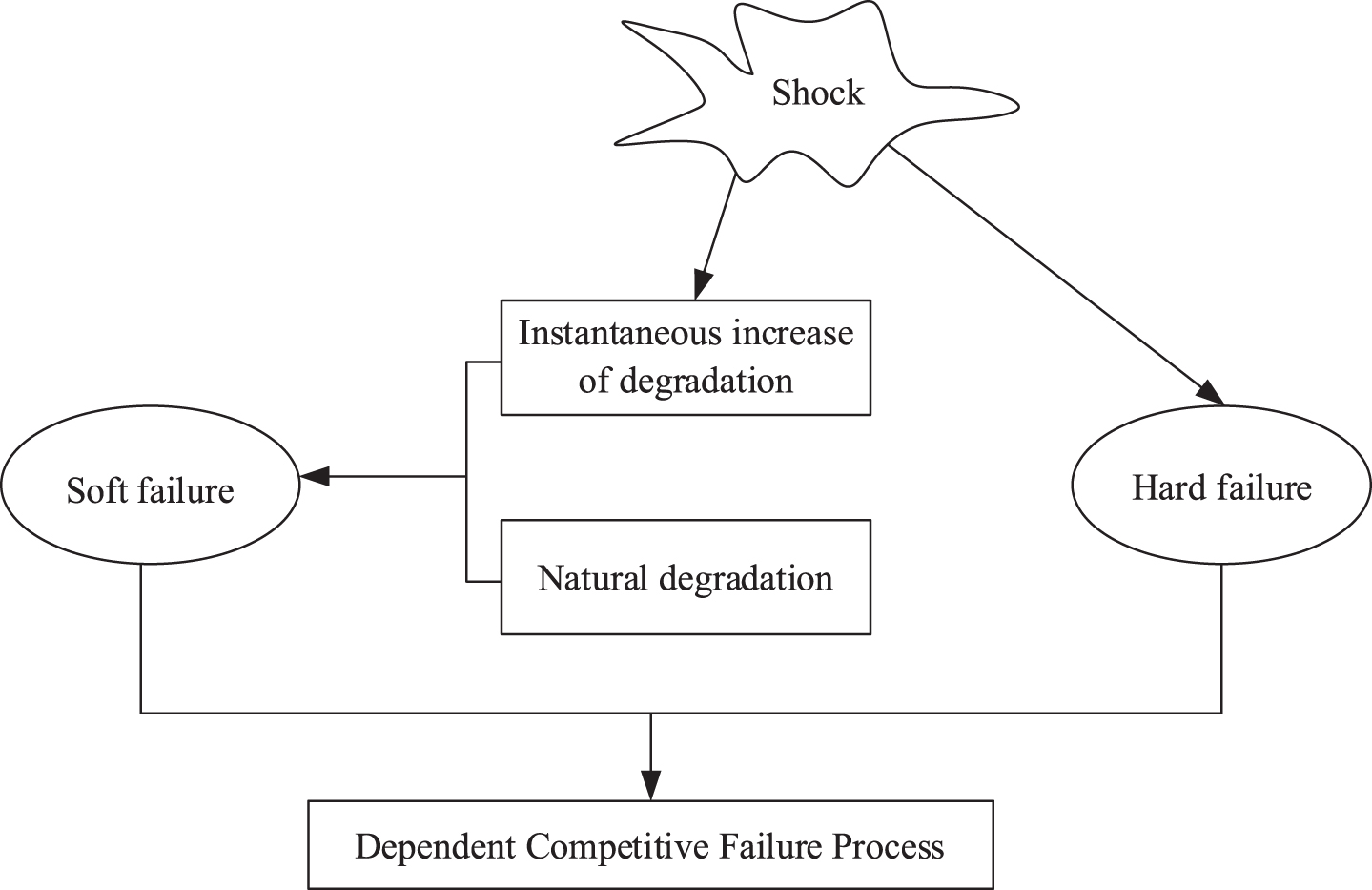
Failure correlations of two competing failures.
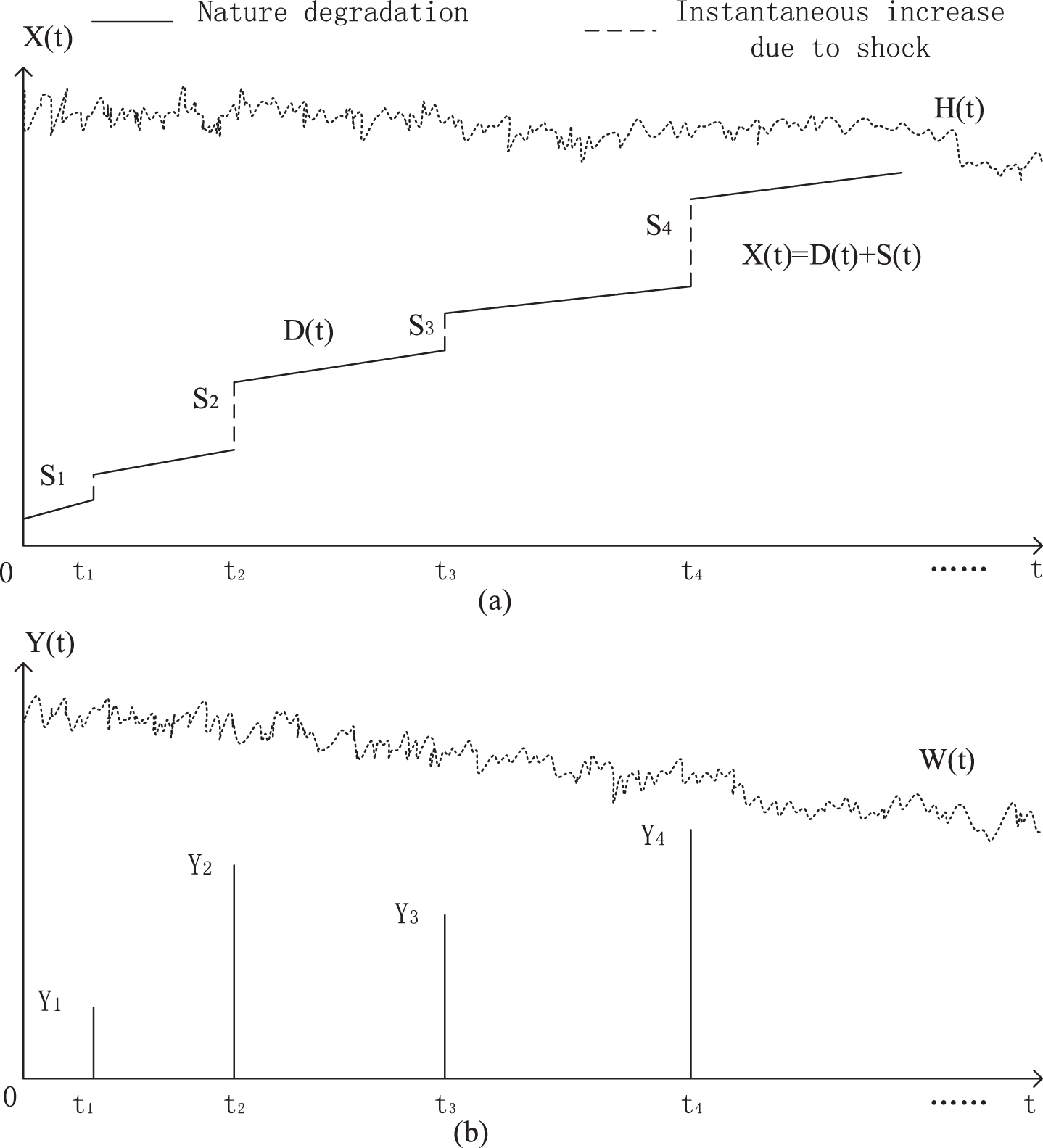
Dependent competitive failure process.
H (t) The threshold level for software failure
W (t) The threshold level for hardware failure
μ1 (t) The deterministic part of soft failure threshold function at time t
μ2 (t) The deterministic part of hard failure threshold function at time t
C (t) Liu process
a The initial level of uncertain degradation
b The uncertain degradation rate
δ1 The coefficient of the soft failure threshold drift part
δ2 The coefficient of the hard failure threshold drift part
Z i The uncertain time interval of the i - 1th uncertain load and the ith uncertain load
Y i The damage size caused by the ith uncertain load
S i The instantaneous increase of the degradation amount caused by the ith load
S (t) The amount of shock degradation at time t
X (t) The total degradation due to continuous degradation and shock degradation at time t
D (t) The natural degradation of the system at time t
N (t) Number of uncertain shocks that have arrived by time t
Y (t) The damage size of uncertain shocks by time t
φ (x) The uncertainty distribution of the uncertain time interval Z1, Z2, ⋯
φ (x) The uncertainty distribution of the uncertain load Y1, Y2, ⋯
ψ (x) The uncertainty distribution of the uncertain variable S1, S2, ⋯
γ t (k) The uncertainty distribution of uncertain variable N (t)
ξ The uncertain variable
η The uncertain variable
F-1 (α) The inverse uncertainty distribution of uncertain variable ξ
G-1 (α) The inverse uncertainty distribution of uncertain variable η
MTTF The mean time to failure of the system
R (t) Reliability function by time t
NHF t The hardware failure does not occur by time t
NSF t The software failure does not occur by time t
∧ minimum operator
∨maximum operator
Modeling of internal degradation processes
Assuming that the natural degradation of the system follows a linear path D (t) = a + bt, where a is the initial degradation amount and b is the degradation rate, and it is assumed that a and b are both constants. The external uncertain shock will also cause an instantaneous increase of the internal degradation amount S (t), that is, the internal cumulative degradation amount X (t) = D (t) + S (t). The instantaneous increase of the degradation amount caused by the uncertain shock is uncertain, assuming the non-negative uncertain variables S1, S2, S3, ⋯, they are i.i.d., and have uncertain distribution function ψ (x), and note
In previous competitive failure models, the failure threshold is constant. However, in practical engineering applications, the threshold of system failure changes with time, temperature, humidity, current, voltage and other factors in the environment, which is a continuous dynamic process. The threshold of failure can be seen as an uncertain process that changes over time. To describe the dynamic behavior of the uncertain threshold, it is assumed that the uncertain failure threshold is an uncertain Liu process that varies with time. To facilitate the description, the definition of the Liu process is introduced.
(i) C (0) =0 and almost all sample paths are Lipschitz continuous,
(ii) C (t) has stationary and independent increments,
(iii) every increment C (s + t) - C (s) is a normal uncertain variable with expected value 0 and variance t2.
C (t) has an uncertain distribution function
Assuming the threshold of soft failure is
When there is a large amount of historical failure data, the frequency of a large number of sample data is close to the probability of event occurrence, we use probability theory as a mathematical tool to study the possibility of system failure. When there is little or no failure data, it is obviously inappropriate to use probability theory to study the possibility of failure. At this time, we use uncertainty theory to study cognitive uncertainty caused by human belief.
The arrival process of external uncertain load is an uncertain renewal reward process. The time between the arrival of uncertain load is independent and identically distributed and non-negative uncertain variable Z1, Z2, Z3, ⋯, assuming that the uncertainty distribution function is φ (x). The damage caused by load is uncertain, which is represented by the non-negative uncertain variable Y1, Y2, Y3, ⋯. For simplicity, it is assumed that Y1, Y2, Y3, ⋯ are i.i.d., and the uncertain distribution function is φ (x).
The instantaneous degradation increment caused by the load to the system is related to the size of the damage caused by the external shock to the system. In order to describe the relationship between them, it may be assumed that S i = cY i , where c > 0 is a constant.
Assuming the threshold of hard failure is
In the dependent competitive failure model, the external uncertainty shock Y
i
has an effect on the internal degradation amount S
i
, increasing the degradation level
Belief reliability analysis
A system undergoes an internal degradation process and an external load shock, both of which depend on each other and compete with each other, causing the system to fail. The belief reliability of a system is defined as the uncertainty measure in which the accumulated degradation does not exceed the soft failure threshold H (t), while the damage to the system caused by the shock of external loads cannot exceed the threshold of hard failure W (t).
Belief reliability without soft failures
The belief reliability of no soft failure is defined as the uncertainty measure that the internal cumulative degradation does not exceed the uncertain soft failure threshold.
The calculation of the above formula is divided into two parts, one part is N (t) =0, the other part is N (t) =1, 2, ⋯, and then the two parts are calculated separately.
Since the time for renewal with uncertain renewal process N (t) is uncertain variable Z1, Z2, ⋯with uncertain distribution function φ (x), then N (t) has an uncertain distribution [28]
Then we have
Assume
So
Combing Equations (7), (9) and (12), we have
Substituting Equations (6), (9) and (13) into Equation (5) yields equation (4).
The belief reliability of the system is defined as the uncertainty measure that the internal accumulated degradation cannot exceed the threshold of soft failure, and the external shock cannot cause hard failure,
In extreme shock model, the amount of damage to the system caused by the load exceeds the threshold of uncertain hard failure at time t, and the system fails.
Next,
Assuming that
So
According to Equations (9), (12), (21), we get
From Equations (6), (17), (22), we get Equation (15).
According to the calculation formula of mean time to failure,
Equation (16) holds.
Taking the GIS in the high-speed rail power supply system as an example to illustrate the proposed model. Under the long-term external working environment of this substation, the internal conversion equipment and connecting devices are degraded due to factors such as wear, fatigue, corrosion, flashover and insulation defects, resulting in aging failure. At the same time, due to the susceptibility of voltage conversion, current conversion and protective equipment to excessive loads, they are susceptible to the impact of traction loads, resulting in sudden failures [29]. Each shock of the traction load accelerates the aging of the components, and the two together build a competitive failure model for GIS.
According to the failure data of the Norwegian substation survey [30], the number of flashovers will not increase due to the increase in the use time of the substation, that is, the internal degradation rate is a constant, and it is reasonable to describe the cumulative degradation amount with a linear model D (t) = a + bt, where a, b are constants. The uncertain shock size and the arrival time interval are respectively assumed to be Y i ∼ N (e1, σ1), Z i ∼ N (e2, σ2). The failure threshold of GIS will change as the working time increases, which is a dynamic uncertain process. The processes of uncertain thresholds are H (t) = μ1 (t) - δ1C (t) = H0e-β1t - δ1C (t), W (t) = μ2 (t) - δ2C (t) = W0e-β2t - δ2C (t). Combined with the survey data of the failure of GIS in the Norwegian power transmission system [30], other parameter settings are shown in Table 1. During the 36 years surveyed from 1973 to 2009, a total of 180 failures occurred, of which 77 were due to internal flashover and arc faults, and the remainder were caused by other factors.
Parameters settings
Parameters settings
The belief reliability of the GIS is studied under the failure threshold with uncertain Liu process and constants, and the extreme shock model are discussed.
In extreme shock model, the belief reliability curves are in Fig. 3. It can be seen from the comparison that the belief reliability decreases gradually from 1 to 0 with the use of longer time. The belief reliability function is about sensitivity analysis of the initial value of the soft failure threshold, compared the reliability when H0 is 12, 13, and 15. As H0 increases gradually, the reliability is higher and the service time is longer. This is because the larger H0 is, the less likely the substation will fail, the lower the probability of failure, and the higher the reliability.
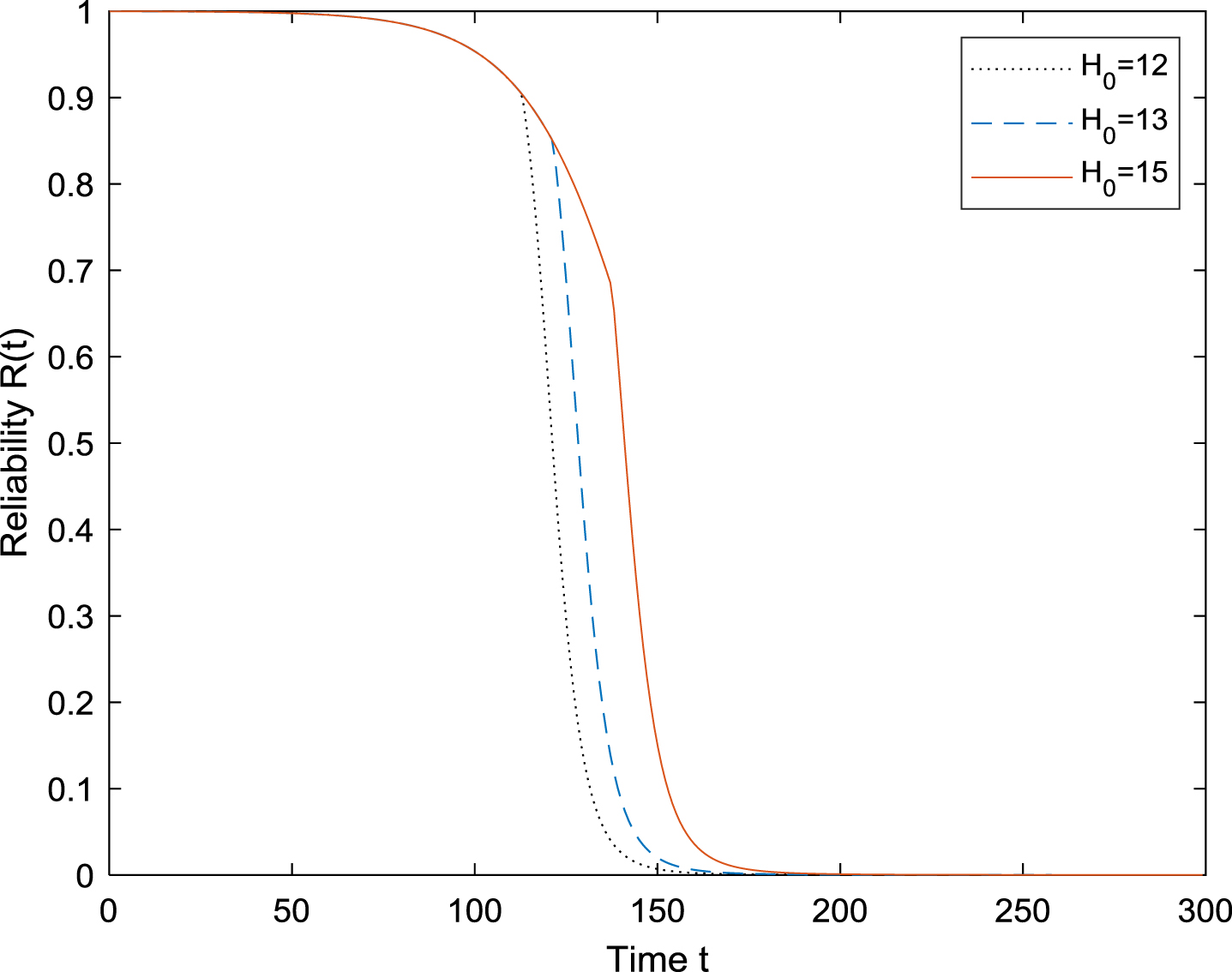
The effect of H0 on reliability.
From the changes of the three curves in the Fig. 4, it can be seen that the larger the β1, the lower the reliability. This phenomenon can be explained as the larger β1, the smaller the soft failure threshold, the higher the failure measure, and the lower the reliability.
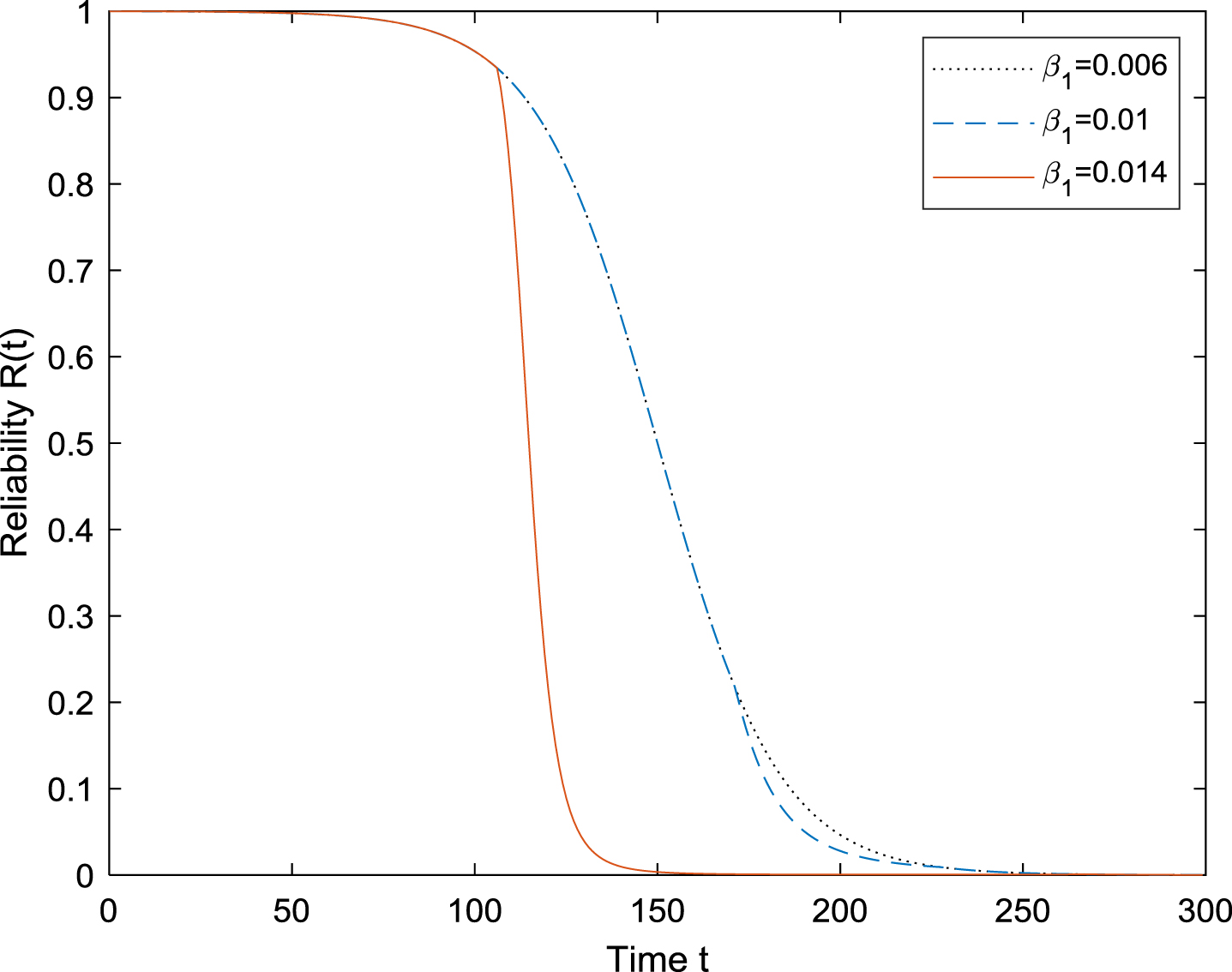
The effect of β1 on reliability.
In the process of increasing the parameter b from 0.000047 to 0.0047 in Fig. 5, the reliability is smaller. Because b is the rate of internal degradation, the larger b means the faster the degradation speed. The failure rate of the gas insulator substation due to internal flashover or arc defects increases, the possibility of failure is greater, and the reliability of the substation decreases.
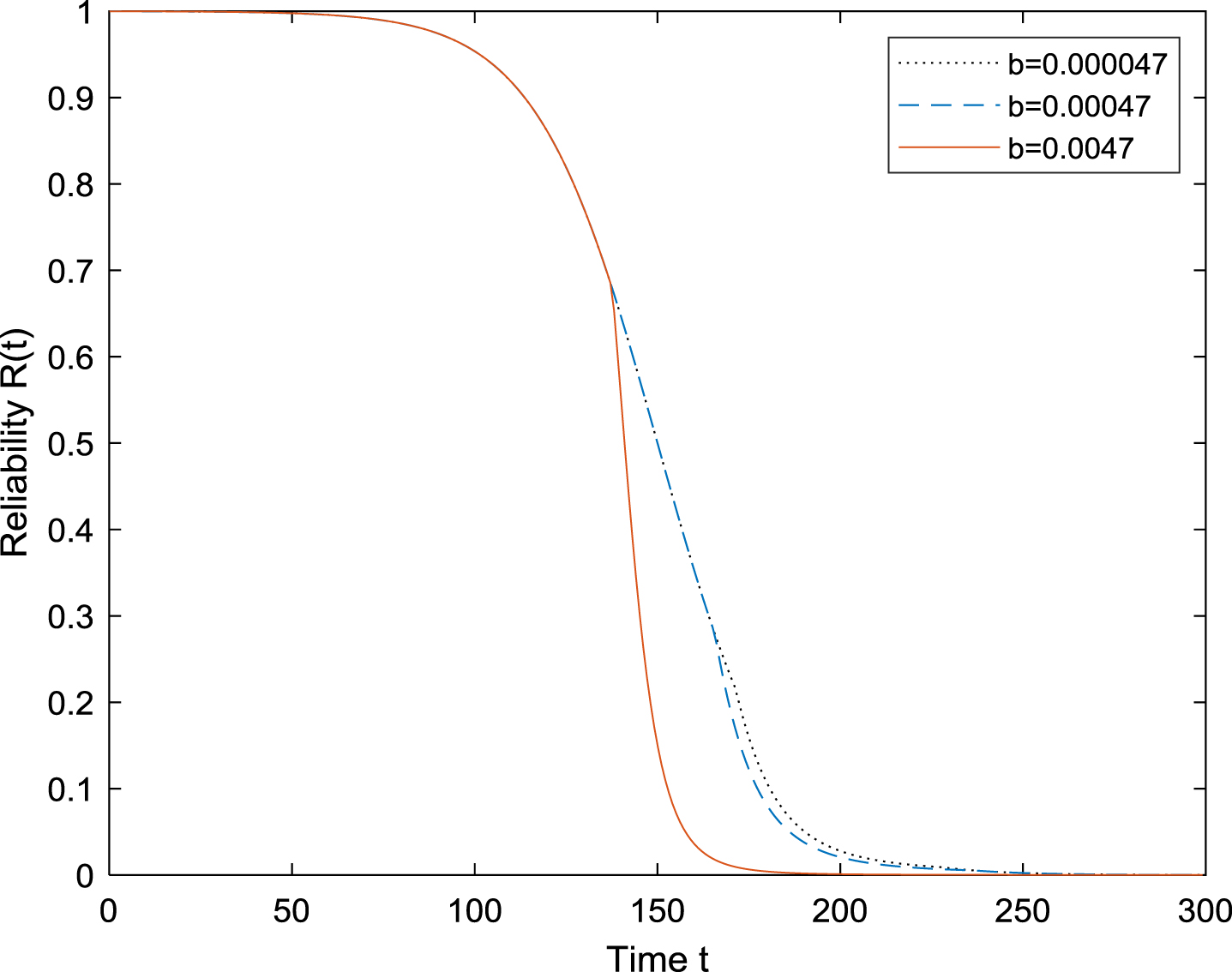
The effect of b on reliability.
The gas insulating substation experiences uncertain external shocks, and the arrival time of the uncertain shocks is uncertain. With the changes of parameters e2, σ2 in the uncertain time interval, the curves of the belief reliability are shown in Fig. 6. The parameter e2 represents the average time of arrival intervals. The longer the average time between arrivals of shocks, the higher the reliability, which is in line with the actual engineering background. The parameter σ2 represents the fluctuation of the time interval of the arrival of the uncertain shock. The greater the fluctuation σ2, the reliability will change accordingly. Compared with e2 = 150, σ2 = 30 ande2 = 150, σ2 = 20, the two reliability functions have an intersection. Before this intersection, the reliability corresponding to e2 = 150, σ2 = 30 is lower than that of e2 = 150, σ2 = 20, after the intersection, the reliability changes are reversed. e2 = 130, σ2 = 30 and e2 = 130, σ2 = 20 there is the same result.

The effect of e2, σ2on reliability.
The failure threshold values of GIS changes as the use time increases, and it will be affected by random factors at the same time. The change of the threshold value is not a simple increase or decrease trend. The failure threshold is the difference between the belief reliability under the Liu process and the constants.
The failure threshold value is different between the belief reliability of the uncertain Liu process and the belief reliability corresponding to the constant, as shown in Fig. 7. From the change trend of the two curves in the figure, it can be seen that the two coincide when is from 0 to 150. When is greater than 150 and less than 250, the belief reliability of the uncertain Liu process thresholds is lower than constants. After is greater than 250, the two almost coincide. This result tells us that if the failure thresholds are directly regarded as constants, the reliability of the substation will be overestimated, which makes the early warning effect of the maintenance strategy too optimistic during the operation of the substation, and there may be potential safety hazards, causing certain economic losses.
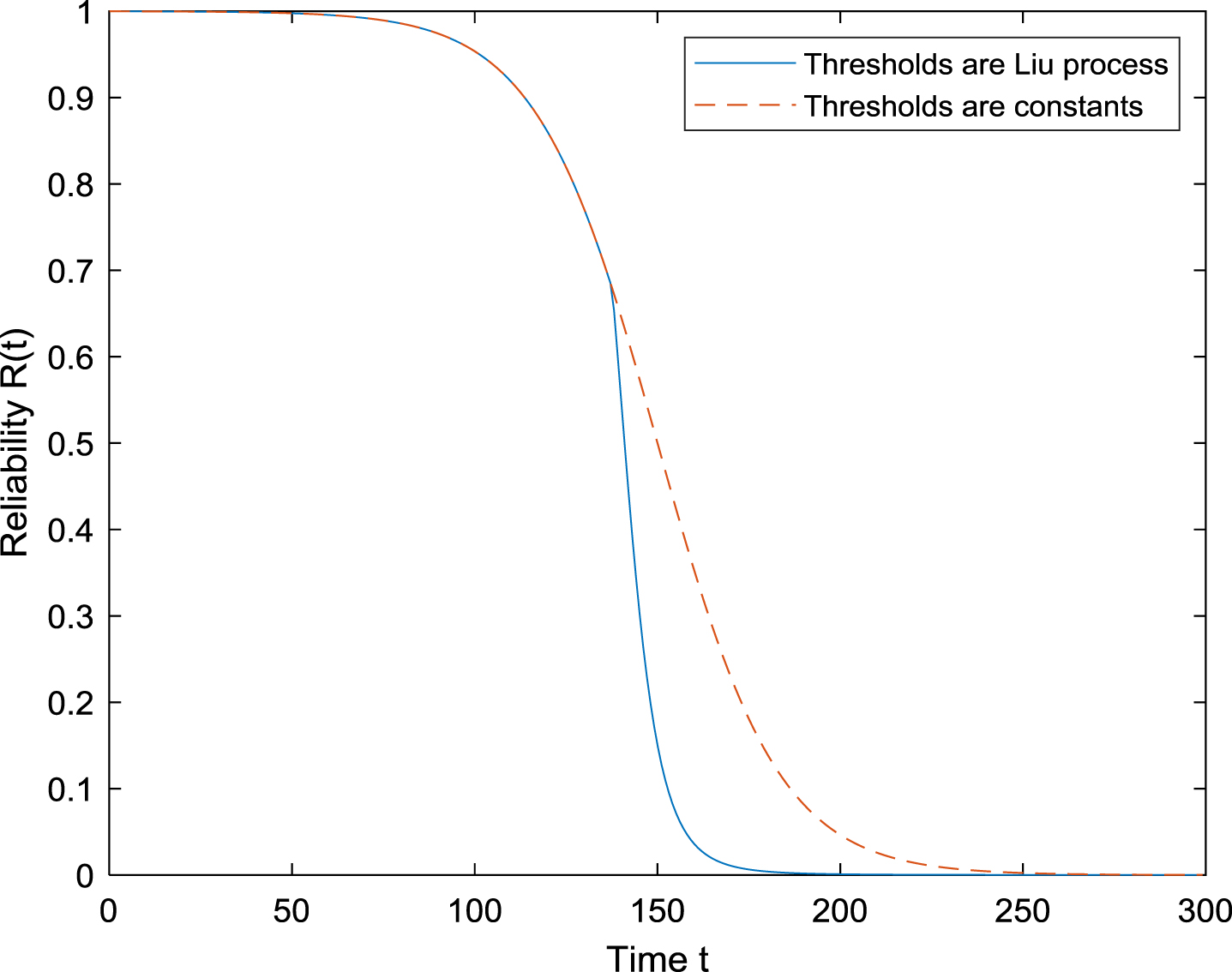
Comparison of reliability under Liu process and constants failure thresholds.
In the actual engineering environment, the failure of a complex system is often affected by many factors, mainly including internal factors and external factors. These two factors will also affect each other and jointly cause system failures. A system or device is more prone to failure over time, which is an indication that the threshold for failure changes over time or factors in the usage environment. Based on this, this paper studies the dependent competitive failure model with uncertain failure threshold in uncertain environment. This model is suitable for many applications. The internal degradation of the system accumulates over time, and a linear model is used to describe the cumulative process of degradation. When the accumulation reaches a certain level, failure occurs. The factors of the external environment are often emergent and are modeled with an uncertain renewal-reward process. If the load in the external environment exceeds a certain threshold, the system will not work properly.
According to uncertainty theory to calculate the belief reliability, relevant parameters in the reliability is studied by taking GIS as an example. The parameters in the threshold are sensitive, indicating that the fault of the substation is mainly caused by internal flashover or arc defects, which is consistent with the failure data obtained by the Norwegian power system survey. In addition, there is a difference between the reliability of uncertain process failure thresholds and the reliability of constants failure threshold. Directly treating the thresholds as constants will overestimate the reliability. Therefore, it is suggested that during the monitoring process of the model, the monitoring interval should be shorter, and the potential danger of the substation can be more accurately assessed to prevent accidents.
The disadvantage of this paper is that based on the established model, the reliability analysis is carried out in combination with actual problems. In the future, the degradation of a certain performance index of the system can be monitored by means of regular monitoring and online monitoring, and the actual data can be obtained for modeling and evaluation. Deal with potential failures and dangers in a timely manner to more accurately improve the reliability of the system.
Footnotes
Acknowledgments
This research is supported by National Natural Science Foundation of China No.71601101, Fundamental Research Program of Shanxi Province Scientific No. 20210302124310, Scientific and Technological Innovation Programs of Higher Education Institutions in Shanxi 2022L415, Shanxi Datong University Project No. 2020K9, 2021K2.