



Abstract
In recent years, with the continuous occurrence of natural disasters, people have gradually realized the importance of improving emergency response capability, and the weight of time constraints for rational allocation of emergency materials has gradually increased. Therefore, a high-dimensional collaborative allocation method of disaster materials with time window constraints is studied. A high-dimensional collaborative distribution model of disaster materials with time window constraints is constructed by combining four dimensional decision-making indexes: maximizing the satisfaction of material demand, fairness of material distribution and minimizing the total cost of expected emergency response; Build SPEA2 + SDE hybrid algorithm, solve the model and output the optimal solution set. The simulation results show that this method can have the ability of high-dimensional distribution of disaster materials, obtain the output of the optimal distribution scheme set of disaster materials, and the material satisfaction is more than 0.70. Under the condition of minimum distribution cost, the distribution of disaster materials can be completed.
Keywords
Introduction
In recent years, natural disasters have occurred frequently, among which the snow and rain and freezing disasters have caused serious losses and casualties. For example, snow disasters in Hubei Province, Jiangsu Province of Anhui Province and other regions in January 2018 have caused 10 deaths and hundreds of thousands of people have been affected. In May 2019, 29 people died in floods across the country. In 2020, freezing disasters occurred in Yunnan, Shandong and other regions, with an area of nearly 80,000 hectares and economic losses approaching 1.7 billion [1]. After the disaster, disaster relief is the most important, but because of the uncertainty, paroxysmal and destructive nature of natural disasters, disaster relief work has a great impact. Generally, the intensity and duration of natural disasters are not clear. Therefore, in order to consider the cost and the effective period of food, when storing materials, there are not a lot of materials stored, but only tents, quilts and other conventional general materials, resulting in the shortage of materials. After the disaster, people walk at the disaster site, lacking a certain sense of direction, lack of guidance and guidance, and fail to form efficient line integration, resulting in unreasonable evacuation. After a disaster occurs, the emergency materials available for allocation are often mainly based on the overall demand of the disaster-stricken areas, but the severity of disasters in different disaster-stricken areas is different, which easily leads to unreasonable distribution and untimely distribution of relief materials [2]. Especially under the time constraint, the material deployment presents high dimensional coordination. High-dimensional collaborative allocation refers to the allocation model with more than three decision-making indicators, in which emergency response time, disaster material satisfaction, material fairness and disaster loss are all part of the target content [3].
In the process of disaster relief, relief work has time window requirements and standards, the distribution and distribution of materials is a vital part. But how to ensure the rapid realization of high-dimensional collaborative allocation and distribution in the prescribed time window has become a vital part of post-disaster management. Combined with algorithms in application fields such as deep learning [4] and transfer learning [5], it can effectively improve the accuracy of capacity estimation in the process of route operation parameters and provide algorithm support for the allocation of emergency supplies. Scholars also put forward their own views, Wang Yanyan et al. [6] in order to achieve a variety of emergency material allocation, the first introduction of fuzzy uncertainty, delay coefficient to build distribution model to achieve distribution. Zheng Yanhui et al. [7] was the first to construct a two-layer model for emergency material allocation. Liu Yang et al. [8] For the first time, based on uncertainty and dynamism, the two correspond to material demand and material distribution distance respectively. The multi-stage allocation and scheduling model of multi-stage disaster relief materials is established, and the ant colony algorithm is still used to solve the model. Akbari V et al. [9] put forward the online frontier rescue and distribution method with the goal of minimizing the total waiting time of key nodes. The competition ratio is used to study the worst-case performance of online algorithm for offline optimal solution of blocking edge. The deterministic algorithm is introduced to determine the competition ratio of the optimal deterministic online algorithm, and the integer programming model is solved to complete the dynamic route assignment. Meilani D et al. [10] put forward a method about the optimal distribution route for disaster relief. Dijkstra algorithm is used to obtain the shortest distribution route that only passes through the main lane, and waterfall method is used to solve the shelter location data information, thus simplifying the distribution process of disaster relief materials. Dachyar M et al. [11] improved the information system of disaster relief distribution by using the Internet of Things, designed the business process of disaster relief distribution by using the business process reengineering method, and reduced the cycle time of disaster relief distribution process and improved the efficiency of disaster relief distribution system through entity relationship diagram and data flow diagram. All of the models mentioned above can achieve material distribution under the premise of fairness, but they pay less attention to time window constraints.
Therefore, aiming at the high-dimensional collaborative distribution of disaster materials, this paper proposes a simulation of high-dimensional distribution of materials with time window constraints. Taking the maximization of material demand satisfaction, the fairness of material distribution and the minimization of expected total cost of emergency response as the decision indicators of high-dimensional collaborative distribution, a high-dimensional collaborative distribution model of disaster materials with time window constraints is constructed. Combining the shift density estimation algorithm with the second generation strength Pareto evolutionary algorithm, the optimal distribution condition solution set is determined, the model solving process is optimized, the convergence performance of the algorithm is enhanced, and the high-dimensional collaborative distribution of disaster materials is achieved within the time window constraint.
High-dimensional collaborative distribution of rain, snow and freezing disaster materials with time window constraints
Building a high-dimensional collaborative allocation model
The construction of high-dimensional collaborative allocation model shall be based on several decision indicators, and the objective function of high-dimensional collaborative allocation of disaster materials constrained by time window shall be constructed [12]. Each indicator shall be:
(1) Objective function F1 is constructed to maximize the time satisfaction of disaster materials:
In formula (1): I, J and K both represent collections, which correspond to distribution centers, disaster spots, categories of materials, and k ∈ K. Time satisfaction is represented by λ ijk , which belongs to material k, and is from i to j, corresponding to the distribution center and the disaster-stricken point respectively. x ijk represents the judgment of the delivery situation of k, and it is equal to 1 to represent delivery, and it is equal to 0 to represent no delivery.
(2) Combined with the maximization of material demand satisfaction, the objective function F2 is constructed.
In formula (2): η jk represents the satisfaction of material demand, which belongs to i to k.
(3) The objective function F3 is constructed according to the fairness of material distribution.
In formula (3): λ j represents the degree of disaster. μ jj * represents the envy value, which belongs to the affected people in the material distribution point to the material distribution point.
(4) The objective function F4 is constructed by combining the expected total cost minimization of emergency response.
In formula (4):
In order to maximize the overall satisfaction of disaster material distribution, without referring to the above target weights [13], a high-dimensional collaborative distribution comprehensive objective function F with time window constraints is constructed:
The constraints are:
Formulas (6) and (7) represent time window constraints, in which time windows include hard time windows and soft time windows. Soft time windows can delay time and hard time windows can not delay time. The formula (8) represents the material satisfaction rate j. The formula (9) represents fairness and belongs to material distribution. The formula (10) represents the distribution standards of materials, and the quantity of materials to be distributed is less than the quantity required but not to be distributed. The formula (11) indicates that the quantity of distributed materials shall be equal to the total quantity of reserves.
In expression, a set of L-tables belonging to a vehicle and L ={ 1, 2, . . . , l }. Both t ik and t jk represent service start times, the former corresponding to j and the latter to i. s i indicates service time and belongs to j. E represents the set of valid arcs and E ={ (i, j) : i, j ∈ V, i ≠ j }. d ij ∀ (i, j) ∈ E stands for distance on (i, j). Q jk indicates the demand for k, which belongs to j. S ijk represents the quantity of k delivered, belonging to i to j. D ik represents the reserve of k and is located in i. δ represents the maximum value, which is a satisfaction difference between any two j’s.
In the case of disaster, the solution of high dimensional material dispatching and allocation model needs to realize the optimization of multiple objectives simultaneously [14]. In order to ensure the optimal solution, this paper combines Shift-based DensityEstimation (SDE) [15] with the second generation Strength Pareto Evolutionary Algorithm (SPEA2) [16] to form the SPEA2 SDE hybrid algorithm.Among them, the shift density estimation algorithm can play a leading role in dealing with multiple objectives, making the diversity maintenance mechanism play a leading role in the evolution process. Shift density estimation algorithm pseudocode.
Input: min (float X,float Y)
{ int Z;
Z = X>Y?X:Y
return (Z);
Ouput: The results of SDE.
end}
However, the preference of the second-generation Pareto evolution algorithm for individual diversity maintenance mechanism is widely distributed in the target space. A modified density estimation is developed to make the algorithm suitable for multi-objective optimization, revealing its competitiveness in balancing convergence and solution diversity. Pseudocode for the second-generation Pareto evolution algorithm:
Input: Data initialization,
Ouput: The results of SPEA2.
1 x = (x1,x2,x3, \dots ,xn)
2 f(x) = 1
3 dis Matrix = Cal Distance to Others (A);
4 EISE
Delete(second);
END IF
END WHILE
At the same time, in order to improve the solution process, the SPEA2 + SDE hybrid algorithm does not deal with constraints. The hybrid algorithm is further optimized based on the adaptive individual correction to ensure the performance and effect of the SPEA2 + SDE hybrid algorithm when the processing is changed to multi-objective constraints.

Flow chart of construction of shift density estimation algorithm.
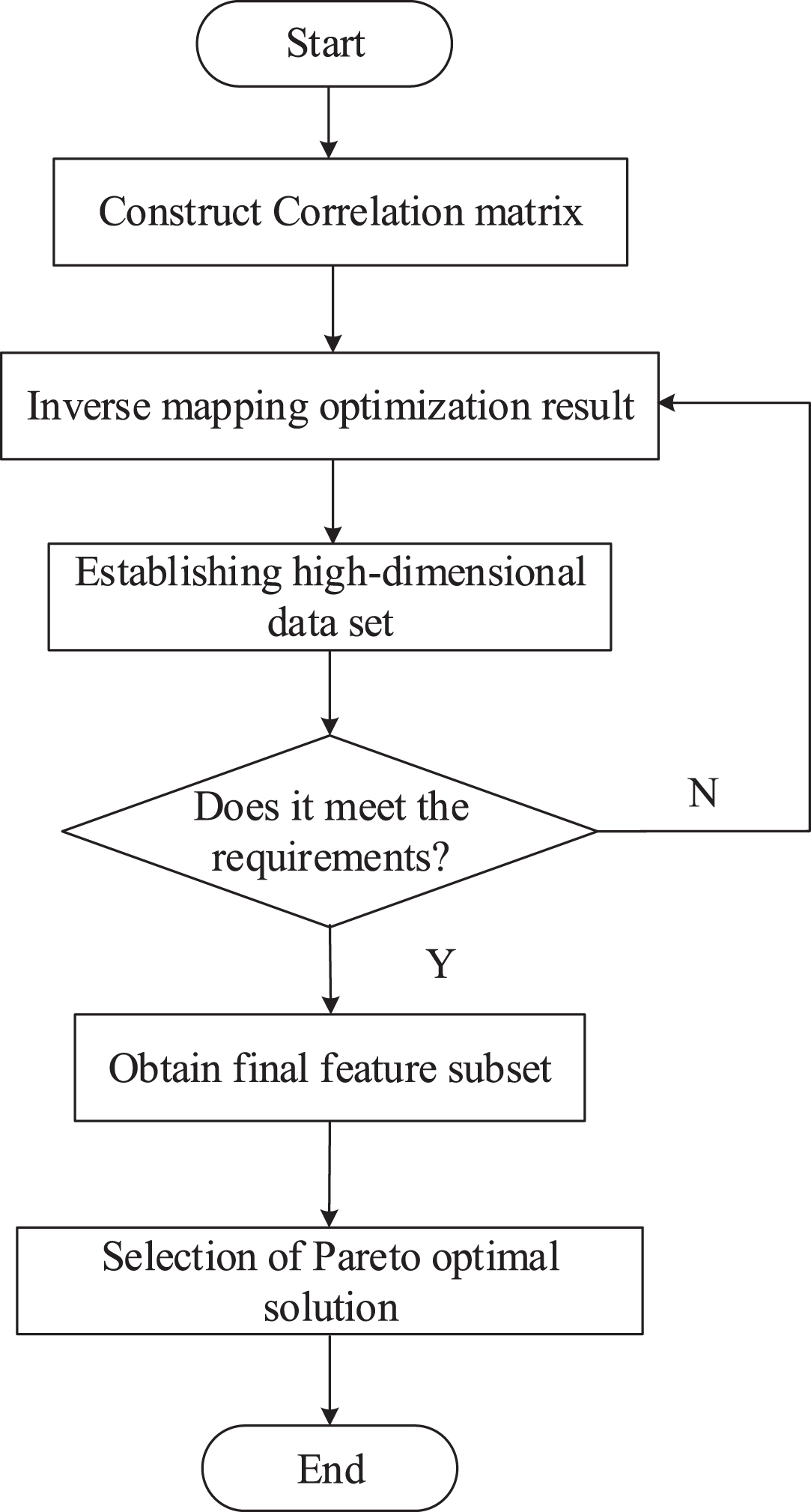
Flow chart of constructing the second generation strength Pareto evolutionary algorithm.
The hybrid algorithm consists of two parts, one is population evolution and the other is external population. The number of individuals contained in the two are N and N′, respectively. The detailed steps are as follows:
(1) Set the initial number of iterations for solving the model, t = 0, and the generation of the population is based on the content to be solved, which is set as the optimal distribution target in this paper. And it contains two kinds, one is the initial evolution, the other is the external, which are represented by Q
t
and
(2) Determine whether the delivery time t reaches the maximum. If it is, stop and output the optimal solution set, which belongs to the incapable individual and is located in
(3) To solve for the values that belong to each delivery condition and lie on the objective function. It needs to be done in terms of coding and multi-objective functions, and belongs to N and is located in Q t .
(4) The distribution solutions of Q
t
and
(5) V
t
is treated with fitness assignment: x represents the individual in V
t
, and S (x) represents the intensity value corresponding to it. And use it to represent the number of delivery solutions that can be dominated by x delivery, the calculation formula of S (x) is:
Based on this, in order to obtain the fitness value of x, and it is the original value, the niche method is used to complete. This value can be used to describe the sum of S (x), namely:
The formula for calculating the crowding degree belonging to x is:
In formula (14): with x as a reference, the individual distance from its optimal solution is represented by
To obtain the distance from individual x to y, the position of y needs to be shifted. And it is completed according to the dominant relationship of the objective function, and then the Euclidean distance between the two is solved:
In formula (15): the convergence of x decreases with the decrease of the value of
(6) Choose V
t
’s hazard environment: Copy the unmanageable individuals in V
t
into a new external population
(7) The max - min normalization process
(8) Selection is performed on
(9) The newly evolved population
(10) At time t = t + 1, go back to step (2). Judging according to the delivery conditions in step (2), determine the output of the optimal delivery condition solution set or continue to iterate.
In order to guarantee the performance and effect of SPEA2 SDE hybrid algorithm, the hybrid algorithm is further optimized based on adaptive individual modification.Firstly, two populations of evolution and exterior were initialized according to 2D vector coding, and the individuals were modified according to the initialization results. Then assign the fitness, select the adaptive individual modified SPEA2 SDE hybrid algorithm environment, cross-selection after the polynomial difference.Verifies that the termination criteria are met and, if not, returns to the initialization phase until the termination criteria are met. After satisfying the output of all the undominated individuals to achieve SPEA2 SDE hybrid algorithm optimization.The flow is shown in Fig. 3.
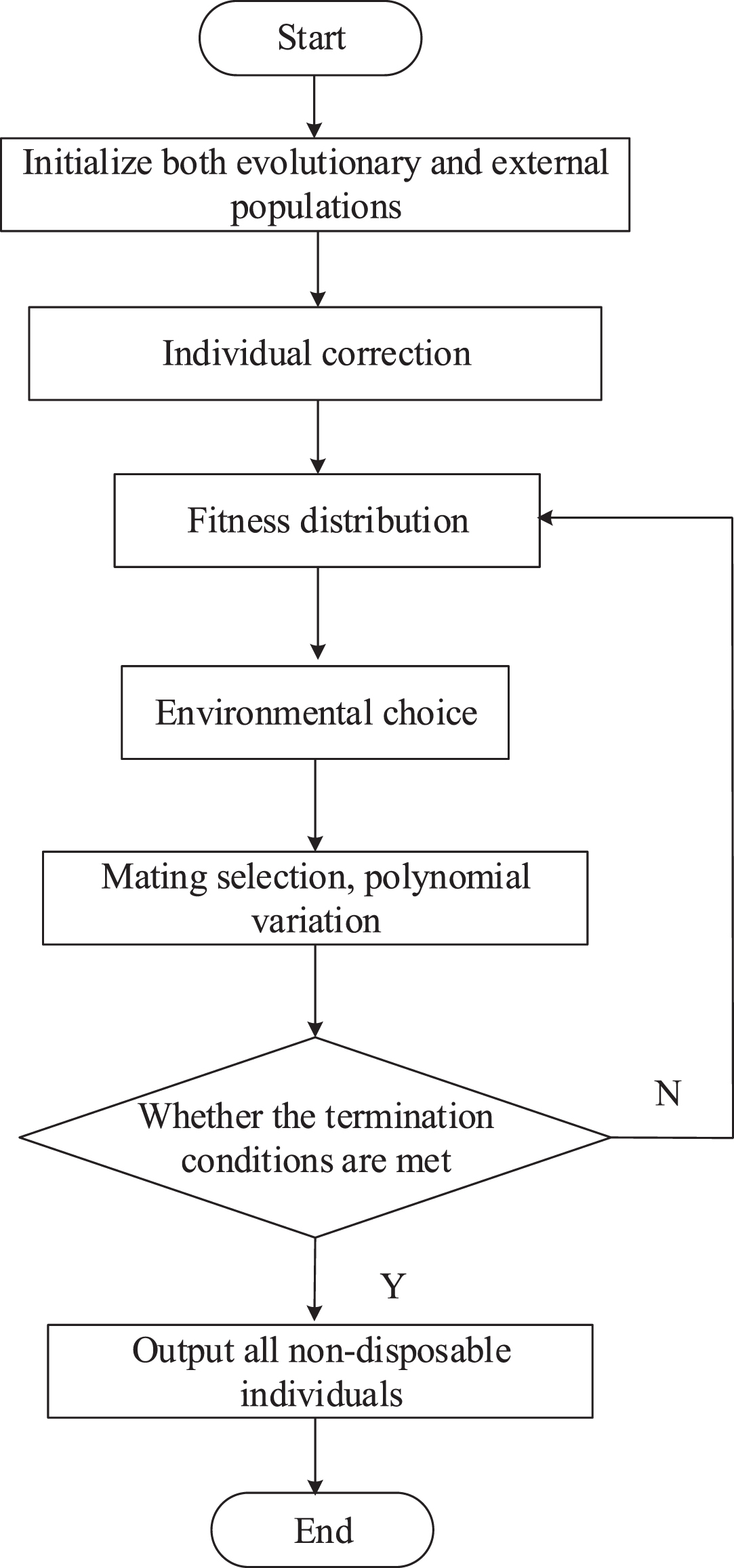
SPEA2 + SDE hybrid algorithm based on adaptive individual correction.
Two-dimensional integer vectors are used to generate evolution and exterior populations, and the modification of combinatorial populations is completed within the constraint space, so that each individual is feasible. The objective function of each individual is solved by formula (5) and the fitness is allocated simultaneously. To generate a new external population, complete by selecting the environment of the combined population [20]. On this basis, a new evolutionary population is generated. When the termination condition is satisfied, the output results are all undominant individuals and belong to the outside population. Conversely, the evolutionary population is modified to make it feasible and the algorithm continues to evolve. It can provide more accurate and reliable heuristic information and enhance the convergence performance of the algorith.
In order to analyze the distribution performance and effect of this method, according to the rain and snow freezing disasters in Anhui Province in 2017, 2018 and 2019. MATLAB R2016a software is used for simulation test in the environment with the main frequency of 1. Set up a real-time simulation platform based on the simulation parameters in Table 1.
Simulation parameter settings
Simulation parameter settings
The real-time simulation process includes five steps, specifically:
Step 1: In Matlab environment, Python is used to compile the data information conversion program, build the corresponding simulation model of disaster materials collaborative distribution at each demand point, and input the simulation parameters to complete the numerical simulation.
Step 2: Solve the fitness value of each distribution condition by using the individual distance of the optimal solution.
Step 3: Write an interactive communication protocol through Java, unify the code format of oscilloscope and upper computer, and facilitate information exchange and data sharing of high-dimensional collaborative distribution of materials.
Step 4 Upload the channel information of the oscilloscope to the upper computer.
Step 5: Real-time simulation proves.
Anhui State Grid Power Company is headquartered in Hefei, Anhui Province, with its center connected to 15 cities in the province, namely Anqing, Bengbu, Bozhou, Chizhou, Chuzhou, Fuyang, Huaibei, Huainan, Huangshan, Luan, Maanshan, Tongling, Wuhu, Suzhou and Xuancheng. There are 87 organizations and institutions for disaster emergency protection. There are 6, 8, 5, 4, 5, 7, 7, 2, 4, 6, 7, 4, 3, 5, 7 in each city. The above 87 institutions are defined as material demand points (disaster material distribution terminus). Among them each city has a headquarters organization dot.
Simulating the freezing of rain and snow in mountainous areas of Anhui Province, and the falling and breaking of transmission lines in 4 cities of Huaibei, Fuyang, Anqing and Hefei. According to the application of emergency materials in 16 material demand points in recent three years, disaster materials distribution was carried out. The results of material allocation for each material demand point and the capacity of vehicle transportation time window are tested. There are 10 kinds of materials in the simulation process, including box-type substation, ring cage, circuit breaker, power cable and overhead insulated conductor, etc. Combined with historical disaster material requisition, the material requisition of each material demand point and the corresponding time window information are shown in Table 2. Due to limited space, only the results of the material needs of the city headquarters.
Demand point material demand and time window information
As can be seen from the data in Table 2, Anqing and Hefei have been the highest users of emergency supplies in the past three years. Huaibei, Fuyang and other five cities followed by emergency supplies. At the same time, according to the distribution situation in recent three years, the time window types of each material demand point are set. The results show that the method of this paper can simulate and calculate the disaster material allocation of each material demand point according to the historical disaster material allocation results.
In order to intuitively analyze the advantages of the method of this paper, reference [6] method, reference [7] method and reference [8] method are used as comparison methods. Time window penalty and material satisfaction are used as measures. The smaller the result of time window penalty is, the higher the material satisfaction is. Test the results of 16 material requirement points after 4 methods of allocation, as shown in Fig. 4.
According to the test results in Fig. 4, that the time window penalty results of the method of this paper are all less than 105, and the lowest value is 34. However, the lowest value of the time window penalty of reference [6] method is 152, that of reference [7] method is 137, and that of reference [8] method is 143. The time window punishment results of the three comparison methods are higher than those of the method of this paper. At the same time, the material satisfaction of the method of this paper at each material demand point is higher than that of the other three comparison methods, and the average satisfaction is about 0.91. However, the average satisfaction of reference [6] method is about 0.62, that of reference [7] method is about 0.61, and that of reference [8] method is about 0.63. Therefore, the practical application effect of the proposed method is better.
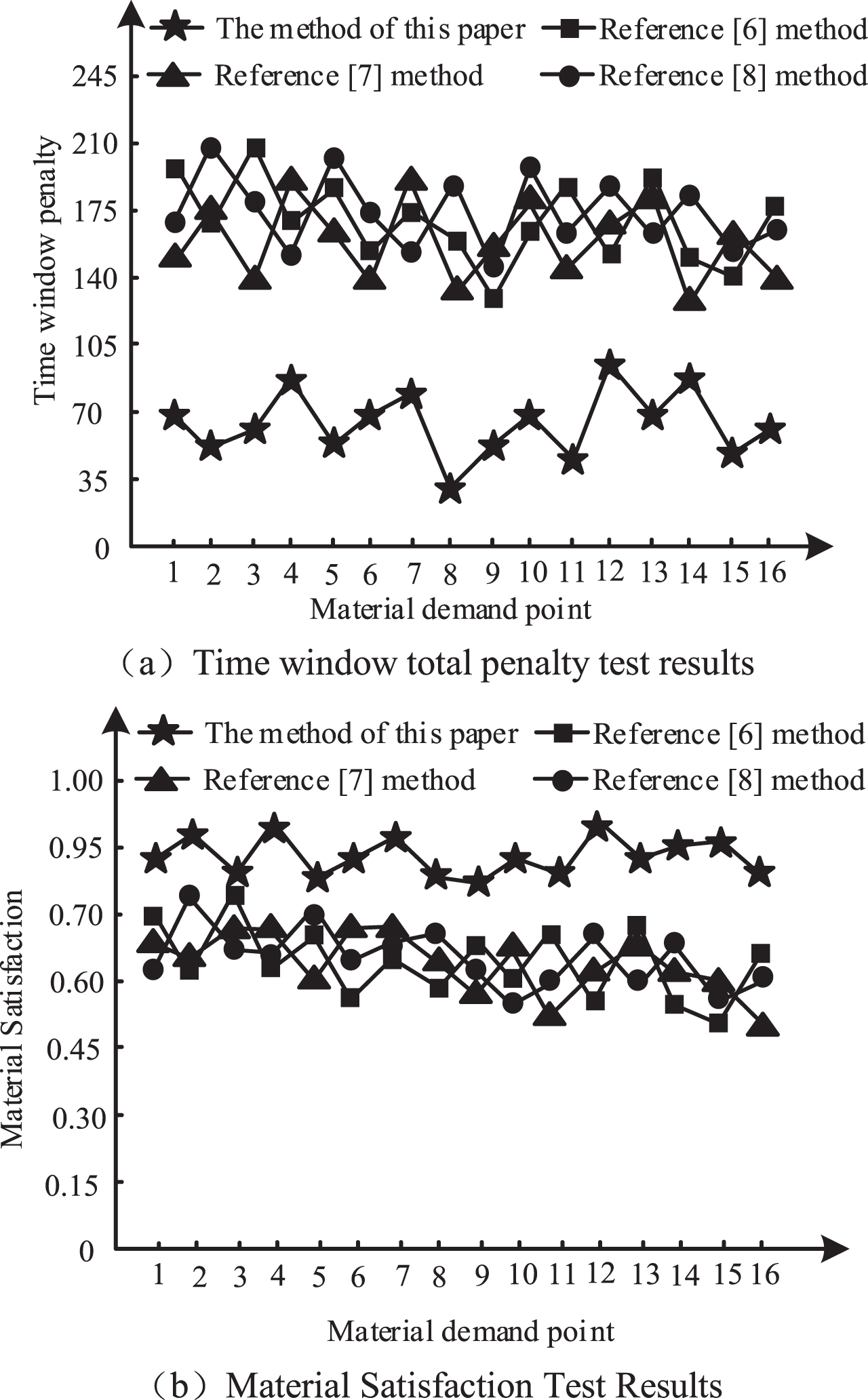
Material distribution and shipping test results.
In order to test the performance of the optimized method in this paper, the convergent speed is taken as the standard. The formula is as follows:
In the equation, n represents the convergent quantity of high dimensional synergetic distribution of rain-snow and ice disaster materials. a b represents the actual number of convergences. a b represents the number of predictive convergences.
According to the formula, the convergence rates of this method, reference [6] method, reference [7] method and reference [8] method in different iteration times are tested, and the results are shown in Fig. 5.
According to the test results in Fig. 5, it can be seen that the convergence speed of the three methods gradually increases with the increase of iteration times. The convergence speed of the method of this paper is fast, and the convergence speed can reach 9.0 m/s when the number of iterations is 180. However, the convergence speed of the method of reference [6] method is 6.9 m/s, that of reference [7] method is 8.3 m/s, and that of reference [8] method is 5.2 m/s. At the same time, the convergence fluctuation of the method of this paper is relatively gentle, and the convergence fluctuation of the three comparison methods is relatively large. The test results show that the method of this paper can complete the convergence faster and has better convergence performance.
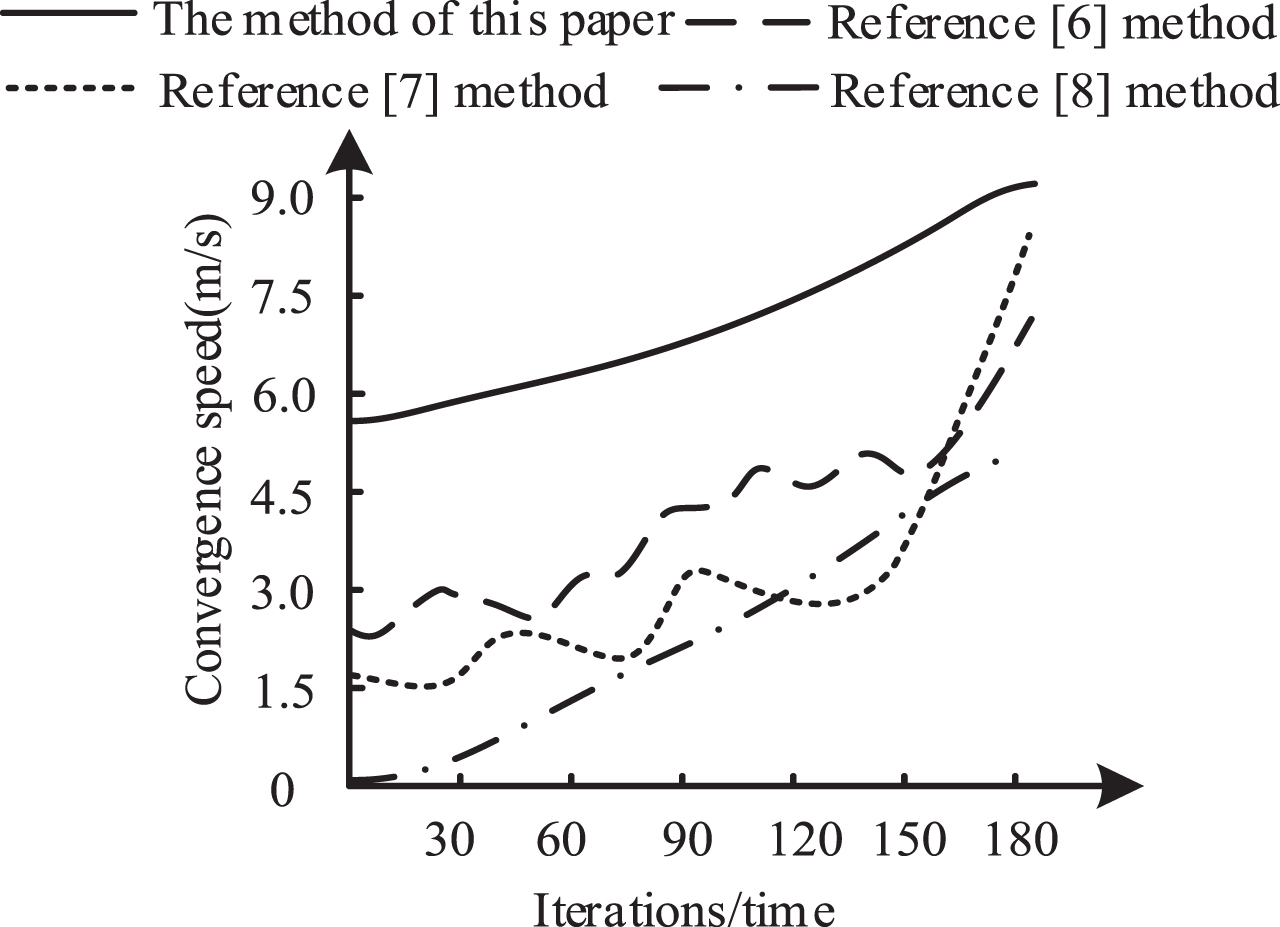
Algorithm convergence test results.
In order to test the material distribution effect of the method in this paper, the shortest distribution path is used as the criterion to obtain the distribution results of disaster materials of the four methods. Based on the previous description, the implementation process of the shortest distribution path for high-dimensional collaborative distribution of rain, snow and freezing disaster materials with time window constraints is as follows:
Step 1: The high-dimensional cooperative distribution of materials establishes an m×n material-distribution item delivery matrix.
Step 2: Computes the similarity of shortest delivery path targets between neighborhoods. And according to the target’s satisfaction degree and fit degree of the shortest delivery route, similar neighborhood sets are planned.
Step 3: Establish a shortest distribution path list for high-dimensional collaborative distribution of rain, snow and freezing disaster materials, and realize the selection of the shortest distribution path for distribution.
The comparison results of different methods are shown in Fig. 6.
According to the test result of Fig. 6, taking Hefei as the distribution center and the starting point of material distribution, the method of this paper completes material distribution through reentry and repeated paths, and the paths are continuous. In the other three methods, there are regression phenomena in different degrees in the process of material distribution. Therefore, the method of this paper can better complete the distribution of disaster materials. This is because, based on a variety of decision indicators, the method of this paper constructs the objective function of high-dimensional collaborative distribution of disaster materials with time window constraints, which can realize the high-dimensional collaborative distribution of materials with time window constraints to a certain extent, and then optimize the path planning.
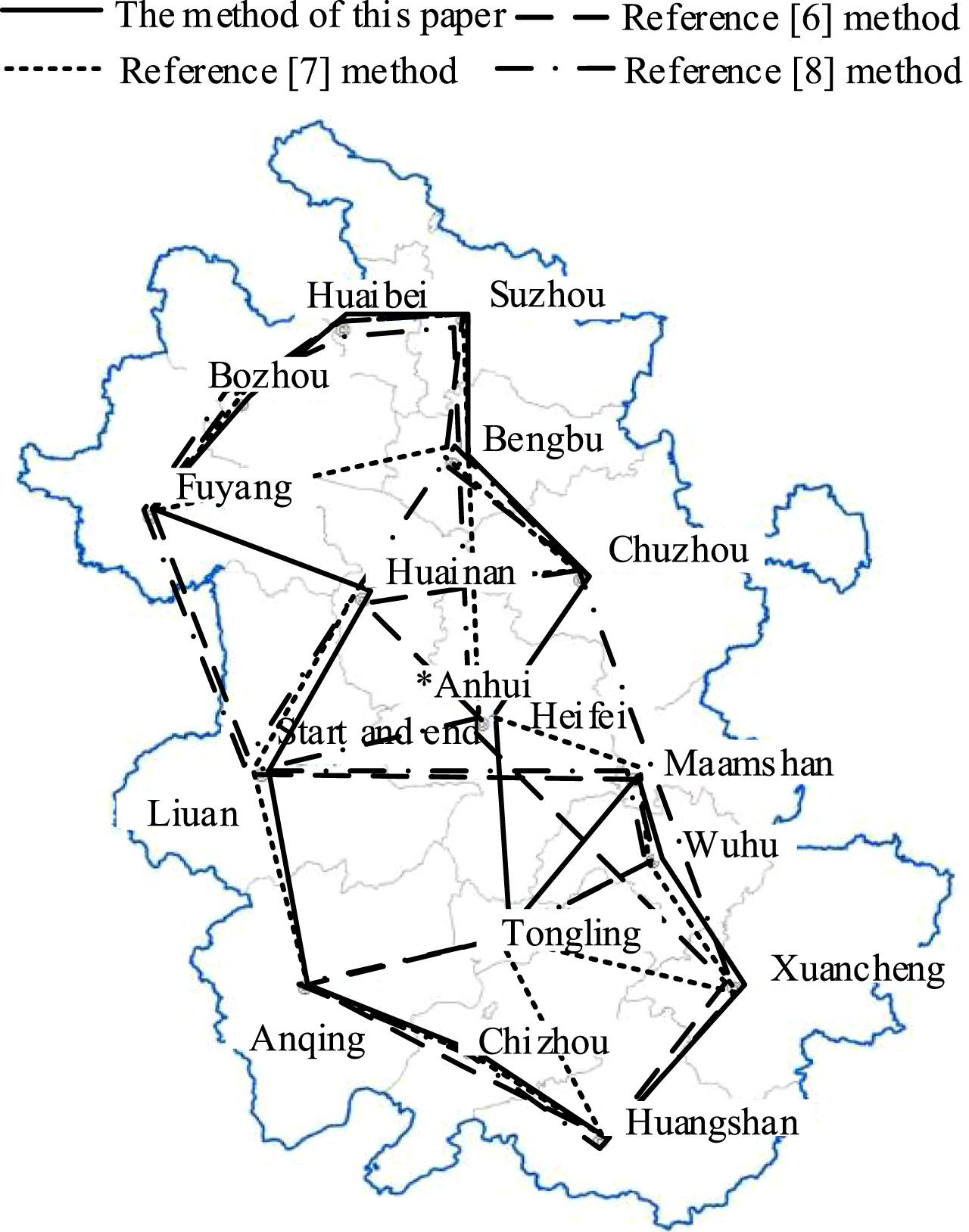
Simulation results of disaster material distribution based on the method in this paper.
In order to ensure the reasonable and rapid distribution of disaster materials and minimize the response of each department and distribution link, the high-dimensional distribution simulation of disaster materials is studied. Through the simulation of material distribution, to ensure this winter and next spring disaster material supply. Simulation results show that the proposed method has the ability of high-dimensional allocation of disaster materials, and obtains the allocation scheme set. The result of material distribution is reasonable. The material distribution is completed in soft and hard time windows, and the satisfaction of each disaster site is high. The best distribution route can be obtained to ensure the timely and efficient distribution of materials in the case of freezing rain and snow. However, due to the limited research time and research conditions, this paper did not consider the situation that the shortage of materials could not meet the needs of various disaster stricken areas, nor did it consider the impact of road damage after the disaster on the route of emergency materials distribution vehicles. Therefore, in the later research, it is necessary to improve and optimize the existing research models and methods, further consider the problem of vehicle route planning in emergency materials shortage, the influence of road damage on vehicle route problem under time window constraint, and more comprehensively consider the planning and decision-making of dynamic scheme in disaster evolution.
Footnotes
Acknowledgments
The study was supported by State Grid Corporation of China – research and application of key technologies for safe production management and control of substation operation and maintenance based on video semantic analysis (Project No.: 5227221001z).
Conflicts of interest
Considered no such competing interests exist so therefore not applicable.