



Abstract
Recent research emphasized the utilization of rechargeable wireless sensor networks (RWSNs) in a variety of cutting-edge fields like drones, unmanned aerial vehicle (UAV), healthcare, and defense. Previous studies have shown mobile data collection and mobile charging should be separately. In our paper, we created an novel algorithm for mobile data collection and mobile charging (MDCMC) that can collect data as well as achieves higher charging efficiency rate based upon reinforcement learning in RWSN. In first phase of algorithm, reinforcement learning technique used to create clusters among sensor nodes, whereas, in second phase of algorithm, mobile van is used to visit cluster heads to collect data along with mobile charging. The path of mobile van is based upon the request received from cluster heads. Lastly, we made the comparison of our proposed new MDCMC algorithm with the well-known existing algorithms RLLO [32] & RL-CRC [33]. Finally, we found that, the proposed algorithm (MDCMC) is effectively better collecting data as well as charging cluster heads.
Keywords
Introduction
The Rechargeable Wireless Sensor Network (RWSN) is a mixture of multiple sensors used for monitoring purpose along with sensed data collection in mesh environment. Generally, sensors sense the data and route to sink/end user through direct or in hop manner. The RWSNs uses rechargeable battery when compared to traditional WSN. Now it is possible to charge these batteries in remote location also. The data collection model along with mobile charging is really needed of the time. The data collection model used to work traditionally (single hop & multi-hop) along with newly deployed techniques like mobile data collection based upon mobile sink whenever the distance from the sink to base station is too long. The mobile sink follows the dynamic path developed by base station as per the data collection request generated by cluster heads. The charging of sensor batteries is based upon wireless power transfer technology. That falls into two categories: static and dynamic charging. In static charging, the mobile chargers follow the scheduled path from base station to all sensor nodes for charging purpose. Whereas in dynamic charging, the mobile charger performs on demand charging [31]. Nodes in the sensor network whose power is below a threshold value, sends a request to base station for emergency charging then the base station immediately sends mobile charger to the location of sensor node for immediate charging purpose. The data collection and mobile charging are both inter-dependent. The sensor nodes mainly lost their energy due to transmission of data; this situation is overcome by using mobile chargers which increases the performance of rechargeable sensor nodes while transmitting data. In the proposed algorithm mobile data collection and mobile charging (MDCMC), mobile van collects the data and charges the sensor nodes at the same time.
In this research study, we proposed a novel MDCMC algorithm to use mobile van for data collection and mobile charging purpose. The following are the contributions made in this paper: In this research study and simulation, we used reinforcement learning to elect cluster heads. Now the mobile van can collect the data from cluster head and the sensor nodes are instantly charged. The mobile charger uses dynamic charging to provide on-demand power. Sensor’s nodes whose power is below a certain value, sends a request to base station for emergency charging then the base station immediately sends mobile charger to the location of sensor node for immediate charging purpose. The result compared to existing algorithms on the basis of packet delivery ratio (PDR), charging efficiency and maximum service time.
Literature review
In [1], Y. Wang et al. proposed CRCM (Combined Recharging & Collecting Data Model) to make a RWSN. Here, authors gathered information and charged sensor nodes in accordance with a suggested design. In [2], T. D. Nguyen et al. created the Mobile Device Scheduling Algorithm (MDSA) after concentrating on the Periodic Energy Replenishment & Data Collection with Multiple Sinks (PERDCMS) problem. This algorithm uses mobile sinks to collect data from sensor nodes and charges a finite number of sensor nodes. In [3], J. M. Yi et al. proposed drone as a mobile sink which collects data from sensor nodes to remove hot spot issue. This proposed algorithm removes the blackouts of sensor nodes. In [4], K. Karunanithy et al. suggested an IOT-based Location Point (LP) that is used to choose a Cluster Head (CH) that specifies the continuity of CHs and then increases energy efficiency with BYPASS beacon-based geographic routing that is designed to deliver data towards a sink. In [5], J. M. Etancelin et al. proposed Decentralized Algorithm under Connectivity constraint with mobility for Coverage and Lifetime Maximization (DACYCLEM), which is used to improve the lifetime along with coverage. In [6], A. Lakhan et al. proposed novel algorithm which contains various fog sensor nodes, this illustrates the deep-learning Q-network based resource allocation that resolves the problems.
In [7], J. D. Abdulai et al. proposed mDBEA (modified distance-based energy-aware) routing protocol, this extends the life of the network while saving energy. In [8], D. Prasannababu et al. proposed ASSO (adaptive social ski driver optimization) algorithm on the basis of the optimal outcome. Multiple mobile chargers create the charging path to demonstrate partial charging. In [9], M. Khalily-Dermany et al. suggested a multi-attribute-based Technique for Order of Preference by Similarity to Ideal Solution (TOPSIS), where the mobile sink gathers features of potential sites and compares them using fuzzy logic technique. After gaining this information, now mobile sink moves towards sites for collecting data. In [10], M. Kunjir et al. proposed MDP based RL model to clearly take the issue of traffic in real time world. We can take these finding to propose mobile sink and mobile charging path. In [11], C. Lin et al. proposed 3D WRSN charging model which also works on UAV to save energy. This is a cost-effective solution towards provable approximation ratio. In [12], Q. Wang et al. proposed sub network of WSN based upon local optimization issue. This charging path is based upon dynamic network topology. This approach is useful only for small scale WSN. In [13], H. Liu et al. proposed algorithm which is based upon the requirements of critical sensor node’s energy issue. The node’s connectivity issue is also taken care in this research study.
In [14], G. Liu et al. proposed a novel epidemic model SILS (Susceptible Infected Low-energy, Susceptible). The results are then compared with sensor nodes of non-optimal control group to finally observe the lower energy cost. In [15], N. W. Najeeb et al. proposed algorithm which works without having the prior power knowledge and without exploration of whole network. Now chargers can reach only to required portion of sensor network without visiting to whole network. In [16], A. A. Kamble et al. present a study on path optimization strategies in this paper. Authors conduct a thorough investigation based on a number of factors. In [17], a survey of different path selection algorithms for mobile sinks is presented by V. Agarwal et al. In [18], C. Thomson et al. provide a simple MAC layer solution called “Dynamic Mobility and Energy Aware Algorithm (DMEAAL)”. This approach, as opposed to earlier ones, balances energy consumption across individual nodes without increasing overall energy consumption. In [19], an innovative mobile sink-based data gathering protocol is presented in this paper by S. Roy et al. In terms of lifetime of network, consumption of energy, packet-delivery ratio, and end-to-end delay, the proposed protocol outperforms existing protocols. In [20], O. Banimelhem et al. presents a principal component analysis (PCA)-based algorithm for generating paths for the mobile sink. Based on simulation results, the proposed approach increases average remaining energy and live nodes in WSNs.
In [21], an innovative hybrid neural network-based routing technique using rendezvous points is presented by C. S. Gowda et al. in this study. The simulation findings demonstrate that, in terms of energy-use, throughput, packet loss ratio, packet delivery ratio, delay, latency, jitter and network lifetime, the proposed methodology outperforms the prior approaches. In [22] S. Yalçın et al., for burst traffic awareness, the paper presents a heterogeneous clustered WSN-based adaptive mobility scheme.
In [23] S. Jain et al, a novel “event-driven virtual wheel-based data dissemination scheme (EDVWDD)” is presented in this paper. EDVWDD performs better than existing techniques in terms of delay of data delivery and consumption of energy. In [24], for extending the life of networks, the T. C. Hung et al. proposed combining colony-optimization algorithm, MS and ACO routing methods named as LEACH-CACO. LEACH-CACO saves energy and extends network lifespan, according to simulation results. In [25], this survey article S. Kim et al. explains the significance of mobile sinks in WSNs. In [26], X. Wu et al. proposed an end-to-end strategy for collecting data. As a result of the experiments, it has been demonstrated that the proposed e-2-e strategy can improve lifetime of network and total consumption of energy, as well as the failure rate. In [27] S. Yalçın et al, this study proposes a new clustering and routing scheme named TEO-MCRP. The simulation results demonstrate that the proposed protocol outperforms the existing ones in terms of consumed energy in the network, network life, packets received by base station and end to end delay compared to existing methods. In [28] R. K. Verma et al, in this paper, an energy and delay efficient data acquisition technique is proposed in the form of EDEDA. A proposed routing algorithm achieves higher throughput and energy efficiency than existing routing protocols. In [29] M. Srinivas et al, the article presents a method for identifying the optimal set of MS for scheduling data packets. A proposed routing algorithm achieves improved packet delivery ratio and throughput. In [30] S. Jain et al, Hierarchical routing protocols are presented in this paper for event driven and query driven scenarios for data transmission.
An innovative approach for wireless charging and mobile data collection for rechargeable WSNs was proposed by M. Zhang et al. in [34], which makes use of self-organizing map (SOM) based on unsupervised learning. This approach can decrease the mobile sink’s travel expenses while simultaneously increasing the sensor nodes leftover energy. Joint Mobile Wireless Energy Transmitter and Data Collector (J-METDC) is a highly effective algorithm proposed by D. Prasannababu et al. in [35]. The spectral clustering technique is used to divide the network, and the cat swarm optimization algorithm is used to determine the best order in which to recharge individual sensor nodes, both of which are utilized by the proposed J-METDC algorithm. This algorithm extends the battery life of the Mobile Element by picking the best times to gather data and charge it.
In [36], X Wang et al. proposed a sleep scheduling system for compressive data collecting in WSN (RLSSA-CDG) based on reinforcement learning. The proposed algorithm employs a mode-free Q learning algorithm to seek optimal choice strategies, and a finite Markov decision process to pick active nodes. Energy usage, network longevity, and data recovery error are all improved by the proposed RLSSA-CDG method. An effective technique of recharging a wireless sensor network was proposed by I. Vallirathi et al. in [37]. This approach extends the network’s useful life by minimizing charging times and conserving sensors remaining power. Tzung Shi Chen et al. in [38] offer dual side charging solutions for Mobile Charging Robot (MR) traversal planning that reduce the MR traversal path length, energy consumption, and completion time. The suggested method is superior in three areas: energy savings, reduced overall distance, and shortened completion time for MR in WSRNs.
System model
The system model for this research study is proposed to operate mobile data collection and mobile charging (MDCMC) algorithm. The mobile van contains mobile sink and mobile charger. It travels from base station to the desired location of sensor nodes. Each rechargeable sensor RSi initially filled with Eo energy. The group of sensor nodes knows as cluster and its elected leader known by cluster head. Mobile van used to arrive at the centre of cluster to collect the sensed data and sensor nodes are charged one by one. This system model is based upon certain notations shown in Table 1.
Notations
Notations
The components of Sensor node contain the following: Sensing Unit Processing Unit Communication Unit Mobility Unit Power Unit Other optional units
Working sequence of MWSN
Installation of all units Topology deployment Sensing period Data Collection & Filtering Information traversal to sink
Research questions
The problem area highlighted where we have pointed out the below research questions, are as follows: How to collect the data in MWSN? How to charge the Mobile Nodes?
Research assumptions
We have made following assumptions in this research study: All the deployed mobile wireless sensor nodes are dynamic and homogeneous. The initial energy is equally set for all MWSN nodes.
The following Fig. 1 representing MWSN Technologies and their usage –

MWSN Technologies and their usage.
The network model for our proposed algorithm is closely tip up with our Mobile Van which contains mobile data collection and mobile charger. Initially, sensor nodes are divided into four clusters by reinforcement learning. The cluster heads are elected as per the leach equation. Whenever the sensor nodes discovered that their leftover energy was below the threshold level, the charging request goes to base station. The base station releases mobile van for charging as well as data collection only after receiving of certain number of requests. The mobile sink also collects cluster heads data. This process is shown in Fig. 2.

Summary of the proposed work.
We used the first radio energy model as the base energy model in this work to predict the outcome of energy consumption. Transmission and reception are the two main categories of energy consumption. The transmission of an l-bit message is represented by equation 1 (energy consumption):
Where E elec displays the amount of energy used. ɛ fs and ɛ mp target the variable for model of free space along with multi path model. The equation 2 calculates the energy consumption at reception mode.
This part of research study highlights sensor node’s clustering, cluster head formation and proposed traversal path for mobile van.
Clustering of sensor node by reinforcement learning and traversal of mobile van
In the reinforcement learning, the sensor nodes act as agent of learning. These agents monitor the nearby node’s energy level and utilize the temporal difference technique to understand the network environment. MDP (Markov Decision Process) also helps in this process by using key elements state, action, reward & policy. The above Fig. 3 represents the clustering of WSN nodes.
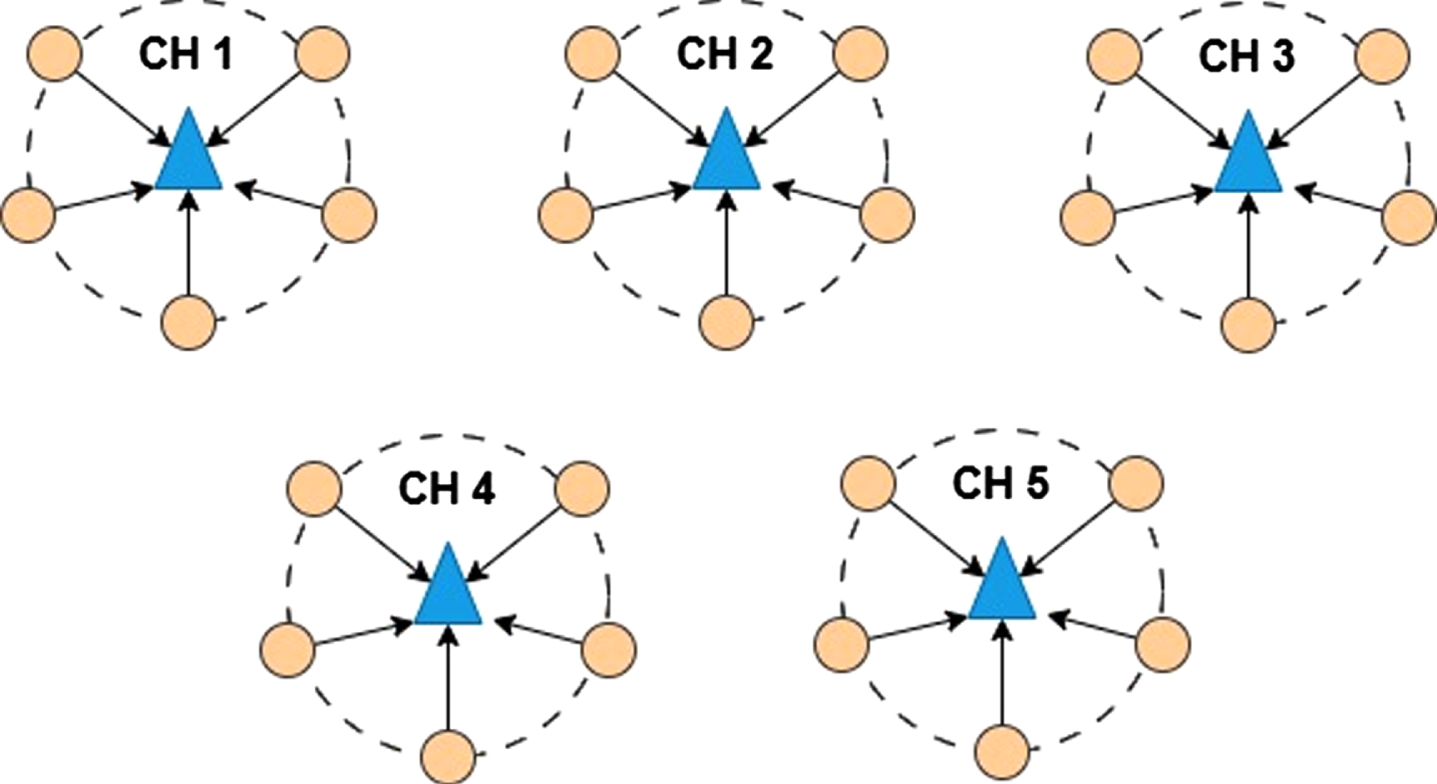
Clustering of WSN nodes.
Based on the simulation parameters listed in Table 2, we have simulated our suggested algorithms 1 and 2 in this section. Contiki Cooja Simulator has been used for the extensive simulation.
Simulation parameters
Simulation parameters
The sensor node clustering achieved after executing the simulation parameters specified in Table 2. The Fig. 4 represents the clear random position of sensor node’s cluster.
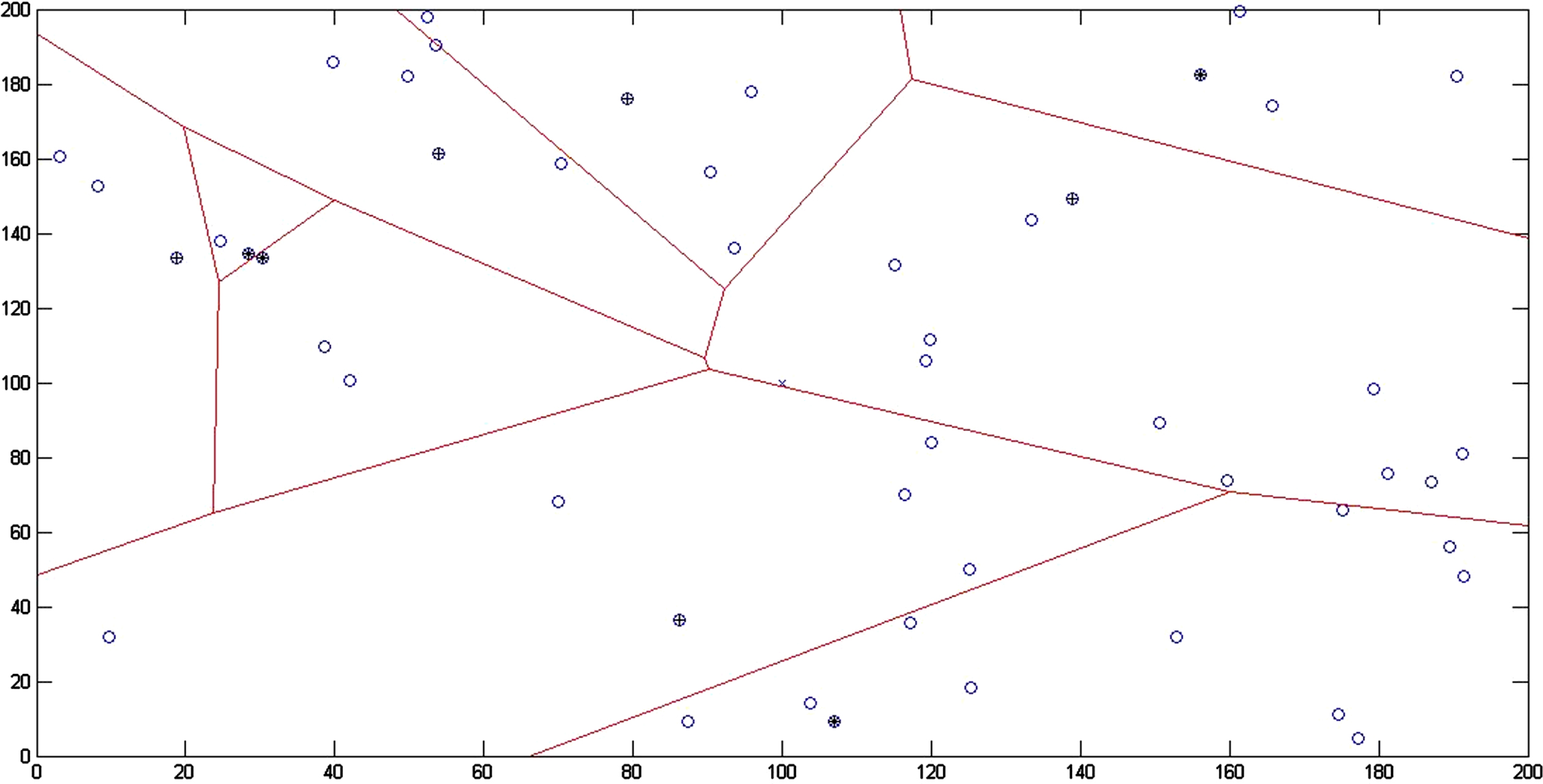
Clustering of Sensor Nodes.
The mobile van starts traversing after the creating of traversal path. During traversal, Mobile van collects the data from cluster heads and charges the sensor nodes one by one as per figure 5. Mobile van traversal path where cluster heads (black circle) requested for data collection purpose are shown in Fig. 6. Whereas mobile van traversal path where sensor nodes requested for mobile charging have been shown through Fig. 7.
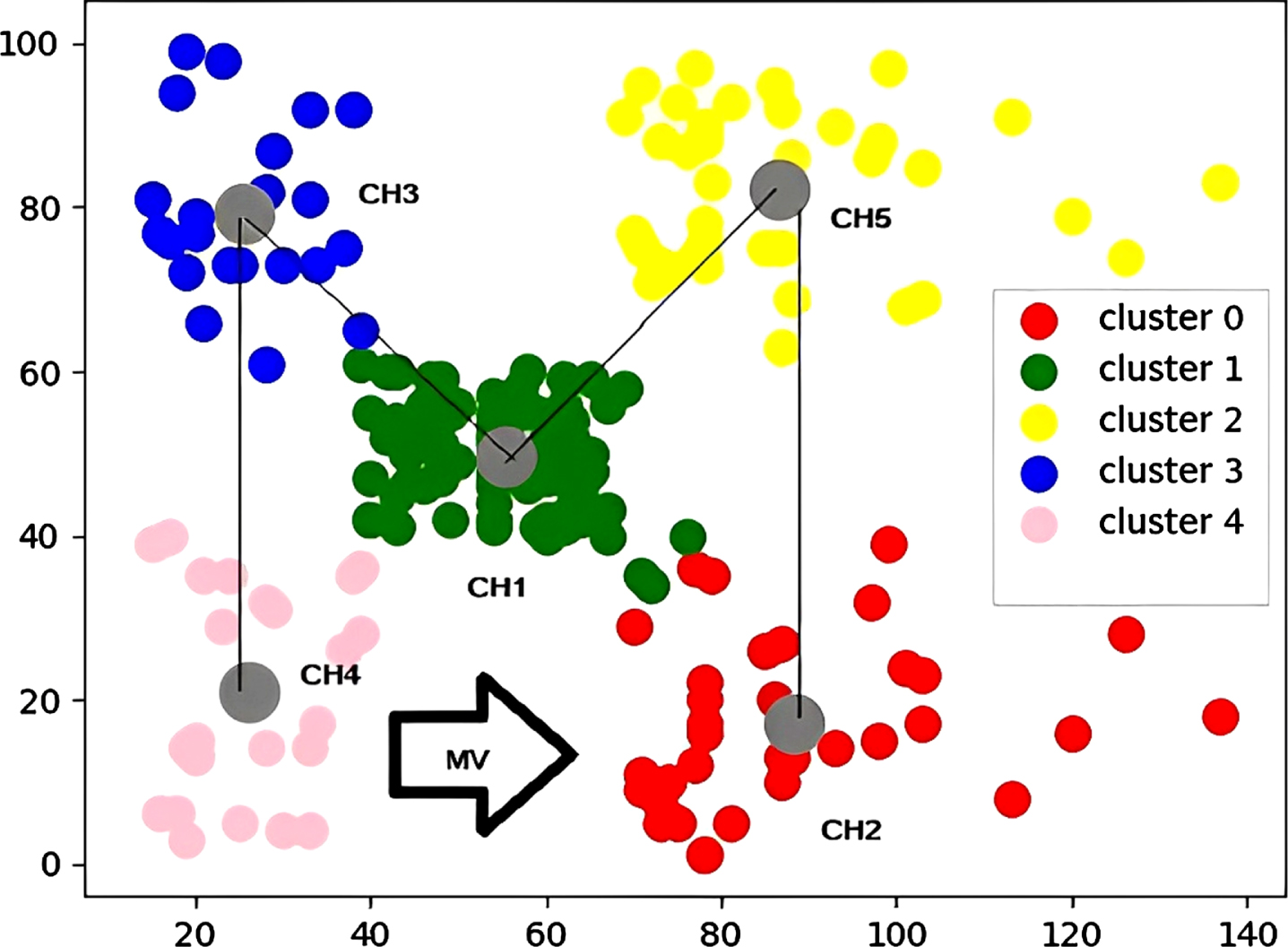
Mobile Van Traversal.
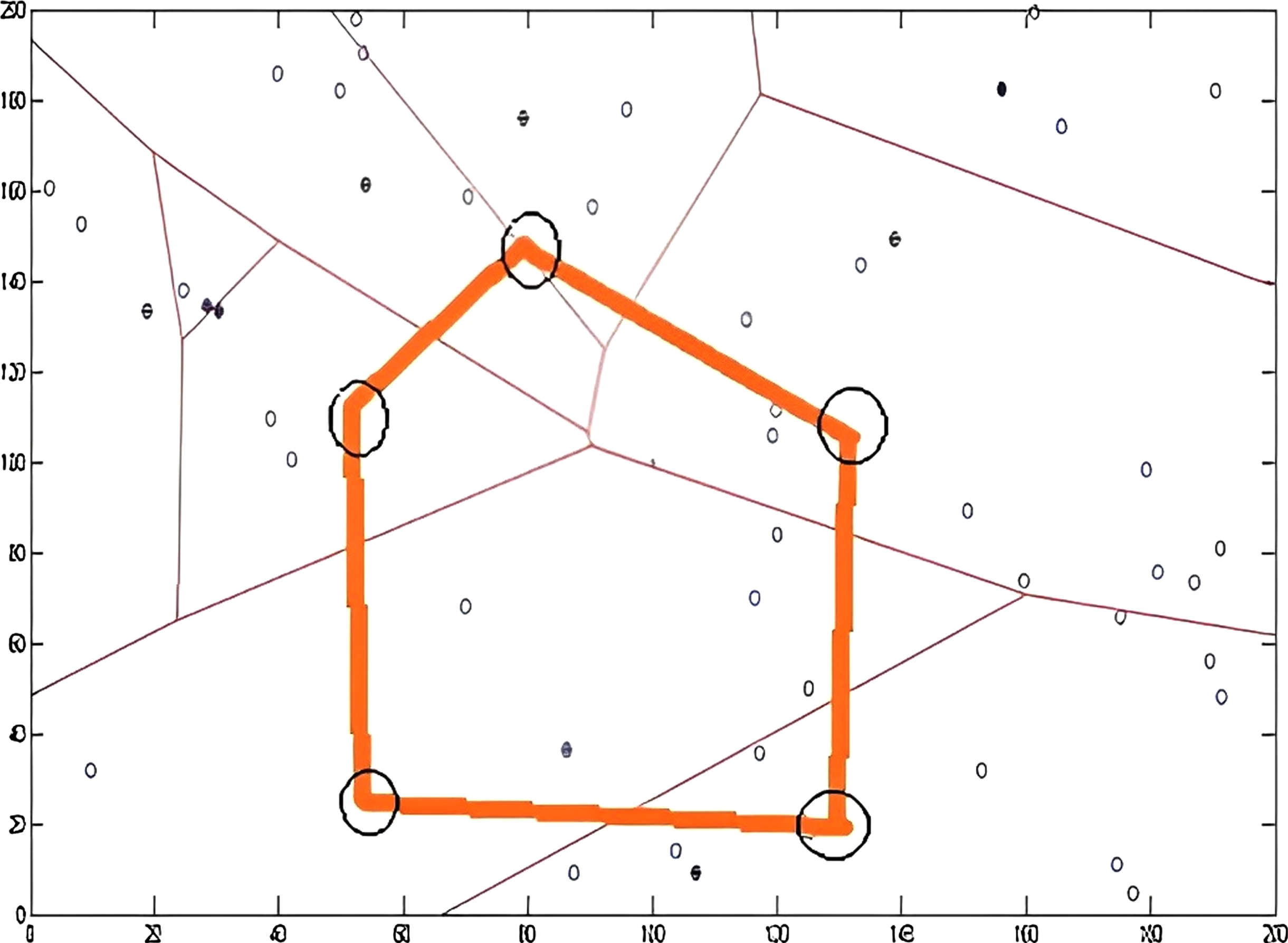
Mobile Van Traversal path where cluster heads (black circle) requested for data collection purpose.
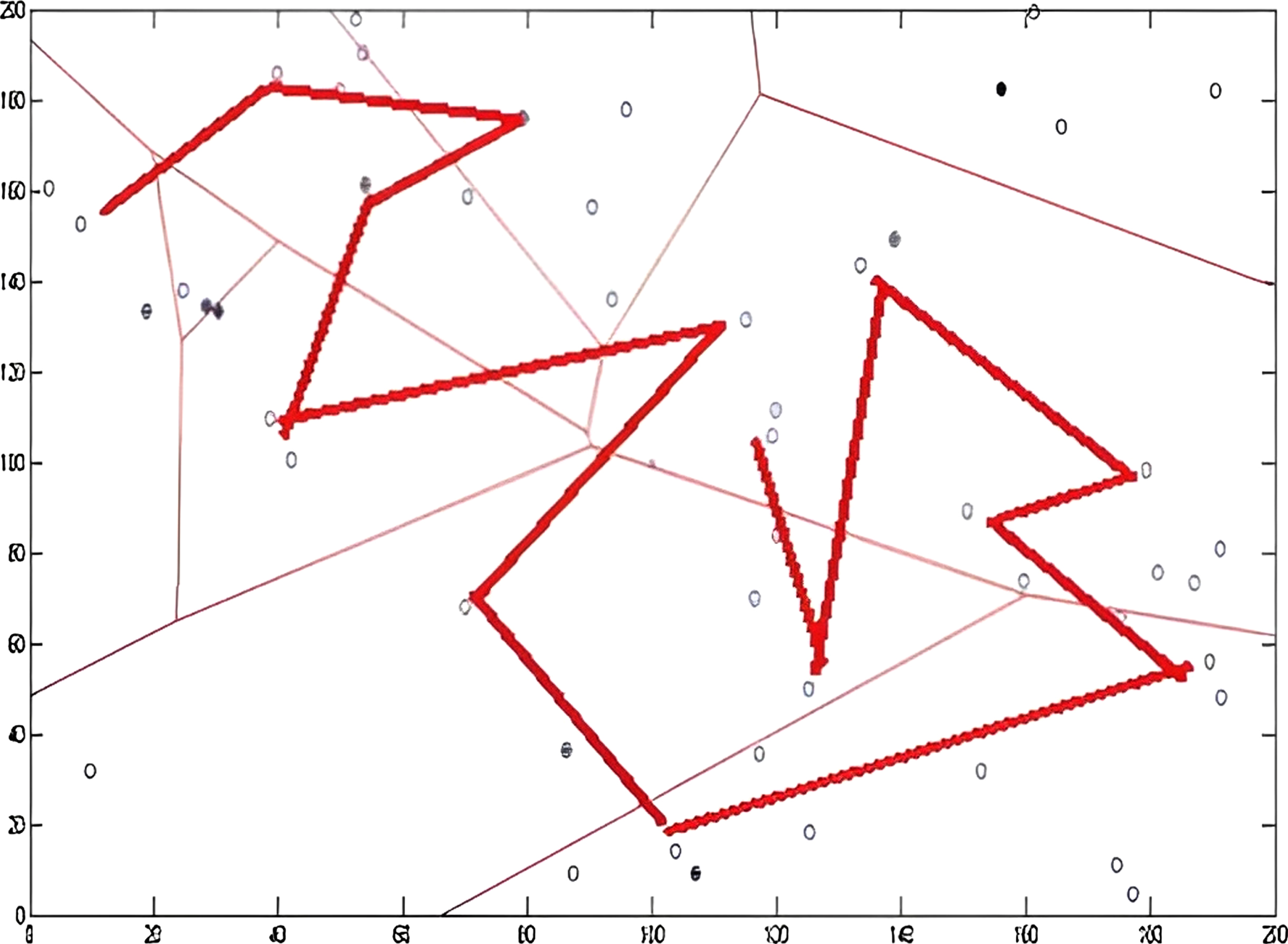
Mobile Van Traversal path where sensor nodes requested for mobile charging.
Performance improvement
Here, we compared the output of our proposed algorithms with existing algorithms [32, 33]. The proposed algorithms have shown extremely improved results as per the Figs. 8, 10 and 11. The benchmark algorithms RLLO [32] & RL-CRC [33] had an issue of consistency while delivering data packets, achieving throughput, end to end delay & energy consumption. Energy consumption is little higher than others due to large number of sensor nodes. End to End delay is significantly less than other algorithms which is remarkable. PDR ratio is higher but decreases as the sensor nodes increases. Throughput is much higher which indicates the success of this research simulation.

Comparison of Energy Consumption of MDCMC with other benchmark algorithms.
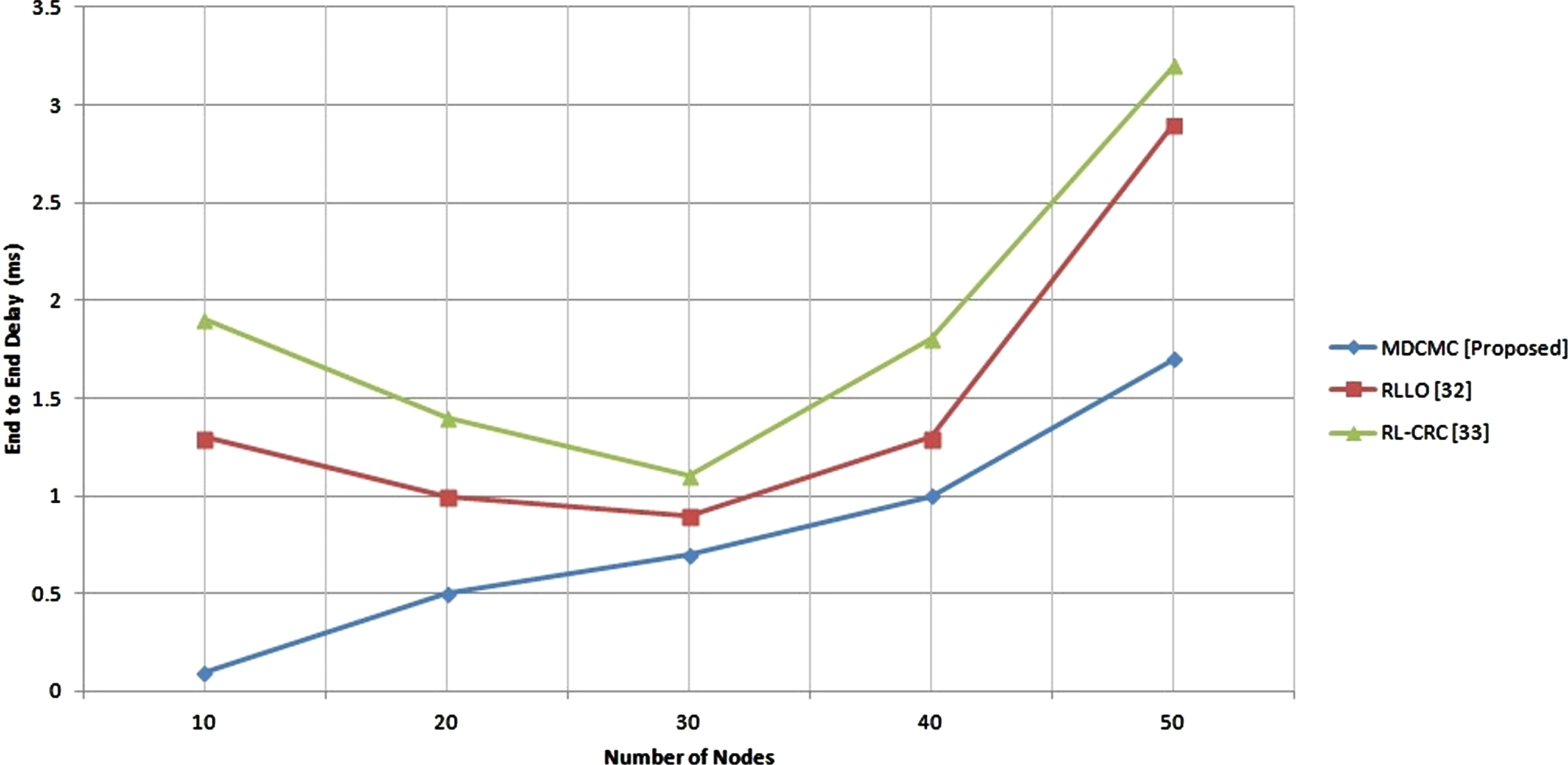
Comparison of End-to-End delay of MDCMC with other benchmark algorithms.
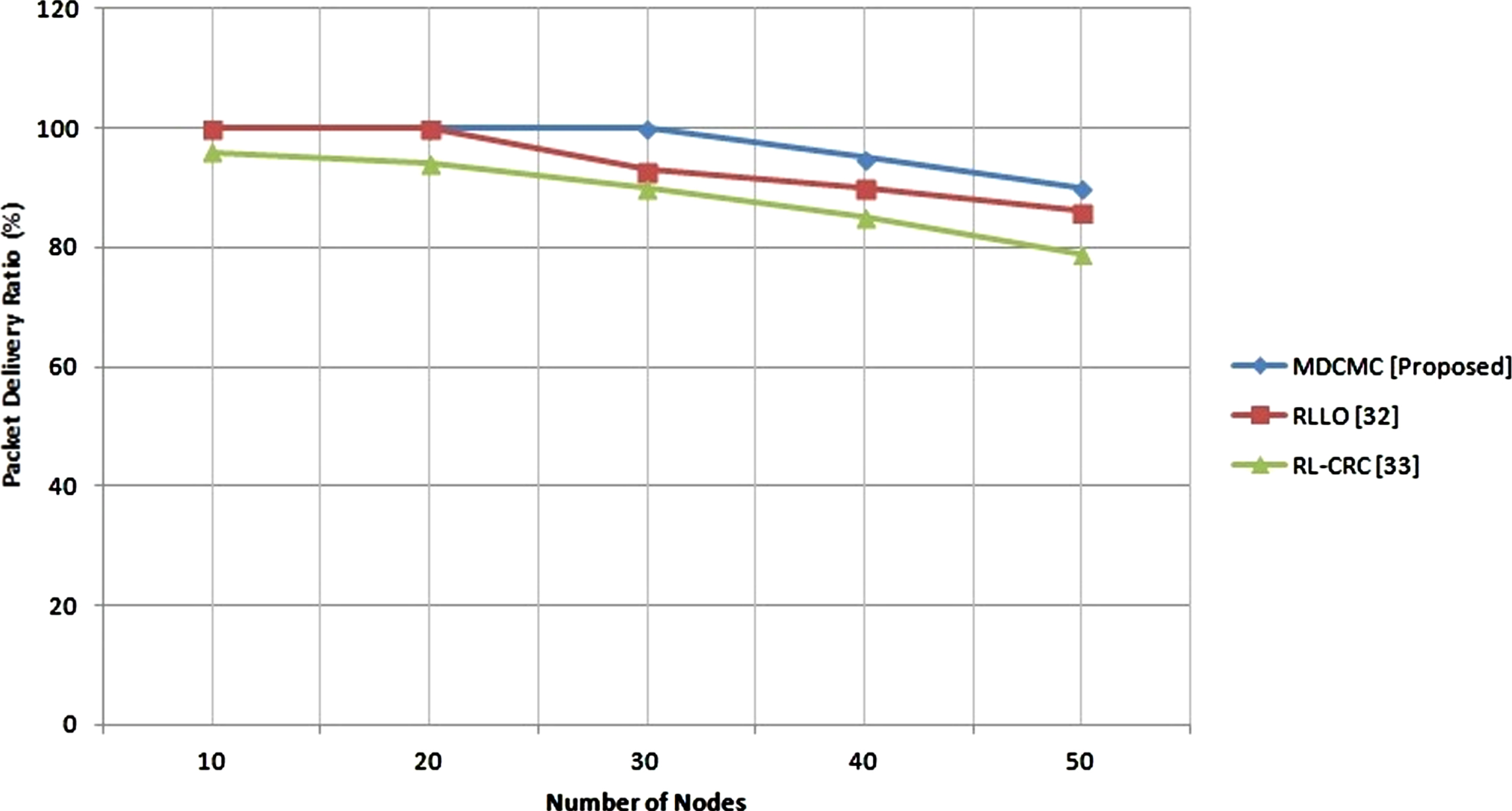
Comparison of Packet Delivery Ration of MDCMC with other benchmark algorithms.

Comparison of Throughput of MDCMC with other benchmark algorithms.
The MDCMC algorithm has been tested under the various simulation environments. The results are well compared with the other benchmark algorithms. Finally, our proposed algorithms have shown about 31% more improvements. The below table 3 shows the detailed performance improvement of various algorithms.
In this research work, we have proposed a novel MDCMC algorithm which is capable of gathering information from mobile sink as well as charge the sensor nodes periodically. Our proposed algorithm has better PDR ratio, and better throughput along with less end-to-end delay compared to existing well-known algorithm RLLO [32] & RL-CRC [33]. The results are well compared with the other benchmark algorithms. Finally, our proposed algorithms have shown about 31% more improvements in terms of PDR ratio; 15% less end-to-end delay, and 48% more throughput than existing algorithms [31, 32]. Previously there was no such type of mechanism present. This type of research is more useful in mobile wireless sensor network where routing, charging and data collection takes place in dynamic manner. In future, we will try to implement this mechanism in real time hardware. This paper has certain limitations like still not implemented in real time hardware, not applicable in large sensor node networks and security measures not taken care off.
Funding and/or conflicts of interest/competing interests
The authors have no conflicts of interest to declare that are relevant to the content of this article. The authors have no financial or proprietary interests in any material discussed in this article.
Data availability statement
Data sharing not applicable to this article as no datasets were generated or analyzed during the current study.