



Abstract
Segmenting outdoor images in the presence of haze, fog or smog (which fades the colors and diminishes the contrast of the observed objects) has been a challenging task in image processing with several important applications. In this paper, we propose a new fractional-order variational model that will be able to de-haze and segment a given image simultaneously. The proposed method incorporates the atmospheric veil estimation based on the dark channel prior (DCP). This transmission map can reduce significantly the edge artifacts and enhance estimation precision in the resulting image. The transmission map is then changed over to the high-quality depth map, with which the new fractional-order variational model can be framed to look for the haze free segmenting image for both grey and color outdoor images. An explicit gradient descent scheme is employed to find efficiently the minimizer of the proposed energy functional. Experimental tests on real world scenes show that the proposed method can jointly de-haze and segment hazy or foggy images effectively and efficiently.
Keywords
Introduction
Because of the presence of an atmosphere, the light reflected from a scenario is constantly dissipated before it arrives the camera focal point, and the light received by any camera focal point is normally mixed with the air light. This leads to inescapable degradation of image such as increased noise, deterioration of visual quality (visibility), low contrast, and loss of color constancy. This sort of contamination is especially severe when the climate conditions are poor, that is when the pressurized canned products (such as fog, haze, rain, fumes or dust) are available. For example, as a common climate phenomenon, haze or fog may deliver an albedo impact, which prompts ambiguity, which has somewhat adverse consequences on extraction and comprehension of contents from the images and makes numerous computer vision tasks more difficult such as image segmentation, detection, object tracking and stereo estimation, etc. In this manner, accurate estimation and removal of haze or fog from images becomes an important component and a challenging task because of its ill-posed nature in a post-processing step and needed urgently in real world applications. Recently, haze or fog removal from natural images has pulled in a lot of consideration in imaging science. The upsides of such operations are clear. Firstly, the haze-free images are more appealing visually, meaningful and realistic. Second, the de-haze or defog images are increasingly appropriate for some significant use such as image segmentation, image fusion and feature extraction, and so forth.
During the most recent decade, a few studies have analyzed restoration of image visibility in hazy climate conditions. Generally speaking, these investigations can be partitioned into two significant categories: those assessing (a) multiple-image de-hazing and (b) single image de-hazing. Multiple image based restoration methods utilize either multiple images taken in a similar scene or pre-existing geo-referenced digital terrain and in depth based models an estimate 3-D geometrical model of the scene is required to evaluate the density (thickness) of the atmospheric veil. All these can deliver great outcomes acquiring 3-D geometrical data and multiple images can be an issue in natural world haze removal applications [1] and especially in [2].
Recently, single image restoration based de-hazing methods have been developed to obtain maximum application independence. As only one image is used for input data, usually these methods utilize either prior strategy to estimate the density of the atmospheric veil (transmission map) and reduce the amount of haze or contrast modification to expel haze formation directly from images contaminated with haze. Xu et al. [3] built up their image visibility restoration approach by applying contrast limited adaptive histogram equalization to redistribute histograms. They improved the contrast of lower visibility segment of foggy or hazy images. The methodology utilized by Ancuti and Ancuti [4], upgrades the visibility of hazy images directly by employing a multi-scale fusion method that joins two hazy images determined by using the shades of gray color constancy approach with a contrast improving method containing luminance, chromatic and saliency weight maps into a haze-free image. Tan’s [5] approach sees the approximation of the atmospheric veil as an ill-posed problem and incorporates a cost function for approximating the atmospheric veil in the Markov random field framework, in which the solution can be obtained by maximizing the local contrast of the haze free image.
Through the un-correlation principle, Fattal’s [6] method estimates the optical transmission map which asserts that scene transmission and surface shading are statistically uncorrelated locally; it utilizes an optical transmission map also to obtain de-hazed image. Although, it fails to work with those images which contain heavy haze or fog. Tarel et al. [7], utilized a prior strategy, adopts hybrid filters based on two constraints namely: (a) it is lower than the minimum of RGB color parts and (b) the atmospheric veil is pure white, to approximate the atmospheric veil. However, images recovered with this approach appear to be un-natural with loss of brightness, particularly in sky regions. He et al. [8], developed a dark channel prior (DCP) based on the assumption that there is at least one color channel with very low intensity mostly in non-sky and free of haze scenes. Based on the physical properties of air-light, Cho et al. [9] introduced a model for the estimation and refinement of the air-light map in order to restore a fog-free image. By taking fractional derivative on both sides of the atmospheric physics scattering model, Wendan et al. [10] established a new space fractional-order PDE based model for haze removal (having the spatial global correlation and good amplitude frequency characteristics of fractional-order differential). The advantage of the fractional order differential is that the proposed algorithm exhibits more detailed information and keeps more texture details of the smoothing area comparing to integer-order partial differential equations based image enhancement algorithms. For more details on the subject, the interested reader is referred to [11]. Next, we provide a review of the basic hazy image formation model and dark channel prior.
Hazy image formation model
The occurrence ray of light is absorbed and dissipated from surfaces of turbid media (for instance, particulate matter) present in the atmosphere during poor climate conditions before it arrives the camera. This marvel involves the deflection of light from its original course of spread. Under this phenomenon, Koschmieder [2] introduced the haze effect model to demonstrate further, the formation of a hazy or foggy image pointed out by [12] through Fig. 1, can be formulated mathematically as follows
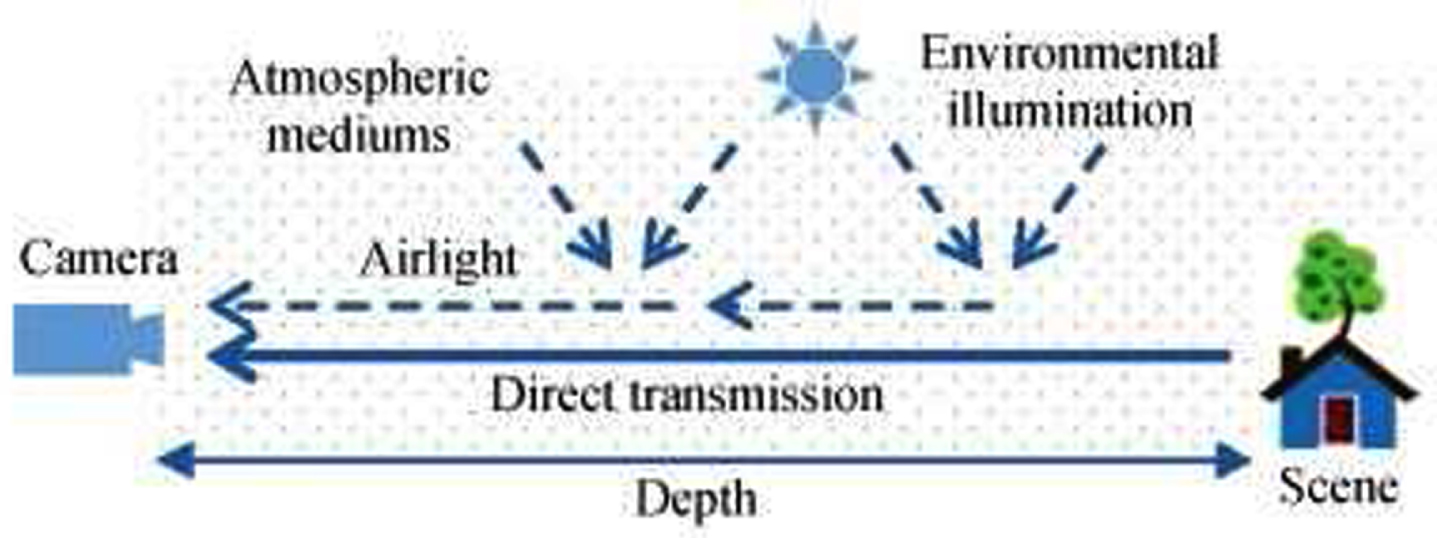
Hazy image formation model.
The dark channel prior introduced by He et al. [14] is based on the assumption that there exist some dark pixels whose intensities are closed to zero for at least one color channel within an image patch of the non-sky region of the haze-free outdoor images. For an image J, the dark channel J
dark
can be defined as follows
Image segmentation, refers to the process of finding (locating) boundaries and objects (lines,curves, etc.) in images and is one of significant problems in image processing and computer vision. Recently, active contour models (ACM) [15] have been developed widely and have a few noteworthy advantages over classical image segmentation models. By and large, the current ACM-methods can be characterized into two groups namely edge based models [15–17] and region based models [18–22]. The choice of these models relies on results adequacy for every image and issue on each specific segmentation application. The region based active contour models tend to depend on intensity homogeneity. For example, the well-known Chan-Vase (CV) model [21], which has been effectively implemented in binary phase segmentation with the assumption that each image region is homogenous statistically. Vase and Chan broadened their work and introduced the piecewise constant models (PCM). For representing multiple regions, this strategy uses level set functions (multi-phase). Both the above models fail in case of in-homogeneous region. Li et al [23] introduced the region scalable fitting model (RSFM), which employs the image local information as imperatives, can successfully segment objects with intensity homogeneity. Zhang et al. [24] improved and extend the similar strategy to segment images with intensity inhomogeneity, however this method is tedious and time consuming. Zhang et al. [25], developed a local image fitting model (LIFM), which reduces computational complexity over RSFM-model. Song et al. [26], combined Laplace zero crossing function and set forward a regularized gradient flow method, which improves edge detection. Based on Bayes rule, Wang et al. [27] introduced a non-linear weighted item that is able of adaptive evolution, therefore can handle boundary leak very well. Nonetheless, the above strategies do not tackle well the problem of sensitivity to the initial evolution curve.
Indeed, fractional differentiation has been proved to be an effective tool for strengthening the components of medium and high frequency, while in a non-linear manner, reserves the part of very low frequency. In image processing, these features are used widely in preserving weak edges and texture details. For instance, Ren et al. [28] employed fractional differential operator to CV-model and combined a fractional fitting term with it. Tian et al. [29] introduced fractional divergence prior to CV-model. Both strategies enhance the weak edges location capacity and the performance of weak edges segmentation. Moreover, both the above mentioned methods are more efficient to noise. Although, these methods fail to perform well while dealing with those images having intensity inhomogeneity, because they use local information only.
To improve the CV-model, another attempt was made by Wu et al. [30] and introduced a variational based convex image segmentation model, within the interval [-1, 1] with a unique global solution for the corresponding energy functional. Akram et al. [31] replaced the signed pressure force function (SPF) in Zhang et al. [25] model by a local-SPF function improving the performance by stopping the contours at blurred or weak edges, which is the modification of Zhang model for scenes with inhomogeneous intensity but the model was not able to tackle the images with multiple intensity objects. Ali et al. [32] combined the SPF function and the generalized average concept and proposed the image segmentation model. In the segmentation of multi-region images with inhomogeneous intensities, the model shows good performance over Akram et al. [31] model. For more details on the subject, the interested reader is referred to [33, 34].
On the other hand, segmentation of real world scenes in the presence of haze, fog or smog have attracted much attention in image processing recently. To the best of our information, in the literature, there is only one recent published work of Ali et al. [35] for joint de-hazing and segmentation of hazy or foggy images. This variational model (based on estimating the atmospheric veil and level set function) is capable of de-hazing and segmenting a given image simultaneously. Although, it has some disadvantages as well. For instance, the employed integer-order total variational prior favors piecewise constant solution and hence, it fails to preserve textures properly and often leads to blocky effect, halo artifacts and color distortion.
To handle the above issues, fractional calculus has gotten wide consideration in recent years because of its remarkable advantages. The studies show that fractional differential has the properties of upgrading high frequency, reducing low frequency, and preserving intermediate frequency for signal and can protect the texture feature and other fine details of low frequency part in non-linear manner when enhancing the high frequency part. Accordingly, when compared with the integer order differential, fractional differential image enhancement can effectively preserve the texture details of the smoothing area as well as make the image edge more prominent. At present, fractional calculus has been generally applied in image de-noising, image enhancement, image segmentation, edge detection, face recognition and other aspects [36]. In addition, the fractional-order differential operator has a “non-local” behavior because the fractional-order differential depends upon the properties of the entire function at a point and not simply the values in the vicinity of the point [37], which is advantageous to improve the exhibition of texture preservation. It has been demonstrated in [38] that the fractional-order derivative fulfills the lateral inhibition principle of the biological visual framework better than the integer order derivative. In [50], Pu et al. have talked about the kinetic physical meaning of the fractional-order derivative and introduced fractional inspection strategies for texture details of images. For more details, see [42, 43].
The aim of this paper, is to introduce a new fractional-order variational model for jointly de-hazing and segmenting a given hazy or foggy image. It incorporates the atmospheric veil estimation dependent on the dark channel prior. This transmission map can minimize the edge artifacts and enhance estimation precision in the resulting image. The transmission map is then reduced to the depth map, with which the new fractional-order variational model is developed to obtain the haze free segmenting image for both grey and color outdoor images. The joint strategy takes advantage of both fractional-order total variational filter and dark channel prior since it can preserve edges while reducing the blocky and halo artifacts in smooth areas. Moreover, we employed the explicit gradient descent scheme. We report experimental results on both grey and color images which show that the proposed model accomplishes state of the art de-haze and segmented results simultaneously.
The outline of this work is as follows. In Section II, our novel model for addressing the problem is proposed. For solving the highly non-linear Euler Lagrange fractional-order PDEs, explicit gradient descent scheme is applied in Section III. In order to demonstrate the performance of the proposed model, some image segmentation and restoration results of outdoor scenes are given in Section IV. Finally, we give some concluding remarks and future directions in Section V.
The proposed model
Fractional-order derivative performs well for avoiding staircase effect, preserving sharp edges, structures with low gradients and textures. This is accepted to be a better approximation than a piecewise constant estimation in smooth regions for a natural scene. Here, a new fractional-order variational model is proposed for simultaneously de-hazing and segmenting a given hazy or foggy image in the presence of homogeneous or inhomogeneous intensity. This model uses clearly advantages of fractional order total variation regularizer (FOTVR) and dark channel prior, which leads to good de-hazing and segmented results and has the upside of better preserving image regions containing textures, colors and other fine features, leads to a more natural scene while reducing the blocky effect in smooth areas. Hence applying this model, better improvement in entropy and Jaccard similarity index (JSI) values is gotten. Let Ω be a bounded open subset of R2 with boundary ∂Ω and C : [0, 1] → R2 be a parameterized curve. The following fractional-order based variational energy functional is proposed to jointly de-haze and segment a given hazy or foggy image
In this section, explicit gradient descent method is employed for solution of the fractional-order based non-linear Euler-Lagrange PDEs (11) and (16) arisen from the minimization of functional (6). In the implementation of (11) and (16), the important problem is the discretization of fractional-order gradient operator D
α. Here, the α-order Grünwald-Letnikov definition [35–37] of fractional differential is used to discretize the fractional-order gradient operator D
α, defined as
Masks in four directions: (a)
where
The remaining terms in (11) and (16) can be easily discretized. The update form of the fractional-order partial differential equations (16) are formulated by
To summarize, the following steps can be performed to obtain the most important steps of the level set evolution and air-light map estimation Initialize φ to its zero-level curve φ0 and Compute Compute If Output Determine whether the solution is stationary. If not, proceed towards another step (n=n+1). End procedure
In this section, some numerical tests are presented to demonstrate the effective performance of the proposed model. We analyze and describe the results on some clean and hazy or foggy images. The image de-hazing and segmentation results are compared with some state of the art models namely, SPF [25], GSPF [32], Cho et al. [9], Wu et al. [30] and Ali et al. [35] through various outdoor scenes. All the experiments are performed in MATLAB R2013a in Haier Win8.1 PC, Intel core i3 CPU @ 1.70GHz with 4.00 GB RAM. To obtain optimal results, the parameters are adjusted and tuned according to the thickness of haze or fog in the given image. The proposed model has been tested from the aspects of segmentation performance, de-hazing performance, robustness to initial curve location and its comparison with the recent state of the art methods.
Image segmentation performance
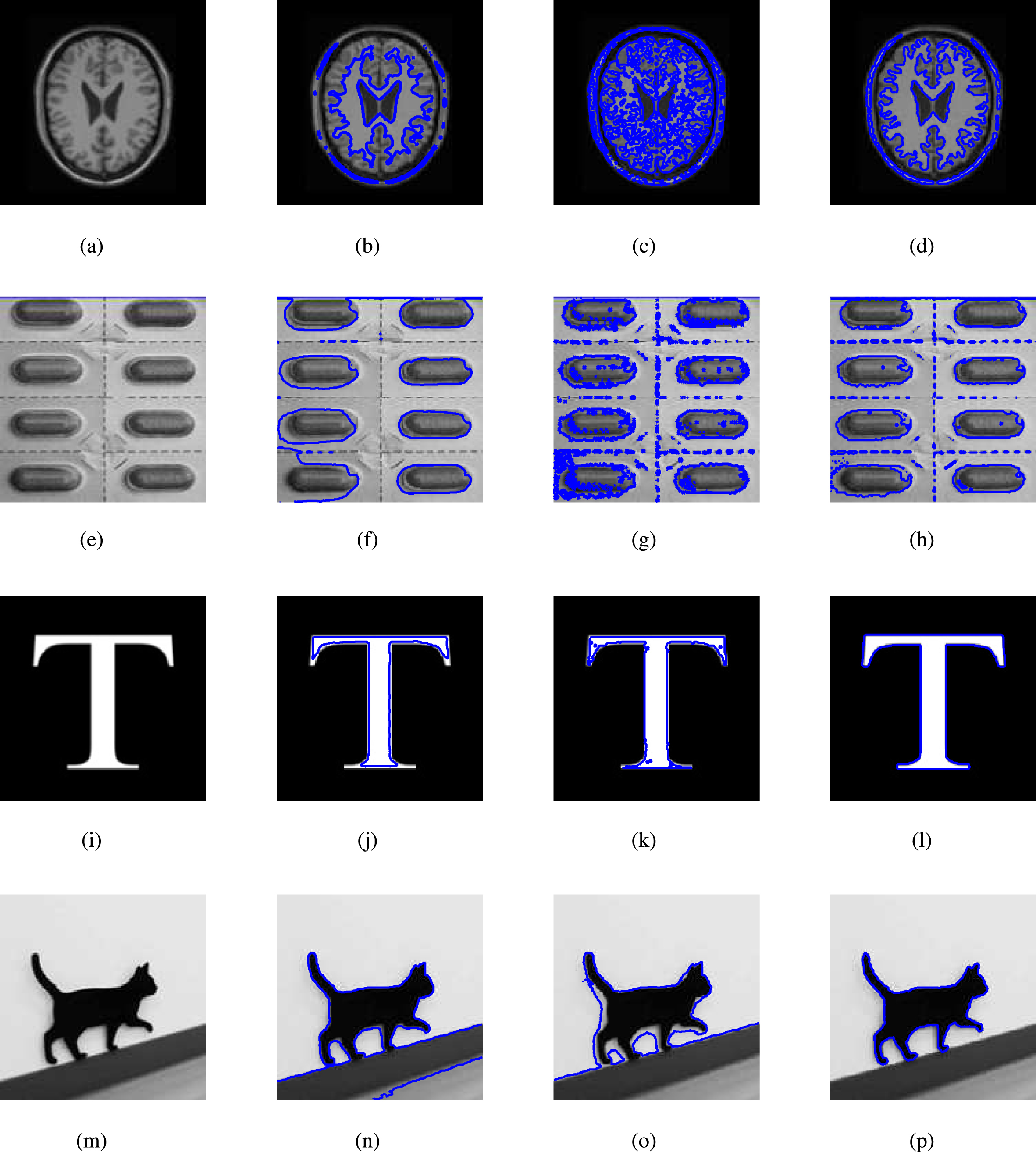
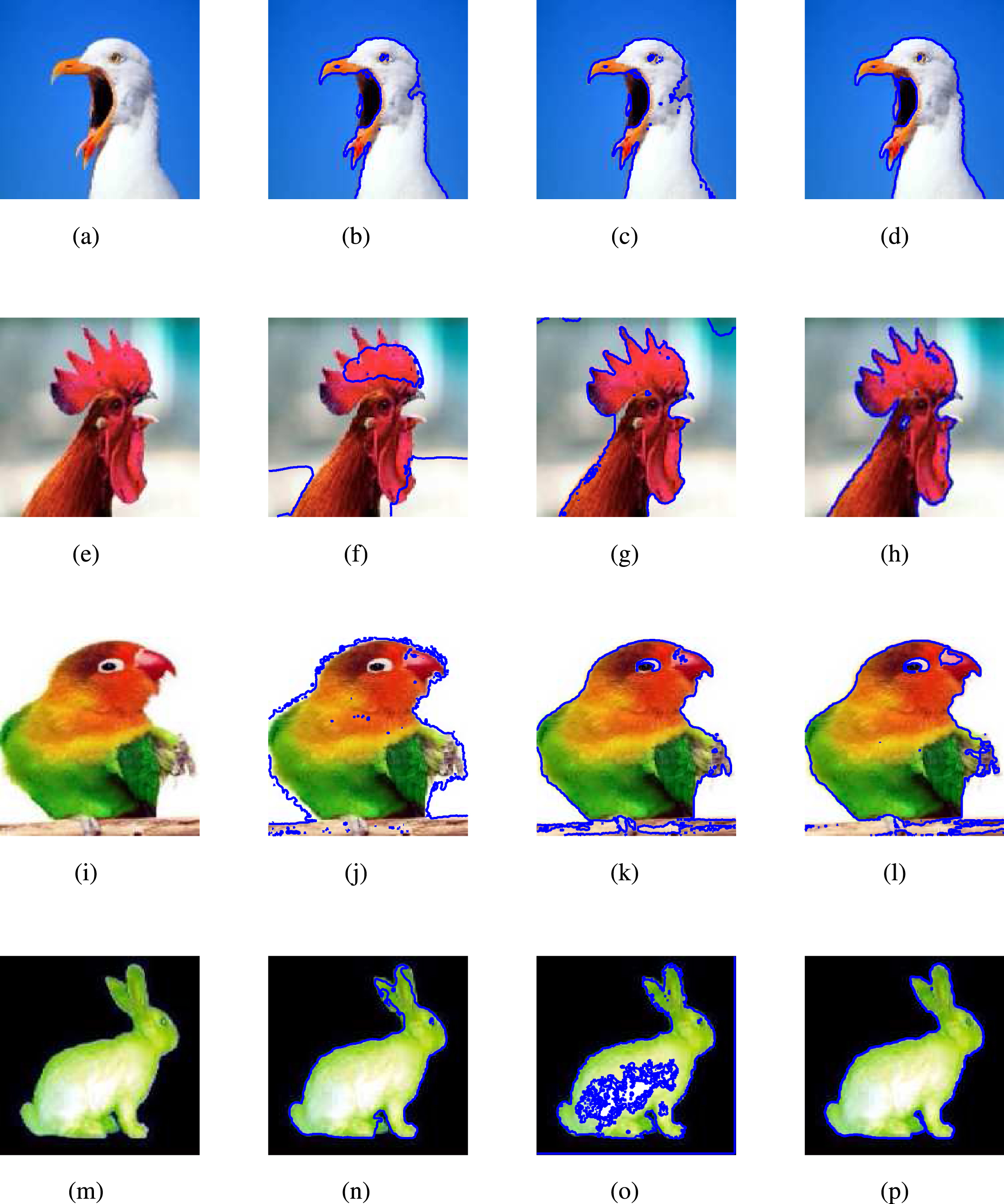
This section focuses on testing image segmentation performance of the proposed model on grey and color clean images. The results obtained by our model are contrasted with those of the GSPF [31] model as well as the Ali et al. [35] model as shown in Figs. 3. Figure 2 shows grey-scale haze free images and Fig. 3 shows vector-valued haze free images. The first column of the figures show the given images. The second, third and fourth columns of the figures represent GSPF [32], Ali et al. [35] and proposed models segmentation results, respectively. From the experimental results, we notice that our method performs well for images having low contrast, low visibility, weak edges and inhomogeneous intensity and successfully segment the object edges whereas GSPF [32] and Ali et al. [35] models can not segment the object edges completely. GSPF [32] and Ali et al. [35] models segment the extra and undesired region of the images with object edges as shown in Figs. 2(c), 3(g) and 3(o).
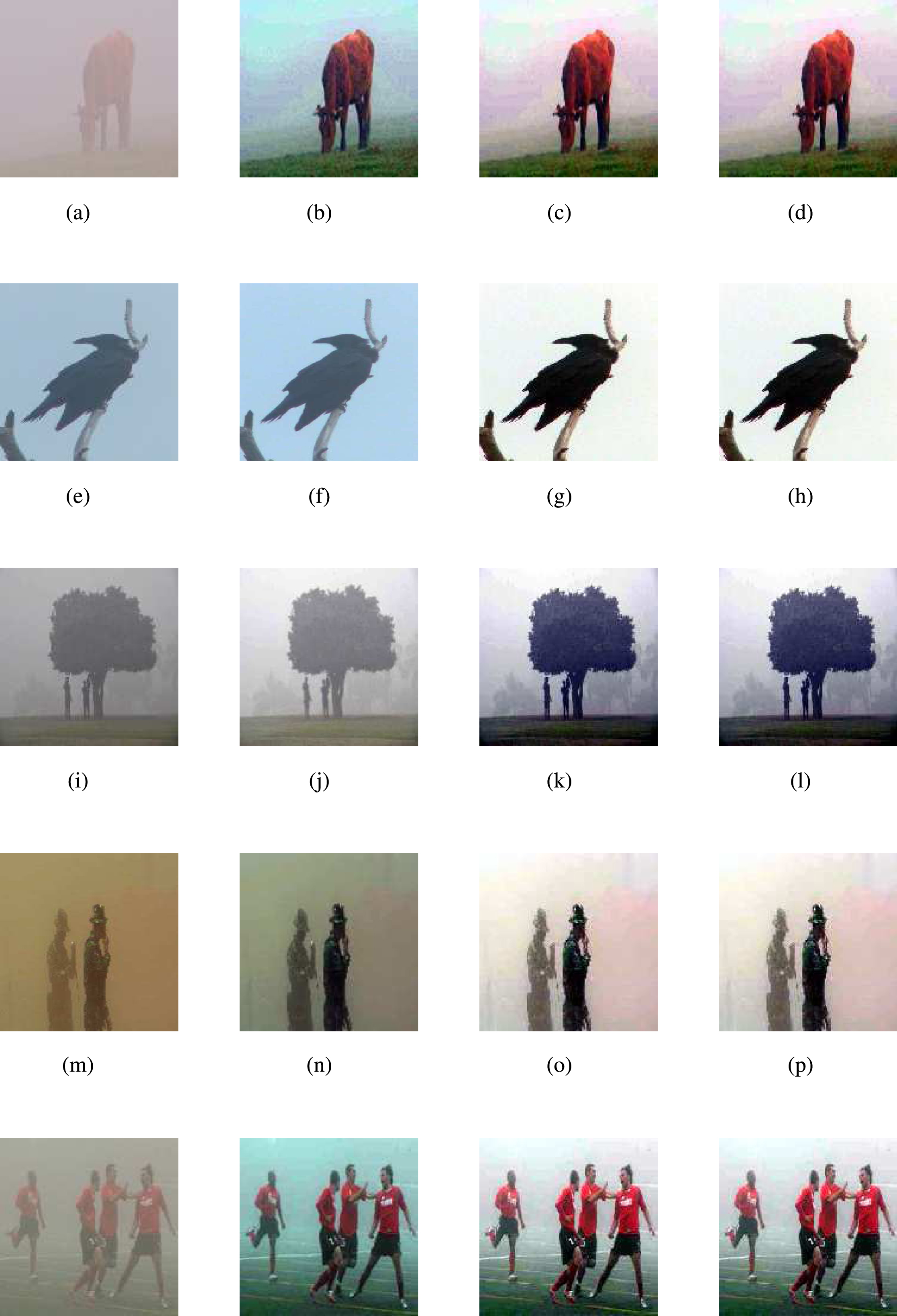
The de-fogging or de-hazing performance of the proposed model in comparison with Cho et al. [9] and Ali et al. [35] models. The first column shows the given hazy or foggy images. The second, third and fourth columns show the restoration results of Cho et al. [9], Ali et al. [35] and proposed models, respectively.
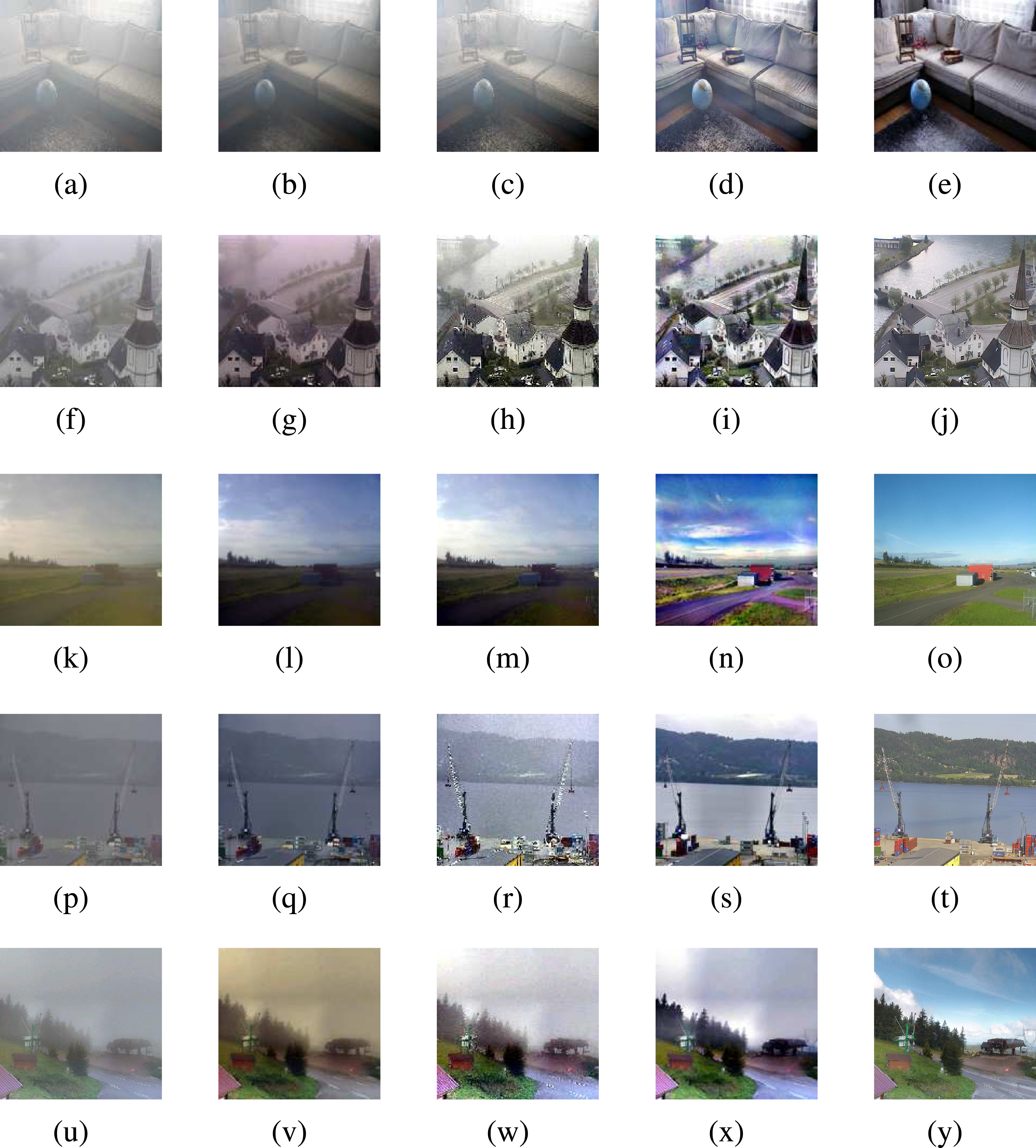
The de-fogging or de-hazing performance of the proposed model in comparison with Cho et al. [9] model, Ali et al. [35] model and clear images. The first column shows the given hazy or foggy images taken from MRFID [40]. The second, third and fourth columns show the restoration results of Cho et al. [9], Ali et al. [35] and proposed models, respectively. The fifth column shows the clear images taken from MRFID [40].
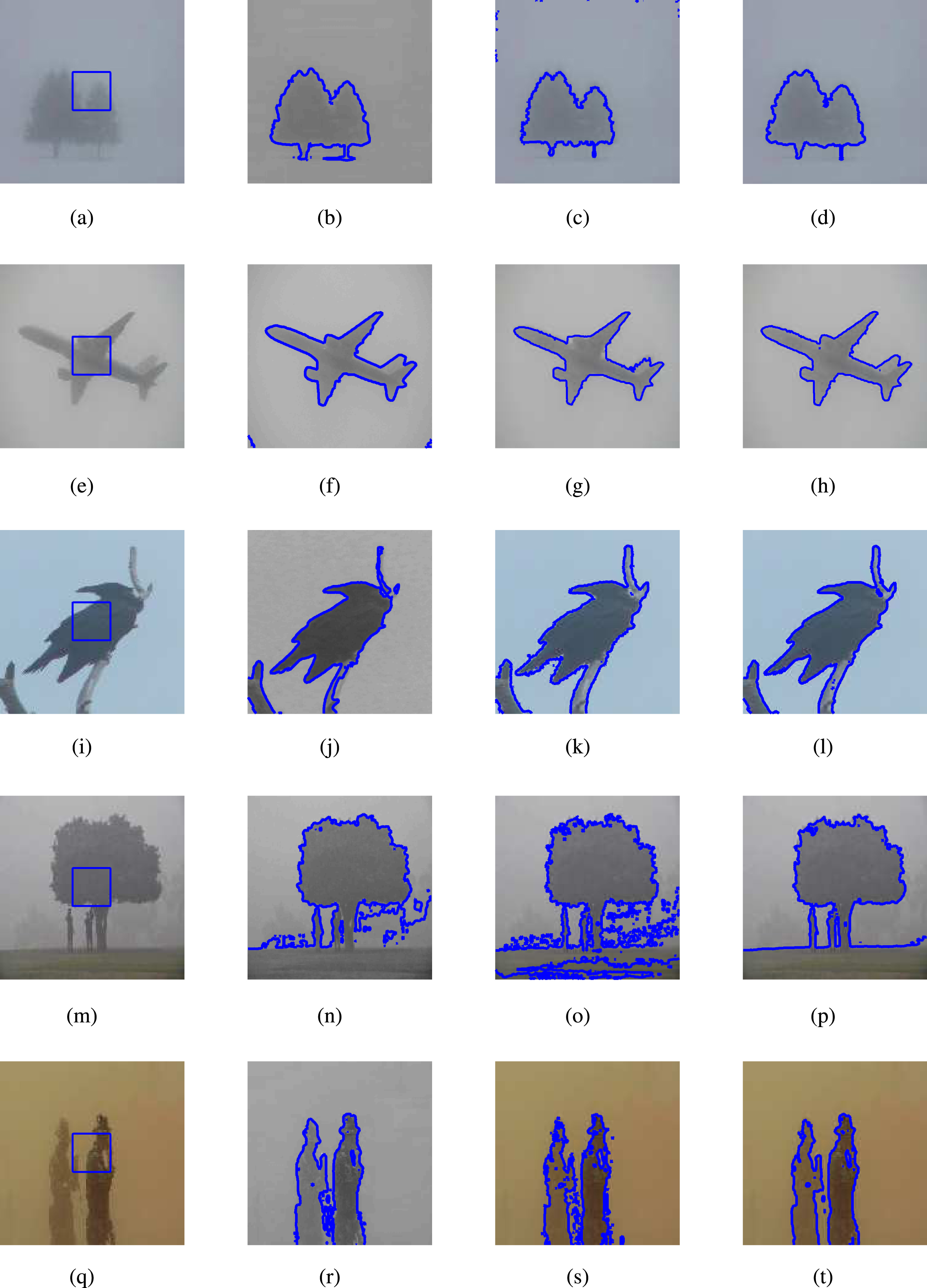
Segmentation performance of the proposed model in comparison with Wu et al. [30] and Ali et al. [35] models on hazy images. The first column shows the given hazy or foggy images. The second, third and fourth columns show the Wu et al. [30] results, Ali et al [35] results and proposed method results, respectively.
In this section, to evaluate the performance of the proposed de-hazing method for haze or fog removal, the de-hazing results are compared with state of the art recent works of Cho et al. [9] and Ali et al. [35]. We have performed experiments on 150 synthetic images of different hazy data-sets brought together from the internet and 150 real images of multiple real-world foggy image data-set (MRFID, http://www.vistalab.ac.cn/MRFID-for-defogging/) [40]. Some of the experimental results are shown in Figs. 5. The first column of the figures show the given hazy or foggy images. The second, third and fourth columns of the figures represent Cho et al. [9], Ali et al. [35] and proposed restoration results, respectively. The fifth column of Fig. 5 shows the clear images of the corresponding hazy or foggy images given in the first column. In the proposed method, the result in the sky region is clearer than other algorithms and the color contrast of the image is increased and preserves edges and textures well which are the advantages of the fractional order derivative based prior over integer order derivative based prior. Since, there is some difference in the contrast and brightness of the clear images and in the de-hazed images of the proposed method i.e., the results of the proposed method are brighter and have some high contrast than the clear images but it can be concluded that our method outperforms other competing methods in most of the cases especially in removing haze or fog from images of multiple real-world foggy image data-set (MRFID) [39] where the competent methods may not work properly. The better performance of our method over other methods can be further confirmed by the quantitative and visual results shown in Table 2, Figs. 5. Table 2 shows the entropy values in terms of
Quantitative results under entropy measure for the de-hazed images
Quantitative results under entropy measure for the de-hazed images
Here
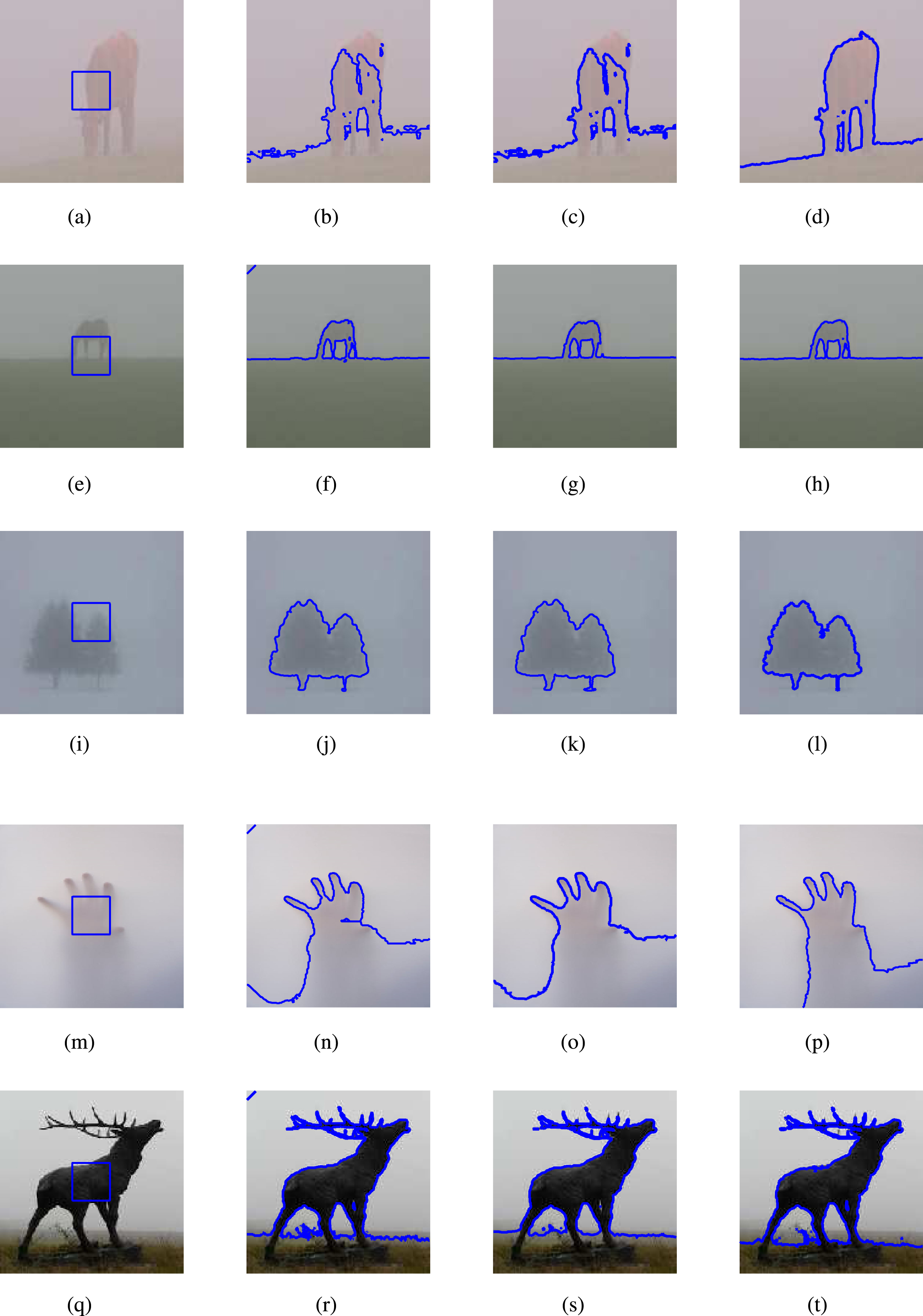
This section aims to test the validity and robustness of the proposed model to segment the desired object of the given hazy or foggy image. For this purpose, we have performed tests on various images having light and dense haze or fog as shown in Figs. 7 respectively. The first column of the figures show the given hazy or foggy images. The outcomes of the proposed model (fourth column) are compared with Wu et al. [29] and Ali et al. [35] models (second and third columns) shown in Fig. 6 and SPF [24] and GSPF [31] models (second and third columns) given in Fig. 7. Computational cost of our model and Ali et al. [35] model is nearly same. Experimental results clearly show that the proposed model successfully segment the object boundaries (desired object) better in hazy images as compared with the existing models. In case of dense fog, we noticed that Wu et al. [29], Ali et al. [35], SPF [24] and GSPF [31] give poor results and even undesired results in some images. The optimal results of the proposed model are achieved due to the physical properties of air-light map estimation through dark channel prior and fractional-order derivative based regularizer incorporated in the model.
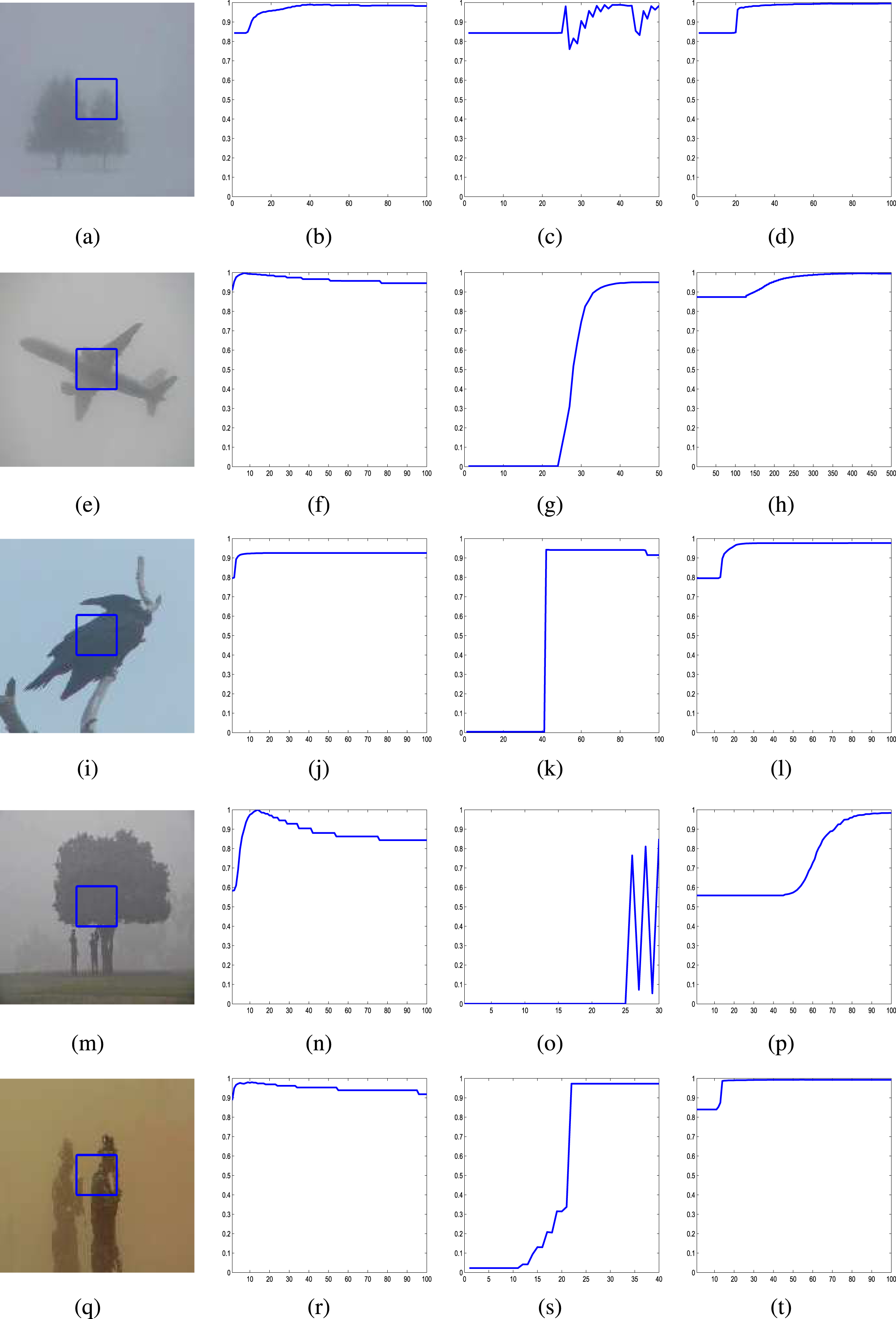
Quantitative analysis of the proposed model in comparison with Wu et al. [30] and Ali et al. [35] models using graphical representation of JSI values. The first column shows the given hazy or foggy images with initial contour. The second, third and fourth column show the graphical representation of JSI values of Wu et al. [30], Ali et al. [35] and proposed models, respectively. The JSI values of the Wu et al. [30], Ali et al. [35] and proposed models of the images (a, e, i, m, q) at final iterations are (0.9824, 0.9452, 0.9287, 0.8433, 0.9805), (0.9830, 0.9502, 0.9145, 0.8498, 0.9723) and (0.9950, 0.9947, 0.9766, 0.9836, 0.9928), respectively, shown from the top images to the bottom images in the second, third and fourth columns.
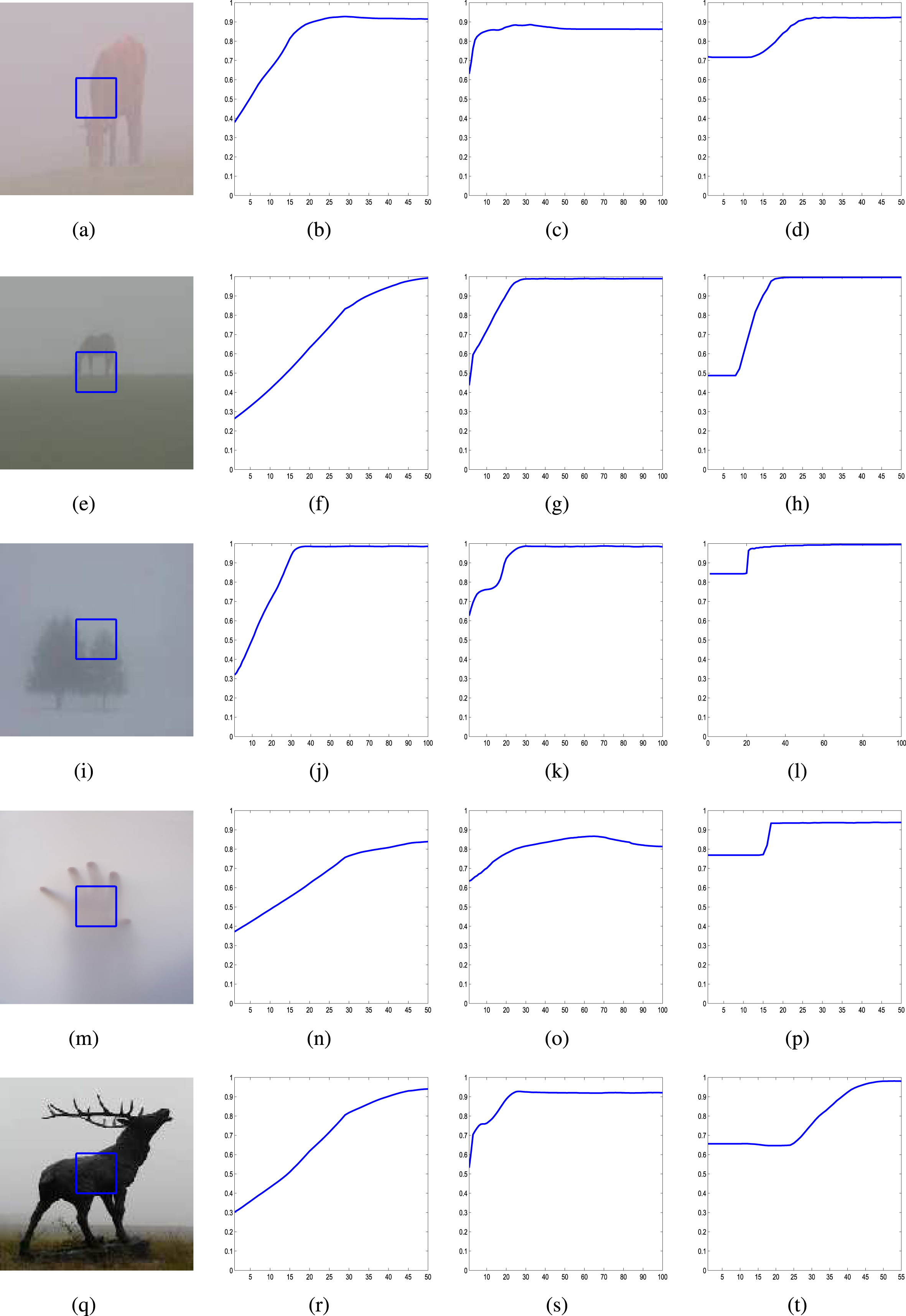
Quantitative analysis of the proposed model in comparison with SPF [25] and GSPF [32] models using graphical representation of JSI values. The first column shows the given hazy or foggy images with initial contour. The second, third and fourth column show the graphical representation of JSI values of SPF [35], GSPF [32] and proposed models, respectively. The JSI values of the SPF [25], GSPF [32] and proposed models of the images (a, e, i, m, q) at final iterations are (0.9164, 0.9908, 0.9853, 0.8386, 0.9402), (0.8620, 0.9894, 0.9894, 0.8131, 0.9210) and (0.9232, 0.9963, 0.9950, 0.9379, 0.9807), respectively, shown from the top images to the bottom images in the second, third and fourth columns.
JSI values for segmentation accuracy using grey-scale images, vector valued images and hazy images
Average values of e,
Average values of e,
In this work, a variety of quality measures/metrics (entropy, Jaccard similarity index (JSI), the ratio of newly visible edges e, the average gradient ratio
Entropy results and the values of e,
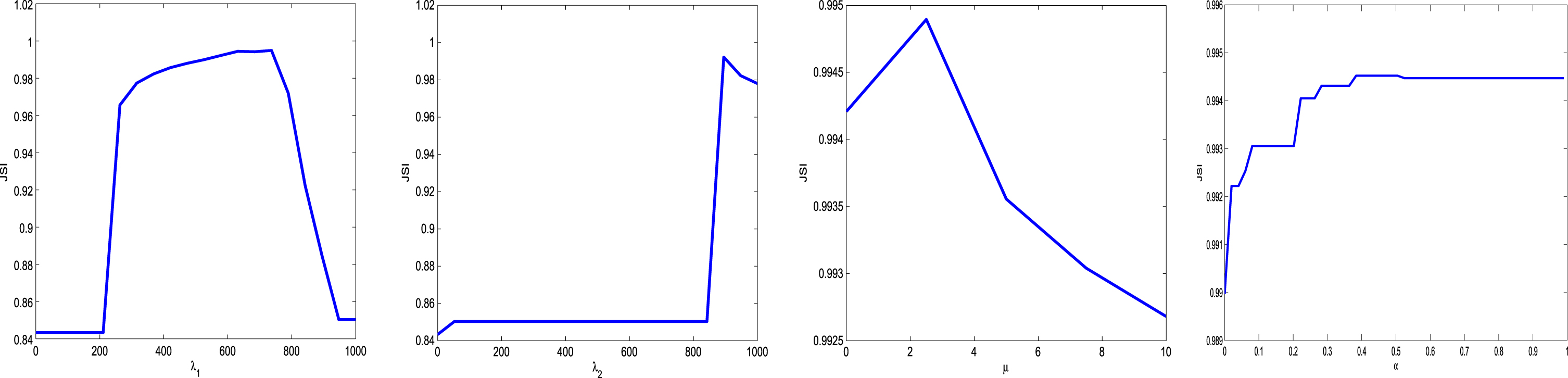
Best values of parameters λ1, λ2, μ and fractional order α with optimal jaccard values for Fig. 6(a) showing sensitivity of the proposed model. The best parameter values are λ1 = 750, λ2 = 890, μ = 2.3 and α in the range of 0.4 and 0.5.
As discussed earlier, the proposed algorithm involves joint learning of two fields: image de-hazing and image segmentation. Therefore, a variety of hazy and haze-free images with different structures (natural/real, synthetic, sharp edges) and sizes were tested in order to show the effectiveness, potency and speed advantage of the proposed algorithm. Different modules of de-hazing, segmentation and jointly de-hazing and segmentation algorithm were used. The proposed and state of the art algorithms are run in MATLAB R2013a in Haier Win8.1 PC, Intel core i3 CPU @ 1.70GHz with 4.00 GB RAM. The same value of atmospheric light I∞ (the top 0.1 percent brightest pixel value of the image) is fixed as initial guess. The running speed of an algorithm or algorithm complexity is always a linear function of size, nature (real, synthetic), haze density ρ, number of sharp edges ν s and number of iterations N i required to de-haze or segment the test images.
For a dim x × dim y size image, the complexity of the proposed joint visibility restoration and segmentation algorithm with haze density ρ and number of sharp edges ν s is O (N i dim x dim y ), whatever the value of ρ and ν s are. The running speed of the proposed joint de-hazing and segmentation model is compared with SPF [25], GSPF [32], Cho et al. [9], Wu et al. [30] and Ali et al. [35] through various outdoor scenes (synthetic, real) having sharp edged objects. The running speed of the proposed fractional order divergence operator based algorithm outperforms other state of the art models especially in de-hazing and segmenting the hazy real world images of MRFID because the state of the art algorithms has the lowest operational efficiency on MRFID.
Various experiments are conducted on more than 300 images, all the images are resized to 150 × 150. The average running time of more than 300 images of the proposed algorithm and other state of the art algorithms is given in Table 6. The running time of the proposed model and Ali et al. [36] model exceeds other state of the art models due to the joint de-hazing and segmentation algorithm.
Average running time for de-hazing and segmenting grey-scale images, vector valued images and hazy images (synthetic and real images(MRFID)). D: De-hazing algorithm, S: Segmentation algorithm, JT: De-hazing + Segmentation algorithm
Average running time for de-hazing and segmenting grey-scale images, vector valued images and hazy images (synthetic and real images(MRFID)). D: De-hazing algorithm, S: Segmentation algorithm, JT: De-hazing + Segmentation algorithm
The proposed model needs a suitable balance between the regularization term and data fitting term, to obtain better restoration and segmented results. In fact selection of parameters is a challenging task. Sometimes a small deviation from the optimal value of the parameter or choosing a wrong value may lead to poor results. Although, finer tuning of the parameters may lead to better performance. For the sake of convenience, we adjust or tune the number of iterations and empirical values of the parameters (λ1, λ2, μ, α) according to the size and nature of the test images. We have tested on various images and have selected the parameter values at which optimal jaccard and entropy values are obtained. Figure 10 reports the best parameter values (λ1 = 750, λ2 = 890, μ = 2.3 and α in the range of 0.4 and 0.5) with optimal jaccard values for Fig. 6(a) affirming dependency of the proposed model on parameters. The parameter values selected for proposed model are detailed in Table 7.
Choice of parameter values for the Proposed Model
Choice of parameter values for the Proposed Model
In this paper, a new fractional-order variational model is introduced for joint restoration and segmentation of (both grey and color) hazy or foggy images. For utilizing the accurate air-light map and recovering desired edges of the target object, we introduce fractional-order edge operator as well as local binary fitting energy terms. The proposed method estimates a transmission map using the dark channel prior which is then converted to the depth map. Using this depth map, we construct a new energy functional to seek the final haze or fog free segmented image simultaneously. Explicit gradient descent method was exploited for solving the non-linear fractional-order PDEs emerged from the proposed functional minimization. Experimental results on numerous real scenes uncovered that the proposed model improves entropy, Jaccard similarity index (JSI), and can preserve edges, textures, other fine features and reduces the staircase effect better than other competing methods. Especially in images with heavy haze or fog, our method outperform other methods. Therefore, we can conclude that the proposed method can jointly remove haze or fog and segment the desired image efficiently and effectively.
Applications:
The applications of the proposed method may be extended to cover image inpainting, image registration, inland river image processing, road scenes image processing under homogeneous and heterogeneous haze or fog, defense and surveillance images, underwater image processing, and hazy or foggy videos processing. Additionally, it can also be extended in numerous possible ways, for example the application of fuzzy membership framework and for inhomogeneous haze or fog.
Future Work:
Developing methods to deal with the sky regions more accurately as well as implementing fast numerical schemes for solving partial differential equations arisen from the proposed model minimization might be considered in future research.