



Abstract
The Vlsekriterijumska Optimizacija I Komprosmisno Resenie (VIKOR) method to some extent modifies the utility function to a value function that can consider different risk preferences. However, the weight and risk attitude parameters involved in the model are difficult to determine, which limits its application. To overcome this problem, a Poset-VIKOR model is proposed. A partial order set is a non-parametric decision-making method. Through the combination of partial order set and VIKOR model, the parameters can be “eliminated”, and a robust method that can run the model is obtained. This method uses the Hasse diagram to express the evaluation results, which can not only directly display the hierarchical and clustering information, but also show the robustness characteristics of the alternative comparison.
Introduction
VIKOR method is a compromise multi-attribute decision-making method based on positive and negative ideal points proposed by Opricovic and Tzeng [1]. It has application in some fields, such as engineering [2], transportation [3], and military [4]. VIKOR method can select a compromise scheme that is closer to the ideal scheme under conflicting criteria. In a comparative evaluation of these methods [5], the VIKOR method yielded a more feasible solution than Technique for Order Preference by Similarity to Ideal Solution (TOPSIS) and Preference Ranking Organization Method for Enrichment Evaluations (PROMETHEE). Because of these unique advantages, in recent years, the VIKOR method has been combined with other methods, such as symmetric language chi-square deviation [6], language value soft rough set [7], interval binary semantic variable [8], and Pythagorean uncertain language [9] to solve many complex decision-making problems.
Similar to the TODIM (an acronym in Portuguese for interactive and multiple attribute decision-making), the VIKOR method can also reflect experts’ preference for risk attitude. It follows the concept of prospect theory to some extent. However, in actual decision-making, it is often difficult to obtain the parameters of the model accurately or to verify the rationality of the parameters, which limits the application of the model. When applying the VIKOR model, we need to give two parameters, namely, the weight parameter and the risk attitude parameter. Weight parameters affect the quality of the model, and there are a variety of weighting methods combined with the VIKOR method. To more intuitively highlight the differences in the concept of weight, Decancq and Lugo [10] divided it into three weighting methods: value-driven, data-driven and hybrid type.
Value-driven method is also called the subjective weighting method, and the representative ones are the Analytic Hierarchy Process (AHP) [11], Best Worst Method (BWM) [12], Step-wise Weight Assessment Ratio Analysis (SWARA) [13]. Its advantage is that it takes full account of the value judgment of stakeholders. However, expert-driven weights often have strong individual differences [14], which may lead to conflicts of opinion, which in turn may undermine the effectiveness of relevant recommended weights [15]. In addition, the subjective weighting method is not repeatable, that is, different people get different weights, and there are problems of poor objectivity and uncertainty. Data-driven is the process of obtaining weights from the information collected by mathematical models. Mainly including the entropy method [16], Criteria Importance Through Intercriteria Correlation (CRITIC) method [17], maximum deviation method [18], et al. This method avoids the value judgment of experts. However, relying solely on the data itself for judgment cannot reflect the differences in importance between indicators, which may lead to overly rigid weight concepts [19].
In order to overcome the shortcomings of subjective and objective weighting methods, scholars combine subjective and objective weighting. The combination weighting method synthesizes the subjective preference and objective evaluation matrix of experts to generate multi-attribute weights. At present, there are different forms of mixed methods in the literature [20–23]. This method combines the advantages of subjective and objective weighting methods and can take into account both expert opinions and the data itself. But it usually involves complex calculation steps [24–26]. At the same time, the exact weight varies with different combination methods, and the stability is poor.
Combining the three ways of empowerment, it can be found that although the core ideas of the three methods are different, they contain a common feature. The final calculation of the three methods yields a set of weight vectors. It is unknown whether these weight vectors are representative and whether the calculated decision results align with the actual results. In other words, judging only by a set of constant weight values is prone to unreasonable decision results [27]. Moreover, the accurate weights obtained by different weighting methods are often inconsistent [28] and obtaining accurate weights not only consumes resources but also is controversial. Therefore, the empowerment dispute is an urgent problem to be solved at present. In addition, there is no definite standard for the assignment of risk decision-making parameters in the existing models, and most scholars adopt the eclectic value, and the default decision-maker is risk-neutral attitude. It does not consider the psychological behavior and decision preference of decision-makers, which is contrary to the situation that decision-makers are often limited rational and have relative preferences in the actual decision-making process.
So how to solve the above problems? In this paper, a unique method is adopted, that is, poset, which is a nonparametric method. When combined with the VIKOR model, it can “eliminate” parameters, transform the VIKOR model into a nonparametric model, and solve the problem of parameter assignment of the VIKOR model. The current partial order set is combined with decision models such as TOPSIS [28] and PROMETHEE [29]. Compared with the ranking results of traditional decision models, the fusion model can not only make the ranking of schemes more objective and order-preserving [30], but also realize the fusion of decision preference and data, and improve the applicability of the model. However, there has been no research conducted on the combination of poset with the VIKOR method and its application in practical decision-making. Based on this, this paper proposes an improved VIKOR method based on poset representation, which constructs the weight space according to the weight order of indicators, and embeds the weight space into the model to solve the parameter assignment problem of the VIKOR method. The evaluation results were analyzed by the Hasse diagram. Compared with the traditional VIKOR method, it improves the robustness of ranking and makes the decision more reasonable and stable.
Literature review
The basic idea of VIKOR method is to first determine the positive ideal solution and negative ideal solution, and then calculate the group utility value and individual regret value, based on which the comprehensive index value is obtained, and the scheme is sorted according to the comprehensive index value. The most important feature in this process is the maximization of group utility (group utility) and the minimization of individual regret (individual regret of the objections).
To solve the weighting problem of the VIKOR model, scholars have tried to combine it with a variety of weighting methods. For example, subjective weighting methods such as SWARA [31], G1 method [32], AHP [33], objective weighting methods such as entropy weight method [34], CRITIC weighting method [35]. Later scholars combined it with the combinatorial weighting method. Li et al. [36] use the AHP-information entropy method to determine the weight of the evaluation index system for the VIKOR model to solve the problem of supplier selection. Ding et al. [37] use the preference ratio method and maximum deviation method to solve attribute weights by combining subjective and objective methods, propose an improved VIKOR method based on prospect theory and obtain the ranking of schemes. Fang et al. [38] combine AHP with CRITIC method and use VIKOR method to evaluate the threat of aircombat.
At present, no matter which kind of weighting method is used, the weight can not be accurately determined, and a group of the most representative weights can not be selected. There is a dispute over empowerment. The fundamental reason is that the weight itself is uncertain. For this reason, scholars put forward random weights and use probability distribution to describe the uncertainty of weights. Tversky et al. [39] give an expression of the probability weight function. On this basis, Gonzalez et al. [40] proposed a weight function with two parameters: discrimination and attractiveness. As the determination of parameters is costly and controversial, later scholars proposed to use simulation to describe this uncertainty. Lahdelma et al. [41] proposed the Stochastic Multicriteria Acceptability Analysis (SMAA) method in 1998. Use random simulation to generate a weight space and observe whether the ranking results of weights change under different assignments.
The SMAA method adopts an ingenious way, it uses the weight space to replace the traditional single weight. It can not only describe the uncertainty of weight, but also solve the problem of weight representativeness, and make the evaluation result more robust. Therefore, SMAA has become a mainstream means to solve the weight dilemma, and has a large number of applications in various fields. Using uncertain priority information from stakeholders, the SMAA method is used to provide decision-makers with the overall acceptability of alternative forest management plans. Tervonen et al. [42] applied SMAA method to design elevator planning schemes. Zhu et al. [43] use it in reservoir flood control operations. Chen et al. [44] used the SMAA method to provide hospital choices that meet individual needs according to the preferences of decision-makers. Yang et al. [45] proposed an improved SMAA method to evaluate the choice of new product development, which solved the decision-making problem with incomplete preference information. However, the implementation of SMAA needs to make clear the changing boundary of the index weight of each layer, which may be “involved” in the uncertainty. The weight boundary often varies from person to person, and the simulation results are greatly influenced by the subjective factors of decision-makers. Simulation can only provide simulation results, which cannot clearly demonstrate the specific process of scheme sorting, nor can it reflect the structural relationships between schemes.
From the perspective of handling the uncertainty of weights, the partial order set method and SMAA’s weight handling method have similarities, both use weight spaces to replace precise weights, and both can express the uncertainty of weights. However, the partial order method is based on the theory of partial order sets and provides an alternative analytical expression for simulation, no longer a black box simulation. In addition, the partially ordered set expresses the partial order evaluation results through the Hasse diagram, which can not only provide hierarchical and clustering information but also show the robust characteristics of the scheme comparison. It effectively solves the problems of difficulty in quantifying and implementing layering in the process of scheme sorting.
There are actually two stages in the application of partially ordered sets in the field of decision-making. The first stage is that Brüggemann et al. [46] applied the partial order set method for decision evaluation research and applied it to water quality evaluation [47]. But at this point, the partial order set method cannot handle weights, and the application of partial order decision-making methods is greatly limited. In order to solve the defect that the partial order decision model can not deal with weights, Yue et al. [48] proposed a partial order decision-making method that can deal with index weights. Using the weight space obtained through experts to replace the weight vector can flexibly express the preferences of decision-makers and improve the robustness of evaluation results. Therefore, this method has been widely used. For example, Chen et al. [49] used partial order sets to establish a financial performance evaluation model of commercial banks, which visually shows the stability of bank financial performance ranking and the overall market competition pattern. Gao et al. [50] used partial order set to evaluate employee performance, express partial order results through the Hasse diagram, identify instability in performance ranking, and predict the risks that may arise in employee evaluation in advance. Lai et al. [51] used partial ordered sets for water quality evaluation, simplifying the evaluation process and providing a new approach to water quality evaluation
It is worth noting that the partial order decision-making method has distinct characteristics of “fusion” and can be widely combined with a multi-criteria decision-making model [28, 29]. The fused model not only overcomes the problem of weighting but also can handle ordinal data that cannot be processed before, expanding the field of computation. Through existing applications, it can be found that the “bridge” between the partial order set method and the model fusion lies in the weight. Using weight space instead of a single weight to achieve a fusion of methods and solve the problem of empowerment. Simultaneously incorporating expert preference information enhances the information dimension of the model and has personalized decision-making characteristics. The fusion of decision-making preferences and data has been achieved, highlighting the connotation of “thick data”.As a method that can embody the characteristics of value function to some extent, the VIKOR model has the problem that “two parameters” are not easy to determine. Therefore, this article proposes a partial set representation VIKOR method based on the traditional VIKOR method and the theory of poset. Based on retaining the framework of the original function, the partial order method is used to “eliminate” the parameters to solve the parameter assignment dilemma of the VIKOR model and improve the applicability of the model.
The previous research on weights
The previous research on weights
The previous application research on partial ordered sets
Introduction to VIKOR model
VIKOR method is a multi-attribute decision-making method, which first determines the positive ideal solution and negative ideal solution, and then calculates the group utility value and individual regret value, which are used to obtain the comprehensive index value on which basis the alternative is sorted. The most important steps in this process are the maximization of group utility (group utility) and the minimization of individual regret (individual regret of the objections).
For the multi-attribute decision-making problem, with A ={ a1, a2, ·· · , a
m
} as the alternative set and IC ={ c1, c2, ·· · , c
n
} as the criteria set, criteria weights can be sorted in order from largest to smallest.For the alternative a
i
, the criteria value x
ij
of A concerning c
j
is measured according to criteria c
j
, ω
j
is the weight of the jth criteria, which forms the decision matrix D = (x
ij
) m×n ∈ Rm×n, as shown below.
Where f j +and f j - is the positive ideal solution and negative ideal solution of the j criteria, respectively.
In the formula, S i is the group utility value of the alternative, R i is the individual regret value of the alternative,and ω j is the weight of the j criteria. The smaller the values of S i and R i , the better the alternative.
Let S- = max S i , S* = min S i , R- = max R i and R* = min R i ; where υ is the risk decision-making coefficient, which is related to the risk decision-making attitude.
When conditions 1 and 2 are satisfied, the alternative is sorted according to Q i , and the smaller the value of Q i , the better the alternative.
Condition1: Acceptable threshold condition Q′′ - Q′≥ 1/(m - 1) in which Q′ is the optimal alternative, Q′′ is the sub-optimal alternative and m is the number of alternatives.
Condition 2: Acceptable decision reliability. Ensure that the optimal alternative is optimal in the ranking of S i or R i .
If one condition is not fulfilled, a set of compromise solutions is obtained.
(1) Reflexivity, for any x ∈ A, there is x Rx.
(2) Antisymmetry,for any x, y ∈ A,if yRx and xRy, then x = y
(3) Transitivity, for any x, y, Z ∈ A, if xRy and yRz, then xRz, then R is called a partial order relation on A. Usually, “
The partial order relation constructed by the evaluation set M = (A, IC, D) satisfies the equation ∀x, y ∈ A.
The poset can not only be used alone but also can be combined with the decision model to improve the applicability and robustness of the original model.
Assuming b
ij
= (f
j
+ - y
ij
)/(f
j
+ - f
j
-) from formula (5) and formula (6), we know that the formula of group utility value and individual regret value is
Next, the proximity matrix B of the positive ideal solution is constructed as shown below,
At this point, the left end of the above formula can be written as follows,
Because x i ≥ 0, the greater the value of ω i , the greater the ω i x i .ω i takes the maximum value under the condition ω1 = ⋯ = ω i and ωi+1 = ⋯ = ω n = 0,and ω1 + ω2 + ⋯ + ω n = 1,where ω i = 1/i is known and max {ω i x i |i = 1, ⋯ , n, ω ∈ Λ} = x/i is taken. Therefore, for n possibilities, that is, ω1x1, ω2x2 ⋯ , ω n x n ,it is possible to take the maximum possible condition
As a result, formula (12) is established and proof completed. According to Theorem 2, under the condition of ω1 ≥ ω2 ≥ ⋯ ≥ ω n ≥ 0, the formula (10) is
That is, the value of R
i
in VIKOR method is
The individual regret R
i
and group utility value S
i
of the alternative can be obtained by matrix B and weight space matrix. Formula (9) can be represented by a matrix [28], and given upper triangular matrix E as follows:
When ω1 ≥ ω2 ≥ ⋯ ω n ≥ 0, upper triangular matrix E and matrix B perform the following operations, the matrix P is obtained.
The weight space of R
i
is a weakly ordered weight space, and its extreme value matrix W is known according to Theorem 2.
Any two alternatives are compared after multiplying the value vector and the extreme point. When comparing multiple alternatives, it is often advantageous to transform them into a matrix format. Remember that the extreme matrix is W, which is multiplied by the decision matrix B to get the transformation matrix Q.
According to Theorem 2, if there is max q il ≤ max q jl (l = 1, 2, ⋯ , n) in matrix, then.Similarly, if p il ≤ p jl (l = 1, 2, ⋯ , n) in matrix P, then as S i ≤ S j shown below [28].
Given a Poset
Where R is the comparative relation matrix, I is the unit matrix, H R is the Hasse matrix and the operator * is Boolean multiplication.
The comparison matrix is transformed into the Hasse matrix [53] according to which the Hasse diagram is drawn(Example as shown in the figure below). The robust ranking of alternatives can be achieved using the Hasse diagram.

Example Hasse diagram.
The output result of the traditional model is a full order, and the sorting result of the Hasse graph of the partial order VIKOR model is a partial order composed of several extended chains, which is a complete sorting combination with more complete information, which can reflect the deterministic and non-deterministic ordering. According to the Hasse diagram above, we can see that the four alternatives are divided into three layers, of which the first tier ranks the highest and the last tier ranks the lowest. Both directly connected and indirectly connected alternatives are comparable alternatives, which reflect the comparative relationship of high robustness. As long as the weight rank is constant, the partial order structure remains unchanged, for example, a4 is better than a3, a4 is better than a2. The alternative without path connectivity, that is, the incomparable alternative reflects an uncertain comparative relationship, for example, a1 and a2 are incomparable, and a1 may be better than a2, or a2 may be better than a1. The ranking relationship between the two may be “flipped” under a certain probability relationship.
At present, there has been abundant research on the decision analysis of Hasse diagrams. In this paper, a relatively simple rank mean is used to rank the schemes [54]. Schemes comparison and ranking with probabilistic properties, alternative layering and alternative robustness analysis can be carried out around Hasse diagrams. For related examples, please see [28, 55], and robustness comparisons and rankings can be found in related literatures (see [56–58]).
ρ
L
(x) is the approximate value of the order value, in which
To sum up, after determining the weight order and risk preference type, the partial order operation process of applying partial order sets to represent VIKOR is obtained. The operation steps are as follows:
Step 1: Normalize the original decision matrix D, arrange the indexes from left to right in a descending order of weight, and get the adjusted matrix Y.
Step 2: Determine the positive ideal solution f j + and the negative ideal solution f j - in matrix Y. The evaluation matrix B is obtained from f j + - y ij /f j + - f j -.
Step 3: Obtain matrix P and matrix Q from formula (18) and formula (20), respectively.
Step 4:Obtain the comparison relationship matrix R according to equation (21)
Step 5: According to the calculation of formula (22), convert R into a Hasse matrix, draw a Hasse diagram, and analyze the ranking results of alternatives.
Step 6: If the partial order satisfies the accuracy, the calculation is stopped, otherwise, the formula (23) is applied to calculate the approximate value of the rank mean.
Compared with the relevant literature on the existing improved VIKOR model [31–38, 60], the main contributions of this paper are as follows:
We propose a partial order VIKOR method to solve the two problems that it is difficult to determine the weight and risk parameters of the original model. On the one hand, currently, there are many weighting methods used in the VIKOR model. However they cannot fully evaluate the uncertainty of weights, and changes in weights will lead to changes in results. The partial order method is greatly different from previous weight processing methods. The partial order method no longer restricts the parameters to a certain value but uses the weight space to express the weight. The weight space used in this article almost includes all weight possibilities, and the evaluation results have better robustness and consistency. Decision-makers can construct weight spaces based on personal preferences and judgments, thereby reflecting their personal characteristics. In many cases, it is necessary to consider the decision-making demands of different stakeholders, which can be expressed in the way of partial order to achieve the full integration of information and data, highlighting the connotation of “thick data”.
On the other hand, compared to TOPSIS [28] and PROMETHEE [29] models, the VIKOR model adds risk attitude parameters. In the previous research on the VIKOR model, there are many literatures to improve the weight coefficient [31–38, 60], but the research on the risk decision-making coefficient in the model is less. Currently, most scholars tend to assume that the risk coefficient υ = 0.5 [32–34, 60], that is, decision-makers are risk preference neutral state. However, in the actual decision-making, the decision-makers preferences, the complexity of decision-making problems, time constraints, and other factors make the decision-making is limited rational, and the risk preference of decision-makers is not neutral. In the VIKOR model, the risk decision coefficient v is used to express the personal preference of decision makers, but in the process of application, the risk decision coefficient is difficult to obtain the exact value.In response to this deficiency, the partial order set method is introduced to fuse with the VIKOR model, which can express the types of risk preferences of decision-makers.
By employing Theorem 1 and 2, the weight parameters can be eliminated, thereby solving the weighting problem of the model and expressing weight uncertainty. However, a challenge remains in determining the risk attitude of decision-makers within the model. Changes in the external environment and increasing decision-maker experience can lead to shifts in risk preferences. In addition, due to human characteristics, different decision-makers express risk attitudes in different ways. Even if the same value of risk attitude is given, each decision maker has different criteria for measuring risk, which makes these values not comparable. In order to solve the problem that risk preference is difficult to measure, this paper uses the way of poset to solve it.
According to equation (6), risk preference can be classified as risk-seeking type when υ > 0.5, and risk-averse type when υ < 0.5. When υ > 1 - υ, it indicates that the importance of (S i - S*)/(S- - S*) is greater than (R i - R*)/(R- - R*). Conversely, when 1 - υ > υ, it indicates that the importance of (R i - R*)/(R- - R*) is greater than (S i - S*)/(S- - S*). According to the literature [48], using partial ordered sets to express decision-makers risk preferences. An example is provided to illustrate this,assuming (S i - S*)/(S- - S*) as C1 and (R i - R*)/(R- - R*) as C2.
Sample data
Sample data
When υ > 1 - υ, for example, υ = 0.7 and 1 - υ = 0.3, it indicates risk preference. According to Equation (7), Table 4 is processed, resulting in the following table:
Transformed data
According to the fifth and sixth steps of the operation procedure in Section C, the ranking of the alternatives is as follows: A3 ≻ A2 ≻ A4 ≻ A1. Similarly, when 1 - υ > υ, it can be determined that A3 ≻ A1 ∥ A2 ≻ A4. From the above example, it can be observed that when there is risk preference, A4 is preferred over A1. However, when there is risk aversion, A1 is preferred over A4. The different risk attitudes of decision-makers lead to different rankings of the alternatives.
Partial order representation process
To illustrate the feasibility of the poset representation of the Vikor method proposed in this paper, the data used for employee performance evaluation are selected for analysis [50]. Eight evaluation standards such as reward and punishment record, attendance, training performance, work improvement, team spirit, innovation ability, work efficiency and interpersonal relationship are used to evaluate the performance of the production department employees of small and medium-sized private enterprises. The results are shown in Table 5.
Initial data
Initial data
Standardized data
The alternative set is A ={ a1, ⋯ , a10 } and the criterion set is IC = {c1, c2, ⋯ , c7, c8}. According to the specific weight given in the example, the order of weight is ω1 > ω2 > ω3 > ω4 > ω5 > ω6 = ω7 > ω8.
Evaluation Matrix Y
The first step involves normalizing the Initial data and sorting the indices based on the assigned weights. This process generates the evaluation matrix Y, arranged according to the weight order.
The positive ideal solution
1.0000, 1.7186, 1.0000)
The negative ideal solution
0.0000, 0.1385, 0.0000)
In the second step, the evaluation matrix B is obtained from matrix Y according to the formula
Evaluation Matrix B
In the third step, matrix P and matrix Q are obtained from formula (18) and formula (20), respectively.
Matrix P
Matrix Q
In the fourth step, the calculation results of each alternative R i based on matrix Q are shown in Table 10,
Calculation Results of R i
According to the calculation of R i , a6 > a9 > a1 > a4 > a5 = a8 > a10 > a2 = a3 > a7, the order of preferred alternative is a7 ≻ a2 (a3) ≻ a10 ≻ a5 (a8) ≻ a4 ≻ a1 ≻ a9 ≻ a6.
The relative matrix R is obtained from the pairwise comparison of matrix P.
Comparison Relationship Matrix R
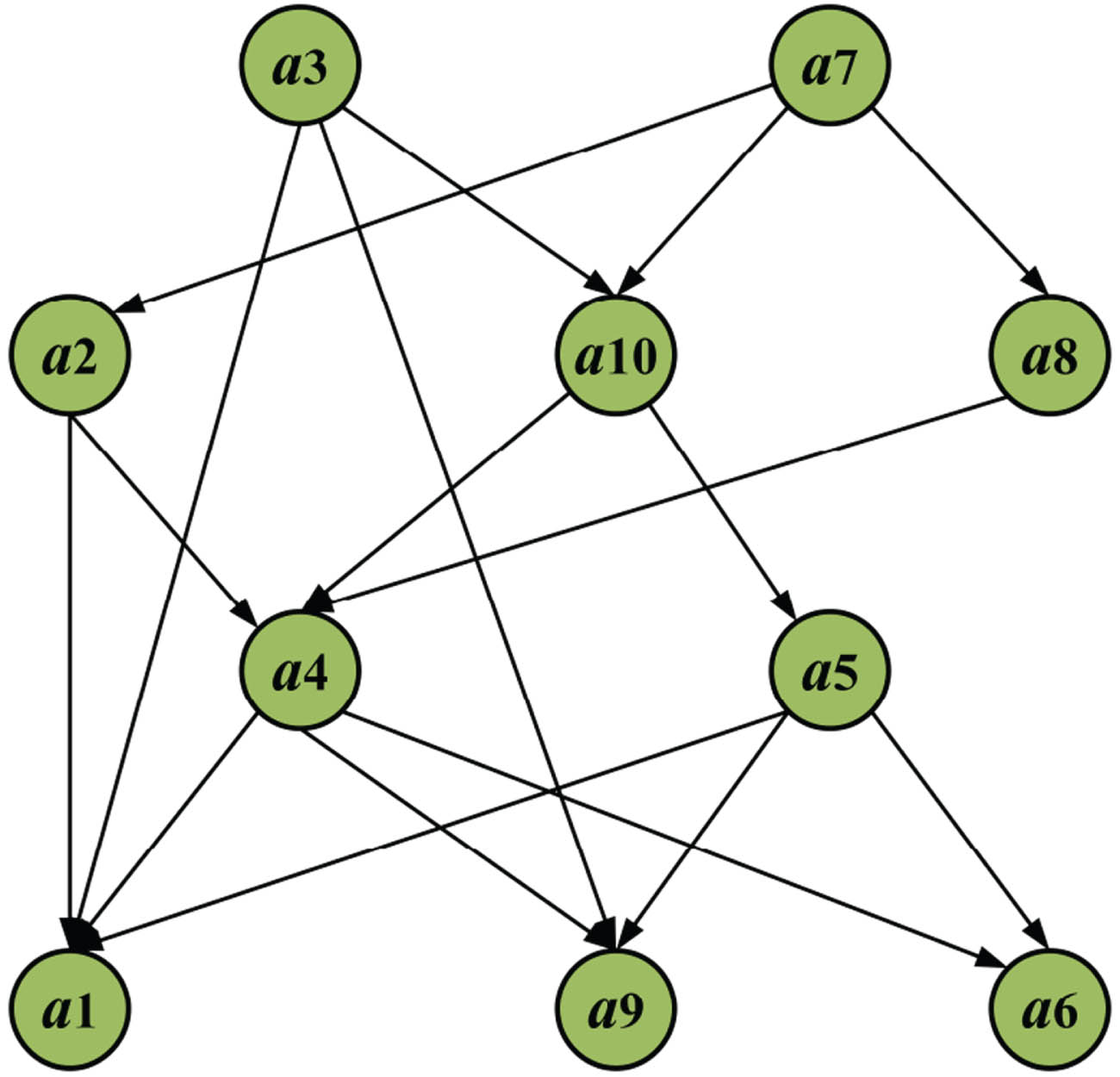
In the fifth step, according to the formula (22), the comparison matrix is transformed into a Hasse matrix, according to which the Hasse diagram is drawn.
In 3.4 Discussion, two scenarios were considered: risk preference and risk aversion. Similarly, construct the Hasse diagram of risk preference and risk aversion according to the above way to represent the decision-maker’s risk attitude.
(1) Taking Fig. 2 as an example, analyze the sorting results of the Hasse graph. The Hasse diagram can provide hierarchical and clustering information. From a hierarchical point of view, it can be clearly found that the 10 alternatives are divided into four layers.The first layer set is {a3, a7}, the second layer set is {a2, a10, a8}, the third layer set is {a4, a5}, and the fourth layer set is {a1, a9, a6}. Among them, the first layer set is the optimal alternative set, and the fourth layer set is the worst alternative set. The ranking of the 10 alternatives is a partial order structure, and the ranking obtained by Hasse diagram is a7 ∥ a3 ≻ a2 ∥ a10 ∥ a8 ≻ a5 ∥ a4 ≻ a1 ∥ a9 ∥ a6.
Risk-neutral Hasse diagram.
The Hasse diagram can also show the robustness of the alternative comparison. The arrow-connected alternatives in Hasse graphs are comparable, such as a3 and a10 with comparability. If the weight order remains unchanged, the comparative relationship between the two remains unchanged. The non-arrow connected alternatives in the Hasse graph are incomparable alternatives. For example, a3 and a7 are not comparable. With the change of weight, the order of the two may be reversed, and the ranking is uncertain.
The final result displayed in the Hasse diagram is two-dimensional information, which can achieve full sorting with probability information. The approximate rank mean of the alternative calculated by the formula (23) is used to carry out a more detailed ranking of the alternative, and the result is: ρ L (a1) =0.125, ρ L (a2) =0.6, ρ L (a3) =0.8, ρ L (a4) =0.5714, ρ L (a5) =0.4, ρ L (a6) =0.1667, ρ L (a7) =0.9, ρ L (a8) =0.7143, ρ L (a9) =0.1111, ρ L (a10) =0.6667. Therefore, the ranking of the alternative isa7 ≻ a3 ≻ a8 ≻ a10 ≻ a2 ≻ a4 ≻ a5 ≻ a6 ≻ a1 ≻ a9, which is a full sort with probability information, and the probability information of the ranking can be obtained by 4.4 simulation. For example, a4 and a5 the probability that a4 is better than a5 in the simulation is 97.43%.
(2) Poset-VIKOR can reflect the decision maker’s risk preference. Different preference types lead to different Hasse diagrams. For example, in risk-neutral situations, a8 is considered better than a10. However, in risk-averse situations, a10 is considered better than a8, and in risk-seeking situations, they are incomparable.
The current VIKOR model is integrated with a variety of weighting methods, such as AHP [50] and ordinal weight [61]. Due to the different accurate weights, the ranking results are not the same.Through the application of the partial order VIKOR method, we find that regardless of the variations in the precise weights obtained through different weighting methods, if the weight order remains consistent, that is within the category of partial order VIKOR weight space, the resulting alternative rankings can be considered as a subset of the partial order Hasse graph ranking. Although the weighting methods are different, they have something in common, which is any precise weight that satisfies the order of weights, and the resulting ranking intersection is a Hasse graph. On the other hand, when the weight is difficult to obtain or express accurately, the partial order VIKOR method can replace the traditional method and use it alone to sort the alternatives. Table 13 shows that the results obtained by partial order VIKOR are similar to those obtained by other methods. The ranking of alternatives obtained by the AHP-VIKOR and Ordinal weight-VIKOR method accords with the sorting framework of partial order VIKOR, so partial order can be used to replace other methods. Besides, compared with other methods, this method has the following advantages:
Comparison of sorting results by different methods
Comparison of sorting results by different methods
(1) Concerning index weighting, the weight results obtained by different weighting methods are indeed different, thus it is difficult to determine which method is more suitable for the VIKOR model. The partial order VIKOR method utilizes expert judgment to determine the order of importance for various weights. By incorporating this information into the model, it can effectively address disputes regarding empowerment.Additionally, the information dimension of expert preference is integrated into the partial order VIKOR model, making full utilization of expert experience, and giving play to the advantages of the subjective weighting method. Considering the diversification of information sources, and realizing the full integration of information and data.
(2) The partial order VIKOR uses the Hasse diagram to express the ranking results, which can directly display the structure information between alternatives. Figures 2–4 shows the advantages of this method compared with other methods. The previous multi-criteria decision-making methods, the results of alternative comparison are total order, that is, each alternative has a fixed ranking, and the ten suppliers rank from 1 to 10 in order. However, the Hasse graph can achieve hierarchical clustering. Taking Fig. 2 as an example, dividing ten alternatives into four levels.

The Hasse diagram of risk preference.

Hasse diagram of risk aversion.
(3) Hasse diagrams can identify the instability in ranking and predict the risks in the decision-making process in advance. Through the Hasse diagram, it can be found that a2 and a8 are incomparable alternatives, and the ranking relationship between them is not invariable and will be reversed under certain probability conditions with the change of weight. AHP-VIKOR thinks that a2 ≻ a8, but the ordinal weight-VIKOR thinks a8 ≻ a2, the order is reversed. It can be seen that the partial order is an effective auxiliary tool, and the partial order Hasse diagram can be used to see through the uncertainty in the Ordinal weight-VIKOR and AHP-VIKORranking.
(4) Compared to TOPSIS, partial order VIKOR can express the decision maker’s risk preference, adding subjectivity to the decision-making process and making it closer to reality. Although there are now partial order TOPSIS models [28], this approach also loses risk preference and cannot reflect the decision maker’s risk attitude.
To verify the robustness and feasibility of the ranking of Hasse diagrams, take risk-neutral as an example, the proposed method is compared with the SMAA method. Under a given weight space, Monte Carlo simulation is used to compare pair by pair to observe how the ranking of weight change schemes changes under a given weight space. With the help of Python software, the simulation is programmed and the code is run. The specific steps of the simulation program are as follows: (1) According to the weight rank relation, 10000 7-dimensional weight vectors are randomly generated; (2) The weight is multiplied by the alternative vector (10 alternative data). Get 10000 rows and 10 columns of evaluation data; (3) Compare the columns of the evaluation data, and finally get the simulation result as Table 14.
Comparison results of alternatives under random weight changes
Comparison results of alternatives under random weight changes
According to the properties of Hasse diagram, for comparable alternatives, no matter how the weight changes, the comparison relationship between them remains unchanged under the condition that the order of weight is constant. For example, in the Hasse diagram (Fig. 2), a3 is better than a10, and the simulation results show that alternative a3 is superior to alternative a10 for 10000 times, that is to say, the probability that the former is better than the latter is 100% which is completely in line with the theoretical expectation.
For incomparable alternatives, the ideal simulation results of these alternatives should be between 0 and 1. For example, in 10000 simulations, the evaluation value of scenario a4 is greater than a5 9743 times, that is, the probability that the former is better than the latter is 97.43%. Although the probability that a7 is better than a3 in the simulation is 99.63%, the two can not be compared from the Hasse diagram. If the weight of index c5 is 1 and the weight of other indicators is 0 in the weight space, then a3 is better than a7. It can be seen that the comparison results of the simulated random weights in Table 14 are in good agreement with the theoretical results! The results obtained by the proposed method are consistent with those obtained by the SMAA method, which shows that the proposed method is practical.
By using the combination of poset and VIKOR model, the parameters in the model are eliminated according to the parameter elimination principle (Theorem 1 and 2), and the VIKOR model is transformed into a non-parametric model, which solves the parameter assignment dilemma. Compared with the traditional method, the partial order VIKOR method is unique in that: (1) In practical application, the model can be run only by obtaining the weight order, which greatly reduces the running cost of the model. The weight space composed of a preference sequence is used to replace the exact weight. compared with the single weight, the ranking of alternative under the weight space has “natural” robustness. (2) The partial order VIKOR method outputs the expression results through the Hasse diagram, which visually shows the hierarchical clustering relationship between the alternatives, the vertical relationship reflects the hierarchical information between the alternatives, and the horizontal relationship, that is, the clustering information within the same layer. (3) The use of a Hasse diagram allows for the clear visualization and representation of comparative information regarding certainty and uncertainty, providing deeper insights into the essence of decision-making. Alternatives within the same layer of the diagram are considered incomparable, and by identifying instabilities in the ranking, potential risks in the decision-making process can be predicted in advance. The ranking of comparable alternatives between levels is robust, as long as the order of weights remains unchanged, no matter how the exact weights change, the ranking of alternatives will not change. (4) The final result of the Hasse graph is two-dimensional information, and the full sort can be realized according to the Hasse graph, and this kind of full sort contains probability information, which is a full sort with moreinformation.
It is worth noting that the partial order VIKOR model is a non-parametric model that not only eliminates the weight parameters of the VIKOR model and solves the weight problem, but also eliminates the risk attitude parameters, which can reflect the risk attitude and psychological behavior of decision-makers.
Footnotes
Acknowledgments
The work was partly supported by the National Natural Science Foundation of China (No. 52174184), Liaoning Provincial Department of Education Funded Project (LJ2020JCL028).