



Abstract
In comparison to intuitionistic fuzzy set (IFS) and Pythagorean fuzzy set (PFS), the Fermatean Fuzzy Set (FFS) is more efficacious in dealing ambiguous and imprecise data when making decisions. In this paper, we propose unique operations on Fermatean fuzzy information based on prioritized attributes, as well as Einstein’s operations based on adjusting the priority of characteristics in the Fermatean fuzzy environment. We use Einstein’s operations with prioritized attributes to propose new operations on Fermatean fuzzy numbers (FFNs), and then introduce basic aspects of these operations. Motivated by Einstein operations on FFNs, we develop Fermatean fuzzy Einstein prioritized arithmetic and geometric aggregation operators (AOs). In the first place, the concepts of a Fermatean fuzzy Einstein prioritized average (FFEPA), Fermatean fuzzy Einstein prioritized weighted average (FFEPWA), and Fermatean fuzzy Einstein prioritized ordered weighted average (FFEPOWA)-operators are introduced. Then, Fermatean fuzzy Einstein prioritized geometric (FFEPG) operator, Fermatean fuzzy Einstein prioritized weighted geometric (FFEPWG) operator, Fermatean fuzzy Einstein prioritized ordered weighted geometric (FFEPOWG) operator, and Fermatean fuzzy Einstein hybrid geometric (FFEHG) operator are given. We also go through some of the key characteristics of these operators. Moreover, using these operators, we establish algorithm for addressing a multiple attribute decision-making issue using Fermatean fuzzy data and attribute prioritizing. The case of university faculty selection is taken as a scenario to analyze and demonstrate the applicability of our suggested model. In addition, a comparison of the proposed and current operators is conducted, and the impact of attribute priority on the ranking order of alternatives is explored.
Keywords
List of Abbreviations
Intuitionistic fuzzy set
Pythagorean fuzzy set
Fermatean Fuzzy Set
Fermatean fuzzy number
Aggregation operator
Fermatean fuzzy Einstein prioritized aggregation operator
Fermatean fuzzy Einstein prioritized weighted aggregation operator
Fermatean fuzzy Einstein prioritized ordered weighted aggregation operator
Fermatean fuzzy Einstein prioritized geometric aggregation operator
Multi-attribute decision making
Fermatean fuzzy Einstein
Intuitionistic fuzzy number
Spherical fuzzy set
Environment Fermatean fuzzy environment
Intuitionistic membership grade
Pythagorean membership grade
Fermatean membership grade
Rating
Einstein t-norm
Einstein t-conorm
Fermatean fuzzy Einstein
Prioritized average
Decision makers
Introduction
Zadeh proposed the core notion behind fuzzy set theory first in 1965. Zadeh characterized fuzzy set through positive membership only. Fuzzy set theory has been extensively applied in many areas, like decision-making problems [24], clustering analysis [42], pattern recognition [33], and medical diagnosis [12]. In certain situations, a negative membership grade is required and so the ordinary fuzzy set can not be employed. To address such situations, Atanassov in 1986 introduced the notion of the intuitionistic fuzzy set by including negative membership in the existing structure of the fuzzy set such that the sum of membership and non-membership grades doesn’t exceed unity. Atanassov [7, 8] introduced fundamental operations like union, intersection, complement, and the algebraic product and sum (based on Archimedean t-norm and t-conorm) on IFSs. Information aggregation under the Intuitionistic fuzzy environment is an important research area among scholars. Many researchers have applied IFSs to devise new kinds of operators and develop new approaches for aggregating or processing data, see for example [11, 15–17, 25, 31]. As an alternative to algebraic sum and product, the Einstein t-norm and t-conorm provide the best approximation for the product and sum of intuitionistic fuzzy numbers (IFNs). Wang and Liu suggested IF Einstein average aggregation (IFEAA) operators in [38], and gave IF Einstein geometric aggregation (IFEGA) operators in [39]. Zhao and Wei [46] utilized Einstein operations and developed the IF Einstein hybrid averaging and geometric aggregation operators. Similarly, many researchers considered IFSs for ordering alternatives employing various aggregation operators, see for instance [9, 13, 14, 17–22, 27–29, 31, 35, 45].
In practice, there are situations when the two membership grades of IFS are not enough to handle uncertain information. The voting process for instance, three types of opinions exist, that is, “yes”, “no”, and “abstain”. In order to manage such situation, Cuong [9] added the neutral membership grade, which also lies in the unit closed interval, to IFS and introduced a new structure called the picture fuzzy set (PFS) in which the sum of membership, neutral membership, and non-membership is bounded by unity. Cuong [10] also defined the basic operations of union, intersection, and complement on PFSs. Wei [41] proposed picture fuzzy average and geometric aggregation operators. Jana et al. [26] utilized Dombi t-norm and t-conorm and introduced the picture fuzzy Dombi aggregation operators. Khan et al. [30] introduced Einstein average aggregation operators for picture fuzzy information. Other numerous researches have discussed PFSs and proposed various operators for MADM problems, see in [27, 29, 35, 37, 40, 45].
The importance of PFSs is widely accepted. However, due to the constraint on the membership grades that their sum is less than or equal to 1, the decision-makers are constricted in allocating numerical values to the membership grades. To overcome this issue, Ashraf and Abdullah [1] introduced an extension of PFS called spherical fuzzy set (SFS), which increases the space of membership grades to a size that is larger than that of PFSs. In SFS, the square sum of membership, neutral membership, and non-membership doesn’t exceed 1. Ashraf and Abdullah [1] defined the basic set theoretic operations of union, intersection, complement, sum, product, and proposed spherical fuzzy average and geometric aggregation operators. Integrating the notions of linguistic fuzzy set and spherical fuzzy set, Jin et al. [28] initiated the concept of linguistic spherical fuzzy set and developed the linguistic spherical fuzzy aggregation operators. Ashraf et al. [2] introduced spherical fuzzy triangular norms and conorms and gave some classifications of these norms. Ashraf et al. [3] gave Dombi t-norm and t-conorm and constructed spherical fuzzy Dombi aggregation operators. Akram et al. [4] studied prioritized aggregation operators for spherical fuzzy information. Ashraf and Abdullah [5] combined sine function and SFS to define sine average and geometric aggregation operators. Ashraf et al. [6] integrated the concepts of Einstein t-norm and t-conorm with SFS to give spherical fuzzy Einstein average and geometric aggregation operators.
In the case of PFSs, the constraint is that the sum square of membership grades must not exceed 1, again confines the decision-makers to a particular domain in assigning values to the membership grades. This hinders assigning values whose sum square exceeds 1. For a particular situation, if we consider 0.8, 0.5 and 0.6, as membership grades, then their sum as well as square sum both exceed 1, but on the contrary, their cubic sum is bounded by 1. For such membership grades, and to give decision-makers more freedom in assigning the values, we define a new structure where a Fermatean fuzzy set (FFS) administers additional ability to capture the uncertainty because the cubic sum of the membership grades is bounded by 1. This emphasizes the fact that FFSs are better at dealing with uncertainty than PFSs and SFSs.
FFEPAOs have several advantages over other aggregation operators:
(i) FFEPAOs are very flexible and can handle data in situations where the ordinary aggregation operators of Pythagorean fuzzy set (PFS) theory and Intuitionistic fuzzy set (IFS) theory are failed. This makes them suitable for a wide range of decision-making problems, especially in situations where the information provided is in PFS or IFS format.
(ii) FFEPAOs can incorporate prioritization of criteria into decision-making process. This means that the decision-makers can specify the relative importance of each criteria, which allows for a more efficient and effective decision-making process.
(iii) FFEPAOs are computationally efficient than the ordinary AOs of PFS and IFS, this means that they can be used to process large amounts of information in relatively short amount of time in comparison of PFS and IFS information. This quality of FFS is particularly important in decision-making problems where the information is constantly changing or updating.
(iv) FFEPAOs are robust and can handle inconsistencies in data. This applicability of the present study is important in decision-making problems where data may be incomplete or inconsistent.
(v) FFEPAOs have wide range of possible applications in information such as risk assessment, resource allocation, and quality control. This makes them very versatile and useful in various industries and fields.
In present work prioritization of attributes is considered for decision making problems. In decision-making challenges, prioritization is crucial for a number of reasons:
(i) Resources like time, money, and labor are typically scare in decision-making circumstances. By placing the highest priority tasks/options first, prioritization facilitates the optimal allocation of these resources.
(ii) Prioritization helps with time management by determining which tasks/options require immediate attention and which may wait or be assigned.
(iii) Prioritization aids in risk management by helping to identify and rank the most important risks or problems that must be resolved first.
(iv) Prioritization makes ensuring that the decisions are made in accordance with the organization’s or personal’s overall goals and objectives. Decision-makers can make sure that their choices match their overall vision by prioritizing options/tasks that are most pertinent to the goals.
(v) In decision-making process of evaluating options/tasks, prioritization provides consistency in the process. This make decision-makers in avoiding rash or erroneous choice based on prejudices or preferences they may have.
Some importsnt properties of the proposed study are pointed out below:
(i) How are decision-making issues be addressed by FFEPAOs?
(ii) What are the accuracy and computational efficiency differences between FFEPAOs and other aggregation operators?
(iii) How may missing or inconsistent data be handled using FFEPAOs?
(iv) What are the drawbacks of FFEPAOs and how might they be overcome in the next studies?
The novel facts of the present notion of FFSs are highlighted in the following points. For decision makers to analyze the uncertain scenarios in real-world challenges, the FFS offers more promising results than the classical IFS and PFS. In circumstances when classical IFS and PFS models fail, FFS models can be used. The FFS is a special case of q-Rung Orthopair fuzzy set for q = 3. The prioritization of attributes in FF-environment is a novel contribution in fuzzy decision support system.
The following are the goals of this article: Introducing Fermatean fuzzy Einstein prioritized operations. Under Fermatean fuzzy Einstein prioritized operations, offering novel aggregation operators based on FFSs. Developing an algorithm for the solution of MADM problems based on the suggested operators in the FF environment. To study the effect of prioritization of attributes in decision process.
The arrangement of the article is given in the following. The fundamental concepts of IFSs and PFSs, as well as their attributes, and a detailed treatment of FFSs are presented in Section 2. Section 3, comprises the Einstein operation on FFNs. In Section 4, the novel Fermatean Einstein aggregation operators are introduced. Moreover, in Section 5, a decision-making approach based on these operators has been developed for ranking alternatives using Fermatean fuzzy information. The proposed method was also explained using an example in order to test its stability, dependability, and effectiveness. Finally, several comparisons are made between the suggested and existing approaches.
Preliminaries
We present some preliminaries of intuitionistic fuzzy sets (IFSs), Pythagorean fuzzy sets (PFSs), and Fermatean fuzzy sets (FFSs) in this section, which will be useful in the upcoming analysis.
For a fixed x ∈ S the ordered pair
where
The following theorem establishes the fact that the space of FMGs (Fermatean membership grades) is bigger than that of IMGs (intuitionistic fuzzy membership grades) and PMGs (Pythagorean membership grades).
(i)
(ii)
(iii)
(iv)
(v)
(i)
(ii)
(iii)
(iv)
(i)
(ii)
(iii)
(iv)
(v)
(vi)
(vii)
(viii)
For the rating of FFNs, the rating value is defined as:
In order to compare FFNs, we recap the following criteria.
Definition 2.9. [32] Let
(i) If
(ii) If
The case when the rating values of two FFNs are equal, the rating function becomes invalid for comparing FFNs. To deal with this issue, we study the accuracy degree.
In the following, a complete procedure for the ranking of FFNs is given.
(i) If
(ii) If
(iii) If
(a) If
(b) If
(c) If
Based on Einstein t-norm (ETN) and t-conorm (ETCN), the Fermatean fuzzy Einstein operations i.e, Einstein sum and the Einstein product are defined by.
In this section, by utilizing the concepts of ETN and ETCN, we first recall the Einstein operations for FFNs, and then based on Einstein operations, we define FF Einstein (FFE) aggregation operators.
(i)
(ii)
(iii)
(iv)
FFEP AOs
FFEP Arithmetic AOs
The set of all non-empty FFNs, is denoted by
In 2008, Yager introduced the concept of prioritized average (PA) in [47], the definition below reminds us of this:
where
Here, we propose some arithmetic prioritized aggregation operators on FFNs based on Einstein operations. Throughout this section, Γ denotes the collection of all FFNs on a nonempty set X .
In the following theorem, we use the Einstein operations given in Definitions 3.1 on FFNs to show that the aggregated value of a family of FFNs under FFEPA operator is again a FFN. We also give a formula for FFEPA operator in terms of membership and nonmembership grades.
Using Equation (5), one gets
This shows that Equation (5) is true for ℓ=2 . Suppose that Equation (5) is true for ℓ = k, that is,
Now we show that Equation (5) is true for ℓ = k + 1 . Upon using the basic laws of Einstein operations, one obtains
This shows that Equation (5) is true for ℓ = k + 1 . Thus, it is true for all
Also, since
Hence, 0 ≤ αξFFEPA ≤ 1 . In similar manner, it follows that 0 ≤ γξFFEPA ≤ 1 . Moreover,
Thus, FFEPA ∈[0, 1] , and we showed that the aggregated value of a family of FFNs by FFEPA operator is again an FFN. This completes the proof.
In the following result, the comparison between the Fermatean fuzzy Einstien prioritized average (FFEPA)-operator and Fermatean fuzzy prioritized average (FFPA)-operator are considered.
be the weight vector of ξℓ = (αℓ, γℓ) (ℓ =1, 2, . . . , ø) such that
And upon using Equation 6, we obtain
Thus,
If sc(ξℓ) =sc
Therefore, FFEPA△ (ξ1, ξ2, . . . , ξ ø) ≤ FFPA△ (ξ1, ξ2, . . . , ξø) , where equality holds if and only if ξℓ are equal for all ℓ .
Now using FFPA operator, we have
Therefore, from above discussion, it is clear that FFEPA△ (ξ1, ξ2, ξ3) ≤ FFPA△ (ξ1, ξ2, ξ3) .
Noticing the weights, one can see that ℧ = (℧ 1, ℧ 2, . . . , ℧ ȼ)
T
of FFS ξℓ (ℓ =1, 2, . . . , ȼ) such that ℧ℓ > 0 and
is called the ø-dimensional Fermatean fuzzy Einstein prioritized weighted averaging operator abbreviated as FFEPWA, where
where
The notion of a Fermatean fuzzy Einstein prioritized ordered weighted averaging (FFEPOWA) operator is presented below.
The next theorem establishes a formula for FFEPOWA operator based on FFS.
where
In this part, based on Einstein operations, new prioritized geometric aggregation operators for FFNs are presented.
The following theorem employs the Einstein operations reported in Definitions 3.1 and 5.1 on FFNs to show that the aggregated value of a family of FFNs under FFEPG operator is again a FFN. Moreover, we develop a formula for FFEPG operator in terms of FFNs.
In the following theorem, we demonstrate that the aggregated value of a family of FFNs under FFEPWG operator is again a FFN. In addition, a formula for FFEPWG operator in terms of FFNs is also given.
In order to see the practicality of weighted geometric operators, we present the notion of a Fermatean fuzzy Einstein prioritized ordered weighted geometric (FFEPOWG) operator.
The theorem below uses Definition 3.1 and 5.6 to establish the fact that the values of FFEPOWG operator are FFNs. Furthermore, it deduces a formula for FFEPOWG operator in terms of the membership/nonmembership grades.
where where
By using Theorem 5.7, we have
In this portion, we shall apply the developed models in multiple attribute decision making problem (MADM), the data used for the evaluation of the process are in the form of FFNs. Let
and
or apply FFPWG operator
to obtain the totaled values of
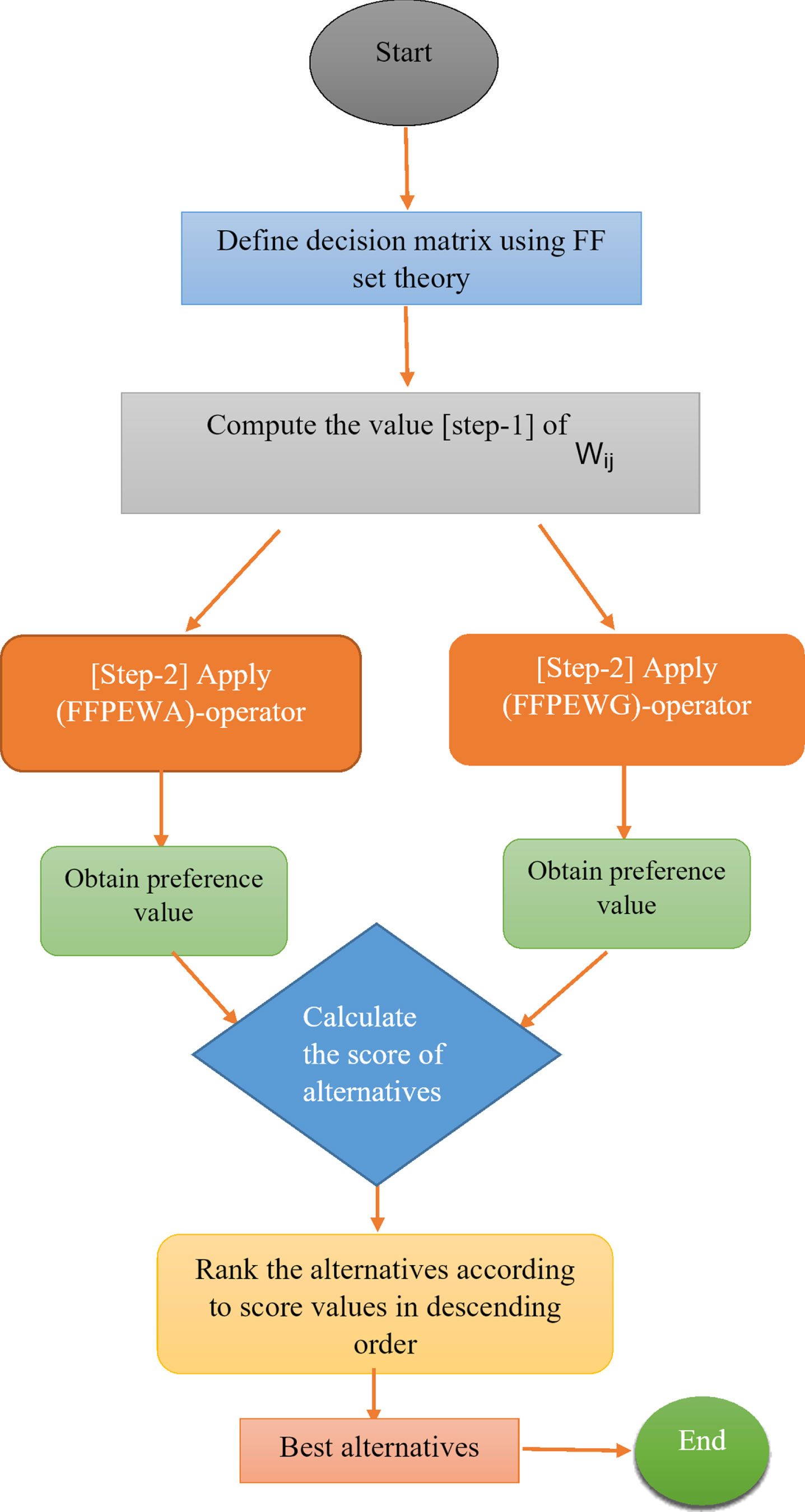
Flowchart of proposed method.
An illustration of description
We talk about how our university selects its teaching staff. The Department of Mathematics at Abdul Wali Khan University aspires to recruit exceptional educators from around the world to help improve the university’s educational system. Following several critical Department meetings, an experienced team is chosen to complete the process of selecting outstanding teachers. The university vice chancellor (VC), dean of physical and numerical sciences (P&NS), and human resource development officer make up the expert panel. This group of experts will examine five prospects Aℓ (ℓ =1, 2, 3, 4, 5) following the four attributes
The vice chancellor of the university has absolute decision-making authority, followed by the dean of P&NS. They will also follow a strict principle of combined ability and will be unaffected by political honesty. The prioritizing criteria are as follows:
Fermatean fuzzy decision matrixr
Fermatean fuzzy decision matrixr
In order to choose the most appealing candidate, Aℓ (ℓ =1, 2, 3, 4, 5) , in the next algorithm’s steps, we employ FFEPWA and FFEPWG operators.
FFEPWG operator
For appointing the most appropriate candidate, the selection procedure for FFEPWG operator is the same as above.
The optimum results obtained by applying both the methods of FFEPWA and FFEPWG-operators, it is noticed that the desired sorted results are different. In FFEPWA-operator the optimum alternative is A1 while in FFEPWG-operator it is A3 . The main reason behind the dissimilar outcomes is the behavior of two methods. In practice, FFEPWA-operator focuses on the impact of the overall data, whereas the FFEPWG-operator considers the role of individual data. It is also noteworthy to mention that if the level of priority among the attributes have same level, then both the developed techniques are reduced to FFEWA and FFEWG-operators.
From above analysis, we conclude that the proposed models have the following main advantages: Our proposed models of Fermatean fuzzy Einstein prioritized AOs are not only accommodates the Fermatean fuzzy situations but also more feasible and practical when considering the prioritization among the attributes and DMs as compared to the traditional Fermatean as well as Pythagorean fuzzy AOs. The proposed Fermatean fuzzy Einstein prioritized AOs are more flexible than the intuitionistic fuzzy Einstein prioritized AOs as well as Pythagorean fuzzy Einstein prioritized AOs as in the Fermatean fuzzy environment the DMs deal with the situations where the degree of membership and nonmembership of particular attributes are such that its sum is greater than 1.
Comparative analysis of models
To compare the suggested methods to the current methods, we noticed that the ranking orders of alternatives generated by different techniques on FFNs are different. However, the ideal option remains the same, ensuring the validity and application of the provided approaches. In FFWA, FFWG, FFEWA, and FFEWG operators, the best and worst alternative remain the same, while the ranking of the middle alternatives has small fluctuations as shown in Table 2.
Different methods of current and proposed aggregation operators
Different methods of current and proposed aggregation operators
Figure 2 depicts the graphical representations of various rating orders where the operators that have been proposed as well as those that are already in operation. Alternatives are represented on the x-axis while scores on y-axis.

Comparison of ranking orders of alternatives of different operators.
The ranking orders of all the options employing numerous current and new operators are different, as shown in Fig. 2. In this graph, the ranking orders of alternatives are compared with four existing operators and two proposed operators as shown in the graph. By close observation, we notice that the FFEWA and FFEWG operators have similar behavior. Similarly, the FFEPWA and FFEPWG operators have similar characteristics. The other operators have some fluctuations in the ranking orders of alternatives.
The score values and ranking orders of alternatives in the FFEWA, FFEPA, & FFEWG, FFEPG operators are listed in Table 3.
Prioritization effect on ranking order in proposed operators
Prioritization effect on ranking order in proposed operators
Table 3 shows that, the ranking order of options in FFEPA and FFEPG operators has relatively few changes as shown in Fig. 4. Similarly, the FFEA and FFEPG operators’ ranking orders contain minor variations. It is deduced that the order of alternatives based on Einstein operations is very little affected by the ordering of alternatives in prioritized aggregation operators of FFSs.
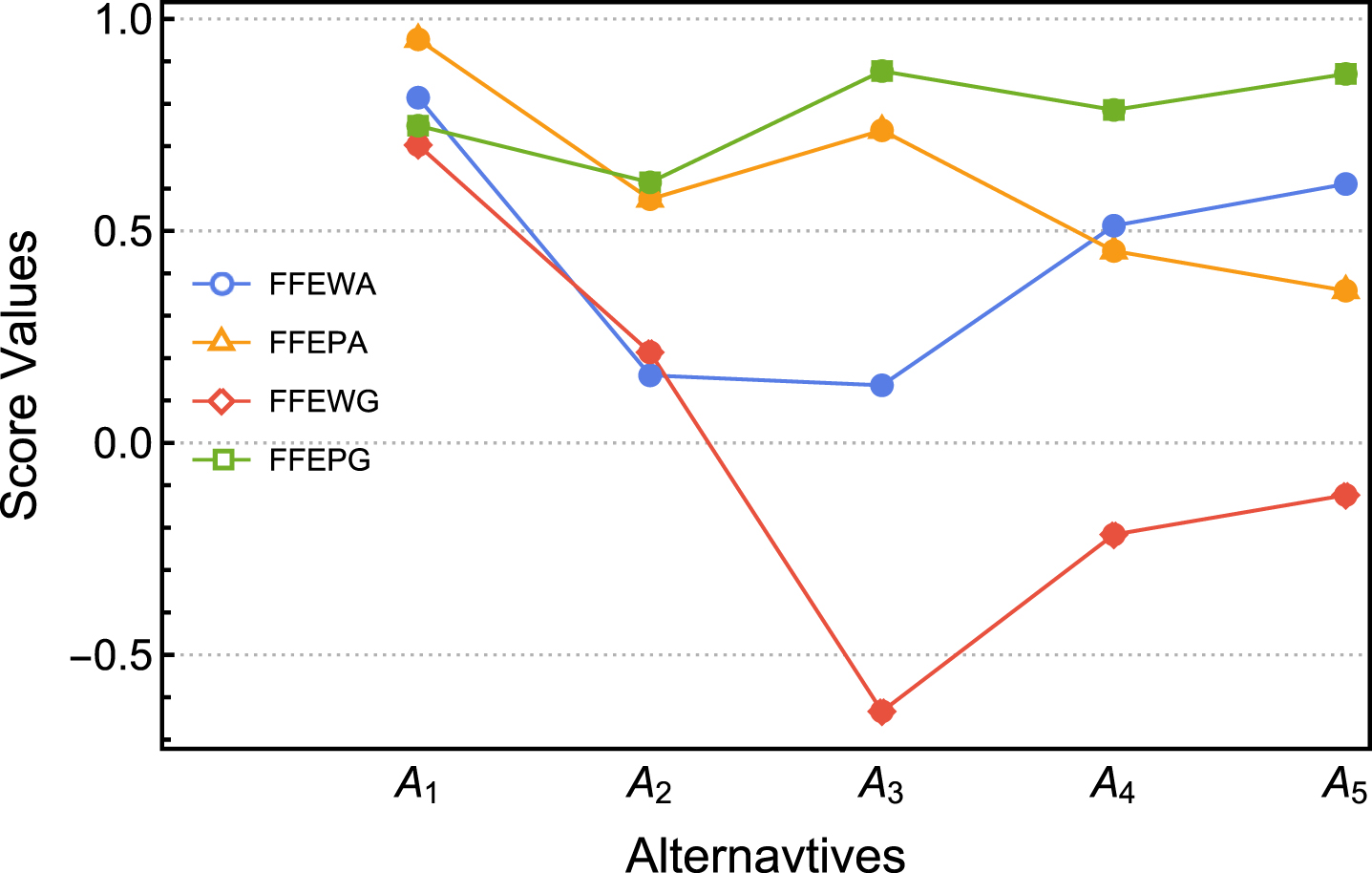
Effect of prioritization on ranking orders of alternatives.
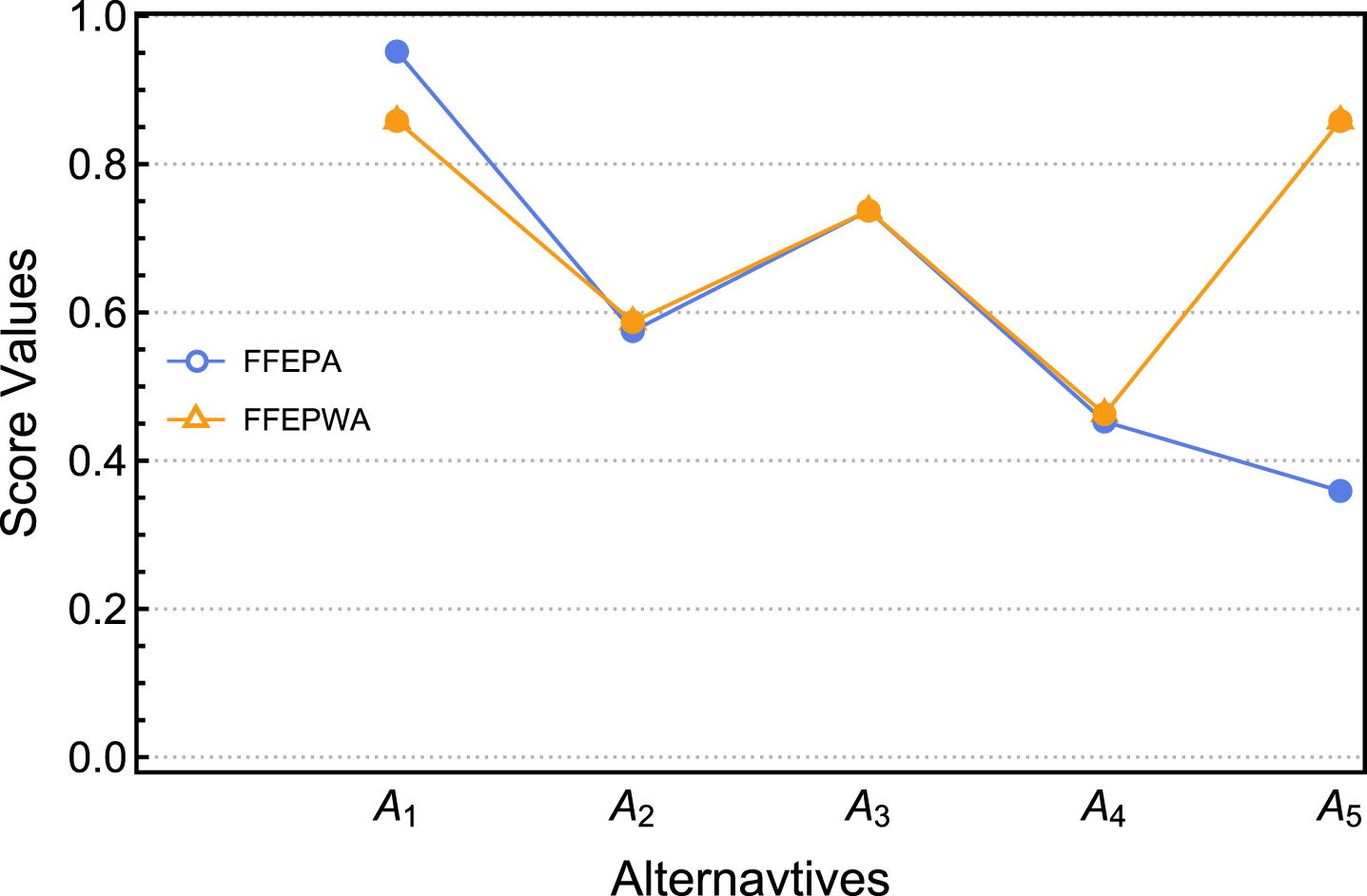
Comparison of ranking orders of alternatives using FFEPA and FFEPWA operators.
The weighted prioritized ranking order of alternatives are obtained in the illustrative example. If we drop the weights of alternatives and consider only the prioritization factor among the alternatives. Then, the aggregated values are given in Table 4. The score values and corresponding ranking order of alternatives are shown in Table 5.
Aggregated values of alternatives using FFEPA and FFEPG operator
Aggregated values of alternatives using FFEPA and FFEPG operator
Score values of alternatives using FFEPA and FFEPG operator
Given below in Figs. 4, 5, we match Fermatean fuzzy Einstein prioritized AOs (without weights) and Fermatean fuzzy Einstein prioritized weighted AOs with each other.
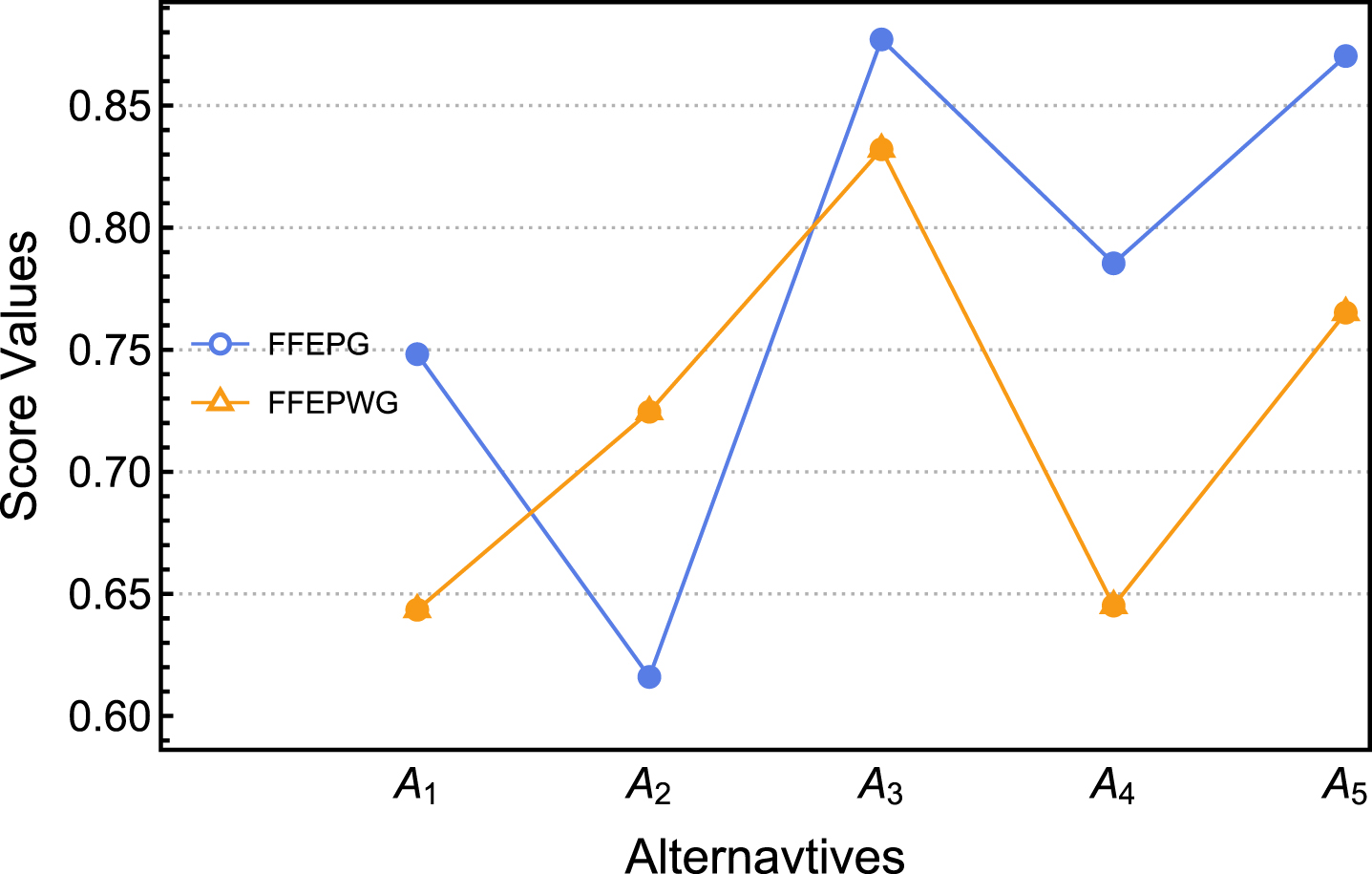
Comparison of ranking orders of alternatives using FFEPG and FFEPWG operators.
In Fig. 4, a comparison of FFEPA and FFEPWA operators is shown. In this figure, we noticed that the weight has a rare effect on the ranking order of alternatives. While in Fig. 5, the comparison of FFEPG and FFEPWG operators is shown. We observe that the ranking order of alternatives in FFEPA operator (green line) has no stability on the other hand, if we include the weight factor on attributes, then the ranking order of alternatives become stable as shown in Fig. 5.
We evaluate the approaches and compare the results obtained by utilizing Fermatean fuzzy Hamacher prioritized arithmetic and geometric aggregation operators in Khan et al. [30] with the operators introduced in this analysis.
In Khan et al. [30], if we assume the attribute alternatives weights as Φ = (0.2, 0.2, 0.3, 0.3) T , and employ fuzzy weighted averaging and geometric aggregation operators based on FF Hamacher prioritization of attributes, then the subsequent aggregated and score values of alternatives are listed in Tables 6, 7.
Aggregated values of alternatives using FFHPWA and FFHPWG operator
Aggregated values of alternatives using FFHPWA and FFHPWG operator
Score values of alternatives using FFHPWA and FFHPWG operator
The proposed operators are compared to the existing operators FFHPWA and FFHPWG given in Tables 8 and 9, respectively.
Score values of alternatives using FFHPWA and FFEPWA operator
Scores in FFHPWG and FFEPWG operator
In the following figures, we compare our proposed operators with the existing operators of Fermatean fuzzy Hamacher prioritized averaging and geometric operators.
The graphical comparison showing the behavior difference between FFHPWA and FFEPWA operators are depicted in Fig. 6. It can noticed that FFEPWA-operator has fewer fluctuations as compared to FFHPWA-operator in this graph. This means that the proposed model is more stable than the existing model. In Fig. 7, we compare FFHPWG-operator and FFEPWG-operator. We observe that the existing FFHPWG-operator is more stable than FFEPWG-operator as evident from Fig. 7.
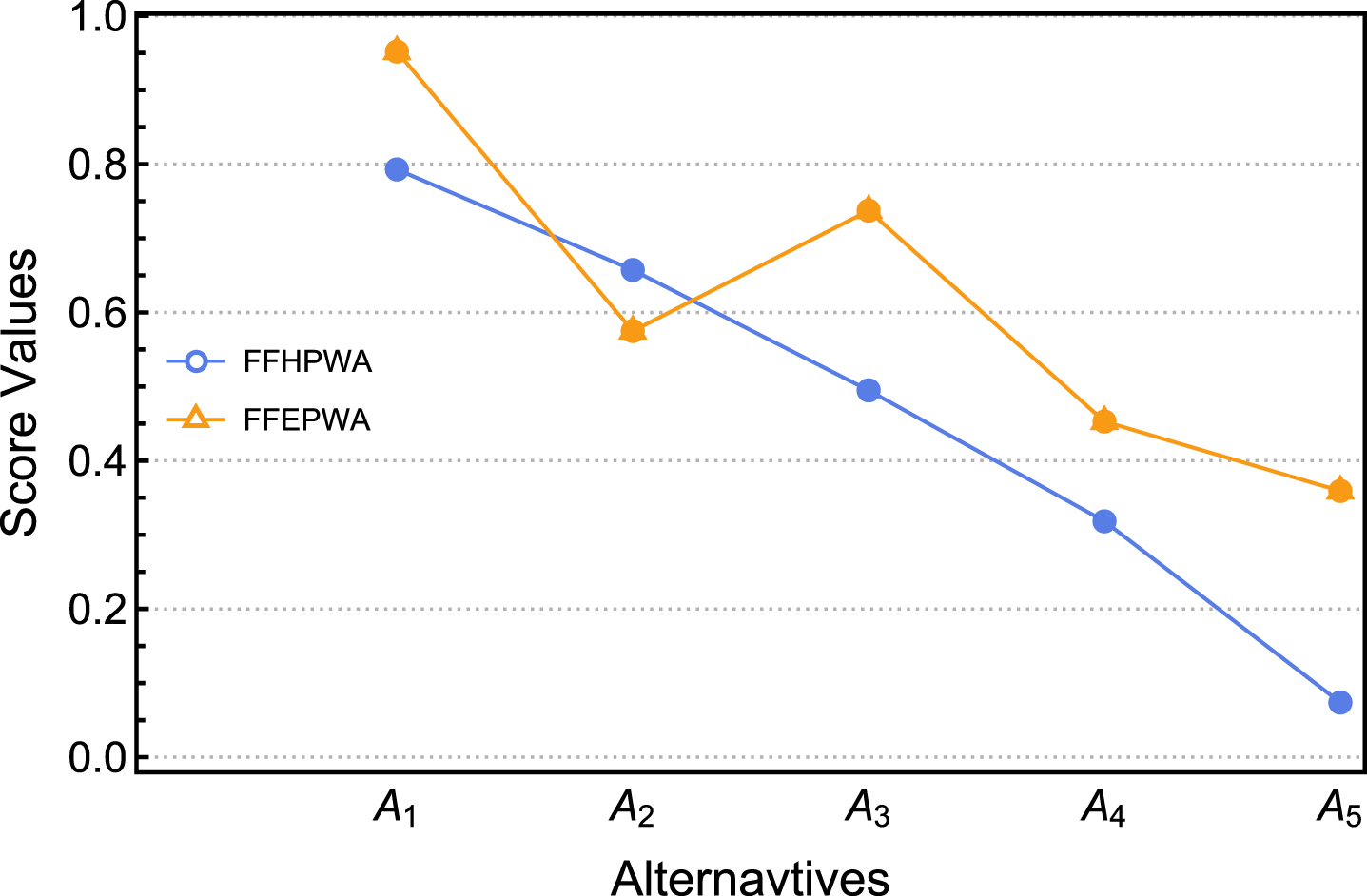
Comparison of ranking orders of alternatives using FFHPWA and FFEPWA operators.

Comparison of ranking orders of alternatives using FFHPWG and FFEPWG operators.
In this study, many forms of aggregation operators based on Einstein operations are presented for use in the FFS decision-making process. Previously, the FFSs environment described many Einstein operations without regard to attribute priority. From the rationale of Einstein operations, we presented arithmetic and geometric operations to initiate some Fermatean fuzzy Einstein prioritized aggregation operators as Fermatean fuzzy Einstein prioritized average (FFEA), Fermatean fuzzy Einstein prioritized weighted average (FFEPWA), Fermatean fuzzy Einstein prioritized geometric (FFEPG), and Fermatean fuzzy Einstein prioritized weighted geometric (FFEPWG). New characteristics of these suggested operators are taken into account. We used these operators as a fact check to investigate solutions for dealing with MADM issues. Finally, a real-life example of our university’s teaching staff selection procedure is explored in order to establish a strategy and demonstrate the handling of the proposed method. The new operators are compared with Pythagorean fuzzy Einstein aggregation operators listed in Khan et al. [30] which proved the operators dependability. For the suggested Fermatean fuzzy sets with prioritized attributes structure, we intend to investigate risk theory and other fields for uncertain cases in our future analysis.
Footnotes
Acknowledgment
The Deanship of Scientific Research (DSR) at King Abdulaziz University, Jeddah, Saudi Arabia has funded this project, under grant no. (KEP-4-611-42).