



Abstract
This study attempts to develop the adaptive neuro-fuzzy inference system (ANFIS) with biogeography-based optimization (BBO) (ANFIS-BBO) for a case study of the actual number of COVID-19 vaccinations in a medical center, considering the variables of the date and time of vaccination, the brand of vaccine, and the number of open appointments on the government network platform in Taiwan. The COVID-19 has brought about a great burden on the health and economy of the world since the end of 2019. Many scholars have proposed a prediction model for the number of confirmed cases and deaths. However, there is still a lack of research in the prediction model for mass vaccination. In this study, ANFIS-BBO is developed to predict the number of COVID-19 vaccination, and three other forecasting models, support vector machines (SVM), least-square support vector machines (LSSVM) and general regression neural network (GRNN) are employed for forecasting the same data sets. Empirical results show that the ANFIS-BBO with trapezoidal membership function model can achieve better performance than other methods and provide robust predictions for the actual number of COVID-19 mass vaccination.
Keywords
Introduction
With the coronavirus disease (COVID-19) outbreak at the end of 2019, statistics show that by May 2022, more than 500 million people in the world had been infected, and more than 6 million people had died from the virus. It has brought about a great burden on the health and economy of the world. In order to reduce the incidence rate and mortality of COVID-19, the world actively invested in the research and development of vaccines, which were allowed to be used in a brief period of time around the world at the end of 2020, the largest vaccination program in history.
Taiwan started the COVID-19 vaccination campaign in May 2021. There were three COVID-19 vaccines that the World Health Organization initially endorsed to be used urgently: AstraZeneca (AZ), Moderna, and Pfizer-BioNTech (BNT). In order to enable people in Taiwan to get vaccinated according to their priorities, the government initially developed the COVID-19 vaccine registration and appointment reservation system so that qualified people can easily make an appointment online for the time and place of vaccination. According to statistics, by March 31, 2022, the coverage rate of the COVID-19 vaccination population has reached 83.43% for the first dose, 78.36% for the second dose, and 50.12% for the booster shot. Therefore, the Taiwanese government decentralized the online reservation system to the municipal governments, where citizens could make an appointment for vaccination through the municipal network system or directly go to the hospital or clinic to make an appointment to simplify the vaccination process.
Scholars from all over the world have devoted themselves to the research of the COVID-19 vaccine on its effects on humans. In addition, to improve vaccination rates, many scholars analyzed the factors people consider for vaccination and further predicted the intention of vaccination. Fernandes et al. [21] collected variables such as government policies, personal characteristics of local residents, background, and psychological factors in the Portuguese region and used an artificial neural network (ANN) model to predict individuals’ intention to get vaccinated for COVID-19. Nguyen et al. [22] used a fuzzy analytic hierarchy process (AHP) to obtain the factors affecting the intention for vaccination. They used structural equation modeling (SEM) to test the correlation between the collected data and put the results of SEM into an ANN model to predict the intention of Vietnamese people to get vaccinated. Mewhirter et al. [12] conducted a survey of American adults to collect data on people’s trust in the media, comfort in healthcare, vaccine awareness, beliefs, politics, and risks. The gradient boosting model was used to predict whether people were vaccine-hesitant or vaccine recipients.
In addition to predicting the intention to get vaccinated against COVID-19, predicting the actual number of vaccinations was crucial. Aqil et al. [6] used the autoregressive integrated moving average (ARIMA) model and Facebook prophet to predict the actual number of vaccinations in Indonesia. The experimental results showed that the Facebook prophet is more suitable as a prediction model for vaccination. Kannan et al. [3] used the actual data on vaccination to predict the number of vaccinations in India everyday through long short-term memory (LSTM). Maugeri et al. [4] found a strong correlation between keywords in Google trends in the Italian region and the actual number of COVID-19 vaccinations. They used the data in Google Trends and vaccination data to input into an ARIMA model to predict the daily number of COVID-19 vaccinations.
Machine learning has been successfully used in predicting time series in different fields. Isazadeh et al. [11] combined particle swarm optimization (PSO) and adaptive neuro-fuzzy inference system (ANSIF) to optimize the parameters of ANSIF. Rabiei et al. [24] used ANSIF to simulate corporate work situations to help managers improve employee job satisfaction. Girinath and Shanmugam [7] used ANFIS to predict weld bead profiles and stress-strain plots. In addition, many scholars have proposed a prediction model for COVID-19 propagation. Nguyen and Choi [25] used ANFIS, which filtered the ANFIS from the noisy and massive databases (NMDs), to handle online processes for noisy and massive databases. The results indicated that the ANFIS could obtain lower predicting error and calculating time. Dirik [19] adopted ANFIS with particle swarm optimization (PSO) into the emotion recognition model in the MUG database. The results indicated that ANFIS with PSO has outperformance. Dairi et al. [1] used the hybrid gated recurrent unit-convolutional neural networks (GAN-GRU), hybrid Convolutional Neural Networks-Long Short-Term Memory (CNN-LSTM), Restricted Boltzmann Machine (RBM), GAN, LSTM, Convolutional Neural Networks (CNN), Support Vector Regression (SVR), and Logistic Regression (LR) to predict the number of confirmed and recovered COVID-19 cases in Saudi Arabia, France, Brazil, the United States, Mexico, India, and Russia. The results showed that the hybrid model could improve the accuracy of prediction. Chowdhury et al. [5] used NFIS and LSTM to predict the number of confirmed cases in Bangladesh and found that LSTM could obtain better prediction results. Kumar et al. [23] used ANFIS to predict the number of confirmed cases in India daily, providing the local government with important information on the spread of COVID-19. Ly [15] proposed an ANFIS prediction model to predict the number of confirmed cases in the UK. Chyon et al. [10] used ARIMA to predict the number of confirmations worldwide and found that good accuracy could be obtained for short-term prediction. Alassafi et al. [20] used the Recurrent Neural Network (RNN) and LSTM to predict the number of confirmed cases, recovered cases, and deaths in Saudi Arabia, Morocco, and Malaysia. They found that LSTM could obtain better accuracy.
In addition to the prediction model of the number of confirmed cases and deaths proposed by scholars, vaccination was the main confounding factor to interfere with the prediction. Furthermore, vaccination against COVID-19 was the key strategy to mitigate the COVID-19 pandemic. However, there was still a lack of research in this area. Therefore, this study considered the date and time of vaccination, the brand of vaccine, and the number of open appointments on the government network platform and used the actual number of COVID-19 vaccinations in a medical center in Taiwan as a case study. The main contributions of the research are bellowing: This study is the firstly attempts that develops a robust ANFIS-BBO prediction model for a case study of the actual number of COVID-19 vaccinations in a medical center. This study investigated these variables “day of the week”, “vaccination”, “reservation period”, “number of reservations”, and “number of COVID-19 vaccination” for the numbers of COVID-19 vaccination prediction model. The accurate forecasting can achieve a more efficient allocation of medical personnel during the mass vaccination process.
Moreover, this study developed the ANFIS with biogeography-based optimization (BBO) (ANFIS-BBO) to address the forecasting problem of the actual numbers of COVID-19 vaccination, which could assist human and material resource arrangement for mass vaccination sites by a data-driven technique. The BBO algorithm was proposed by Simon [8]. Given its strong search capability and ability to obtain a rapid convergence rate, BBO was employed in this study for selecting parameters of ANFIS models. Notably, the optimal ANFIS with BBO can achieve lower prediction error.
The rest of this paper is organized as follows: Section 2 introduces ANFIS with BBO; Section 3 shows a case study and discusses and compares the results with other methods; Section 5 draws the research conclusions and puts forth future research suggestions.
ANFIS-BBO
Jang [14] developed ANFIS, a supervised learning method that can efficiently model nonlinear functions. The ANFIS is based on the FIS system, which can be assumed to have an input and an output. The FIS contains five functions: (1) fuzzy rule base, (2) database, (3) decision-making unit, (4) fuzzification interface, and (5) defuzzification interface.
In this study, the ANFIS adopts the fuzzy if-then rules of Takagi and Sugeno’s type, which can be shown as follows:
where A and B are linguistic labels; x is the front of fuzzy inference; and p, q, and r are the back of fuzzy inference. The weighted averaged defuzzifier method is employed as follows:
The Takagi and Sugeno ANFIS can be illustrated in Fig. 1. Layer 1: Every node in this layer is a square node with a linguistic variable. Layer 2: Each node in this layer is a labeled circle node. The symbol Π means the incoming signals are multiplied, and the product is sent out. Layer 3: Each node in this layer is a circle node labeled as N, which is used to calculate the normalized firing strengths. Layer 4: Parameters in this layer will be referred to as consequent parameters. Layer 5: The single node in this layer calculates the total output as the sum of all incoming signals. The detail procedures or principles of Takagi and Sugeno ANFIS can refer to [14].
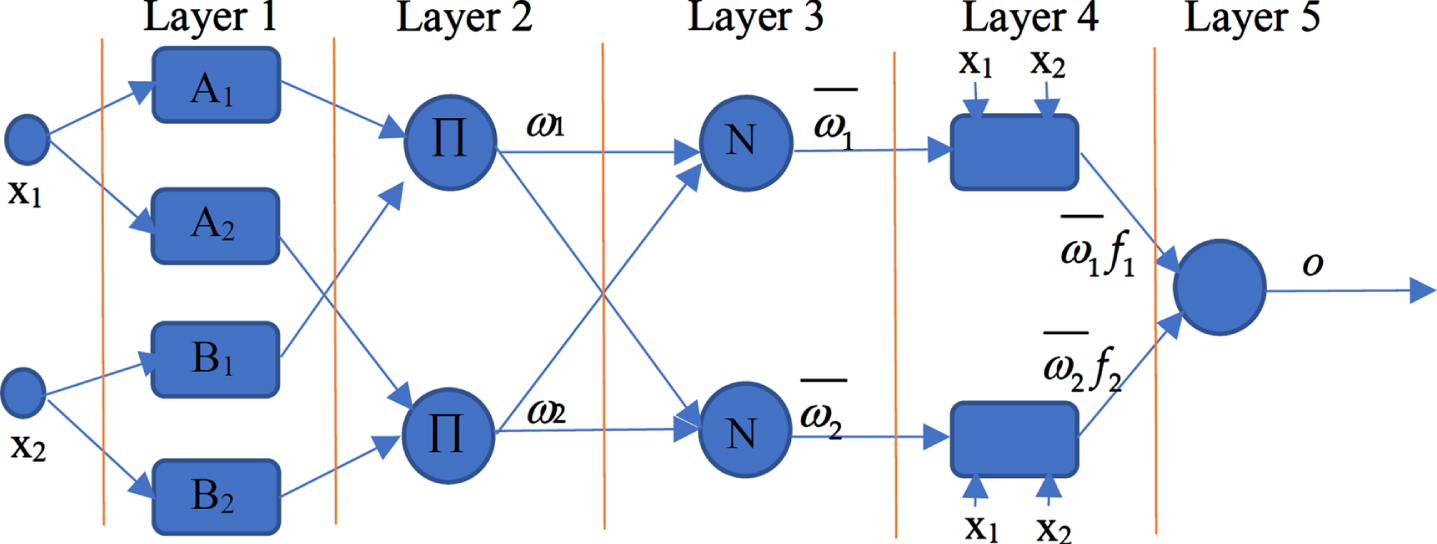
The ANFIS architecture.
BBO can effectively improve the performance of ANFIS. It has been applied in various fields, such as job scheduling [26], optimal design of plate-fin heat exchangers [2], substation location problems [18], and parameter optimization [16]. In ANFIS, the number of input membership functions (MFs) is significant because the fuzzy rule base is generated by the input membership functions. Hence, the ANFIS with BBO for the number of input membership functions is developed. The procedure of BBO can be referred to in [8]. The ANFIS with BBO can be briefly described below:
In Taiwan, COVID-19 vaccination could be reserved through the government’s web platform/mobile application. In particular, the user could select a scheduled time and mass vaccination site from the government’s web platform. Therefore, analyzing the numbers of COVID-19 vaccination was crucial for mass vaccination sites. In the numerical example, this study collected a total of nine days of data during mass vaccination from a hospital information system. The variables were “day of the week”, “vaccination”, “reservation period”, “number of reservations”, and “number of COVID-19 vaccination”. Table 1 shows the definition of all variables. These variables were selected from expert judgment. The members of the expert committee include family physicians and soft engineers of the hospital. Figure 2 shows the frequency histogram of the number of COVID-19 vaccination. It could be observed that the number of COVID-19 vaccination datasets is imbalanced.
Definition of variables information of numbers of COVID-19 vaccination cases
Definition of variables information of numbers of COVID-19 vaccination cases
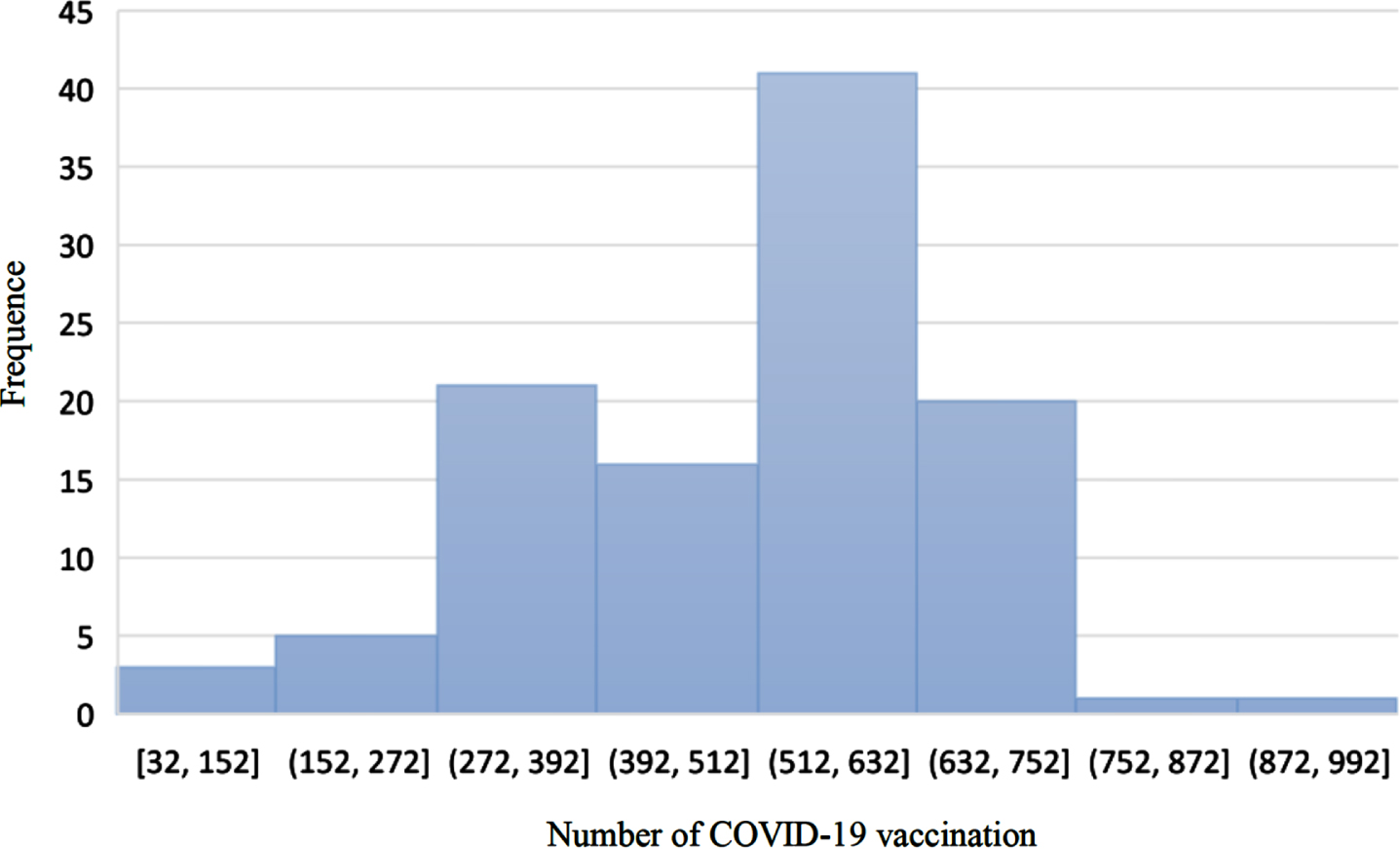
The frequency histogram of the number of COVID-19 vaccination.
In this study, ANFIS-BBO is developed to address the forecasting problems of the actual number of COVID-19 vaccination. In order to evaluate the accuracy, the root-mean-square error (RMSE) and mean absolute percentage error (MAPE (%)) were employed. The formulations are as follows:
The flowchart of the numbers of COVID-19 vaccination forecasting problems using ANFIS-BBO is shown in Fig. 3. The COVID-19 vaccination dataset was collected and stored in a database.

The flowchart of numbers of COVID-19 vaccination forecasting problem by using ANFIS-BBO.
First, the input data were divided into two parts when using the ANFIS-BBO model: the training set and the testing set with random selection. A total of 108 raw data points was divided into training and testing sets. The number of the training dataset is 86, and the number of the testing dataset is 22. This study randomly selected the training (80%) and testing (20%) datasets.
Second, for searching the optimal parameter combination using BBO, train the ANFIS-BBO model with training data and the parameter combination number of input membership functions. In this study, the briefly procedures of BBO are (1) Initial parameter setting is as describe of section 2. (2) Evaluating the fitness of each habitat in the population. (3) The emigration rate determines the probability that a habitat will leave its current location. The immigration rate governs the probability that a habitat will receive immigrants from other locations. (4) The new habitats resulting from immigration and mutation compete with the existing habitats in the population. (5) Once the termination criteria are satisfied, the algorithm outputs the best solution found during the optimization process. In order to search for the proper parameters, the RMSE was employed as fitness function and measure index.
The testing dataset
Third, the testing data set was utilized to calculate the prediction performance of the ANFIS-BBO model with the optimal parameter combination. The parameter [3 3 3 3] was determined after executing the maximum number of iterations. Further, the finalized ANFIS-BBO model was utilized to make a forecast, and the testing errors were obtained.
Table 2 shows the testing dataset which is randomly selected from collecting raw data points. In Table 2, the “days of the week” are 1, 2, 4, and 5, which means Monday, Tuesday, Thursday, and Friday. All types of vaccination were selected in the testing set. Not all reservation periods 1 and 15 were selected in testing dataset. The average and standard number of reservations were 578 and 152, respectively.
Figure 4(a) displays the ANFIS architecture for predicting the number of COVID-19 vaccination using MATLAB R2019b. The input variables are “day of the week”, “vaccination”, “reservation period”, and “number of reservations”, and the output variable is “number of COVID-19 vaccination”. The logical operation “and” is employed in this ANFIS model. The total fuzzy IF-THEN rules are 81. Figure 4(b) shows the fuzzy inference system based on the fuzzy IF-THEN in ANFIS. The input membership functions can be selected as: “Trapezoidal (ANFIS-BBO-TraM)”, “Triangular (ANFIS-BBO-TriM)”, “Gbell (ANFIS-BBO-Gbell)”, and “Gaussian (ANFIS-BBO-Gauss)”. The trapezoidal fuzzy number can be defined as (a1, a2, a3, a4), where a1, a2, a3, a4 are real numbers. Equations a1≤a2≤a3≤a4 can be referred to in Zadeh [17]. The fuzzy IF-THEN rules are as follows:
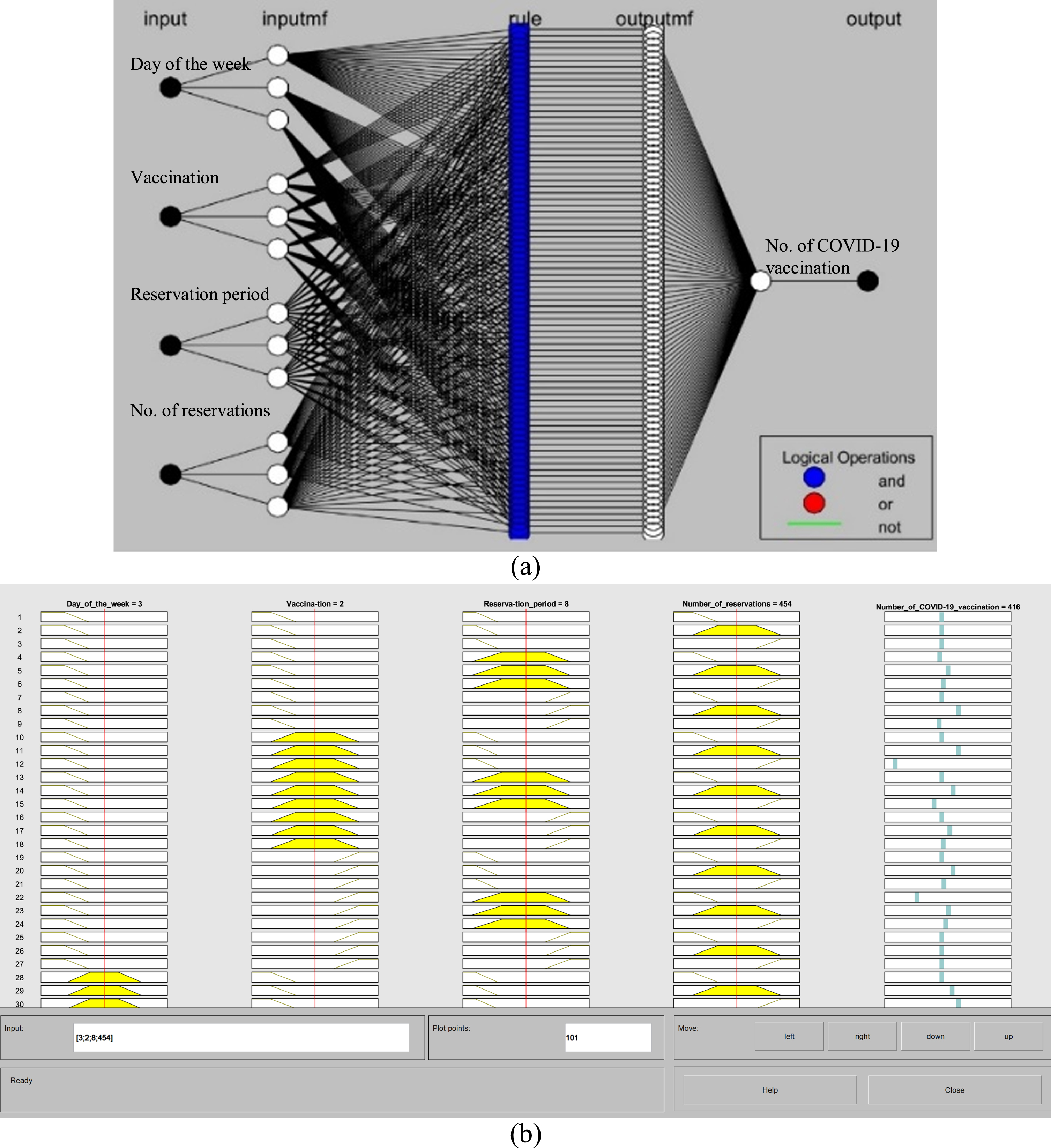
(a) The ANFIS architecture for predicting the number of COVID-19 vaccination; (b) Fuzzy inference system.
⋮
In ANFIS-BBO training, the hybrid optimization method, which can be referred to in [14], was adopted. The error tolerance is 0, and the number of epochs is 100. Figure 5(a) to (f) shows the surfaces of all fuzzy IF-THEN rules for predicting the number of COVID-19 vaccination. The surfaces show the nonlinear mapping of the number of COVID-19 vaccination. This phenomenon verifies that the ANFIS-BBO can effectively approach nonlinear functions based on fuzzy IF-THEN rules. Table 3 shows the test results, which examined ANFIS with various input membership functions: ANFIS-BBO-TraM, ANFIS-BBO-TriM, ANFIS-BBO-Gbell, and ANFIS-BBO-Gauss. Table 3 also shows that the ANFIS-BBO-TraM can obtain superior performance (RMSE is 142.814). In Fig. 3, the ANFIS-BBO-TraM is close to the actual number of COVID-19 vaccination, and the ANFIS-BBO-Gbell obtained the worst performance because it had an outlier prediction value at Item 17.

The surfaces of fuzzy IF-THEN rules for predicting the number of COVID-19 vaccination.
The ANFIS-BBO with various membership functions for predicting the number of COVID-19 vaccination
In demonstrating the superiority of the ANFIS-BBO model, three other forecasting models, support vector machines (SVM), least-square support vector machines (LSSVM) and general regression neural network (GRNN), were examined in predicting the number of COVID-19 vaccination. In the study, SVR, LSSVR, and GRNN can respectively be referred to in the studies of Vapnik et al. [27], Suykens et al. [13], and Specht [9]. Table 4 shows the results of predicting the number of COVID-19 vaccination using various forecasting methods. Figure 7 illustrates point-to-point plots of testing data for the ANFIS-BBO-TraM, SVM, and LSSVM. Table 4 and Fig. 6 show that the ANFIS-BBO-TraM model had lower MAPE (%) and RMSE, which were 24.905 and 144.419, respectively, than the traditional SVM, LSSVM, and GRNN methods. ANFIS-BBO-TraM significantly improved the prediction performance of SVM, LSSVM, and GRNN in predicting the number of COVID-19 vaccination. Further, it has been proved in this study that ANFIS-BBO can capture the nonlinear structure of a process, adaptation capability, and rapid learning capacity. Therefore, ANFIS-BBO has an important advantage compared with other techniques because fuzzy logic-based methods can model uncertainty using membership values. Hence, ANFIS-BBO-TraM can also effectively predict the actual number of COVID-19 vaccination in mass vaccination sites. Moreover, the limitation of the study lies in the data from one hospital information system and that the characteristics of collected dates may affect the final forecasting performance.
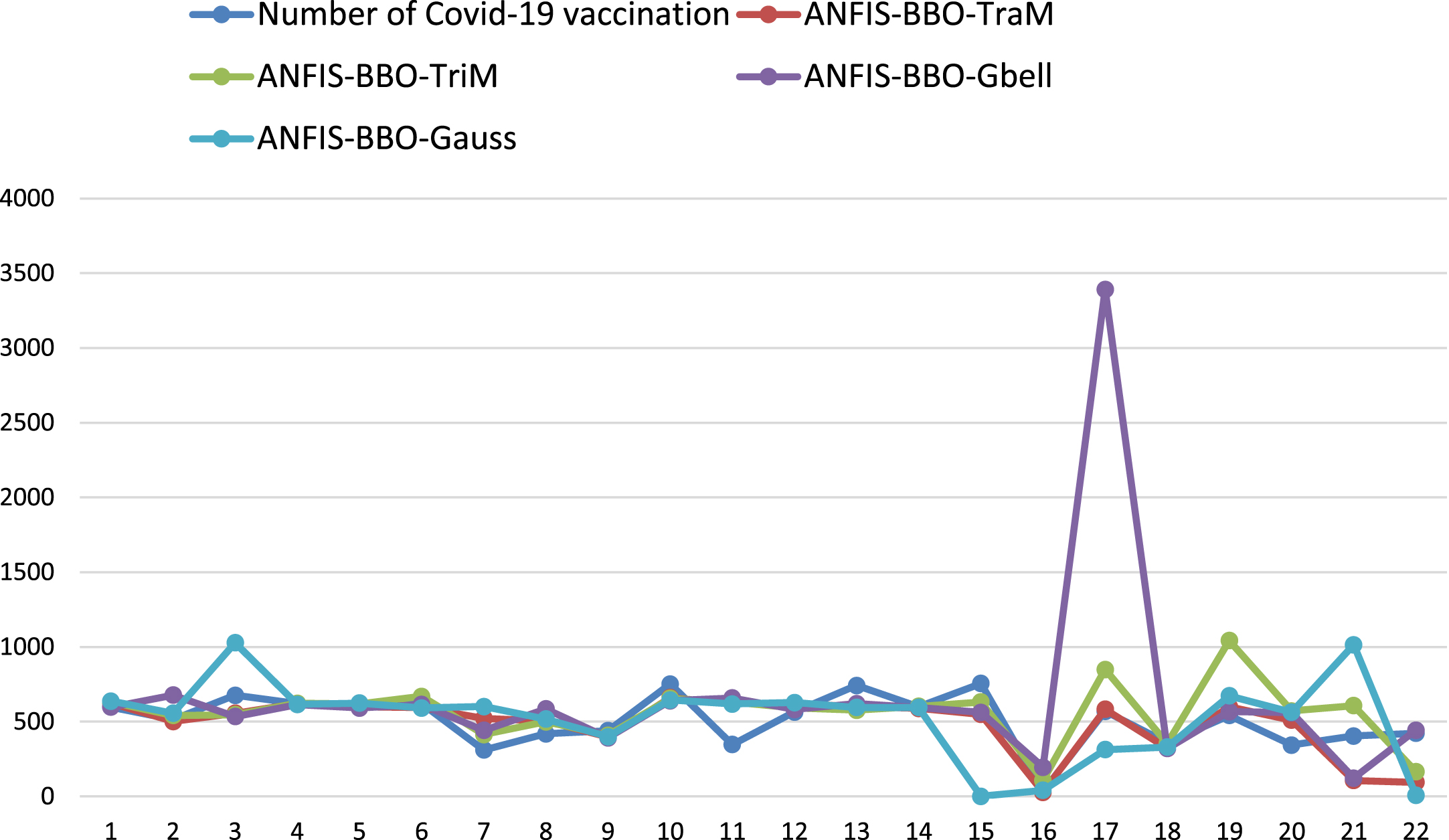
Illustration of ANFIS-BBO with various membership functions for predicting the number of COVID-19 vaccination.

(a) Illustration of actual values, forecasting values of ANFIS-BBO-TraM model, and error. (b) Illustration of actual values, forecasting values of SVM model, and error. (c) Illustration of actual values, forecasting values of LSSVM model, and error. (d) Illustration of actual values, forecasting values of GRNN model, and error.
Comparisons of ANFIS-BBO-TraM with various methods for predicting the number of COVID-19 vaccination
This study is the firstly attempts to develope an ANFIS-BBO model with various input membership functions to predict the actual number of COVID-19 vaccination in a medical center. The results show that the ANFIS-BBO-TraM model can achieve better performance by MAPE (%) index than other methods in predicting the actual number of COVID-19 vaccination. The superior performance of the ANFIS-BBO-TraM model can be attributed to two reasons. First, the fuzzy IF-THEN rules can efficiently capture variances of nonlinear data. Second, the ANFIS-BBO-TraM model can provide robust predictions for the actual number of COVID-19 vaccination because fuzzy logic-based methods can model uncertainty using membership values, and BBO can effectively improve performance. More accurate forecasting can achieve a more efficient allocation of medical personnel during the mass vaccination process. For future work, using the ANFIS-BBO-TraM model to predict other types of uncertain data would pose research issues. Thus, the customized logical operators in the ANFIS-BBO-TraM model can also be considered. Further, various heuristic algorithm techniques to improve the accuracy of prediction of the ANFIS-BBO-TraM model may be employed in future work. ANFIS-BBO-TraM forecasting techniques also can apply in various fields such as finance, economics, supply chain management, and environmental studies, and the recent approaches such as deep learning, bayesian models, neural networks, and more could also be employed for the issue.
Footnotes
Funding
This research was funded by the National Science and Technology Council of the Republic of China, Taiwan, grant number MOST-110-2622-E-029-001, MOST-110-2221-E-029-026, MOST-111-2221-E-029-015-MY2, and was funded by University of Economics Ho Chi Minh City, Vietnam.