



Abstract
Wireless sensor networks (WSN) is a popularly emerging technology with several opportunities to sustain in various field that require multipurpose sensor nodes, less energy and non-expensive system. But in the WSN, the radio transmission needs high amount of energy and this creates the critical problem. Hence consumption of energy has to be decreased to extend the network durability. Even though there are so many techniques existing for clustering approach of WSN, they have limitations like increased energy consumption, less delivery rate of data, redundancy and unbalanced network load. Hence, these problems are solved by introducing the energy efficient deep learning techniques for clustering and finding the optimal route. Initially the initialization process of system model is performed with the implementation of energy model. In WSN, energy consumption should be reduced to enhance the QoS and balance the network traffic. Hence clustering method is used to group up the sensor nodes and the optimal cluster head is selected with the proposed technique of hybrid cuckoo search and particle swarm optimization (CSO-PSO). As the CH is chosen, the optimal path of routing data should be found in addition with the procedure of optimization and it is done through the proposed model of Optimization based routing protocol that incorporates the Energy Aware Multi Point Routing (EAMPR) protocol along with the Improved Tuna Search Optimization (ITSO) algorithm. Finally, by the use of ITSO-EAMPR technique the energy consumption will get reduced with the decrease in relative mobility and high stability of nodes would be achieved. The simulations are proceeded and the outcomes are validated. The result obtained is compared with the traditional methods to show the effectiveness of proposed technique. As per the results obtained the proposed ITSO-EAMPR attains maximized PDR and Throughput, higher energy efficiency with extension in lifetime of WSN along with decrease in BER, end-to-end latency as compared to the existing techniques.
Introduction
Wireless sensor networks (WSNs) that has sensor nodes have been employed in various fields like military, monitoring applications, hazardous predictions, healthcare monitoring, forest fire detection and surveillance etc. Substantially, the sensor nodes operate with energy limitedly. WSN when installed in specific region acquires several parameters of environment and this information is transmitted to the base station (BS) that performs forecasting and detecting applications. Generally, WSNs are employed in hazardous environment, so replacement or recharging of batteries in sensor nodes is problematic. Hence efficient usage of battery energy should be designed with several routing energy efficient protocols. A cluster-based routing protocol uses the sensor nodes in the network to divide it into clusters for reducing the consumption of energy for maximum distance of communication. Cluster head or leader is selected for the group of clusters that is responsible of removing the interrelated data so as to reduce the final volume of data. The aggregated data generated is transmitted to base station. The cluster not only saves energy it also balances the workload in between nodes thus CH is capable of prolonging the network life and enhances the efficiency of energy. By the selection of optimal CH by clustering protocols the earlier death of sensor nodes can be prevented [1]. Initially network model and general conventions are made to create cluster and the node is activated along with weight factor. Routing of packets is performed by the estimation of path reliability ratio in order to avoid the packet loss. Based on the channel model capacity, the implementation of energy model is performed. For middle layer-oriented network, protocol of genetic algorithm could be implemented that has different stations for getting data and forward the same to the sink node. The number of stations should be limited to maintain the cost of construction and to avoid extra energy consumption during transmission [2][3]. Selection of CH can be optimized with genetic algorithm while for sink mobility, particle swarm optimization aids in locating the optimized route as a hybrid approach. The K-means clustering designed routing protocol generates an optimal size of fixed packet based on the transceiver’s channel condition and radio parameters. By this method, consumption of energy is minimized for each node and hence durability of network is increased. Data transmissions are regarded for various power levels that is from CH to cluster member along with BS [4][5]. Batch based clustering method is configured in the network with various rounds of functions that does not need control overhead. Based on the enduring energy, number of adjacent nodes, number of backward relay nodes and distance to the sink, the network is divided into unequal clusters. Reliable and efficient inter clustering is devised from cluster head to the sink node. With the formulation of heuristic function, distance between current node and adjacent node, preferred number of probable relay nodes and energy of next hop sensor node are estimated [6]. The communication between clusters and cluster head is established through the multi-hop routing scheme by receiving data packets from cluster nodes and transmits it to sink in the precomputed path in the form of aggregated data. Intra-cluster communication occurs by two methods, they are: neighbor node with maximal residual energy and another one is nearest node that acts as next hop. This scheme refrains nodes from transmitting through long distance communication thereby reduces the consumption of energy in the network [7].
As some the nodes shut down earlier at the time of transmission in network, the effectiveness of the system drops down in WSN. Also, sensor nodes consume increased energy that leads reduce the lifetime of network with lesser PDR and throughput. Hence in this paper effective clustering and routing is done with optimization-based routing protocol termed as ITSO-EAMPR which integrates the Energy Aware Multi Point Routing (EAMPR) protocol along with the Improved Tuna Search Optimization (ITSO) algorithm to enhance the lifespan of network by reducing consumption of energy and maintain network stability.
The major contribution of this work are as follows: To propose an optimized scheme for CH selection and routing for effective transmission of data over the network. To implement an optimization-based cluster head selection using Hybrid CSO-PSO approach To find an optimal path using ITSO thereby carry out routing process with the use of EAMPR routing protocol to initiate communication.
The residual part of the paper is structured as follows: section 2 is the analysis of various existing methods reviews employed so far. Section 3 is the detailed explanation of proposed system. The performance analysis of proposed system is estimated, and the outcomes compared are projected in section 4. At last, the conclusion of work is made in section 5.
Related work
A review of various prevailing methods was made in this section.
In [8] the author proposed an algorithm for multi-path routing that focuses on the hop count and residual energy of each node. Among several routes, one of the best routes is selected and entered into the routing table. The idea of ACO (Ant Colony Optimization) is utilized to find the best route that have limited number of hops, weighted energy within the active nodes and maximum energy. This extends the lifetime of network with resource of limited energy. Maintaining energy stability in WSN is the main motive and it is implemented through distributed routing algorithm. At the time of network flooding, each node generates a value of energy factor and route request previous to insertion of that path in the routing table. In this method, a parameter for hop count is also introduced.
In [9] the author presented the method that can minimize consumption of energy consistently and affect the network scale lesser with the protocol named Low-cost multipath routing based on adapting opportunistic routing. The information is transferred by multipath routing protocol so that the it reaches the destination at the same time through the multiple paths and hence increases the consistency of the network. The single hop reliability is improved initially by the opportunistic routing protocol hence the consistency of entire network is improved. The number of paths ensured is reduced and so the restrictions of network scale is lessened with reduction in consumption of energy.
In [10] the author designed an approach of deep learning in secured manner for WSN-IoT with dynamic cluster-based way. The network model is shaped like a bi-concentric hexagons based on mobile sink technology to enhance the efficiency of energy. Within this network dynamic clusters are created and hence the selection of optimal CH is performed by phenomenon of quality prediction. In every cluster, data is aggregated and higher level of security is achieved through OT-PRESENT algorithm of cryptography method. Quality of service is ensured at higher level during the transmission of ciphertext to sink in the finest route. For IoT user’s authentication the perception of datamining is configured. Efficiency in energy, security and QoS is attained through this scheme.
In [11] the author developed a protocol of LEACH routing for choosing CHs. The root CH with low distance and more energy transmits the collected data to the sink. This improved LEACH has ability to increase the lifespan of the network. Energy efficiency is obtained in the better rate with stability. The technique of multi hop is used in the WSNs by this method. It is hierarchical type of clustering protocol in which network is categorized into clusters. There are two phases to be followed in each round they are, setup and steady phase. The first phase starts with choosing the CHs and forms the clusters. The random value of 0 and 1 is produced by each sensor nodes. In the next phase, after selection the information is distributed in the network and allotted a time slot. Various metrics are used to obtain the best results with decreasing the energy utilization to improve the period of network life.
In [12] the author analyzed the applications of WSNs according to the aspect of usage and highlights the issues of designing protocol. Effectiveness of energy for proactive routing protocols are observed through different perspectives. Based on the need of application, for various purposes nodes occupy all the region of interest. In WSNs, the challenge is met with sending the data to the base station. With coverage of network and connections, the higher performance in network is achieved through dynamic routing. Routing protocols for networks of homogenous type are observed and existing methods are compared to research challenges. From the results it is proved that overhead of energy and choosing route are the important factors of influencing lifespan of network along with efficacy.
In [13] the author explained about the algorithm of subtractive clustering which involves in generating CH nodes. This is one of the cluster-based routing method in WSN with node in dense area. In non-CH nodes, the technique has ability of solving the problem in attribution and its utilization is dispersed evenly in the network. Distribution of CH nodes are mapped and the expiry time of first node is delayed so as to stabilize the nodes and extend the durability of network. SCC depends on the function density that can assess the data dispersal, finds the center of clustering, leaves the data dimension and also creates a linear bond with data. The generated proportion of cluster head nodes by SCC is hence certain with efficient usage.
In [14] the author proposed a method to select the CH on the basis of node’s rank. The routing mechanism based on energy centric cluster in WSNs is developed for reducing the utilization of energy. By the average distance and residual energy of member nodes the rank is calculated. The node with higher rank is selected as CH.
By the method of accretion of data and transmitting data, CH takes responsibility in electing next phase CH using the rank. At the time of intra cluster communication, the local data is shared. The overhead control messages can be reduced in formation and selection of CH through this method of static cluster. As per results energy saving between nodes and endurance of network is improved significantly by this technique.
In [15] the author discussed the approach of various clustering by hierarchical routing protocol in WSNs. Generally, clustering methodologies provides energy efficiency to the WSNs All the types like centralized, distributed along with hybrid method of clustering are explored. These all methods are utilized for optimization of the energy and supports the scalability of WSNs. The comparison of clustering algorithms like centralized, distributed along with hybrid are made on different attributes in this literature. The classification of hierarchical routing cluster method is explained clearly to provide the better idea for the researchers.
In [16] the author suggested the scheme called AECR that varies from all other features of energy efficient routing protocol. The model is proposed to enhance performance of data distribution and utilization of energy. Initially stabilized clusters are generated by the distribution of nodes and prevents the formation of random clusters. After that, the routing paths of intra and inter clusters are optimized so as to improve the functioning of data transmission. In the route of forwarding, data traffic is balanced thereby consumption of energy is reduced. Dynamically the function of cluster head is reallocated to nodes in WSNs. Several performance metrics are evaluated and AECR is proved to be effective protocol.
In [17] the author proposed the framework of hybrid fitness function used in ETOR (energy-aware trust and opportunity-based routing) algorithm. There are two steps mainly involved in this method that are selecting protected nodes and selecting opportunistic nodes. Based on the tolerance constant, the secure nodes are chosen and this executes routing. The mechanism of multi-hop communication between inter and intra clusters is established through ETOR with technique of multipath routes. The parameters like QoS, trust, connectivity, energy, network traffic, distance and hop count are used along with the hybrid fitness function for selecting the protected optimal route. Criteria like delay, throughput, PDR, NRL, rate of detection and energy are evaluated and comparison is performed with the traditional methods that validates this method to be effective.
In [18] the author provided the idea of making decisions of routing based on residual energy, environment and depth in diverse potential field. SMRP (sustainable multipath routing protocol) gives instruction to choose the path. Survivability of routes, stable energy and delivery latency are transmission measures of SMRP. The construction of environmental field is within the WSN and hence the sensing capability updates it. Therefore, the multipath created is secured. The impact of sink nodes and paths on performance of routing is also explored. The comparison of SMRP with other methods is performed and the proposed one has better PDR and durability of network.
In [19] the author proposed the method for ensuring energy efficiency with the protocol named EHMR (enhanced hybrid multipath routing). The model is aided with hierarchical clustering. A mechanism of next hop selection is proposed within nodes in terms of minimum hop count and maximum remained energy. High PDR and lower latency rate are attained by stabilizing load of network traffic. Lower delay and higher data rate guarantee the effective reliability. When the path failure occurs, EHMR augments the recovery of failed path through its mechanism. Higher PDR, minimized consumption of energy and less latency are achieved by EHMR as compared to conventional methods.
In [20] the author discussed the problems like flow management and multipath generation due to multipath routing in WSNs. To solve this, Q-MMTP (QoS oriented multipath multimedia transmission planning) is designed with spline path generation planning traditionally. Multipath transmission is enabled with balance of energy delay in this routing scheme. A sequence of perfect path of routing is generated for uniform distribution in field with the consideration of need in delay, power of transmission and path specifications. By the planning method of flow control the redirection of high load sub-flow to lower load sub-flow happens. The evaluation shows that many routing paths are generated with less consumption of energy at a greater extent.
In [21] the author presented a novel Distributed On-demand clustering (DISC) protocol approach. The CH selection in this is not a periodic one, however it is adaptive depending on the event occurrence dynamism. This execution of on-demand DISC intends at reducing the message overheads and computation significantly. The performance of DISC was thus validated over an extensive experiment. The outcomes shows that the DISC is about 25% having energy balance by attaining 32% excess lifespan on comparing existing methods.
From the review made, it was understood that there were several techniques presented for the effective CH selection and routing protocol for optimal path identification. But the existing techniques lack some aspects and is having some drawbacks like low PDR, Throughput, high BER, high consumption of energy, E2E, and is not satisfying QoS factor for the network system. Hence, an enhancement is essential to meet such issues.
Proposed method
The overall working of the system is described in this section. The model is initialized first with the energy network system and clustering of nodes are performed. Then the cluster head is selected by proposed hybrid CSO-PSO algorithm. The optimal path is selected next for transmitting the packets by the proposed ITSO-EAMPR protocol which is the combination of Energy Aware Multi Point Routing (EAMPR) protocol along with the Improved Tuna Search Optimization (ITSO). Optimization is performed along with the energy efficient routing model in this method. The entire flow of this implementation is shown in Fig. 1 as follows.
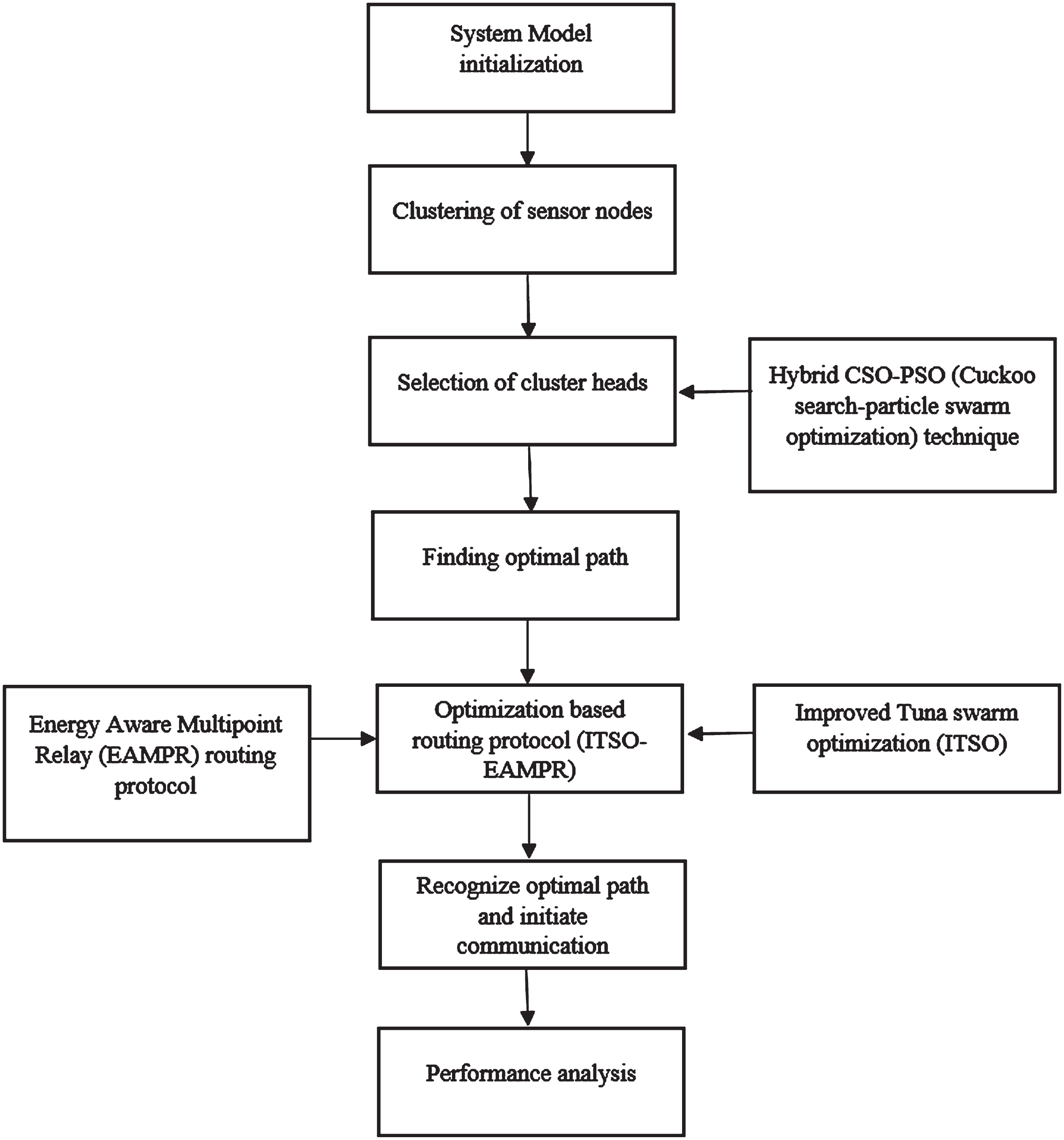
Overall flow of proposed model.
In Wireless Sensor Networks, the sensor nodes present are alike with respect to processing time and initial energy. The sensors distance was evaluated using the Euclidean distance formula. In the sensing areas the sensor nodes are installed randomly, and its position remains constant after installation. The sensor nodes send the data of distance and residual energy to the base station. Depending on this information, CHs are chosen for all the sensor nodes. Further, using the routing process, path between CHs and BS was obtained. Energy limitation is the main issue confronted by the WSN, because of the increase in number of turns. Hence, for solving these issues, based on the level of energy WSN is divided into three regions. Closer to the BS is said to be the lowest region which has standard nodes of less energy, then in the intermediate region there is the super nodes with medium level of energy and the remote nodes to BS are the last region that are the advanced nodes of high energy. Through the sensor nodes are responsible for detecting the information and propagating the sensed data to BS. The transmission of energy and acceptance of SN was reduced by the clustering algorithms.
Energy Model:
The energy model of WSN is explained in detail. The sensor nodes contained in WSN generally works by the batteries. For transmitting data, energy is considered to be a significant factor for each of the nodes. As the SN utilize the energy carried by the batteries, it gets reduced during the data transmission. Using an antenna, transmitter produces radio waves to transfer data. Also, the receiver utilizes the energy for operating radio electronics.
Let us assume that the transmitter node transfers the data of D bits over a distance m, then the node distribution energy is specified by,
In Equation (1) E t (D, m) represents transmitter energy, E t represents electronics energy, D represents data, m signifies distance, m o Signifies threshold distance, M a denotes amplifier energy in free space and M r denotes radio amplifier energy. The energy excluded out when the receiver node obtains message is denoted as,
In Equation (2), E r (M) represents the transmitter energy.
The initialization phase is done with energy model extraction in this phase which is followed by the process of clustering and selection of cluster head.
In management of network topology, clustering is the important technique and by this technique nodes are categorized into groups termed as clusters with the criteria of improving resource consumption, stabilizing network load and maintaining quality of service etc. After performing the clustering process, the optimal cluster head selection is done the technique of hybrid CSO-PSO. The method of implementation is described in detail as follows:
Particle Swarm Optimization (PSO): This algorithm was developed and stimulated by the concept of social behaviour in fish schooling or bird flocking as it is population based stochastic optimization model.
Let us assume that, a group of P particles that moves through a N-dimensional search space to seek a global optimum position for deriving a best fitness objective function. At first, every particle x is assumed randomly in the position p
xd
and having v
xd
as velocity, here (x = 1,2, . . . ,P) and d=(1,2, . . . N). Every particle alters its velocity at each iteration to obtain two fittest solutions. The first part is the perceptive part in which the particle proceeds its individual best solution and this implements solution at low cost with highest fitness. This is named as best particle and denoted as (pfit
x
). Another best solution is the present best value of the group (swarm) and it is called as global best and denoted by (gfit
x
). From the two best solutions, x particle iteratively updates position along with velocity and it is represented in the following equation as shown below,
Hybrid CSO-PSO (Cuckoo search-particle swarm optimization) technique:
One of the nature-inspired algorithms that implements on the basis of reproduction of cuckoos is Cuckoo Search Optimization (CSO) Algorithm. While manipulating CSO, the solutions obtained potentially depends on the eggs of cuckoo bird. In general, cuckoo bird lays egg in the nest of other cuckoos’ which trusts that their eggs would be fed up by another paternities. After few days, the cuckoos recognize that the eggs in their place (nest) are not belonging to theirs and that time they leave its nest. The CSO algorithm is developed with three set of rules and they are as follows: Nest is being selected randomly by the cuckoo and laid the eggs. The nests that are best has been selected for future generation eggs of cuckoo With some of the nests, a foreign egg could be identified by the host cuckoo with the pb∈ [0,1] as probability. In such situation, the egg would be discarded by the host cuckoo or depart the nest and form a new location in some other place.
The third rule is rounded off by the substitution of ratio of host nests to latest new nests. The fitness of the solution is proportionate to the target value of performance. In the viewpoint of execution, the initial population is denoted in a way that every egg in a nest has solution and every cuckoo is assumed to lay a single egg. The aim is to provide a better solution for the cuckoo egg that should change the situations of bad result in the nest. CSO algorithm is robust for optimization techniques as it provides stability between global and local random search as it is influenced by pb∈ switching parameter [0,1]. The relationship of local and global searches is explained stochastically as follows:
In Equation (4),
Implementation Procedure: An integrated technique of Cuckoo Search and Particle Swarm Optimization is presented in this paper. Clustering approach is the basic idea behind the technique of hybrid CSO-PSO that locates the optimal CH through the evaluation criteria of main network by calculating distance between CH in every cluster, the distance from the cluster head to the sink and the remained energy of cluster heads. Optimization of energy consumption and quality of service objectives is achieved by the optimal CH selection. The data sensed within the network is conducted from the CM to the CHs first which is then transmitted to the sink by multi-hop routes within the cluster heads. The hybrid CSO-PSO algorithm prefers the routes in between the CHs as input. When the route preferred by the hybrid CSO-PSO is not global in optimization then that route will be omitted and a global optimal path between the cluster heads will be chosen in the network. The global optimal path in the hybrid CSO-PSO algorithm can minimize the energy consumption in overall, maximize delivery rate of data and minimize the end-to-end latency in the network.
As the optimal cluster head is selected the optimal route should be found for data transmission. We proposed the integrated method of EAMPR and ITSO to perform optimization along with routing. The methods are explained in detail further.
Energy Aware Multi Point Routing (EAMPR) protocol:
As there occurs rapid changes in an environment of WSN topology, the network efficiency may get affected. To manage this situation and to do the routing without block effectively, the Energy Aware Multi Point Routing protocol is utilized for link routing. Let us assume R0 be the original node energy, which is typical fixed value with R1 as residual energy of ith node that reflects the residual energy of node N E and its value is represented as follows,
By the method of distribution, the protocol recommended choose the CH (cluster head). Establishment of a secured cluster was done through determining the number of nearest nodes along with channel state between CH and cluster agents for CH group. The information transfer between nodes is performed by the proposed protocol in the form of messages. When the target node is not clearly analyzed, the source node, starts the initialization of exploration process of the route. Otherwise, the source node transmits the packet to the target node. The sink node evaluates the value of competence for it and its nearest adjacent node. It is needed to have a maximum ranking integrity for the position of node to be Cluster Head. First sink node takes response to select the nearest node direction based on the measurement of energy efficiency. With factor L xy the fuzzy reasoning for the nodes x and y can be derived as:
In the above equation, L im , L jm , L in , L jn signifies the fuzzy node movement and it is normalized between the nodes as,
The relative stability and residual energy of nodes in the proposed EAMPR is mainly investigated in this paper. Also, the process of stabilization is implemented with mobility levels and consumption of energy relatively. For various networks, the proper factor of enhancement is selected. As the energy consumption is less, lower will be the relative mobility with nodes’ stability. Hence, the high stability energy efficient node with lower value of RL i is,
In the Equation (9), RL is the cumulative route stability and R is the number of nodes. To evaluate the best optimal route by EAMPR protocol the function explored is
In Equation (10), the number of directions is denoted as j, which selects the energy efficient path with less value RL. After the selection of energy efficient path, the data is transmitted to the target from the source. The route preferred should have limited interaction overhead. The Route Reply (RREP) packet is recovered as the message reaches the destination node through the original route along with reporting the final RL of the connection series. Also, at that time the details of RREP packets are provided to the source node. With the use of formula (10), the shortest route with RL is selected.
In Equation (11), the routing data was denoted as rth feature, the maximum and minimum value of routing distance was represented as max and min correspondingly. Then the upper and lower bound of routing information was denoted as bu and bl respectively. The normalized data would be in the range between [0,1] that is utilized for routing widely.
Improved Tuna Swarm Optimization (ITSO)
In general, optimization technique in WSN has a capability to minimize the consumption of energy and redundancy. In this paper improved tuna swarm optimization is proposed to optimize the cluster head.
Tuna is a kind of carnivorous fish in different sizes having wide ranged species in it. Generally, they forage in the mid water and for top marine it seems to be a surface fish which has the rigid body with lengthy thin swinging tails. Hence this fish is said to be a continuous swimmer. The agile tiny fish swims faster than the individual fish. Hence, group travel method is adopted by this tuna fishes. By the use of group intelligence, tuna seek and prey on for food. Spiral and parabolic foraging are the two types of foraging procedures followed by tuna.
Initially, the mathematical model of proposed algorithm Improved TSO is derived as
(i) Spiral Foraging
Tuna forms a spiral model to easily capture their prey inside deep water and hence it is known as spiral foraging. When small fishes come across the predators (tuna), this tuna group changes its swimming direction consistently that forms the dense network and makes the situation complex for the preys to escape. When the small fish group moves towards certain direction the nearest ones automatically regulate its movement. Finally, it forms a larger group and starts to hunt. Based on this procedure, the mathematical formula is obtained as:
In Equation (13),
After the global exploration, the transit of local exploration is accomplished. Due to the increase in iterations, ITSO changes its reference points from random to optimal individuals for spiral foraging and its mathematical model is obtained as:
(ii) Parabolic Foraging
In this method, every tuna moves behind the another in a shape of parabola to capture the prey and so it is known as parabolic foraging. The method uses food as a reference point and tuna searches for food around it. With the probability analysis of 50 percent both the approaches are performed. The parabolic model’s mathematical formula is obtained as:
In Equation (20) R is the random number that has value as –1 or 1. By the two techniques of foraging the tuna can hunt its prey effectively. The individual selects one of the methods of foraging and performs according to the search space probability. The overall process of optimization by ITSO is updated and evaluation is carried out till the condition end is attained. At last, the fitness and optimal value in the algorithm are looped.
Hence by the Improved Tuna Swarm Optimization Algorithm the process of optimization is performed and the best fitness value is obtained for the cluster head. Due to increased size of networks, lot of energy consuming occurs which leads to the premature closing of nodes. So, energy saving protocols were introduced abundantly to reduce the quantity of power used up for collecting data so as to prolong the lifespan of network. Our proposed ITSO-EAMPR framework lessens the network energy consumption by optimization and energy routing protocol algorithms. Comparisons performed with existing protocols illustrates that the ITSO-EAMPR model has lesser size of routing list and it send and receive data at lesser time. On comparing, the parameters like use of energy, end-to-end delay and loss of packet rates, the proposed ITSO-EAMPR outperforms the existing techniques.
The proposed ITSO-EAMPR method is implemented by MATLAB tool. Randomly the nodes are located first in the WSN. As the cluster heads are chosen the efficient routing method is determined by implementing the proposed ITSO-EAMPR technique. The proposed technique is compared with existing clustering and routing methods like LEACH, HEED, MBC, FRLDG and F-GWO and conducted the performance analysis. The parameters like packet delivery ratio, throughput, bit error rate, energy consumption, end-to-end delay and system lifetime are evaluated with 500 cluster nodes and comparison is performed to other traditional models. The battery energy is considered to be infinite with several sensor nodes and some cluster nodes. The relationship between the number of deployed nodes and network performance are illustrated in detail as follows:
Packet delivery Ratio:
The ratio of packets obtained at the receiver side versus packets delivered by the transmitter side is termed as packet delivery ratio. It is expressed by:
By equation (22), ‘PDR’ is estimated at which ‘n’ denoting number of network nodes. Table 1, shows the analysis of PDR in proportion to number of clusters for the proposed and existing schemes [22]. As per the table demonstration, the PDR value is higher in the proposed scheme.
Packet delivery ratio % comparison
From Fig. 2 it is observed that the PDR percentage value is higher in proposed ITSO-EAMPR compared to other existing methods [22].

PDR vs Number of clusters.
The ratio of number of packets accepted in the receiver side to the time it needs for the delivering the packet is termed as throughput (bits/sec). It is given by:
In Table 2, the comparison of proposed and existing techniques in terms of throughput is shown. It proves that the proposed ITSO-EAMPR outperformed other existing techniques [22].
Throughput comparison
The Fig. 3, depicts the proposed ITSO-EAMPR and traditional techniques’ throughput performance and from it is clearly validated that the proposed one has an increased value of throughput.
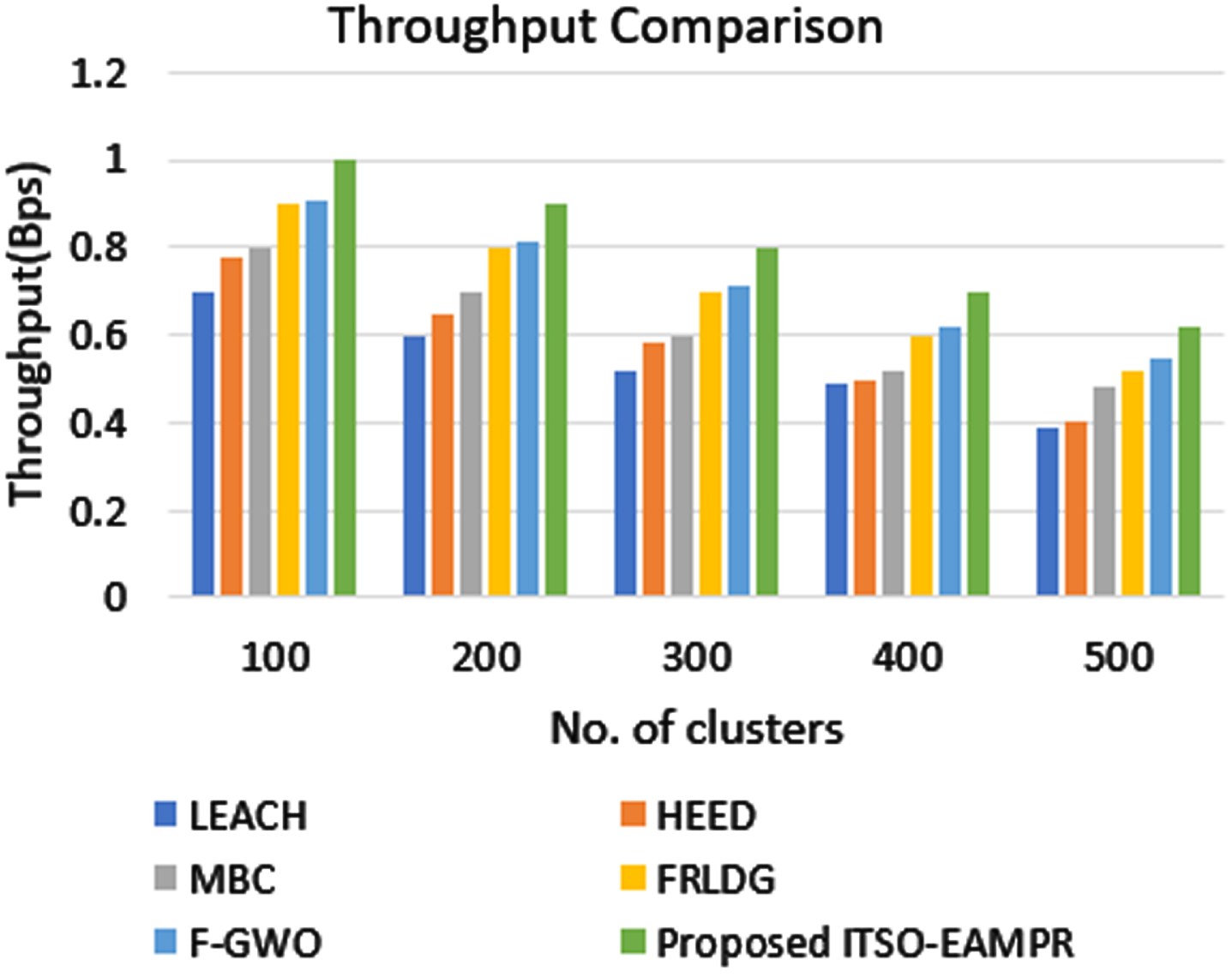
Throughput vs Number of clusters.
The sum of the number of nodes, transmitted energy and received energy is defined as energy consumption.
By (24), ‘EC’ energy consumption is estimated depending on number of nodes and consumed energy in establishment of path is signified by ‘E (PE)’. This is evaluated by ‘J’.
In Table 3, the proposed and existing model [22] is compared in terms of energy consumption and it proves that there is less energy consumption in our proposed ITSO-EAMPR technique.
Energy consumption comparison
From Fig. 4 it is noted that as the quantity of nodes increases there is increase in energy consumption. Also, it is observed that in the proposed model less amount of energy is consumed than the existing techniques
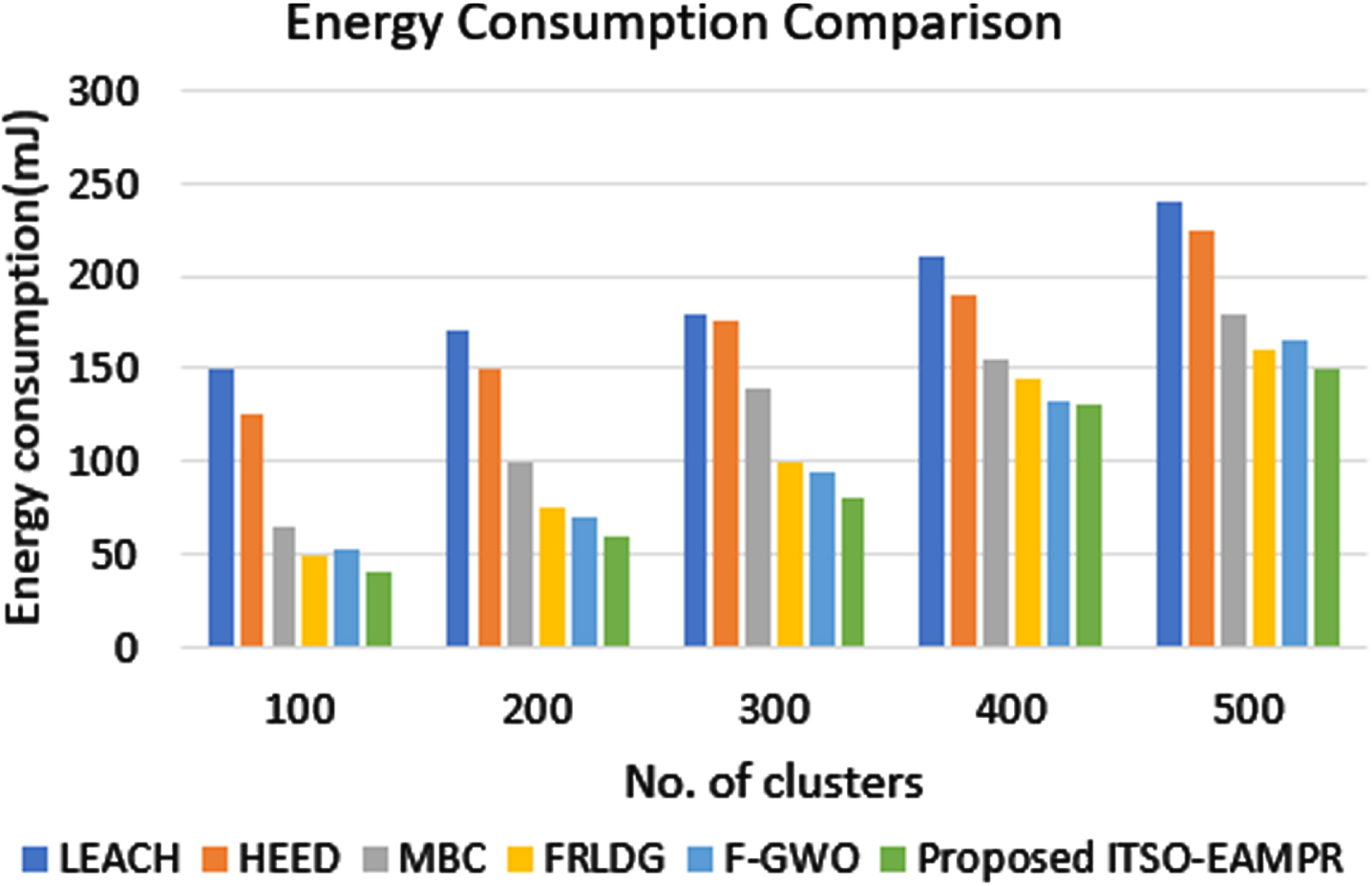
Energy consumption vs Number of clusters.
The ratio of time taken to send a packet to the receiver to the packets received is termed as end-to-end delay.
Here Ps is the time taken to the sent packet, and Pr is the overall time consumed.
The table 4, shows the comparison of proposed ITSO-EAMPR and the existing techniques [22] in terms of end-to-end delay. It is observed that if the number of cluster nodes upsurges, then the end-to-end delay will be increased. Our proposed model has lesser end-to-end delay compared to other existing approaches.
End-to-end delay comparison
Figure 5, depicts the end-to-end delay analysis for proposed and existing approached and it is noted that the proposed one has lesser end-to-end delay than other traditional methods.
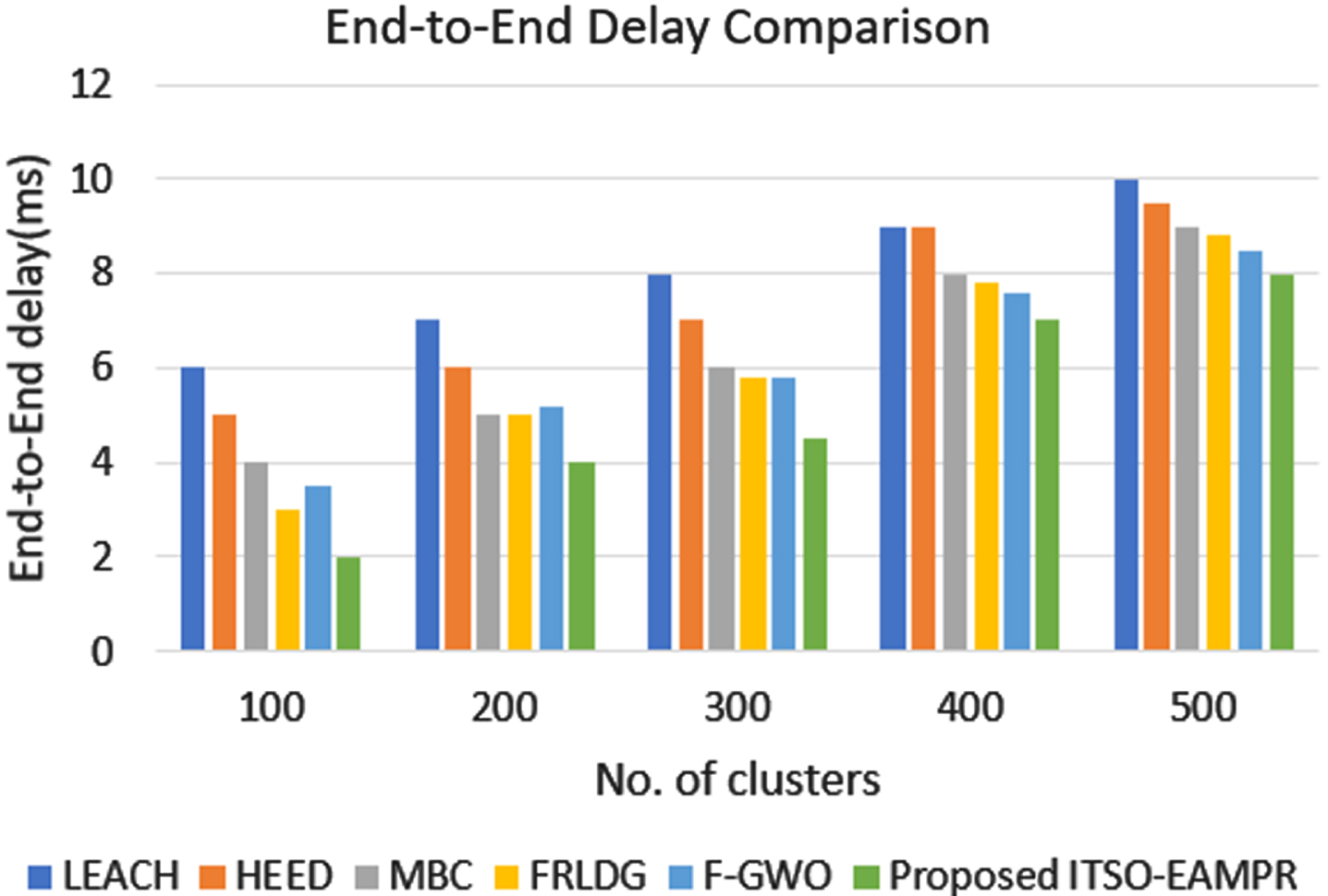
End-to-end delay vs Number of clusters.
The percentage of bits which have faults in terms of total bits received during broadcast is termed as BER (bit error rate). In Table 5, the BER for existing approaches [22] and proposed ITSO-EAMPR is performed and the result are compared. It is observed that the BER is less for the proposed scheme than other techniques. As the number of clusters are increased, the BER values get increased.
Bit error rate comparison
Bit error rate comparison
The BER analysis for the proposed ITSO-EAMPR and existing techniques were depicted in the Fig. 6 which shows the down surge of BER values in proposed methodology.

Bit error rate vs Number of clusters.
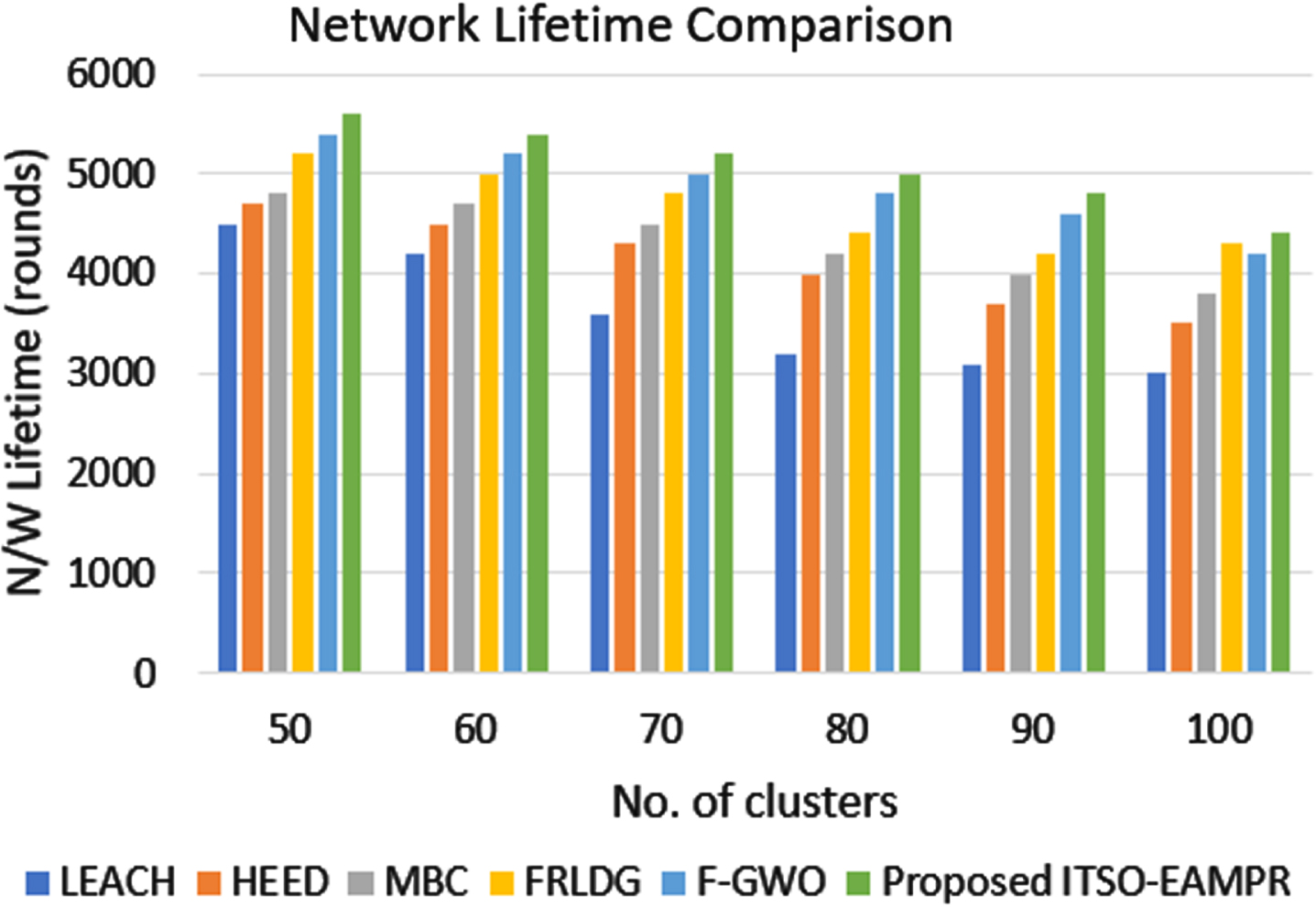
The amount of time taken by the system to work on its allotted tasks is called network lifetime. The comparison on performance of network lifetime for proposed ITSO-EAMPR and existing models [22] are shown in Table 6.
Network lifetime comparison in terms of rounds
Network lifetime comparison in terms of rounds
The Fig. 7 displays the proposed ITSO-EAMPR has extended lifespan compared to other existing techniques.
Network lifetime vs No. of clusters.
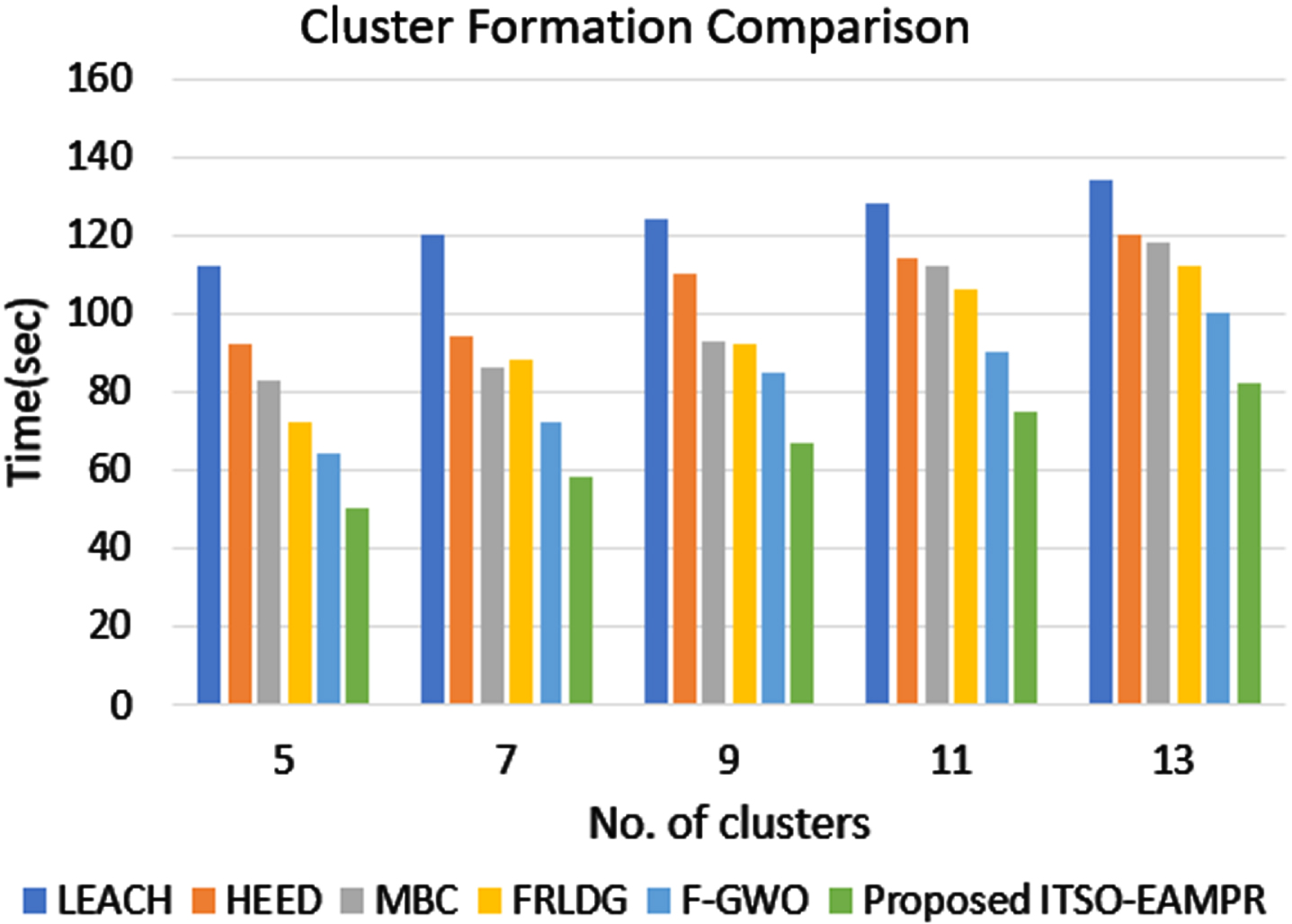
Amount of time involved overall for formation of cluster and selection of CH is represented as time analysis. In Table 7, the proposed ITSO-EAMPR and other existing methods [22] are compared for time taken by cluster creation and it is observed that the proposed scheme takes lesser amount of time to form cluster than others.
Cluster formation time comparison
Cluster formation time comparison
Figure 8, depicts the cluster formation versus overall time spent for both the proposed and existing techniques. Execution time is lesser in proposed as per the results.
Cluster formation time vs No. of clusters.
The selection of CH and time taken for its execution is shown in Table 8 and the comparison to existing techniques [22] are performed. The proposed ITSO-EAMPR method achieves the selection of CH at less time. If the number of CH is raised then there will be in extension in time also.
Cluster heads selection comparison
From Fig. 9, it is observed that proposed method is achieving CH selection at lesser execution time than the other techniques.

CH Selection Time vs No. of clusters.
Hence through performance analysis with parameters of various techniques, it is proved that the proposed ITSO-EAPMR technique achieves the better performance and effectiveness compared to all other existing techniques.
The overall performance depicts that the performance of proposed system is greater in proposed ITSO-EAMPR technique compared to other existing techniques.
In real time applications, security and in some prediction analysis, the sensor nodes are required in WSN. For this clustering approach, based on energy efficient routing protocol system is required which is implemented successfully in this paper. The work is proceeded by initiating the system energy model. By the method of clustering the sensor nodes are grouped and selected the optimal CH using the proposed hybrid CSO-PSO opportunistic technique. Then the optimal route was determined by the proposed optimization-based routing protocol termed as ITSO-EAMPR technique that performs optimization, followed by routing finally. The proposed method lessens the consumption of energy thereby increases the network lifetime, decreases the relative mobility and maintains stability in between clusters. The metric evaluation was performed with PDR, BER, throughput, end-to-end delay, network lifespan and time analysis etc and its results shows that the proposed model ITSO-EAMPR outperforms the existing methods like LEACH, HEED, MBC, FRLDG and F-GWO. In future, this work might be extended on employing some enhanced techniques and protocols so as to satisfy security and privacy concerns by implementing this model in real-time framework.