



Abstract
In the present marketing environment, choosing the right suppliers is very difficult for any construction company. Current supplier selection models in the construction industry often suffer from limitations such as incomplete criteria coverage, inadequate handling of uncertainties, and oversimplification of decision-making, leading to sub-optimal supplier choices and project risks. This paper aims in selecting the best suppliers among the different M-Sand environment suppliers. In this study 13 qualitative criterions are selected by the expert team. For handling the attributes, uncertainties, vagueness associated with supplier selection problems the Fuzzy Delphi, Fuzzy Analytical hierarchal Process (AHP) and Fuzzy Technique for order preference by similarity to ideal solution (TOPSIS) methods were chosen. In the first phase of this study, Fuzzy Delphi Method is employed to select the 5 significant criterions. These criterions can be used to help the construction company in the direction to choose the right suppliers at the end. During the second phase, one of the significant Multi-criteria Decision Making Method called AHP is employed with extended support of fuzzy logic to evaluate the weightage of each criterion. Further ranking of various alternative suppliers are done by Fuzzy TOPSIS model. The ranking results indicate that A2 is the best supplier followed by A1 and A2. The third phase of this study deals with analyzing both the qualitative and quantitative criteria, hence Data Envelopment Analysis (DEA) is adopted to correlate the criteria. This is done to select efficient suppliers. The develop model is demonstrated in the construction industry.
Keywords
Introduction
The construction sector is widely acknowledged as one of the oldest industries globally and is often characterized by its traditional nature and underdevelopment in several areas, including information technology, innovation, and supply chain management (SCM) [1]. Experts who are professionals from academy as researchers in this field and construction industry employees decided criteria by considering features and needs of construction industry in Turkey [2].
The construction industry heavily relies on suppliers to provide the necessary materials, equipment, and services for successful project execution. The selection of supplier is very important for continuing its supply chain throughout the project cycle. It is also very essential to check the supply chain dealer’s service, quality and timeliness of cost. For selecting the right suppliers the Multi-criteria decision making (MCDM) model is utilised [3]. MCDM or Multi-Criteria Decision Analysis (MCDA) has emerged as a highly effective approach to decision-making, representing a significant breakthrough in this field [4]. Over the past few decades, various authors have contributed to the development and enhancement of multiple types of MCDM methods. These methods differ in terms of algorithm complexity, criteria weighting techniques, representation of preference evaluation criteria, handling of uncertain data, and the type of data aggregation employed [5]. It is found that there is numerous application of MCDM in construction industry ranging from project selection, material selection, supplier selection management and sustainable construction. Focusing the selection of suppliers in construction involves various parameters by various types of MCDM methods like Analytical hierarchy process (AHP), Analytical network process (ANP), Data envelopment analysis (DEA), Gray Relational Analysis (GRA), Artificial neural networks (ANN), Goal programming (GP), Linear programming (LP), Multi-objective programming (MOP), Simple multi-attribute rating technique (SMART), Case-based reasoning (CBR), Genetic algorithm (GA) and Technique for order preference by similarity to ideal solution (TOPSIS) [6]. Over the past 20 years, the construction sector, particularly AHP, has received significant attention as a well-known MCDM technique due to its intrinsic capacity to cope with many types of decisions [7]. Through AHP decision making is simplified by lowering the problem into the framework of hierarchy and divide into structured parts to easily identify and find the way out [8]. The another study integrates the Fuzzy Delphi, Fuzzy AHP and Fuzzy TOPSIS method in order to get the best supplier provided with high satisfaction [9]. Top of Form Bottom of Form. The assessment of satisfaction is evaluated through online feedback from P2P accommodation users in a large-scale group of decision makers To establish a feedback mechanism for group decision-making in dynamic social networks, a bargaining game is employed [10].
The contribution of this article lies in its application of a comprehensive approach that combines Fuzzy AHP, Fuzzy TOPSIS, and DEA techniques to evaluate and select suppliers in the construction industry. Top of Form Bottom of FormBy considering both qualitative and quantitative variables, this integrated approach can help ensure the quality and timeliness of construction materials, ultimately contributing to the success of construction projects. The main innovation of this article is, integration of MCDM methods, for identifying the best suppliers of M-Sand construction material.
This study aims to evaluate supplier selection performance in a construction company for M-Sand material using three different methods: Fuzzy AHP, Fuzzy TOPSIS, and DEA techniques. The evaluation will be conducted based on the performance appraisement of the selected suppliers. By integrating various techniques such as Fuzzy AHP, Fuzzy TOPSIS, and DEA techniques, this study addresses the complexities of supplier selection and offers a comprehensive approach to support construction companies in their decision-making process.
This study paper is now organised as follows: the next section provides an overview of the vast literature on Fuzzy logic, Fuzzy AHP, Fuzzy TOPSIS, and DEA for the supplier selection industry. The theories and equations of the suggested technique are presented step by step in the next section, with suitable explanations. Then, a Case study about M-Sand supplier is given as a case study in order to understand the theories discussed and illustrate the decision procedure. Finally, a conclusion is drawn with managerial insights of the proposed model and providing some future research directions.
Literature review
Fuzzy logic
Fuzzy logic is utilized in supplier selection to assess qualitative criteria like quality and delivery time. By assigning scores based on degrees of membership in different categories, fuzzy logic provides a more accurate and systematic approach to supplier evaluation. This approach offers advantages over traditional crisp number-based evaluations by accommodating imprecise and uncertain information and allowing for the consideration of multiple criteria simultaneously. The application of fuzzy logic in supplier selection has been explored in various domains, including the construction industry. Its flexibility, ability to handle imprecision, and provide a systematic decision-making framework makes fuzzy logic a valuable tool in supplier selection processes [11].
Fuzzy Delphi method (FDM)
The purpose of the fuzzy Delphi method is to facilitate consensus building and decision-making in a group by allowing for the expression of uncertainty and ambiguity through fuzzy logic-based evaluations of expert opinions. One of the researches uses this FDM technique for establishing an evaluation model for selecting the most appropriate technology for development in hydrogen production technologies at Taiwan, based on 14 evaluation criteria [12]. Delphi method is to develop an efficient method for selecting the best construction project manager candidates [12], construction of elementary school campus [13], Building green schools in Israel. Costs, economic benefits and teacher satisfaction [14, 15], the Energy Consumption of Different Typologies of School Buildings in the City are analyzed by FDM (Taiwan) [16].
FuzzyAnalytical Hierarchy Process (FAHP)
The AHP Originally established by Saaty [17], an essential method for solving MCDM problem, has been used in various corners of construction management, such as Analysis of advanced automation construction technology[18, 19], contractor prequalification and selection [20], project delivery measurement [21], assessment of construction safety [22], and disagreement resolution / conservation / equipment / building assembly collection [23]. However, the AHP approach is unable to handle the inherent subjectivity and ambiguity related with the mapping of one’s awareness to an exact number. Hence, Buckley developed a Fuzzy AHP model to tackle this problem [24].
Selection of global suppliers is more challenging than that of local suppliers as it requires more qualitative and quantitative considerations. Suppliers are outside businesses and work with manufacturers. Their performance rendered by the suppliers will determine the supply chain’s entire future. As a result, the efficient approach of choosing a worldwide supplier is crucial in the current business environment.Triangular fuzzy numbers were used to apply Fuzzy Extended AHP for supplier selection in the textile industry [25], in a gear motor company to select the best supplier [20], and the fuzzy set theory in multi-criteria evaluation facilitated mapping with decision-making process [26].
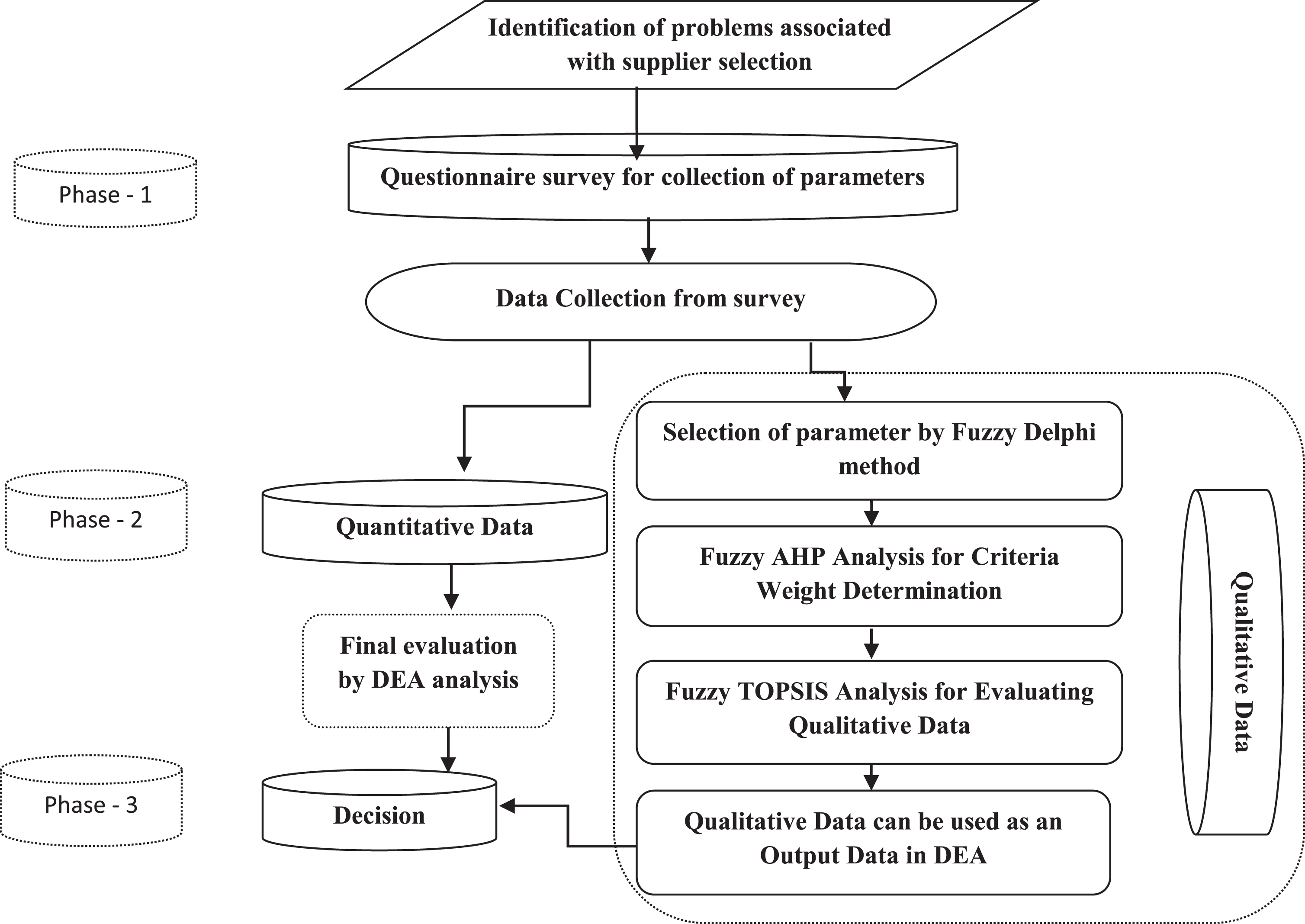
Proposed Integrated model for supplier selection.
In the another study supplier selection is applied in the electronic supply chain network, and the study proposed a Fuzzy AHP model to select the most suitable raw material suppliers for a nano sim-card connector production company. The model used both qualitative and quantitative criteria, and incorporated personal preferences and judgment of decision-makers. The model helped in identifying crucial criteria and selecting the right suppliers effectively, thus reduced potential risks and improved the competitiveness [27].
The study proposed a new method to find fuzzy weights in fuzzy hierarchical analysis by directly fuzzifying the max method used in analytical hierarchical process. An example is presented to demonstrate the application of this method with five criteria and three alternatives [28]. This paper proposed a methodological approach to selecting staff based on the FAHP and FDM. The approach is aimed at analyzing the criteria for modern administrative skills required by managers for successful administrative practices. The case study involved the selection of academic staff at Neapolis University Pafos, Cyprus. The proposed method provides a tool to obtain the most appropriate decision for the problem under study [29]. The another study involves implementation of lean management through this Fuzzy AHP and COPRAS [30].
TOPSIS, a term invented by Hwang and Yoon in 1981, stands for technique for order preference by similarity to an ideal solution [31]. TOPSIS extended to fuzzy contexts as Fuzzy TOPSIS, which substituted a fuzzy linguistic value for the directly provided crisp value in the grade assessment [32]. The Fuzzy TOPSIS method displays relatively successful practice samples, especially in realistic problems where personal opinions and convictions are expressed by linguistic data. The solicitation of the Fuzzy TOPSIS method for traditional supplier selection has recently been investigated in most of the studies [32, 34].
The Fuzzy TOPSIS method was used by the Haji et.al [35] select the best supplier for garment company ‘X’ in Turkey. Results showed that supplier 1 was the most suitable, followed by supplier 3 and supplier 2. FTOPSIS used to findout the best alternatives for another case study involving an accident in the oil field of Jubarte, in the south coast of Espirito Santo state, Brazil. The convincingness of the proposed method was reported to serve as an aid in identifying the best alternatives in the cases of management of accidents management with oil spill in the sea [36].
Data envelopment analysis method
Supplier selection can consider both quantitative and qualitative metrics. MCDM approaches (e.g. AHP, ANP and etc.), mathematical models (e.g. DEA), group decision making (e.g. NGT) are some of the approaches used to select the suppliers [37]. Various research articles and books have highly probed the application of DEA, a nonparametric technique in operations research, for calculating the efficiency of Decision Making Units (DMUs). Inspired by the concepts presented in [38], the study conducted by [39], titled “Quantifying DMU Efficiency,” employed linear programming (LP) as an approximation method for experiential production technology frontiers. This spurred to a significant body of literature that delves into DEA and its utilization across various research domains.
Proposed methodology
The group of experts consist of construction managers, site supervisors, suppliers, and two academicians who are the experts in the field of our construction management was established to determine the technical issues encountered while choosing suppliers in the construction sector. These issues were taken as criteria and are considered in various literatures. This questionnaire was distributed to several companies to collect responses regarding choosing suppliers in the construction sector. This systematic methodology includes the following steps: Identifying the needs of the best suppliers, defining criteria using questionnaires, Fuzzy Delphi analysis and Fuzzy AHP, Fuzzy TOPSIS. Finally, DEA analysis is used to incorporate qualitative and quantitative criteria.
Phase I
Step 1: Identification of parameters
In order to choose the most crucial criteria from the questionnaire survey, the Fuzzy Delphi Method is used [40].
Optimal values for each criterion are obtained based on the opinion by the expert committee. The resulting comment must be in the set of possible denoted by S
C
range from 1 to 10. The scores for each criterion is C
i
(denoted as most pessimistic value) and E
v
(denoted as most optimistic value) obtained from Equations (2) [41].

Gray zone.
The following equations are used to obtain the consensus significance value of the factor i, si. If l
i
and h
i
do not overlap (there is no gray area), then the factor’s consensus significance value is mentioned.
If a gray zone is present and the gray zone interval value of g
i
(g
i
=
If gi > di and there is a gray area, there is a significant difference in opinion among the experts. Repeat the aforementioned steps until convergence is attained. To determine the consensus significance value of factor v, s v , the same process is used. Pick a factor from the list of factors. Select factor i(v) if si ≥TC (sv ≥TE),which is a threshold value set by experts based on the mean of all si (sv) and is greater than or equal to the consensus significance value of the factor i(v).
Step 2: Fuzzy AHP
The weight vectors of the five risk variables are calculated using Chang’s extent analysis [42] approach for Fuzzy AHP. To compute the weights of the risk factors, Fuzzy AHP is employed Equation (6). The decision-makers who identify the flaws in the prototype model are part of the Fuzzy AHP technique. Assume that U={u1, u2, . . . ., un} is a target set and that X={x1, x2, . . . , xn} is a target set. Every object is taken and an extent analysis is done for each target in accordance with the extent analysis approach. As a result, ‘m’ extent analysis values for each object ‘n’ are obtained by the subsequent steps:
The following are the steps in extent analysis:
Step 1 Equation (6) is used to determine the fuzzy synthetic extent value in relation to the ith item
Step 2 As
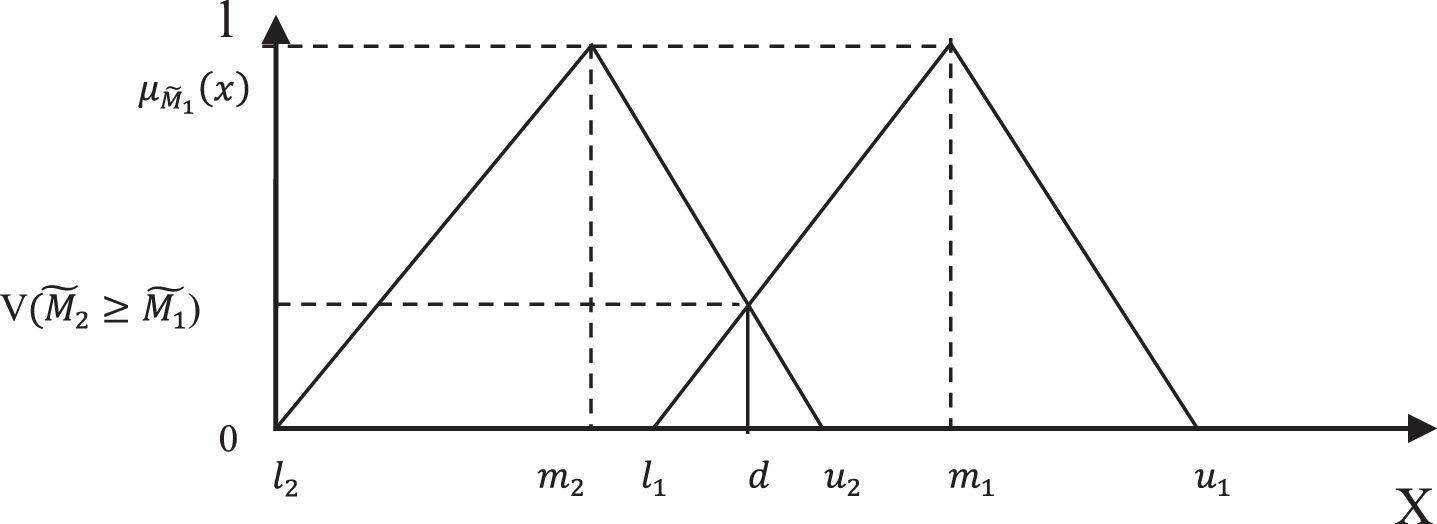
The intersection between
To compare
Step 3 provides the formulas needed to compare two triangular fuzzy numbers (frequently adopted indecision problems), and Step 3 calculates the degree of possibility.
Step 4 the probability that a convex fuzzy number is bigger than k convex fuzzy numbers
Step 5 Via normalization, the normalized weight vectors are
Where W is a non-fuzzy number.
The pair-wise assessment method can be used to generate the weight vector of risk factors. The decision-makers assess the weight vector risk factors using the linguistic variables in Table 1 [49]. It is necessary to examine the comparison matrix’s consistency ratio. This is accomplished by using the graded mean integration method, and the following equation 14 defuzzifies the fuzzy numbers into crisp numbers.
Fuzzy evaluation scores for the weight vector [46]
Each matrix value is defuzzified. The consistency ratio is calculated and tested to check whether it is less than or equal to 0.1.
The closeness co-efficient is utilized to order the errors using fuzzy TOPSIS [47]. The decision-makers assess the evaluations of alternatives in relation to criteria using linguistic factors. The linguistic scale fuzzy ratings for the five criteria—Supplier connection, Supplier accessibility, Risk and Safety, Customer service, and SC performance—are shown in Table 2 [48]. The following formula can be used to determine how K experts rated each choice in relation to each criterion:
Fuzzy ratings for critical parameters [48]
Fuzzy ratings for critical parameters [48]
After getting the weights of the criteria and fuzzy ratings of options with regard to five criteria, the fuzzy multi-criteria decision-making problem is described as follows in matrix format:
The linguistic variables are described by triangular fuzzy numbers:
The aforementioned normalization technique keeps the characteristic that the ranges of normalized triangular fuzzy numbers belong to (0, 1). The weighted normalized fuzzy decision matrix is created taking into account the varying importance of each criterion:
The weighted normalized fuzzy decision matrix indicates that, the elements
The distance of each alternative from A* and A- can be currently calculated as:
A closeness coefficient (CC
j
) is defined to establish the ranking order of all alternatives once the
The alternative suppliers are ranked in order of importance based on the closeness co-efficient value. These suggestions are sent to the decision-making authorities so as to can choose the supplier. Up until the choice of the optimum supplier selection, the actions in the aforementioned stages are repeated.
Step 4: Data Envelopment Analysis (DEA)
According to the constant returns to scale (CRS) assumption, the authors R. D. Banker et al. [49] created the CCR-(DEA), and Banker, Charnes, and Cooper [50] created the BCC-DEA model according to the variable returns to scale (VRS) assumption. The Decision Making Units (DMU) that are on the efficiency frontier in DEA, which is not a parametrical method, are rated as being moderately efficient and given the letter “1”. In sustainable supplier selection using DEA, DMUs refer to the Decision-Making Units, which represent the suppliers being evaluated. These DMUs are assessed based on their inputs and outputs to determine their relative efficiency and performance in sustainable practices. DEA helps identify suppliers that demonstrate efficient resource utilization and sustainable output generation, aiding decision-makers in selecting suppliers aligned with sustainable goals. Based on the CRS assumption, the CCR-DEA model posits that all DMUs function at the ideal scale. Equations are employed to formulate the input-oriented CCR-DEA model that was used in this investigation. The mathematical language and formulation of the DEA approach are briefly described below,
Let Y
i
be the appropriate vector of the outputs for the DMU I and let X
i
be the vector of inputs for the DMU i, therefore, let’s assume that X
O
and Y
O
represent the input and output vectors of the DMU0 whose efficiency is being examined. The following linear programme can then be solved to determine the effectiveness of the DMU0:
The number of quantitative factors (3 different types of occurrences) and the number of qualitative factors (5 factors) are taken into consideration for the system’s inputs and outputs, respectively. To meet the theoretical requirements of the DEA, some alterations are done to the data that was initially acquired. Section 4 gives a detailed explanation of these adjustments and changes made to the study’s model.
Need of identification
A considerable portion of a company’s financial resources are expended during the supplier selection process, which is crucial to any business’ success. The main objectives of the supplier selection process are to decrease purchase risk, boost total value to the buyer, and create strong, long-lasting partnerships between buyers and suppliers. M-sand, also known as manufactured sand is a type of sand that is produced by crushing hard granite rocks. It has become an alternative to river sand, which is a naturally occurring resource that is becoming increasingly scarce and expensive. M-sand is preferred in construction activities because it has better workability for concrete, reduced permeability, higher unit weight, and better abrasion resistance as it is devoid of silt and clay particles. Additionally, it is eco-friendly as it is produced by crushing rocks and does not involve any dredging or extraction of river sand. M-sand has gained popularity in recent years and is widely used in the construction industry for various applications such as making concrete, plastering, and brickwork. So the main motive of this research is to identify the best M-Sand suppliers for construction companies in Coimbatore. With the help from experts, a survey conducted among the technical workers in the field of supplier selection for M-sand.Initially, several visits were made to different construction companies upon the discussion with the experts from various hierarchy levels gave us a solid understanding of the parameters used in practice for selecting the M-sand suppliers. Further, a crew of five experts was formed. To decide the standards to be used for assessing the M-Sand providers, this research involved 3 industry managers and 2 academic specialists (from supply chain management). The criteria used in this application are therefore based on three basic sources: academicians’ preferences, industry specialists and literatures.
Results and discussion
Selected factors by using FDM
Important criterions were selected from group of experts by questionnaire survey. In order to determine the consensus significance value ((s v ) a ), FDM is applied to the criteria. The results of FDM for CRs are shown in Table 3. with the TE for CRs set at 6, five of the 13 CRs are shortlisted. From FDM, the selected CRs are depicted in Table 3.
Fuzzification of linguistic expressions for the importance of criteria
Fuzzification of linguistic expressions for the importance of criteria
From Table 3, five criterion were shortlisted for supplier selection namely, Supplier relationship (C1); Accessibility of the supplier (C2); Risk and Safety (C3); Customer service (C4); SC performance (C5)
Criteria and sub-criteria from the Delphi approach have been identified from the previous step. The second step is to find pair wise comparisons between each criterion in order to specify the best from expert opinion. This Fuzzy AHP analysis used to rank and prioritize the alternative potential suppliers for M-Sand. To conclude the weight vector of five risk factors namely Fuzzy AHP is utilized namely, Supplier relationship (C1); Accessibility of the supplier (C2); Risk and Safety (C3); Customer service (C4); SC performance (C5) are considered. The expert committee offers their thoughts on the risk elements and how they relate to the possible failure modes. Based on the linguistic values given in Table 1 and the risk factors provided in Table 3, a paired comparison matrix has been created. Using equations (11), the weight vectors for each risk factor are calculated and given below in Table 4.
Evaluation of expert opinions and risk factor weights for choosing a potential M-Sand provider
Evaluation of expert opinions and risk factor weights for choosing a potential M-Sand provider
Fuzzy TOPSIS method can be utilized to determine the final evaluation of the entire weighted criterion obtained from Fuzzy AHP method. M-Sand supplier alternatives choice matrix that has been weighted and normalized ought to be computed. The TOPSIS method’s result has been obtained by the following procedure. Create a group of three decision-makers by generating all feasible options (A1, A2, A3, and A4) and identifying the various evaluation criteria’s (C1, C2, C3, C4 and C5) (DMs1, DMs2, DMs3). Decision-makers use a group of applied criteria from criteria to assess how well the literature and desires align [51]. Decide proper linguistic terms proposed for the importance weights of the criteria. Make linguistic judgments for alternatives with respect to weight of criteria expressed as TFN. It is shown in Table 5 [52],
Different linguistic expressions for pair wise comparisons of each criterion
Different linguistic expressions for pair wise comparisons of each criterion
By aggregating the weight of criteria, determine the aggregated fuzzy weight of the criterion by taking into account the experts’ judgment on the criterion to obtain combined fuzzy evaluations of the alternatives. Using Table 6, a normalized fuzzy decision matrix has been created. From Table 7 the normalized fuzzy decision matrix is used to create a weighted normalized fuzzy decision matrix (Table 8).The computations used to derive the fuzzy PIS Z+(FPIS) and fuzzy NIS Z–(FNIS) are displayed below (Table 9) [53]. Determine how far possible alternatives or suppliers are from FNIS and FPIS in relation to each of the criteria in Table 10 [54]. Determine each option’s closeness coefficient (CCr) as shown in Table 1.
Fuzzy aggregated decision matrix
Risk factor weights for selecting a possible M-Sand supplier
Weighted normalized matrix with experts opinion
Values of fuzzy PIS Z+(FPIS) and fuzzy NIS Z–(FNIS)
Distance dv (Ar, A+) and dv (Ar, A–) for alternatives
From Table 12 by relating the Closeness coefficient results of four alternatives, it is decided that A2 is the most preferred supplier than the other alternative suppliers and A4 is the least preferred supplier.
Ranking of alternatives
Using AHP model, the main criteria for selecting the suppliers were identified with weight for each alternatives. For finding out the efficiency scores for each alternatives, DEA model were used. In Table 13, the final weights were displayed. Thus, the qualitative data utilized as output in DEA namely cost, quality, and delivery time were transformed into quantitative data. The super-efficiency scores of suppliers are derived through DEA by using qualitative characteristics as outputs and a quantitative component as an input.
Final criteria weights with regard to suppliers
Final criteria weights with regard to suppliers
With the input-oriented CCR-DEA analysis, the study evaluated the suppliers’ performance. The super-efficiency scores from DEA are displayed in Table 13. Out of the efficient suppliers, four were evaluated in this study. The 50 companies chose these suppliers because they could create most of the products for the least amount of money. Using the super-efficiency scores, it is possible to order the efficient suppliers.
Using the super-efficiency scores, it is possible to order the efficient suppliers. Even if their input costs rise, suppliers with efficiency scores higher than “1” might still be efficient. The other vendors were not productive. A4 received the lowest efficiency rating with a score of 72.8 %. This means that even if this supplier’s cost were to drop by 20.2%, the output would remain the same. Supplier A1 had the highest performance with 109.4% followed by A3 with 104.55%.
Computation of (
Finally the AHP results indicate that A2 is the best supplier followed by A1 and A2 as shown in Table 7. The TOPSIS results, however, indicate that A2 is the best supplier followed by A3 and A1 as shown in Table 12. In general, the comparison matrices demonstrate high consistency, with a consistency ratio consistently below 10%.
Input and outputs of DEA model
This study holds significant importance for both theoretical and managerial aspects. By addressing the lack of prior research on supplier selection specifically for m-Sand material, this study contributes to bridging the existing gap in the literature. Managers can derive multiple benefits from this research. It offers valuable insights to develop comprehensive supply chain strategies that promote or enhance the circular approach in the building and construction sector. Additionally, it helps overcome the challenges associated with implementing supply chains in diverse construction techniques of various sector. The proposed methodology not only provides the importance weightage of supplier selection criteria but also offers a ranking of the chosen suppliers. This information empowers managers and decision-makers to formulate effective strategies that integrate circularity and sustainability into their businesses, thereby minimizing adverse impacts on society, the economy, and the environment.
Conclusion
In today’s technological competitive market all types of construction companies can achieve their competence against other companies, if they are working with high performing potential suppliers with a long term relationships. But there exists a challenge in selecting efficient supplier. This article aims to address the issues of supplier selection in the construction industry involving the integration of multiple methodologies and techniques. The article proposes to use an integrated model combining the Fuzzy AHP, Fuzzy TOPSIS, and DEA for the supplier selection problem. Fuzzy AHP helps in handling uncertainties and determining the weights of criteria, Fuzzy TOPSIS was subsequently used to rank all of the alternative supplies such as A1, A2, A3, and A4, and DEA provides a quantitative evaluation of supplier efficiency. This comprehensive approach aims to enhance the accuracy and effectiveness of supplier selection for evaluating the best suppliers among the various M-Sand suppliers in the construction industry.
Based on the Fuzzy AHP and Fuzzy TOPSIS results in the case study on supplier selection for M-Sand material in the construction company, it is identified that supplier A2 consistently emerges as the best supplier based on weightage criteria and ranking with respect to alternative suppliers. However, there is a discrepancy in the rankings between A1 and A3. While A1 is ranked higher in the AHP results, A3 is ranked higher in the TOPSIS results. It can be inferred that FAHP exhibits higher sensitivity compared to FTOPSIS, as this is attributed to the alteration in the pairwise comparison process. Future works could consider these discrepancies and can develop a model to address these issues. The developed integrated supplier selection models can be further applied to different construction sectors such as residential, commercial and infrastructure to address specific requirements.
Suppliers’ super efficiency ratings
Data availability statement
No data, models, or code were generated or used during the study.