



Abstract
Algebras of Logic deal with some algebraic structures, often bounded lattices, considered as models of certain logics, including logic as a domain of order theory. There are well known their importance and applications in social life to advance useful concepts, as for example computer algebra.
Starting from results obtained by Di Nolla and Lettieri in [1], in which they analyzed the structure of finite BL-algebras, in this paper we find properties and give examples of commutative unitary rings R with its set of ideals Id (R) to be a BL-algebra of a given type. Moreover, we present properties of finite rings or rings with a finite number of ideals in their connections with BL-rings.
Introduction
Algebras of Logic are explicit algebraic systems that show the basic mathematical structure of Logic. These algebras deal with some algebraic structures, often bounded lattices, considered as models of certain logics, including logic as a domain of order theory. There are well known their importance and applications in social life to advance useful concepts, as for example computer algebra, also called symbolic computation or algebraic computation, which it is a scientific area that refers to the study and development of algorithms or/and software used for computing mathematical expressions and manipulating other mathematical objects, as well as in the study of truth values from social analyses. In the following, we will exemplify some of the applications of Algebras of Logic.
Basic Logic (BL, for short) was introduced by Hájek in [2] to formalize the many-valued semantics induced on the real interval [0, 1] by a continuous t-norm. Basic Logic generalizes the three most used logics in the theory of fuzzy sets: Łukasiewicz logic, Gődel logic and Product logic. BL-algebras are Lindenbaum-Tarski algebras for Basic Logic.
In [1], Di Nolla and Lettieri analyze the structure of finite BL-algebras. Starting from some of these results, in this paper we will study and find conditions such that a commutative unitary ring R, with a finite given number of ideals, to have or not on its algebra of ideals, Id (R) , a BL-structure. For example, to obtain rings with three ideals such that Id (R) is a BL-algebra which is not an MV-algebra, we must search among non-unitary rings or among non-commutative rings or both, or to find such an algebra as a subset or as a subalgebra of an infinite BL-algebra (see Theorem 3.1, Theorem 3.6, Theorem 3.9, Remark 3.10).
Moreover, we present properties of finite rings or rings with a finite number of ideals and their connections with BL-rings. We give some examples in this purpose and we present in Conclusions directions of research to find classifications of such rings.
In this paper, all considered rings are commutative and unitary rings.
Preliminaries
Let R be a commutative unitary ring. The set Id (R) denotes the set of all ideals of the ring R. Let I, J ∈ Id (R). The following sets are also ideals in R :
1) If (m, n) = 1, then
2)
3) If I = I1 × I2 is an ideal in the ring R [X] × R [X], then
(1) (L, ∧ , ∨ , 0, 1) is a bounded lattice;
(2) (L, ⊙ , 1) is a commutative ordered monoid;
(3) z ≤ x → y iff x ⊙ z ≤ y, for all x, y, z ∈ L .
The property (3) is calledresiduation, where ≤ is the partial order of the lattice (L, ∧ , ∨ , 0, 1) .
In a residuated lattice is defined an additional operation: for x ∈ L, we denote x∗ = x → 0 .
If we preserve these notations, for a commutative and unitary ring we have that (Id (R) , ∩ , + , ⊗ → , 0 = {0} , 1 = R) is a residuated lattice in which the order relation is ⊆, I → J = (J : I) and I ⊙ J = I ⊗ J, for every I, J ∈ Id (R), see [4]
In a residuated lattice (L, ∧ , ∨ , ⊙ , → , 0, 1) we consider the following identities:
2) A BL-chain is a totally ordered BL-algebra, i.e., a BL-algebra such that its lattice order is total.
(1) (L, ⊕ , 0) is an abelian monoid;
(2) (x∗) ∗ = x ;
(3) x⊕ 0∗ = 0∗ ;
(4) (x∗ ⊕ y) ∗ ⊕ y = (y∗ ⊕ x) ∗ ⊕ x, for all x, y ∈ L .
We recall that in [1], Di Nolla and Lettieri analyze the structure of finite BL-algebras. They introduced the concept of BL-comets, a class of finite BL-algebras which can be seen as a generalization of finite BL-chains. Using BL-comets, any finite BL-algebra can be represent as a direct product of BL-comets.
2) Let L be a finite BL-algebra and
i)
ii) The set
It is clear that
A finite BL-algebra L is called a BL-comet if max
We recall that in a BL-comet L, the element max
(i) L is a BL-comet and pivot (L) =1 ;
(ii)L is a BL-chain.
Using the characterization of Boolean elements in BL-algebras, we establish the connections between BL-comets and BL(MV)-chains.
Conversely, if we suppose that pivot (L) ∗∗ = pivot (L) , using the characterizations of Boolean elements in BL-algebras, see [7, Proposition 3.3], it is clear that pivot (L) is a boolean element in L, so, pivot (L) ∨ pivot (L) ∗ = 1 . We deduce that pivot (L) ∗ is also a boolean element, so, an idempotent element in L . Then pivot (L) ∗ ∈ C (pivot (x)). We conclude that pivot (L) and pivot (L) ∗ are comparable.
If pivot (L) ≤ pivot (L) ∗, then 1 = pivot (L) ∨ pivot (L) ∗ = pivot (L) ∗, so, pivot (L) =0, a contradiction.
If pivot (L) ∗ ≤ pivot (L) , then 1 = pivot (L) ∨ pivot (L) ∗ = pivot (L) . Using Proposition 1.10, L is a BL-chain. □
From the above proposition, we deduce the following result:
(i) L is a BL-comet;
(ii)L is an MV-chain.
Some remarks regarding commutative unitary rings
1) The ideal M of the ring R is maximal if it is maximal, with respect of the set inclusion, amongst all proper ideals of the ring R. That means, there are no other ideals different from R contained M. The ideal J of the ring R is a minimal ideal if it is a nonzero ideal which contains no other nonzero ideals.
2) A commutative local ring R is a ring with a unique maximal ideal.
3) Let P ¬ = R be an ideal in the ring R. Let a, b ∈ R such that ab ∈ P. If we have a ∈ P or b ∈ P, therefore P is called a prime ideal of R.
1) The ideal M of the ring R is maximal if and only if R/M is a field;
2) The ideal P of the ring R is prime if and only if R/P is an integral domain.
From here, we have that a maximal ideal is a prime ideal.
For other details and properties, the reader is referred to [8].
ii) A commutative ring R is called Noetherian ring if the condition of ascending chain is satisfied, that means every increasing sequence of ideals I1 ⊆ I2 ⊆ . . . ⊆ I r ⊆ . . . is stationary, therefore there is q such that I q = Iq+1 = . . ..
iii) A commutative ring R is called Artinian ring if the condition of descending chain is satisfied, that means every decreasing sequence of ideals I1 ⊇ I2 ⊇ . . . ⊇ I r ⊇ . . . is stationary, therefore there is q such that I q = Iq+1 = . . ..
i) ([10], Lemma 3.5) Let
ii) ([10], Lemma 3.6) Let R be a multiplication ring and I be an ideal of R. Therefore, the quotient ring R/I is a multiplication ring.
i) R [X] is a multiplication ring;
ii) R is a finite direct product of fields.
1) If R is a Noetherian ring, therefore the polynomial ring R [X] is Noetherian and the quotient ring R/I is also a Noetherian ring, for I an ideal of R.
2) Any field and any principal ideal ring is a Noetherian ring.
3) Every ideal of the Noetherian ring R is finitely generated.
4) An integral domain R is Artinian ring if and only if R is a field.
5) The ring K [X]/(X t ) is an Artinian ring, for K a field and t a positive integer.
6) A commutative Noetherian ring R is Artinian if and only if R is a product of local rings.
7) In an Artinian ring every prime ideal is maximal.
8) An Artinian ring is a finite direct product of Artinian local rings.
1. In a commutative ring R, the set of non-unit elements is an ideal if and only if the ring R is local.
2. If R is a commutative Noetherian ring and I is an ideal in R consists of zero-divisors, then its annihilator is a non zero ideal.
□
2) If n I (R) is finite, from Proposition 2.11, we have only the following two possibilities:
-R is an integral domain, therefore it is a field and, in this case, we have n m (R) = n p (R) = 1 and n I (R) = 2 or
- R is not an integral domain and n m (R) = n p (R) ≥ 1 and n I (R) > 2.
3) From the above proposition it is clear that there are not commutative unitary rings such that (n
m
(R) , n
p
(R) , n
I
(R)) = (3, 3, 5) or (n
m
(R) , n
p
(R) , n
I
(R)) = (2, 2, 5), since 5 is a prime number. To find such an example, we must search in non-commutative rings. Therefore we have examples only in the case (n
m
(R) , n
p
(R) , n
I
(R)) = (1, 1, 5). The same situation for n
I
(R) = 7. We have only the case (n
m
(R) , n
p
(R) , n
I
(R)) = (1, 1, 7) But, we can find examples of commutative unitary rings such that (n
m
(R) , n
p
(R) , n
I
(R)) = (2, 2, 4) or commutative unitary rings such that (n
m
(R) , n
p
(R) , n
I
(R)) = (1, 1, 4). For example, for the first case, we have the ring
Remarks regarding BL-rings
Let R be a commutative unitary ring and Id (R) be the set of all ideals of the ring R. We know that (Id (R) , ∩ , + , ⊗ → , 0 = {0} , 1 = R) is a residuated lattice in which the order relation is ⊆ and I → J = (J : I) , for every I, J ∈ Id (R). A commutative ring is a BL-ring if and only if Id (R) is a BL-algebra (see [9], Corollary 2.3.). A Noetherian multiplicative ring is an example of BL-ring (see [9], Example 2.4, 2.).
If we consider R1 and R2 two BL-rings and their lattices of ideals Id (R1) and Id (R2), therefore the lattice Id (R1 × R2) = Id (R1) × Id (R2) is a BL-algebra, then R1 × R2 is a BL-ring. Indeed, for Z, W ∈ Id (R1 × R2) , Z = (I1, J1) and W = (I2, J2), we define
□
2) Let n = p1p2, with p1 and p2 two prime distinct integers. We have the following isomorphism
1) We consider the ring
2) From the above results, we have the following rings isomorphisms
Indeed, since X2 = (2X2 + 3) (3X2 + 2), we have that (3, X2) ⊆ (6, 2X2 + 3). Conversely it is also true, since 2X2 + 3 =2 · X2 + 3 and 6 = 3 +3. Therefore (6, 2X2 + 3) = (3, X2). Similar, we have (6, 3X2 + 2) = (2, X2). In the rings R1 and R2, we have X2 = 0, since X2 = (2X2 + 3) (3X2 + 2). Then, in R1 we have 3 = 0 and in R2 we have 2 = 0 .
3) From the above results, we obtain the following isomorphism of rings:
In the same way, we have the following isomorphisms of rings:
4) From the above results, we have the following isomorphism of rings:
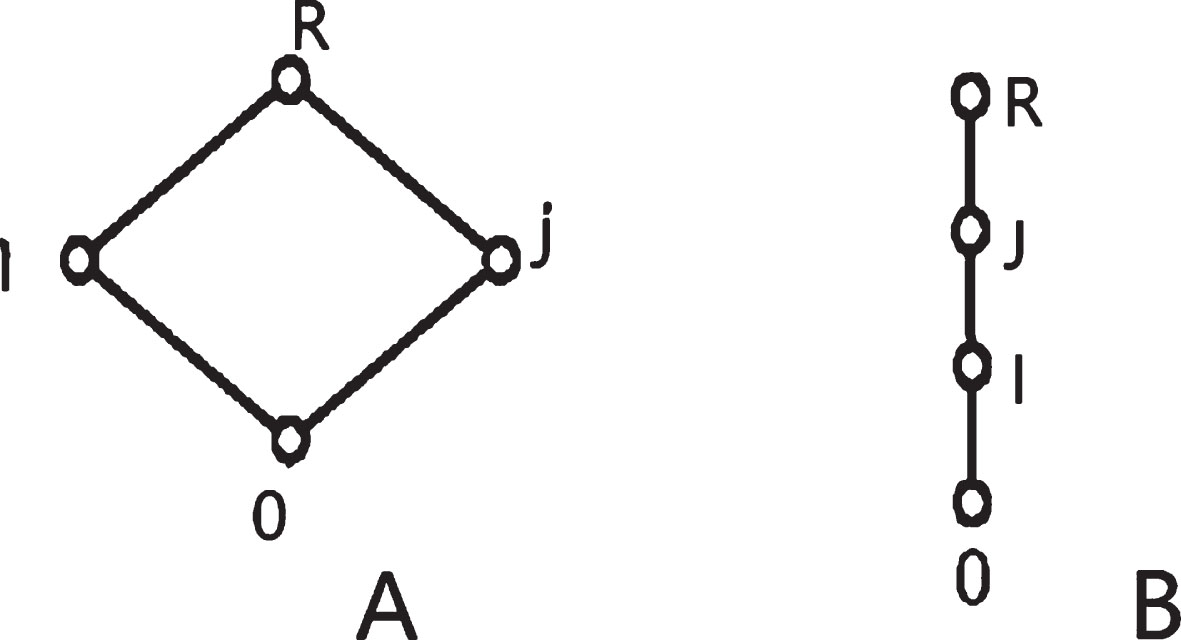
Latices with four elements.
In this situation, we have {0} ⊂ I ⊂ R and {0} ⊂ J ⊂ R, with I + J = R. Therefore, Id (R) is a lattice as in Figure 1, A. We have that I and J are coprime. It is clear that I ⊗ J = I ∩ J = {0} and I2 = I, J2 = J. From here, it results that Ann (I) = J and Ann (J) = I. Also, J → I = (I : J) = I and I → J = (J : I) = J. Therefore, we obtain an MV-algebra structure with the following operations:
Since {0} ⊂ I ⊂ J ⊂ R, the ring is local. Also, we remark that I is the only minimal ideal. Let x ∈ I, x ≠ 0. Therefore, 0 ¬ = < x > ⊆ I. Since I is minimal, we have I = < x > , then I is finitely generated. We have the following subcases.
1) I2 = {0} , J2 = I, I ⊗ J = {0}. We have Ann (I) = (0 : I) = J and Ann (J) = (0 : J) = I. Also, J → I = (I : J) = J. Therefore, we obtain an MV-algebra structure with the following operations:
2) I2 = {0} , J2 = I, I ⊗ J = I. In this case we do not obtaine a residuated lattice, since ⊗ is not associative. For example, I ⊗ J2 = I2 = {0} and (I ⊗ J) ⊗ J = I ⊗ J = I.
3) I2 = {0} , J2 = J, I ⊗ J = I. We have Ann (I) = (0 : I) = I and Ann (J) = (0 : J) = {0}. Also, J → I = (I : J) = I. Therefore, for Id (R) we obtain a BL-algebra structure (which is not an MV-algebra) with the following implication and multiplication tables
4) I2 = {0} , J2 = J, I ⊗ J = {0}. We have Ann (I) = (0 : I) = J and Ann (J) = (0 : J) = I. Also, J → I = (I : J) = I. Therefore, we have J ⊗ (J → I) = J ⊗ I = {0} and J ∧ I = I, false. Condition (div) is not satisfied. It results that Id (R) is not a BL-algebra.
5) I2 = {0} , J2 = {0} , I ⊗ J = {0}. We have Ann (I) = (0 : I) = J and Ann (J) = (0 : J) = J. Also, J → I = (I : J) = J. Therefore, we have J ⊗ (J → I) = J ⊗ J = {0} and J ∧ I = I, false. Condition (div) is not satisfied. It results that Id (R) is not a BL-algebra.
6) I2 = {0} , J2 = {0} , I ⊗ J = I, it is not possible, since I = I ⊗ J ⊂ J2 = {0}.
7) I2 = I, J2 = I, I ⊗ J = I. We have Ann (I) = (0 : I) = 0 and Ann (J) = (0 : J) = 0. Also, J → I = (I : J) = J. Therefore, for Id (R) we obtain a BL-algebra structure(which is not an MV-algebra) with the following implication and multiplication tables:
8) I2 = I, J2 = I, I ⊗ J = {0}, it is not possible, since I = I2 ⊂ I ⊗ J = {0}.
9) I2 = I, J2 = J, I ⊗ J = I. We have Ann (I) = (0 : I) = 0 and Ann (J) = (0 : J) = 0. Also, J → I = (I : J) = I. Therefore, for Id (R) we obtain a BL-algebra structure (which is not an MV-algebra) with the following implication and multiplication tables:
10) I2 = I, J2 = J, I ⊗ J = {0}, it is not possible, since I = I2 ⊂ I ⊗ J = {0}. 11) I2 = I, J2 = {0} , I ⊗ J = I, it is not possible, since I = I ⊗ J ⊂ J2 = {0}. 12) I2 = I, J2 = {0} , I ⊗ J = {0}, it is not possible, since from I ⊂ J we obtain I2 ⊂ J2 = {0}, so I = {0} , a contradiction.
b) We consider the ring
c) If n = p
r
, r ≥ 2, there is an MV-algebra isomorphic to
d) From ([10], Corollary 1.3), we know that an Artinian ring is a multiplication ring if and only if it is a finite product of Artinian local principal ideal rings. Moreover, if r = 1, the ring
e) If we take the ring
In [1], Corollary 28, the authors proved that each finite BL-algebras are isomorphic to a direct product of BL-comets. A BL-comet of order 5 has Hasse diagram as in Figures 3, D or E. If we consider a BL-comet of order 5 as in Figure 3, D, generated by a commutative ring R, then Id (R) has two maximal ideals, impossible. We conclude that, BL-comets Id (R) generated by commutative rings R with five ideals are chains. As in Remark 3.6, we can obtain all 8 BL-chain of order 5, one MV and seven BL-chain as Id (R) of a ring with 5 ideals with (n m (R) , n p (R) , n I (R)) = (1, 1, 5). In this way, we recover the results obtained in [15], Table 2.
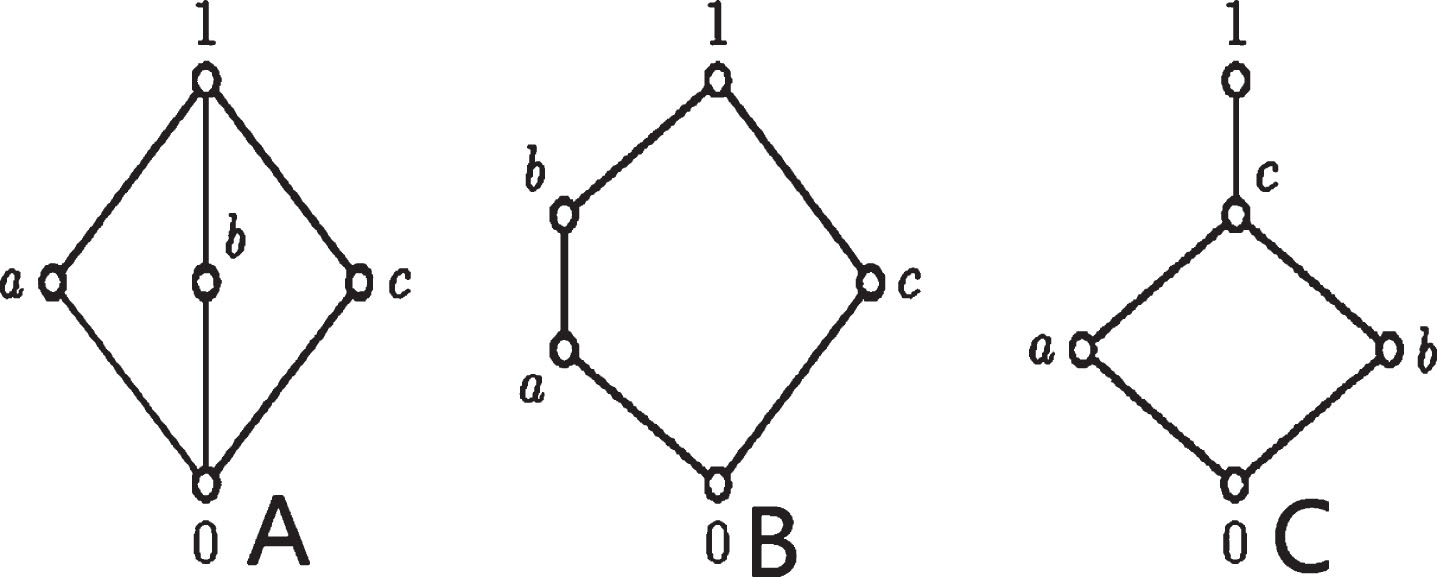
Latices with five elements.
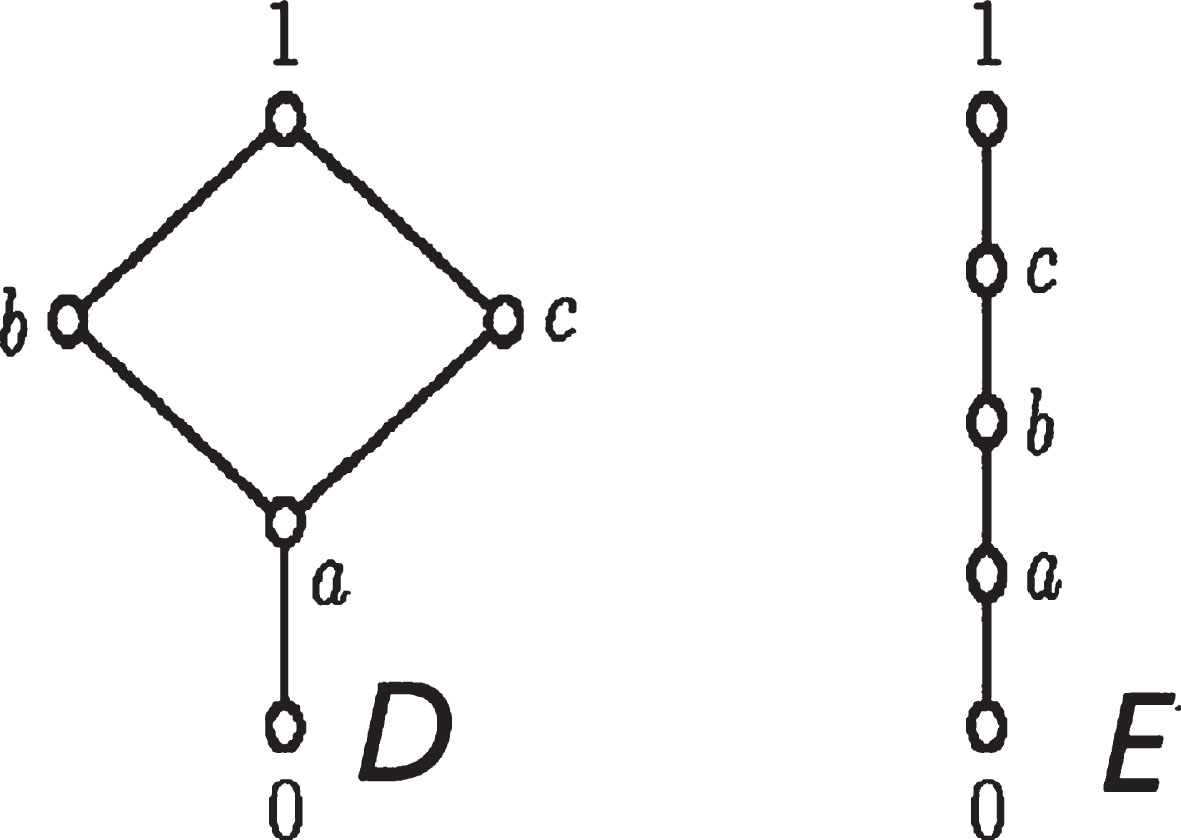
Latices with five elements.
b) We can have only commutative unitay R rings of the form (n m (R) , n p (R) , n I (R)) = (1, 1, 7) with Id (R) a BL-algebra, since 7 is a prime number, that means Id (R) is a chain.
b) If n I (R) = 8, we can have commutative unitary rings of the form (n m (R) , n p (R) , n I (R)) = (2, 2, 8) or (n m (R) , n p (R) , n I (R)) = (3, 3, 8), with Id (R) a BL-algebra.
d) For n
I
(R) = 9, we do not have commutative unitary rings of the form (n
m
(R) , n
p
(R) , n
I
(R)) = (2, 2, 9), with Id (R) a BL-algebra which is not an MV-algebra, since there are not commutative unitary rings R with three ideals such that Id (R) is a BL-algebra which is not an MV-algebra. But we can have rings R of the form (n
m
(R) , n
p
(R) , n
I
(R)) = (1, 1, 9), that means Id (R) is a chain. For MV-algebras of order 9, there are examples of rings whit which this MV-algebras is isomorphic to, namely
e) For n I (R) = 10, we can have (n m (R) , n p (R) , n I (R)) = (2, 2, 10) or (n m (R) , n p (R) , n I (R)) = (1, 1, 10) such that Id (R) is a BL-algebra which is not an MV-algebra.
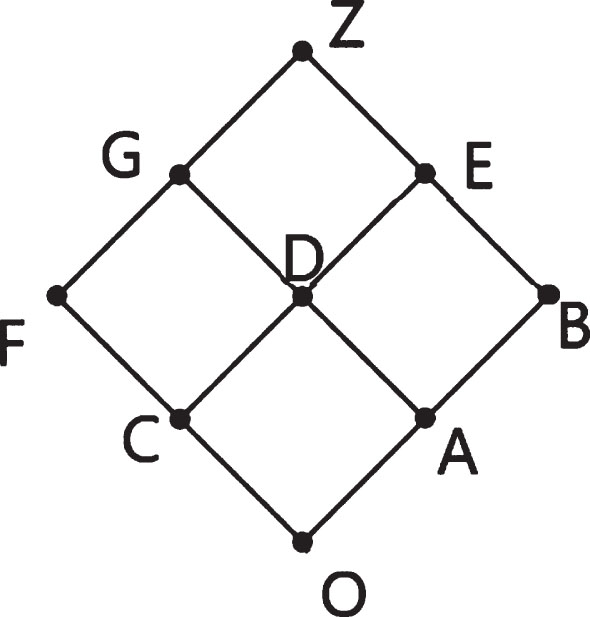
Latices with nine elements.
From here, we remark that {C, D, E, F, G, Z} is a BL-algebra of order 6 (see bold parts from relation (3.8)), extracted from the algebra
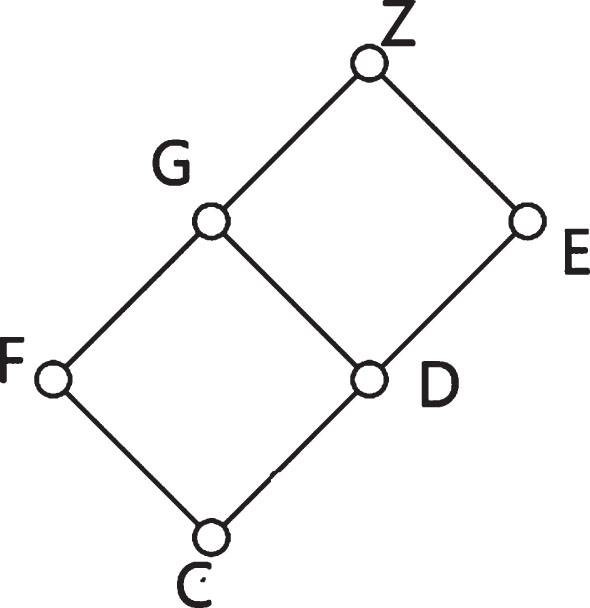
Latices with six elements.
In this paper, we presented some conditions for rings with a finite number of ideals to have their lattice of ideals equipped with a structure of BL-algebra.
As a further research, we intend to find circumstances for a given ring R to have on its lattice of ideals Id (R) a BL-algebra structure which is not an MV-algebra. As we have seen in the above, these conditions depend on the given number of ideals, that means depend on the 3-uple (n m (R) , n p (R) , n I (R)). Since it is clear that there are some values which indicate that we must search amoung non-unitary rings or amoung non-commutative rings or both, this study can helps us to give a classification of this type of rings.
Acknowledgments
The authors thank referees for thier patience and for their advices which helped us to improve this paper.
Statements and declarations
The authors declare that no funds, grants, or other support were received during the preparation of this manuscript
The authors have no relevant financial or non-financial interests to disclose
Data sharing not applicable to this article as no datasets were generated or analysed during the current study.