



Abstract
In order to effectively prevent and control accidents, it is essential to trace back the causes of gas explosions in cities. The DT-AR(decision tree-association rule) algorithm is proposed as a quantitative analysis of gas accident features and causality. First, 210 gas explosion accident investigation reports were taken as samples. The gas accident causation system is divided into three aspects, including environmental factors, management factors and physical factors. Management factors were sorted into organizational-level and individual-level factors from the investigation reports. Second, the CART decision tree model was used to compare location features, organizational causality features, and individual causality features of the piped and bottled gas accidents, and a decision tree model with the gas system fault site as the root node was built to filter the key feature variables. In order to reveal factor correlations and deep-level causation, the Apriori algorithm is used to mine accident association rules. The combinations on the branches of the decision tree are used as constraints to filter the critical causality rule, which improves the efficiency of association rule screening and enhances prediction accuracy. The results demonstrate that the DT-AR algorithm can evaluate the importance of variables, quickly locate effective combinations of factors, and mine the complete causal chain. The association rule is screened based on the constraint of the key element combination of the decision tree, which compensates for the low efficiency of the Apriori algorithm for association rule mining. In addition, the accident-caused excavation results provide an effective path for gas companies, outsourced service companies and administrative departments to implement gas safety chain supervision, which can address the problem of gas accident safety management failures and provide decision support for accident prevention.
Introduction
Gas explosions are one of the most significant types of emergencies in cities and communities, clarifying the gas accidents causal system and evolution mechanism, which is of practical significance to maintain regional safety and improve the emergency prevention system [1].
Most gas explosion accidents risk studies have been conducted through accident statistics [2, 3], assessment of causal elements [4], and cause distribution prediction [5]. In fact, safety accidents are not triggered by independent factors, but are the result of the interaction and coupling of multiple risk factors [6]. Reverse traceability of accidents based on the “Why-Because” idea, the “24model” model proposed by Gui Fu et al. can realize post-accident analysis, hazard identification and risk analysis [7], which is widely used in pipeline gas leakage accidents [8], ship traffic risk accidents [9], etc.
Compared to other accident causation models, 24model emphasizes the systematic and holistic character of accident hazards. The earliest model of accident causation was the Domino Model proposed by Heinrich in 1931, which describes an accident as a series of discrete events occurring in a specific time sequence [10]. This model laid the foundation of chained accident modeling analysis. After that, Failure Modes and Effects Analysis (FMEA) [11], Fault Tree Analysis (FTA) [12], Event Tree Analysis (ETA) [13] Cause-Consequence Analysis [14], and other models were presented. These models are capable of analyzing physical component failures or human error in relatively simple systems, but cannot reasonably explain accidents that occur in complex social management systems. 24model is based on systems theory thinking, which views the occurrence of accidents as a result of the migration of the system as a whole to a high-risk state. The occurrence of an accident is the failure of all the elements of the system and the undesirable interaction of the elements, which includes human factors, physical factors, organizational factors, environmental factors, and the interaction between the factors [7].
Due to the complexity of safety management in gas companies, 24model is widely used in gas accident hazard source analysis. Gui Fu et al. [15] were the first to identify the causal factors of 88 gas leakage accidents with a 24model framework structure, and by analyzing the correlation between the factors, they emphasized that accident prevention should focus on the root cause, then to restrain its effect on the essential, indirect, and direct causes. However, the logical relationship between factors has not extended to the whole chain and the whole process. Besides, Zhao et al. combined 24model with a major gas explosion case to clarify human unsafe behaviors, physical failure states, and additional failing habitual and organizational behaviors [16], finally to draw a flowchart about the cause analysis of the accident, with the drawback that the causative path of a single case reveals a lack of universality. Sun Yilin et al. were the first to quantitatively analyze the evolutionary mechanism of urban pipeline gas accidents with the use of 24model, combining the gray DEMATEL-ISM-MICMAC method to divide the recursive hierarchy of accident causation [8].
The main purpose of the existing studies is to analyze the law of gas accidents by listing and classifying the causative factors, and there is a lack of integration of the causative factors and the depth of the concurrency law between the factors based on multiple cases. The purpose of the existing research on gas accident law analysis is the listing and classification of causal factors, there is a lack of the causal factors consolidation and concurrency law deep excavation to multiple cases. Decision tree is a hierarchical model that classifies samples to identify the effects of different explanatory variables on key accident types. Lili Zhang et al. used decision tree algorithm to establish a decision tree model of water traffic accident influence factors, and extracted multi-factor coupling patterns from the generated inference rule set [18]. Ashraf used the CART decision tree algorithm to classify 251 traffic accidents according to the type of collision, extracting the accident characteristics during rear-end, side-impact, and head-on collisions [19]. Zhao Chufan et al. used association rules to mine the strong causal relationships of electrical personal accidents, and finally extracted the key causal chains of accident evolution paths [20]. Based on 200 tower crane accident investigation reports, Yuqi Sit et al. improved the traditional Apriori algorithm to mine the association rules to attributes and causal factors rules of tower crane accidents, using a multi-dimensional and multi-layer model of association rule mining [21]. In 2020, Gao Yang et al. used SPSS Modeler for mining the helicopter accidents, and built a frequent item set network graph with Apriori association rule, resulting in three sets of strong rule association combinations [22]. In summary, the decision tree combined with Apriori algorithm can profoundly explore the attribute characteristics and evolution mechanism of gas accidents, generate a gas accident causation map, and provide a decision basis for the prevention and control of urban gas accidents.
Gas accident case analysis
The investigation reports of gas explosion accidents were collected from the provincial government official websites, local emergency management official website, gas explosion official accounts, combustion blogs and other websites. Finally, we collected a total of 210 accident investigation reports with a complete accident review and a determination of responsibility, which spans the period from 2015 to 2022. Analyse accident characteristics and causal mechanisms of gas accidents with decision trees and association rule algorithms based on 210 accident investigation reports.
Accident Properties
divided into two forms, pipeline gas and bottled gas. Pipeline gas is an influential part of the city’s energy, paved under the ground. Natural gas is transported and entered indoor along the pipeline. Pipeline usage is related to environmental factors such as pipeline service time, internal and external environment, and human factors such as construction damage and traffic damage. In addition to being influenced by external accidents, maintenance workers and users’ control errors on pipeline valves can also lead to pipeline gas accidents. Compared to pipeline gas, bottled gas explosions are more likely to cause extra casualties and property destruction. According to the national industrial policy, urban pipeline gas is managed as a monopoly by means of government concession granted, while bottled gas enterprises take the form of market competition. Although the market share of bottled gas has decreased in the era of pipeline gas, the safety risks of the entire bottled gas industry have not decreased. Risk source including transportation process, bottle damage, customer gas usage, etc.
Combining the accident investigation report with the actual situation, the explosion location is divided into residential building, individual business shops, and public space. Residential buildings are the end use of gas equipment, with the primary purpose of meeting the daily needs of the residents. Individual business stores have relatively dense populations and large human mobility, and bottled gas is frequently used as a source of supply. Public places include streets, event centers, plazas and other areas of public activity where underground gas lines must be laid.
The gas system contains many important components. The following four were extracted— Pipeline and its valve, gas bottle and its components, Connection hose, gas meter and its valves. Pipelines and their valves include outdoor laid pipes, indoor risers for incoming pipe systems, and pipe valves between pipes. Gas bottle and its components include bottle, valve, base, safety device, etc. A section of the shortest pipe in the gas supply system, which is the weakest link in the gas supply system, is a major safety risk and a major cause of gas accidents. In addition, gas meters are an overlooked component of gas equipment, but are equally critical to maintaining system safety.
Human factors analysis according to 24model
According to the 24 model version 6 concept proposed by Fu Gui, accidents occur in relation to activities within the organization.According to the process of accident occurrence, the causal factors for accidents within an organization are divided into two categories: organizational factors and individual factors, as shown in Fig. 1. Organizational factors, that is, the behavior of the organization as a whole, including instructional behavior based on the safety culture and operational behavior from the management system. Individual factors are divided into habitual behavior and one-time behavior at the individual level, habitual behavior involves safety capabilities, and one-time behavior indicates the action that causes the event to occur [7]. The direct cause of public number accidents are a combination of individual one-time behavior and physical factors. Combined with the characteristics of gas accidents, the physical factors are mainly the system failure site [23]. For organizational external factors, the external regulatory environment of the management organization [8] and the physical environment where the accident occurred [1] should also be considered.
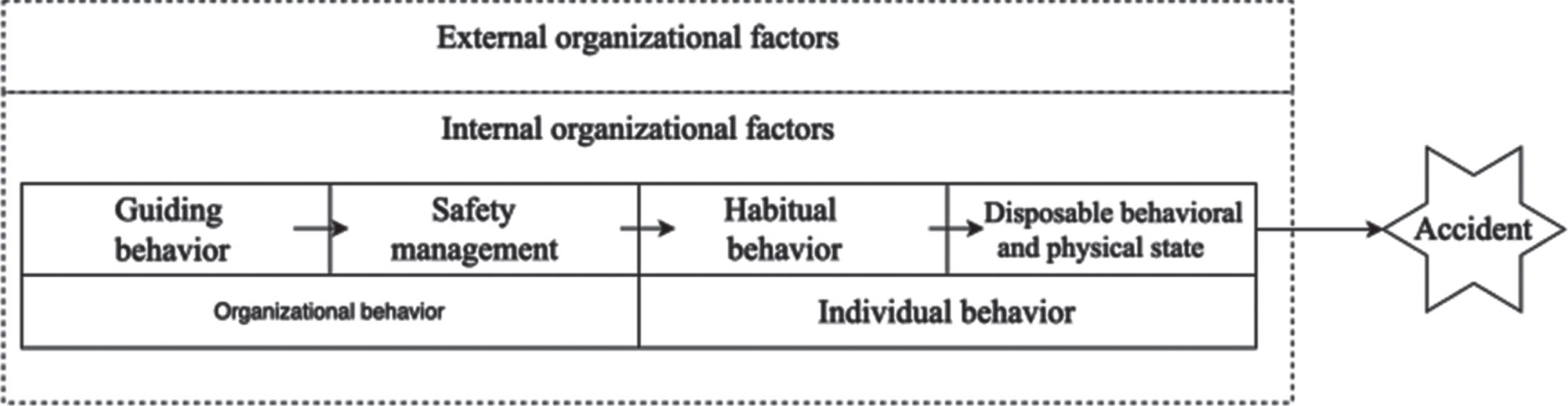
Structural framework diagram of 24model.
Individual behavior is divided into habitual and one-time behavior. Habitual behavior involves security capabilities, whereas one-time behavior refers to actions directly related to the occurrence of an event. Organizational behavior includes all behavior within a company or department. Organizational behavior includes all behaviors within the organization, including the conduct of guidance related to the security culture, and the conduct of operations issued by the management system.
Individual unsafe actions indicate subjective unsafe actions by individuals, and gas accident investigation reports classify individual unsafe actions into five categories - failure to close valves, unreasonable selection of gas equipment, illegal maintenance, violations of construction site operations. The failure to close the valve is the most frequent in most pipeline gas accidents. Moreover, the improper use of the bottle was the cause of the most notable bottle gas accidents.
Habitual behavior is used to describe the relevant personnel safety knowledge, safety awareness, safety habits and other aspects of deficiencies, including five types— Insufficient grasp of construction procedures, Insufficient knowledge of maintenance procedures, Weak safety awareness, Insufficient understanding of the protection measures importance, Insufficient understanding of the protection measures importance, Insufficient realization of environmental risks. According to the accident investigation report, many behavioral subjects were involved in habitual behavior failure. For example, construction procedures related to outsourced service company workers, maintenance procedures and protection measures are carried out by gas company maintenance workers. In addition, safety awareness and understanding of environmental risks among households and residents are also important habitual behaviors.
The safety management system refers to improper setting of safety management or inadequate management procedure, which is reflected in the deficiencies of the outsourcing management system, the failure of the emergency management plan, the lack of HSE training, and the wrong maintenance procedures [24]. Guiding behaviors refer to the safety culture of the relevant department and organization, such as the organization’s appearance of perceived and emphasized safety [16].
Using 24model to sort through 210 accident investigation reports, the causal factors of the accidents were analyzed as shown in Table 1.
Gas explosion accident causal factors
Emergencies are the result of multiple factors, each of which can be represented as a logical combination of influencing factors. The decision tree summarizes the contingency features, which can be used as constraints for the Apriori algorithm, resulting in a causal factor combination. By interrupting the causal chain in the work of safety management, accidents can be effectively prevented..
Decision Tree Model
DT is a graphical hierarchy that extracts rules and determines the influence of different explanatory variables (i.e., accident characteristics together with the causative factors). The terminal nodes of the tree are called leaves and represent the expected values of the class variables. There are various algorithms for constructing DT, and splitting criteria is the main difference between algorithms [25], and the CART model developed by Breiman is the most commonly used method in accident data analysis [26].
The CART model uses the Gini index as the segmentation criterion to measure the impure degree, until purity of each node cannot be improved. The Gini index is calculated using the following formula Equation 1:
p is probability of a variable of variable Y being classified into a specific category yj at a node of DT. The segmentation criterion based on Gini index can be defined as Equation 2:
In this Equation gini (Y|Z) can be calculated as:
Z is another known independent variable as shown in the Table 1.
The decision tree rule is a logical conditional expression that describes the combination of events. It is presented in the form of “ IF A then B, “ where A is the antecedent and B is the consequent. P denotes the probability that such events may occur under this rule. The CART DT algorithm is applied to gas explosion accident analysis, where each node forms a tree diagram in the form of a dichotomy, and the paths where the end nodes are located are analyzed to resolve accident characteristics.
Association rules are one of the widely used non-parametric data mining techniques for causality analysis of safety incident causal factors. Association rules generate rules in a variable-based manner, rather than following a specific functional distribution. The Apriori algorithm was first proposed by Agarwal et al. [27]. It is applied in gas explosion accident analysis to filter rules with support, confidence and boost. The relevant definitions are as follows: Assume that I ={ i1, i2, . . . , in } is the set of all gas accident types and causal factors, Each ik represents an element, and the set N of several of these elements is called the N set. Association rules are logical implication relations between sets of items, such as A → B, A,B both belong to N set, and A∩ B = ∅, A and B are called prior event and subsequent event. Support is the frequency of simultaneous occurrence of item set A and item set B in an incident causation rule, which describes the frequency of occurrence of the association rule.The support of a rule is expressed as Equation 4:
Confidence is the conditional probability that if set A occurs in an incident causation rule, item set B also occurs at the same time, which describes the reliability of the association rule. The confidence of a rule is expressed as Equation 5:
Elevation is the ratio of the probability of simultaneous occurrence of item set B to the overall probability of occurrence of item set A in the accident causation rule, which describes the degree of correlation between the preceding and following elements of the rule. The confidence of a rule is expressed as Equation 6:
The rule that satisfies the minimum support and minimum confidence is called the strong correlation rule, where if L > 1, it indicates that the former term in the rule has a positive effect on the occurrence of the latter term; if L = 1, the two sets are uncorrelated; if L < 1, the set of terms A has an inhibitory effect on the occurrence of B.
An improved method, DT-AR (Decision Tree-Association Rule Algorithm), is proposed to extract association rules under the classification results of the decision tree for accident features. After the decision tree model is constructed using the CART algorithm, the accident characteristics of piped and bottled gas are classified and the minimum support of the association rule is determined. Subsequently, the effective association rules are filtered under the decision tree constraints. The decision tree based fast association rule mining (DT-AR) algorithm can be described as follows:
Input: gas accident dataset D, decision tree max depth = 5
Output: The key variables, important association rules
Step 1: Prepare the gas accident dataset.
Step 2: For each variable in the training set, the samples are categorized into Q1 and Q2.
Step 3: Calculate the Gini coefficients of the two subsets separately; the larger the value of the variable, the greater the error rate of the categorization method for that variable.
Step 4: Determine the best attribute and segmentation threshold. The variable with the smallest Gini coefficient is selected as the best basis for segmentation and two child nodes are generated.
Step 5: Repeat Step2 to Step4 until the tree reaches a depth of 5.
Step 6: Determine the leaf node of the smallest set as Min Supp.
Step 7: Output the combination of decision tree branch
Step 8: Find all items in D with support greater than Min Supp.
Step 9: Generate the candidate set Ck containing k elements.
Step 10: Scan all events in dataset D.
Step 11: Check all candidate sets in Ck that contain relation t.
Step 12: Compare Support Levels
Step 13: Result in a frequent item set C, α i for rule i.Rule “α i ” is the “ith” principle within C.
Step 14: Iterate over the path of each leaf node in the decision tree, denoted as β j .
Step 15: if α i ∩ β j ≠ Φoutput β j ∪ α i = L, L is the final frequent itemset, The minimum support of both β j and α i , denoted as Min Supp, is considered as the support of L.
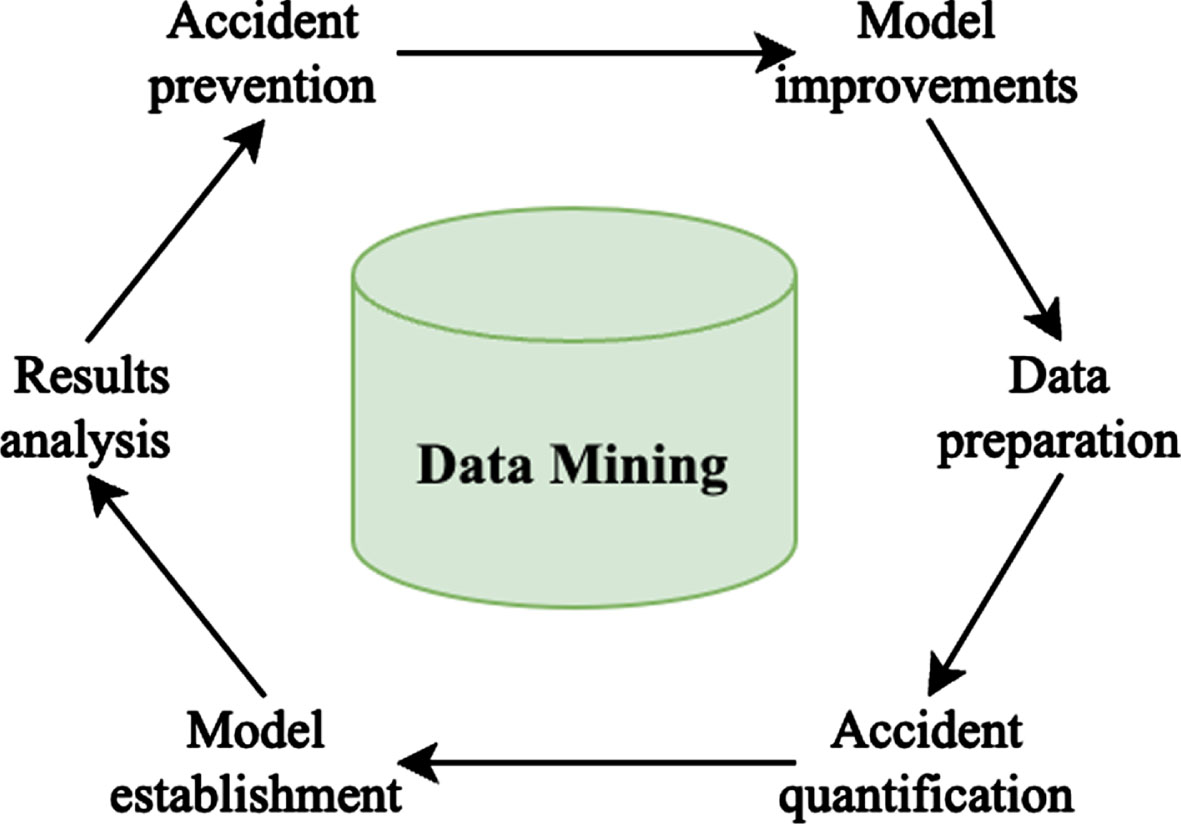
The flowchart of the DT-AR algorithm is shown in Fig. 2.

Flowchart of DT-AR algorithm.
SPSS Modeler is a data mining software with powerful features to enable prediction, clustering, association and classification of data, among others. It is capable of data preprocessing, data reading, graphical and other data exploration methods, supports data export in various formats, and has a visual data mining process and well-established predictive analysis models. The basic procedure of operation is shown in Fig. 3.
Data mining in Spss Modeler.
1) CART decision tree construction
Firstly, select “source” module in the SPSS Modeler, import the “sav.” format of the gas accident data table. Subsequently, select the “Filter” module in the field options to filter incomplete data. Subsequently, select the “Filter” module in the field options to filter incomplete data. Add the “Type” option, each indicator is represented by an integer between 1 to 9, thus select the “Categorical” type, and set “accident type” as an output, additional factors as input. Then select the CART decision tree Model from the output options, click “Run” at the top of the screen. The results of the decision tree model can be analyzed as shown in Fig. 4.
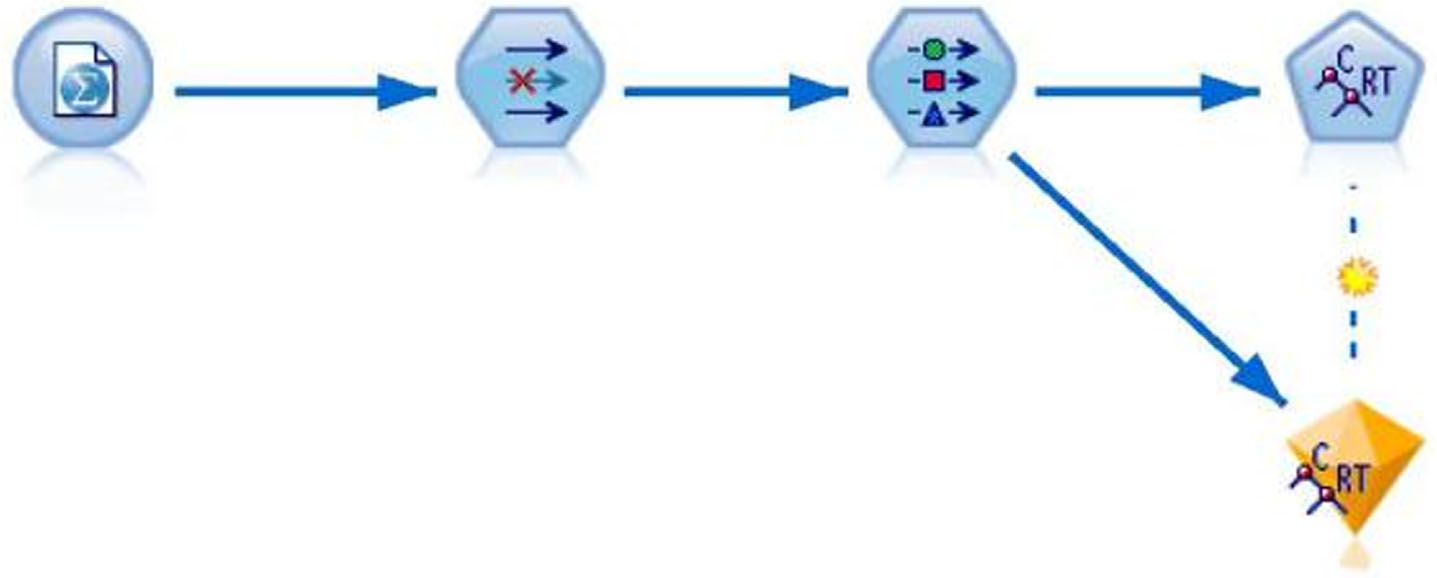
CART decision tree model construction.
2) Apriori algorithm association rule mining
In the Aprior modeling process, the event attribute variable is set as a field antecedent, and the accident type is set as a field consequent, which is conducive to the differentiation of the causation rules for the explosion accidents of two different gas forms, namely, bottled gas and pipeline gas, as shown in Fig. 5.
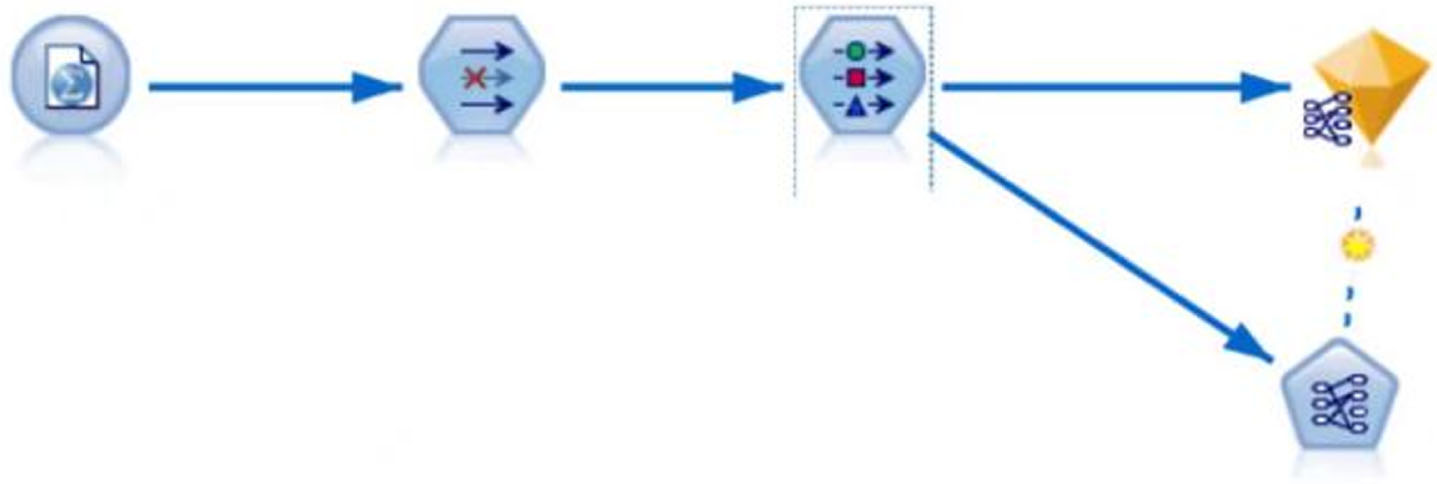
Apriori association rule model construction.
Characteristics analysis based on decision tree
DT uses CART model development, where 70% of the accidents were used to train the model and 30% of the data were used to validate the model. The accuracy of the CART model is approximately 66.47% and 65% for the training and validation datasets, respectively. De Ona et al. used the DT method to extract rules from police incident reports, where the CART model had an accuracy of 55.87% [25]. Respectively, Abdelwahab, Abdel Aty and Juan de et al. also reported similar accuracy in crash severity modeling studies using data mining and Bayesian networks [28, 29].
There are two types of accidents, pipe gas and bottled gas, as shown in Fig. 6. The accident type is the root node, which includes both pipeline gas and bottled gas types. Each node is additionally divided according to guiding behavior, operational behavior, habitual behavior, external environment of the organization, etc. The DT obtained using the CART model has 14 nodes in total. Node 3, 11 and 13 show the characteristics of a pipeline gas explosion incident. The combination of factors at Nodes 3 and 11 reflects the fact that the primary responsibility for pipeline gas explosion rests with the gas company and the outsourced service company. In total, there were 25 incidents under Rule 1, or 29.41 percent of the total number of pipeline gas explosion incidents, such incidents indicating illegal outsourcing of work. Node 3 represented 52.94% of the incidents, with the main guiding conduct failures lying with gas companies and outsourced services. For gas companies, when safety training at the company was inadequate or safety inspections were inadequate, employees were not sufficiently aware of maintenance procedures, resulting in the failure of indoor pipes, pipe valves and gas meter valves. For example, the “10–21” general gas explosion accident in Shannan District, Shandong Province, maintenance employees had opened the indoor gas meter valve and the meter after the single-headed plug in the process of investigating problems and forgot to close it, after that the user open the pipe valve, the gas leakage from the meter near, finally exploded in the kitchen.
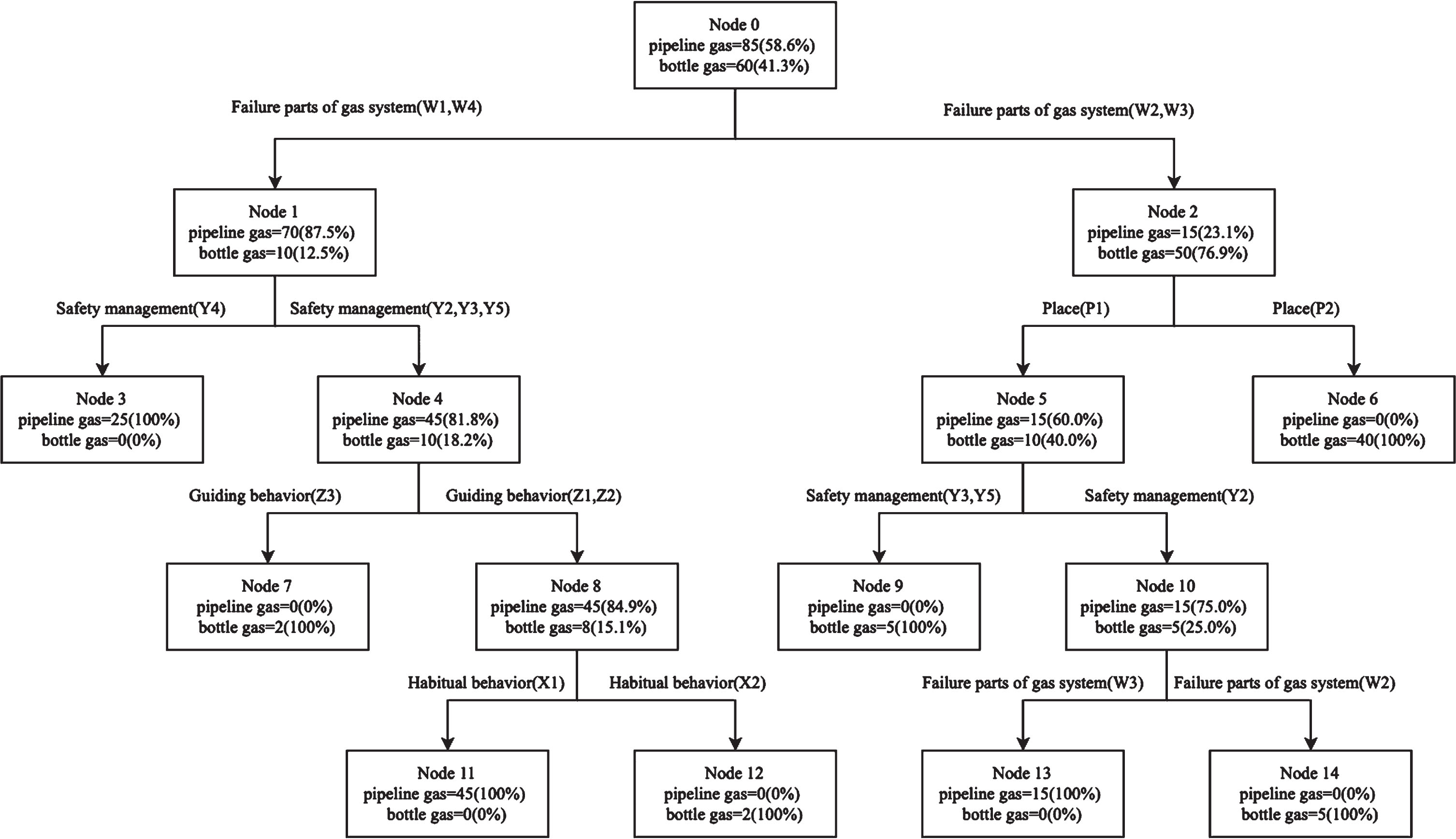
Gas explosion accident characteristic classification based on CART DT.
On the other hand, due to the lack of safety management at the construction site, the workers had a bad grasp of the construction procedures, so they drilled the ground directly without knowing the underground pipelines distribution, then opening the underground pipelines resulting in gas leaks that gathered to a certain extent and explosion caused. For example, the “Investigation Report on the Large Gas Leak Explosion Accident in Biyang County Rural Domestic Water Replacement Project on August 17th” released by Baoding Emergency Management Bureau, and the Investigation Report on the “10–21” Large-scale Pipeline Gas Leakage and Explosion Accident at 222 Taiyuan South Street, Heping District, Shenyang City, released in 2021. Node 11 reveals that when a piped gas explosion occurs indoors, the gas leaks due to failure of inadequate safety inspections, lack of employee safety education and training, etc. For instance, the investigation report of the “2–14” gas explosion and combustion accident at the residential house of in Baohe District in 2022 showed that, as the connection between the hose and the stove is not tight, the user’s stove front valve is in a prolonged-term open status, and the gas meter front valve is opened, resulting in natural gas explosion.
The remaining nodes exhibit the characteristics of a bottle gas accident. There were 40 incidents under Rule 4, accounting for 47.06% of all incidents involving bottled gas, revealing the location characteristics of individual businesses where bottled gas incidents are more likely to occur. Node 13 revealed that the administration’s lack of hidden danger checks for bottled gas users contributed to the accident. Such as the liquefied petroleum gas explosion occurred at No. 22 Yipin Sheep Mud House in Yujiawu Village, Tongzhou District. According to the investigation report, because the comprehensive law enforcement team has not established a complete and comprehensive basic work ledger, no security risks have been found in daily security law enforcement inspections and special law enforcement inspections. Node 6 shows that when a bottle gas accident occurs in a residential home, the operational behavior that affects it is inadequate safety inspection, and the failure site is the bottle and its components. Bottled gas incidents at Node 13 also occurred in residential homes, with physical failure of parts in furnace valves, gas cylinders and their components, for which the operating reason was inadequate safety inspection and failure to implement a gas facility protection program.
In summary, based on the location of the accident, organizational factors, and individual factors, the following features were summarized: In the external environment of the organization, the location characteristics of the bottled gas accidents are more obvious, mostly occurring in individual business merchants, and the failure parts are gas bottle and its components. Among the organizational factors, the failure of guiding behavior for pipeline gas incidents lies with gas companies and outsourcing service companies, and the failure of guiding behavior for bottled gas incidents is between the administration and gas companies. At the level of personal factors, habitual behavioral failures to the bottled gas accidents include inadequate knowledge of construction procedures, inadequate knowledge of maintenance procedures, physical failure parts corresponding to the gas meter and its front and rear valves, connecting pipes and piping valves; the failure parts of the bottled gas accidents are the cylinders and their parts.
The decision tree summarizes the characteristics of the bottled gas and the piped gas, but the description is not clear and the description of the coupling and concurrence between the factors is not complete, so it is necessary to use association rules to make up for this deficiency.
Based on the accident causality features summarized by the decision tree, the association rules between the causal factors of gas accidents are mined. With event type as the posterior term, organizational factor causation and personal factor causation as the anterior term, setting a minimum support value of 0.1 and a confidence value of 0.8, a total of 509 association rules were generated in SPSS Modeler, and 9 key association rules were selected according to the completeness of the causation chain, their support, confidence, rule support and elevation. The support level indicates the number of recorded occurrences of both antecedent and antecedent. The lift level indicates the degree of correlation between the antecedent and the consequent. The lift values of the generated rules are all greater than one, which means that the antecedents and the consequences in all rules are positively correlated. Among them, the key association rules for pipeline gas and bottled gas accident causes are shown in Table 2.
Rules generated from association rule method
Rules generated from association rule method
The rules show that in the case of gas accidents, when the Place = Public space Habitual behavior = Insufficient grasp of construction procedures, Individual unsafe action = Violation operation in construction site, pipeline gas explosions occur in about 85%. Piped gas accidents occur in approximately 98% of cases when the Guiding behaviour = Administrative department, Safety management = Non-implementation of security enforcement inspections and Failure parts of gas system = Connection hose. When there is Guiding behaviour = Outsour-cing service company), Safety management = Lack of employee safety education, Habitual behavior = Insufficient knowledge of maintenance procedures, Individual unsafe action = Illegal maintenance and Failure parts of gas system = Gas meters and its valves, the occurrence of pipeline gas explosion accidents in the database is about 87%. When Safety management = Lack of safety management in the construction site, Habitual behavior = Insufficient realization of environmental risks, Individual unsafe action = Violation operation in construction site, and Failure parts of gas system = Pipeline and its valve, pipeline gas explosion accidents occur in 90% of cases.
The more likely Individual unsafe action in pipeline gas accidents are Illegal maintenance, Violation operation in construction site, and corresponding gas system failure parts including the gas meter valve and pipe valve. Besides, Habitual behavior is Insufficient grasp of construction procedures Insufficient knowledge of maintenance proceduresa. The Safety management level is the Lack of employee safety education and Lack of safety management in the construction site. Therefore, gas service companies should strengthen safety education and training for their employees, familiarize themselves with the maintenance operation process, so as to reduce piped gas accidents caused by improper maintenance. Building construction companies should strengthen the implementation of the system, improve workers’ awareness of risk prevention and reduce forced construction for the sake of time during the construction process. Before construction operations, the distribution of underground pipelines must be clarified.
Factors at the individual level of bottled gas accidents are Individual unsafe action = Improper use of gas cylinders, unreasonable gas process equipment and equipment; Habitual behavior = weak safety awareness, insufficient knowledge of environmental risks. Factors at the organizational level are operational behavior = inadequate safety inspections, lack of implementation of gas facility protection programs; guiding behavior has gas companies or administrative departments. In the bottled gas explosion accident, the main failure part is the gas bottle and its components, one-time behavior is mainly improper use of bottles and unreasonable use to gas process and equipment selection, individual level habitual behavior including weak safety awareness, awareness of the protective measures. Therefore, gas companies should implement gas facility protection programs, while administrative departments conduct strict safety inspections and raise the level of risk awareness among bottled gas users, which can effectively reduce the generation of bottled gas accidents.
Based on the 24model behavior system model, a total of 22 index factors at the organizational and individual levels were sorted out from 210 gas accident investigation reports, and the failure behaviors of each control level were systematically sorted out using gas companies, outsourcing service companies and administrative departments as guiding behaviors. The DT-AR algorithm was used to classify gas accident features and multiple causal factors. The analysis results show that the bottled gas accident occurred in private merchants, and the wrong guidance behavior is the lack of supervision of the administrative department. Pipeline gas accidents occur mostly in residential and public places, and the guiding behavioral failure is between the gas company and the outsourced service company.
DT-AR algorithm is used to analyze the characteristics and causes of urban gas accidents, and the combination of risk factors in the decision tree operation results is used as the constraint, which makes the constraint more objective and effective, and improves the screening efficiency of key association rules. With max_dep = 5 as the termination condition of the decision tree, the number of samples on the smallest leaf node of the decision tree is used as the minimum support degree of association rules, which solves the subjective problem of setting the confidence degree of association rules. DT-AR method provides a quantitative research method for analyzing complex causes of accidents and mining multi-dimensional association rules efficiently..
In the context of outsourcing gas company services, the gas company, the relevant outsourcing unit, and the administration are unable to effectively reduce the occurrence of gas accidents. This paper advocates “chain supervision” under the four control levels of 24Model, specifying the failure behavior of each link and forming an effective path of “whole process supervision” to prevent accidents continue to deteriorate. Gas companies should strengthen their own construction and staff management training, while strengthening the publicity and education of community residents on safe gas use, and cooperate with administrative departments to implement hidden-danger investigations and increase the efforts to dispose of violations. As the business contractor, the outsourcing unit should work with a gas company to develop a construction plan, strengthen the safety management of the construction site, and enhance the awareness of environmental risks among construction personnel. The administration should establish better systems and regulations to create an atmosphere of safe gas use and conduct periodic inspections of gas facilities prone to failure to curb accidents from deep roots.