



Abstract
This paper improves the visual change-based personnel evacuation model by considering the evacuees’ gravity. Specifically, first, the new model incorporates the gravity formula in the model’s mechanic part to consider the influence of gravity. Second, the new model involves rules for determining the visual range of personnel moving in the stairwell. Third, the proposed model investigates the influence of the angle and width of the stairwell, the number of people, and other factors during personnel evacuation under the influence of gravity. The model is developed in Python and is compared with actual results, revealing that the proposed model is more realistic considering the evacuation time compared to current models. Indeed, under a fixed number of people, when the stairwell angle is less than 34°, the evacuation time decreases as the angle increases, and when the stairwell angle exceeds 34°, the evacuation time is almost unchanged. Additionally, under a fixed number of evacuees, the evacuation time decreases as the width of the stairwell increases, and due to stairwell width space redundancy, the evacuation time tends to stabilize. The results of the new model research provide reference for the design of building safety evacuation, thereby improving the safety of buildings.
Introduction
The development of society has increased the number of crowded places and imposed the necessity to evacuate people from a building in the event of an earthquake, terrorist attack, or other emergencies in a timely, orderly, and rapid manner to reduce the loss of people and property. Hence, research related to evacuation strategies has become a hotspot. The maturity of computer simulation technology allows simulating evacuation of people without considering the risk and cost of the exercise, thus making the evacuation simulation safer and more practical. However, many factors affect evacuation simulation research, which can be broadly divided into using commercial simulation software and using mathematical models to define the evacuee’s motion and derive its laws.
Regarding commercial tools, several stairwell evacuation simulation programs exist, e.g., building EXODUS [1], Anylogic [2], Pathfinder [3], Simulex [4], and EVACNET [5, 6]. However, these commercial tools do not express how personnel can access information that helps their evacuation from the perspective of their field of view. Considering mathematical modeling, Cellular automata are widely used as evacuation models for personnel evacuation. For instance, Georgoudas et al. [7] proposed a meta-automata model with an electrostatic induction potential field generated by charges at selected positions and providing basic knowledge of the entire route. Georgoudas et al. [8] proposed a crowd management system framework based on an electrostatic-induced potential field model to avoid congestion. It uses Coulomb’s law to calculate attractive or repulsive forces. Zhang et al. [9] first introduced the concept of high potential fields, which considers the travel time and non-adaptive costs required to move to adjacent meta cells and expects everyone to minimize the cost of high potential fields when making decisions. The metacellular automata model can simulate pedestrian flow in stairwells by dividing the building space into grids [10, 11]. For instance, Ning et al. [12] introduced the walking preference of the people in the stairwells, where the psychology of the people was based on the metacellular automata model. The authors derived a highly realistic evacuation model. Then, Ding et al. [13] divided the stairwell of a building into several areas and used the metacellular automata model to define the movement law of the personnel, thus predicting the evacuation time. Gao [14] used the metacellular automata model to establish a personnel evacuation system applicable to an offshore platform and derived the effect of a smoke environment on evacuation. Besides, the social force model has already been used for stairwell evacuation, owing to its ability to explain the mechanics of the evacuation process [15, 16]. In turn, Wang et al. [17] proposed an extended force-based 3D model to describe the movement of pedestrians on the stairwell and derived the effect of stairwell inclination on evacuation. Although the above methods utilizing mathematical modeling play an important role in guiding peoples’ evacuation, these do not adequately consider the effect of gravity on moving down to evacuate.
Spurred by the above problems, this paper improves the personnel evacuation model based on visual field changes [18]. The personnel evacuation model based on the field of view changes combines cellular automata and behavioral heuristics and is used to express the model of people obtaining surrounding information through a field of view in sudden situations. Specifically, first, this paper adds gravity formulas to the mechanic part of the original model to consider gravity during the calculations of the evacuees’ speed. Second, this paper modifies how the visual field range of the personnel is determined while moving on the stairs, allowing the model to simulate the range of the personnel’s visual field more accurately when they are in the stairwells. Third, the model studies the influence of the angle and width of the stairwell on personnel evacuation scenarios and determines the optimum stairwell angle and width. Finally, true evacuation generally brings huge costs and labor so that it can be avoided. This article compares the new and old models with actual evacuation to verify the feasibility of the new model.
This article investigates how stairs affect evacuation efficiency during the evacuation process through an improved new model. Starting from the basic perspective and width, it aims to discover their patterns and find the optimal evacuation angle and width, providing building designers with a reasonable staircase design angle and width to improve the overall safety of the building. Then, establishing a new model provides strong technical support for the operation of new simulation evacuation software in the future. This paper is organized as follows. Section 2 reviews the literature on personnel evacuation in the presence of stairs. Section 3 describes a visual evacuation model for personnel considering the influence of gravity. Section 4 provides simulation results and corresponding discussions, and Section 5 concludes this work.
Model
Choice of direction
The cellular automaton model was proposed by Von Neuman [19], in which many physical systems and natural phenomena can be analyzed through local discretization of the cellular automaton model, using simple rules to reveal and simulate complex real-world problems. Cellular automata can be widely applied in practical evacuation problems. For example, Qiang et al. [20] established a large-scale sports stadium crowd evacuation model based on multi-agent and cellular automata technology. Zhu et al. [21] used a cellular automaton model considering corridors to simulate classrooms with multiple obstacles. Cellular automata can be well represented as a model in the process of direction selection due to its plasticity. Because cellular automata models have good plasticity, this paper adopts the extended Moore type of the metacellular automata model, with the motion direction depicted in Fig. 2-1. For the calculations, we consider a cell size of 0.4×0.4 m, similar to the human body’s radius size.
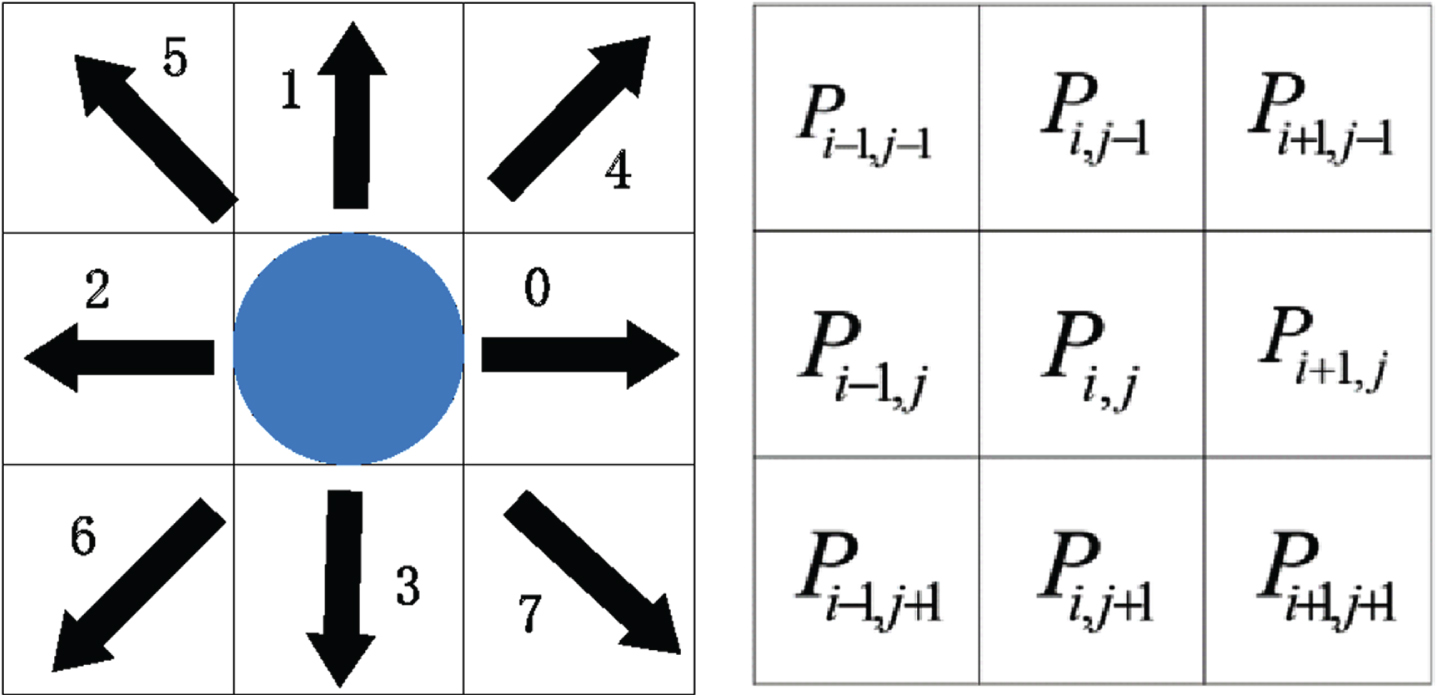
Direction of movement and its probability.
This paper improves the model’s direction process utilizing the computational principle of the traditional metacellular automata that is formulated as follows:
(I) The k d algorithm adopts the calculation method of Xu Yang et al. [22] regarding conformity psychology in the evacuation simulation process. The calculation formula is as follows:
(II) k s uses a motion heuristic model to calculate the degree of dependence of personnel on path services, and its principle is as follows
(III) Static field S ij The calculation formula for ij is as follows:
(IV) Regarding D
ij
and according to [23], when t = 0, the field value of the dynamic field is 0, i.e., when pedestrians move from one unit to the next, the calculation steps can be divided into three steps: Leave a mark on the moved site
Calculate the dynamic field of attenuation and diffusion
where λ, δ represent the diffusion coefficient and attenuation coefficient, both of which are set to 0.5. Standardize the formula
Further details on the k
d
, k
s
, S
ij
, D
ij
are presented in Sections 3.1 and 3.2 in [18].
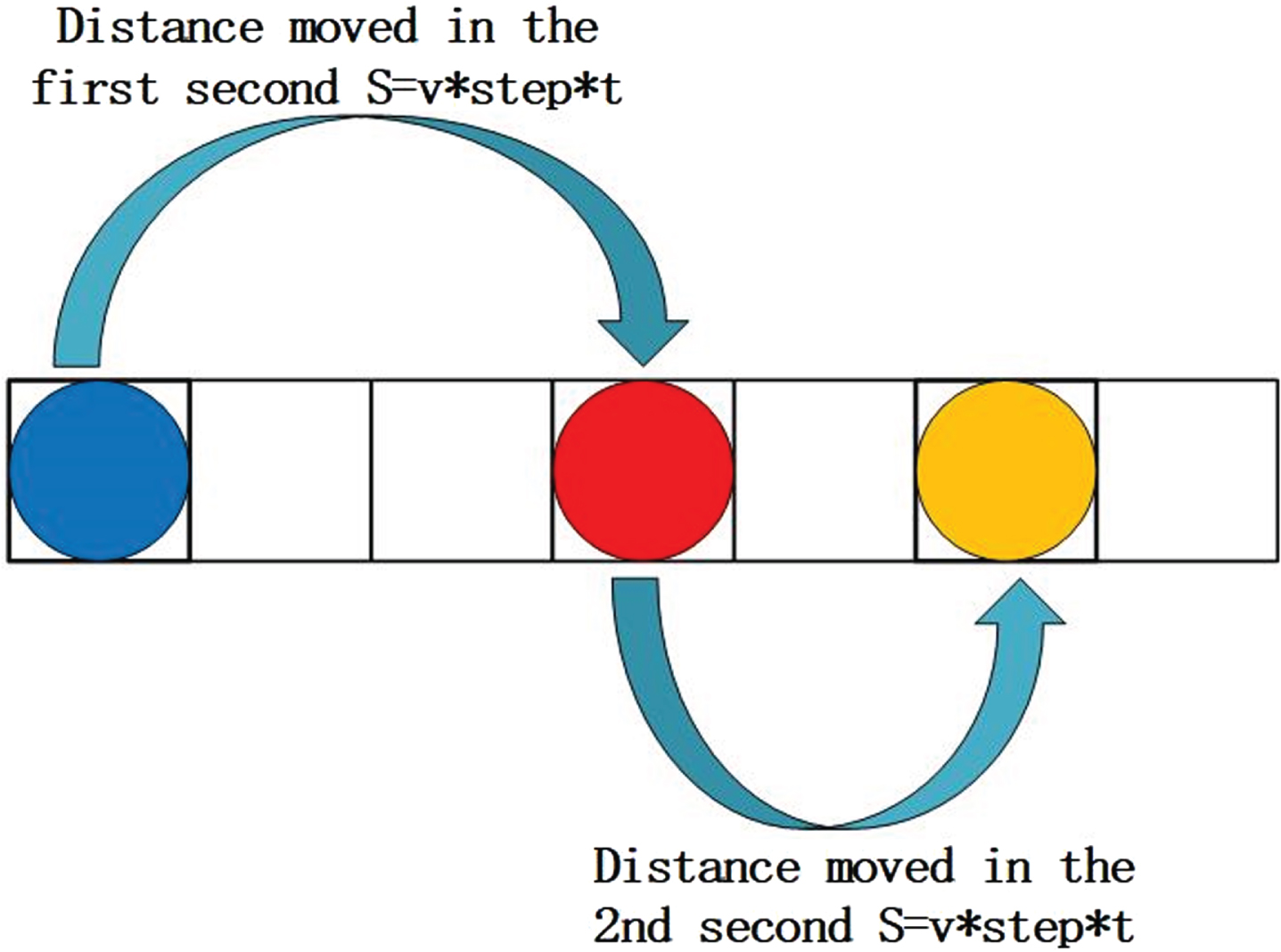
Distance traveled by the evacuees.
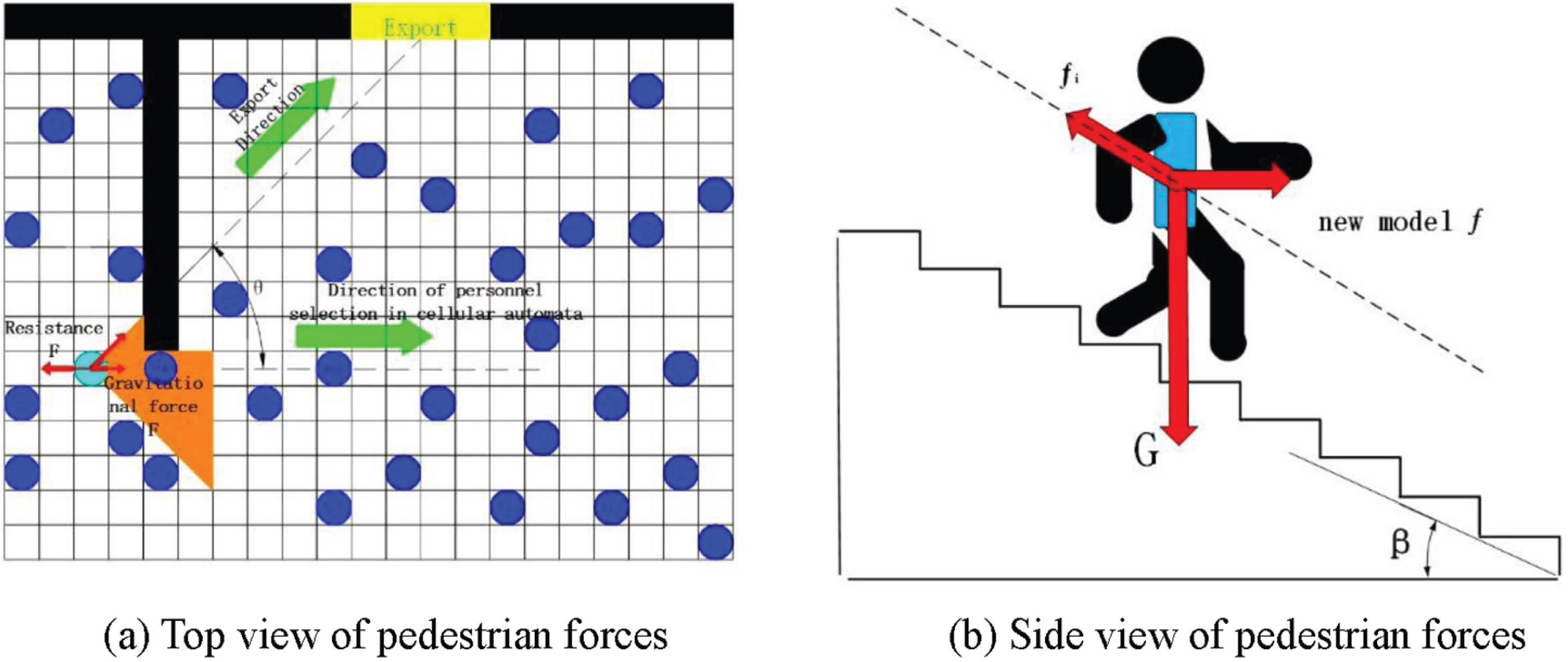
Pedestrian force diagram.
The social force model was proposed by Helbing et al. [24], which considers humans as particles, and the movement of each particle needs to satisfy Newton’s second law, thus opening up research on social force models. Researchers have optimized the model’s performance, and Seyfried et al. [25] optimized the mechanism of personnel collision in the social force model. Once the actual distance is less than expected, the expected velocity instantly decreases to zero, and the self-driving force disappears, prompting individuals to decelerate. Sticco et al. [26] used analytical techniques and numerical simulations to adjust the friction coefficient appropriately. The results were consistent with empirical data, making the density and flow relationship output by the basic social force model consistent with the relationship in pedestrian dynamics. Therefore, this paper the social force model, to determine the evacuees’ moving direction, running speed, and thus their moving distance. Figure 2-2 depicts the corresponding principle.
Since acceleration is controlled by force, it affects the moving distance of the evacuees. In the process of personnel evacuation, it is necessary to consider the personnel’s force situation, including the force between people, the force between people and obstacles, and the gravity people experience when moving downstairs. Therefore, this article improves the description of the combined force presented in [18] because the original model lacks consideration of gravity, which provides downward thrust when evacuees move downstairs, allowing people to evacuate faster. Hence, gravity is an indispensable force in calculating the evacuation process of stairs. Therefore, this article adds the influence of gravity in the attraction calculation section, and the combined force principle is calculated as follows:
Let
When running through a stairwell, [30–32] suggests the maximum running speed is 0.9 m/s 1.3 m/s. Thus, we consider 1.1 for the maximum running speed
The final formula for determining the evacuees’ speed is as follows:
where t is the buffer time, m is the mass of the evacuee, and
This formula limits the speed within the maximum field of view of the person, preventing overlap between people and obstacles. Where
In order to enhance the accuracy of the model’s visual field expression, this paper establishes 8 directions of the respective visual field range, which in this work is set to 2 m. Regarding the horizontal region of the visual field problem, we adopt [33, 34], which states that the Earth’s surface has curvature when people look down. Therefore, the line of sight will be farther from the ground, so when the evacuees look down, their field of view is farther than the stairwell. Hence, to express this phenomenon, we consider a downward direction of the field of view with an increased length by 1 box grid. Figure 2-4 depicts the field of view in each direction, where the red arrow points toward the direction of the downstairs, with the corresponding range extended by 1 grid box.
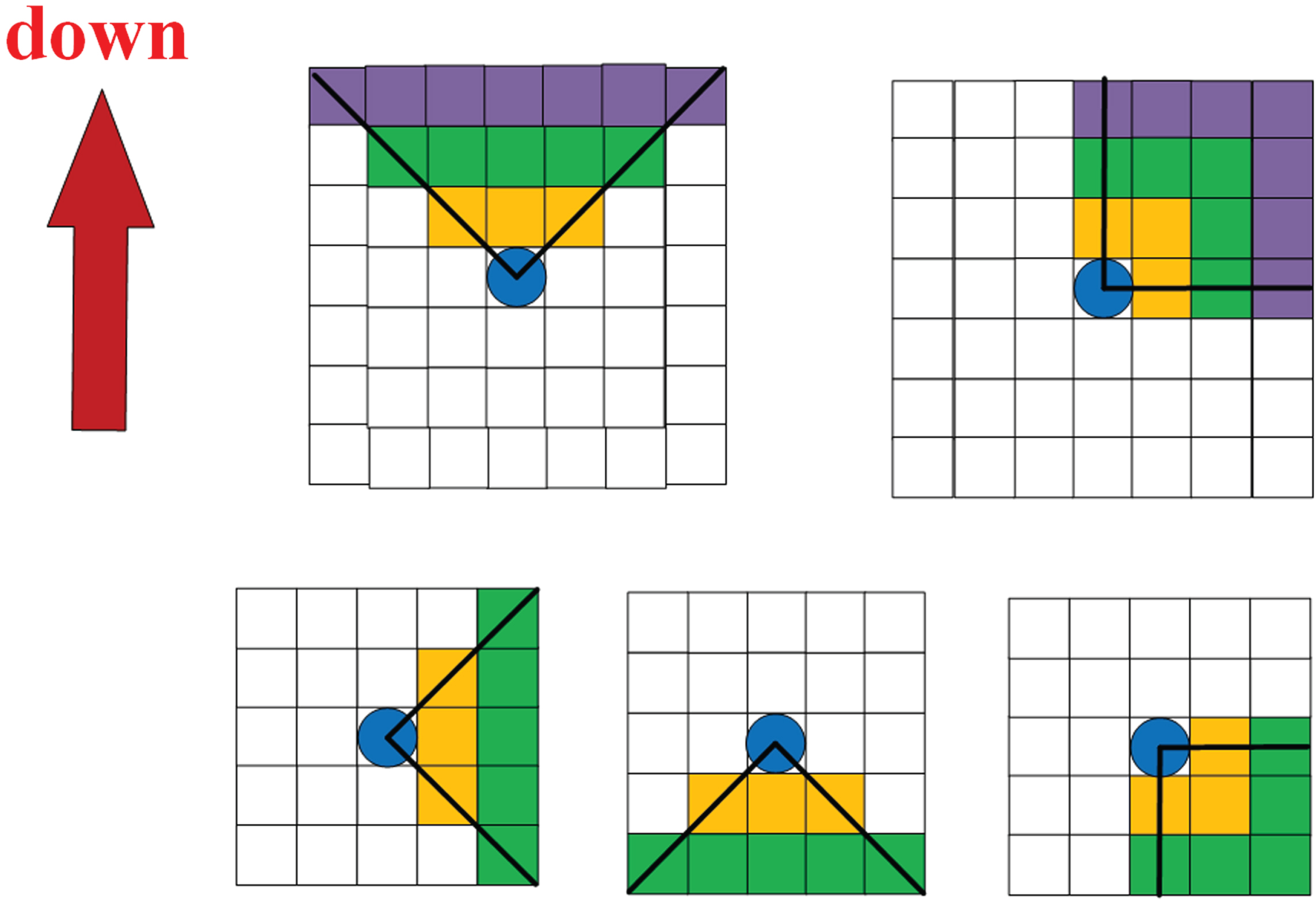
Field of view calibration chart.
This paper selects the employee dormitory of Shandong Humon Smelting Group as the experimental site, so the evacuation site is rectangular, and the evacuation direction of personnel in the stairwell is to move downstairs. This paper considers the evacuation problem of people in a stairwell and improves [17] by developing the vision flowchart presented in Fig. 2-5, which adds a stairwell direction judgment scheme and the evacuees’ motion principles. This figure presents a flowchart judging the moving direction of the people in the direction of going down the stairs. It involves the following judgment steps:
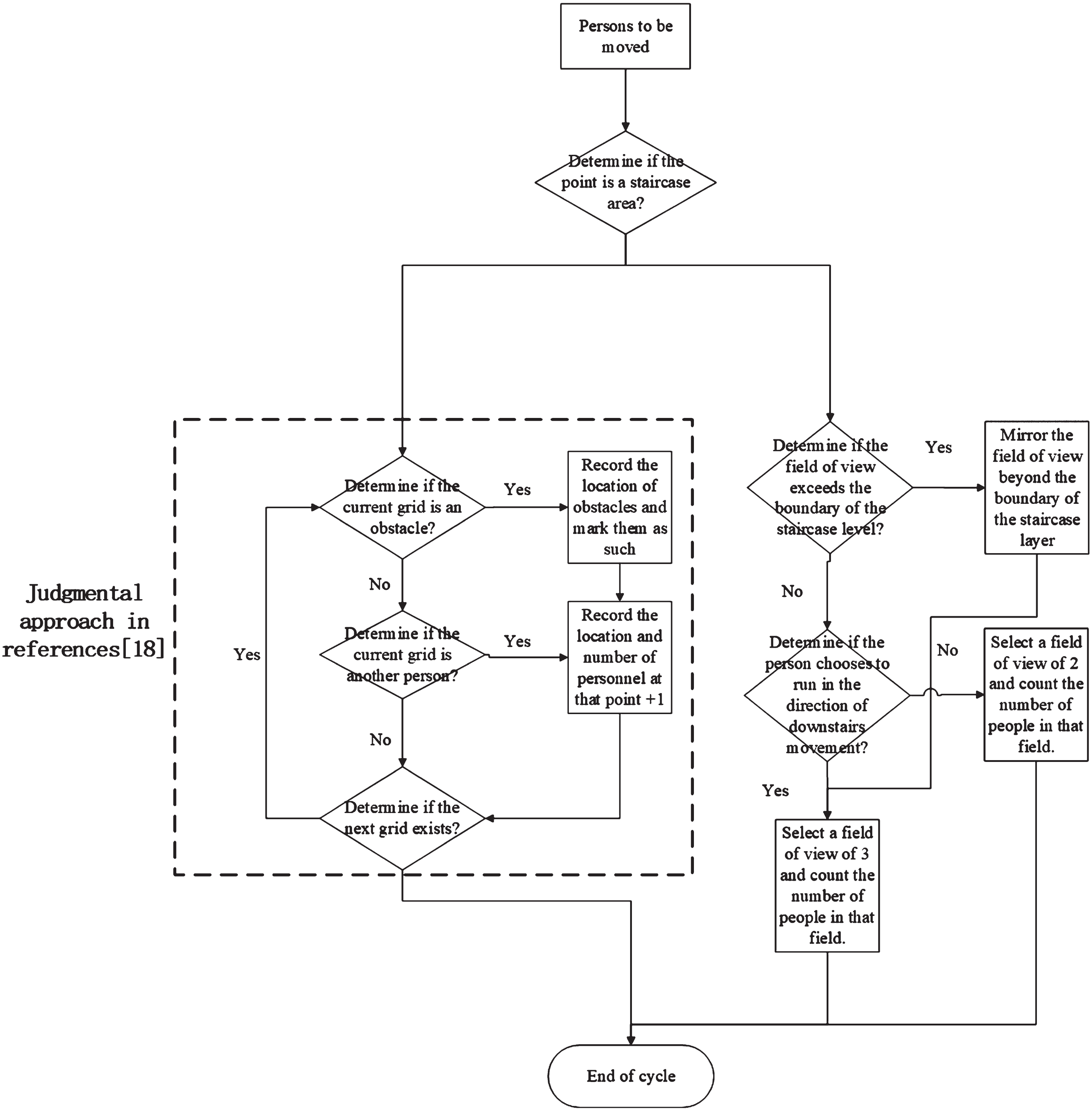
Judgment Flow Chart.
Record the exit center point position coordinates (X1,Y1). Record the evacuee’s starting position coordinates (X2,Y2). Record the neighbor coordinates (X3,Y3) of the direction in which the person is about to move. Determine whether X1 equals 1 or the length of the experimental site. If it is equal to 1 or the length of the rectangular experimental site, calculate |X3-X1|, |X2-X1|. The direction is downstairs if |X3-X1|-|X2-X1|<0. All other cases involve other directions. If neither X1 equals 1 or the length of the rectangular experimental site, determine whether Y1 equals 1 or the rectangular experimental site’s width, and calculate |Y3-Y1|, |Y2-Y1|. If |Y3-Y1|-|Y2-Y1|<0, it is the downstairs direction. Otherwise, it is another direction.
The mirror rules in Fig. 2-5 are as follows. Due to the limitations of cellular automata and social force models, the new model adopts a 2D format for visual presentation, but the field of view in the stairwell is considered from a 3D perspective, as depicted in Fig. 2-6.
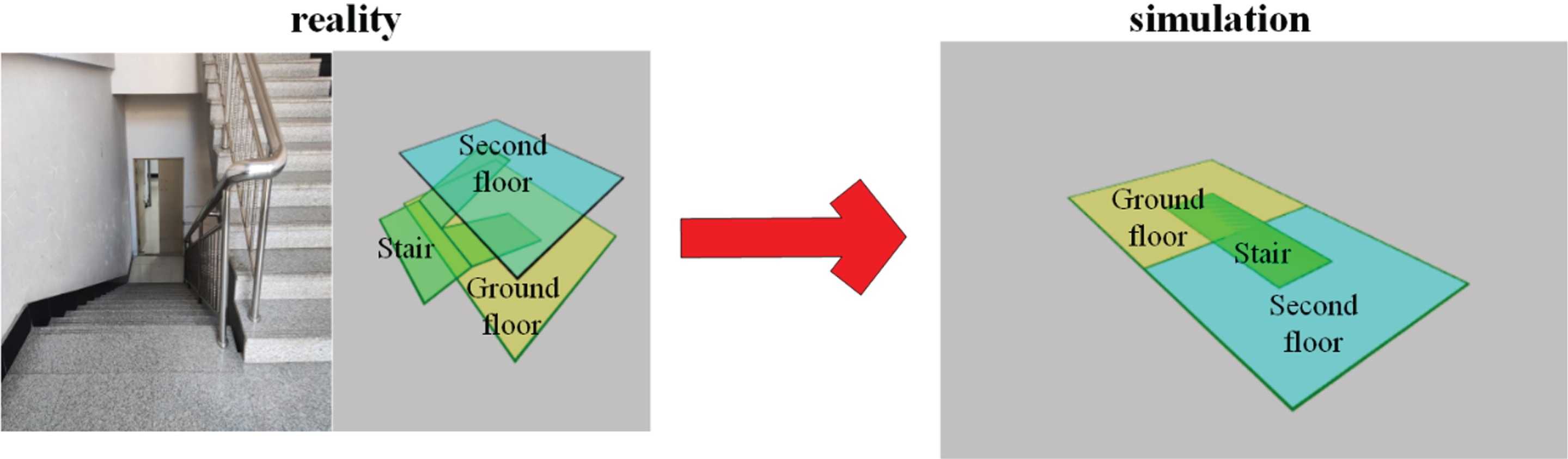
Staircase simulation diagram.
In order to better express the field of view in 3D situations, this paper further formulates the following rules for evacuating personnel. The red arrows in Fig. 2-7 represent the direction of personnel evacuation movement, as highlighted in Circle 1. This paper divides the staircase into two parts, representing different areas. When the evacuating personnel is at the stairwell, the phenomenon presented in circle 2 in Fig. 2-7 will occur, which observes the situation of personnel moving from one staircase to another. That is, when the field of view of the evacuee exceeds the staircase boundary (this article defines the boundary of the staircase as the right side of the second-floor staircase, and the other boundary is the wall). As illustrated in circle 3 in Fig. 2-7, this article refracts the field of view of green personnel (those whose field of view exceeds the staircase boundary) in one area to another area and transmits the information they see to the green personnel. However, when the boundary is a wall, refraction cannot occur. Therefore, this article specifies the following rules:
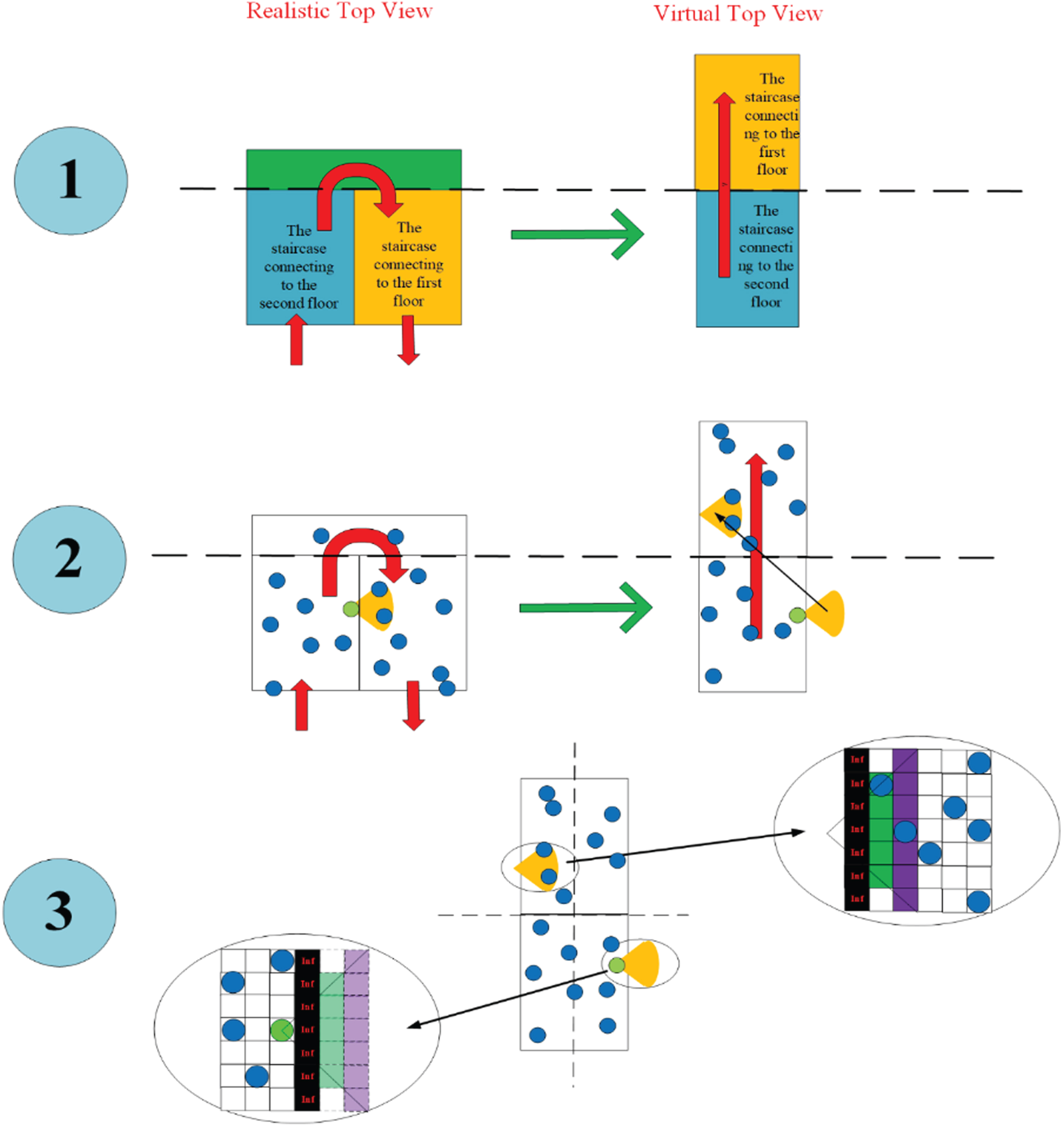
View Mirror Rule Chart.
Determine if the evacuees are in the stairwell connected to the second floor. If so, proceed to the Step 2. If evacuees are not present, perform normal movements inside the stairwell.
Determine whether the field of view exceeds the boundary of the staircase layer (this article sets the boundary of the staircase layer to be on the right side of the second-floor staircase and the left side of the first-floor staircase). Define the coordinates of the area beyond the field of view (x e , y e ). The coordinates of the boundary of the staircase layer are (xinf, yinf). Since looking from the second-floor staircase to the first-floor staircase is a top-down view, the limit of the personnel’s field of view is defined as 3. If |x e - xinf| ⩽ 3 or |y e - yinf| ⩽ 3 so, proceed to Step 3. Otherwise, execute the original method of collecting information within the scope of the field of view.
Determine whether the coordinates of the view beyond the first floor are within the range of the first floor. This article sets the width d one and the length of the first floor l one , l one > d one , as well as the width d sone and the length of the first-floor staircase l sone . As illustrated in Fig. 2-8, proceed to Step 4 if |x e - X1| > d one or |y e - Y1| > d one occurs. Otherwise, the area beyond the visual range will be treated as an obstacle.
Mirror the area beyond the field of view to obtain the mirror coordinates (x ne , y ne ). If, Y2 - y c = - d one then x ne = x e - d sone , y ne = d one - |y e - d one |; If Y2 - y c = d one , then x ne = x e + d sone , y ne = d one + |y e - d one |; If X2 - x e = - d one , then x ne = d one - |x e - d one |, y ne = y e - d sone ; If X2 - x e = d one , then x ne = d one + |x e - d one |, y ne = y e + d sone .
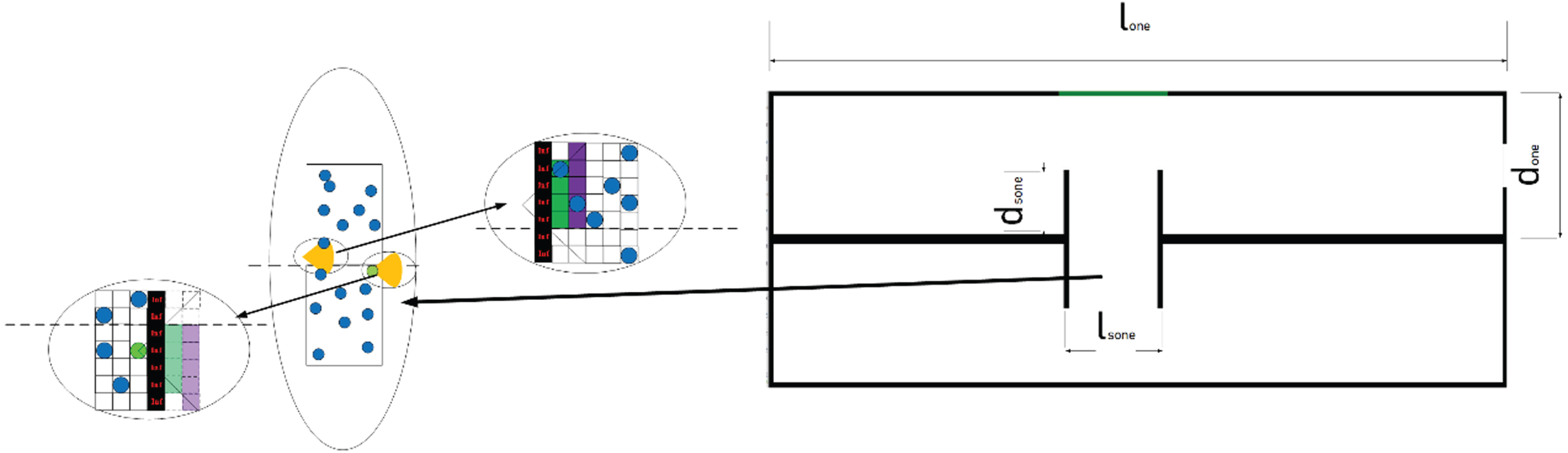
Field of view Boundary Rule Diagram.
In case of toxic gas leakage problems in chemical enterprises, evacuating people to a safe area within a limited time is the focus of such enterprises. Therefore, this paper simulates and executes real evacuation for the Shandong Humon Smelting Co under different building conditions, as illustrated in Fig. 3-1. This article selects three internal staircase design buildings that comply with the Code for Fire Protection Design of Buildings (GB50016-2006). In order to reduce the impact of building size on evacuation, this work limits the size of the three buildings and selects an area of 36 m to 12 m for activities. The distribution of building stairs and exits is presented in Fig. 3-2, where the three building types are named Building 1, Building 2, and Building 3. Figure 3-2 presents the 36×12 m site model. We rely on the metacellular automata as the experimental model, which is a 2D model, so the 3D stairs are converted into the 2D domain. In this paper, the floor of the two-story building and the stairs are tiled. In order to better study the new model, we chose the attributes of the stairwell related to gravity, i.e., the angle and the width of the stairwell, and studied their effect on people’s evacuation. This paper considers a default stair width of 3.2 m and an angle of 34°.
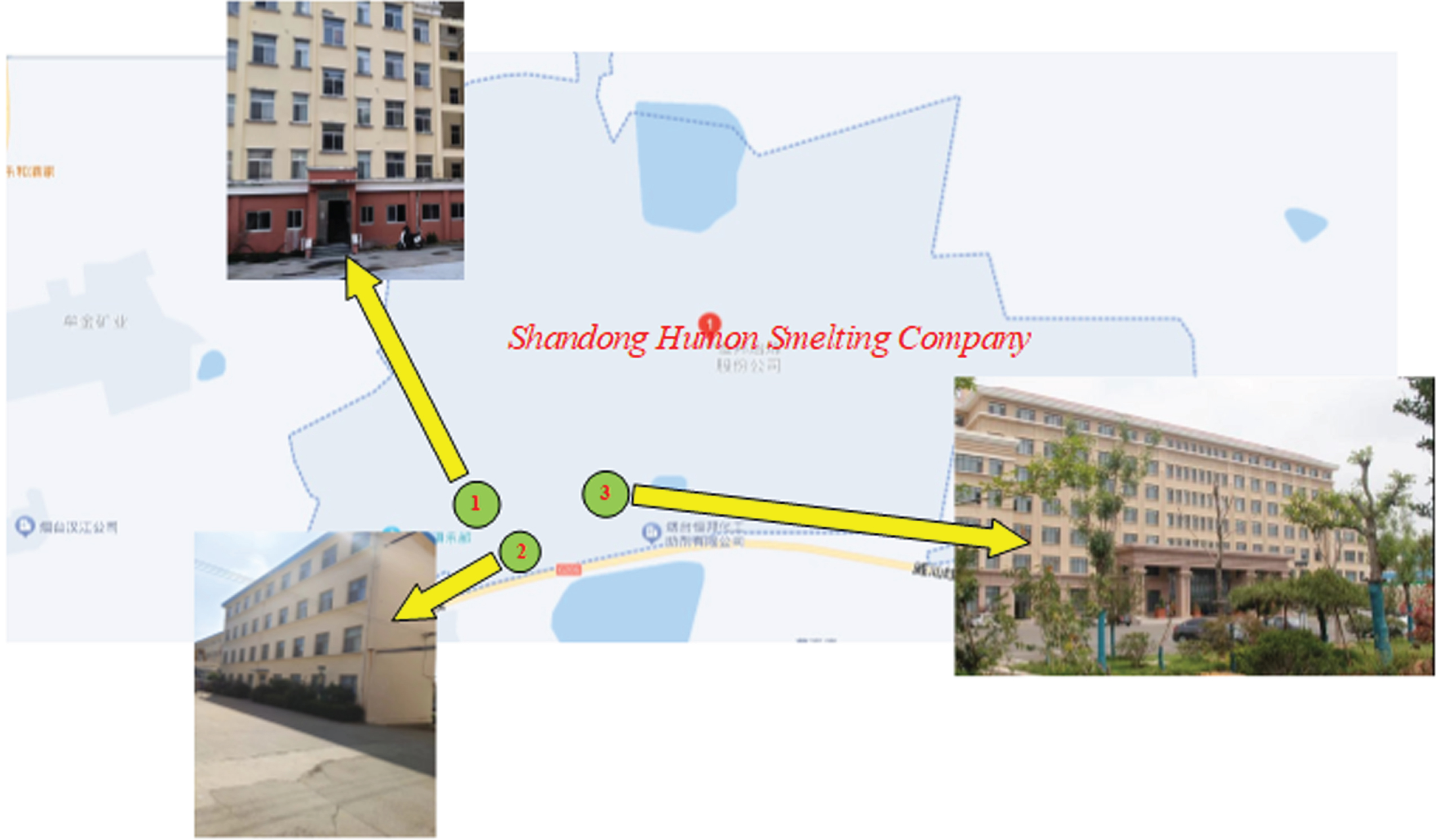
Humon Smelting Co. staff dormitory.

Simulation of the simulation field map.
The proposed model improves the personnel evacuation model based on vision changes. Thus, we compare our model against the original on the evacuation time and personnel density. Regarding evacuation time, we improved the experiment’s randomness by randomly selecting 20 to 120 employees in the factory and randomly distributing them on the first floor of the staff dormitory and the two floors, respectively. Figure 3-3 presents the evacuation time of the two competitor methods for 20, 40, 60, 80, 100, and 120. The results highlight that the proposed model has a similar evacuation time to the real situation, while the old model has a longer evacuation. Therefore, the new model is more realistic compared to the old one.

Evacuation Time Comparison.
In order to verify the applicability of the new model in different situations, this paper compares the real evacuation data of buildings with different internal staircase designs, as shown in Figs. 3 and 4. The graph shows that the new model is almost similar to the real evacuation data regarding evacuation time, so it can be concluded that the new model is more realistic.
We further investigate our method’s performance from the perspective of personnel density, with Fig. 3-5 revealing differences between the old and our simulated personnel density heat map. Specifically, the improved model has a sparser stairwell personnel motion because adding gravity to simulations allows the evacuees to move faster and safer toward the exit. Thus, combined with the quicker evacuation presented in Fig. 3-3, adding gravity makes the new model more realistic than the old model.
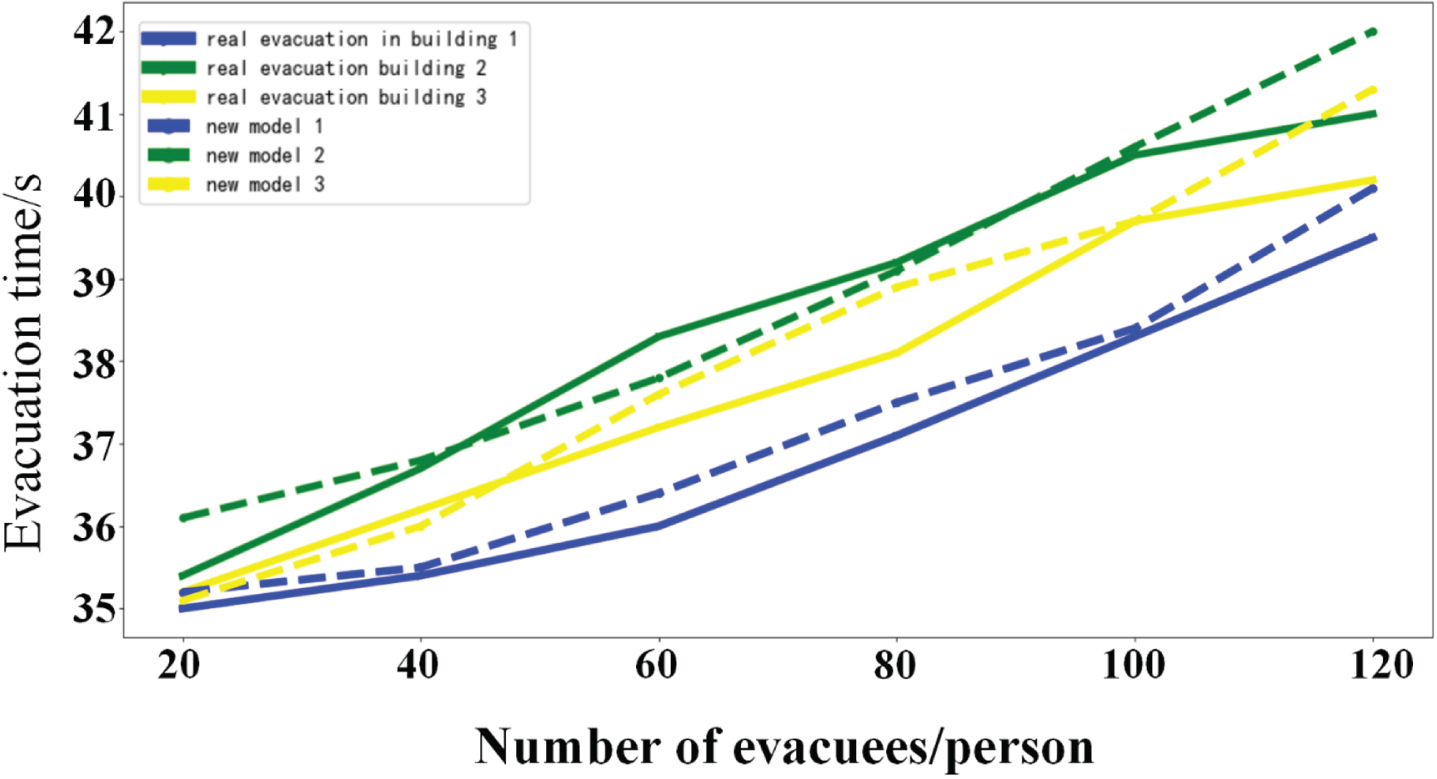
Comparison of time under different buildings.

Heat map of personnel density between new and old models.
Secondly, this article compares and studies the new and old models from the traffic perspective. The figure shows that the staircase exit is chosen as the traffic statistics point. Then, the number of people moving per second at this point is counted, and the statistical results are presented in Fig. 3-6, which highlight that the peak flow of the new model at the staircase exit is higher than that of the old model and appears earlier. Therefore, when the flow rate at the staircase entrance is the same, the density of personnel in the stairwell of the new model is less. Hence, more people are flowing towards the exit, allowing for a faster evacuation (Fig. 3-3). Therefore, adding gravity makes the new model more realistic than the old model.
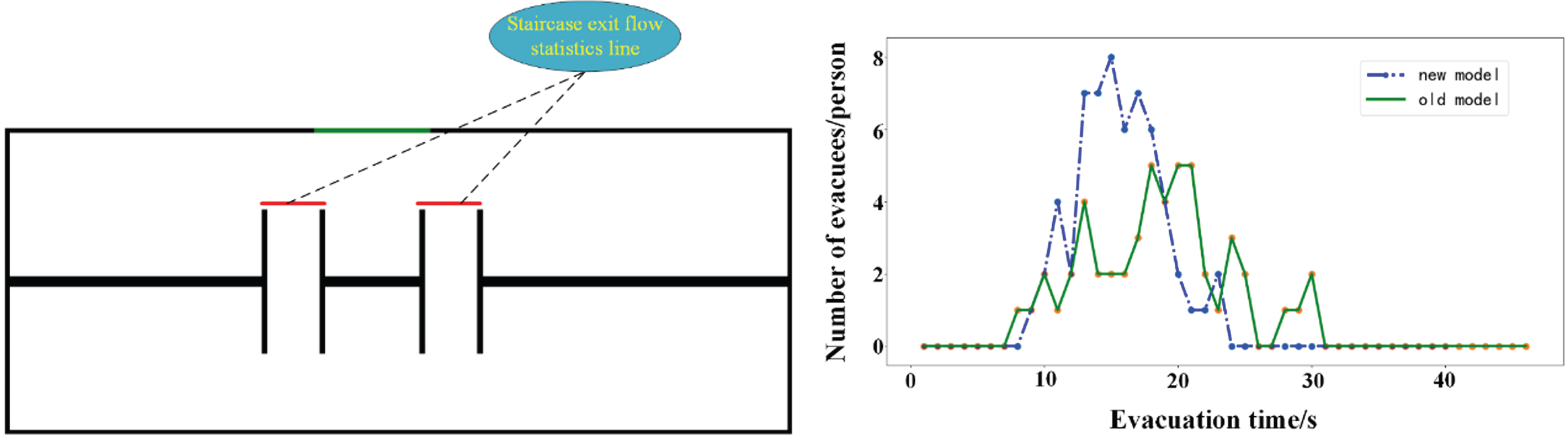
Personnel evacuation flow chart.
According to the Chinese standard GB 50009-2012 Code for Structural Loading of Buildings and the design description of the stairwell angle in the Code for Fire Protection in the Design of Public Buildings (GB 50045-95), this paper chooses 28° 38° as the research angle. The corresponding evacuation time of the people under different angles is depicted in Fig. 3-7, which reveals that when the stair angle is fixed, the evacuation time increases as the number of evacuees increases. Additionally, when the number of evacuees is fixed, and the stairwell angle is less than 34°, the evacuation time decreases as the stairwell angle increases. Accordingly, when the stairwell angle exceeds 34°, the evacuation time stabilizes as the stairwell angle increases. In order to investigate this phenomenon in depth, we statistically analyze the evacuees’ running speed in the stairwell under different stairwell angles by recording the evacuees’ speed when they pass through the stairway exit, and we take the average value. The corresponding statistical results are presented in Table 3-1, which infers that for an angle less than 34°, the evacuees’ running speed increases as the stair angle increases, allowing them to reach the exit and reduce the evacuation time quickly. When the angle exceeds 34°, as the angle of the stairs increases, the stairwell personnel’s running speed is unchanged to reach the evacuees’ speed limit, which is about 1.1 m/s, and preserve the evacuation time. The reasons for this phenomenon can be explained from two aspects: Model construction: Due to adding gravity to the model, as the angle of the stairs increases, the force of gravity in the direction of moving downstairs will increase, accelerating the speed of pedestrian movement and reducing evacuation time. Experience during evacuation: When the angle of the stairs increases to 34°, the model takes into account the force generated by pedestrians to prevent falling, which hinders the increase in pedestrian tilt acceleration, thereby allowing pedestrians to reach the speed limit for evacuating personnel, and the evacuation time remains almost unchanged.
Hence, the optimal staircase angle for the building is 34°. Selecting the optimal evacuation angle through the model can not only improve the overall safety of the building but also provide building designers with a staircase angle design standard that is suitable for the actual evacuation situation of the building.
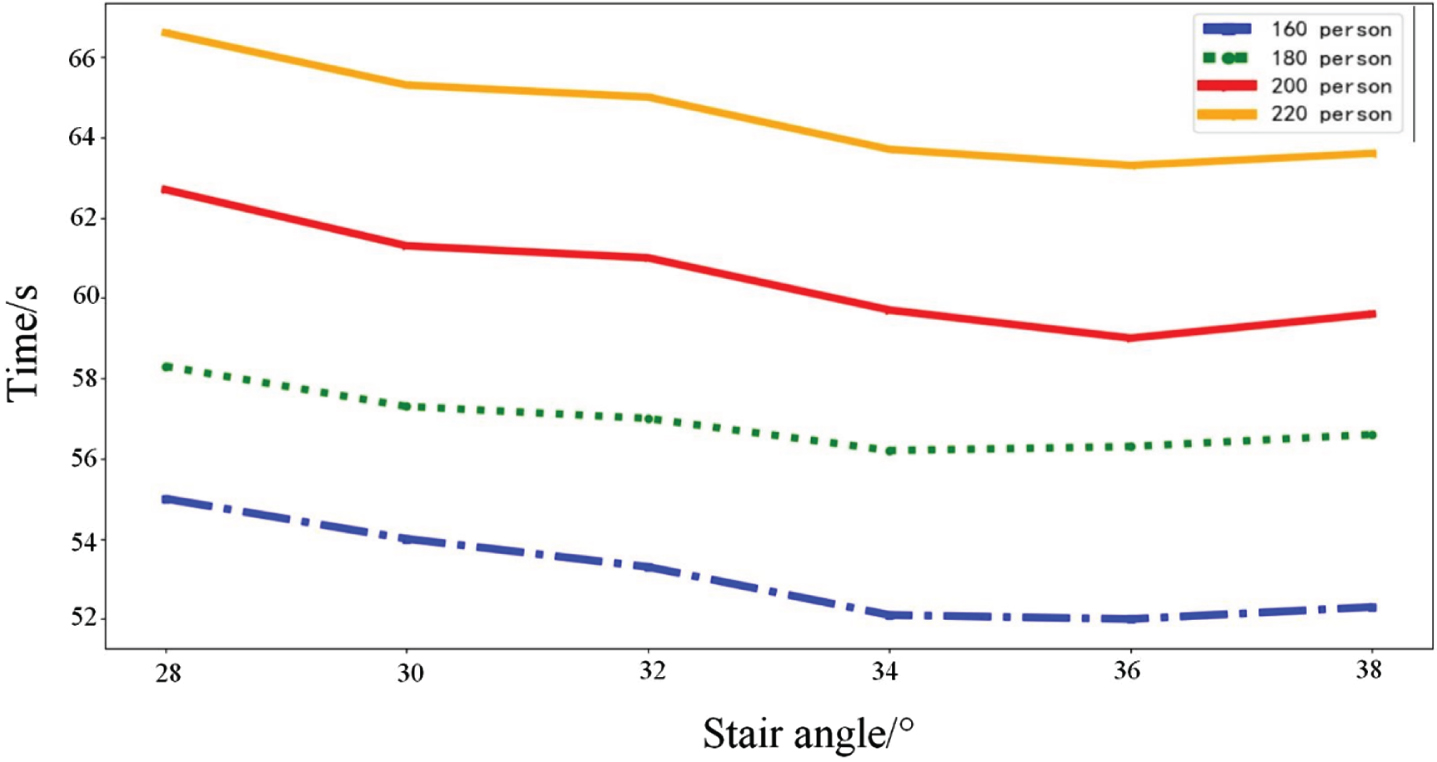
Stairway Angle vs. Evacuation Time.
Velocity statistics for people in stairs
We also investigate how the stairwell width impacts the evacuation of personnel by evaluating different stairwell widths and the number of people during the evacuation time. According to “GB 50009-2012 Building Structural Load Specification”, the stairwell width should exceed 1.4 m, so this paper evaluates a stair width of 1.6 m, 2.4 m, 3.2 m, 4.0 m, 4.8 m, and 5.6 m. Additionally, the number of people residing on the staff dormitory’s first and second floors ranges between 160 and 220 people.
The statistical results are depicted in Fig 3-8, which suggests that for a fixed stair width, the evacuation time increases as the number of evacuees increases. When a certain number of people evacuate the building, increasing the width of the stairs decreases the evacuation time, and after some point, it tends to stabilize. Besides, as the stair width increases, the evacuation time depends on the number of evacuees. For the simulation experiment presented in this paper, when the number of personnel is between 160 and 220 and the width of the staircase is equal to 1.6 m, the evacuation time is relatively large for any number of people. Therefore, choosing a staircase width of 1.6 m is not advisable. When the evacuation involves more than 160 people, which is a common situation in the scenario studied, people are squeezed onto the stairs. When the width of the staircase is equal to 4 meters, we found that the evacuation time of personnel begins to stabilize, so the optimal evacuation width for the building is 4.8 m.

Stair Width vs. Evacuation Time.
Furthermore, we employ the evacuation density map presented in Fig. 3-9 to explain this phenomenon, where the green triangle corresponds to the heat map with the smallest width. The evacuation time tends to stabilize when the density of the stairwell is lighter in color and there is almost no red or orange area. The reason why the evacuation time tends to stabilize is that as the width increases, the density of personnel during evacuation does not change, leading to the following two factors that make the evacuation time tend to stabilize: Personnel stress: As the stairs increase, the personnel density remains constant, and the interaction forces between people also tend to stabilize, resulting in a smaller change in personnel stress and less change in speed, leading to a more stable evacuation time. Conformity psychology: As the stairs increase, the density of people remains constant. The model shows that the number of people within the field of view does not change much, so conformity psychology has almost no impact on evacuation. Therefore, the probability of pedestrians choosing the correct evacuation direction is the same, so the evacuation time is the same.
Hence, at this time, the stairwell width does not affect the evacuation efficiency, and there is no need to expand the width to reduce the evacuation time. However, as the number of evacuees increases, the width of the stairway increases when it reaches redundancy. This phenomenon helps builders choose the correct staircase width when considering personnel evacuation. Overwidth staircases may occupy too much space, leading to overall architectural design waste. However, models can determine the maximum width of staircases for personnel evacuation and reduce design waste.

Personnel Density Plot for Different Stair Widths and Number of Persons.
This paper improves the evacuation model using visual field changes and develops a new model considering gravity’s influence. However, applying gravity creates a 3D problem to be solved, which we transform into a 2D problem. Additionally, this paper investigates the influence of the angle and width of the stairs on people’s evacuation and concludes the following: The new model is closer to the actual evacuation time than the original, non-improved model due to the addition of gravity. Hence, the new model is more realistic. When the number of people is fixed, and the stairwell angle is less than 34°, the evacuees’ running speed increases as the angle increases, which speeds up the evacuation process and reduces the evacuation time. However, when the stairwell angle exceeds 34°, the evacuees’ running speed reaches a limit of about 1.1 m/s, and even if the angle increases again, the speed remains unchanged. Thus, the evacuation time will not change. Therefore, determining the optimal evacuation angle of a building through an improved model can help provide building designers with a staircase design angle that is conducive to personnel evacuation, as long as the staircase design allows. Under a fixed stairwell width, the evacuation time increases as the number of evacuees increases. When the number of evacuees is fixed, the evacuation time decreases as the width of the stairwell increases and tends to stabilize due to the redundancy of the stairwell width. Providing reasonable staircase width for architectural designers to avoid redundancy in staircase width construction and use redundant staircase space for more meaningful building construction. This article establishes an evacuation model that considers changes in the field of view due to gravity. Although it performs well in handling the evacuation of personnel in stairwells, there are still many complex influencing factors, such as psychology and behavior during the evacuation, and the new model itself has high plasticity. Therefore, the new model will focus on addressing evacuees’ psychological and behavioral aspects and addressing the forces that individuals experience during the evacuation process due to other factors, as future research directions. In future work, we will also focus on 3D image imaging as one of the key areas for model improvement.