



Abstract
The constant development and application of new technologies, such as big data, artificial intelligence and the mobile Internet, have profoundly changed the personal and professional spheres. Despite these advances, finance professionals are still faced with a multitude of routine, repetitive and error-prone tasks. At the same time, they are challenged by the shift to management accounting, resulting in reduced productivity. This paper addresses these issues by introducing a financial statement filing robot developed using Robotic Process Automation (RPA) technology. The application of this robot has been shown to provide superior efficiency and accuracy, reduce the heavy burden of routine tasks, and facilitate a smooth transition to management accounting practices. In addition, this research provides a valuable reference for the application and diffusion of RPA technology in the financial sector. Given the large amount of text data generated by financial processes, this paper proposes an automatic text categorization model. The effectiveness of the model is demonstrated as a response to address the challenges encountered in the consultation and archiving process. This contribution informs the development of text categorization robots tailored to the needs of finance professionals.
Introduction
The rapid development of big data, artificial intelligence, mobile Internet, cloud computing, and the Internet of Things is making the world an era of “interconnected, ubiquitous, virtual-real, intelligent computing, open sharing” [1]. The development of new technologies, especially the Robotic Process Automation (RPA) technology, innovates financial technical tools, and changes the financial work mode, bringing in the era of digital intelligent management. RPA, as an intelligent software, independently runs pre-set business processing rules, simulates and enhances the interaction between users and computer systems, automatically executes a series of specific workflows and tasks, and integrates people, business, and information systems [2]. RPA robots are capable of data collection and input, file upload and download, image recognition and text processing, data processing and analysis, process management and monitoring, information output, and feedback. It has the characteristics of human-machine collaboration and symbiosis, non-invasive business collaboration, simulated manual operation and interaction, low error rate, compliance, security, reliability, and low code development. With the advantages of low cost and high efficiency, it is user-friendly to operate and requires little IT background [3]. The global impact of COVID-19 has forced companies to use the automation technology [4]. Today, more than half of large companies have applied the RPA technology [5, 6]. The application of financial robots began with RPA [1, 7, 8]. In 2017, the Big Four accounting firms, Pricewaterhouse Coopers (PwC), Deloitte Touche Tohmatsu (Deloitte), KPMG, and Ernst & Young (EY), successively launched RPA financial robots. The advent of the Kingdee financial robot marked a key step on the road to financial automation and intelligence in China, changing the traditional work mode, and promoting the process of China’s financial transformation [9–13]. Dobrica’s RPA technology for robots simulated and automated human-user interactions in applications by using software robots to perform regular and repetitive business process tasks. The research results indicated that the proposed method effectively automated robots [12]. Through the research, it is found that finance has used financial robots in the specific business process of income and expenditure, but so far it has not been applied in the financial statement filing process. In order to improve work efficiency, reduce the burden from work, and promote the transformation to management accounting, a financial statement-filing robot using the RPA technology is developed in line with the realities of work and other technologies. Meanwhile, an automatic text classification method through theoretical research is also put forward. The contribution of this paper mainly lies in the following aspects: The application scope of RPA in the financial field is expanded. The overall framework for the development of the financial statement filling robot is designed and the development process of the overall framework is elaborated, providing a reference for the development of other RPA financial robots. Aiming at the large amount of text constantly generated by the use of robots, an automatic text classification model is proposed, and its effectiveness is proved, which solves the difficulty of archiving, and provides a reference for the development of text classification robots. The Uipath financial robot and the UiBot financial robot are respectively used for comparison and verification, which promotes the use of the Uipath robot in China.
With the development of technologies, the efficiency of all industries has been improved to varying degrees. However, due to the security, economic, and practical reasons of new technologies, there are still serious problems in financial work. First, a large number of financial personnel engage in basic financial work. Second, it takes financial personnel a large amount of time to do simple and repetitive financial work. Third, the work efficiency is very low. Thus, there are two financial problems that need to be solved urgently. New technical tools are used to replace the basic financial work, improve work efficiency, and save time and energy for financial personnel, for example, the financial statement filing mentioned above. A large amount of data needs to be saved by financial personnel. However, with the passage of time, the financial system functions slowly and ineffectively, so it is imperative to have automatic classification with the help of new technical tools. For example, there will be numerous “payroll forms”, “balance statements” and “balance sheets” produced, which costs a lot of time to consult or manually classify and file.
Business process of financial statement filing
Financial statements refer to the accounting statements reflecting the funds and profits of enterprises or budget organizations for a certain period, and the declaration of financial statements is also an obligation that enterprises and institutions must undertake. In accordance with the relevant provisions of the Administrative Measures for the Submission of Financial and Accounting Statements of Taxpayers formulated by the State Taxation Administration, taxpayers shall prepare and submit financial and accounting statements in accordance with the requirements of the Accounting Standards for Business Enterprises, whether with or without taxable earnings, income and other taxable items, or during the period of tax reduction or exemption. Monthly declaration of financial statements by enterprises and institutions takes time and has high error rates. Institution A is taken as an example, the declaration process is as in Fig. 1.
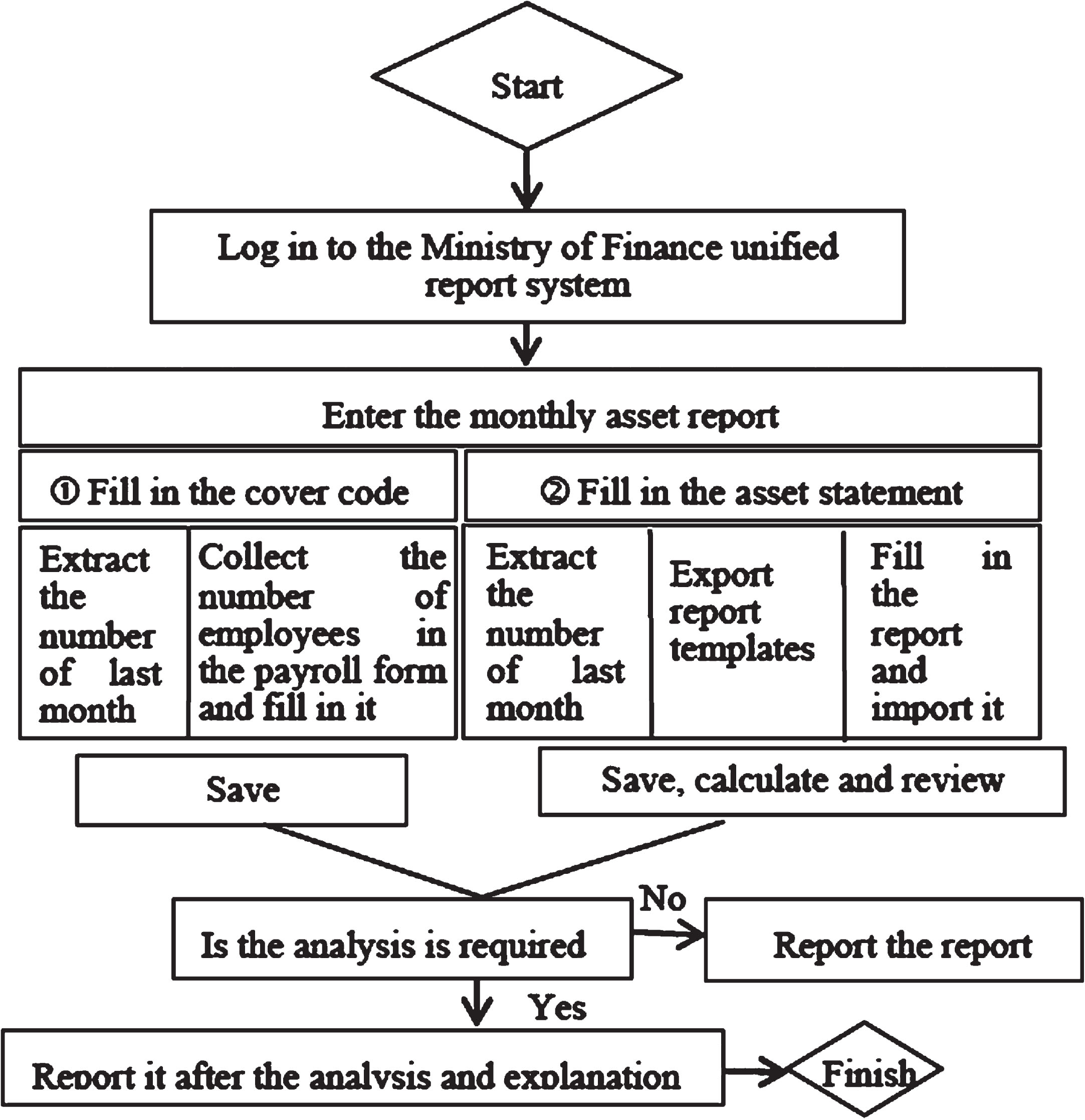
Declaration process of financial statement filing.
As in Fig. 1, the application process for filling out financial statements first involves logging into the unified reporting system of the Ministry of Finance and inputting monthly asset reports into the system. For asset reporting, the process begins with entering the cover code, extracting numbers from the previous month, and gathering employee payroll figures. Subsequently, the asset report is completed by extracting the previous month’s numbers, exporting the report template, filing out the report, and importing it. Following specified requirements, the need for analysis is determined. If analysis is not required, a report is generated. Alternatively, if analysis is necessary, it is conducted and explained prior to reporting. RPA technology is an automation technology that utilizes software robots to simulate and perform prescribed tasks performed by humans in digital systems. These tasks are typically highly regimented and repetitive and involve extensive data processing and rule-following. The goal of RPA is to automate the execution of prescribed tasks in everyday business processes by simulating human operations in a way that improves efficiency, reduces errors, frees humans from tedious, repetitive tasks, and allows them to focus more on creative and strategic work. RPA technology typically involves the creation or configuring of software robots that can integrate with existing applications and systems to perform tasks such as data entry, processing, interaction, and decision making. RPA does not automate by replacing existing systems, but rather by interacting with the user interfaces of existing systems to mimic manual inputs and actions to accomplish tasks. In the finance domain, RPA technology is widely used for tasks such as processing financial data, generating reports, and performing account reconciliations to improve the efficiency and accuracy of financial processes. The advantage of RPA technology is that it can be rapidly deployed without modifying existing systems, thus providing a relatively low-cost and efficient automation solution. There are two types of RPA financial robots: attended and unattended [4]. Unattended robots operate independently batch processes without human intervention and perform operations around the clock. Attended robots need humans to initiate the execution of automated processes through a program (such as clicking on a button), and additional human-computer interaction is required at different time points in the process. As the data needs to be analyzed in the unified report system of the Ministry of Finance, the attended robot is adopted for financial statement filing.
Framework development overall function design
According to the above requirements and business processes of the financial statement filing robot, the overall framework for the development of the financial statement filing robot is designed. The framework functions mainly include an initialization module, data analysis module, implementation module, etc. The framework development functions are as in Fig. 2.
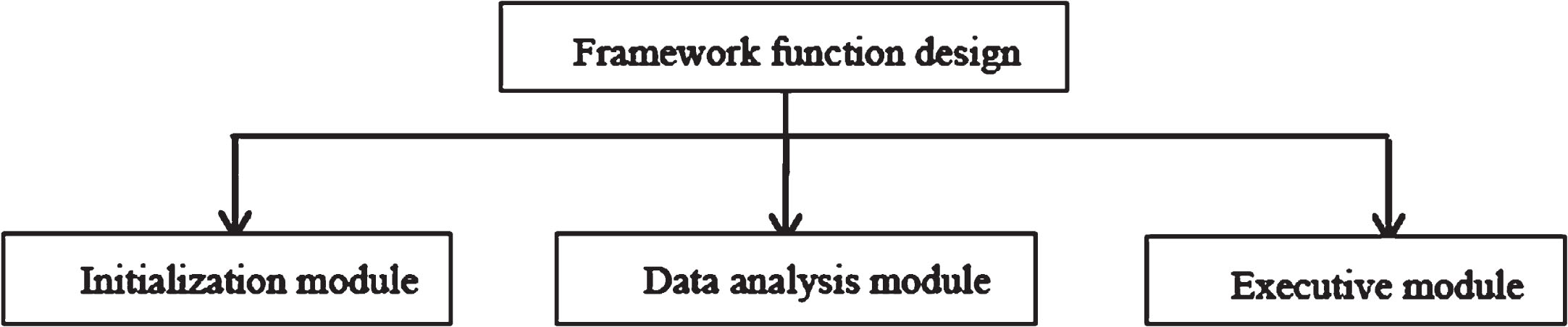
Framework development function design drawing.
As in Fig. 2, the functional design of the framework encompasses an initialization phase that primarily focuses on defining the configuration file. This file serves as the database, aiming to streamline operations for enhanced simplicity. The data analysis module contains two functions: data acquisition and data analysis. After obtaining the data information from the configuration file, analyze and apply it, and finally execute the command. The configuration file includes the project ID, name, summary and other information, and uses the following VBA code.
Chinese and English switching VBA code:
Sub Language_En_Click()
Sheet1.Shapes(“Language_En”).OLEFormat.Object.Value = True
Sheet1.Shapes(“Language_Ch”).TextFrame.Characters.Text = “Chinese”
Cells(2, 1) = “Setting File”
Cells(4, 2) = “Item” Cells(4, 3) = “Value” Cells(11, 2) = “Item”
Cells(11, 3) = “Value(Production)” Cells(11, 4)= “Memo(Production)” Cells(11, 5) = “Value(Test)” Cells(5, 2) = “ProcjectID”
Cells(6, 2) = “ProcjectName” Cells(7, 2) = “ExecutionMode” Cells(8, 2) =“ProductionFlag” Cells(12, 2) = “Mail send to” Cells(13, 2) = “Log path”
End Sub
Within the development tool, the initial step involves opening RPA to generate a new project. Subsequently, project details such as the name and storage location are entered, followed by clicking “Create” to initiate the creation process. The overall flow of the framework is shown in Fig. 3.
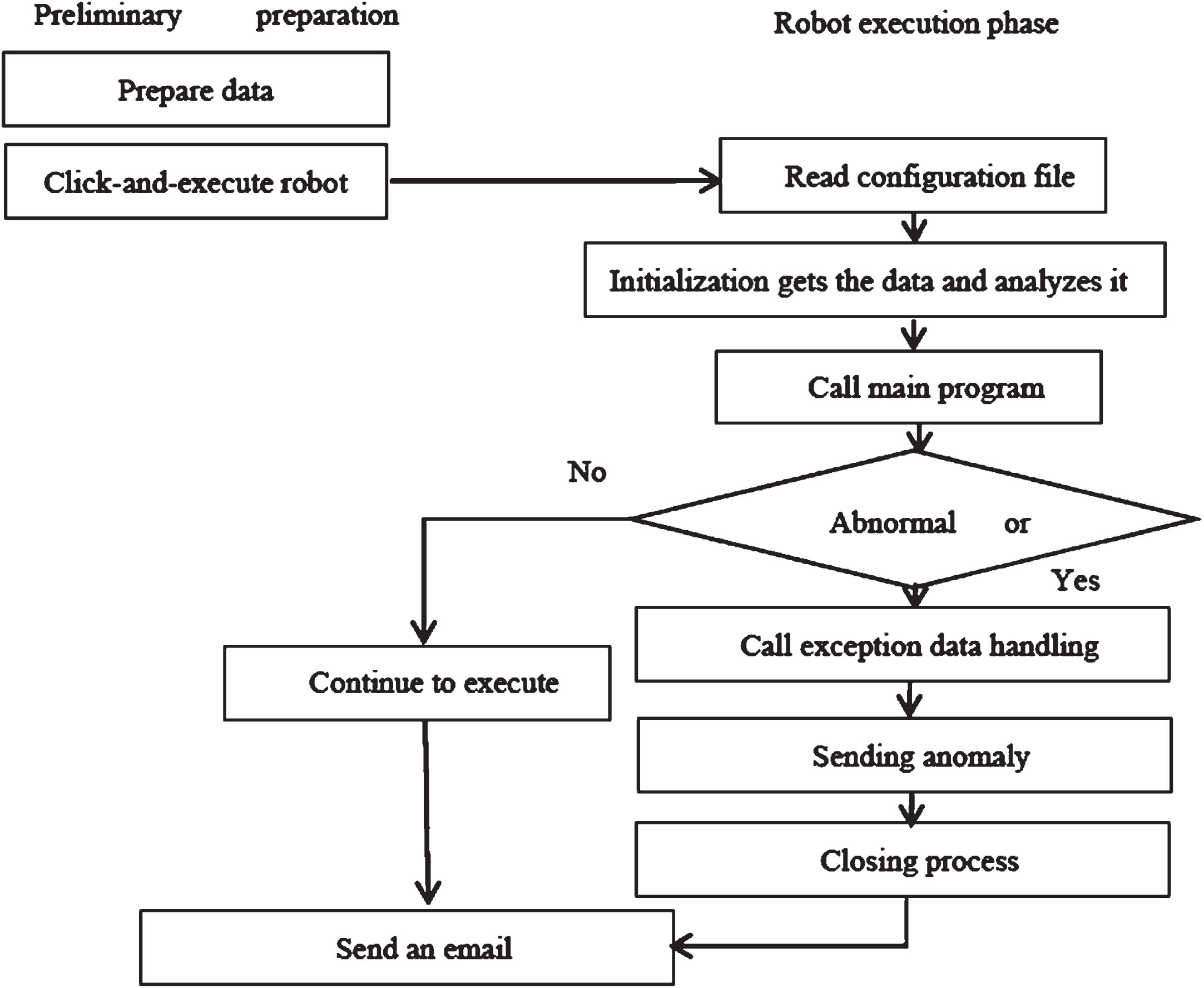
Overall flow chart of framework development.
As in Fig. 3, the first step is to prepare the data and click on the execution robot. By reading the configuration file, the data is initialized and analyzed, and the main program is called to detect anomalies. If there are anomalies, the abnormal data is processed and an exception reminder is sent. Finally, the process is closed and information is transmitted via email. If there are anomalies, the abnormal data is processed and an exception reminder is sent.
According to the overall process of framework development and the specific business process of financial statement filing, the specific business course of the development framework of financial statement filing robot is designed. The specific business processes for framework development are as in Fig. 4.
As in Fig. 4, the data is first prepared and clicked on the execution robot to initialize the acquisition of the data and analyze it by reading the configuration file, and then logging into the Uniform Reporting System of the Ministry of Finance and entering the monthly asset report into the system. To generate the asset report, the initial step involves filing in the cover code to extract figures from the previous month. Concurrently, the number of employees in the payroll is collected and entered. Subsequently, the asset report itself is completed by extracting the previous month’s figures, exporting the report template, filing it out, and importing it. Based on specified requirements, the need for analysis is determined. If analysis is not necessary, the report is exported. However, if analysis is required, it is conducted, interpreted, and then included in the report. Finally, the report is sent via email.
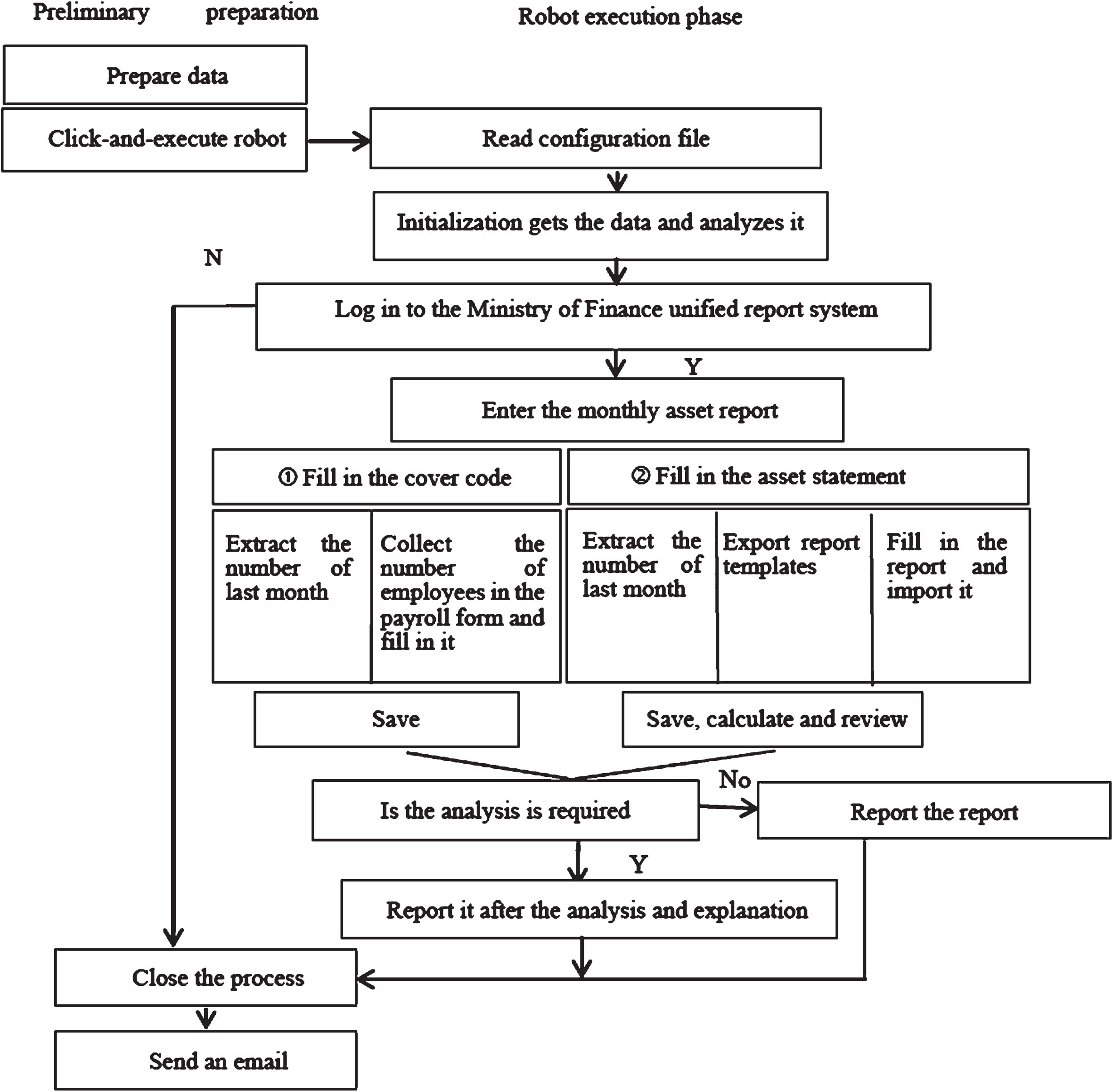
Specific business flow chart of the framework development.
Application object
In order to verify the effectiveness of the RPA financial robot studied in financial statement filing, this paper chooses institution A as the application object. Institution A as a university needs to log in to the unified report system every month to fill in the number of employees and the status of assets manually by the financial personnel, which is time-consuming and error-prone.
Verification method
Application results comparison table
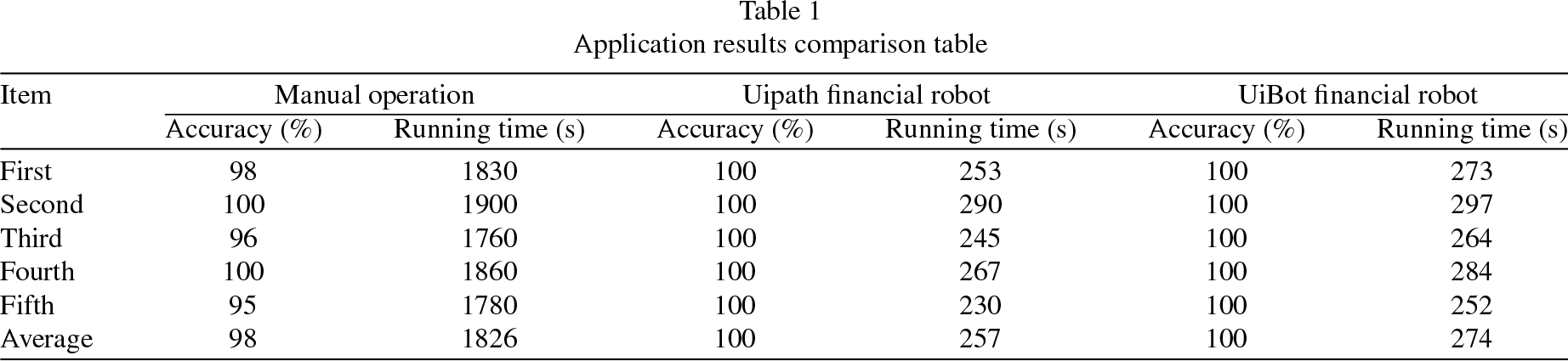
Application results comparison table
In this paper, a comparative verification method is adopted to compare the Uipath financial robot, UiBot financial robot, and manual filing. UiPath and Uibot are popular RPA software at present. In terms of the penetration rate of RPA products in enterprises, Uipath is the automation product with the highest penetration rate, reaching 45% [14, 15]. This paper uses PRA software Uipath Community edition to develop. UiBot is a robot process automation tool used in RPA. It is a software and work process automation solution for companies and individuals. It can replace manual software and platform or tedious, tedious, repetitive and mass operation in the computer. UiBot software is a process automation platform developed by domestic technology companies in 2019. It is developed according to Chinese habits and also has a free version, so it is also widely used in China.
According to the financial statements to fill in the specific circumstances of the business, the text takes the accuracy and the time of the running time as the verification criteria. In order to ensure the accuracy of the results, when the RPA financial statement robot fills in the report, it needs to eliminate the errors caused by the development factors through repeated tests. After several experiments, it was found that the trend of the experimental results was basically the same. To ensure the economic efficiency of the experiment, five runs of data were selected, and then the average value was taken.
Application results
The financial statements for Unit A in October 2022 are completed in three steps, each involving data entry without submission. (see Table 1). In addition, a completion diagram of the Uipath financial robot is as in Fig. 5. The completion diagram of one of the UiBot financial robots is as in Fig. 6.

Screenshot of the completion of declaration by the Uipath financial statement filing robot.
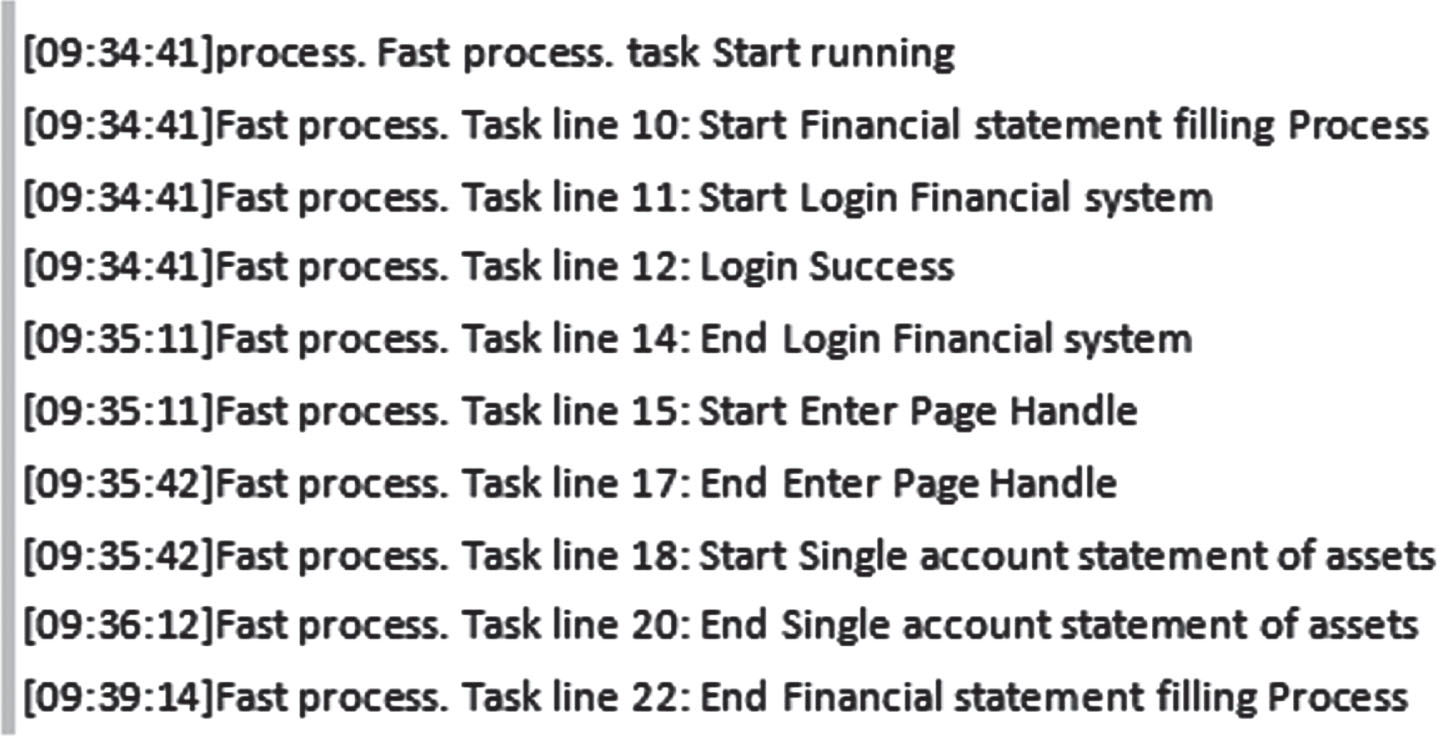
Screenshot of the completion of declaration by the uibot financial statement filing robot.
Figure 5 shows a screenshot of the Uipath Financial Statement Filing Robot completing the filing.
Figure 6 represents a screenshot of the UiBot financial statement filing robot completing the filing.
In summary, the following results are achieved by using the financial statement-filing robot: Fast and efficient. RPA financial robot has fast execution speed and high efficiency, which solves the problems of time-consuming and error-prone manual input. According to the performance of the financial statement filing robot of the above-mentioned university in October 2022, whether Uipath financial robot or UiBot financial robot, the accuracy is 100%, the running time is 257 seconds and 274 seconds respectively, while the manual operation takes 1826 seconds, the accuracy is 98% . It can be seen that the RPA financial statement filing robot has high accuracy and improves the work efficiency by about 7. The operation efficiency of the Uipath finance robot is slightly higher than that of the UiBot finance robot. According to the institution’s financial statement, the operation efficiency of the Uipath financial robot is slightly higher than that of the domestic UiBot financial robot when the business process is not particularly complicated, which provides a reference for the promotion and application of the Uipath financial robot.
The use of the financial statement-filing robot saves a lot of time and energy, and improves efficiency. However, there is a large number of texts produced over time, which cost a lot of time to consult or manually classify and file. In the paper, three methods for theoretical automatic text classification are summarized: Term Frequency-Inverse Document Frequency (TF-IDF), an algorithm based on statistics to measure the importance of a feature word to the text [16–18]; N-Gram [19], a probabilistic language model based on n-1 order Markov chain, which has been widely used in text recognition, speech recognition, information retrieval and other fields; Naive bayes classifier (NBC) [20–24], a simple and populous automatic text classification model based on the Bayes classification model.
Although simple and easy to understand, TF-IDF is almost invalid when the text is short, and it could not get valid key information if each word appeared only once in the text. N-Gram saves the feature information and position information of the vocabulary, bypasses the limitations of linguistics, and extracts the potential features, and the numerical eigenvectors of this model makes the computer operation faster. However, the N-Gram is computationally large, and the probability of vocabulary is amazing for large texts. The word segmentation result of this model contains a large number of invalid feature words without any meaning, leading to a sparse matrix in computation. The Naive Bayes classification algorithm is a simple, fast, easy-to-understand, and implemented classification algorithm, which is suitable for high-dimensional data and large-scale datasets, and is insensitive to missing data, and its classification efficiency is relatively stable. Therefore, NBC was adopted for the automatic text classification.
As a statistical classification method based on the Bayes theorem, NBC is also a generative model that directly models the joint probability p (x, c) to obtain the target probability value. C is the category variable, x1, x2,..., and xn are the category attribute variables. NBC adopts the “attribute conditional independence assumption”, which means that each attribute independently affects the classification results. P(C = c|X = x) can be recorded as P(c|x), and NBC is expressed by the formula below:
In formula (1), n is the number of attributes, x
i
is the value of x on the i-th attribute. As p (x) is the same for all categories, MAP can be changed to:
In formula (2), the prior probability p(c) and the posterior probability p (xi|c) are the target parameters. When using Laplace estimation, in order to ensure that no zero frequency attribute leads to a probability value of an attribute of zero and avoid underestimating the probability, the formula of the prior probability p(c) is:
In formula (3), n is the number of training datasets. c
i
is the class tag for the i-th training instance. The posterior probability p (xi|c) is:
In formula (4), x ij is the j-th attribute value of the i-th instance. The value of the j-th attribute in the test instance is x j , δ (x,y) is a binary function. The function value is 1 if the two parameter values are equal, and 0 if they are unequal. For the selection of features, this study focuses on three aspects. Firstly, it involves extracting specific vocabulary features related to the financial field, such as financial indicators, company names, industry terminology, etc. Then there are text length features, which are length related features such as the number of characters and words in the text. Finally, there are grammatical structural features, namely the position of noun phrases, verb phrases, etc. in the text.
Experimental data
Due to the confidentiality of financial data and the limited number of samples available for selection, this article selected the EDGAR Database (https://www.sec.gov/edgar) from the United States Securities and Exchange Commission. (see in Table 2).
Text partition diagram

Text partition diagram
The experimental procedure are as in Fig. 7.
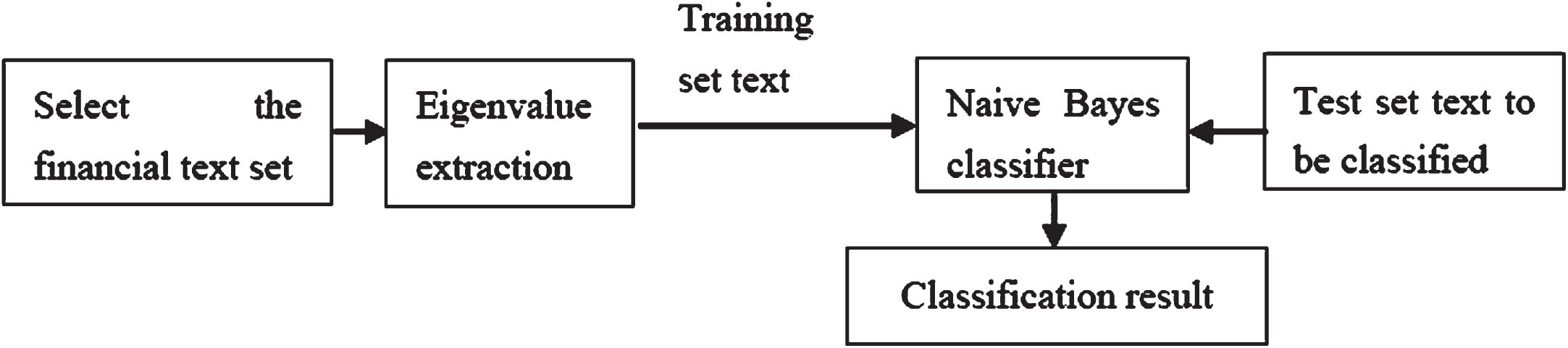
Financial text classification experiment step diagram.
From Fig. 7, the experimental steps for financial text categorization are as follows: Extract feature words The feature words of the training set text are sent to the NBC to train the classifier model. The trained NBC is used to classify all the texts to be classified and tested. Experimental result
The classification results are as shown (see in Table 3).
The financial text classification experimental results table

The financial text classification experimental results table
From the experimental results, the classification accuracy of three different categories of texts achieved more than 90%, which verified the reliability of the financial text classification method of the naive Bayesian classifier model. The accuracy of the algorithm model on three different text sizes is as in Fig. 8.

The accuracy of the algorithm model on three different text sizes.
From Fig. 8, it can be seen that the model performed well in terms of classification accuracy for three different texts, with an average accuracy fluctuating around 0.8. The experimental results showed that the proposed method achieved good classification performance in different sizes and types of text, and its generalization ability and robustness performance were good.
With the rapid development of technology, the application of automation technology in various industries has become a key factor in driving efficiency and business process optimization. RPA technology is an automation technology that uses software robots or “robot workers” to simulate and perform prescribed tasks performed by humans in digital systems. In the finance domain, RPA technology is widely used for tasks such as processing financial data, generating reports, and performing account reconciliations to improve the efficiency and accuracy of financial processes. This research utilizes RPA technology to develop a financial statement-filling robot. The application proves to be efficient and accurate, reducing the workload and facilitating the transition to management accounting, as well as providing a reference for the application and promotion of RPA technology in the financial field. A comparative validation method is used to compare the Uipath financial robot, the UiBot financial robot and manual filling. The experimental results showed that the average accuracy rate of manual reporting was 98%, and the average time spent was as high as 1826 s. The average accuracy rate of the Uipath financial robot reached 100%, and the average time spent was 257 s. The average accuracy rate of the UiBot financial robot reached 100%, and the average time spent was 274 s. The reason for this situation is that the UiPath financial robot is capable of automating a wide range of financial tasks and processes, can adapt to different financial tasks and processes, and provides rich automation capabilities covering common data entry, processing, decision-making, and reporting tasks in financial processes. This enables finance robots to automate tedious, repetitive tasks, thereby increasing efficiency.
Conclusion
Based on actual financial work, a financial statement-filing robot using RPA technology is developed, and the application speaks volumes of its high efficiency and accuracy. It reduces the burden of financial work and promotes the transformation to management accounting, it also provides a reference for the application and promotion of RPA technology in the financial field. In view of the large quantity of texts produced, this paper puts forward an automatic text classification method and proves its effectiveness, which would provide reference in developing text classification robots for financial personnel. This research expands the application of RPA in the financial field. The general framework for the development of the financial statement-filing robot is designed, and the development process of the general framework is described, which provides a reference for the development of other RPA financial robots. Aiming at the large amount of text constantly generated during the use of the robot, an automatic text categorization model is proposed, and its effectiveness is verified, solving the problem of difficult archiving and providing a reference for the development of text categorization robots.
Funding statement
This research was supported by the Science and Technology Research Program of Chongqing Municipal Education Commission, China (Grant No. KJQN202202810).