



Abstract
Prefabricated buildings (PBs) are a new type of building construction, which are less time-consuming and cause low environmental pollution and resource consumption. They play an important role in industrialized construction and clean production and have gained worldwide attention. However, the high construction costs have become a major obstacle to their popularity and application. This study investigates the factors influencing construction costs of PBs in China using a systematic literature review (SLR), fuzzy interpretive structure modeling (fuzzy ISM), and the Matrice d’Impacts croises-multiplication appliqué an classment (MICMAC) technique. First, 32 influencing factors were identified from the SLR. Second, out of which 16 critical factors were selected and mapped in a hierarchical model through semi-structured interview screening, and the MICMAC technique was used to classify the cost-influencing factors of PBs into different categories. The results revealed that all identified factors played pivotal roles in various capacities and influenced the cost of PB construction. This study may assist administrators and policymakers in better understanding the factors that influence the costs of PBs construction to manage and reduce them.
Abbreviations:
Introduction
As an important industry in a national economy, construction plays a vital role in driving the economic growth of any country [1]. However, the slow and inefficient traditional construction industry exerts enormous pressure on the environment, social security, and sustainable development [2], generating 40% of construction waste [3, 4], consuming 32% of resources, and producing 40% of greenhouse gases [2]. Dust in the vicinity of construction sites seriously affects the health of the local residents [5]. Prefabricated buildings (PBs) are characterized by energy conservation, low carbon emissions, and high efficiency, and are gaining increasing global attention as they play an important role in the development of green and energy-efficient buildings [6, 7].
PBs have the essential characteristics of design standardization, production standardization, and construction assembly [8]. Furthermore, PBs are a sustainable production method that save, reduce emissions, and produce clean and eco-friendly construction products [6, 7]. Cao et al. [9]. reported that the use of PBs reduced resource consumption by 35.82%, ecosystem damage by 3.47%, and energy consumption by 20.49% compared with traditional on-site construction. Cao et al. [9]. have analyzed the current advantages and shortcomings of PBs in China using the available literature, and reported that the use of prefabricated components reduced the amount of wood formwork, water consumption, and construction waste by 87%, 70%, and 30%, respectively. Hong et al. [10]. discovered that PBs can also be recycled to save energy by 16% –24%, while the energy consumption in the entire life cycle of the PBs can be reduced by 4% –14% . Moreover, PBs are well-established and extensively used in several developed countries, accounting for > 80%, >20%, >9%, and > 2% of the total constructions in Sweden, the Netherlands, Germany, the United Kingdom, and Japan, respectively [11]. PBs were introduced in China in the 1950 s [12, 13]. In recent years, the Chinese government has introduced several policies for the rapid development of PBs, including guides on the vigorous development of PBs (https://www.gov.cn/gongbao/content/2016/content_5120699.htm">https://www.gov.cn/gongbao/content/2016/content_5120699.htm">https://www.gov.cn/gongbao/content/2016/content_5120699.htm). In 2020, China had 630 million square meters of new PB areas, increasing by 50% compared to 2019, accounting for 20.5% of new floor space and exceeding the target of reaching > 15% of PBs by 2020 (https://www.mohurd.gov.cn/gongkai/zhengce/zhengcefilelib/202103/20210312_249438.html). Currently, the Chinese government is actively promoting PBs and increasing policy support to reach 30% of the new building areas by 2025 (https://www.gov.cn/xinwen/2022-02/09).
PBs are an effective means to achieve cleaner production in the construction industry; their increasing application in China has gained the attention of the academic community and several studies are being conducted on them. Higher construction costs remain the biggest obstacle to developing and promoting PBs [14], with prefabrication costs being 10–20% higher than on-site construction costs [15]. Wu et al. [6] explored the factors influencing technology diffusion and cleaner production in PBs. Zhang et al. [16] selected six key factors for assessing the limitations or constraints to PB construction. Hong et al. [17] have developed an analytical framework to investigate the cost components of the PBs by comparing the cost gap observed between prefabricated and traditional construction, which enabled to understand the drivers of increased cost of prefabricated components. Gan et al. [18] used an interpretative structural model (ISM) to explore the interrelationships among barriers to adopt off-site construction in China, which provided valuable information to policymakers regarding the overall structure of barriers. Xue et al. [19] only explored the factors affecting the construction cost of assembled buildings in China, but they are not conducive to effectively controlling construction costs.
In summary, numerous studies have been conducted to analyze the challenges, barriers, and drivers for developing PBs in China from different perspectives and have achieved constructive results. However, there are still some limitations that need to be further addressed. First, the presence of multiple participants in the engineering, procurement, and construction processes of PBs lead to confusion in management. Second, the high construction costs limit their development. Finally, several factors influence the construction costs and have complex interactions among themselves. Therefore, we used engineering–procurement–construction (EPC) contracts to consider PBs as a single entity, using fuzzy ISM and Matrice d’Impacts croises-multiplication appliqué an classment (MICMAC) techniques and further stablished the priority of different influencing factors, which can help experienced main contractors to effectively control the costs at all stages of the PBs construction process. The four major contributions of this study are as follows: (1) As a new management modeling of the design, procurement, and construction of assembly buildings, the critical influencing factors for the construction cost of PBs in China under EPC contracts were determined through systematic literature review (SLR); (2) The hierarchical structure and relationship between different influencing factors of PBs construction costs were revealed through the Fuzzy ISM model; (3) The MICMAC technique was used to calculate the driving and dependent forces of critical factors and classification analysis was conducted to provide valuable references for stakeholders to understand the priority of factors affecting the cost of PBs, reasonable allocation of resources, and ways of cost-reduction; (4) Countermeasures and suggestions for cost control of PBs in China under EPC contracts are presented. The remainder of this paper is organized as follows: Section 2 reviews the factors affecting the construction costs of PBs in terms of engineering, procurement, and construction. Section 3 describes the research methodology. Section 4 discusses the results. Section 5 provides the conclusions and proposes optimization strategies for the direct influencing factors of construction costs of PBs in China.
Literature review
PBs are buildings in which prefabricated components are produced in a factory, after which the complete or semi-components are transported to the building site and are assembled on-site [10, 20]. The high cost of construction is the main obstacle that restricts its development [14]. The primary objectives of engineering project construction are to strictly control and reduce project costs, and guarantee construction quality. Therefore, under an EPC contract, an experienced main contractor integrates and considers the design, procurement, and construction of the project in depth by the contractual agreement, which not only safeguards the quality, safety, and risks of the project but also helps to achieve lean management of the project and minimization of construction costs.
Phase of engineering
In the engineering phase, PBs have strict requirements in terms of the abilities and professional skills of designers, mainly because of the need for detailed knowledge of the traditional designs. Otherwise, design changes will be generated, resulting in unreasonable time and cost for prefabricated component manufacturers and contractors [21]. In the process of deepening the design, if the assembly rate, degree of component standardization, and splitting of components are not reasonable in the engineering stage, it will lead to reworking and increase the cost. Hao et al. [22] analyzed the cost risk factors from different stages of PBs construction and reported that the rational disassembly of prefabricated components considerably affects the engineering costs. Yuan et al. [23] reported that the design stage determines up to 80% of the operational costs of a building. Therefore, an effective design for the PBs is vital. Ye et al. [24] demonstrated that the assembly rate during the engineering stage has a relatively large influence on the cost of PBs. PBs cost somewhere between 26.3% and 72.1% more than traditional buildings [17]. Khalili’s study showed that the type of mold and turnover rate in the precast production process impact the production cost of precast components [25]. Moreover, deepening the design of PBs requires coordination and cooperation among different professions. The integrity of the multi-professional and standardized design of prefabricated components directly affects production costs [26, 27].
Phase of procurement
Procurement of PBs components mainly includes two key links: production and transportation. The prefabricated components are handled and produced by prefabricated-component factories, which are responsible for transporting the prefabricated components to the construction site. The procurement phase of prefabricated components is affected by several factors, such as management quality of the prefabricated component factory, transportation distance, transportation scheme, delivery period, and worker proficiency, which directly affect the construction cost of PBs [24]. Chang et al. [28] explored the cost-effective risk factors of PBs during transportation by constructing a loading plan optimization model, and identified transportation efficiency as a critical factor affecting PB costs during the delivery phase. Yang et al. [29] proposed an optimization algorithm for the logistics of the transportation costs of prefabricated components to reduce the scheduling costs of assembled prefabricated components. Jaillon and Poon found that the transportation cost of prefabricated components raises the initial cost [30]. Zou et al. [31] considered both transport costs and the effect of road traffic congestion, and constructed a linear programming model with the lowest integrated cost to reduce the scheduling cost of PBs.
Phase of construction
The lifting and construction of PBs is the longest phase of a project and is the most expensive. Owing to the large size of prefabricated components, there are strict requirements for the construction process and sequence, rationalized layout and mechanization of construction-hoisting machinery, and level of construction organization design and site management. Additionally, various uncertainties exist during construction that increase the cost risk of PBs [32]. Jin et al. [33] demonstrated that the construction level, maturity, and site management level of PBs are essential aspects affecting costs during the construction phase. Li et al. [34] adopted computer technology combining building information modeling (BIM) and radio frequency identification (RFID) technologies to achieve fine-tuned construction management for PBs.
The construction cost of PBs can be affected by composite factors and various factors at multiple stages. Cost control is a systematic and complex process, and most existing studies focus on different influencing factors or a particular stage. Therefore, this study evaluates the stepwise relationship between various factors affecting the construction costs of PBs in China under EPC contracts and puts forward cost control countermeasures and suggestions for main contractors, which can help further promote the development of completed buildings [19, 35]. This study is crucial in terms of research content and perspective.
Methodology
A three-step research design was followed to achieve the research objectives (Fig. 1), which are as follows: (1) Determining the research objectives: Under the EPC contracts, 16 representative influencing factors affecting the construction cost of PBs were identified and determined by SLR. (2) Fuzzy ISM model: The interrelationships between different factors were determined using questionnaires and semi-structured interviews, and a hierarchy of different affecting factors was established. (3) MICMAC technique: The drivers and dependencies of the different influencing factors were calculated according to ISM model, and the MICMAC technique was used to classify and logically rank these influencing factors.
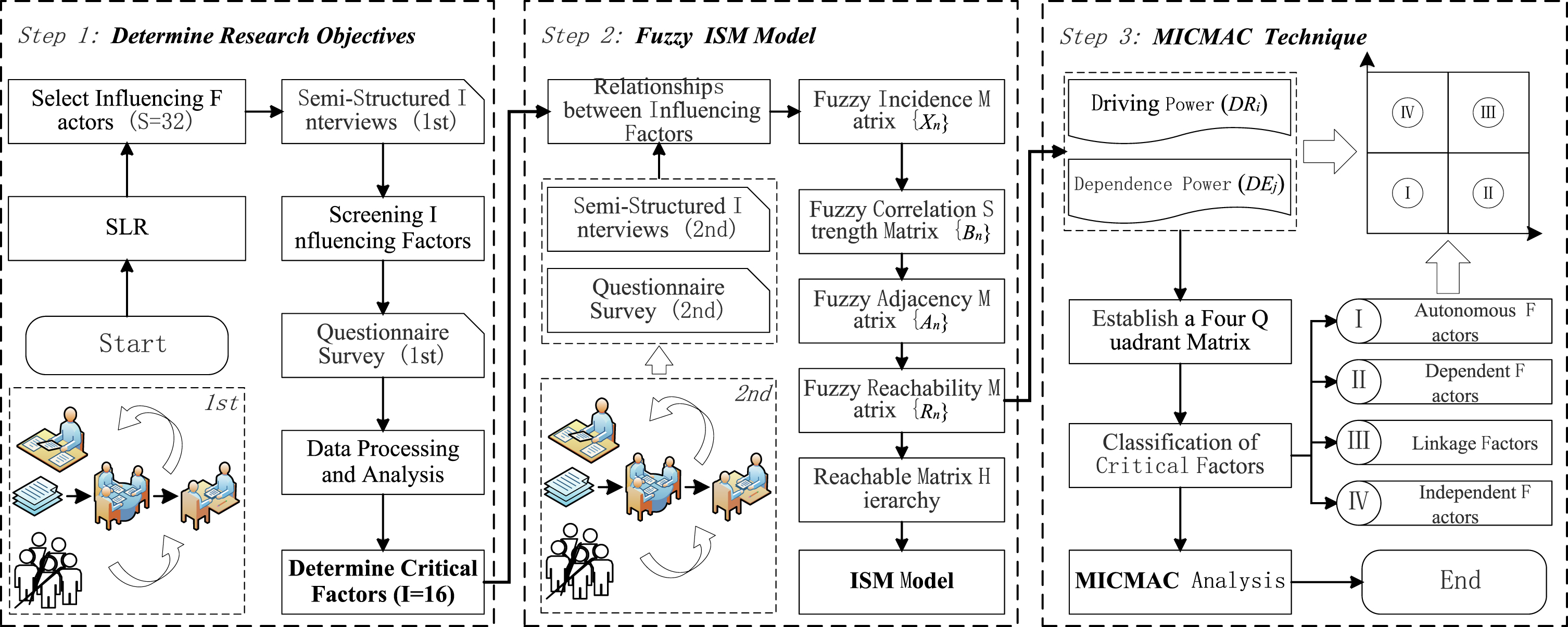
Research flow.
Three methods–systematic literature review, on-site interviews, and questionnaires–were used to objectively and effectively identify the factors affecting the construction costs of PBs. The steps are as follows: First, an SLR was performed to determine all the influencing factors. Second, semi-structured interviews were conducted to analyze the initially identified factors and select the critical influencing factors. Finally, a questionnaire was administered to validate the selected data.
Identification of initial influencing factors
Through Web of Science and Scopus, 225 relevant studies conducted in the past five years were retrieved using the keywords “assembly construction cost,” “construction cost,” and “cost control.” To ensure relevance of the retrieved literature to the subject of this study, those related to “prefabricated buildings” and “construction costs” was screened. According to the definition of the EPC contracts, 32 elements that have a significant impact on the construction cost of PBs were identified from four aspects: engineering, production-transportation (procurement), and construction (Table 1).
Preliminary identification of factors influencing the construction cost of PBs
Preliminary identification of factors influencing the construction cost of PBs
To further focus on the core issues affecting the construction cost of PBs, further filtering from the initially identified influencing factors to identify the critical influencing factors. It mainly involves the following two steps: (1) Semi-structured interviews: 12 industry professionals from different architectural backgrounds were invited to conduct semi-structured interviews, of which four were from research institutes, two were from real estate developers, four were from engineering and construction companies, and two were from design companies, and more than four professionals invited to participate in the semi-structured interviews will be considered valid [36, 37]. Therefore, in this study, the process of identifying key influencing factors is reasonable. (2) Identification of the main influencing factor: In the decision-making process, there were only two types of evaluation results, including “yes” and “no”. The former indicated that the professional believed that this influencing factor is important, and the latter indicated that this influencing factor is not important. Of these, the top three-fifths of the factors most recognized by professionals were identified as the major influences [38, 39]. Finally, a total of 16 factors were identified the main factors influencing the construction cost of PB, as shown in Table 2.
Critical factors affecting construction cost of PBs under EPC contracts
Critical factors affecting construction cost of PBs under EPC contracts
To determine whether the 16 indicators screened in Table 2 could be used as the primary influencing factors for the construction cost of PBs, we continue to use the expert consultation method to evaluate the importance of the 16 factors in Table 2 using the Likert 5-point scale method in the form of expert consultation and the distribution of questionnaires on a scale of importance from 1 to 5 [6]. In the questionnaire, “1,” “2,” “3,” “4,” and “5” indicated slightly important, important, generally important, relatively important, and very important, respectively.
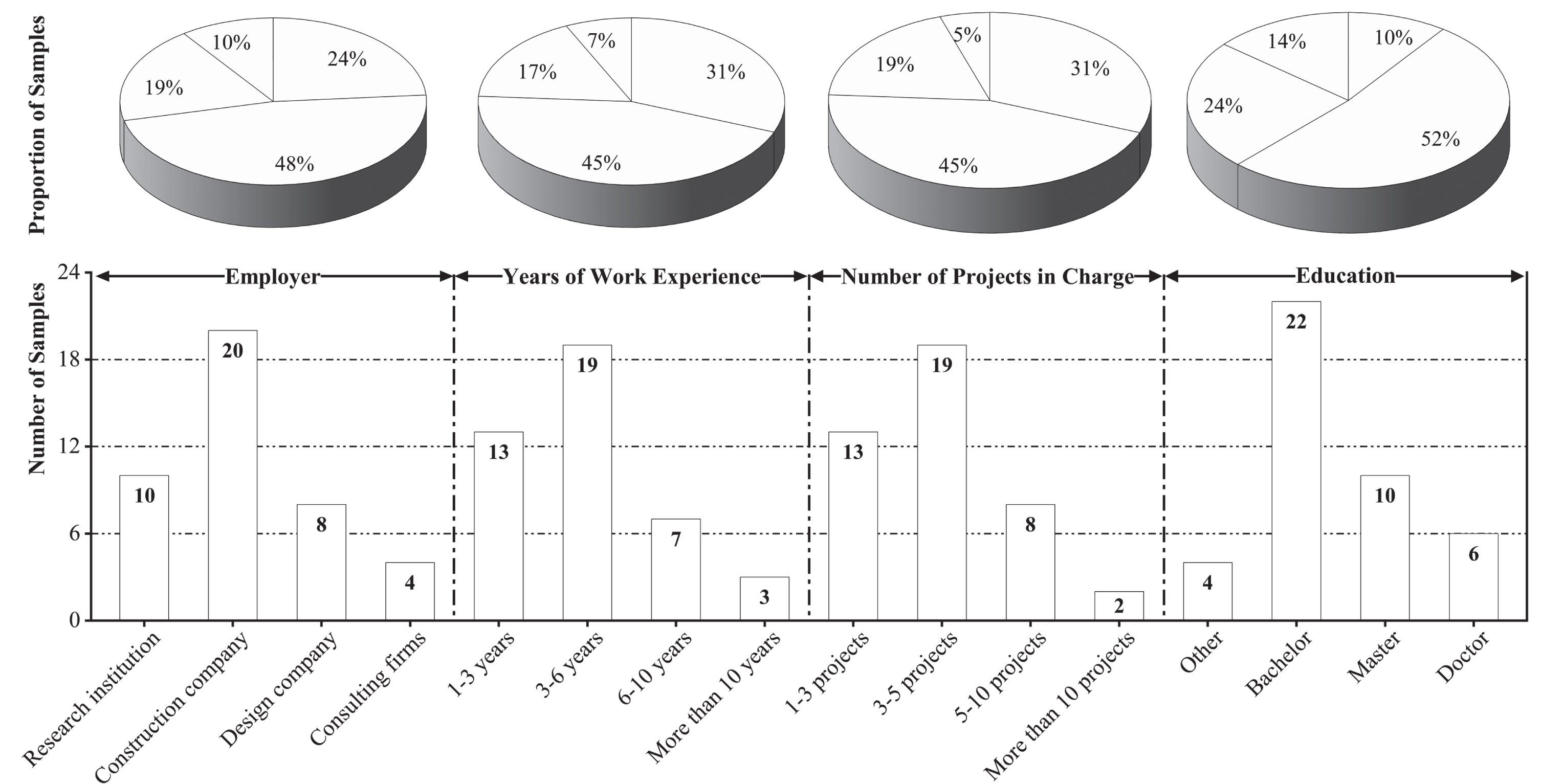
Background information on respondents.
ISM, proposed by Warfield in 1974 [47, 48], is a method to determine the interactions between factors in a complex system based on the judgments of the people working in the group, and can effectively identify the dependencies of different factors [49, 50]. Although the ISM model has significant advantages and has been used in various aspects of architecture [18, 51], it only considers the existence of relationships between system elements (The relationship is “1”; otherwise, it is “0”). Moreover, it cannot determine the strength of a relationship and is not adapted to normative, vague, and uncertain relationships that exist in the real world [52]. Therefore, fuzzy mathematics was introduced into ISM to improve it and obtain Fuzzy ISM [53]. Using this, the factors influencing the construction cost of PBs were analyzed, which avoided the subjectivity of expert scoring to some extent and made the analysis results more accurate and reasonable [54]. The steps of the fuzzy ISM are as follows.
The interrelationships between the factors influencing the construction cost of assembled buildings were determined according to the findings of the questionnaire and semi-structured interviews and X n = (a ij ) n×n of the influencing factors was obtained, where a ij is the association strength between two influencing agents.
B
n
= (bij)
n×n
represents the factors influencing the construction costs of the PBs.
λ is the threshold value. λ ⟶ 0 indicates that a greater range contained in the subsystems divided by the system will lead to a coarser system division. λ ⟶ 1 indicates that a smaller range contained in each subsystem will lead to a finer system division. A collocation matrix {A n = (a ij ) n × n} was constructed after screening B n of the factors influencing the construction costs of PBs.
Based on the rules of Boolean matrix operation, A
n
was added to the unit matrix {E}, and a related calculation was performed. If the matrix satisfies equation (3), R
n
= (a
ij
)
n
×n for matrix {A
n
} is obtained.
Basis on R
n
, the reachable set R(S
i
), prior set Q(S
i
), and intersection set A(S
i
) = R(S
i
) ∩ Q(S
i
) were solved, and the highest layer element was identified from equation (6). The first layer factor determined was then deleted from the matrix. This was repeated to acquire other layers of the influencing factors, which finally resulted in a hierarchical recursive structure with a directional diagram of the factors influencing the PBs construction cost.
The MICMAC method was proposed based on matrix multiplication properties [55], and is used to evaluate the mutual relationships and reciprocal interactions between various factors in a system. The core function of the method is to classify the elements of the system by multiplying the cross-influence matrix, calculating the driving and dependence degrees of different factors based on R
n
, and then classifying them into multiple categories using the MICMAC technique [54, 56]. The mathematical equations for the driving and dependence powers are as follows:
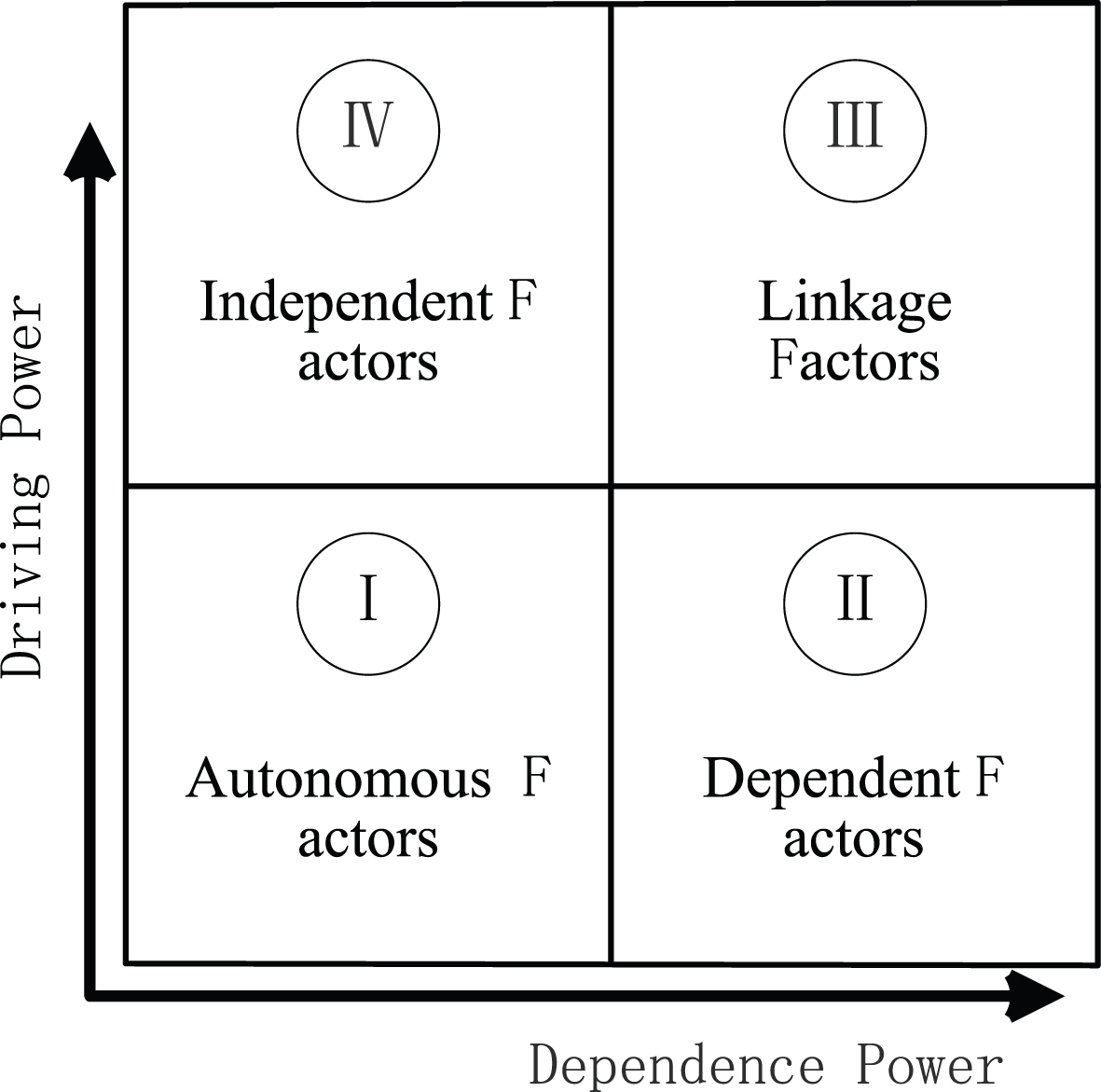
The driving force and laziness dependence were evaluated by adding the values of all entries in the rows and columns of the relevant factors in Rn such that each factor could be classified into four categories (Fig. 3). Impact factor drivers and dependency matrix.
ISM
Establishing fuzzy correlation matrix Xn
After identifying 16 highly representative influencing factors on the construction costs of PBs, 12 experts were again invited to conduct semi-structured interviews to determine their opinions on the interrelationships among these factors. The questionnaire used a scale of 0 to 1 [54] to score the correlation strength values of the 16 evaluation indices and covered all participants affected by the PB construction. The data reflected the actual situation more realistically, and the questionnaire results were collated and analyzed to obtain the matrix X n (Table 3).
Fuzzy correlation matrix of the influencing factors {X
n
}
Fuzzy correlation matrix of the influencing factors {X n }
Considering the 16 factors influencing the construction cost of PBs as a system I i (i = 1, 2, ... , 16), A n is a matrix reflecting the one-step arrival relationship between two elements in the system based on X n = (a ij ) n ×n of the influencing factors. Cluster analysis was performed according with equation (1) to B n = (b ij ) n ×n of the influencing factors. The collocation matrix {A n = (a ij ) n × n} was determined by equation (2), as shown in Table 4.
Fuzzy adjacency matrix of the influencing factors {A
n
}
Fuzzy adjacency matrix of the influencing factors {A n }
where I i had a significant effect on I j when a ij = 1, while I i had no significant effect on I j when a ij = 0.
R n is calculated using Equation (3) (Table 5).
Fuzzy reachable matrix of the critical factors R
n
Fuzzy reachable matrix of the critical factors R n
The regional division of R n was used to further clarify the relationship and extent of the influence of each factor on the construction cost of the PBs and is defined as follows: R(I i ): the set of column factors corresponding to the matrix elements containing “1” in the rows corresponding to I i in R n , representing the factors arrived at by I i . Q(I i ): the set of row factors corresponding to matrix elements containing “1” in the columns corresponding to I i in Rn, representing the factors obtained by I i , where A(I i ) = R(I i ) ∩Q(I i ) and the elements of A(I i ) equal to R(I i ) were selected as the first layer of R(I i ) of the ISM model, in order of derivation, (Table 6).
Relationship set and hierarchy of the critical influencing factors
Relationship set and hierarchy of the critical influencing factors
According to this hierarchy, the ISM model of the PBs construction cost was finally obtained by considering the relationship between the influencing factors and connecting the associated factors (Fig. 4).
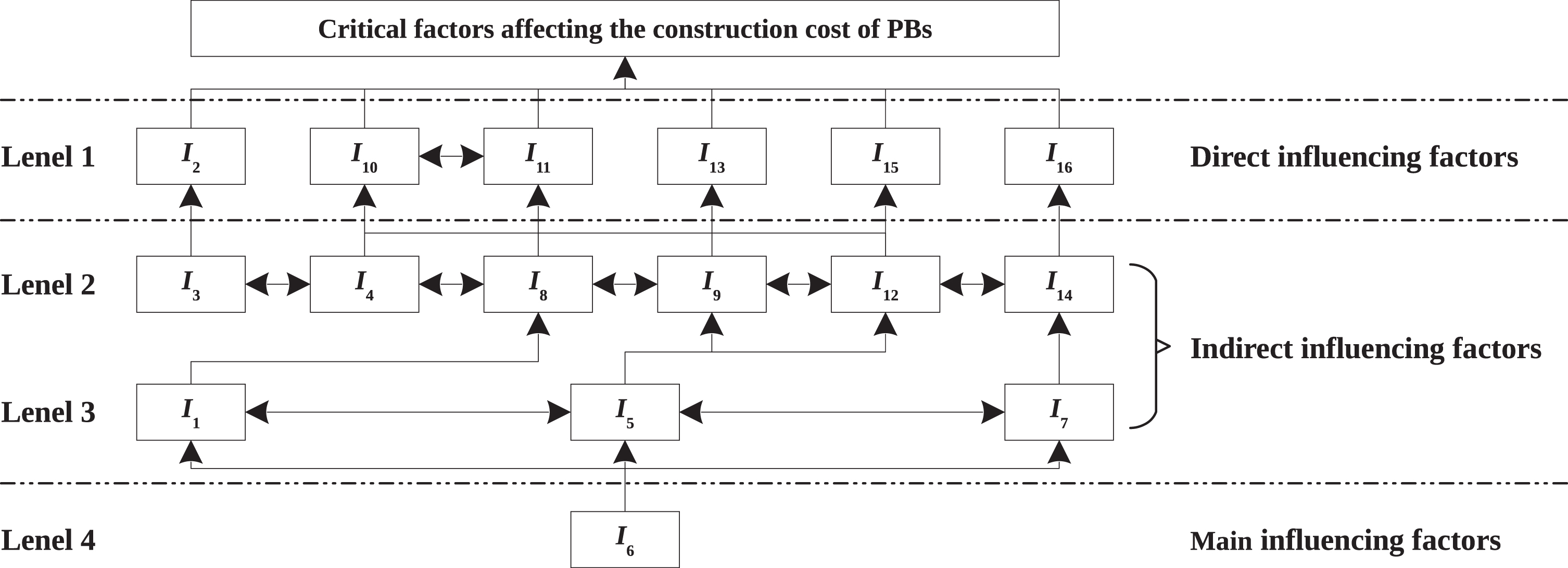
Structural model for the critical factors.
Further analysis of this hierarchical structure revealed the ISM structure of the layers in which the construction cost-influencing factors of the PBs were located.
Integrating the ISM model and MICMAC technique helps distinguish the most important influencing factors from the less important ones [57]. After the ISM analysis, the driving and dependent forces of the different factors were calculated based on R n and equations (7) and (8) (Table 5), and the MICMAC technique was used to classify the different influencing factors. Tan et al. [38] suggested that factors with a strong dependent force indicate that the influencing factor is not eliminated until other factors are addressed, whereas factors with a large driving force indicate that their elimination leads to the mitigation of other factors. By applying the dependency forces on the x-axis and driving forces on the y-axis, the 16 primary factors can be divided into four clusters in the MICMAC diagram
(autonomous, dependent, linkage, and independent) (Fig. 5). Using the MICMAC technique to classify the factors influencing the construction cost of PBs can help stakeholders gain an understanding of the prioritization of influencing factors, allocate resources, and reduce the construction cost of PBs.

Classification of the critical factors.
These factors had low driving and dependent forces, including I 3, I 4, I 8, I 19, I 12, and I 15 (Fig. 5). These seven factors were relatively independent and objective, implying that they were indirect and not strongly linked to other factors (Fig. 4) Additionally, they were less strongly associated with other factors.
Dependent cluster
The factors in the dependency cluster had low drivers and high dependencies, primarily in the form of direct and indirect factors that were highly influenced by other factors, including I 2, I 10, I 11, and I 13 (Fig. 5). In the ISM model (Fig. 4), these four factors were all at Level 1, and needed to act through the middle- and bottom-level factors, which are direct factors at the surface level. Therefore, this study demonstrates that a scientific and reasonable deepening design scheme, intelligent scheduling of prefabricated components, and improvement of the project management level are key to controlling the construction costs of PBs.
Linkage cluster
The influencing factors in this cluster had strong driving and dependence forces. No influencing factors were observed in the linkage cluster (Fig. 5), indicating that all 16 selected factors for the construction cost of the assembled building had good stability.
Independent clusters
The influence of the cluster has a high driving force, but the dependence is low; the driving variables are I 1, I 5, I 6, and I 7 (Fig. 5). In the ISM model (Fig. 4), (i) I 6 was at the lowest level, directly or indirectly influencing the other factors through the effect of intermediate factors, and thus, may be seen as the main influence on the construction cost of PBs. (ii) I 1 (prefabrication rate), I 5 (production scale), and I 7 (output of components) were at level 3 and did not directly influence the construction cost of the PBs. However, these factors significantly influenced the system. Therefore, to promote PBs, the government and market need to devote more attention to controlling this cluster, which will achieve twice the result with half the effort.
Through analysis in Fig. 4, the material cost (I 6) is located in the lowest layer, which is the fundamental factor affecting the construction cost of PBs, and the government enacts the necessary policies to effectively control the construction cost of PBs from the root. The middle layer of indirect influencing factors, such as I 1 (assembly rate) and I 5 (scale of production), although it will not directly affect the cost of PBs, higher assembly rate and production scale predict that prefabricated component factories will take on more production tasks, transferring part of the original on-site construction labor to prefabricated component plants. Production scale foretells that prefabricated component factories will undertake more production tasks, moving part of the actual on-site construction labor force to prefabricated component factories. The advantage of highly integrated industrialization makes up for the potential cost enhancement by increased labor costs while reducing the demand for personnel in building construction. The direct influence of the topmost layer is easily affected by the indirect factors of the middle layer, and it will be the key to controlling the construction cost of PBs to develop scientific and reasonable deepening design and transportation scheduling plan and improve the project management level by the organization of the main contractor under the EPC contracts.
Discussion
Under a new management model, this study takes the PBs as the research object and the EPC contracts as the research perspective. It identified 16 representative influencing factors of the construction cost of PBs in China by reviewing existing studies. The hierarchical structure of different influencing factors was established using the ISM model (Fig. 4), and the other influencing factors were clustered according to the driving force, dependency force, and MICMAC techniques (Fig. 5).
Analysis of factors affecting construction costs of PBs in China under EPC Contracts
According to the study, material cost (I 6) exhibits high driving force and low dependence. It is characterized by a more significant influence on other factors and a lesser influence of different factors on him. Therefore, in the process of promoting assembled buildings, local governments should give full play to the leading role in planning and constructing multiple assembled prefabricated component production bases within the city [40], the distance and time of prefabricated component transportation will be effectively shortened. The reasonable layout of the industrial structure will form a benign market competition environment to avoid market monopoly, which can radically reduce and control the material cost of assembled buildings.
Figure 4 clearly shows the interrelationships bet-ween the 16 representative influencing factors. The highest level (Level 1) of the ISM model includes six elements, I
2, I
10, I
11, I
13, I
15, and I
6, which play significant roles in the cost control of PBs in China under EPC contracts. In the MICMAC technique, these factors were all assigned to dependency clusters, further validating their direct influence on the construction cost of PBs. Therefore, the main contractor must focus on these factors, as described below.
This study adopts SLR, Fuzzy ISM, and MICMAC techniques to identify, analyze, and classify critical influencing factors and comprehensively analyzes the influencing factors of the construction cost of PBs in China under EPC contracts, with the following three innovations: Innovation of methodology: The ISM method can effectively identify the dependency relationships of different factors in complex systems and carry out multifaceted research in the field of construction, but ISM only takes into account whether there is a relationship between the elements of the system, and is unable to determine the strength of the relationship. Therefore, fuzzy mathematics is introduced into ISM and improved to obtain FISM. This method avoids the subjectivity of expert scoring to a certain extent and makes the analysis results more accurate and reasonable. Innovation of perspective: Existing studies mainly focus on critical issues, such as heritage building [64], BIM implementation in China’s prefabricated construction [38], the transition towards off-site construction [18]. In this study, according to the EPC contracts, an experienced main contractor is hired to take full responsibility for the design, procurement, and construction of the PBs, which avoids the confusion caused by multiple participants in different construction processes and helps to guarantee the project from a holistic perspective and also helps to protect the construction of the PBs from the perspective of the whole project. It helps to ensure the quality and safety of the project from the overall perspective and reduces the construction cost. Innovation of content: This study evaluates the stepwise relationship and relative importance of the influencing factors of the construction costs of assembly buildings in China under the EPC contracts. It puts forward cost control countermeasures and suggestions for main contractors, which can help to promote the development of PBs in China.
The model developed in this study is derived from the opinions of experts in a single region whose evaluations may be influenced by the socio-economics of their area. Therefore, future studies may consider quantifying these interrelationships through large-scale national questionnaires for a more robust analysis. To minimize the effect of subjectivity, other studies may use the results of this study as a basis, and the stability of the study’s results requires further validation. Therefore, other analytical methods, such as sensitivity analysis, artificial neural networks, and system dynamics, will be used in future studies to investigate the complexity of different influencing factors. In the design stage, if the standardized design of prefabricated components is not appropriate, it may lead to design changes, increased production costs, and construction rework; in the procurement stage, delays in the production of prefabricated components will affect the decision-making scheme of vehicle scheduling and the construction progress of the project. Therefore, the complex network relationship of different influencing factors and the impact on the economic efficiency of assembled buildings can be considered in future research.
Conclusion
In this study, 16 critical factors affecting the construction cost of PBs were identified using SLR through expert semi-structured interviews, and a hierarchical structure model of the various influencing factors was constructed using the fuzzy ISM model. Using the MICMAC technique to analyze the driving forces and dependencies of each impact factor, the following conclusions were drawn by exploring the correlation mechanism of the impact factors of the construction costs of Chinese PBs under EPC contracts: The fuzzy ISM–MICMAC technique effectively distinguished the critical factors influencing the construction costs of PBs in China under the EPC contracts. The impacts on the construction costs of PBs are distributed in different stages of construction. Among them, the cost of materials for the production phase is a deep-rooted factor and a strong driver of PBs construction costs. The factors that directly affect the cost of constructing PBs include the standardized design of components, vehicle scheduling schemes, vehicle loading schemes, and project management levels, of which the first has the most direct impact, followed by the project management level, vehicle-dispatching scheme, and vehicle-loading scheme. Given the fundamental and direct influencing factors affecting the construction cost of PBs, from the perspective of reducing and controlling the construction cost of completed buildings, the government should start from a macroscopic point of view, continuously improve the industrial structure of assembled buildings, and the market environment, and increase the degree of standardization of China’s industrialized construction market; the main contractor should do an excellent job of organization, management, and coordination, strengthen the standardized design of prefabricated components, develop a modern information management system and integrate it with project management in depth, and adopt advanced methods to optimize the production, transportation, and construction scheduling of prefabricated components, and maximize and minimize the construction cost of China’s PBs under the EPC contracts.
The construction costs of PBs in China under the EPC contracts can be optimized and controlled in the following ways:
Optimize industrial structure and stimulate market competitiveness
Under the guidance of the policy, the government should approve the planning and construction of more prefabricated component factories within the city to meet the market demand for prefabricated components, and according to the market situation of a reasonable layout of the industrial structure, to avoid the phenomenon of price monopoly, the formation of a favorable situation of scale and a stable market competition environment, which is positively contributing to the reduction of the construction cost of PBs.
Improve standardization and integrated design of prefabricated components
The main contractor under the EPC contracts is the main body of the project construction. In the design process, it is essential to improve the standardization of prefabricated components and the level of integrated design, which can effectively reduce the types of prefabricated elements, reduce the kind of molds, and improve the mold turnover rate. Not only that, design changes and engineering rework will also be reduced. Therefore, the project cost during the construction of PBs will also be controlled by strengthening design management by main contractors and improving the standardized and integrated design level of prefabricated components.
Optimize the transportation and vehicle dispatching scheme of prefabricated components
After the standardized production of prefabricated components, a suitable loading scheme must be selected for transportation to the construction site as it accounts for a large proportion of the overall logistics costs. Setting a reasonable loading and dispatching scheme is an effective method for reducing the construction costs of PBs. According to the supply and demand of prefabricated components, the main contractor should establish a mathematical model for their transportation and vehicle scheduling under various constraints, and the loading scheme and transportation route should be explored using scientific and reasonable algorithms. The material supply, transportation program, and transportation time should be optimized to satisfy the demand for components at a construction site, leading to a more standardized optimization and control of PBs construction costs.
Introduce advanced technology and improve project management level
The construction process of PBs requires the participation of multiple subcontractors, and the transmission of project information and data is complicated and prone to deviation. To ensure the accurate interaction and transmission of information and data between different stages, links, and participants, the main contractor should organize the development of a modern information management system, strengthen the exemplary management of project quality, cost, and progress through information technology, and realize the real-time monitoring and recording of on-site construction progress. In addition, for the crane path planning problem at the construction site, the main contractor should propose a prefabricated component construction scheduling plan based on an intelligent optimization algorithm according to the location of prefabricated component supply points and the sequence of prefabricated component lifting to solve the optimization problem of construction scheduling at the construction site, to achieve the purpose of highly efficient construction and reduce the construction cost.
Footnotes
Acknowledgments
We thank all authors for their efforts in conducting this research.
Funding
This research was funded by the National Natural Foundation of China (grant number 52209034).
Informed consent statement
Informed consent was obtained from all subjects involved in the study.
Data availability statement
The data used to support the findings of this study are available from the corresponding author upon request.
Conflicts of interest
The authors declare no conflict of interest.