



Abstract
The ultracold neutron (UCN) source at the Paul Scherrer Institute (PSI) [1–4] has been in regular operation for the last 7 years for up to 8 months each year. It is serving UCN to three beam ports with a priority on maximizing the UCN intensity for the neutron electric dipole moment experiment (nEDM) [5,6] at PSI which was data taking with world-record sensitivity.
The high UCN intensity is based on PSI’s reliable 590 MeV proton accelerator with highest beam currents of up to 2.4 mA. The full beam (1.4 MW) impinges for a duration of up to 8 s on the UCN lead spallation target and slightly more than 7 neutrons per incident proton are created [7]. Beam pulses are repeated every 300 s. The neutrons are thermalized in room-temperature heavy water, and further cooled and finally down-scattered by phonons to produce UCN in solid deuterium (sD2) at 5 K. Figure 1 sketches the important parts of the UCN source’s vacuum tank, where neutron generation and UCN production occur. The distance between the sD2 vessel at 5 K and the 1.4 MW beam on target is only 40 cm. After production, UCN have to pass a 0.5 mm AlMg3 lid and are subsequently guided first vertically to an intermediate storage vessel, and later horizontally to experiments at the three beam ports. All UCN guides were tested for UCN transmission before installation using a pre-storage method [8].
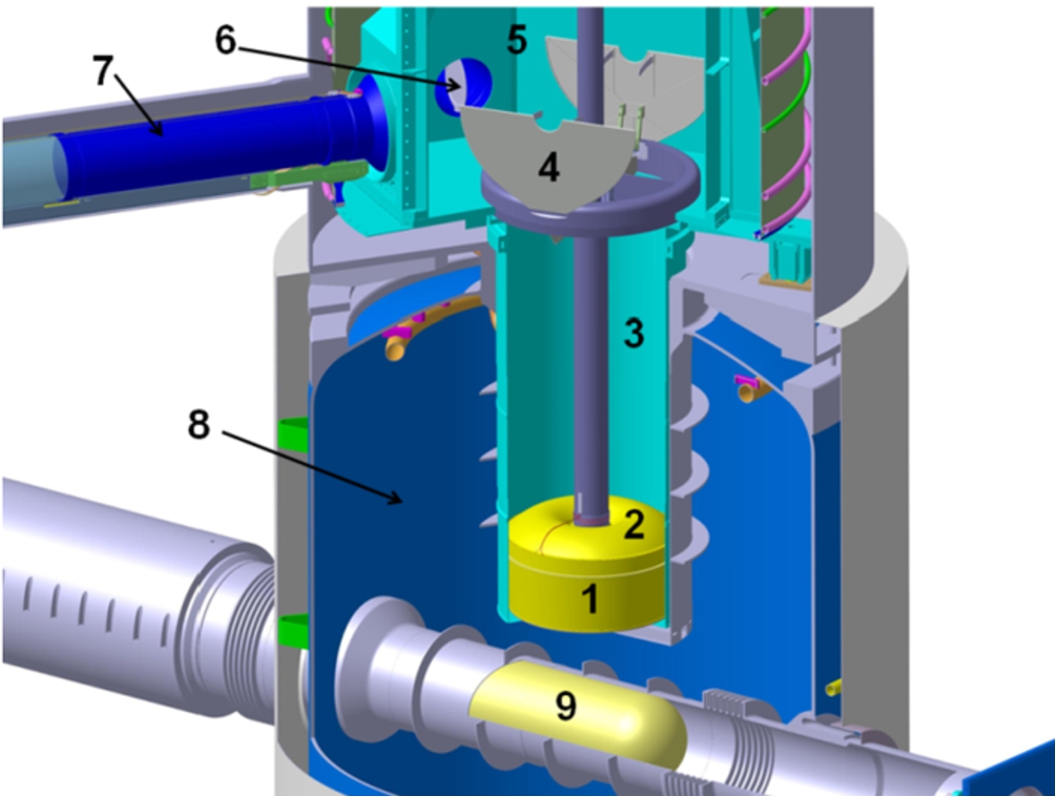
Main parts of the PSI UCN source. 1: Solid deuterium vessel; 2: Vessel lid; 3: Vertical UCN guide; 4: Storage vessel shutter; 5: UCN storage vessel; 6: Guide port; 7: UCN guide; 8: D2O thermal moderator tank; 9: Lead spallation target.
Operating parameters and procedures were improved over the last years and a corresponding increase of the UCN output was observed. Figure 2 shows the UCN operating statistics. The displayed parameters are integral proton current on target and number of pulses on target. The steady increase peaked in 2016 during continuous nEDM data taking. On average, around 280 beam pulses per day were delivered with data taking 24/7. The decrease in 2017 was caused by the dismounting of the nEDM apparatus and the subsequent experiment area refurbishment, and the SINQ operation schedule.

UCN operation statistics of all years.
Understanding the process of D2 crystallization and the behaviour of sD2 under pulsed heat input is of major importance for increasing the UCN output of the source. Raman spectroscopy [9] is used to monitor the ortho-D2 concentration which was always well above 98%. This also allows monitoring and limiting the contributions from isotopic impurities like HD molecules below significant levels.
Observing the behaviour of UCN output over time shows a typical pattern of decrease of the intensity on a time scale of days. PSI has invented and optimized a procedure called “conditioning”, which lasts about 2 hours and consists of a special warm-up and cool-down sequence. By applying this procedure, the loss in UCN intensity is fully regained, and over a time scale of weeks even improved. Figure 3 shows the UCN output over a 4-day period as monitored on the West-2 beam port. Recently [10] we have interpreted this behaviour with formation of a frost-like layer on the sD2 surface which is caused by the heat impact during beam pulsing, and giving rise to sublimation and amorphous refreezing of D2 on the surface. Even extremely thin layers of frost can already generate a relevant decrease of UCN intensity due to back-scattering effects, as has been shown in simulations [11].
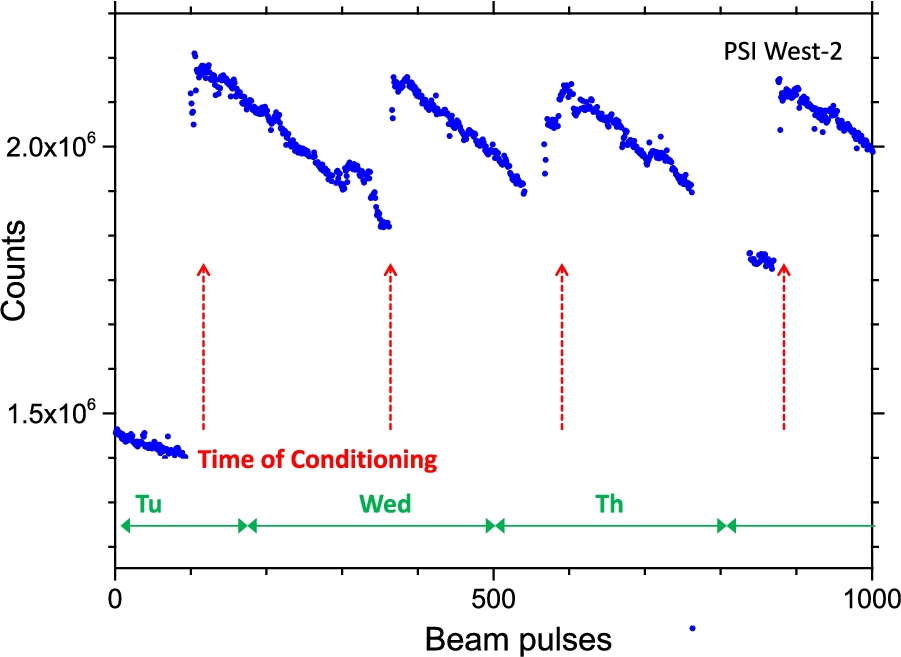
UCN counts measured on beam port West-2 over 4 days. The output decrease is fully regained after a 2-hour conditioning treatment of the solid D2.
In addition to measurements at the PSI UCN source, we have recently conducted a comparison of UCN densities at various operating UCN sources [12]. The intention was to define a standardized travelling UCN storage bottle and detector system [13] which allows comparing UCN densities without the impact of the local measurement methods and/or devices. While some of the sources have been upgraded since then and increased their UCN output, the PSI source and UCN area South (named after the relative location with respect to the storage vessel) provide the best conditions for the n2EDM experiment, the new apparatus at PSI for a neutron EDM search with increased sensitivity.
Footnotes
Acknowledgements
PSI acknowledges the support by the Swiss National Science Foundation Projects 200020_137664, 200020_149813, and 200020_163413, support by the proton accelerator operations and UCN source operations groups, support by P. Erismann, M. Meier and C. Zoller, and access to the computing grid infrastructure PL-Grid.