



Abstract
As the world’s leading centre for neutron science, the ILL provides scientists with a very high flux of neutrons. The transport of neutrons to the different instruments is continually being adapted to the latest technologies in order to maximise the useful neutron flux available. Dedicated neutron guides can now be created with a geometry and wavelength spectrum that are optimised for individual instruments and this paper gives an overview on the recent achievements as well as some insight on guides projects foreseen for the ILL future.
Design considerations
The guide designs at the ILL evolved very much over the last ten years. Keeping Liouville’s theorem in mind (Fig. 1), they share the following principles which were made possible thanks to huge progress and in particular the provision of high m supermirror coatings and the reliable production of guide substrates of suitable glass and metal:
Collect neutrons with the largest angular distribution from the moderator, and increase the guide section to create individual branches with usable lower flux divergence.
Optimize each individual branch of a single instrument instead of sharing a common standard guide with successive instruments.
The guide entrance unit is optimised by a combination of surfaces with reflective coatings of high m index and geometrical considerations to reach a complete filling of the guide by neutrons. Then, a progressive expansion of the guide (primary guide) reduces the flux divergence, reduces losses by successive reflections and increases the usable section. Individual branches may then be extracted at its enlarged extremity. The primary guide as well as individual branches are curved in order to avoid the direct view on the moderator and minimise neutron background on the instruments. Of course, the radius of curvature must also be adjusted to fit the geometrical constraints imposed by the guide halls (existing feed throughs, casemates, instruments, etc.). This is achieved by adapting the reflective surfaces of the guide using specific supermirror coatings and by using safe evacuated metallic guides to accommodate some severe space constraints on multiple guides.
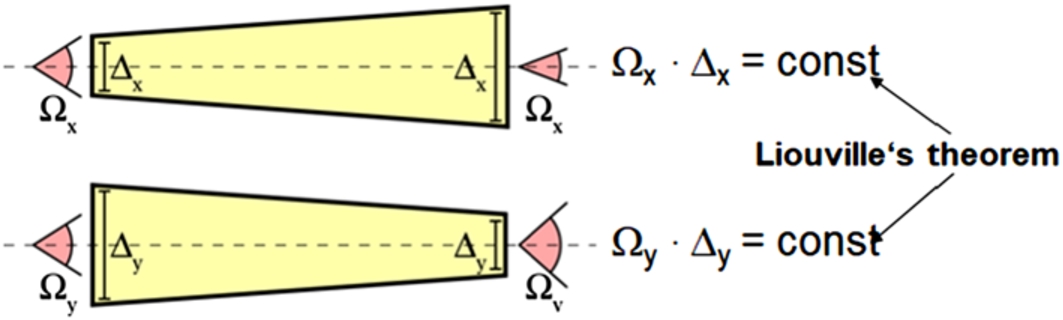
The design of the neutron delivery systems is driven by the Liouville’s theorem.
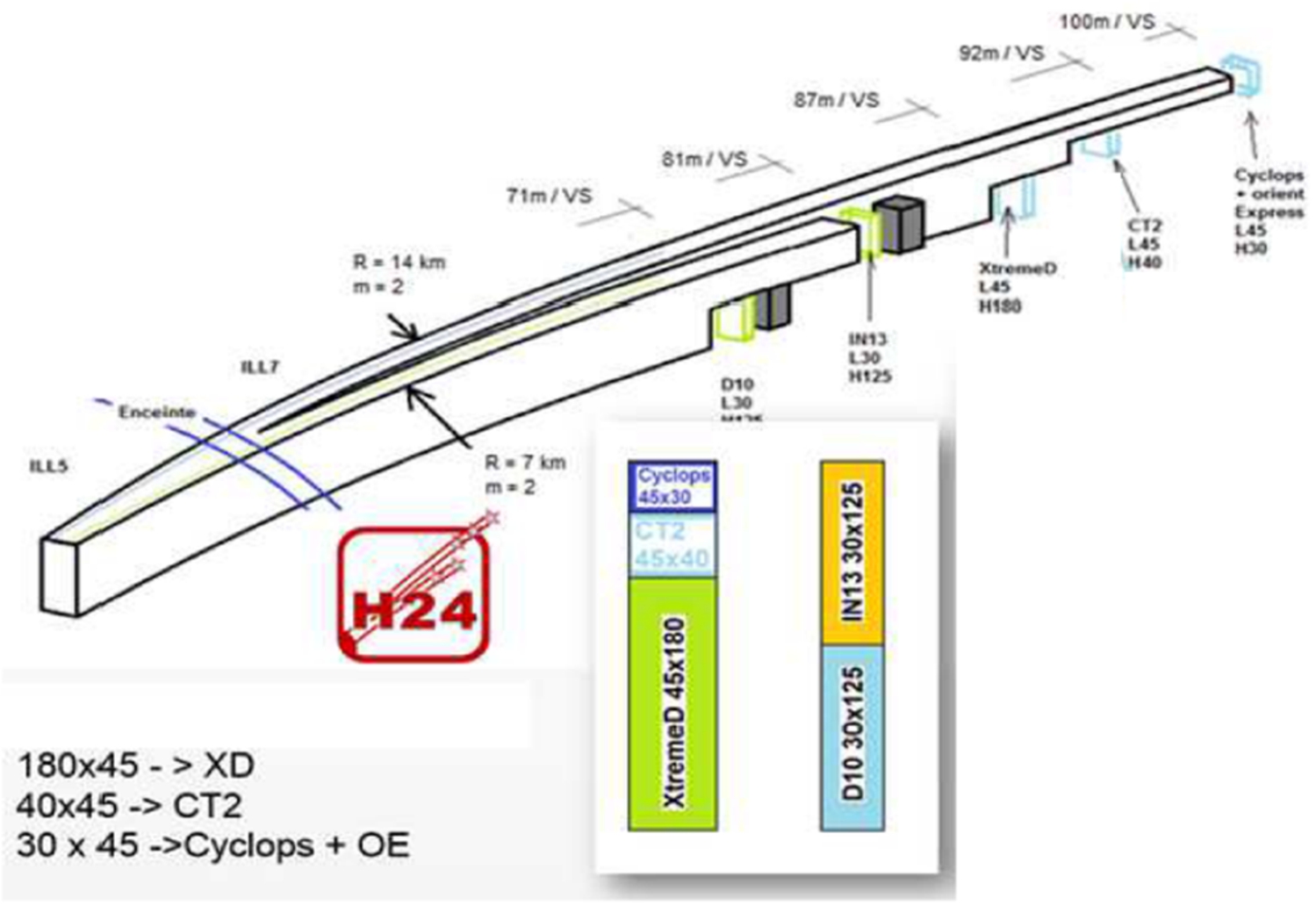
General overview of the new H24 delivery system (Chartreuse side of ILL7).
At the guide extremity, close to the instrument, the beam is shaped to fit the divergence acceptable by each instrument (focusing guide, collimation section). The design of pseudo elliptic focusing sections with a high m supermirror makes possible flux increases by typically a factor of 2 to 4 in line with the trends to use smaller samples. But this is done at the expense of increasing divergence.
For long guides, typically longer than 30 m, the transport optimization requires to reduce the number of neutron reflections inside the guide. An elliptical shape is in theory very efficient as it should transport neutrons in one or two bounds but it is almost impossible to implement at the ILL because of the space extension of the neutron source and radiation constraints close to the neutron moderator. The so-called ballistic shape combined with the very high reflectivity achieved by supermirrors guides is preferred at the ILL for the longest guides (>80 m).
We also improved the engineering design with 2.5 m long glass guides blocked within aluminium housing and by developing an evacuated borated aluminium guides technology (contractual collaboration with the S-DH company). Each unit is aligned from the outside of the housing or evacuated guide by the ILL team using a laser tracker system.
The completion of the Millennium program in 2016 has brought an astonishing gain factor, increasing the average detection rate across the ILL instrument suite by a factor greater than 25 over the last decade. A significant part of this gain comes from the improvement of neutron delivery system.
Amongst the main guide projects completed since the NDS2015 conference, lets start with the new H5 guide system connected to the horizontal cold source and fully commissioned at the beginning of 2016 [1]. The guide hall has been extended by 750 m2. This extension was realized while the previous guide system made of three branches was replaced by six new ones for a total length of 300 m. The measured neutron fluxes have shown a gain factor of 2 to 3 on the usable capture flux at the instrument entrance positions. More recently, the H523 branch has been designed with a very specific octagonal shape to feed the future ultra-cold neutron source SuperSUN [5]. This last branch of H5 will be installed and commissioned in 2019.
In the frame of the ILL Endurance program, the H24 thermal guide has been entirely redesigned. Starting from an enlarged section in the reactor pile, the guide expands and splits into two branches (Fig. 2). The first branch will feed the upgraded D10+ and IN13 [2] instruments and the second one will transport neutrons to the future extreme condition diffractometer XtremeD [3] and three technical instruments.
The constraints related to the transport of thermal neutrons in a multiple guide raise specific difficulties compared to cold neutrons. The new design developed with SDH [4] based on borated aluminium and high-m supermirrors (Fig. 3) has allowed to overcome the challenge to build such a dense integration of guides and monochromator mechanics.
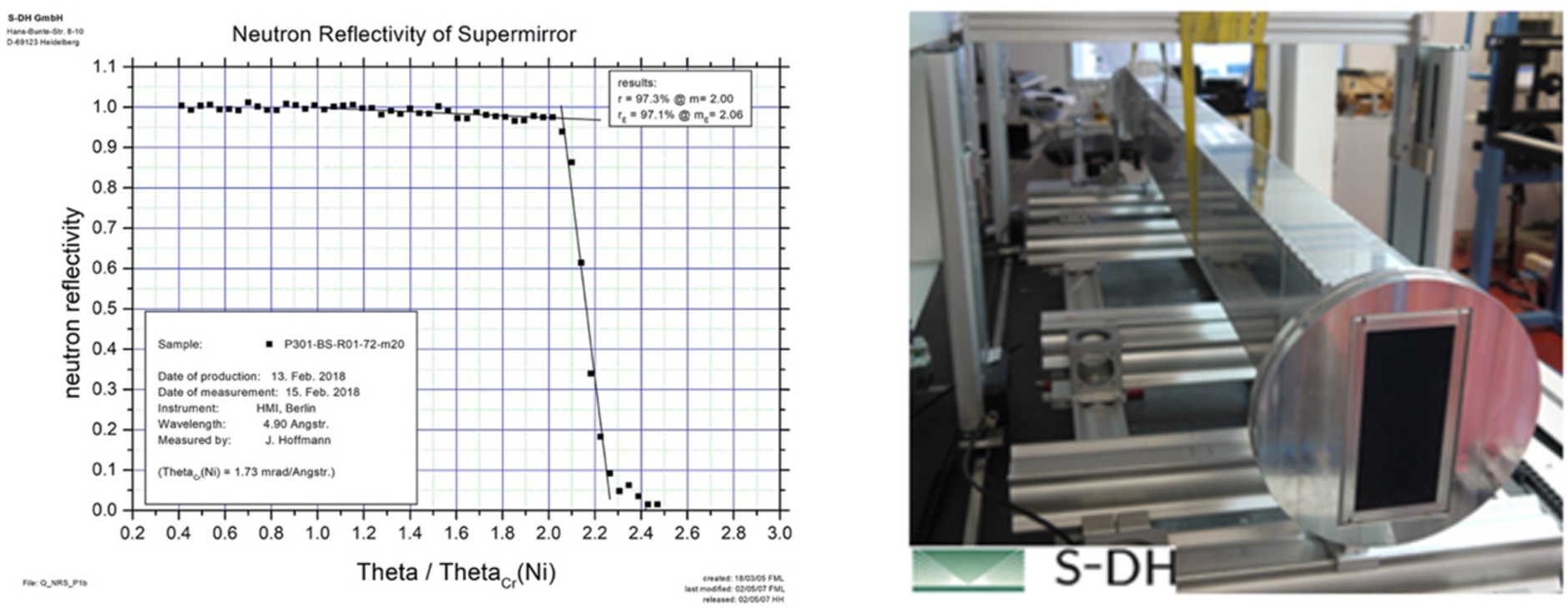
New design based on borated aluminium developed in collaboration with the SDH company.

Overview of the future H15 guide and related instruments that will be commissioned by 2023.
As for the H16 guide project started in 2017, it was run in a very effective way to make possible the delivery of guides for the 2018/2019 winter shutdown of the ILL. This guide and its specific focalizing section are expected to increase the usable flux on the Time of Flight spectrometer IN5 by a factor greater than two.
Last but not least, the H15 neutron delivery system looks to be the most complex one ever designed by the ILL (Fig. 4). It will deliver neutrons at the end of the Endurance phase 2 investment programme. Starting from an enlarged section with