



Abstract
HRPD-X is a proposal to completely replace the current high-resolution powder diffractometer (HRPD) at the ISIS Neutron and Muon Source. The new instrument is expected to deliver a factor of four increase in solid-angle coverage. Taking advantage of new detector technology and coupled with a non-magnetic sample tank and improved incident- and diffracted-beam collimation, the new instrument will substantially improve HRPD’s scientific capabilities to study magnetic structures and behaviour, high-pressure phenomena and supramolecular structures whilst strengthening its performance in already-established areas.
Introduction
The high-resolution powder diffractometer (HRPD) at the ISIS spallation neutron and muon source has been in operation for almost 35 years and remains one of the leading instruments of its kind in the world. With a 95 m primary flight path and backscattering detectors covering 2θ = 158–176° the instrument achieves an optimum
In light of this and the continuing evolution of the scientific landscape, HRPD instrument scientists and ISIS design engineers developed a plan for a comprehensive upgrade to the instrument and its infrastructure. In spite of some delays and modifications to the design, the upgrade project – now dubbed “HRPD-X” – remains a bold proposal to significantly increase the scientific capabilities of the instrument and retain its world-leading position.
The aim of the HRPD-X upgrade is to demolish the existing building in which HRPD is housed, erect a new building and then to install an entirely new instrument, replacing the old detector arrays, sample tank and incident-beam conditioning devices, but retaining the guide. The proposed detector arrays will be based on wavelength-shifting fibre technology, and cover a substantially larger solid angle than the current arrays, particularly in forward-scattering geometry which accesses longer d-spacings. Provision of a non-magnetic sample tank will allow HRPD-X to carry out measurements in applied magnetic fields up to 10 T. Furthermore, improvements in upstream beam conditioning and sample collimation will work to reduce the comparatively large divergence of the supermirror guide and reduce backgrounds from in-situ sample environment devices.
This short paper will outline the current configuration of HRPD, summarise the scientific drivers for the upgrade specifications and provide some details of the proposed HRPD-X instrument.
Current instrument configuration
HRPD occupies port S8 on ISIS target station 1 (TS-1), viewing a centrally-poisoned cryogenic CH4 moderator. Neutrons propagate along an initially straight path through the shutter and target shielding (all lined with

Diffracted-beam geometry of the current HRPD instrument; lines are drawn in the illuminated areas in increments of 2° in 2θ.
The geometry of the present detector arrangement is illustrated in Figure 1 and detailed in Table 1. The backscattering detectors comprise a circular array, split into eight wedge-shaped octants. The neutrons are detected by 5 mm-wide strips of ZnS:Ag/6LiF-scintillator coupled by clear plastic fibres to single-channel photomultiplier tubes (PMTs) [5]. These modules were installed in 1994, replacing the instrument’s original 1984 Li-glass detector modules in which the detector-element pitch was 15 mm. Since 2007, the top and bottom octants have been excluded from the reduced data used for analysis due to the larger vertical divergence introduced by the new guide. Following a replacement of the backscattering PMTs in 2019 (see below), the exposed fibre ends in these two vertical octants (numbers 1 and 5) were covered over with Al plates, rendering the omission of these data a permanent feature.
Two banks of detectors are installed at 2θ = 90 ± 10°, one on the north side of the sample tank and one on the south side. These were fitted in 1999, replacing a single array of detectors on the north side that had been in operation since 1988. Like the backscattering modules, these consist of ZnS:Ag/6LiF-scintillator modules with a 3 mm pitch, coupled by clear fibres to single-channel PMTs [5].
In forward scattering there is a small array of 1/2-inch helium tubes covering 2θ from 28–32°. These tubes were recycled from a previous installation on another instrument and installed in 1992. They are mounted in a 3 × 3 array of modules, each module containing eight tubes mounted vertically with a centre-to-centre separation between the tubes of 24 mm.
The main sample tank consists of a simple cuboid box, with a volume of ∼0.39 m3, comprised of
Data on the coverage and resolution of HRPD’s current detector modules
Full-bank rather than optimal resolutions are quoted.
It should be noted that the original generation of detectors in backscattering and at 90-degrees were replaced after 10 years of operation but that those replacements are now 25 and 20 years old, respectively. Moreover, the recycled low-angle bank is now 27 years old. Coupled with old power supply and data-acquisition electronics, this has led to a substantial decrease in reliability and increase in electronic noise over recent years, with a significant risk that the crucial backscattering array would experience major failures before an upgrade of the instrument could be implemented in the early 2020s. As a result, 96 new PMTs were installed on octants 2–4 and 6–7 of the backscattering array, and the electronics for the backscattering and 90° banks were replaced over the summer of 2019, with those for low-angle bank to be completed in Spring 2020. The stipulation that all new electronic equipment must be located in an air-conditioned ‘counting house’ necessitated a concomitant refurbishment of the user area, with a temporary cabin being mounted externally to the west wall of HRPD’s brick building; a new doorway and extended mezzanine connect the cabin to the existing instrument platform.
In order to maintain a globally competitive position at the forefront of high-resolution neutron powder diffraction, HRPD must build on its early 1990s track record of adopting new detector technology and adapting to the changing needs of the scientific community.
There is a general trend towards studying more complex materials, typically with larger unit cells, which includes supramolecular frameworks (MOFs, zeolites, clathrates), materials that develop superstructures, modulated structures and complex magnetic structures. In HRPD’s range of available wavelength bands, the relevant structural information (e.g., superlattice peaks, magnetic reflections) are best observed at moderate to low 2θ values so our first upgrade specification is to increase the instrument’s coverage at 2θ < 90°, whilst retaining the current performance at high 2θ. This has the additional benefit of eliminating gaps in d-spacing coverage that currently appear in longer time-of-flight windows.
There is another trend in the direction of carrying out more complex ‘complementary’ or ‘in-situ’ measurements, which might colloquially be described as “powder neutron diffraction plus something else done simultaneously” where the ‘something else’ could be electrical transport measurements, resonant ultrasound spectroscopy, Raman spectroscopy, heat capacity measurements, and so forth. Since this often introduces additional material in the vicinity of the sample, be it support structures or measurement devices, there is thus a need for improved collimation of both the incident beam (to limit over-illumination) and of the diffracted beam. Likewise, a developing need to make high-pressure measurements at the highest possible resolution places even more strict demands on the collimation by virtue of the small sample size compared with the size of the pressure-generating devices. Our second specification is thus to minimise overall instrumental backgrounds and cut as much parasitic scattering as possible from complex sample-environment equipment by introducing a radial collimator around the sample position. This specification is also highly relevant for other measurements of small sample volumes, due to e.g. high-pressure synthesis or other synthetic techniques in which homogeneity between batches cannot necessarily be guaranteed.
HRPD’s current sample tank is too small simply to insert a radial collimator of the kind used on GEM and Polaris, so this objective in turn mandates the provision of a new larger vacuum tank. Since it is also the case that the scientific community wishes increasingly to make high-resolution neutron powder diffraction measurements under an applied magnetic field, which the current stainless-steel vacuum tank precludes, our third specification is that the new vacuum tank must be fabricated from non-magnetic materials and the PMTs be appropriately shielded.
The HRPD-X upgrade plan
Following a successful upgrade to the ISIS high-intensity diffractometer Polaris in 2012 [6], a plan was developed to adopt a similar tank and detector architecture for an upgrade to HRPD. This involved a large increase in the solid angle coverage, with two new large detector banks replacing the small low-angle bank, a Polaris-style (ca. 20 m3) vacuum tank and a Polaris-style radial collimator drum. Technical designs and McStas-based optimizations were carried out, which formed the basis for the 2014/15 HRPD Instrument Development Plan and International Review. Since that time, small modifications have been made, principally to the secondary flight paths of the proposed detector array to find improvements in resolution (most notably in bank 3), and further McStas simulations have been performed primarily to assess the effect on beam divergence of adding additional upstream collimation.
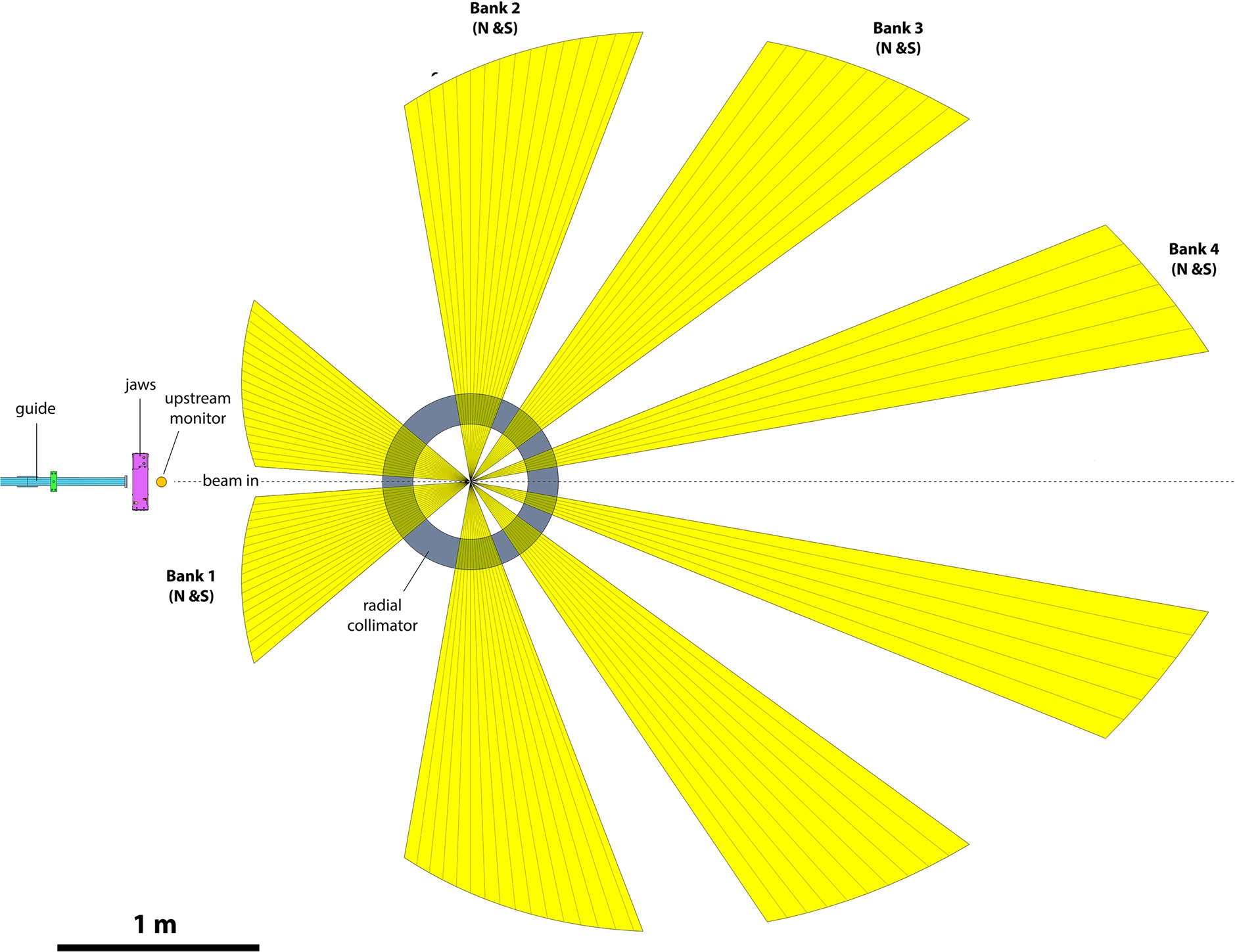
Provisional diffracted-beam geometry of the proposed HRPD-X instrument; lines are drawn in the illuminated areas in increments of 2° in 2θ.
Data on the coverage and resolution of the HRPD-X detector modules
Full-bank rather than optimal resolutions are quoted.
The most recent iteration of the proposed upgrade design involves an array of wavelength-shifting fibre detector elements [7] positioned on a logarithmic spiral in 2θ such that

Calculated

Available d-spacing ranges for the various ‘standard’ time-of-flight windows operated on HRPD; (a) the current instrument and (b) for HRPD-X. Note the gap in coverage that appears between banks 2 and 3 for the 100–200 ms window in the current instrument configuration.
Nevertheless, the upgraded detectors will ensure better count-rate matching between banks and eliminate gaps in d-spacing that occur in the current detector array when using longer time-of-flight windows (Figure 4).
The original intention to have a 20 m3 vacuum tank, with most of the secondary flight paths in vacuum resulted in two significant problems. The principal difficulty was the dimensions of the vacuum windows in front of the detector modules, which would have needed to be extremely large and require a great deal of invasive support structure. Secondly, the large tank would have comparatively long pump-down times, even with a dry-air let-up system, and it would be inconveniently time-consuming to achieve the high vacuum needed to run closed-cycle refrigerators without introducing a separate cryogenic vacuum bin, adding to the background and the diffracted beam attenuation. Our solution to this, at present, is to design a non-magnetic sample tank that is only slightly larger than the current HRPD vacuum tanks but which can nonetheless host a Polaris-style radial collimator, and to propagate the diffracted beam between the vacuum windows and the detectors through tanks filled with natural argon. This is essentially the same arrangement HRPD uses today on its forward-scattering bank, where the diffracted neutrons pass through ∼1.26 m of vacuum, 2.0–2.7 m of argon and 0.3–0.4 m of air (with a 1.2 mm vacuum membrane and two 50 μm-foil gas-tank windows), and is similar to the design employed on WISH. In this scenario, the vacuum windows have unsupported areas of 0.2–0.4 m2, which compares favourably with the smaller windows currently in use on HRPD (0.08–0.27 m2) and is much smaller than the secondary vacuum windows on the current 90° detectors (1.04 m2).
Whilst striving to minimise alterations to the existing supermirror guide, work has been carried out to evaluate what may be done to reduce the divergence of the incident beam whilst simultaneously preserving beam homogeneity, flux and resolution. HRPD currently has two pairs of B4C jaws centred ∼70 mm downstream of the guide exit window, which are typically used to define a rectangular aperture 20 mm high and 15 mm wide; the final evacuated section of the flight-line then contains a fixed rectangular B4C collimation snout with a 40 × 20 mm aperture located 450 mm in front of the sample position. Various configurations of additional rectangular apertures were tested in McStas simulations; the results indicate that a second set of moveable jaws at L = 92.3 m (i.e., 1 m upstream of the guide exit) achieves our goals of maximising beam homogeneity, reducing divergence by 45% and keeping 60% of the flux at λ = 2 Å.

Geographical constraints on the HRPD upgrade instrument and building arise from the proximity of nearby building and the need for large articulated vehicles to move around the area (large dashed arrows), with a minimum lateral clearance of 5 m. HRPD and its guide tunnel are shaded black, other buildings in dark grey, and raised off-road areas in light grey.
Since the new instrument cannot be accommodated inside the present brick building (designated R69), the initial upgrade plan included the provision of a new steel-framed building of considerably larger dimensions. The location of HRPD (Figure 5) in a ‘notch’ between the second target-station building (R80), an array of electrical workshops (R6a), and the TS-2 extracted-proton beam (R6–R80 link), with a roadway passing around the eastern end R69 that must be navigable by fire engines and other large articulated vehicles, places significant constraints on how much the footprint of the building may be enlarged, and indeed on the instrument geometry itself: the instrument must fit within a square box that extends no more than 5.5 m downstream of the guide exit and 2.75 m either side of the beam centre-line.
The initial 2014 upgrade building design, with a large shielded blockhouse around the new instrument, created a significant pinch-point on the SE corner, reducing the width of the road between the building and the crash-barrier adjacent to TS-2 down to 3.1 m. We have since reviewed the way in which the area around the instrument itself should be shielded and interlocked, whilst aiming to maintain safety and accessibility for detector maintenance, and have been able to design a building with a substantially smaller footprint that avoids the vehicular pinch-points. This 196.5 m2 two-story building is designed to be fully wheelchair accessible to cater for users with diverse mobility needs, and includes 52 m2 of space for instrument control and data analysis, 87 m2 of mezzanine floor around the instrument sample pit, to include sample-preparation laboratory space, and approximately 35 m2 to house all of the instrument’s electronics.
The detector arrays, the vacuum/gas tanks, and the building have recently moved into the detailed design phase, anticipating the release of funds in the time-period after ISIS Target-Station 1 undergoes its refurbishment (Sept. 2020–Dec. 2021) [1]. To prevent further disruption to the HRPD user programme it is anticipated that the instrument will continue to operate in its current configuration for at least 1 year after the TS-1 project. The current instrument would be dismantled and the building demolished around the beginning of 2023, with the expectation that construction of the new building should be complete in early 2024 and the new instrument installed and fully commissioned before HRPD’s 40th birthday in December 2024. The anticipated overall cost of the upgrade will be ∼£9 M.
The proposed developments outlined in this paper will allow HRPD’s exceptional capabilities to be applied to a range of new scientific problems, including supramolecular frameworks, complex magnetic structures and multi-GPa high-pressure studies whilst adding considerably to the extent and quality of data obtained in the instrument’s day-to-day range of, e.g., parametric variable-temperature studies, variable-composition studies, and precise crystal structure refinements.
Footnotes
Acknowledgements
We would like to acknowledge the significant volume of work undertaken on the HRPD upgrade project by previous instrument scientists and researchers (including K.S. Knight, W.I.F. David, R.M. Ibberson, A. Daoud-Aladine and J. Jacas Biendicho) along with critical input from other members of the Crystallography Group (in particular S. Hull) and engineering and technical staff at ISIS (in particular D. McPhail, S. Waller, N. Rhodes and G.J. Sykora).