



Abstract
Total thermal neutron cross section measurements serve as the primary means of validation for thermal neutron scattering kernels, an important quantity for neutron transport calculations. In an effort to improve the quality of thermal neutron scattering kernels, researchers at Rensselaer Polytechnic Institute (RPI) designed and constructed a polyethylene based cold moderation system to enhance neutron flux below 10 meV when coupled with the Enhanced Thermal Target (ETT) at the RPI Gaerttner LINAC. The final design yielded an increase in sub-thermal neutron flux (below 10 meV) by a factor of 4.5 for a moderator temperature of 37.5 K relative to the ETT alone. A further increase to a factor of 6 is expected after a minor geometry modification and decrease in polyethylene temperature to 25 K. This novel capability will be used to conduct total thermal neutron cross section measurements from 0.0005–10 eV for different materials including moderator materials.
Introduction
Accurate neutronic computational tools are required to appropriately conduct nuclear criticality safety calculations. These computational tools, such as MCNP [7], have recently undergone a dramatic reduction in their associated uncertainties, increasing their already substantial dependance on the underlying physics and nuclear data. Therefore, the underlying physics must be rigorously tested and the uncertainties in the nuclear data quantified in an effort to further refine these tools.
Nuclear systems that produce and rely significantly upon the levels of thermal neutron flux can certainly produce criticality issues – issues that can be prevented through enhanced modelling and simulation of thermal neutron interactions. When a neutron scatters down to the thermal region (below 10 eV), its energy becomes very close in magnitude to that of molecular bond vibration and rotational energies, thus allowing the bonds within molecules to affect how the neutron will interact. Molecular bond effects are normally accounted for through the inclusion of a thermal scattering kernel, which can dramatically alter the neutron cross section and scattering kinematics, as seen in Fig. 1. Without the use of a thermal scattering kernel, neutronic models such as MCNP will utilize free gas cross section that treats the atoms in a material as free, unbound atoms. Free gas treatment is not accurate below 10 eV for any material that is comprised of molecular bonds.
Atomistic calculations of the phonon spectrums serve as the basis for predicting scattering kernels, heavily impacting neutron scattering physics below 1 eV. Evaluated scattering kernels rely heavily on neutron total cross section measurements that span the entire thermal region, defined as 0.5 meV–10 eV, in order to gauge their level of accuracy. Nuclear data evaluations in the thermal region can affect the neutron multiplication factor of a thermal system by upwards of 12%, thus making thermal scattering kernels vital to criticality safety [4].
Currently, targets at the Rensselaer Polytechnic Institute (RPI) accelerator produce low neutron flux below 10 meV, leading to large statistical uncertainty or excessive measurement time when conducting measurements in this energy region. In an effort to improve this sub-thermal flux, a cold moderator system was proposed. A previous RPI study found that the sub-thermal neutron flux could be enhanced by at least a factor of 5 over a room-temperature moderator system through the addition of a cold moderator [5]. Sub-thermal neutron flux enhancement would improve the accuracy of thermal total cross section measurements and enable measurements below 1 meV, and thus help quantify the accuracy of evaluated scattering kernels.

Hydrogen in high density polyethylene (HDPE) scattering cross section at 293 K for the free gas model and for a thermal scattering kernel generated through the S(a, B) scattering law (ENDF/B-VIII.0) [1].
The enhanced thermal target
The cold moderator system is intended to couple to an existing target when the thermal flux needs to be extended down into the sub-thermal regime. The Enhanced Thermal Target (ETT) was designed to produce large amounts of thermal flux and is the perfect target to improve with a new cold moderator system [5]. The ETT places a water-cooled tantalum target in the path of a high energy electron beam to produce bremsstrahlung radiation, which then goes on to produce neutrons in the tantalum via photo-nuclear reactions. Utilizing water, graphite and polyethylene moderators, the ETT moderates neutrons down to thermal energies on their way to the detector. The cold moderator system is designed to easily couple to the front face of the ETT when sub-thermal flux enhancement is required.
Cold polyethylene
With the ETT chosen as the intended target, the optimal cold moderator material could be investigated. A wide variety of hydrogenous materials were explored, including solid methane, liquid hydrogen, solid mesitylene and polyethylene. They were evaluated based on safety, performance, and reliability. While solid methane, liquid hydrogen, and solid mesitylene all outperformed polyethylene in thermal neutron production, they all posed a potential hazard to the experimenters and the facility. Polyethylene proved to be the most safe and reliable of the materials due to a lack of phase change when cooling below room temperature, designating it as the optimal cold moderator material.
A preliminary experiment was thus required to validate that polyethylene could boost flux below 10 meV. A block of polyethylene was surrounded in polystyrene and placed in the neutron beam to evaluate its impact on the neutron spectrum at 293 K and 77 K. To cool it to 77 K, a hose was placed above the polyethylene that dripped liquid nitrogen, as seen in Fig. 2, the moderator temperature was monitored by thermocouples placed inside the polyethylene. The preliminary experimental results are compared against MCNP calculations that use ENDF/B-VIII.0 thermal scattering kernels in Fig. 3 [1], where polyethylene dramatically shifts the neutron spectrum to lower energies when cooled. The sharp edges found in the spectrum are Bragg edges from

Preliminary experiment setup showing the Styrofoam surrounded moderator.

Measured neutron emission spectra from polyethylene at 293 K and 77 K for the geometry shown in Fig. 2.
The new moderator was optimized for the best neutronic performance given the design constraints imposed by coupling to the existing ETT target. The cooling requirement and harsh radiation environment results in a unique design.
Neutronic design
After validating polyethylene as an effective cold moderator, an add-on system was designed to couple to the ETT. The primary design factor governing such a system is the maximization of the sub-thermal flux gain over the ETT alone, defined as the integral number of neutron counts in the 1–5 meV energy region. It was found that a 7″ × 7″ × 1″ polyethylene block would effectively enhance sub-thermal flux when coupled with a polyethylene pre-moderator, such as the 1.57″ polyethylene moderator in the ETT. Figure 4 shows a top view of the MCNP geometry of the finalized design where an internal aluminum plates serves to provide optimal cooling to the polyethylene block.

MCNP model of finalized design.
In order to lower the polyethylene block down to cryogenic temperatures, a series of design constraints were formed to ensure adequate cooling and preserve the lifetime of the system, all while ensuring the polyethylene would be mounted as close as possible to the tantalum source of neutrons. The system needed to minimize the energy deposition in the polyethylene from gamma rays escaping the target, while also ensuring that heat could only leak inside the cryostat through radiative means. By incorporating a single stage cryocooler, a long copper cold finger and an aluminum vacuum shroud as central design concepts, a finalized design was created via MCNP energy deposition studies coupled with COMSOL Multiphysics [3]. Figure 5 shows the finalized cryostat design in position as viewed from the detector. For more information on the cryostat design internal see [6].
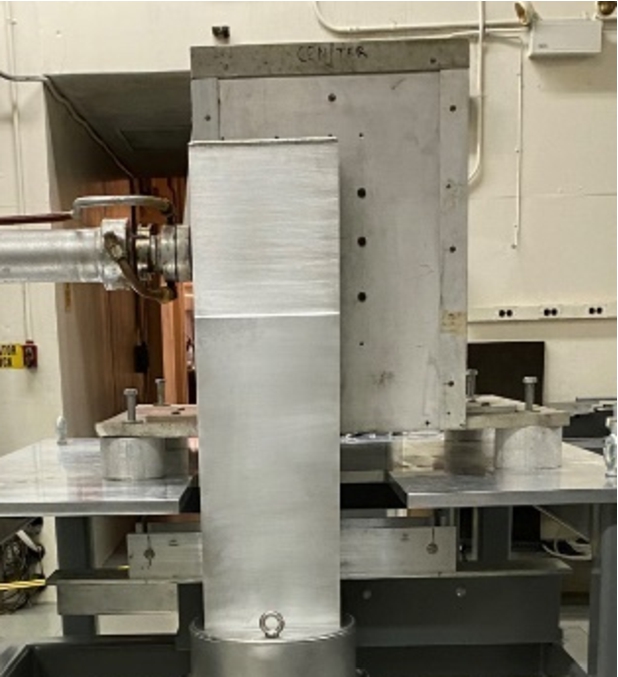
Detector view of cryostat in position.
The finalized design has been constructed and tested, achieving a temperature distribution between 20 and 25 K in the polyethylene at steady state under no LINAC operation. An experiment has since been run to verify the neutronic design calculations and determine the cold moderator (CM) sub-thermal flux enhancement capability, as shown in Fig. 6, where
It should be noted that the inclusion of the cold moderator system will increase the effective moderator thickness of the target and therefore affect the resolution of an experiment. However, this is a secondary concern to the neutron intensity as the ETT currently provides very little flux below 10 meV and accurate cross section measurements below a 1 meV are not be possible within a reasonable time without sub-thermal flux enhancement. Additionally, cross sections in the thermal region vary slowly with energy in general and the energy resolution of the new moderator is more than sufficient for the intended measurements, thus optimization of the neutron emission time was of secondary concern. It is important to also note that the uncertainty in all experimental data shown is generally very small and therefore cannot be seen in either Fig. 3 or Fig. 6. The maximum uncertainty occurs at 2 meV and is less than 3% for all experiments.
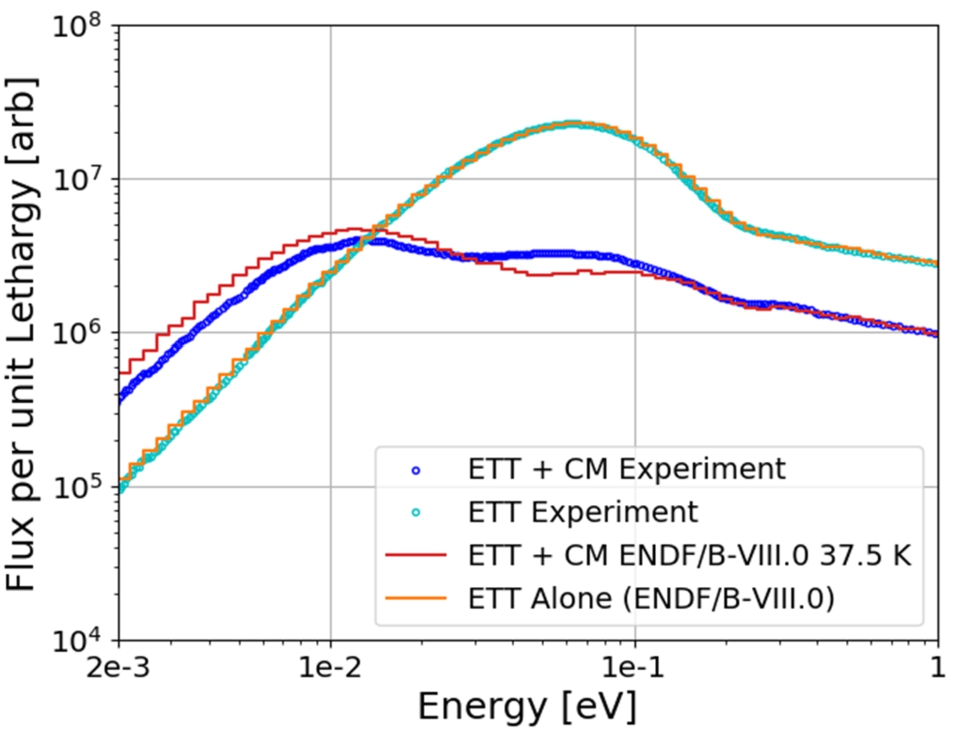
A preliminary experiment was performed to test the effect of temperature on polyethylene’s ability to produce sub-thermal flux when coupled with the ETT. This experiment indicated polyethylene’s usefulness as a cold moderator and validated neutronic calculations. Through a series of coupled thermal and neutronic calculations, an optimal design was reached, which targeted at yielding the maximum possible gain while ensuring the highest degree of safety and ease of use for the operators. When tested at 37.5 K, the cryostat design provided a sub-thermal flux gain of 4.5 over the ETT. The sub-thermal flux enhancement is expected to increase to a factor of 6 after minor geometry modifications and a reduction in polyethylene temperature to 25 K. Additionally, the cryostat proved simple to move in and out of position with no modification to the ETT required. Future work involves the continued beam characterization of the cold moderator and total thermal cross section measurements from 0.0005–10 eV. The primary materials of interest for these cross section measurements are moderator materials such as polyethylene, polystyrene, Plexiglas, and yttrium-hydride.
Footnotes
Acknowledgements
The authors would like to thank Professor Emeritus Robert Block (RPI), Dr. Kemal Ramic (RPI), Dr. Michael Rapp (NNL) and Dr. Ignacio Marquez Damian (ESS) for their insight and assistance through the course of this project. This work was supported by the Nuclear Criticality Safety Program, funded and managed by the National Nuclear Security Administration for the Department of Energy. Additionally, this material is based upon work supported under an Integrated University Program Graduate Fellowship.