



Abstract
BACKGROUND:
Companies often defending their products when there are concerns about their safety and/or effectiveness.
OBJECTIVE:
This study looks at drugs removed from the Canadian market from 1990 onward and examines how companies responded.
METHODS:
This descriptive analysis used a previously published article and a hand search of a Government of Canada website to generate a list of drugs withdrawn from Canada from 1990 onwards. For each product the following information was extracted: brand name, generic name, company, date of withdrawal and evidence base for withdrawal. Google and Factiva searches were used to identify sources containing statements from the company about the withdrawal. Statements were independently graded by two people into the following categories: company agrees with the withdrawal; drug could be used safely with certain precautions; company may reintroduce the drug; company disagrees with the withdrawal. Searches were carried out between September 15–20, 2020.
RESULTS:
There were 22 drugs for which there were company statements. In 10 statements, the companies disagreed with the decision to withdraw the drug and in 7 they agreed with the decision. In the other 5 cases they felt that the drug could have been kept on the market with restrictions (2 cases) or they might reintroduce the drug (3 cases). The level of evidence for the withdrawal did not seem to influence the companies’ position.
CONCLUSION:
In 15 out of 22 cases, the company either disagreed with the decision to withdraw the drug or felt that the drug should continue to be available to Canadian patients.
Introduction
When there are concerns about the safety and/or effectiveness of drugs on the market, pharmaceutical companies often respond by defending their products. As an example, when Nissen and colleagues published a meta-analysis showing an association between rosiglitazone and a significant increase in the risk of myocardial infarction [1], the response from GlaxoSmithKline was that the company “strongly disagrees with the conclusions reached in the NEJM article, which are based on incomplete evidence and a methodology that the author admits has significant limitations” [2]. A JAMA article that raised “a cautionary flag about the risk of cardiovascular events with COX-2 inhibitors” [3] was met with a letter from an employee of Merck Research Laboratories and a Merck consultant claiming that “the analysis provides no substantial support for their conclusion” [4].
There has not been any previous research in Canada or other countries about whether company defense carries over when drugs are removed from the market because of a significant safety concern and/or a lack of effectiveness. This study looks at drugs removed from the Canadian market from 1990 onward and investigates how companies responded to the decision by examining their publicly available statements.
Methods
Source of data for withdrawn drugs
This is a descriptive analysis. A list of drugs withdrawn from the Canadian market or that had their licenses suspended for reasons of safety and/or lack of effectiveness from 1990 was generated from two sources: the previously published article by Lexchin that covered the period to the end of 2009 [5] and for drug withdrawals from 2010 onwards by a hand search of Health Canada announcements on the Recalls and Safety Alerts website of the Government of Canada [6]. Since 1997, Health Canada has published safety information, including notices about drug withdrawals, on the Recalls and Safety Alerts website. Drugs were included if all versions or a particular formulation, e.g., the intravenous version, was withdrawn. As this study was concerned about the inherent safety of a product, drugs withdrawn due to manufacturing problems, for example, contamination or the incorrect volume of active ingredients, were excluded. Drugs that were later reintroduced onto the market were included. The search was carried out between September 15–20, 2020. For each product the following information was extracted: brand name, generic name, company selling the product in Canada, date of withdrawal and evidence used by Health Canada in deciding to withdraw the product. Missing information, such as the name of the company marketing the product, was supplemented by the Drug Product Database [7]. Since it was not always clear if the withdrawal was ordered by Health Canada or was the result of negotiations between Health Canada and the company that distinction was not made.
Source of data about company statement about withdrawal
Google and Factiva searches were undertaken between September 15–20, 2020 to find newspaper or magazine stories, press releases or news articles in journals containing statements directly by the company about the withdrawal. The Google search used the phrase “COMPANY X withdraws DRUG Y from Canada”. Factiva aggregates content from more than 32,000 sources such as newspapers, journals and magazine from nearly every country worldwide in 28 languages. All sources in the Factiva database were searched for 60 days before and after the withdrawal date using the brand name of the drug. If the Google and Factiva searches did not find any relevant material, then a Medline search was carried out using the terms <brand name> OR <generic name> AND <withdraw> OR <remove>. There were no language restrictions on the search.
If both brand name and generic companies sold the drug, only statements from the brand name company were used. Press releases from the company were the preferred source, but if they were not found and the Google, Factiva or Medline searches yielded more than one story or news article then the source with the most amount of information that came directly from the company in the form of quotes or paraphrases of quotes was used. Quotes or paraphrases in news stories from the company were likely to have come from press releases. If there was a statement that did not deal with the withdrawal from the Canadian market but talked about a withdrawal from another country’s market or the worldwide market that occurred at the same time as the Canadian withdrawal and for the same reason as the drug was withdrawn from Canada, then the statement was used. Only direct statements by the company were used; statements such as “Company X is withdrawing drug Y from the Canadian market…” were not used. The URL link to the statement or the source of the statement when it came from a source located through the Factiva search was also recorded as well as the date of the statement.
Companies’ statements were independently read by two evaluators, the author and a retired general practitioner, and classified into one of the following categories: the company agrees that the drug is either unsafe and/or is not effective; the drug could be used safely with certain precautions; the company may reintroduce the drug at a later time; the company disagrees with the decision to withdraw the drug / the company believes that the drug is safe and/or effective. Disagreements between the two evaluators were resolved by discussion.
Source of evidence for withdrawal
Companies may be more likely to defend their drugs if the evidence for withdrawal is weak. The evidence used by regulators was graded based on the five-point scale described by Onakpoya and colleagues: Level 1: Systematic review of randomized trials, systematic review of nested case-control studies; Level 2: Individual randomized trial or (exceptionally) observational study with dramatic effect; Level 3: Non-randomized controlled cohort/follow-up study (post-marketing surveillance); Level 4: Case reports; Level 5: Mechanism-based reasoning [8]. The evidence ratings in the Onakpoya article were used for the drugs withdrawn from the Canadian market. If drugs were not included in the article, then the evidence cited by Health Canada in its announcement was independently evaluated by the author and the retired general practitioner and discussion was used to resolve disagreements.
Consistency in company responses
In order to examine whether the type of company response has changed over time, the responses were plotted over time.
Statistical analysis
Only descriptive data is reported. No statistical analysis was undertaken.
Ethics and patients
All the data for this study was publicly available and therefore ethics review was not necessary. No patients were involved in this study.
Results
From 1990 onwards 31 drugs were withdrawn from the Canadian market. One (troglitazone) was approved by Health Canada but never marketed because of a dispute with the Patented Medicine Prices Review Board about its price and was excluded, leaving 30 drugs to investigate. For 5 drugs there were no newspaper stories, press releases or articles identified about the withdrawal from the Google and Factiva searches and for an additional 3 the sources did not contain any statements directly from the company. The Medline search did not find any statements directly from the company about these 8 drugs.
Out of the 22 drugs whose statements were evaluated, 11 statements were specific to the Canadian situation and the other 11 dealt with the simultaneous withdrawal in another country or worldwide. Two drugs – aprotinin (Trasylol) and amphetamine salts (Adderall XR) – that had their licenses suspended were later reintroduced onto the market (complete data is available in the Supplement). Nineteen of the drugs were withdrawn because of safety concerns, two (drotrecogin and idebenone) because of the failure of post-market efficacy studies and one (ceftobiprole) because of unspecified problems with the conduct of the clinical trials (Supplement).
Table 1 presents the information for the 22 drugs analyzed. In almost half (10 of 22), the companies disagreed with the decision to withdraw the drug from the market and in just under one third (7 of 22) they agreed with the decision. In the other 5 cases they felt that the drug could have been kept on the market with restrictions (2 of 22) or said that they might reintroduce the drug (3 of 22). In the two cases where the drug was reintroduced onto the market, the companies had disagreed with the decision to suspend their licenses.
Drugs withdrawn from the Canadian market and companies’ statements about safety and/or effectiveness
Drugs withdrawn from the Canadian market and companies’ statements about safety and/or effectiveness
∗
In 15 out of 22 cases, the company’s statement and the announcement of the withdrawal were within 7 days of each other (Table 1). In the case of cisapride, the time difference was 110 days. The statement from the company occurred at the time that the drug was withdrawn from the United States (US) market because it caused cardiac arrhythmias. It was withdrawn from Canada about 4 months later for the same reason [9]. The company statement about the withdrawal of nefazodone (2004-05-20) was made at the time it was removed from the United States market. It was withdrawn from Canada earlier on 2003-11-27.
The evidence that led to the withdrawals came from the article by Onakpoya in 18 cases and in 3 from Health Canada statements (Table 1). One drug (ceftobiprole) was withdrawn due to concerns about the conduct of the clinical trials and therefore the strength of the evidence was not graded. For 15 of the other 21 drugs the evidence was case reports (Table 2). In 6 of those 15 cases the company agreed with the decision to withdraw the drug and in 7 cases the company disagreed.
Relationship between company response and level of evidence for withdrawal∗
∗One drug was not included as withdrawal due to concerns over the conduct of clinical trials.
When evidence for a withdrawal was the strongest (systematic review) companies agreed with the withdrawal only once out of 3 times.
Four companies had 2 drugs withdrawn. Bristol–Myers Squibb and Novartis disagreed with the decision both times whereas Eli Lilly and Pfizer each agreed with the decision one time and opposed it one time.
Figure 1 looks at the type of company responses from 1997, the year of the first withdrawal until 2018. There have been 8 withdrawals since 2010 and in 5 of these the company has agreed that the drug should be withdrawn.
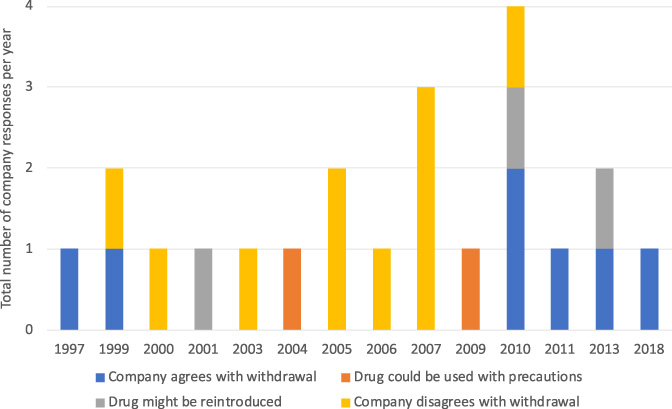
Company response to withdrawal by year of withdrawal.
In 10 out of 22 cases where a drug was removed from the Canadian market or had its license suspended since 1990 because of safety concerns and/or lack of effectiveness, the company disagreed with the decision and in 7 out of 22 cases it agreed with the decision. In another 5 cases the company felt that the drug could either have continued to be sold or hoped to bring it back onto the market. Therefore, over two thirds of the time, companies believed that the drug was either safe or effective enough to continue to be available to Canadian patients. The level of evidence used to make a decision did not seem to influence whether or not the company agreed with the decision, suggesting that the position that companies took was not based on agreement or disagreement with the evidence. There was not enough data to be able to determine if companies consistently agreed or opposed a decision to withdraw one of their drugs. Although the numbers are small, it appears that in recent years that companies are more likely to agree that the withdrawal of their drugs is justified.
Companies could have had multiple non-exclusive reasons for defending their drugs: a commercial motivation to see the drug brought back onto the market, defending the corporate image and integrity, a different scientific interpretation about the nature of the evidence used to withdraw the drug from the market and an agreement about the safety problem but a different assessment about the overall benefit to harm ratio of the drug. It was beyond the scope of this study to investigate whether any or all of these reasons apply.
Health Canada typically engages in interactions with companies before taking any action with respect to safety issues [10]. The frequent defense of the safety and efficacy of products by companies raises the question about what effect, if any, the positions taken by companies during interactions with Health Canada has on the eventual safety communications that Health Canada issues. Documents released by the Food and Drug Association (FDA) show that Janssen engaged in “extensive” efforts with the FDA over the wording of a safety warning about the risk of lower limb amputation associated with the use of canaglifloxin. Due to the redaction of large sections of the document it is not possible to know how extensive the changes in the safety warning were [11].
Limitations
There were no company statements that could be found for 8 of the 30 withdrawn drugs. In 11 of the 22 cases the company statements only applied to the Canadian situation and companies may have had different views about the same drug in other countries, i.e., they may have opposed the withdrawal from another country’s market but agreed with the withdrawal from the Canadian market. The difference in the position of the company could reflect factors such as the greater risk of litigation in another jurisdiction and/or differences in how a drug is used. It is possible that the lack of any statement by the company for 8 drugs could indicate that the company agreed with the withdrawal. In that case, the company would have agreed with the withdrawal decision 50% of the time. Finally, there is no way of verifying that notices of all drug withdrawals from Canada have been posted on the Recalls and Safety Alerts website.
Conclusion
Companies frequently disagree with the decision to withdraw a drug because of safety concerns or lack of effectiveness. Information from the US shows that these disagreements might compromise messages about safety. Further research should be undertaken to determine the extent to which companies defense of their products affects safety communications to healthcare professionals and/or the public.
Footnotes
Acknowledgements
Catherine Oliver assisted in the data interpretation.
Conflict of interest
(1) Associations with commercial entities that provided support for the work reported in the submitted manuscript (the timeframe for disclosure in this section of the form is the lifespan of the work being reported).
None.
(2) Associations with commercial entities that could be viewed as having an interest in the general area of the submitted manuscript (in the 36 months before submission of the manuscript).
In 2017–2020, Joel Lexchin received payments for writing a brief in an action for side effects of a drug for Michael F. Smith, Lawyer and a second brief on the role of promotion in generating prescriptions for Goodmans LLP. He receives royalties from University of Toronto Press and James Lorimer & Co. Ltd. for books he has written.
(3) Any similar financial associations involving authors’ spouses, partners, their children under 18 years.
None.
(4) Non-financial associations that may be relevant to the submitted manuscript.
Joel Lexchin is currently a member of research groups that are receiving money from the Canadian Institutes of Health Research and the Australian National Health and Medical Research Council. He is a member of the Foundation Board of Health Action International and the Board of Canadian Doctors for Medicare.
Funding
There was no funding associated with this study.
