



Abstract
BACKGROUND:
People with disabilities experience longstanding barriers to employment. However, beyond the conventional metrics of labor force participation or unemployment rates we know very little about the workplace experiences of people with disabilities.
OBJECTIVE:
This study describes findings from the 2015 Kessler Foundation National Employment and Disability Survey (2015 KFNEDS), a nationally representative survey of Americans with disabilities.
METHODS:
A dual-frame, random digit dial, nationally representative survey was conducted. Survey respondents included 3013 working age adults with a disability. Survey respondents were asked about disability, employment status, job search activities and workplace experiences.
RESULTS:
Over 42% of survey respondents were currently working. 68.4% were striving to work characterized by job preparation, job search and/or participation in the workforce since the onset of their disability. Although some barriers persisted in the workplace, many were able to overcome the same. Overall, 47.8% of the respondents used workplace accommodations, 45.3% were satisfied with their jobs, 86.6% felt accepted in their workplace.
CONCLUSION:
The 2015 KFNEDS highlights how people with disabilities strive to work and overcome barriers, a discourse largely overlooked in contemporary disability and employment research. Survey findings can inform new programs and policies to improve employment outcomes for people with disabilities.
Introduction
Work is a highly valued activity that provides opportunities to engage in meaningful activity, socialize with others, and achieve economic self-sufficiency. People with disabilities experience pervasive and persistent barriers to employment, resulting in consistently lower employment rates, fewer hours worked, and lower wages compared to people without disabilities (Bureau of Labor Statistics, 2013; Houtenville, Brucker, & Lauer, 2014; Konrad, Moore, Ng, Doherty, & Breward, 2013; Pagán & Malo, 2009; Schur, 2003). Several national, population-based surveys provide evidence to support this employment disparity (Bureau of Labor Statistics, 2014), but beyond the conventional metrics of employment to population ratio, labor force participation and unemployment, less is known about the experiences, strategies, and resources required to sustain people with disabilities in paid employment on a national level.
Reliable data are needed to document what people with disabilities are actively doing to seek and maintain employment, advance in their careers, and improve their overall employment potential. Addressing this need, this paper reports findings from a nationally representative survey; the 2015 Kessler Foundation National Employment and Disability Survey (2015 KFNEDS) which examined the ways in which people with disabilities strive to work and identified strategies used to successfully overcome barriers to employment. It is anticipated that the findings from the 2015 KFNEDS will inform programs and practices that support employment goals and improve the employment outcomes of people with disabilities.
Background
Employment disparities and barriers to employment
Compared to people without disabilities, people with disabilities have long experienced employment gaps, as evidenced by poorer labor force participation, unemployment, underemployment, lower wages earned, and lower educational attainment (Bureau of Labor Statistics, 2014; Houtenville et al., 2014; Schur, 2003; Yelln & Trupin, 2003; Yin, Shaewitz, & Megra, 2014). People with disabilities generally work in lower paying jobs that offer limited opportunities for advancement and have less job security (Baldwin & Johnson, 2006; Gunderson & Lee, 2015; Kruse, Schur, & Ali, 2010; Maroto & Pettinicchio, 2014; Schur, Kruse, Blasi, & Blanck, 2009). Factors associated with employment disparities experienced by people with disabilities can be broadly classified as (1) individual factors such as a person’s health and functional capacity (van Campen & Cardol, 2009), work skills (Hernandez, Cometa, Velcoff, Rosen, Schober, & Luna, 2007), and career interests (Ali, Schur, & Blanck, 2011); (2) environmental or contextual factors such as trends in the labor market (Fogg, Harrington, & McMahon, 2010; Kaye, 2010), employer characteristics including commitment to hire and accommodate people with disabilities (Peck & Kirkbride, 2001); and (3) social and policy related factors such as stigma and prejudice against disability (Brostrand, 2006), the safety net of unemployment benefits (Burkhauser & Daly, 2011), and lack of accessible transportation (Hernandez, et al., 2007).
Individual barriers
Employment outcomes for people with disabilities can vary by individual characteristics such as age, gender, race, ethnicity, marital status, and educational attainment (Sevak, Houtenville, Brucker, & O’Neill, 2015). The presence of a disability at older age poses an increased risk for unemployment (Ipsen, 2006). Older persons with a disability are more likely to be discriminated against in hiring decisions and denied workplace accommodations (Cichy, Li, McMahon, & Rumrill, 2015). Lack of education or training can also negatively influence employment rates and wages earned (Fogg, et al., 2010; Hernandez, et al., 2007; Kaye, 2010). However, most job seekers with disabilities perceive the nature of their disability as the primary barrier to employment (Kessler Foundation/National Organization on Disability, 2010; Kruse et al., 2010; Bureau of Labor Statistics, 2013) and are less likely to recognize the role of social, environmental, and contextual factors that cause unemployment.
Environmental and contextual barriers
Shifts in the labor market account for some of the employment disparities experienced by people with disabilities (Chan, Strauser, Maher, Lee, Jones & Johnson, 2010; Chan, Wang, Ditchman, Kim, Pete, Chan, & Dreis, 2013). For example, surveys of employers and human resource professionals indicate that hiring of people with disabilities can vary depending on the type of industry, size of the organization, and managers’ previous experience with persons with disabilities (Katz and DeRose, 2010; Erickson, von Schrader, Bruyère, VanLooy, & Matteson, 2014; Fraser, Johnson, Hebert, Ajzen, Copeland, Brown, & Chan, 2010). Managers in small- and large-sized companies view hiring of persons with disabilities as a risk, and they are fearful of legal complications, loss of revenue, and costs associated with providing reasonable accommodations (Erickson, von Schrader, Bruyère, VanLooy, & Matteson, 2014; Hernandez, et al., 2007; Schur, Nishii, Adya, Kruse, Bruyère & Blanck, 2014). In fact, Brohan et al. (2012) reported that job seekers with mental illness who request a modification or accommodation during the hiring process were less likely to be hired than others.
Social and policy barriers
Perhaps one of the most well -researched policy-related barriers to employment is the structure of unemployment safety net programs in the United States. The Social Security Disability Insurance (SSDI) program has been linked with decline in employment rates, especially for low-skill and low paying jobs (Autor & Duggan, 2003; Burkhauser & Daly, 2011; Duggan & Imberman, 2009). Participation in SSDI or the Social Security Income (SSI) programs may serve as a disincentive for unemployed individuals with disabilities (Houtenville & Brucker, 2013). Compared to people without disabilities, the unemployment rate for people with disabilities was five times higher in during the Great Recession of 2007–2009 (Bureau of Labor Statistics, 2012; Mitra & Kruse, 2016). Recovery from the effects of this recession was more challenging for people with disabilities with many exiting the labor force and fewer people returning to the labor force post-recession (Kaye, 2010; Livermore & Honeycutt, 2015).
Social barriers also persist, as employers continue to view people with disabilities as being unfit and unable to perform the job (Brostrand, 2006; Schur, et al., 2009). Stigma and negative attitudes of employers toward people with disabilities are major barriers, reported by as many as one-third of people with disabilities (Bureau of Labor Statistics, 2013; Erickson et al., 2014). A common misconception among managers and administrators is that people with disabilities are not capable of holding strong leadership positions within an organization (Peck & Kirkbride, 2001). As a result, people with disabilities are rarely considered for career development and advancement opportunities, especially for leadership positions (Roulstone & Williams, 2014; Wilson-Kovacs, Ryan, Haslam, & Rabinovich, 2008).
Overcoming barriers to employment
While it is well documented that persons with disabilities experience multiple barriers in job seeking and working, the research rhetoric has almost exclusively focused on the barriers or factors that hinder persons with disabilities achieving their employment goals. However, the experience of barriers is only part of the story. People with disabilities are overcoming barriers, striving to work, and often successfully overcoming obstacles in their paths. For example, in the recent survey, over 80% of employees with disabilities reported feeling comfortable disclosing their disability to their employers and co-workers (Bureau of labor Statistics, 2012). While decisions to disclose disability are personal, individuals take into consideration organizational policies, practices and culture within their workplace. Also, a certain level of self-advocacy and social interaction is required to achieve successful integration in the workplace (Dunstan & Maceachen, 2014; Hill, Maestas, & Mullen, 2016; Jans, Kaye, & Jones, 2012; Nevala, Pehkonen, Koskela, Ruusuvuori, & Anttila, 2015). Factors such as co-worker and employer attitudes, knowledge of disability, supports and accommodations have been consistently associated with overcoming barriers and experiencing positive workplace outcomes (Gates, 2000; Lacaille, Sheps, Spinelli, Chalmers, & Esdaile, 2004; Rivilis, Van Eerd, Cullen, Cole, Irvin, Tyson, Mahood, 2008; Varekamp, Verbeek, de Boer, van Dijk, 2011).
Unfortunately, the few studies that focus on facilitators of employment are limited to surveys based on convenience samples for specific sub-populations of people with disabilities or case studies and narrative design (Lock, Jordan, Bryan, & Maxim, 2005). Moreover, many of the studies on employer perspectives are field experiments or small-scale regional surveys (Ameri et al., 2015; Chan et al., 2010). The field lacks crucial information on the specific mechanisms and strategies persons with disabilities use to find jobs, request accommodations and successfully navigate challenges in the workplace (Gewurtz & Kirsh, 2008) and several questions remain unanswered. For example, to what extent do persons with disabilities use formal channels by approaching human resources professional to request an accommodation? Or, how often do they use informal social interactions to ask for accommodations or support? What activities do people with disabilities undertake to prepare for entry into the labor force? What strategies have been successful or unsuccessful in job search? Such information would be vital in designing regional and national programs and policies that aim to reduce employment disparities and increase employment opportunities for people with disabilities. In short, there is an urgent need to better understand how people with disabilities are striving to work and overcoming barriers.
Purpose
The overarching purpose of this study is to describe the findings from the 2015 KFNEDS as a nationally representative, scientifically rigorous means of exploring the experiences of Americans with disabilities in finding and maintaining employment. The 2015 KFNEDS survey looks beyond the common metrics of employment such as Social Security program enrollment and labor force participation to document the things people with disabilities are actively doing as they strive to overcome barriers and succeed at work. By asking survey respondents about successful employment strategies implemented by themselves and their employers, the survey seeks to change the discourse from one of experiencing barriers to that of overcoming barriers and striving to work.
Methods
Questionnaire design
A multidisciplinary team of researchers at the University of New Hampshire developed the survey questionnaire in consultation with Kessler Foundation and with input from an external advisory board. The initial pool of survey items included disability- and employment-related questions from several national survey instruments such as the Current Population Survey (CPS), the CPS-Disability Supplement (CPS-D), Veteran’s RAND 12-Item Survey, National Beneficiaries Survey, American Community Survey (ACS), Canadian Survey on Disability (CDS), and Head Start Family and Child Experiences Survey (FACES). The research team systematically eliminated questions by judging their merits against the overall purpose of the survey. Questionnaire drafts were reviewed and revised for redundancy, language sensitivity, clarity, and comprehensiveness before pilot testing.
The final version of the survey included 64 items: 10 eligibility questions to screen for the presence of a working-age person with a disability in the household; seven questions to select respondents and obtain consent; eight questions related to employment and disability status; five questions on employment status and history; six questions about job search activities; five questions about the workplace and workplace experiences, 10 questions specific to workplace accommodations, supports needed and used, and lastly, nine questions on demographic characteristics. Computer-assisted telephone interview software routed participants through appropriate subsets of the questions in order to best capture their current and past experiences.
For the 2015 KFNEDS, employment status was categorized as currently working, previously worked (but currently not working), and never worked. After determining employment status, respondents were asked if they were currently looking for a job, resulting in six groups: (1) currently working and not looking for a different job; (2) currently working and looking for a different job; (3) previously worked and not currently looking for a job; (4) previously worked and currently looking for a job; (5) never worked and not looking for a job; and (6) never worked and looking for a job.
For this study, striving to work was operationalized as any behavior that demonstrated active engagement in job preparation, job search, and/or participation in the workforce since the onset of disability. According to this definition, the following categories described individuals striving to work: (1) currently working, (2) looking for work, or (3) previously working since disability onset but not currently working or looking. The third category is included as a striving group for two reasons. First, it helps to dispel the notion that people with disabilities are idle or generally lack the ability or desire to find and maintain jobs. Second, it avoids underestimation of the prevalence of striving that may have stemmed from recent downturns in the economy and the disproportionate number of people with disabilities who lost jobs or were pushed from the workforce due to recession in the few years preceding the survey (Fogg, et al., 2010; Kaye, 2010).
Another key feature of the 2015 KFNEDS is how it addressed barriers to employment. Not only were respondents asked about the presence of certain barriers but also the extent to which they were able to overcome the same barriers. In addition, respondents were asked how they overcame the barrier and interviewers recorded the responses. This provided information about the prevalence of a particular barrier and its complexity. For example, it may be the case that a barrier is frequently faced but also frequently overcome, whereas another obstacle could be cited less frequently but pose greater difficulties for people with disabilities. With such information, interventions can be targeted more purposefully to areas that represent either a relatively easy fix or to problems that will likely require more effort, more resources, and more sophisticated solutions.
Disability screening
One of the most challenging aspects of disability-related survey research is identifying individuals with disabilities within the civilian household sample. For the present study, disability was defined as experiencing a difficulty in one or more of the following areas: hearing, vision, ambulation, and cognition. The disability inclusion criteria were based on a modified version of the disability screening questions used in the ACS and CPS. The full version of the questionnaire is available at < http://kesslerfoundation.org/kfsurvey15>. The ACS-modeled questions related to serious difficulty hearing, serious difficulty seeing even when wearing glasses, serious difficulty walking or climbing stairs, and serious difficulty concentrating, remembering, or making decisions.
Given current research suggesting that these ACS questions may fail to identify some individuals with these difficulties (Burkhauser, Fisher, Houtenville, & Tennant, 2014), additional prompts were added in order to readily identify a larger sample. For example, a negative response to the ambulatory difficulty question prompted an additional question about walking a particular distance (difficulty walking a quarter of a mile or about three city blocks). A negative response to the cognitive difficulty question prompted additional questions about learning disabilities (a condition that makes it difficult in general for you or them to learn such as attention problems [ADD], hyperactivity [ADHD], or dyslexia), mental health conditions (an emotional, psychological or mental health condition such as anxiety, depression, bipolar disorder, substance abuse, anorexia, or other conditions), and developmental disabilities (developmental disability or disorder, such as Down syndrome, autism, or Asperger syndrome). Furthermore, the disability screen included a question about difficulty in upper-body function (difficulty in lifting, carrying, bending or manipulating small objects), and an open-ended question designed to capture disability types not previously addressed. The open ended question also allowed participants to specify their disability or condition. When respondents reported more than one type of disability, they were asked to identify their most limiting disability, and subsequent survey questions were stemmed based on the most limiting disability.
Sampling
The sampling frame for the survey was households with a landline telephone and/or cell phone. A random digit dial (RDD) sampling frame from 50 states and the District of Columbia was used. A list of telephone numbers was obtained with roughly 50% landline and 50% cell phone numbers, which minimized potential non-coverage bias for households that use cell phones exclusively (Brick, Dipko, Presser, Tucker, & Yuan, 2006). Non-working, disconnected, and business numbers were not included in the list in order to reduce calls to unusable numbers.
In an effort to reduce the number of dials and improve response rates, an initial pre-screening letter with a self-addressed return envelope was sent to all households in the sampling frame, when a mailing address was available. The pre-screening letter included questions about ages of the members in the household and the presence of any disability or health condition in the household. Households that returned the pre-screening letter and met initial eligibility criteria were placed on a higher priority for the survey interview. Households that returned the pre-screening letter and did not meet the eligibility criteria were removed from the calling list.
The sampling strategy sought households that included at least one person between the ages 18 to 64 (also referred to here as working-age) who experienced a disability. Interviews were completed with 3,013 working-age persons with disabilities from 117,871 selected telephone numbers. Interviews were partially completed with 12 working-age persons with disabilities; these interviewers were not included in the analyses. Enough information was obtained from an additional 3,977 households to identify them as containing a working-age person with a disability, but these households could not be interviewed for various reasons, such as refusal and disconnections. No information was obtained from the remaining 110,869 telephone numbers. Given an estimated disability prevalence rate of 13% in the US (Houtenville, Brucker, Lauer, 2016), it may be assumed that approximately 15,522 of these 110,869 telephone numbers would have yielded an interview with a working-age person with a disability. Thus, this sampling strategy achieved a response rate of 13.4%, using American Association for Public Opinion (AAPOR) Response Rate 3 definition (i.e., 3,013 / [3,023 + 12 + 3,977 + 0.14 * 110,869]).
Data collection
Trained professional interviewers at the UNH Survey Center and Penn State Survey Research Center conducted the telephone interviews between October 17, 2014, and April 23, 2015. The average interview length was 18 minutes. If the number called was not a residential one, it was discarded and another random number was called. If the number was residential and the household was eligible to participate (i.e., at least one member of the household was working-age and had at least one disability), the interview proceeded. If the household had more than one adult member who met the eligibility criteria, the adult who had the most recent birthday was chosen to be the respondent; this ensured that every adult with a disability (between 18 and 64 years of age) in the household has an equally likely chance of being included in the survey.
If the selected adult was not at home, the interviewer made an appointment to call back when the selected adult was at home. In the event that the selected adult was unable to answer for himself/herself, a proxy was selected based on the person in the household with the most knowledge about the selected adult’s work experiences. Of the 3,013 interviews completed, 18% were through proxy respondents because the person with the disability was unable to complete the telephone interview independently.
Data analyses
Data analyses were conducted using the Complex Samples Module of IBM SPSS Statistical Software version 23. The data were weighted to account for known biases of telephone surveys (i.e., data were weighted by the number of working-age adults with disabilities and the number of telephone lines within households) to equalize the chances that any one working-age adult with a disability would be selected for inclusion. The data were also weighted by respondent sex, age, race, and region of the country. The estimates presented in the results section and in the data tables are based on weighted frequencies. A research assistant conducted content analysis of the qualitative data obtained through open-ended survey questions. For each open-ended question, responses were coded and categorized into broad themes. The first author conducted an independent review of the categories and themes identified by the research assistant.
Results
Sample characteristics, disability type, and employment status
To demonstrate how the 2015 KFNEDS sample compares to the US population of people with disabilities, Table 1 compares 2015 KFNEDS disability prevalence estimates to results from the 2014 ACS. Of those with hearing, vision, ambulatory, and/or cognitive difficulty in the ACS, 20.6% had hearing difficulty, 18.9% had vision difficulty, 52% had ambulatory difficulty, and 45.3% had cognitive difficulty. The 2015 KFNEDS sample was reasonably comparable. Of those with hearing, vision, ambulatory, and/or cognitive difficulty in the 2015 KFNEDS, 30.6% had hearing difficulty, 34% had vision difficulty, 56.6% had ambulatory difficulty, and 45.1% had cognitive difficulty.
Sample Comparison: 2015 KFNEDS and 2014 American Community Survey (ACS)
Sample Comparison: 2015 KFNEDS and 2014 American Community Survey (ACS)
In the 2014 ACS, the percent currently employed was 49% for those with hearing difficulty, 38.1% for those with vision difficulty, 23% for those with ambulatory difficulty, and 22.7% for those with cognitive difficulty. Similarly, in the KFNEDS, the percentages were 43.2%, 30.4%, 24.7%, and 27%, respectively. Of those reporting any of these four difficulties in the 2015 KFNEDS, 25.6% were currently working compared to 45.2% in the ACS.
Table 2 provides demographic, socioeconomic, and employment characteristics by disability type for all respondents of the 2015 KFNEDS sample. Overall, 48.9% of the sample were male, 36.4% were between the ages 55–64, which was the largest age group represented; 27% were 45–54 years old; 15.4% were 35–44 years old; 12.4% were 25–34 years old and 8.7% were 18–24 years old. About 79% were White; 16.6% were Black; 6.7% were people of Hispanic origin. Many people had some college experience (27.5%) or were college graduates (22.1%).
Demographic, socioeconomic, and employment characteristics by disability type for all employees
Among the disability types, vision difficulty was the lowest reported at 21.7%, and cognitive difficulty was the most frequently reported type of disability (63.2%). Of course, individuals may experience more than one type of disability. Of the total sample, 64.6% reported multiple disabilities (23.4% had two disabilities, and 41.2% had three or more disabilities). Among the five types of difficulties identified, cognitive difficulty was most frequently reported as the most limiting disability (26.9%) followed by lower limb mobility difficulties (24.1%).
In terms of employment status, 42.6% of the respondents were currently working, 51.5% were not working but had worked previously, and 5.9% never worked (Table 3). A substantial proportion (21.4%) of people with disabilities were looking for work. Among people currently working, 12.7% were looking for a different job, while 29.9% of people who were not currently working but had previously worked were looking for new employment. People with disabilities who had never worked were the least likely to look for work (0.8%) (Table 3).
Employment status (percent)
*Previously worked and currently not working.
Regarding disability types, vision difficulty was the lowest reported at 21.7%, and cognitive difficulty was the most frequently reported type of disability (63.2%; Table 4). Of the total sample, 64.6% reported multiple disabilities; 23.4% had two disabilities, and 41.2% had three or more disabilities. It should be noted that respondents may experience more than one type of disability and therefore categories reported in Table 4 are not mutually exclusive.
Disability type (percent)
An examination of employment status by disability type (Table 5) shows that people with hearing difficulty (as their most limiting disability) were most likely to be currently working (75.5%), and people with lower limb mobility (as their most limiting disability) were least likely to be working (29.6%).
Employment status by most limiting disability (percent)
Information on employment status, job search activities, and onset were utilized to define and estimate the degree to which people with disabilities are striving to work. As shown in Fig. 1, 68.4 % of survey respondents were striving to work. The striving group is comprised of individuals who are currently working (42.6%), those not currently working but who have worked since disability onset (23.5%), those who have not worked since disability onset but are currently looking for work (1.5%), as well as those who have never worked but reported looking for work (0.8%).
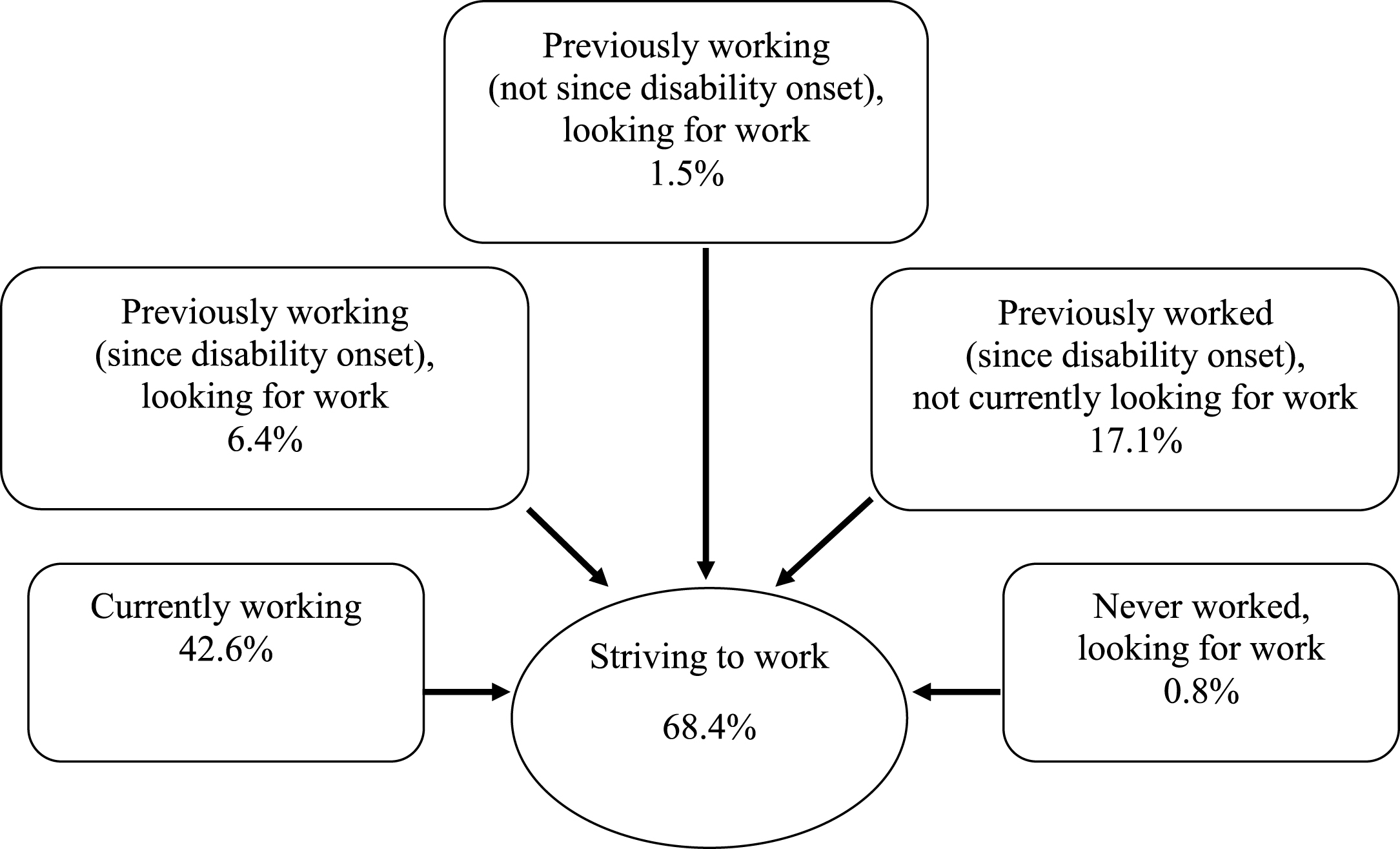
Striving to work. The infographic depicts five squares——with the text, “Currently working, 42.6 percent,” “Previously working (since disability onset), looking for work, 6.4 percent,” “Previously working (not since disability onset), looking for work, 1.5 percent,” “Previously working (since disability onset), not looking for work, 17.1 percent,” and “Never worked, looking for work, 0.8 percent.” All squares have an arrow, pointing to a center circle, “Striving to Work, 68.4 percent.”
The onset of disability very likely affects the degree to which an individual is able to make adjustments to the work place environment, and thus it is important to consider when investigating labor market and workplace issues. In the 2015 KFNEDS, 27.2% reported disability beginning in childhood, 49% beginning in adulthood while at work, and 21.6% beginning in adulthood while not a work. As shown in Table 6, people with work related disabilities acquired during adulthood were the largest group (49%). People with non-work related, adult onset disabilities were most likely to have worked previously but not currently.
Onset of disability or health condition (%)
Many Americans with disabilities continued to work full-time despite their functional difficulties or age. About 13.6% of currently-working Americans with disabilities worked 60 or more hours per week, and another 20.8% worked more than 40 but less than 60 hours a week. Among people who were currently working, about 40.6% pointed out that they would like to work more hours.
Table 7 shows the approaches being used for job preparation. Conventional approaches such as obtaining medical or rehabilitation treatment were the most frequently used approach by Americans with disabilities to prepare for employment (72.7%). People with disabilities also had a strong tendency to rely on informal networks such as family and friends to assist with job preparation (62.4%). Pursuing vocational/job skills training and obtaining assistive devices/special equipment were not frequently used approaches (25.6% and 22.5%, respectively). Many people used more than one strategy to prepare for jobs; 92.9 % used one or more strategies; 9 % used only one; 18 % used two; 16.4% used three; 13% used four and; 35.7% used five or more strategies.
Approaches used for job preparation among people with disabilities currently not
working
Approaches used for job preparation among people with disabilities currently not working
Table 8 shows the approaches used to look for jobs and the percentage of people reporting use of each approach, among those who people not currently working. Americans with disabilities most frequently relied on online sources (76.7%) and familiar informal networks such as family and friends (68.1%) to look for jobs. Another job search strategy reported by many (61.2%) was to contact the employer directly. There was limited use of community and governmental resources such as vocational rehabilitation programs in the actual job search process. An indicator for the intensity of job search is the number of strategies used in the search: 92.9 % used one or more strategies; 13.2 % used only one; 17.3 % used two; 25.9% used three; 18.5% used four and; 18% used five or more strategies.
Approaches used to search for jobs among people with disabilities not currently
working
Approaches used to search for jobs among people with disabilities not currently working
Job seekers were asked about the challenges they faced while looking for jobs and whether they succeeded in addressing any of those challenges (Table 9). About 41.1% of job seekers expressed that not having enough education or training was a barrier, followed by 36% who indicated that employers incorrectly assumed that they could not do the job because of their disability. A small percentage of people experienced discouragement from family members (10.4%), however, it was the easiest barrier to overcome with 63.1% able to negotiate with their family members the importance of working. Lack of transportation and lack of education and training were also easily addressed by job seekers. The barriers that were least likely to be overcome by those who faced them were denial of health insurance or work-related benefits (19.8% faced this barrier, of which only 16.3% of these overcame it) and lack of job counseling (21.6% faced the barrier, of which 23.6% people overcame it).
Barriers people with disabilities faced and overcame during the search for work (%)
Americans with disabilities looking for work were also asked about their need for workplace accommodations (Table 10). The top two accommodations that respondents indicated they would need once they found jobs included flexible schedule (49.6%) and modified job duties (35.6%).
Accommodations used at work by currently or previously working people with disabilities
Table 11 presents a summary of barriers faced by people with disabilities at work. At the workplace, getting lower pay than others in a similar position was the most frequently reported barrier (16.5%), followed by negative attitudes on the part of the supervisor (15.7%) and co-workers (15.5%). Similar to job seekers, workers with disabilities reported negotiating with family members and obtaining transportation as the most frequently overcome barriers (64.3%). Not having workplace accommodations were reported as a barrier by 11.4% of the people, of which more than half (57.4%) were able to overcome it.
Barriers people with disabilities faced and overcame at work (%)
Barriers people with disabilities faced and overcame at work (%)
Fewer than half (47.8%) of respondents used some type of accommodations at their workplace. Table 12 shows the types of accommodations used and the percentage of respondents reporting use of each one. The top two accommodations needed by people with disabilities currently working were flexible schedules (28.4%) and modified job duties (14%). Flexible schedule included flexible start and end times, the option to work at home and take more breaks. Modified job duties included reduced hours, light duty and less demanding job tasks.
Accommodations used at work by currently or previously employed individuals
Encouragingly, most respondents (68.4%) reported that their employers provided most or all of the supports or accommodations they needed to continue working. Availability of accommodations for current workers was considerably higher (34.8%) than accommodations provided to people who were previously working (14.9%).
Overall, 45.3% of people who currently work or previously worked were highly satisfied with their jobs. As shown in Table 13, job satisfaction rates, were slightly higher among those who previously worked (25.0%) in comparison to current workers (20.3%).
Job Satisfaction and perceived work potential of people with disabilities
Job Satisfaction and perceived work potential of people with disabilities
Americans with disabilities who were currently working did not believe that their disability made it difficult for them to advance in their career (Table 13). However, people who previously worked perceived disability to be a limiting factor in finding jobs. Among previous workers, 34.8% identified their disability as a challenge in finding jobs compared to 8.0% of current workers who were looking for a different job.
When asked if they felt accepted within the workplace, most respondents (86.6%) reported that they felt accepted at their workplaces. Within each disability type the proportion that felt accepted or supported at work was as follows: hearing, 93.1%; vision, 95.8%; mobility, 87.2%; upper extremity, 82.9%; cognitive, 85.6%.
The 2015 KFNEDS was the first effort in recent years to conduct a nationally representative survey on employment experiences of people with disabilities. Findings from the survey provide up to date, comprehensive data on employment status, job search strategies, and barriers faced and overcome by job seekers and employees with disabilities. To our knowledge, the 2015 KFNEDS is one of the few national surveys that focuses on how people with disabilities strive to work and overcome barriers, a discourse that has been largely overlooked in contemporary disability and employment research.
Striving to work
A primary objective of the 2015 KFNEDS was to document ways in which people with disabilities strive to work. Our findings are consistent with previous research on the value and meaning of work for people with disabilities. Generally speaking, people with disabilities regard the importance of work very highly. However, they are portrayed as less capable or skilled and less willing to be part of the labor force (Foster & Wass, 2013; Holmqvist, Maravelias, & Skålén, 2012; Jammaers, Zanoni, & Hardonk, 2016). Subsequently, people with disabilities, as a group are likely to be viewed as a less viable or desirable group by employers who are making crucial hiring decisions. Findings from our national survey challenge this traditionalist view of people with disabilities and illustrate that people with disabilities are striving to work and overcoming barriers to job search and on the job. Americans with disabilities strive to work by actively looking for work, taking steps to prepare for work, wanting to work more hours, sustaining work, and successfully negotiating barriers while looking for work and at work. One survey respondent demonstrated resilience and persistence when he “just showed up for work every day” because “if you didn’t show up for work, they would just replace you.” Another remarked, “I just showed up to work. I did it for 12 years.” Although, showing up for work may seem insignificant, doing so consistently in the face of multiple, persistent barriers illustrates how Americans with disabilities strive to work. The striving behavior is also reflected in the words of the participants who confronted their employers and “told them that they [employers] were breaking the law,” “wrote (its) a-matter-of (letter) to my Lieutenant to hand to HR,” or by “communicating with the heads of the facility to get everything worked out.”
Americans with disabilities who were not working used multiple strategies to prepare themselves for the competitiveness of the labor market; one respondent reported, “I got involved in an accelerated job search program, I got dressed and ready to be interviewed every day. Every morning we reviewed our previous work from the day before.” Many others actively sought out training and education. Although these statements are not representative of the experiences of all survey respondents, it encapsulates and highlights how Americans with disabilities are striving to work and overcoming barriers.
Our findings did not support some of the frequently cited barriers in the literature such as transportation and lower educational attainment. Although many job seekers initially reported “lack of transportation,” “not enough training or education,” and “negative assumptions of employers” as barriers, majority of Americans with disabilities were able to overcome the same. Respondents reported finding alternate means of transportation such ride shares with family members, public transportation and other personal strategies such as adjusting their medications so that they could drive.
Similarly, survey respondents often spoke of getting training and education that would further their employment goals such as enrolling in college level courses and completing certificate programs: “I’ve pursued other avenues of education. I’m in a teacher’s certification program, so I can become a teacher, as opposed to a full-time substitute”; “I went through vocational rehabilitation for training, for CNA and CMA. I passed all my trainings with As on all my tests and state boards.” Others spoke of the value of experiential training: “working for a company that will teach and train, more technical stuff… learning small engine repair.” A small percentage of people (10.4%) reported experiencing discouragement from friends or family to pursue employment, however 63.1% of those who experience that barrier were able to overcome the same. For example, when asked about the family’s role in their work, one participant mentioned “(I) talked about it- about the fact the worst part of my disability comes and goes and I have to work around it and explain that its going be here and I’m going to have to do what I have to do, and work around it.”
With regards to job search experiences, people with disabilities had a tendency to use personal networks such as family and friends or contact employers directly rather than using vocational rehabilitation service providers and community-based agencies. Such strategies may be the first step in job search for many people who experience disabilities or chronic conditions. The use of personal connections and networking allows individuals with disabilities ensure that the workplace would be supportive of them and also because having personal connections might mean that someone is available to vouch for their own ability to perform the job tasks (Jans et al. (2012).
Given the small percentage of individuals sought the help of disability service organizations to find work, vocational rehabilitation and community agencies should expand their services and outreach to include individuals with disabilities or chronic conditions and their family members. With the passage of the Workforce Innovation and Opportunity Act (WIOA; 2014), there is one major opportunity for State Vocational Rehabilitation Agencies (SRVA) to reach more individuals with disabilities. This opportunity is related to regulations regarding pre- employment transition services for students with disabilities. Traditionally SVRA have an eligibility process that delays the provision of services to such an extent that it negatively impacts employment outcomes (Honeycutt & Stapleton, 2013). Under the pre-employment transition services regulations eligibility can be very simple and efficient. For example, SVRA counselors will only need to see an individual education plan or a 504-education plan for the student to be deemed eligible to receive services. By reducing the duration of wait times to receive services and streamlining the eligibility determination process, SVRA can further expand their reach to vulnerable subgroups such as transition age students and youth.
Implications for current workers
On the whole, working individuals with disabilities reported experiencing fewer barriers than those who were looking for jobs. Getting less pay than others in comparable positions and negative attitudes of supervisors and co-workers were the most frequently reported barriers. Barriers such as “employers assumed that you can’t do the job because of your disability” and “transportation,” which were previously frequently cited as barriers were not as prominent for working people with disabilities.
Based on our survey and previous studies (Schur, Kruse & Blanck, 2005; Vornholt & Uitdewilligen, 2013), there is strong evidence supporting the role of supervisors and co-workers in integrating and advancing the careers of people with disabilities. Survey respondents frequently mentioned that they had to discuss their disability and its implications with their supervisor or the human resources personnel. Respondents often “spoke directly to supervisor gave specific example of [her] issue,” “made people aware of the problem I had in learning, and we worked out a different way for me to do it.” For their part, employers accommodated needs by providing special training and not placing the same time restrictions on their employees with disabilities. For many Americans with disabilities, having a job is simply a first step in lifelong career success. In some instances, co-workers perceived the provision of workplace accommodations or flexible work arrangements as unfair or preferential and were less likely to be supportive of people with disabilities. One participant remarked about her situation with co-workers, “There were people who thought - here comes this person, she gets special treatment and gets to work on any machine she wants to, and they thought I was getting special privileges.” However, many were able to break the communication barriers and reach out to supervisors and co-workers.
More than 70% of survey respondents reported feeling comfortable disclosing their disability when necessary. Disability disclosure and subsequent conversations regarding disability can give employees an opportunity to create awareness regarding the disability and any impact it may have. As one survey respondent noted “[I] told them what the disability is and how it affects me. Rather than just saying it and assuming they knew, I had to teach them.” Lyons, Martinez, Ruggs, Hebl, Ryan, O’Brien, & Roebuck,al (2016) suggest that even for people with visible disabilities, there may be benefits to openly discussing their disability beyond gaining access to workplace accommodations. An individual who discloses a disability may be perceived as being more confident and competent and may have more opportunities to build a supportive relationship with their supervisors (Jans et al., 2012; Lyons et al., 2016; Von Schrader, Malzer, & Bruyere, 2014). As exemplified in the words of one participant, “[I] spoke openly and honestly with my boss, and she made the accommodation.”
Consistent with other studies, the most frequently requested and used workplace accommodation was flexible work arrangements (Department of Labor, 2014). In our survey, flexible work arrangements included flexible start and end times, the option to work at home and taking more breaks, if needed. Previous research has established the role of flexible work schedules in facilitating return to employment (Lock et al., 2005; MacDonald-Wilson, Rogers, Massaro, Lyass, & Crean, 2002; Nevala et al., 2015; Vedeler & Schreuer, 2011). Furthermore, for some individuals flexibility in work schedules can be synonymous with autonomy at work, a factor that has been strongly linked with job satisfaction and longer job tenure (Balser & Harris, 2008; Baumgärtner, Dwertmann, Boehm, & Bruch, 2015).
With regards to the experiences of previously or currently working people with disabilities, many reported feeling highly satisfied with their jobs, willing to disclose their disability, when necessary, and feeling accepted in their workplace. Considered together, all of these factors suggest a positive organizational climate and perceived potential to succeed in the workplace among employees with disabilities. This finding is in contrast to those who are looking for jobs, as many job seekers reported experiencing multiple, persistent barriers. Future research should clarify whether people with disabilities who have high levels of self-efficacy and self-advocacy are successful in getting a job or if they develop those skills in the workplace. In any case, increased opportunities for the employer and the employee to co-create and co-craft the workplace expectations can result in positive outcomes. For Americans with disabilities, engaging in conversations related to disability disclosure, accommodations request, and job demands allows them to craft workplace expectations.
Persistent challenges
Despite the many ways in which Americans with disabilities strive to work, several significant barriers to employment persist. “Being denied health insurance or other health benefits” was the barrier that most individuals found difficult to overcome. However, with the passing the Affordable Care Act, some reversal in this trend can be expected. One survey respondent commented “in 2012, I was able to get a part time job where I could get health insurance, but in 2014 Obama Care has been an unbelievably helpful resource - a lot of jobs don’t have health insurance as a benefit and I need health [insurance].” Some respondents also demonstrated a nuanced understanding of government benefits and the risks associated with losing benefits by “making sure I understand how government assistance worked.” At the same time, many others were not so successful in retaining their jobs or benefits. A family member reported, “they knew he could only work a certain amount of hours so they let him go.” Also, at the national level, it is unknown whether people with disabilities are denied benefits that are otherwise available to their non-disabled peers or if they systematically seek low-paying or part-time jobs that do not offer any benefits (Schur et al., 2009).
Consistent with previous studies, we observed that a higher percentage of people who had an adult-onset disability were working compared to those who acquired a disability during their developmental years (age 0–18). Early-onset disability may interfere with educational attainment, which in turn can affect employment opportunities. On the other hand, people with adult onset disability may have acquired and developed their work skills prior to the disability onset. In addition, their employers may have observed their work skills and behaviors prior to disability onset. One way to address the 2015 KFNEDS finding that more people with early onset disabilities have never worked than those with adult onset disabilities is through the provisions of the Workforce Innovation and Opportunity ACT (WIOA) that was passed in 2014 with regulations available in 2016. The WIOA is requiring State Vocational Rehabilitation Agencies (SVRA) to devote 15% of their Federal funds to focus on the transition of students and youth with disabilities from school to postsecondary education and employment. With these funds SVRA are to provide, or to arrange for the provision of, pre-employment transition services for students with disabilities transitioning from school to postsecondary education and employment in competitive integrated settings, and these services are to be coordinated with local educational agencies. Pre-employment transition services can be provided in group settings or individually and include: job exploration counseling; work-based learning experiences; counseling for enrollment in comprehensive transition services or postsecondary education; workplace readiness training focusing on social skills development and independent living and; peer mentoring and instruction in self-advocacy.
Our findings concur with preliminary, qualitative evidence that suggests that people with disabilities are able to overcome barriers related to misperceptions of employers by either openly discussing or downplaying their disability during the hiring process (Jans et al., 2012; Lyons et al., 2016).
Limitations
Some limitations of the study must be noted. The 2015 KFNEDS did not include self-respondents who had severe cognitive impairments or communication difficulties; proxy respondents were used instead. Proxy respondents were also used for people who had difficulty speaking English or speaking on the telephone. Also, our survey did not collect detailed responses from the individuals who were not working and not looking for jobs. Unfortunately, this sub-group continues to experience barriers to employment. Future surveys should delve deeper into experiences of persons disengaged from labor force participation and explore factors that may help them overcome barriers to employment.
Conclusion and future directions
The 2015 KFNEDS highlighted ways in which people with disabilities strive to work and overcome barriers. The survey findings challenge assumptions that portrays people with disabilities as passively experiencing barriers to employment. Despite persistent barriers, people with disabilities are actively engaging in job preparation and job search activities and successfully negotiating barriers at work. Improving employment outcomes for people with disabilities needs to be a multi-faceted effort. Besides social and policy changes, employer training to hire and integrate people with disabilities is imperative. Lastly, people with disabilities need more opportunities to improve their work related self-efficacy and develop positive coping mechanisms. Concerted efforts aimed at improving the self-advocacy of people with disabilities, supporting family members and friends in job search efforts, and training of coworkers and supervisors is vital in reshaping the future of Americans with disabilities.
Although the target population for the 2015 KFNEDS was people with disabilities, our findings will have far reaching impact on the entire disability community and its stakeholders. For example, future analysis of the successful strategies used by current workers to request workplace accommodations can serve as the foundation for a grounded theory approach to design and modify programs and interventions to support the both employers and employees in using workplace accommodations. Employers may benefit from knowledge regarding the types of supports that are valued by employees with disabilities and utilization of this knowledge can subsequently lead to higher rates of job retention, employee job satisfaction, and in the long term creating a supportive organizational culture. Job seekers with disabilities may also benefit from a deeper understanding of how some of their peers navigate the challenging landscape of job search and job retention.
We anticipate that findings from the KFNEDS will contribute to the advancement of knowledge to further the development of new programs and practices that will ultimately improve the employment outcomes for people with disabilities. An analysis of data from the U.S. Bureau of Labor Statistics shows that people with disabilities can perform a large share of new jobs over the next ten years (Kruse et al., 2010). Yet, this workforce remains largely untapped. By focusing on the positive experiences and successful outcomes of those who strive to work and overcome barriers, we add to the growing body of knowledge on best practices for people with disabilities. Future efforts should be directed toward developing timely intervention strategies and building vocational behavior theory for persons with disabilities.
Conflict of interest
None to report.
Footnotes
Acknowledgments
Funding for this project was made possible by grants from the Kessler Foundation and the National Institute on Disability, Independent Living, and Rehabilitation Research (NIDILRR) through its Rehabilitation Research and Training Center on Employment Policy and Measurement (H133B100030).