



Abstract
BACKGROUND:
The years leading up to age 18 are important for youth recipients of Supplemental Security Income (SSI) considering making human capital investments to prepare for the transition to adulthood.
OBJECTIVE:
This paper documents the employment and benefit outcomes of former child SSI recipients and estimates the association between vocational rehabilitation, vocational training, special education, and adult outcomes.
METHODS:
Multivariate analyses using linked survey and administrative data estimate the association between service receipt before age 18 and outcomes 13 years later, at ages 27 to 30, controlling for other factors.
RESULTS:
Vocational rehabilitation is associated with a 9 percentage point increase in the likelihood of earnings above the annualized substantial gainful activity level and a 13 percentage point decrease in the likelihood of SSI or disability insurance (DI) receipt between ages 27 to 30. In contrast, vocational training is associated with a 6 percentage point increase in the likelihood of SSI or DI receipt, while special education is not statistically significantly associated with any of the adult outcomes analyzed.
CONCLUSIONS:
Results suggest vocational rehabilitation improves long-term employment and economic independence, but confounding factors may contribute to the observed relationships.
Introduction
A growing body of literature documents the challenges youth with disabilities face in their transition to adulthood. In addition to ongoing health-related needs, youth must contend with change in the landscape of their supports. As adults, they may be charged with coordinating their medical services for the first time (Osgood et al., 2010). At the same time, accommodations or supports received through school or work decline, relative to supports available in secondary school (Newman et al., 2011). Youth with disabilities who receive Supplemental Security Insurance (SSI), a means-tested income maintenance program administered by the Social Security Administration (SSA), may face additional challenges related to poverty. Another factor is the pending age-18 redetermination, when SSA determines eligibility for continued receipt of SSI benefits under adult eligibility criteria.
In recognition of the difficulty child SSI recipients may have in the transition to adulthood, SSA has dedicated considerable resources to identifying services that may smooth the transition to adulthood and yield positive adult outcomes. Specifically, SSA implemented the Youth Transition Demonstration (YTD) in 2003 and joined with other federal agencies in the Promoting Readiness of Minors in SSI (PROMISE) demonstration, which started providing services in 2014. Broadly, both YTD and PROMISE seek to increase competitive adult employment and independence from SSA disability benefits for transition-age youth. The final evaluation of YTD provides evidence of positive short-term effects of the specialized services offered in some, but not all, demonstration sites (Fraker et al., 2014). Results from the evaluation of PROMISE are not yet available.
Evidence on the long-term relationship between youth services and adult outcomes is limited. One exception is research that estimates the relationship between participation in a private vocational training program targeted to urban youth with disabilities and long-term employment and earnings (Hemmeter et al., 2015). Although research has documented short-term relationships between adult outcomes and specialized programs like YTD and services available nationwide (Fraker et al., 2014, Loprest & Wittenburg, 2007, Hemmeter et al., 2009, Dean et al., 2015), short- and long-term relationships likely differ. On the one hand, short-term associations observed in early adulthood may be obscured by continuing education or regulations and statutes such as Section 301 of the Social Security Disability Amendments of 1980, which allows continued receipt of SSA disability benefits while participating in special education, vocational rehabilitation, or similar services. On the other hand, effects of youth services may diminish over time.
In this research, we study a cohort of child SSI recipients ages 14 to 17 and estimate their employment and SSA disability program participation outcomes 13 years later, at ages 27 to 30, as well as the association between youth service receipt and these outcomes. We focus on three nationally available services: vocational rehabilitation, vocational training (both an aggregate indicator of vocational training as well as five types of vocational training), and special education. We find that vocational rehabilitation is associated with several favorable adult outcomes. There is limited evidence of an association between general vocational training and favorable adult outcomes and no statistically significant relationship between special education and favorable adult outcomes.
Background
The SSI program provides a safety net for elderly people as well as other adults and children with disabilities who have low incomes and few assets. For a child, qualifying disabilities include medically determinable impairments that cause marked and severe limitations and can be expected to result in death or last for at least 12 continuous months. In addition, children must meet income and resources requirements, including part of the parents’ income and resources deemed as belonging to the child. See Davies et al. (2009) for a detailed discussion of SSI eligibility criteria. The income, resource, and medical criteria for award are stringent; fewer than 40 percent of disabled child claims for SSI in 2010 were approved (SSA, 2015). In 2016, children must have resources below $2,000 and earned income less than or equal to $1,551 to continue to qualify for federal SSI payments after the initial award.
In May 2016, SSI provided payments to approximately 1.3 million children with disabilities (SSA 2016). Payments are determined by income and resources available to an individual in each month. The maximum individual payment for SSI recipients in 2016 is $733 and the average payment for children is $646 (SSA 2016). All but four states (Arizona, Mississippi, North Dakota, and West Virginia) provide a cash supplement to the federal SSI payment amount. In addition, in 39 states and the District of Columbia, SSI recipients either automatically receive Medicaid or satisfy the Medicaid eligibility requirements. In the remaining states, most SSI recipients are eligible for Medicaid but some are not because the Medicaid means test is more stringent than SSI’s (Rupp & Riley, 2012).
Children may continue to receive SSI payments until age 18, when SSA redetermines their eligibility under the adult disability standard. The adult criteria are more stringent and, in 2010, SSA terminated the benefits of 42 percent of cases that underwent age-18 redetermination (SSA, 2015).
The years leading up to age 18 are an important time for children with disabilities to prepare for the transition from school to work or post-secondary education or training. Some youth will not receive disability benefits as adults and will need to find alternative means of financial support, such as earned income. In addition, supports for youth with disabilities are more accessible and easier to navigate than the adult supports (GAO, 2012). Adult services are decentralized, often unknown to the transitioning youth, and more frequently subject to delays and waitlists.
For child SSI recipients, the transition to adulthood includes uncertainty about the benefits of making human capital investments to prepare for their future. Precise statistics on the rates of adult receipt of SSI and DI among those who receive SSI as transition-age youth are not available. Previous research compiled longitudinal statistics by award cohort or age at award (Davies et al., 2009, Rupp et al., 2015). These statistics may not be representative of the adult experiences of transition-age youth; indeed, many child SSI recipients lose their benefits before reaching transition age (Davies et al., 2009). As a result, child SSI recipients may miscalculate the probability of receiving disability benefits in the future. In addition, some child SSI recipients may believe that making human capital investments signals their ability to engage in substantial gainful activity (SGA; inability to engage in SGA is a criterion of adult program eligibility) and lower their likelihood of receiving disability benefits in the future. Nonetheless, youth typically have more years than adults to benefit from returns on human capital investments.
Educational and vocational services have the potential to facilitate employment and independence from disability benefits. Indeed, the National Collaborative on Workforce and Disability for Youth’s transition framework (2009) highlights the importance of employment-related services and supports. With 12 percent of adults with disabilities citing lack of education or training as a barrier to employment, this lack is the second most commonly reported barrier, behind disability (BLS, 2013).
Several studies document the outcomes of transition-age youth with disabilities after service receipt. For example, studies by Berry and Caplan (2010) and Honeycutt et al. (2016) use administrative data from State Vocational Rehabilitation Agencies to track the outcomes of transition-age SSI recipients who received vocational rehabilitation services. These studies find that, two years after exiting vocational rehabilitation, these individuals are more likely to be employed than unemployed. Furthermore, about one in seven experiences benefits suspension due to work within four years after receiving vocational rehabilitation services. Literature reviews provided by Alwell and Cobb (2006) and Wittenburg and Maag (2002) provide additional examples. However, these studies do not document what outcomes would have been in the absence of these services and thus do not provide information on service efficacy.
Previous research identifies a short-term association between specific services and increased likelihood of employment in early adulthood. These studies generally measure associations by comparing outcomes for youth with disabilities who did and did not receive services, controlling for available characteristics. For high-school age youth with disabilities, several studies find that some services, such as school-based cooperative education, are associated with positive early adult employment outcomes (Shandra & Hogan, 2008; Lindstrom et al., 2013). However, one study, Carter et al. (2012), finds no statistically significant relationship between service receipt and short-term employment outcomes for youth with disabilities. Focusing on transition-age SSI recipients, Loprest & Wittenburg (2007) find that vocational training is associated with a 19 percentage point increase in the likelihood of employment rates at ages 19 to 23.
A smaller number of studies identify the causal impact of specific vocational services and short-term adult outcomes. These papers apply econometric methods to program data or use random assignment to establish the counterfactual outcomes for service recipients and identify the impact of vocational services on studied outcomes. Using program data, Dean et al. (2015) find that the Post-Secondary Education and Rehabilitation Transition program in Virginia, which develops targeted plans for vocational rehabilitation and school-based services, has a positive impact on employment rates and quarterly earnings. An evaluation of YTD, which provided up to 18 months of services (along with SSA program waivers) to randomly assigned volunteers, finds evidence of positive impacts on paid employment or annual earnings in four of the six sites through the three years after enrollment, when former participants were ages 17 to 28 (Fraker et al., 2014).
There is also evidence on short-term associations between services and another outcome: disability benefit receipt. Loprest & Wittenburg (2007) find no statistically significant associations between past receipt of special education or vocational training and SSI receipt at ages 19 to 23. The authors also find that vocational rehabilitation was associated with an increase in the likelihood of SSI receipt at the same point in time. They hypothesize that the finding may result from SSI policy that grants continued eligibility to those participating in certain vocational rehabilitation activities. In a separate study, Hemmeter et al. (2009) find that vocational training was associated with an increased likelihood of SSI receipt at age 19. They note that training receipt may indicate a connection to supports (such as secondary education) that help maintain SSI. Nonetheless, these findings are in opposition to the notion that vocational supports prepare youth for employment and reduce reliance on disability benefits. As both studies note, results may be confounded with continued service receipt and ongoing receipt of education. These factors are presumably less likely to influence outcomes later in adulthood.
The relationship between longer-term adult outcomes and service receipt is not well understood. To date, research has been hindered by limited data available to track long-term outcomes into adulthood. One exception is an evaluation of Bridges from School to Work (Bridges), a private program operating in nine urban sites providing job placement services to youth with disabilities. Hemmeter et al. (2015) find that youth who received SSI at age 17 and participated in Bridges were more likely to have any earnings, more likely to have earnings above the annualized SGA limit, and had higher average earnings at age 30 relative to SSI youth in the same zip code who did not participate in Bridges. The differences observed could reflect unobserved factors that influence the likelihood a youth participates in Bridges as well as any impact of participation on earnings.
Our research adds to the small body of work on the long-term associations between youth service receipt and adult employment and benefit outcomes. Our analysis focuses on former youth SSI recipients and estimates the association between services available nationwide to youth with disabilities and outcomes 10 or more years into adulthood.
Data and methodology
Data
Linked survey and administrative data provide information on youth service receipt and long-term outcomes. The National Survey of SSI Children and Families (NSCF) is a nationally representative survey of noninstitutionalized children and young adults who were current or former SSI recipients. Fielded between August 2001 and July 2002, the NSCF includes information not available in administrative data, including details on service receipt at and before the time of the survey. The survey also provides information on health and functional status as well as characteristics of a youth’s family not available in administrative data. Importantly, the NSCF surveys a large sample of the target population compared to samples in most general social surveys (Ireys et al., 2004).
We use sample weights in the NSCF file to ensure that results are nationally representative of the sample of child SSI recipients ages 14 to 17 at the time of the survey. The weights account for the probability of selection into the sample and for nonresponse. We use the Taylor-Series linearization method to account for the complex sample selection procedure when calculating standard errors.
To track program and employment outcomes of former child SSI recipients into adulthood, we supplement the cross-sectional information in the NSCF by merging the survey with SSA administrative data sources. Our analysis uses 2014 administrative data—the most recent year for which all data sources were available—capturing outcomes 13 years after the NSCF was fielded. We use information on annual earnings in the Master Earnings File (MEF) to construct and analyze employment outcomes, including annual employment, earnings above three thresholds relative to the annualized SGA limit ($12,840 for non-blind beneficiaries in 2014), and average annual earnings. We also analyze three benefit outcomes: SSI receipt, Social Security Disability Insurance (DI) receipt, and SSI or DI receipt. The Supplemental Security Record (SSR) and Master Beneficiary Record (MBR) provide information on SSI and DI receipt, respectively.
Analysis sample
Our analysis sample includes children age 14 to 17 who completed the NSCF interview, were receiving SSI, and were not incarcerated at the time of the survey. We exclude respondents meeting these criteria who were deceased by 2014 according to the Master Files of SSN Holders and SSN Applications, representing 4.1 percent of observations who otherwise met the sample selection criteria. Our final sample includes 1,054 observations; when weighted, they represent 212,812 transition-age SSI youth.
Summary statistics in Table 1 indicate that the SSI program provides benefits to youth from economically disadvantaged households with significant functional limitations and health needs. According to the NSCF, over half (57 percent) lived in a household where one or both parents were unemployed or out of the labor force. Nearly 80 percent reported needing more services than others of the same age, 57 percent needed or received mental health treatment or counseling, and 23 percent needed help with personal care such as eating, bathing, dressing, or getting around inside the home. In addition, about 71 percent reported being limited or prevented in their ability to do things children of the same age can do. SSA administrative data indicate that 43 percent had a primary disabling condition of intellectual disability, 30 percent had a mental disorder, and 26 percent had a physical disability. These same data show that nearly half of the sample entered the SSI program between ages 5 and 10.
Beneficiary Characteristics and Service Receipt at Ages 14 to 17
Beneficiary Characteristics and Service Receipt at Ages 14 to 17
Source: Authors’ calculations using linked NSCF and SSA data files.
Table 1 also presents demographic statistics on our sample. At the time of the NSCF interview, the youth in our sample were more heavily concentrated toward the younger end of the age distribution; 28 percent were 14 at interview. Sixty-four percent were male and forty-six percent were black and not Hispanic.
Most former child SSI recipients in our sample were currently participating or had participated in special education (73 percent) at the time of the NSCF. Special education is defined by the Individuals with Disabilities Education Act (IDEA) as “specially designed instruction, at no cost to the parents, to meet the unique needs of a child with a disability” (34 C.F.R. §300.39). These services may be provided in a traditional classroom setting, a non-traditional classroom, at home, or an institutional setting such as a hospital. The NSCF includes several measures of special education; the measure we use in our analysis indicates whether the respondent has ever had an Individual Education Plan (IEP), which is an individualized written plan that documents the child’s learning needs and service plan. All youth who receive special education services are required to have an IEP.
Relative to special education, a notably smaller share received services from vocational rehabilitation (13 percent) or participated in vocational training (21 percent). State Vocational Rehabilitation Agencies (SVRAs) provide vocational rehabilitation services to people with disabilities to help them achieve employment-related goals. Services include assessment of vocational needs, development of an Individual Written Rehabilitation Plan (IWRP), and services and supports to achieve the goals of the IWRP. Youth develop the IWRP jointly with a counselor. In this analysis, we define receipt of vocational rehabilitation services as previous receipt of an IWRP. Vocational training is more broadly available to youth than vocational rehabilitation is. Vocational training aims to equip participants with knowledge and skills needed in the labor market, regardless of disability status. Examples include training in specific job skills, training in general skills that support employment, help finding a job or learning to look for a job, and career counseling. A variety of providers can deliver these services, whereas vocational rehabilitation refers specifically to services provided by a SVRA.
We begin our analysis by documenting the employment-related and benefit outcomes of former child SSI recipients 13 years after responding to the NSCF, at ages 27 to 30. We present statistics for eight outcomes: annual employment; earnings above the annualized SGA limit; earnings above one-half and twice the annualized SGA limit; annual earnings; SSI receipt; DI receipt; and SSI or DI receipt.
Multivariate models estimate the association of vocational rehabilitation, vocational training, and special education received at or before ages 14 to 17 with adult outcomes at ages 27 to 30. We conduct a separate regression for each outcome. We use logit models for the binary outcomes (annual employment, earnings above the annualized SGA limit, earnings above one-half and twice the annualized SGA limit, SSI receipt, DI receipt, and SSI or DI receipt) and an ordinary least squares model for the continuous outcome (annual earnings; this measure includes all observations in our sample, including those with no earnings). We use sample weights in all regressions and calculate and present “marginal effects” (the marginal change in predicted outcome per unit change in the predictor, holding other predictors constant) for ease of interpretation.
Our models estimate the relationship between service receipt at or before ages 14 to 17 and adult outcomes at ages 27 to 30 and do not account for any interim service receipt. Vocational rehabilitation and vocational training are generally available starting around age 14, but special education services are available for elementary-school aged children. All three services may continue after age 17; vocational rehabilitation and vocational training are available throughout adulthood and special education is available as long as the student is enrolled in secondary school. Some of the youth who did not report receiving a particular service at the time of the NSCF may have received that service in the 13-year period between survey and follow-up. Similarly, some who received services during youth may have engaged in subsequent rounds of service receipt while others did not have any subsequent service use. However, in our models, we only account for service receipt before or at the time of the NSCF interview.
We conduct a variety of extensions to our main analysis. First, we consider an additional outcome: status of age-18 redetermination. The dependent variable is binary: those who maintained eligibility for SSI at age-18 redetermination and those who did not, which includes both those whose redetermination resulted in cessation and those who did not undergo redetermination. This analysis provides additional context for interpreting the results for earnings and benefit receipt later in adulthood. Second, we take advantage of detailed information on vocational training in the NSCF and replace the broader vocational training category with indicators for the five types of vocational training: specific training, basic training, career counseling, job placement, and other training receipt. Finally, we also conduct a subgroup analysis to estimate models that interact each of the three primary service outcomes with three primary disabling impairment categories.
Our regression models include controls for beneficiary characteristics at baseline that might influence ultimate benefit and employment outcomes. This approach determines whether substantial associations remain between services and long-term outcomes after controlling for observable baseline beneficiary characteristics that might influence long-term outcomes. Many of our controls are variables in the NSCF, including demographic characteristics (gender, race/ethnicity, age), household and family factors (living arrangement, number of children under age 18 in household, parental education, parental employment status), and health and functional status (general health; disability severity; limited compared to peers; needs help with personal care; needs or uses medication prescribed by a doctor; needs or gets physical, occupational, or speech therapy; needs or gets treatment or counseling). We also include baseline controls using administrative data, including primary disabling impairment category (intellectual disability, mental disorder, or physical disability), age group at SSI entry (under 10, 10 to 13, or 14 to 17), state of residence, and urban/rural status. We construct urban/rural status using zip code information in the SSR based on the 2003 rural-urban continuum codes defined by the U.S. Department of Agriculture and classifications provided by the University of Michigan, Population Studies Center, Institute of Social Research. It is important to note that we control only for baseline characteristics. That is, we do not control for changes in time-varying characteristics that occur after the NSCF interview.
We cannot disentangle the causal effect of service receipt on employment or benefit outcomes from the selection effect. Positive associations between two variables, A and B, can occur because A causes B, because B causes A (reverse causality), or there are confounding factors that affect both A and B in the same direction (selection). Here, A is services received while a youth and B is an adult outcome and, because of the time difference, reverse causality presumably cannot occur, but confounding factors might contribute to an observed association. Although we are able to compare long-term outcomes for those who did and did not receive each service controlling for the observed characteristics outlined above, former child SSI recipients in both groups may differ in unobservable ways that affect both the likelihood of service receipt and adult employment and benefit outcomes. Youth who are advantaged relative to others in unobservable ways (for instance, they have stronger family support or greater innate abilities) may be both more likely to receive services as youth and to succeed in employment as adults because of those unobserved advantages. We do not know whether the experiences of those who did not receive services represent an accurate counterfactual to the experiences of those who did receive them.
Finally, to attempt to understand the extent to which selection might be a factor in this analysis, we compare observable outcomes used as control variables by service use. If there are observable differences between youth who did and did not use services, we might also expect unobservable differences between the two groups. This is an exploratory analysis; unobservable differences between the two groups may exist, even if there are no observable differences, and vice versa.
Results
More than half (58 percent) of our sample of former child SSI recipients were not employed in 2014 at ages 27 to 30 (Fig. 1). Of those who were working, less than half had earnings above the 2014 annualized SGA limit of $12,840. Average earnings across the entire sample were $5,383. The adult employment rate for our sample was substantially lower than the 75 percent employment rate for the general population ages 25 to 29 in 2014 (BLS, 2015), but higher than the 17 percent employment rate observed among young adults ages 18 to 29 who were current SSI recipients or DI beneficiaries (Bardos and Livermore, 2016). The adult employment rate for youth in our analysis is similar to employment rates for the 1995 SSI child award cohort, in which 48 percent were employed at ages 24 to 28 and 40 percent were employed from 29 to 33 (Davies et al., 2009).

Employment Outcomes at Ages 27 to 30. Source: Authors’ calculations using linked NSCF and SSA data files.
Next, we explore the relationship between adult employment outcomes and youth service receipt. Table 2 reports results from five logistic regressions that predict (1) annual employment, (2) earnings above one-half the annualized SGA limit, (3) earnings above the annualized SGA limit, (4) earnings above twice the annualized SGA limit, and (5) annual earnings at ages 27 to 30 based on service receipt, controlling for demographic, family, health-related, and geographic characteristics at ages 14 to 17.
Marginal Effects Measuring the Association Between Youth Service Receipt and Employment Outcomes
*Indicates significance at the 10 percent level. Standard errors are shown in parentheses. Source: Authors’ calculations using linked NSCF and SSA data files. Notes: We used self-reports of past or current service receipt from the NSCF to identify vocational rehabilitation, vocational training, and special education receipt. We used MEF data to construct the percent with any annual employment and percent with earnings above the annualized SGA limit at ages 27 to 30. Our results are from separate regressions for each of the three employment-related outcomes. Additional control variables from the NSCF are measured at ages 14 to 17 and include male; Hispanic; Black non-Hispanic; other non-Hispanic; age 14, age 15, age 16; living with one parent; other living arrangement; missing living arrangement; no children under 18 in household; 2 children under 18 in household; 3 or more children under 18 in household; parental education higher than high school; parents unemployment; parents not in the labor force; good health status; poor, fair, or missing health status; high severity disability; limited relative to peers; needs help with personal care; needs or uses prescription medication; needs or gets special therapy; and needs or gets counseling. We also control for several measures from SSA administrative data at ages 14 to 17 including physical disability; intellectual disability; entered SSI before 10; entered SSI between 10 and 13; urban; and state dummy variables.
Vocational rehabilitation at ages 14 to 17 is not associated with an increased likelihood in the rate of employment, but is associated with an increase in the likelihood of earnings above SGA at ages 27 to 30 (Table 2). Other characteristics held constant, vocational rehabilitation during youth is associated with a 9 percentage point increase in the likelihood of adult earnings above SGA, significant at the 10 percent level. Despite this increase, relationships between youth vocational rehabilitation and earnings above one-half SGA, earnings above twice SGA, and earnings amount are not statistically significant (although the associations are all positive). This may indicate that the positive relationship between vocational rehabilitation at ages 14 to 17 and earnings at ages 27 to 30 is concentrated around the annualized level of SGA earnings. It might be that vocational rehabilitation services are most effective for those who need them in order to earn just above the SGA amount. Alternatively, because all associations are positive, this could simply reflect that the survey sample size is too small to detect statistically significant associations of the magnitudes we observe.
Table 2 also shows that vocational training at ages 14 to 17 is associated with an 8 percentage point increase in the likelihood of employment at ages 27 to 30. There is no association between youth vocational training and adult earnings above any of the three thresholds relative to SGA or annual earnings.
Finally, special education at or before ages 14 to 17 is associated with a decrease in the likelihood of earnings above twice SGA at ages 27 to 30 and has no statistically significant association with the remaining four adult employment-related outcomes. The results might reflect the fact that some special education services are not necessarily geared toward promoting employment. Further, most child SSI recipients (73 percent) received these services, so large associations between these services and employment may be unlikely for the majority of outcomes.
Next we describe a set of adult outcomes at ages 27 to 30 related to receipt of SSA disability benefits (Fig. 2). In total, 60 percent received SSA benefits from either SSI or DI when ages 27 to 30 (51 percent received SSI and 23 percent received DI). Previous research reported similar program participation rates among a different cohort of former child SSI recipients. For example, Rupp et al. (2015) found that, among those awarded benefits at age 17 in 2000, about 55 percent received SSI and 22 percent received DI at age 28.
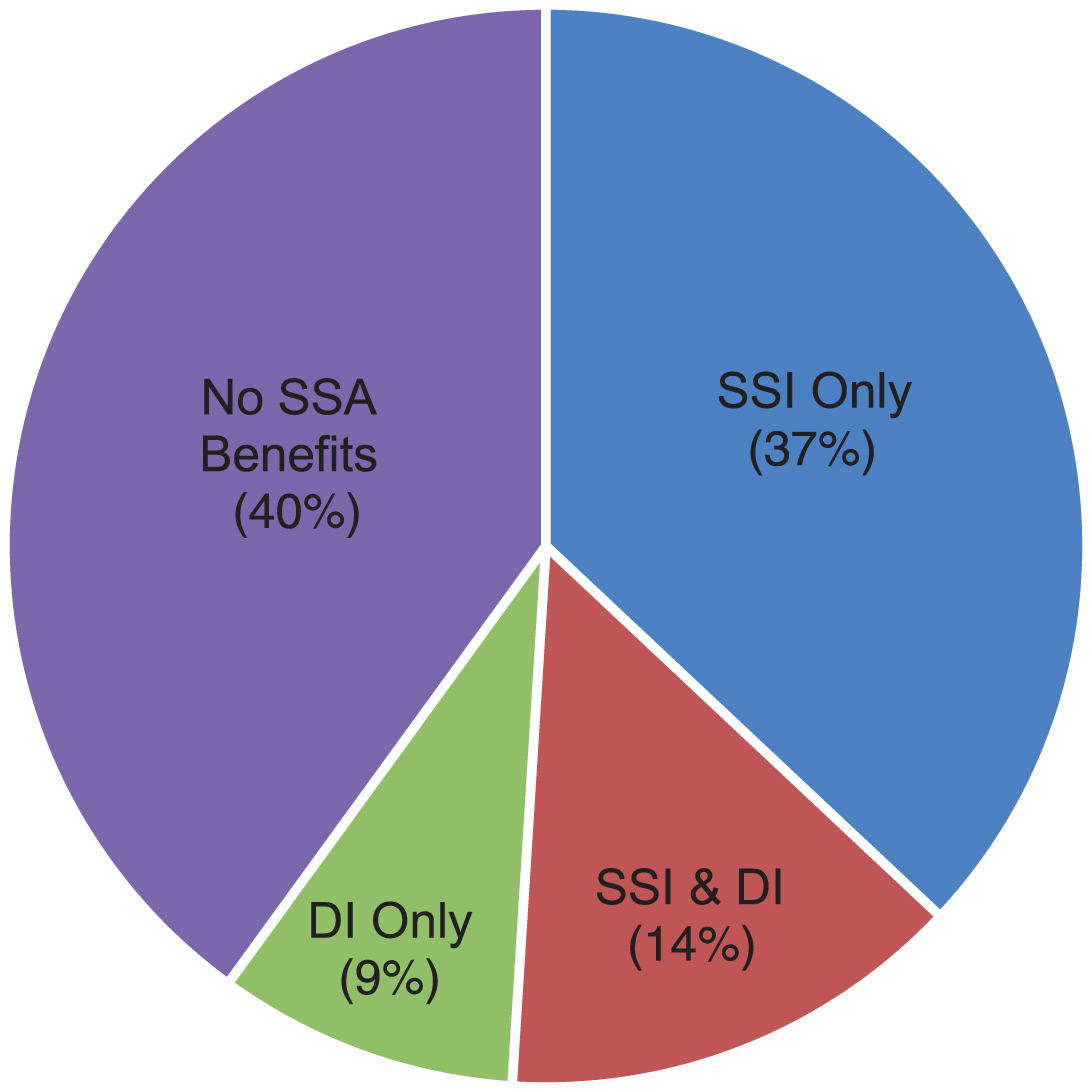
Benefit Outcomes at Ages 27 to 30. Source: Authors’ calculations using linked NSCF and SSA data files.
Results from a logistic regression reveal a negative association between vocational rehabilitation at ages 14 to 17 and adult SSA disability benefit receipt at ages 27 to 30 (Table 3). Vocational rehabilitation at ages 14 to 17 is associated with a 13 percentage point lower likelihood of receipt of SSI or DI 13 years later, driven by a 12 percentage point lower likelihood of receipt of SSI, significant at the 1 and 5 percent levels, respectively. There is no association between youth vocational rehabilitation and adult DI receipt. DI receipt is contingent on having sufficient earnings history to qualify for benefits, but sustained engagement in SGA precludes benefit receipt. Vocational rehabilitation may have offsetting associations with DI receipt, if some who received vocational rehabilitation in our sample qualified for and began to receive DI, while others had earnings high enough to preclude DI receipt.
Marginal Effects Measuring the Association Between Youth Service Receipt and Adult Benefit Outcomes
*∖**∖*** Indicates significance at the 10∖5∖1 percent level. Standard errors are shown in parentheses. Source: Authors’ calculations using linked NSCF and SSA data files. Notes: We used self-reports of past or current service receipt from the NSCF to identify vocational rehabilitation, vocational training, and special education receipt. We used the SSR and MBR to identify SSI and DI status at ages 27 to 30. Our results are from separate regressions for each of the three benefit-related outcomes. Additional control variables from the NSCF are measured at ages 14 to 17 and include male; Hispanic; Black non-Hispanic; other non-Hispanic; age 14, age 15, age 16; living with one parent; other living arrangement; missing living arrangement; no children under 18 in household; 2 children under 18 in household; 3 or more children under 18 in household; parental education higher than high school; parents unemployment; parents not in the labor force; good health status; poor, fair, or missing health status; high severity disability; limited relative to peers; needs help with personal care; needs or uses prescription medication; needs or gets special therapy; and needs or gets counseling. We also control for several measures from SSA administrative data at ages 14 to 17 including physical disability; intellectual disability; entered SSI before 10; entered SSI between 10 and 13; urban; and state dummy variables.
Vocational training at ages 14 to 17 has the opposite association with receipt of SSI or DI benefits at ages 27 to 30 (Table 3). Other characteristics held constant, youth vocational training is associated with a 6 percentage point increase in the likelihood of adult SSI or DI receipt, statistically significant at the 10 percent level. The positive association between youth vocational training and adult SSI or DI receipt conflicts with the notion that vocational services might equip participants with skills that support benefit independence. This finding might reflect characteristics of vocational training participants rather than the effect of training itself. If vocational training is available to people with and without disabilities, it is unlikely that such courses would advocate or teach methods for continuing or establishing disability benefit receipt. However, if vocational training is targeted to individuals with disabilities, then it is possible that those providers would refer individuals to SSI or DI. It seems more plausible that SSI recipients with more limited employment prospects seek vocational services and independently are also more likely to receive SSA disability benefits as adults. There is no statistically significant association between vocational training and SSI or DI receipt alone.
Special education at or before ages 14 to 17 is not associated with any of the three adult benefit outcomes analyzed. All associations are statistically insignificant. As with employment outcomes, the lack of association between special education and benefit outcomes may reflect the fact that most people received special education.
The last column of Table 3 reports estimates from a logit model of the likelihood of continuing SSI benefits after age 18, with no statistically significant associations. The significant negative association between vocational rehabilitation at ages 14 to 17 and SSI receipt at ages 27 to 30 may stem from the negative but insignificant association between vocational rehabilitation and continuing SSI benefits at age-18 redetermination. However, the results cannot offer support of this hypothesis.
We take advantage of additional detail on vocational training services in the NSCF to further investigate the relationship between youth vocational training and adult outcomes. The NSCF asks about the type of vocational service received, including training in specific job skills such as car repair or food services, training in basic skills needed for work like counting change or telling time, career counseling, help finding a job or learning to look for a job, or other sources of training. Between 12 and 14 percent of our sample received each of the first four types of vocational training, while less than 1 percent received other vocational training.
Table 4 shows the relationship between the five types of vocational training at ages 14 to 17 and adult employment and benefit outcomes. For brevity, we present results for one of the three thresholds of earnings relative to SGA: earnings above annualized SGA. Basic training at ages 14 to 17 is associated with a 12 percentage point higher likelihood of adult SSI or DI receipt. This association appears to drive the positive association observed between the aggregate measure of vocational training and SSI or DI receipt. In contrast, specific training at ages 14 to 17 is associated with an 11 percentage point lower likelihood of adult SSI or DI receipt. These results could be consistent with selection bias: youth who seek and receive basic training may differ in unobservable ways from their counterparts who receive specific training. For example, youth who receive specific training would presumably have well-defined employment goals, while youth who receive basic training may have few practical work-related skills. There are no significant associations between career counseling or job placement at ages 14 to 17 and adult outcomes.
Marginal Effects Measuring the Association Between Youth Receipt of Specific Types of Vocational Training and Adult Employment and Benefit Outcomes
Marginal Effects Measuring the Association Between Youth Receipt of Specific Types of Vocational Training and Adult Employment and Benefit Outcomes
*∖**∖*** Indicates significance at the 10∖5∖1 percent level. Standard errors are shown in parentheses. Source: Authors’ calculations using linked NSCF and SSA data files. Notes: We used self-reports of past or current service receipt from the NSCF to identify specific training, basic training, career counseling, job placement, and other training receipt. We used MEF data to construct the percent with any annual employment and percent with earnings above the annualized SGA limit at age 27 to 30. We used the SSR and MBR to identify SSI and DI status at ages 27 to 30. Our results are from separate regressions for each of the six outcomes. Additional control variables from the NSCF are measured at ages 14 to 17 and include male; Hispanic; Black non-Hispanic; other non-Hispanic; age 14, age 15, age 16; living with one parent; other living arrangement; missing living arrangement; no children under 18 in household; 2 children under 18 in household; 3 or more children under 18 in household; parental education higher than high school; parents unemployment; parents not in the labor force; good health status; poor, fair, or missing health status; high severity disability; limited relative to peers; needs help with personal care; needs or uses prescription medication; needs or gets special therapy; and needs or gets counseling. We also control for several measures from SSA administrative data at ages 14 to 17 including physical disability; intellectual disability; entered SSI before 10; entered SSI between 10 and 13; urban; and state dummy variables.
Receipt of other, unspecified vocational training at ages 14 to 17 is rare and associated with several adult outcomes. However, because receipt of other vocational training during youth is uncommon, the associations with adult outcomes are unlikely to influence the associations with the aggregate measure of vocational training in a notable way.
To explore the possibility that associations between service receipt and adult outcomes vary based on observable factors, we conducted a subgroup analysis with three groups of primary disabling impairments: physical disability, intellectual disability, and other mental disorders. Table 5 shows variations in the associations by primary impairment type.
Marginal Effects Measuring the Association Between Youth Service Receipt and Adult Outcomes at Ages 27 to 30, by Impairment Subgroup
Marginal Effects Measuring the Association Between Youth Service Receipt and Adult Outcomes at Ages 27 to 30, by Impairment Subgroup
*∖**∖*** Indicates significance at the 10∖5∖1 percent level. Standard errors are shown in parentheses. Source: Authors’ calculations using linked NSCF and SSA data files. Notes: We used self-reports of past or current service receipt from the NSCF to identify vocational rehabilitation, vocational training, and special education receipt. We used the SSR to identify primary disabling impairment at the time of the NSCF. We used MEF data to construct the percent with any annual employment and percent with earnings above the annualized SGA limit at ages 27 to 30. We used the SSR and MBR to identify SSI and DI status at age 27 to 30. Our results are from separate regressions for each of the six outcomes. Additional control variables from the NSCF are measured at ages 14 to 17 and include male; Hispanic; Black non-Hispanic; other non-Hispanic; age 14, age 15, age 16; living with one parent; other living arrangement; missing living arrangement; no children under 18 in household; 2 children under 18 in household; 3 or more children under 18 in household; parental education higher than high school; parents unemployment; parents not in the labor force; good health status; poor, fair, or missing health status; high severity disability; limited relative to peers; needs help with personal care; needs or uses prescription medication; needs or gets special therapy; and needs or gets counseling. We also control for several measures from SSA administrative data at ages 14 to 17 including physical disability; intellectual disability; entered SSI before 10; entered SSI between 10 and 13; urban; and state dummy variables.
The positive association between vocational rehabilitation at ages 14 to 17 and earnings above the annualized SGA limit, as well as the negative association with SSI and SSI or DI receipt at ages 27 to 30 observed for the full sample are driven by those with intellectual and physical disabilities, respectively. For those with an intellectual disability, vocational rehabilitation at ages 14 to 17 is associated with a 12 percentage point increase in both the likelihood of any annual employment and earnings above SGA 13 years later, as well as more than $2,265 higher annual earnings. For those with a physical disability, vocational youth rehabilitation is associated with a 27 to 28 percentage point decrease in the likelihood of SSI receipt as well as SSI or DI receipt at ages 27 to 30. The association between youth vocational rehabilitation and adult SSI or DI receipt is also negative and statistically significant for individuals with intellectual disabilities, at a magnitude similar to that predicted for the full sample. These results suggest that vocational rehabilitation received during youth may effectively foster employment and benefit independence for individuals with intellectual or physical disabilities. There are no statistically significant beneficial associations between youth vocational rehabilitation and adult outcomes for those with other mental disorders.
Vocational training at ages 14 to 17 is associated with unexpected outcomes at ages 27 to 30 for individuals with physical and intellectual disabilities. Among those with physical disabilities, youth vocational training is associated with a lower likelihood of earnings above SGA and lower annual earnings at ages 27 to 30. Youth vocational training is also associated with a higher likelihood of adult SSI or DI receipt among those with intellectual disabilities. In contrast, vocational training at ages 14 to 17 is associated with increased likelihood of annual employment at ages 27 to 30 for those with other mental disorders. These results may reflect selection of individuals who elect or have access to and the opportunity to participate in vocational training.
Although special education at or before ages 14 to 17 does not have a significant association with any of the adult outcomes for the sample as a whole, it is significantly associated with adult outcomes for individuals in two primary impairment groups. Special education at or before ages 14 to 17 has large negative associations with adult employment-related outcomes and large positive associations with adult SSI receipt and SSI or DI receipt for those with physical disabilities. Although special education serves children with a variety of disabilities, the majority of those served have non-physical disabilities. In the 2000 to 2001 school year, 62 percent of secondary school youth receiving special education had learning disabilities; 11 percent had an emotional disturbance (Wagner et al., 2005). Many of those with physical disabilities may have had another disability necessitating special education. For those with physical disabilities, the observed association between special education and adult outcomes may reflect an association between multiple disabilities and adult outcomes. In contrast, for those with other mental disorders, we observe a positive association between special education at or before ages 14 to 17 and annual employment and a negative association with SSI receipt and SSI or DI receipt. There are no significant associations between special education and employment- and benefit-related outcomes among those with intellectual disabilities.
The results presented in Tables 2–5 may be influenced by selection. We attempt to understand the extent to which selection may be a factor by comparing observable characteristics across service receipt categories.
Table 6 summarizes some of the key observable differences between individuals who did and did not receive vocational rehabilitation, vocational training, and special education services at or before ages 14 to 17. A few notable differences exist in characteristics by receipt of vocational rehabilitation. Youth who received vocational rehabilitation were less likely to need help with personal care or use special medical equipment and more likely to need or receive mental health treatment or counseling, compared to those who did not receive vocational rehabilitation. The same differences occurred across youth who did and did not receive vocational training. In addition, youth who received vocational training were more likely to need or receive special therapy, more likely to have a primary impairment of a mental disorder, and less likely to have an intellectual disability, compared to those who did not receive vocational training. Those receiving vocational training were also more likely to be age 16 or 17 at the time of the survey (not shown). Finally, there were differences in gender, race, parental education, general health status, special therapy, and mental health treatment, by special education.
Significant Differences in Select Beneficiary Characteristics at Ages 14 to 17 by Service Receipt
Significant Differences in Select Beneficiary Characteristics at Ages 14 to 17 by Service Receipt
+/– Indicates that a 10 percent statistically significantly higher/lower proportion of beneficiaries who received the service had the specific characteristic, compared with beneficiaries who did not receive the service. Source: Authors’ calculations using linked NSCF and SSA data. Notes: We used self-reports of past or current service receipt from the NSCF to identify vocational rehabilitation, vocational training, and special education receipt. We calculated significant differences by a chi-square test for categorical variables and by a two-tailed t-test for binary outcomes.
We also observed differences in characteristics by type of vocational training (not shown). For example, 62 percent of those who received basic training needed or received special therapy, compared to 34 percent of those who received specific training (and did not receive basic training). Statistically significant differences appeared across the two groups in gender, number of parents in the household, general health status, need for special medical equipment, and primary disabling impairment.
The differences in several observable baseline characteristics by use of each type of service suggest that selection may influence some of the results presented here. For example, youth with personal care needs and those who use special medical equipment are less likely to receive vocational rehabilitation or vocational training. These health and service needs may also negatively impact the likelihood of employment. Although we controlled for these characteristics in our analysis, there may be similar confounding factors that were unobserved and hence not included in analysis. However, we cannot formally test for differences in unobservable characteristics.
Approximately 40 percent of transition-age child SSI recipients do not receive support from SSA disability programs as adults and must find other means of financial support. Our results indicate that 42 percent of our sample were employed at ages 27 to 30, but only 17 percent had earnings above the annualized 2014 SGA limit of $12,840. This limit is similar to the 2014 federal poverty level for a one-person household of $11,670 and suggests that few former child SSI recipients have earnings high enough to live above the poverty level without additional financial support.
Assisting youth with the transition to adulthood garners significant policy interest and funds for service provision, including SSA-funded demonstrations like YTD, PROMISE, and state-level and private initiatives. However, evidence is lacking on the effectiveness of services currently available nationwide, such as vocational rehabilitation, vocational training, and special education.
Our results indicate that vocational rehabilitation and specific training at ages 14 to 17 are favorably associated with several adult outcomes. Vocational rehabilitation at ages 14 to 17 is associated with a 9 percentage point increase in the likelihood of earnings above the annualized SGA limit and a 13 percentage point decrease in the likelihood of SSI or DI receipt at ages 27 to 30. Specific training received during youth is associated with an 11 percentage point lower likelihood of adult benefit receipt. Collectively, these results suggest that youth engagement in services linked to specific employment goals is associated with lower dependence on benefits at ages 27 to 30. Although we cannot definitively say that vocational rehabilitation or specific training have impacts on adult employment and benefit outcomes, the findings are consistent with these positive impacts.
In contrast, there is limited evidence of an association between the broad category of youth vocational training and favorable adult outcomes. One exception is that vocational training at ages 14 to 17 is associated with an 8 percentage point increase in the likelihood of employment at ages 27 to 30. Notably, youth vocational training is also associated with a 6 percentage point increase in the likelihood of adult SSI or DI receipt. There are no significant associations between special education at or before ages 14 to 17 and any of the adult outcomes analyzed.
Given recent policy emphasis on the potential importance of services to assist transition-age youth, one might be surprised not to find more and stronger significant associations. For example, although we highlight some potentially important relationships, both youth vocational rehabilitation and vocational training are significantly associated with just one of the five adult employment-related outcomes we analyze. Note that we analyze service receipt in 2001, and both rates of engagement with services and the nature of provided services have likely changed in the past 15 years. In addition, our results indicate that long-term associations vary by primary disabling impairment, suggesting that services may have different effects for youth with different disabilities. For example, vocational rehabilitation and vocational training at ages 14 to 17 have no relationship with most adult outcomes for the group with “other mental disorders.” This group includes children with increasingly common impairments, such as autism spectrum disorders and attention deficit hyperactive disorder.
It is important to note that our results do not account for the duration, intensity, or quality of services. In our analysis, we classify a youth who received a total of two hours of vocational rehabilitation services and a youth who received vocational rehabilitation services four hours a week for 12 weeks as vocational rehabilitation users and do not account for the different service experiences. An analysis that included only those who received a minimum amount of a given service or controlled for various service factors might yield different results.
Our results are not causal and could reflect selection into service receipt. For example, child SSI recipients with greater work capacity or greater family support (not fully captured by our control variables); may choose to participate in vocational rehabilitation at higher rates and, even without these services, engage in SGA at higher rates. However, many of the results are in the expected direction and some of the results are strong. The negative association between vocational rehabilitation at ages 14 to 17 and SSI or DI receipt at ages 27 to 30 is significant at the 1 percent level and represents over 20 percent of the mean rate of SSI or DI receipt. Accordingly, even if this result reflects selection, some of the association might still be causal.
More research is needed to identify the long-term causal relationship between youth services and adult outcomes. This research could help policymakers better target resources to programs that are effective in facilitating employment and reducing the need for benefit receipt. Analyses of different cohorts of transition-age SSI recipients could help identify changes in the associations between youth service receipt, employment, and benefit outcomes over time. In addition, cost-benefit analyses could generate evidence for or against attempts to expand youth services. Future research could also shed light on service components that lead to the most beneficial adult outcomes.
Conflict of interest
None to report.