



Abstract
BACKGROUND:
Best practices in transition planning include interagency collaboration during the planning process. While IDEA 2004 requires interagency collaboration in the IEP process, getting all the right people to the table can be difficult.
OBJECTIVE:
To investigate stakeholder perceptions of interagency collaboration resulting from Communicating Interagency Relationships and Collaborative Linkages for Exceptional Students (CIRCLES).
METHODS:
Using qualitative and quantitative methodologies, we explored stakeholders’ interagency collaboration experiences with CIRCLES.
RESULTS:
Data indicated high levels of interagency collaboration and satisfaction from students, parents, teachers, and agency personnel.
CONCLUSIONS:
CIRCLES may help transition personnel overcome many of the barriers to successful interagency collaboration.
Introduction
A successful transition to post-school education, employment, community engagement, and independent living are goals of most high school students. For many students, high school has become a time of identifying goals and networking with friends and supports to make those goals a reality whether they involve preparing for postsecondary education, choosing a career, or making decisions about where they want to live. For students with disabilities, this process can be difficult without the help of school personnel and adult service providers (Kohler, 1996). Federal laws including the Individuals with Disabilities Act (IDEA, 2004) and the Workforce Innovation and Opportunity Act (WIOA, 2015) stipulate guidelines for education systems and adult service agencies in assisting youth with disabilities in this transition process. IDEA (2004) mandates that each student with disabilities have a transition component in their Individual Education Program (IEP), based on their individual interests, strengths, and needs, in place by their 16th birthday. IDEA (2004) further mandates that the transition component must contain a coordinated set of outcome-related activities which will guide the student through the transition from high school to adult life. WIOA (2015) uses this same terminology to define transition services and to address service providers who work with these students to connect them with opportunities for postsecondary education and employment. These coordinated services imply that these two systems work together to build a smooth transition. Making and maintaining these connections across the education system/adult service providers divide is fundamental to ensuring positive post-school outcomes for students with disabilities.
Kohler, Gothberg, Fowler, and Coyle (2016) in the Taxonomy for Transition Programming 2.0 (Taxonomy), categorized this connectivity and intention of educators and adult service providers (e.g., vocational rehabilitation counselors, community rehabilitation agencies, and providers of independent living) in working together to assist in the successful transition to adult life for students with disabilities as Interagency Collaboration. Within interagency collaboration, various stakeholders including parents and students work together with transition teachers and adult services providers to problem-solve to develop student-centered transition activities to be implemented through the student’s IEP (Webb, Repetto, Seabrook-Blackmore, Pattersons, & Alderfer, 2014). Interagency Collaboration is pivotal for increasing post-school outcomes for students with disabilities (Noonan, Morningstar, & Gaumer Erickson, 2008). In a systematic review of correlational literature to identify in-school predictors of post-school outcomes, Test, Mazzotti, et al. (2009) identified interagency collaboration as a predictor of positive post-school outcomes.
Even with guidelines (Kohler et al., 2016; Noonan et al., 2008), and mandates (IDEA, 2004; WIOA, 2015), researchers have found building collaboration across agencies is often difficult as educational systems and adult service agencies may work with different mindsets, such as specialized definitions and policies for collaboration and assisting students with disabilities in achieving their transition goals (Oertle, Plotner, & Trach, 2013). For example, in a secondary analysis of data from the National Longitudinal Transition Study-2 (NLTS2), vocational rehabilitation (VR) counselors were found to have very little participation in transition planning for students with intellectual disability, as well as other disabilities (Grigal, Hart, & Migliore, 2011). On one hand, transition teachers may find themselves overwhelmed with the tasks of transition planning, wondering why the vocational rehabilitation counselors are not participating, while on the other hand, VR counselors may be waiting in the wings to be invited to the transition planning table (Trach, 2012).
Unfortunately, research on effective strategies for interagency collaboration has been sparse (Landmark & Zhang, 2010; Oertle et al., 2013). In fact, Test, Fowler, et al. (2009) found no evidence-based practices in the category of interagency collaboration in a review of secondary transition literature. This lack of research has been recognized by others. First, in a position paper of the Council of Exceptional Children Division of Career Development and Transition (DCDT), Mazzotti, Rowe, Cameto, Test, and Morningstar (2013) called for researchers to focus on interagency collaboration and identify evidence-based practices in this area. More recently, Haber et al. (2016) conducted a second meta-analysis of in-school secondary transition predictors and found interagency collaboration was a predictor of postsecondary education and, even though there were few studies investigating the topic, interagency collaboration showed strong effects, suggesting the need for effective strategies for promoting interagency collaboration. To date, current research has focused on three areas (a) potential barriers to successful collaboration, (b) perceptions of levels of collaboration, and (c) successful models of interagency collaboration.
Barriers to collaboration
Reisen, Morgan, Schiltz, and Kupferman (2014) conducted a Delphi study to investigate possible barriers of transitioning from school to work for youth and young adults with disabilities. Forty-six transition professionals (i.e., special educators, vocational rehabilitation counselors, community rehabilitation providers) across one state, identified and rated barriers of school to work in 11 domains including interagency collaboration. Within this category, lack of continued supports after high school and lack of knowledge of available supports ranked as having the highest impact on youth and young adults with disabilities.
Next, Meadows, Davies, and Beamish (2014) conducted a confirmatory analysis of Beamish, Meadows, and Davies (2012) data to ascertain special educators’ level of locus of control over commonly used interagency collaboration practices. Comparing scores from rating scales on implementation levels of 15 interagency collaboration practices (Meadows et al.) and a survey inquiring on teachers’ perceptions of locus of control for each of the practices, results indicated a positive correlation between teacher’s perception of locus of control (i.e., school-based v. regional/systemic) and level of implementation of the practice.
Perceptions of levels of collaboration
To understand perceptions of interagency collaboration among VR counselors and transition teachers, Taylor, Morgan, and Callow-Heusser (2016) utilized two surveys to determine level of collaboration and satisfaction with collaboration practices. This four-state study found many of the responses by VR counselors and transition teachers were somewhat aligned, reporting low levels of collaboration in several areas, such as teachers providing student information to VR counselors, teachers inviting VR counselors to IEP meetings, and VR counselors participating in the IEP meetings. One area of responses showed a large difference across participants. VR counselors regarded themselves as an essential part of the transition planning process for students with disabilities, while transition teachers indicated VR counselors played much less of a role.
Successful models of interagency collaboration
Other research has examined what is working in interagency collaboration. For example, Noonan, Gaumer Erickson, and Morningstar (2013) investigated the level of high-quality interagency collaboration of 73 members of community transition teams who received training and support for interagency collaboration for one year. Members were assessed before and after the first year using the Transition Collaboration Survey which measured 11 essential components of interagency collaboration (Noonan, et al., 2008). The 11 key strategies identified including (a) flexible scheduling and staffing, (b) follow-up after transition, (c) administrative support for transition, (d) using a variety of funding sources, (e) state-supported technical assistance, (f) ability to build relationships, (g) agency meetings with students and families, (h) training student and families, (i) joint training of staff, and (j) meeting with agency staff and transition councils. Results revealed school staff had an increase in all 11 components of high-quality interagency collaboration, while agency staff had increases in most of the components except administrative support for transition and training time.
In another study using the Levels of Collaboration Scale (Frey, Lohmeier, Lee, & Tollefson, 2006) and social network analysis, Noonan, Erickson, McCall, Frey, and Zheng (2014) examined changes in collaboration among members of a state-level interagency education team over a three-year period. Directors of state-level agencies who worked with youth and adults with disabilities, rated their own level of collaboration with the group, as well as their perception of other agencies’ level of collaboration. In this study, participants were given results of the analysis each year and had the opportunity to generate and discuss strategies for improving the collaboration, resulting in increased levels of collaboration from networking to cooperation over the three-year period.
Additionally, Povenmire-Kirk et al. (2015) conducted focus groups with school district personnel and adult service providers to investigate the successes and challenges from the first-year implementation of a three-tiered model of interagency collaboration. Stakeholders including school district and agency personnel who were involved in planning or participating in Communicating Interagency Relationships and Collaborative Linkages for Exceptional Students (CIRCLES) were asked to reflect on the first year of implementation in their districts. Themes for successes included increased levels of networking and collaboration among agency and school participants, improved communication about services across stakeholders, and the esoteric gratification of helping students develop self-advocacy and self-determination by teaching them how to lead their own School Level Team (SLT) meetings.
This review of literature, while offering essential characteristics (Lee & Carter, 2012, Noonan et al., 2008) of quality interagency collaboration, also presented ongoing challenges and suggestions for improvement (Lee & Carter, 2012; Noonan et al., 2012; Reisen et al., 2014; Taylor et al., 2016). One research-based model that schools can use to effectively implement interagency collaboration is CIRCLES. The CIRCLES model of interagency collaboration, which has been successfully implemented for four years in 12 school districts, addressed many of these challenges and suggestions. In addition, in a randomized control trial investigation of the efficacy of the CIRCLES model, Flowers, Test, Povenmire-Kirk, Diegelmann, Bunch-Crump, and Kemp-Inman (2018), found students who went through CIRCLES experienced higher levels of self-determination and participation in their IEP meetings.
Therefore, the purpose of this study was to use mixed methods (i.e., qualitative and quantitative) to investigate the full implementation of the CIRCLES model of interagency collaboration. Using grounded theory method, focus groups were conducted to collect data on the perspectives of four different stakeholder groups (i.e., students, parents, teachers, agency personnel) to determine success and challenges throughout implementation of CIRCLES. Quantitative data were also gathered using surveys to examine different stakeholders’ perception of involvement in CIRCLES. The following research questions were addressed:
What are CIRCLES students’ perception of their preparedness, involvement in planning and setting goals for post-secondary education, job, and living in the community? Are parents involved in planning and preparing their child for post-secondary education, job, and living in the community? What are interagency members’ perception of collaboration among schools and other agencies?
Method
Description of CIRCLES service delivery model
CIRCLES involves three levels of interagency collaboration including Community Level Team, School Level Team, and IEP Team. While each team has a specific purpose, they work together to address transition planning needs and issues of individual students with disabilities to improve both in-school and post-school outcomes of students with disabilities (Aspel, Bettis, Quinn, Test, & Wood, 1999; Povenmire-Kirk et al., 2015). CIRCLES targets students with disabilities who may need support from multiple adult service providers to experience successful post-school outcomes. For example, students with a mild learning disability who have family issues including poverty, homelessness, or high-risk parents could benefit from services available through CIRCLES team members. On the other hand, similar students who have a strong family system of support, are college bound, and have no other specific needs may not benefit from the interagency team involvement that is the hallmark of CIRCLES. In summary, CIRCLES allows agencies to provide support services directly to students and families who need involvement from multiple adult service providers using three levels of teaming.
Community Level Team
The Community Level Team (CLT) is comprised of administrators and supervisors of every agency able to provide support for transition from high school to adult life. This team could include Vocational Rehabilitation, Department of Social Services, Health Department, The Arc, Easter Seals, Autism Society, residential service providers, and any other local service providers. The CLT is organized and convened by district-level school staff (e.g., special education director, program coordinator, transition specialist) to address community-level needs for services. The CLT meets two to four times per year to identify gaps and overlaps in services, and work together to change policy and practice to better serve youth with disabilities. As the CLT works to identify and address areas of need in their community, this can result in changes in policies, services, budget allocations, or community outreach and education. One of the key roles for CLT members is to appoint a direct service representative from their agency to serve on their School Level Team (SLT). As such, administrative-level buy-in is vital to success of CIRCLES.
School Level Team
The School Level Team (SLT) is what makes CIRCLES different than other models that utilize interagency transition teams; while interagency community-level transition teams exist, the SLT, brings adult agency representatives together to meet directly with students and their families. The SLT is comprised of direct service providers (e.g., case managers, counselors, care coordinators, etc.) from each agency represented on the CLT; these are adult service professionals special educators might traditionally invite to attend IEPs for students in need in the more traditional model. These are also representatives who, because of the size of their catchment area, are often unable to attend IEP meetings of every student in need. Instead of inviting these representatives to attend every IEP meeting, district-level school staff responsible for convening CIRCLES meetings invite them to attend one full-day meeting a month during the school year, in which they see multiple students and address post-school goals in areas of transition, specifically, postsecondary education, employment, and independent living. Rather than spending time calling agency members to invite them to IEP meetings, in the CIRCLES model, special educators prepare their students individually to present information about themselves, including their post-secondary goals and needs to SLT members. Students use technology (e.g., PowerPoint, Voki, Wobook, GoAnimate) to describe their strengths, areas of need, and post-school goals. Student presentations typically take three to eight minutes. For the remaining time allotted (20 – 40 minutes per student), members of the SLT talk with the student, his or her family, special educators, and one another to determine how best to deliver transition services to each student. In addition to giving each student, parent, and special educators a personal contact to associate with each agency, the SLT format also allows time for appointments to be made and questions to be answered by agency members. Families can discuss any needs they may have as a unit (e.g., poverty, homelessness, transportation, food insecurity, guardianship assistance, etc.). Agencies negotiate with one another and the student and family to create the most comprehensive plan to meet each student’s specific needs. After each student is seen, agency members prepare to hear the next student presentation during a 5–10 minute break, and then start the process over for each new student. SLTs typically see between six and 10 students per meeting day. To ensure follow-through of the service plans developed at these meetings, and because the SLT’s main purpose is to develop transition activities and services for the student with a disability, the minutes of each SLT meeting are distributed to every member of the SLT, the IEP team via the special education teacher, the student, and his or her parents.
IEP team
The IEP team is the final level in the CIRCLES multi-level approach. After the SLT meeting, special education teachers take the minutes and decisions made at the SLT meeting back to their IEP meeting and write transition components based on the services agreed upon at the SLT. This process enables the IEP team to write other components of the IEP with end goals of each student in mind and plan for transition activities and supports that exist and are available to each student. Because the district-level school staff are responsible for convening both CLT and SLT meetings, time special education teachers typically spend inviting folks to IEP meetings is freed up for preparing students for SLT and IEP meetings. Student assessments and interviews that go into developing their presentations to the SLT are all part of what should be standard operating procedures for preparing for transition components of any IEP meeting. The only activity that may not be part of standard procedures is the training of the technology tools to help students present. However, many districts require students to present a portfolio their senior year, and use the students’ SLT presentations as both a practice activity and a starting point for this larger portfolio presentation. In some schools, teachers used technology their students utilize as part of CIRCLES as “technology instruction” needed to meet criteria associated with graduation. Figure 1 illustrates the relationships of these teams to one another, the student, and the community.
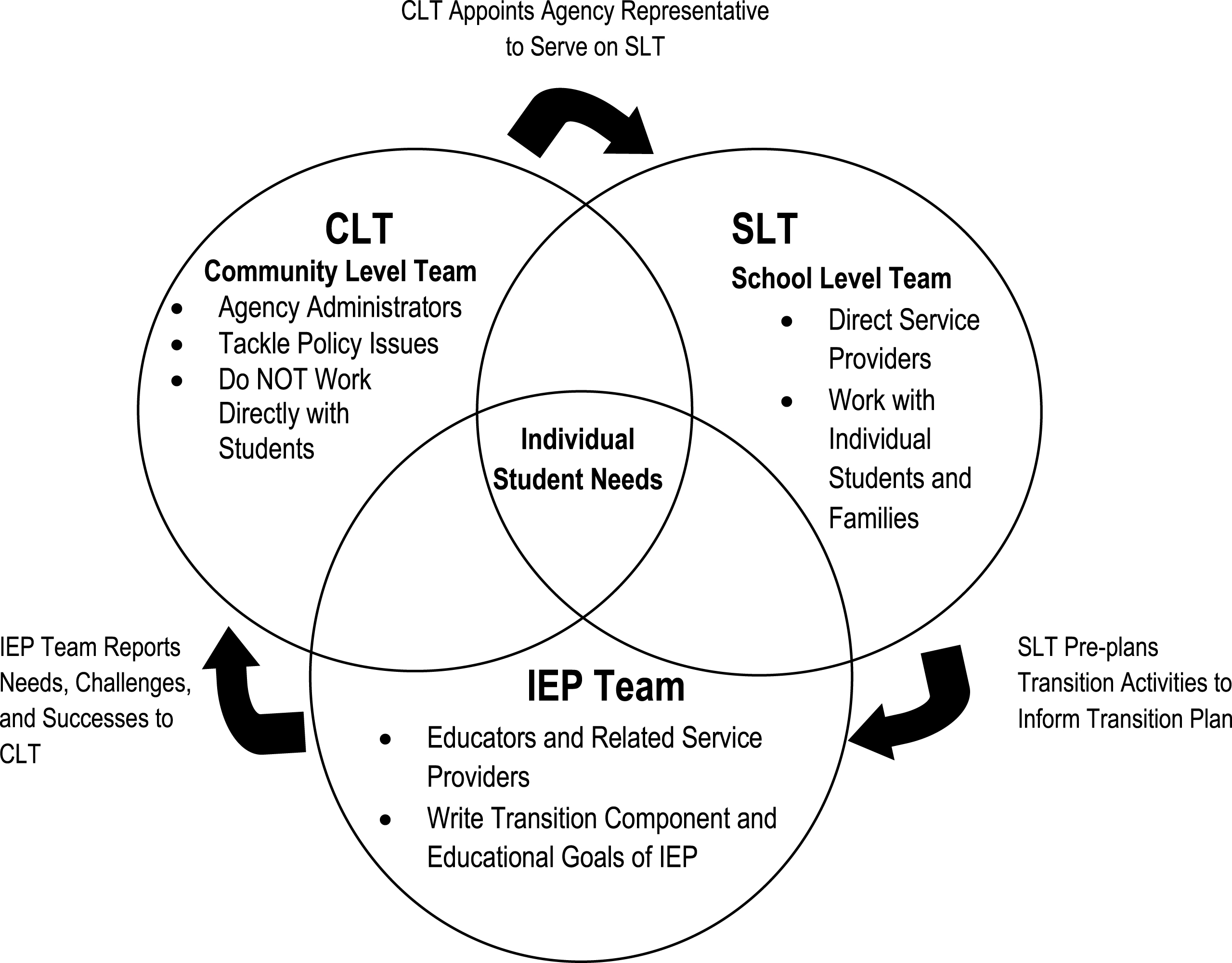
CIRCLES.
Setting
We conducted focus groups at regular meetings of CLT and SLT team members for agency personnel, and at high schools for parents, students, and teachers. Although we offered focus groups to each district, six of the 12 districts participated in all four focus groups, giving us a total of 24 focus groups (i.e., 4 = agency personnel, 4 = parents, 4 = students, 4 = teachers). The six districts that participated in focus groups represented a range of demographics at district and school level. One district was classified as urban, two as suburban, and three as rural. Of the six schools which participated in focus groups within the districts, three schools had enrollment greater than 1000 students and five schools had more than 50% free/reduced price lunch. Finally, during the grant, two schools had school staff turnover, but there was no agency staff turnover. District reasons for not participating in focus groups included scheduling issues and District Level Team leadership changes.
Participants
Each of the six districts held four focus groups that included a total of 175 participants. Focus groups varied from 3 to 18 participants. Overall, 62 district and agency personnel, 40 teachers, 31 parents, and 42 students participated. We did not collect individual demographic information at these focus groups as the unit of interest was the district’s experience of CIRCLES, not the individual.
Instruments
We used IRB approved focus group questions developed to maximize the use of focus groups versus individual interviews (Morgan, 1996). We developed open ended, but guiding questions, designed to maximize conversation between the members of the various groups. Instruments used for each group are available from the first author.
Data collection
Each separate focus group was facilitated by a member of the CIRCLES project staff trained in probing questions to glean more information in response to the questions on our focus group protocols. All focus groups were audio-recorded and transcribed by a professional transcriptionist.
Data analysis
Two members of CIRCLES project staff coded transcripts of each focus group separately, beginning with a general list of themes related to our questions, regarding supports, barriers, and needs moving forward. During the coding process, they used grounded theory (Glaser & Strauss, 1968) and allowed themes to emerge from the data, creating new codes as these themes emerged. After coding each transcript once, each coder returned with the new list of themes generated by the data and coded a second time. After all coding was complete, the coders met to review their codes and generated consensus. These codes were entered into N-Vivo and code reports were developed. Coders then returned to the code reports and wrote summaries of our findings, again, reaching consensus. Focus group data were gathered from participants from six districts for each focus group category providing triangulation and confidence in trustworthiness and credibility of the data.
Student, parent, and interagency surveys
Participants
Surveys were administered to students and parents who participated in CIRCLES and agency members who attended the SLT or CLT meetings. There were 143 students, 72 parents, and 52 interagency members who completed the surveys. All participants were asked to complete the survey online at the end of the school year. All 12 school districts were represented in the samples. The return rate was 46% for the student survey, 23% for the parent survey, and 88% for interagency survey.
Instruments
Three surveys were administered to three stakeholder groups, students, parents, and participating interagency teams. Student and parent surveys were administered at the end of the year after participating in CIRCLES and examined the perceptions of the students’ preparedness to transition out of high school. The survey to interagency teams examined the extent of the collaboration across the different agencies.
The student survey had 10 items that asked students to rate using a 3-point scale (1 = disagree, 2 = not sure, & 3 = agree) their perception of preparedness (see Table 1 for the items). Parents responded to seven items, using a 4-point scale (1 = Strongly Disagree, 2 = Disagree, 3 = Agree, & 4 = Strongly Agree), about their perception of their child’s preparedness (see Table 2). The agency member survey included 27 items asking respondents to rate (a) the extent their transition collaborative team coordinated, implemented, or collaborated on a series of transition activities and (b) rate their organizations collaboration with other organizations (see Table 3 for items).
Student Perception of Preparedness
Student Perception of Preparedness
Parent Perception of Student Preparedness
Interagency Collaboration Ratings
Descriptive statistics are used to summarize all participants’ responses. Specifically, means and percentages were used to summarize student and parent survey results. For the agency members’ survey, frequencies and percentages were reported for each item.
Results
Focus groups
After analysis, we found themes discussed by focus group participants fit into one of three categories (a) Successes and Supports, (b) Challenges and Barriers, and (c) Needs Moving Forward.
Successes and supports
Most agencies agreed that the CIRCLES process was successful in several areas, including promoting collaborative relationships that allowed community agency members and school-level personnel to better understand what each agency can offer students and can better point families in the right direction for services. The collaborative nature of CIRCLES also motived team members, as they were able to hear about successes of students and families getting the services they need as a result of their efforts – they felt that they had made a difference. Some aspects of CIRCLES seemed to be critical for success, including clearly assigning responsibilities for follow-up and providing reminders to each person involved, providing complete student profile sheets to agencies ahead of time, and having teachers present in meetings to help guide and support students as they presented.
Collaborative relationships. Meeting with other community agencies allowed all team members to better understand what each one can offer students and can better point families in the right direction for services. Collaboration also has improved communication between the different agencies.
“Through collaboration in CIRCLES meetings, I learned what other agencies are out there and what they do; it’s incredibly beneficial.” - Agency Member
“ ... I’ve learned from everybody around the table and I’m able to help families better, point them in directions.” – Special Education Teacher
“I like getting out with and networking with other team members and seeing what these kids are doing.” - Agency Member
When team members heard success stories, “ ... You feel like you’re making a difference.” – Agency Member
The collaborative nature of CIRCLES meetings was something enjoyed by agency members, teachers, and families, alike.
“I really enjoyed having the teacher in there while the student was presenting. It seems to make the student a lot more comfortable.” – Parent
Developing systems for follow-up. One team member at the SLT meetings wrote down what each student, agency, and teacher had agreed to do and gave each party a copy. Email reminders also helped for one district.
Provide adequate student information in SLT. Giving the agencies student profile sheets ahead of time was crucial for agencies to best know what would be a good fit for each student, and to have some background on the students.
“It’s just helpful to have a little background before we’re in front of the students.” – Agency Member
“And the student profile sheets, having those ahead of time helped you, as well, know the student’s capabilities because some present differently than their ability indicates or their IQ indicates.” – Agency Member
Challenges and barriers
Despite the successes reported throughout the CIRCLES process, team members perceived several challenges and barriers that may need to be addressed to produce optimal student outcomes. Primarily, these challenges and barriers can be described in three areas: understanding the process, getting everyone to the table, and follow-up.
Understanding the process. During initial training, some confusion occurred because team members were not sure about many of the details of the process. It sometimes was difficult for the transition team to decide how to prioritize students, whether based on age or need.
“So the training, you can sit in and you can listen to what all it entails but you’re really not going to understand it very well until you actually come and sit down with the students and hear their presentations.” – Transition Educator
“I think the training was not as clear because I didn’t totally understand the difference between the community level and the school level.” – Agency Member
“So if I’m a mom walking in with my child I kind of want to know what I’m walking into, and I’ve seen looks of surprise ... It’s a little bit intimidating. I think the comfort level would be better if they knew what to expect.” – Special Education Teacher
Getting everyone to the table. When implementing the CIRCLES process, it was sometimes challenging to get parents and agencies to the SLT and CLT meetings due to scheduling, agencies not responding to meeting invitations, and parents feeling intimidated to meet with a room full of professionals. Parental participation in IEP meetings and other school-based meetings has been documented to lag as students get older; CIRCLES meetings are no exception. It was challenging to get families to attend SLT meetings, possibly because the situation is intimidating for them, and often available meeting places were not conducive to setting up an inclusive environment (e.g., one big table).
“One of the hardest things to do when you set up these meetings each month is to get participation from family members.” – Special Education Teacher
Getting everyone together at one time is challenging due to agencies not responding and also remembering to invite the right people.
“I guess the other part would be able to get everybody together at one time, is always the challenge.” – District Transition Specialist
Follow-up: Several factors also seemed to affect follow-up on contacts after SLT meetings, including a lack of clearly defined responsibility allocation between parents and agencies, as well as privacy concerns that prevented agencies from initiating the follow-up contact with parents. When agencies provided contact information and waited for families to follow up, often families did not contact agencies to follow through on plans made at the SLT. Who is responsible for follow-up was not clearly defined during the meetings. The information parents receive also can be overwhelming, so it was difficult for them to know where to start.
Furthermore, the outcomes from SLT meetings did not always get transferred to the IEP’s transition plan.
“We give them our information and our business cards and are kind of waiting for them to get in contact with us, so I think that contact piece is really the most difficult part.”- Agency Member
Needs moving forward
Several suggestions for meeting needs going forward emerged that may help guide school districts in implementing CIRCLES with optimal student outcomes. These included establish responsibility for follow-up, increase parental awareness and participation, improve agency participation with careful planning by individual student needs, ongoing training for teachers, and report successes and actions of SLT back to CLT.
Responsibility for follow-up. First, it is critical to clearly define who is responsible for making contact for follow up, parents or agencies, and to obtain any necessary parent permissions for agency follow-up.
“It’s sort of your pat on the back and your motivation when you hear that oh, they really did follow through with that and they really are already connected with VR.” – Special Education Teacher
Increase parental awareness. Second, parental awareness and understanding of the CIRCLES process should be promoted, possibly through brochures given during IEP transition discussions, parent trainings and/or discussions about the process, formal parent invitations to SLT meetings, and posting resources on the school website. Provide parents with information/brochures ahead of time, and provide parents with some type of training to help them understand the CIRCLES process. Also, increase parent familiarity with CIRCLES by mentioning it or discussing it to some extent at every parent meeting, and emphasize CIRCLES during the IEP meeting when discussing transition. Send formal invitations to parents about their child’s SLT meeting. Schools could add a prominent link with CIRCLES resources to their websites.
“If you meet with your freshman parents that would be a good time to start talking with them.” - Transition Specialist
“Possibly with training and them understanding the benefit for their child would result in more of them participating.” - Special Education Director
Improve agency involvement with careful planning. Third, consider improving agency involvement by identifying ahead of time those agencies that might most support a particular student, and provide agencies with student profiles prior to the SLT meetings so the agencies can better prepare to meet their needs.
“It creates buy in and yeah I would think that it would create more participation.” – Agency Member
Ongoing training for teachers. Fourth, training should be ongoing as new teachers and agencies join the CIRCLES process. Continue training new teachers about CIRCLES, providing an overall perspective of the program and each team level’s responsibility, and how to best prepare students for the SLT meeting. Additionally, if teachers knew at the beginning of the year all the dates for the meetings, they could plan accordingly with their students. Set meeting dates ahead of time, and provide reminders and follow-up contact to agency members who miss a meeting.
Report successes and actions of SLT to CLT. Finally, a reliable system should be developed to report back to the CLT team any decisions made at the SLT to maintain motivation and effective decision-making at the CLT level. These could include presenting a brief stakeholder evaluation or survey of the SLT process, SLT meeting notes, or even invite a student to present at the CLT on occasion.
“It would be motivating for the CLT members to hear success stories of students who connected with agencies and continued this relationship after the SLT. A brief evaluation of the SLT process could be taken back to the CLT meeting, as well as parent input and notes from the SLT meeting. Perhaps a student could present at the CLT meeting on occasion.” – Agency Director (CLT member)
Student, parent, and interagency surveys results
Student perception of preparedness
The items, means, and percentage of students who agreed with each item (1 = disagree; 2 = not sure; 3 = agree) are reported in Table 1. All means were above 2.5, and the percentages of students who agreed ranged from 64% (I am prepared for school (e.g., college, university, training) after high school to 91% (I have been involved in preparing goals for my future).
Parent perception of child’s preparedness
Table 2 displays the means and percentage of parents who agreed or strongly agreed with the items (1 = Strongly Disagree; 2 = Disagree, 3 = Agree; 4 = Strongly Agree). All means were at or above 3.36, with most parents agreeing or strongly agreeing with statements, ranging from 92% (I communicate on a regular basis with school personnel on the process of preparing my child for life after high school) to 100% (I understand my child’s needs and goals).
Interagency collaboration survey
The frequencies and percentage for all survey items can be found in Table 3. At least 50% of respondents rated items great or very great for all items expect item 3 (Implements collaborative funding of transition services). The highest rated items (i.e., greater than 90% rated great or very great) suggested respondents collaborated, developed solutions, understood their roles and responsibilities, felt trustworthy, and felt worthwhile in working with partner agencies (i.e., items 11, 12, 13, 22, 24, and 27).
Discussion
While previous research (Flowers et al., 2018) has demonstrated the positive impact of CIRCLES on student self-determination and IEP participation, findings from the current study indicate high levels of stakeholder satisfaction with CIRCLES. For example, both students and parents felt they had been actively involved in the transition planning process and that students were prepared for post-school life. In addition, stakeholders indicated high levels of interagency collaboration as a result of CIRCLES. These findings extend the literature on interagency collaboration in a number of ways. First, this study appears to be one of the first to collect perceptions of students and parents on their satisfaction with the interagency collaboration provided. Second, the current findings support previous research (Noonan et al., 2014; Noonan et al., 2013; Taylor et al., 2016) indicating agency satisfaction with specific interagency collaboration strategies.
Other key findings from the study included strategies for overcoming the barriers to interagency collaboration noted in previous research (Meadows et al., 2014; Reisen et al., 2014) including implementing procedures for follow-up after SLT meetings, providing training to parents on what to expect from CIRCLES, improving communication with agency members, and continuing ongoing training for teachers. These findings confirm those of Povenmire-Kirk et al. (2015) and also extend the knowledge in the field. For example, Noonan et al. (2013) named establishing follow-up procedures for students and providing training of families as two of the 11 key strategies for successful interagency collaboration. Another key strategy listed was training of teachers and staff (Noonan et al., 2013), which may improve teachers’ perception of locus of control, leading to increased interagency collaboration (Meadows et al., 2014). In addition, Noonan et al. (2014) noted the importance of communication among agency providers leading to higher levels of collaboration and cooperation. The respondent groups in this study included parents, teachers, and students, in addition to the agency and district personnel who participated in Povenmire-Kirk et al. (2015). It is encouraging to find the same positives and supports identified across all four groups, confirming what agency members reported in 2015.
Limitations
One limitation of this study, as in many focus group analyses, is that there may be undue influence of some members of the group that stifle the input of a few. A second limitation is that focus groups tend to attract people who either really like or really hate a program or entity. Third, because the focus of this study was on district-level experiences with CIRCLES, participant demographic were not collected. Together, these limitations may have resulted in a sample not representative of the whole.
Suggestions for future research
Results of this study indicated need for future research in a number of areas. First, future research should collect stakeholder demographic data to ensure representativeness. Second, although most items on the interagency collaboration ratings (see Table 3), were positive, 55% rated collaborative funding of transition services as “very small” to “somewhat.” As a result, future research is needed to investigate ways to braid funding. It is possible the pre-employment transition services and memorandum of understanding required by WIOA (2015) will provide an opportunity for this research to emerge.
Third, future research should consider gathering pre-post data on consumer satisfaction and levels of collaboration. Without these data, it is difficult to claim a causal relationship between an intervention and changes in satisfaction and collaboration.
Fourth, future research in the area of secondary transition and interagency collaboration should consider using social network analysis (SNA; Knoke & Yang, 2008). SNA would allow researchers to examine changes in the strength of collaboration between agencies over time.
Finally, while findings from the current study indicate CIRCLES had a positive impact on local community levels of interagency collaboration similar to Noonan et al. (2013), future research is needed for strategies of both the local and state levels (cf., Noonan et al., 2014).
Implications for practice
Results of this study indicate CIRCLES may improve the collaborative transition planning efforts of teachers, parents, students, and agency members, including vocational rehabilitation counselors. As such, they point to several implications for practice. First, as previous research has noted, teacher lack of knowledge of available post-high school supports (Reisen et al., 2014) and lack of information sharing and VR involvement in the IEP process (Taylor et al., 2016) are often barriers to successful interagency collaboration. It appears these barriers can be overcome through the SLT process by having stakeholders learn about the support each community agency can provide. This increased awareness can be then be shared with other teachers and parents to extend the collaboration. Second, agency members, including VR counselors should collaborate with other agencies to expand their knowledge of what is available and what each agency can provide to increase collaboration. Third, school transition personnel should use this model to implement a “CIRCLES-type” tiered interagency collaboration program in their district by first building a CLT. This can be accomplished by connecting with an existing community team or establishing a new one. The CLT can also provide necessary training for teachers on preparing students. With a CLT in place, the SLT can then bring students, families, teachers, and agencies together to help students transition seamlessly into their adult life after high school.
Conclusion
When used with fidelity, the CIRCLES model can ensure the right people are involved in transition planning process of students with disabilities. Results of this study indicate CIRCLES may be used to overcome many barriers to successful interagency collaboration identified by previous research. With careful planning and training, students, parents, teachers, and agencies can all work together to develop a collaborative plan for transition services for each individual student.
Author note
This document was produced under U.S. Department of Education, Institute for Education Sciences Grant No. R324A110018 awarded to Dr. David W. Test and Dr. Claudia Flowers at the University of North Carolina at Charlotte. The opinions expressed are those of the authors and do not represent views of the Institute or the U.S. Department of Education.
Conflict of interest
None to report.