



Abstract
BACKGROUND:
A key step for increasing the employment outcomes of job seekers with disabilities includes ensuring that employment consultants who assist them have the tools to succeed, including feedback about how they are performing.
OBJECTIVE:
Supporting employment consultants in their work with job seekers by providing feedback about the implementation of the support strategies recommended in the literature.
METHODS:
Sixty-one employment consultants completed a daily survey for one year, on their smartphones.
RESULTS:
Providing supports that lead to hire represented 30% of the employment consultants’ work time. When providing supports that lead to hire, most of the primary interactions were with job seekers (69%), followed by business personnel (12%), and families or acquaintances (3%). Secondary interactions represented another 17% of time with business personnel and 8% with families or acquaintances. The largest share of supports leading to hire were provided in the offices of the employment consultants (41%).
CONCLUSION:
Employment consultants should be supported in investing a larger share of time in supports that lead to hire, increasing involvement of family members and business personnel, and providing supports in typical community settings rather than in their offices.
Keywords
Introduction
The employment rate of people with intellectual and developmental disabilities in the United States has been historically lower than the corresponding figures of their peers without disabilities. For example, according to the American Community Survey, between 2011 and 2015 only 22% to 25% of adults with cognitive disabilities ages 16–64 were employed, compared to 70% to 73% of their peers without disabilities (Winsor et al., 2017). To bridge this gap, state and federal policies have been adopted. Moreover, funding has been established to operate employment programs specialized in supporting job seekers with disabilities (APSE, 2014; Center for Medicare and Medicaid Services, 2014; Domin & Butterworth, 2013; Haines et al., 2012; Moseley, 2009; NACDD, 2011).
In parallel with these policy and funding efforts, researchers have documented best practices for supporting job seekers with disabilities. “Supported employment” emerged as the prevailing model in the 1980s. It was based on the “place-then-train” approach, with an emphasis on supporting adults with disabilities to learn on the job through supports provided in the workplace, rather than waiting for job seekers to be job ready (Bellamy & Melia, 1991; Rusch, 1990; Wehman, Revell, & Kregel, 1998). Building on the supported employment model, in the 1990s “customized employment” emphasized discovery strategies for learning about job seekers’ preferences and skills, and creating new job descriptions when job matches were not available (Callahan, 2003; Griffin-Hammis, 2017; Griffin, Hammis, Geary, & Sullivan, 2008; Riesen, Morgan, & Griffin, 2015).
The supported and customized employment models rely on employment consultants— also known as employment specialists, job developers, or rehabilitation counselors— to deliver the recommended supports to job seekers (Luecking, Fabian, & Tilson, 2004; Tilson & Simonsen, 2013). Broad elements for support include (a) establishing trust with job seekers, (b) getting to know job seekers’ preferences and skills, (c) finding the best job matches, (d) providing other supports to smooth job entry, and (e) ensuring job retention and career advancement after hire (Harvey, Szoc, Dela Rosa, Pohl, & Jenkins, 2013; Luecking & Luecking, 2015; Migliore, Nye-Lengerman, Lyons, Bose, & Butterworth, 2018; Parent et al., 1993).
Involving key players such as family members, acquaintances, and employers is key for supporting job seekers in their pursue of employment (Barrows et al., 2016; Griffin, Hammis, & Geary, 2007; Griffin-Hammis, 2014; Phillips et al., 2009). Family support is an important predictor of employment success because families provide help with logistics, including connecting with a network of potential employers, facilitating transportation, or recognizing when challenges at work require the employment consultant’s attention (Granovetter, 1995; Migliore et al., 2018; Petner-Arrey, Howell-Moneta, & Lysaght, 2016; Stensrud, Sover-Wright, & Gilbride, 2009; Timmons, Hall, Bose, Wolfe, & Winsor, 2011).
The settings where supports are provided are important as well. Spending time with job seekers in workplaces or other places where people without disabilities typically live and work is key for learning about job seekers’ skills and preferences. Experiencing typical settings provides job seekers with a full range of experiences, and helps identify their interests and preferences while contributing to developing their social skills (Callahan, Shumpert, & Condon, 2009; Harvey et al., 2013; Griffin et al., 2007; Migliore et al., 2018). Spending time in workplaces also allows employment consultants to expand their understanding about a business’s operations, its culture, and how tasks could be reorganized to create new job descriptions, a key aspect for increasing the employment options of job seekers when existing jobs are not a match (Condon, Enein-Donovan, Gilmore, & Jordan, 2004; Griffin et al., 2007; Migliore et al., 2018; Nietupski & Hamre-Nietupski, 2000).
The literature about the recommended support practices described above is extensive. What is missing is a better understanding of the extent to which these recommendations are translated into practice, and how to support employment consultants in delivering highly effective services to job seekers (National Archives and Records Administration, 2013; Graham et al., 2013; Inge et al., 2016; NIDILRR, 2017; Sudsawad, 2007).
A variety of methodologies exist to investigate the implementation of employment support practices. A common method uses existing data, mostly from the Rehabilitation Service Administration’s case record review data (RSA-911). This national dataset includes information about the types of services received by adults with disabilities who sought supports from the vocational rehabilitation program. A strength of this dataset is that data are available for all people with disabilities who sought services from the program: over half a million people, yearly, nationally. A limitation is that the data describe whether or not a service was received, without details about the intensity, quality, and duration of service delivery. Moreover, because the data are collected for administrative (not research) purposes, the accuracy and validity of the data for some variables is uncertain (Dutta, Gervey, Chan, Chou, & Ditchman, 2008; Migliore, Timmons, Butterworth, & Lugas, 2012).
Other studies have focused on individual employment programs. For example, Wehman et al. (2016) examined records completed by employment consultants in a program in Virginia. Staff logged the amount of time they spent while supporting 64 job seekers with autism over a period of about 2.3 years. The findings showed that employment consultants spent on average about 9 hours to complete a job seeker’s profile, 29 hours to complete job development and career search, and 140 hours for job site training and support after hire. Another similar study focused on 81 job seekers with spinal cord injury (Ottomanelli, Barnett, Goetz, & Toscano, 2015). The authors asked that employment consultants track all the services provided to each job seeker and the amount of time spent for each service on an electronic form. The findings suggested that office-based vocational counseling was less likely to lead to an employment outcome compared to community-based job development services.
A strength of these two studies is the ability to measure the intensity of service delivery through measuring the amount of time spent for each service, for each job seeker. At the same time, a limitation is accuracy of remembering the data if the employment consultants complete the report after a few days or at the end of the week. Moreover, while these data contribute to understanding the services that job seekers receive individually, they are less suitable for describing how employment consultants invest their overall work hours and, therefore, how best to help them manage their time. Also, tracking the hours spent supporting a specific job seeker may miss activities that are not necessarily tied to a specific job seeker, for example, building partnerships with local stakeholders or expanding the professional network of connections with employers. Additionally, details about the supports provided cannot be measured.
Another research approach consists of asking employment consultants to respond to a one-time survey. In a recent study, 59 employment consultants in 25 employment programs were asked whether each of 33 practices was implemented for all, most, half, a few, or none of the job seekers who gained employment during the year before the survey. These 33 practices focused on support activities such as career planning and assessment, employer engagement, and facilitating transition after hire. The findings indicated a need for employment consultants to increase job seekers’ family members and/or acquaintances’ involvement, observe job seekers in work and/or non-work environments, focus on employers’ needs, develop customized jobs, and assist with work incentives planning (Migliore, Butterworth, Nord, Cox, & Gelb, 2012).
A strength of a one-time survey is that it is relatively fast, and it allows for framing the survey questions to address specific research questions. However, a challenge is accurately capturing the complexity of activities involved in providing employment supports by asking questions at one point in time and relying on self-reported data. Small sample sizes and representativeness are other concerns of this methodology (Creswell, 2014; Kahneman, 2013).
Building on the strengths of the studies described above— while addressing some of their limitations— this article describes a longitudinal study that relied on smartphones to capture a snapshot of key aspects of employment supports when assisting job seekers with intellectual disabilities: types of supports provided, interactions involved, and settings where supports were provided.
Purpose and research questions
The purpose of this study was to increase our understanding about the implementation of effective employment support practices when assisting job seekers with intellectual disabilities. The goal is to support employment consultants in their work with job seekers by providing feedback on how they are doing. The following research questions guided our work: What percentage of their time do employment consultants spend in providing supports that lead to a hire? To what extent do employment consultants interact with key players including families and employers? Where do employment consultants deliver their support services?
Method
The research design was longitudinal survey research involving 61 employment consultants. Participants completed a short survey, repeated Monday through Friday, each day at a different random time, for one year, on their smartphones. The daily survey asked the employment consultants to report on their primary activity, with whom they interacted, and where they were during the 30 minutes before receipt of a text message on their smartphones. The following sections describe the participants, the instruments, procedure, and data analysis.
Participants
A total of 61 employment consultants— also known as employment specialists, job developers, job coaches, or more generically support professionals— participated in this study. They were from 37 employment programs in 17 states. 1 Their age ranged from 24 to 64 (Mean = 44; n = 60), and their tenure reported at baseline went from 2 months to 30 years (Mean = 6 years; n = 61). They worked between 30 and 70 hours per week (Mean = 42; n = 60), and they supported a caseload of adults with disabilities ranging from 1 to 80 (Mean = 15; n = 60). Adults with intellectual and developmental disabilities represented between 25% and 100% of the caseloads (Mean = 85%; n = 60). Table 1 summarizes the employment consultants’ demographics characteristics.
Demographic characteristics of employment consultants
Demographic characteristics of employment consultants
During the year prior to enrolling in the daily survey, between 0 and 30 job seekers with disabilities gained paid individual employment with support from each of the employment consultants enrolled in this study (Mean = 8; n = 61). Between 0% and 100% of these job seekers were adults with intellectual disabilities (Mean = 80%; n = 61). Based on outcomes data regarding the job seekers with intellectual disabilities who most recently gained paid individual employment, hourly earnings ranged between $7.25 and $14 (Mean = $8.99; n = 56), and weekly work hours ranged between 4 and 40 hours (Mean = 18.7 hours; n = 56). It took between 0 and 38 months to gain a job since starting job search (Mean = 5.7 months; n = 57).
The age of these job seekers ranged from 19 to 69 (Mean = 34; n = 57). Table 2 summarizes the main other demographic characteristics of the job seekers who gained employment the year before this study as reported by each employment consultant.
Demographic characteristics of job seekers
The daily survey was distributed every day at a different random time of the day, for one year, between June 1, 2016 and May 30, 2017.
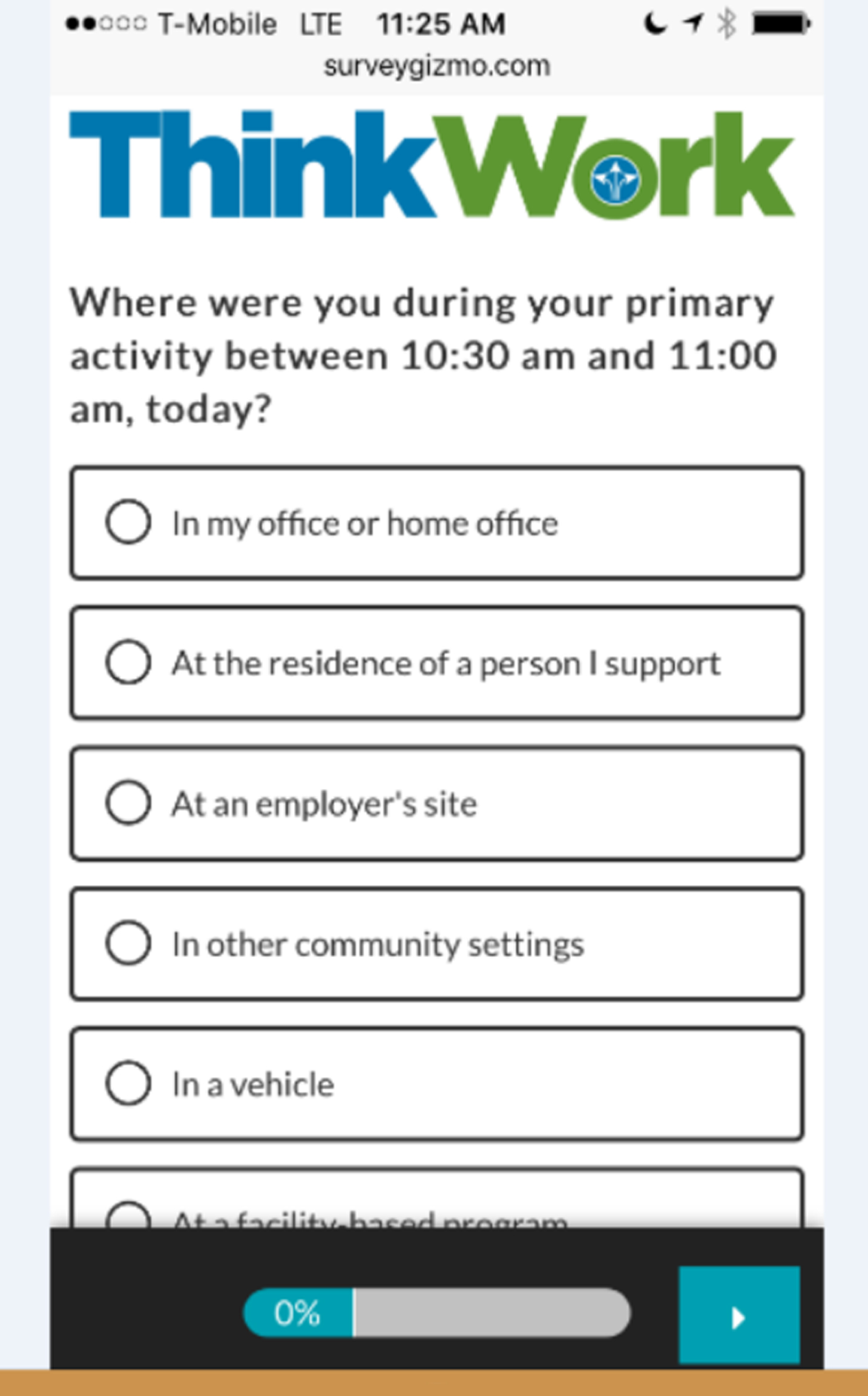
The link to the survey was delivered through a text message to the participants’ smartphones. Three multiple-choice questions inquired about the primary activity implemented during the 30 minutes before receiving the text message with the link to the survey. The three questions focused on what the respondents’ primary activity was, with whom they were interacting, and where they were. If a participant received a text while working on “job duties other than competitive employment,” this participant could select “Not employment related” as a response to the daily survey. Figure 1 shows a screenshot of the “Where” question. On December 1, 2016 a second “Who” question was added to ask who else was involved in the interaction. Access to the daily survey closed at midnight each day to ensure that employment consultants reported only on the same day of the activity.
Daily survey.
This study was approved by the Institutional Review Boards (IRBs) at the two universities that carried out the study. Following receiving IRB approval, we sent a call for participation to the mailing list of the Association of People Supporting Employment-First (APSE). APSE is a national advocacy organization whose mission is to promote employment of adults with disabilities. The APSE mailing list includes about 5,000 members, of whom many are directors of employment programs. The call for participation invited the directors who had an interest in knowing more about the study to request more information by completing a short online form. We asked the directors who responded to forward an invitation email to their employment consultants who met all of the following eligibility criteria: They had one year or more of experience providing direct support services to job seekers with disabilities, leading to paid individual employment. They worked full time. At least 50% of the consultant’s caseload was comprised of job seekers with intellectual disabilities. One or more job seekers gained paid individual employment with their primary supports during the year before this study. They had a smartphone and were willing to use it for research purposes.
The invitation email included instructions, a list of FAQs, and a link to a baseline online survey, as well as an IRB-approved consent form. A total of 97 employment consultants completed the baseline survey. All of them were enrolled to receive the daily survey. Ten employment consultants did not meet all the eligibility criteria at baseline. Two of them had less than one year of work experience before baseline, four reported zero placements before baseline, and four reported less than 50% job seekers with intellectual and developmental disabilities in their caseload at baseline. However, data from the daily survey confirmed that they provided employment supports leading to hire. Therefore, they were retained in the sample for analysis. Overall, the data from the daily survey confirmed that the participants spent between 2% and 81% of their work time providing supports leading to hire, including getting to know job seekers, finding jobs, and other supports before hire. About 90% of participants spent at least 10% of their work time providing supports leading to hire.
Throughout the one-year duration of the study, 61 employment consultants were retained (a 63% retention rate). Of the 36 employment consultants who discontinued participation, 18 left because they changed their job description or left their organization, and 18 left without any particular reason provided. The average daily completion rate of the daily survey was 90%.
An online baseline survey was completed at the onset of the study with the goal of collecting demographic characteristics of the employment consultants and of the job seekers they served. The data about the job seekers referred to the most recent job seeker who gained paid individual employment with the primary support of the employment consultants in the study.
Data analysis
Descriptive data analysis was used. Means and range were computed to describe scale measures such as number of placements, weekly earnings, and hourly wage. The findings to address the research questions were expressed as percentage of time. This measure was an approximation of time, based on the frequency of each response out of the total responses provided by the employment consultants as a group. For example, the percentage of time that employment consultants spent providing supports leading to hire was computed using the following procedure: (a) All instances of getting to know job seekers, finding jobs, or other supports before hire reported by each employment consultant from June 1, 2016 to May 31, 2017 were added up. (b) Next, the sum of these instances were divided by the total responses of each employment consultant during the one-year period examined, and divided by 100 to generate a percentage. (c) The average of such percentages was computed to determine the proportion of time that employment consultants as a group spent in supports leading to hire.
The percentage of time invested interacting with the key players and the percentage of time invested in the various settings were computed in a similar way. However, the denominator was limited to the total number of instances of activities leading to hire: getting to know job seekers, finding jobs, or providing other supports before hire.
Findings
The purpose of this study was to increase our understanding about the implementation of effective employment support practices when assisting job seekers with intellectual disabilities. The following key findings emerged from this study: As a group, employment consultants spent only a relatively small proportion of their work hours providing supports leading to hire (30%). When providing supports leading to hire, 3% of the employment consultants’ time involved a primary interaction with families and friends and 12% of their time involved a primary interaction with business personnel. When asked who else was involved in the interactions, families represented another 8% and business personnel another 17% of the interaction time. The largest share of supports before hire was delivered in the employment consultants’ offices (41% of the time), rather than in settings where people without disabilities typically interact.
Supports leading to hire
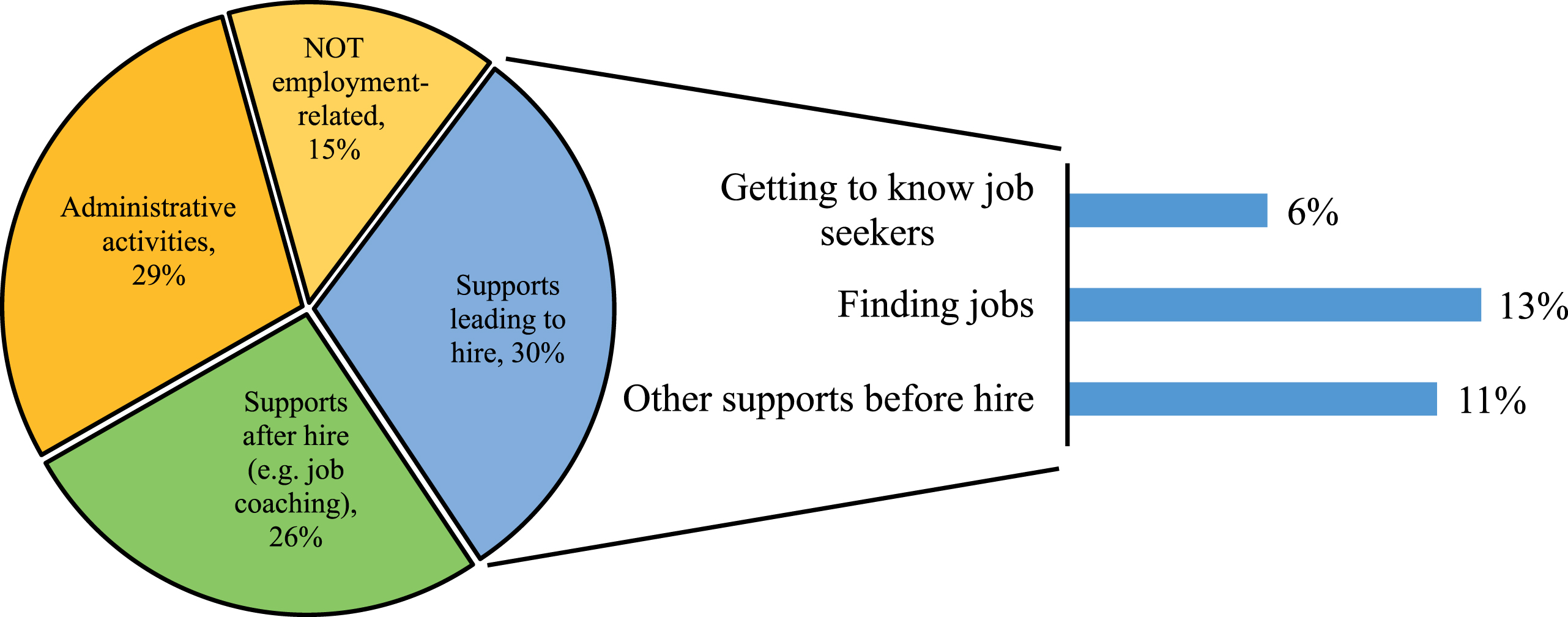
As a group, on average the employment consultants spent 30% (Min = 2%; Max = 81%; n = 61; Fig. 2) of their time supporting job seekers in gaining individual paid jobs, including getting to know job seekers (6%), finding jobs (13%), and providing other supports before hire (11%).
Primary support activities (n = 61 employment consultants).
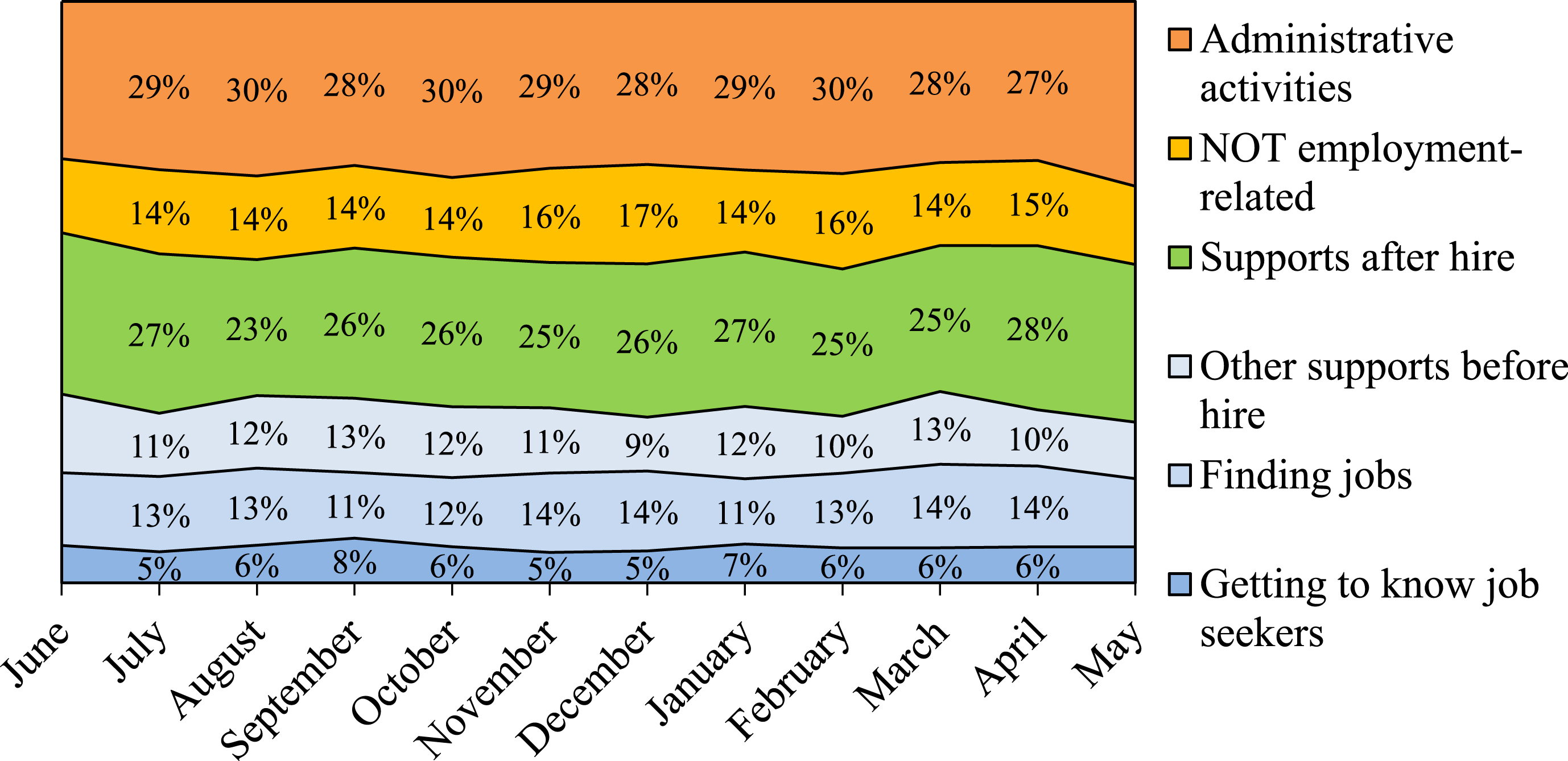
The remaining time was spent supporting people after hire (Average = 26%; n = 61), completing administrative activities (Average 29%; n = 61), and conducting non-employment-related activities (Average = 15%; n = 61). This distribution of time was relatively consistent during the one-year longitudinal data collection (Fig. 3).
Primary support activities over time (n = 61 employment consultants).
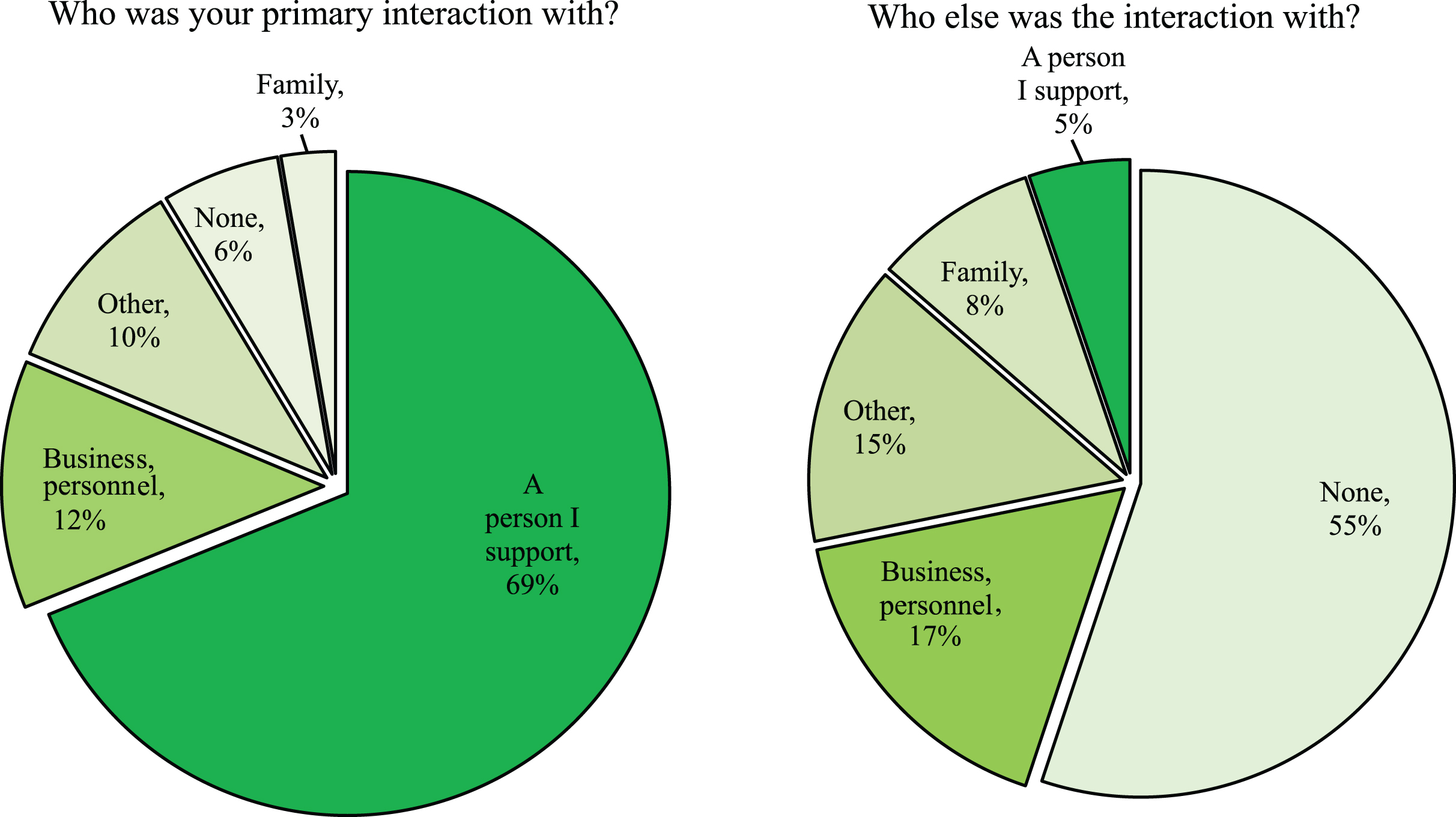
Next, we examined the interactions while providing supports that led to hire— e.g., getting to know job seekers, finding jobs, or providing other supports before hire. As a group, the employment consultants spent a substantial amount of time (69%) interacting with job seekers (Min = 33%; Max = 100%; n = 61). A relatively small amount of time (3%) was spent in a primary interaction with job seekers’ family members or acquaintances (Min = 0%; Max = 25%; n = 61), and 12% of time was spent in a primary interaction with business personnel (Min = 0%; Max = 45%; n = 61; Fig. 4). The category of business personnel included employers, managers, supervisors, co-workers, or other people in the workplace.
Interactions while providing supports leading to hire (n = 61 employment consultants).
When asking who else was involved in the interactions, families/acquaintances represented another 8% and business personnel another 17% of the interaction time, whereas job seekers represented 5% of the time. More than half of the time (55%) the secondary interactions involved no one (Fig. 4). Table 3 provides a more detailed description of the interactions across each type of support activity that lead to hire.
Interactions across types of support activities
When providing supports leading to hire, the largest share of time (41%) was spent in the office (Min = 0%; Max = 88%; n = 61), about a quarter (25%) in community settings (Min = 0%; Max = 81%; n = 61), and 18% in workplaces (Min = 0%; Max = 60%; n = 61). Five percent of respondents’ time was spent in facility-based settings (Min = 0%; Max = 74%; n = 61). Figure 5 illustrates the distribution of settings where direct supports leading to hire were provided. Table 4 provides a detailed description of the settings where each of the three types of supports leading to hire were provided.
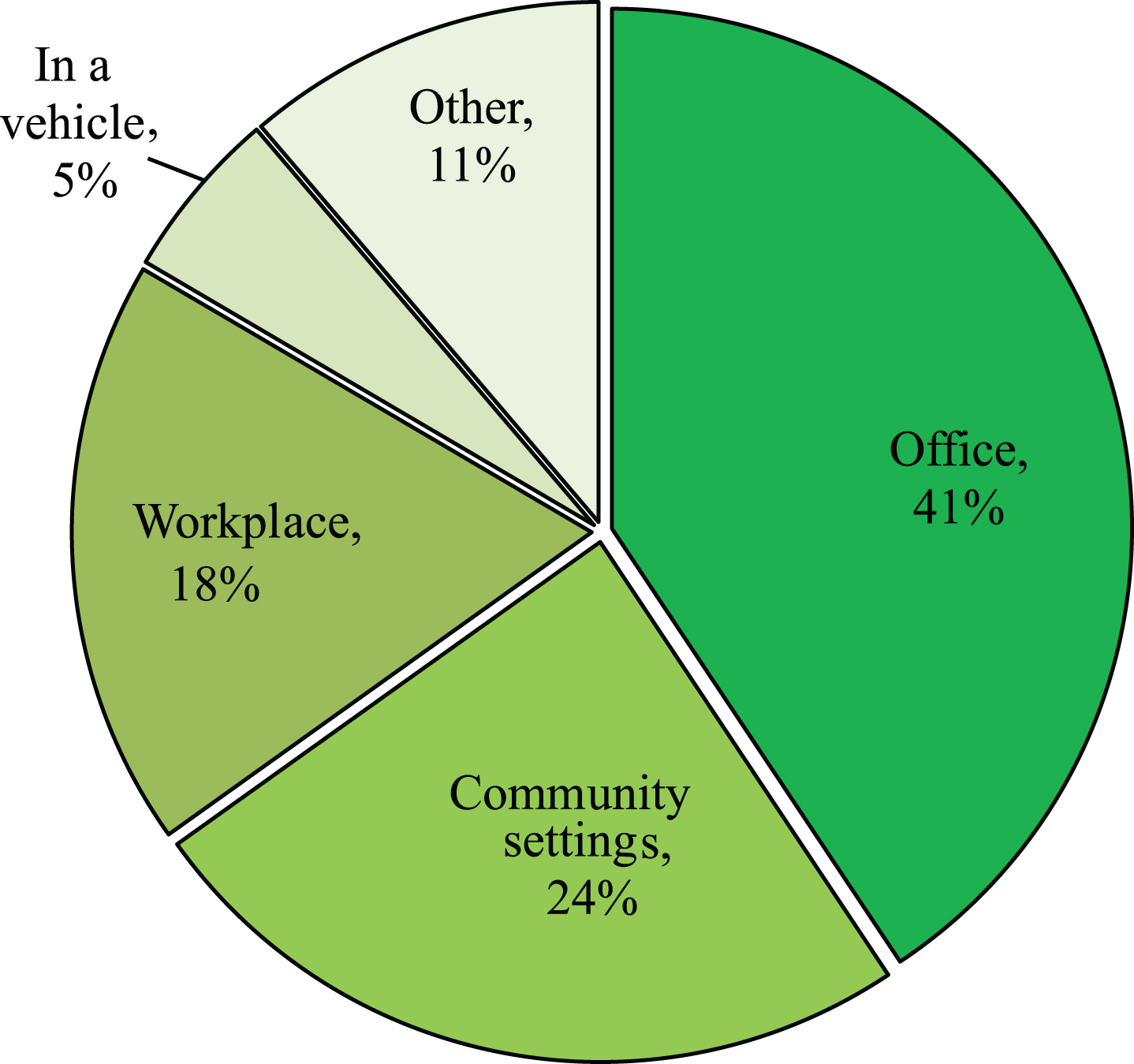
Settings where supports leading to hire are delivered (n = 61 employment consultants).
Settings across types of support activities provided
The purpose of this study was to increase our understanding about the implementation of effective employment support practices when assisting job seekers with intellectual disabilities. Key findings documented that, as a group, employment consultants spent only a relatively small proportion of their work hours providing supports leading to hire, and a relatively large amount of time on administrative activities and activities that are not employment related. Of the time dedicated to providing supports leading to hire, a relatively small proportion was spent interacting with employers and job seekers’ families. Finally, a substantial amount of supports before hire was delivered in the professionals’ offices rather than in settings where people without disabilities typically live and work. This section discusses these findings and recommendations for policy, practice, and research.
Supports leading to hire
As a group, employment consultants spent on average only 30% of their work day providing supports that lead to hire. Based on an 8-hour work day, this finding corresponds to an estimated 2.4 hours a day. Although the literature does not provide benchmarks about the optimal number of hours per day that employment consultants should spend in supports that lead to hire, principles of economy of scale indicate that investing more time in a narrower set of highly effective tasks would lead to better results while lowering costs (Pukelienė & Maksvytienė, 2008; Sinsky et al., 2016). For example, if employment consultants could invest more time providing supports that lead to hire, most likely they would increase their chances of repeating similar tasks, thus better mastering how to support job seekers more efficiently. They would be exposed to a larger repertoire of situations or problems, and therefore expand their portfolio of solutions to tap into when challenges arise (Ferriss, 2007; Newport, 2013). Building a solid expertise in supports that lead to hire would be particularly beneficial given the complexity of the tasks involved, ranging from addressing the subjective needs of job seekers and their families to meeting employers’ demands for adding economic value to their businesses (Chan & Rumrill, 2016; Gilbride & Stensrud, 2008; Novak, Parent-Johnson, Owens, & Keul, 2014; Tilson & Simonsen, 2013).
Greater effectiveness of employment consultants would likely result in the ability of employment programs to assist a larger number of job seekers without additional costs of hiring, training, and managing new staff. These savings could be reinvested in better salary and benefits packages for employment consultants, thus increasing their job retention, often reported as a challenge for delivering greater employment outcomes (ANCOR, 2017; Davidson, Timo, & Wang, 2010; Hiersteiner, 2016; Bogenschutz, Hewitt, Nord, & Hepperlen, 2014).
Increasing employment consultants’ retention would be key for building organizational know-how, maintaining networks of employers and other key stakeholders, and improving the reputation of employment programs as reliable business partners. These are all key factors for increasing the effectiveness of employment programs and, therefore, the employment outcomes of job seekers with disabilities (Bogenschutz et al., 2014; Bogenschutz, Nord, & Hewitt, 2015).
More research is needed to answer the question about what activities employment consultants should do less of, to carve more time for supports that lead to hire. The authors’ initial hypothesis is that efforts should be directed at streamlining administrative activities, promoting natural supports after hire, and delegating non-employment activities to non-work-support professionals. In particular, given that about a third of employment consultants’ time is spend in administrative tasks, a clear priority should focus on simplifying authorization, reporting, and billing tasks, as well as promoting the use of electronic technology for handling administrative tasks (ANCOR, 2017).
Interactions leading to hire
When providing services that led to hire, employment consultants spent a substantial share of this time interacting with job seekers. Clearly, interacting with job seekers on a regular basis is key for building trust with them while learning about their preferences and skills. This practice is consistent with the recommendations in the literature, especially if interactions take place in workplaces or other settings where people without disabilities typically live and work (Barrows et al., 2016; Griffin et al., 2007; Griffin-Hammis, 2014; Phillips et al., 2009). However, of the time spent providing supports that lead to hire, only about 12% was spent with business personnel as primary interaction, corresponding to about 17 minutes per day. Primary interactions with business personnel are likely to represent reaching out to employers with the goal of expanding the networks of employers. The literature does not provide benchmarks about the optimal amount of time that employment consultants should invest in reaching out to and building relations with employers. However, it is likely that investing substantially more time connecting with employers would help employment consultants in several ways. Practice would improve their ability to speak the language of business, help with understanding employers’ needs, and enhance their reputation within the business community. These are key traits highlighted in the rehabilitation literature for building and retaining relationships with businesses and thus expanding the networks of potential employers (Bolles, 2013; Darling, 2010; Gilbride & Stensrud, 2008; Henry, Petkauskos, Stanislawzyk, & Vogt, 2014; Owens & Young, 2008).
When asked who else was involved in the interaction while providing supports that led to hire, employment consultants reported that 17% of the time in these interactions was spent with business personnel as secondary participants. This corresponds to about 24 minutes per day. These secondary interactions with business personnel are likely to represent time spent in getting to know job seekers by observing them in workplaces or supporting them in interacting with employers for the purpose of finding jobs or negotiating hires.
Similarly, we know from the literature that involving families is important for a number of reasons, including leveraging their support to learn about the job seeker’s skills and preferences. Families can also help with logistics, including expanding the network of potential employers or monitoring and providing some supports after hire (Granovetter, 1995; Migliore et al., 2018; Petner-Arrey et al., 2016; Stensrud et al., 2009). However, we found that only 3% of the time spent in supports leading to a hire was spent interacting with families and acquaintances as a primary interaction and 8% of the time as a secondary interaction. The amount of time spent with families may depend on the role families still play in the lives of the job seekers with disabilities. However, based on the extended literature about the importance of involving families, we are inclined to recommend that employment consultants invest a larger share of their time with families (Francis, Gross, Turnbull, & Turnbull, 2014; Gross, Francis, & Pijem, 2015; Jones & Gallus, 2016).
Settings where supports leading to hire took place
Only about 18% of the time spent for supports leading to hire was spent in workplaces, and 24% of time was spent in other settings where people without disabilities typically live or work. That corresponds to about one hour per day spent in either workplaces or other community settings. We are not aware of literature recommending how much time employment consultants should spend in typical settings while supporting job seekers to gain employment. However, the literature highlights the importance that typical settings play when employment consultants get to know job seekers or find jobs. For example, getting to know job seekers is thought to be more effective when observing or doing things with them in typical settings like workplaces, coffee shops, restaurants, or playgrounds. In these community settings, employment consultants are more likely to learn about job seekers’ skills and preferences, compared to filling out forms or reviewing records while sitting in an office. Moreover, the more job seekers experience typical settings, the less stress they will face when they find a job and need to interact with employers and co-workers (Callahan et al., 2009; Harvey et al., 2013; Griffin et al., 2007; Migliore et al., 2018).
Spending time in workplaces is particularly important, because it allows employment consultants to deepen their understanding about how businesses operate, how tasks are distributed, and therefore how new job descriptions could be created or carved by reorganizing existing tasks. Situational observations, touring businesses, and informational interviews are some of the key activities that help employment consultants and job seekers to make better decisions about job matches (Condon et al., 2004; Griffin et al., 2007; Migliore et al., 2018; Nietupski & Hamre-Nietupski, 2000).
Based on the literature’s emphasis on supporting job seekers in typical settings, we are inclined to recommend that employment consultants increase the share of time that they spend in settings where people without disabilities typically work and live, including in workplaces.
Recommendations
The findings from this study lead to a number of recommendations for policy, practice, and research that would support employment consultants in their work with job seekers.
Policy
Federal and state regulations should include provisions that support employment consultants in their work with job seekers by promoting the implementation of the employment support practices described in the literature. For example, funding mechanisms should create incentives for investing a larger share of employment consultants’ time in services that lead to hire. At the same time, authorizations and billing protocols should be simplified and software technology made available to minimize paperwork, thus increasing the available time for providing direct employment supports to job seekers.
Practice
The findings suggest the value of engaging in reflective practice, observing and analyzing the distribution of staff time at the employment consultant and work team levels. The optimal distribution is influenced by the characteristics of the individuals receiving supports, the roles of the employment consultants and the staffing structure, and best-practice guidelines. However, the findings of this study suggest that attention should be paid to increasing the overall investment of time in supports that lead to hire, and in specific investments in time spent with employers, family members, and acquaintances. Similarly, attention to increasing time spent in community and workplace settings may support higher-quality outcomes. Investment in technology and data systems that both reduce administrative burden and support program management is recommended.
Research
In addition to describing employment consultant activities, future research should address improving validity and reliability of measuring how employment supports are implemented and how they align with the existing literature. Assessment of the relationship between activities, settings, and outcomes can support refining benchmarks for practice and support program management. Finally, experimental studies that address strategies for improving adherence to existing best practice guidelines, and causal relationships between specific practices and employment outcomes, would support improving guidance and lead to better employment outcomes.
Limitations and strengths
The job of employment consultants is complex. Therefore, it can be difficult to capture the essence of the actual support activities consistently across participants and over time. This study used snapshots of time to describe support services. However, the quality of how time is spent is an equally important factor in determining employment outcomes and should be investigated. Also, the findings may over-represent activities or interactions that lasted less than 30 minutes, but were reported because they were the primary activities. On the other hand, some activities could have been underrepresented if they systematically took less than 30 minutes and, therefore, were not reported.
This paper did not examine the relationship between time investment and employment outcomes. Addressing such a research question requires accounting for the quality of the employment outcomes (e.g., earnings, work hours, job satisfaction, and job retention) and the job seekers’ characteristics (e.g., support needs, work history, and families’ supports). Therefore, we limited the scope of this article to a descriptive analysis of how employment consultants invest their time and how the findings align with what we know from the literature. This information will serve as a foundation for future analyses about the relationship between time investment and outcomes.
Finally, this study is not necessarily representative of all employment consultants. The participants were recruited through the APSE mailing list. Although APSE is a national organization and includes a large membership, not all employment programs in the United States are APSE members.
This study has also a number of strengths. First, using a survey to be answered on a smartphone, anywhere, and therefore closer to the time when the action of analysis is performed, increases the validity of the data collected. Compared to traditional one-time survey research, collecting longitudinal data, daily, for one year, increases the representativeness of the supports provided to job seekers. Collecting data from employment consultants in different programs in different states strengthens validity. Finally, many participants provided positive feedback about the daily survey as a tool for challenging them to be more intentional in how they invested their time.
Conclusion
Federal and state policies provide a framework for supporting job seekers with intellectual disabilities in the pursuit of paid individual employment. Effective support strategies to assist job seekers are well documented in the literature. However, over the past decades the employment rate of this population has been unacceptably low, and previous research suggests that practices are not consistently implemented. This study documented that more could be done to align research to practice, including ensuring that employment consultants invest more in supporting job seekers to find jobs; interacting with key players, including job seekers’ family members/acquaintances and employers; and providing supports in settings where the general population typically live and work, rather than in the employment consultants’ offices. Supporting employment consultants by providing feedback on their work with job seekers could contribute to bridging the employment gap of adults with intellectual disabilities.
Conflict of interest
The authors declare that they have no conflict of interest.
Footnotes
Acknowledgments
The development of this manuscript was supported in part by Grant #90RT5028 (RRTC on Advancing Employment for Individuals with Intellectual and Developmental Disabilities) and grant # 90RT5019 (RRTC on Community Living). Both grants are funded through NIDILRR, the Administration for Community Living (ACL), U.S. Department of Health and Human Services (HHS). The content of this manuscript does not necessarily represent the policy of NIDILRR, ACL or HHS.
The authors would like to thank the Association of People Supporting Employment First (APSE) for helping with participants’ recruitment, Paul Foss for developing the app for smartphones, Jeff Coburn for guidance on app development, Mark Hutchinson for generating the daily survey email campaigns, Anya Weber for copyediting, and all employment consultants and their organizations who made this study possible with their participation.
1 CA (N=1); CO (N=1); GA (N=10); IA (N=3); IL (N=4); IN (N=3); MA (N=2); MI (N=2); MN (N=3); MO (N=3); NE (N=2); NM (N=3); PA (N=2); RI (N=3); SD (N=1); WA (N=6); WI (N=12).