




Abstract
BACKGROUND:
Employment has been associated with high quality of life and independence; however, employment outcomes for individuals with disabilities are much lower than their peers without disabilities.
OBJECTIVE:
This study investigated the effects of a treatment package, UPGRADE Your Performance, on the employment soft skills of secondary students with disabilities. The intervention taught students a strategy for self-evaluation, which included self-monitoring, goal setting, and self-graphing.
METHOD:
Using a multiple probe across students design, researchers investigated the effects of UPGRADE instruction on students’ soft skills while working on two different in school job sites.
RESULTS:
Results indicated all students improved in both a self-selected soft skill area and their overall performance, and they generalized their skills to a second in-school job site.
CONCLUSIONS:
Findings indicated the potential for UPGRADE Your Performance as a method for teaching soft skills to students with disabilities.
Introduction
Employment is associated with overall quality of life (Canha, Simoes, Ownes, & Matos, 2013), but unfortunately, employment outcomes of students with disabilities transitioning from school to work have persistently lagged behind their peers without disabilities (Fogg, Harrington, & McMahon, 2010). For instance, the National Longitudinal Transition Study-2 indicated youth with disabilities, 8 years after leaving high school, reported working fewer hours and earning less compared to their peers without disabilities (Newman et al., 2011). Individuals in certain disability categories fared even worse. For instance, Anderson, Larson, and Wuorio (2011) found only 15% of adults with intellectual or developmental disabilities reported being employed.
Efforts to determine what factors help individuals with disabilities attain and maintain employment reveal a key factor is the ability to interact appropriately with co-workers, supervisors, and others in the workplace (Chadsey, 2007). Casner-Lotto and Barrington (2006) conducted a survey of 461 business leaders and found employers viewed “soft” skills as more important for work readiness than reading, writing, and arithmetic. Similarly, Ju, Zhang, and Pacha (2012) found employers valued nonspecific job skills such as integrity, honesty, following instructions, showing respect for others, cooperation, and being on time over technical skills.
In the field of employment, soft skills have been defined in a variety of ways. For example, Dixon, Belnap, Albrecht, and Lee (2010) defined five basic soft skills: (a) teamwork, including adaptability; (b) problem solving, including persistence; (c) decision making, including the stages of pre-decision, decision, and post-decision; (d) communication, including nonverbal and auditory aspects; and (e) working under pressure, including managing time and balancing multiple projects. Next, Robles (2012) identified the top 10 soft skills valued most by business executives including integrity, communication, courtesy, responsibility, social skills, positive attitude, professionalism, flexibility, teamwork, and work ethic. For this study, soft skills for employment were defined as (a) having a good attitude and being cooperative by demonstrating initiative, accepting feedback, and interacting respectfully with others (e.g., co-workers, supervisors, customers) in the workplace; (b) being reliable by having good attendance, being on time, wearing appropriate attire (e.g., uniform), and being prepared for work; (c) being productive and on-task by staying focused, working without assistance, and at a consistent pace comparable to other employees; (d) demonstrating quality work by fully completing each job task, identifying mistakes and correcting them without assistance, and checking over work before finishing a job task; and (e) communicating and working with a team by appropriately interacting and communicating with others at work (e.g., co-workers, supervisors, customers), asking for assistance when needed, offering to help others, being polite and courteous to others, and following all of the rules and regulations of the job (see Table 1).
Job Performance Rubric Areas
Job Performance Rubric Areas
Given the lack of soft skills as a major barrier to employment for individuals with disabilities (Riesen, Morgan, Schultz, & Kupferman, 2014), secondary transition programming should emphasize these skills. Transition personnel agree. For example, Agran, Hughes, Thoma, and Scott (2016) surveyed secondary special educators, transition coordinators, vocational rehabilitation counselors, and job coaches to identify important employment social skills. Respondents identified the most important skills as (a) asking for clarification when they do not understand instruction, (b) being on time, (c) refraining from touching others inappropriately, (d) following instructions when immediate attention is needed, (e) asking for assistance from a supervisor when needed, (f) responding appropriately to constructive criticism, and (g) interacting positively with customers.
Some literature suggests students might learn soft skills through student practice, reflection, and feedback (Blaszczynski & Green, 2012; Dixon, Belnap, Albrecht, & Lee, 2010). McEwen (2010) described a framework for building soft skills including (a) introducing the skills to be developed, (b) explaining how the skill is developed, (c) practicing the skills with guidance, and (d) reinforcing skills based on evaluation and feedback. In addition, the Office of Disability Employment Policy (2010) suggested three strategies of experiential learning could be used to teach soft skills including interactive teaching, coaching in the workplace, and in school simulations of a workplace (i.e., in school job sites). Despite these suggestions for teaching soft skills and the fact employers and teachers value such skills, there is a lack of experimental research on how to effectively teach soft skills to students with disabilities.
Despite the lack of research on teaching soft skills, research on teaching other employment and behavior skills (e.g., technical skills, social skills) offer some useful instructional strategies. For example, specific job skills have been taught using (a) goal setting and attainment (Agran, King-Sears, Wehmeyer, & Copeland, 2003); (b) self-monitoring and self-reinforcement (Lagomarcino & Rusch,1989); (c) self-graphing, self-evaluation, and self-reinforcement (DiGangi, Maag, & Rutherford, 1991); (d) self-monitoring and teacher matching (Peterson et al., 2006); and (e) self-directed problem-solving (Wehmeyer et al., 2003). These components have been used both individually and in combination. For example, Rogers, Brethower, Dillon, Malott, and Sallwey (1983) found individuals with disabilities were able to improve their work behaviors when they were given frequent specific feedback on their evaluations and self-graphed their performance. Next, Peterson et al. (2006) found students were able to successfully generalize skills to their general education classes by self-monitoring their own behavior during class and then comparing their scores to the teacher’s scores at the end of the class to determine how often their scores matched the teacher’s scores. Results indicated self-recording and matching with teacher’s scores increased students generalization of newly acquired social skills and also decreased their off-task behavior. These results extended findings from Hoff and DuPaul (1998) who found students increased their on-task behavior and decreased disruptive behavior when their self-ratings matched their teacher’s ratings and they were provided with feedback when their scores demonstrated a discrepancy of more than one point. Most recently, Nittrouer, Shogren, and Pickens (2016) investigated the effects of combining goal setting and attainment instruction with self-management on the job performance of individuals with disabilities. Results suggested goal setting and self-management led to meaningful changes in on-task performance and job completion behavior of individuals with disabilities in inclusive employment settings. However, solely setting and reviewing goals on a daily basis did not lead to sustained changes over time; instead greater changes occurred during the self-management phase suggesting combining goal setting and self-management strategies may lead to sustainable changes in behavior.
Soft skills have been recognized as essential in promoting employees’ abilities to maintain employment; however, little research has been conducted on teaching soft skills for the last two decades (Agran, Hughes, Thoma, & Scott, 2016). This study aimed to combine several self-management practices that have been used to teach specific job skills into one intervention to teach soft skills to students with disabilities. The purpose of this study was to investigate the effects of a soft skills instructional package called UPGRADE Your Performance on the acquisition of soft skills (i.e., attitude, cooperation, reliability, productivity, on-task behavior, quality of work, and teamwork) of students with disabilities.
Students
Four high school students with disabilities participated in this study. To be included, their special education teacher selected students based on the following inclusion criteria, students had to have an individualized education program (IEP) goal of gaining employment and a record of good attendance. All students were enrolled in an occupational course of study, which provided instruction in all academic areas, self-determination skills, and vocational skills. All students were freshman in high school and were receiving specialized instruction in all academic content areas and vocational skills, however, none of the students had received instruction on soft skills for employment prior to participating in this study and did not receive soft skills instruction in other settings during the study.
MaKayla
MaKayla was a 15 year-old, Black female identified as having a specific learning disability in reading comprehension, written expression, math calculation, and math reasoning. Her academic skills were in the low average range in reading, writing, and math (Woodcock-Johnson III [WJ-III]). She was diagnosed with a learning disability using the discrepancy model when she was 11 years old. She had been receiving special education services for four years. She did not have any physical limitations. Her first in-school job site included cleaning windows throughout the school and her second in-school job site was cleaning classrooms including desks, tables, and counter tops.
Robert
Robert was a 14 year-old, Latino male identified as having autism and a mild intellectual disability (full-scale IQ: 64; Weschler Intelligence Scale for Children, 4th Edition [WISC-IV]). He did not have any physical limitations and his adaptive scores (Vineland Adaptive Behavior Rating Scales [Vineland]) were moderately low. His first in-school job site included cleaning windows throughout the school and his second in-school job site involved sweeping stairwells throughout the school building.
Amelia
Amelia was a 15 year-old, White female identified as having a hearing impairment. Audiological evaluations indicated she functioned with a mild hearing loss with cochlear implants in both ears. She received a cochlear implant in her right ear when she was three years old and a cochlear implant in her left ear when she was seven. Her academic skills were in the very low average range in reading, writing, and math (WJ-III). Her first job site was cleaning classrooms including desks, tables, and countertops. Her second job site included collecting recycling throughout the school building.
Deondra
Deondra was a 16 year-old, Black female identified as having a hearing impairment. Deondra had severe hearing loss in her right ear and profound hearing loss in her left ear. She received a cochlear implant in her left ear when she was three years old. Her academic skills were in the very low average range in reading, writing, and math (WJ-III). Her first job site was working in an attendance office inputting data and organizing files. Her second job site was collecting recycling throughout the school building.
Setting
Students attended a suburban public high school in the southeastern United States with a total enrollment of 1,198 students. All instructional lessons took place in a small conference room located within the school building. The experimenter sat next to the student at a table during intervention sessions. Data collection took place throughout the school building based on the job site location (e.g., classrooms, hallways, offices, stairwells). During the study a job coach or paraprofessional did not supervise students during their work on in-school job sites.
Experimenter
The first author served as the experimenter. She had a master’s degree in school administration and was in her second year of a doctoral program in special education. She had eight years of experience teaching high school students with autism, intellectual disabilities, and behavioral and emotional disabilities. Another doctoral student in special education collected interobserver reliability and treatment fidelity data.
Dependent variables
Job Performance Rubric (JPR)
To assess student acquisition of soft skills a Job Performance Rubric (JPR) was created based on a survey of employers’ perceptions of needed soft skills and how they were defined. The JPR included the following soft skills (a) attitude and cooperation, (b) reliability, (c) productivity and on-task behavior, (d) quality of work, and (e) teamwork and cooperation. Each soft skill had three or four subcomponent areas (Table 1). The rating scale included a 4-point rating for each subcomponent area as follows (a) 4 = consistently meeting the standards and expectations of a regular employee, (b) 3 = inconsistently meeting the standards of a regular employee, (c) 2 = not quite being up to the standards of a regular employee, and (d) 1 = not meeting expectations or being well below the standards of a regular employee. For each soft skill, the JPR further detailed what skills and behaviors comprised each score. The overall total score across all soft skills of the JPR could range from 17 to 68. For each individual soft skill area the scores could range from 3 to 12 points (3 subcomponents) or 4 to 16 (4 subcomponents).
Individual soft skill component
The primary dependent variable was attainment of soft skills on one student-selected soft skill area of the JPR. As part of goal setting instruction (GSI), each student reviewed his or her initial baseline scores and selected a soft skill area measured by the JPR to focus on. In this study, MaKayla, Robert, and Amelia chose productivity and on-task; Deondra chose quality of work (Table 2). Data collection occurred daily on each self-selected soft skill area of the JPR on an in-school job task.
Scoring Criteria for Productivity and On-Task
Scoring Criteria for Productivity and On-Task
Data were also collected daily each student’s performance on an in-school job task using the entire JPR as a measure of generalization to non-targeted soft skills.
Interobserver agreement
To assess interobserver agreement, a second scorer independently scored 30% of all sessions (e.g., baseline, intervention, maintenance). This also assisted in eliminating experimenter bias by having a second scorer evaluating students on the JPR. The second scorer was trained on the JPR in two days. The first day of training lasted for two hours and included an overview of the JPR, practice with grading using the JPR by watching videos of individuals working, and then discussing each area of the JPR and each level of the rating system. A second day of training lasted for one hour and included watching a video of a person working and both the interventionist and second scorer evaluating the person in the video. Then, they compared and discussed their scores and reviewed the different parts of the JPR. A level of 85% agreement had to occur during training before ending the session. During training and intervention an item-by-item analysis was used to determine agreement for all dependent variables. Agreement was calculated for each individual soft skill of the JPR, as well as, the whole JPR. Scorers assigned points for the items, and the number of agreements was divided by the total number of items (i.e., 4 subcomponents for two soft skill areas plus 3 subcomponents for 3 soft skill areas totaled 17 subcomponents for all 5 soft skill areas of the rubric). The same process was followed for each individual soft skill area and results across four subcomponents of attitude and cooperation were 94% (range: 75–100%), three subcomponents of reliability were 97% (range: 67–100%), three subcomponents of productivity and on-task were 90% (range: 67–100%), three subcomponents of quality of work were 90% (range: 67–100%), and four subcomponents of teamwork and communication were 91% (range: 75–100%). Across all five soft skill areas the quotient was multiplied by 100 to yield a percentage of 92.4% (range: 82–100%).
Social validity
To measure student satisfaction on procedures and outcomes, students completed an 8-item questionnaire modified from the Student Intervention Rating Profile (SIRP; Snyder, 2002) on the last day of intervention. The questionnaire used a 4-point rating scale (1 = I strongly disagree; 2 = I disagree, 3 = I agree; 4 = I strongly agree). Higher scores indicated greater treatment acceptability. Directions and statements were read aloud to the students, and they were instructed not to put their names on the survey and to be honest in their responses.
To measure their special education teacher’s perception of the intervention, two different questionnaires were used. The first, given at the completion of all intervention sessions, was an 8-item questionnaire on the intervention. The questionnaire used the same 4-point rating scale as the student’s survey. A second questionnaire on her perception of each student’s performance during and after UPGRADE instruction was completed on each student once a student completed intervention. This was a 6-item survey that asked specific questions on the teacher’s perception of the student’s performance on each soft skill on the JPR. This questionnaire used a 5-point rating scale (1 = I strongly disagree; 2 = I disagree; 3 = Neutral; 4 = I agree; 5 = I strongly agree) to provide the teacher with the option of “neutral” if she had not seen any effect on a student’s performance.
Lastly, two employers from the community, who were not familiar with the study, (one from a service industry, one from an event industry) were given JPR scores from baseline, the final scores from Job I and Job II, and maintenance. They were asked to indicate which employee they would hire for their company with a blue sticker or would not hire with a red sticker. They also completed the 5-question survey on their perception of the skills measured on the JPR using the same 4-point rating scale as the students’ and teacher’s survey.
Experimental design
The experimental design was a single-subject multiple probe across participants design (Cooper et al., 2007). All students received three initial baseline probes followed by two days of GSI. During the first day of GSI each student selected one soft skill area of the JPR to focus on based on their scores from the first three days of baseline data and the second day of instruction focused on the particular area of the JPR they chose.
After both GSI sessions, students received three additional baseline probes to measure the potential effect of GSI, as well as, each student’s performance on the soft skill they chose. The student with the most stable baseline score was chosen to begin intervention first. Once the first student began intervention, the other students were probed every four days throughout intervention. When students reached mastery, which was defined as a 3 or 4 on each subcomponent area for the area of the JPR they chose (e.g., productivity and on-task, quality of work) for two consecutive days, they moved to the second phase of the intervention at a different job site. Once students reached mastery on the second job site, they moved to maintenance. Maintenance data were collected once a week for three weeks on the second job site. The same rules were used to begin intervention with each subsequent student.
Procedures
Baseline 1
During baseline 1 students were asked to perform a job task and were evaluated on the JPR based on their performance on the job task. The observation period lasted between 30 to 45 minutes each day. Students did not receive any instruction from the interventionist or their teacher on soft skills measured by the JPR. They had been given instruction on how to perform the job task by their teacher so they knew what they were required to do while working at their jobsite. However, students did not get any feedback or instruction in the soft skill areas measured by the JPR. Baseline 1 probes occurred for a minimum of three days.
Goal setting instruction (GSI)
GSI included two days of lessons that occurred in a one-to-one setting. The first day included introducing the student to the JPR, explaining the importance of employability skills, and explaining the components of the JPR. Then, students looked at their baseline scores and selected one soft skill area to focus on (i.e., one of their lowest areas). The second day of instruction was specific to the soft skill area they selected (i.e., productivity and on-task or quality of work). The lesson included defining key words in the JPR, role-playing, and using a video where the student practiced grading someone using the JPR. At the end of the second lesson, each student set a goal for improving in the soft skill area they selected. MaKayla’s goal was to improve her productivity and on-task score to 4 in each subcomponent by staying focused and working at a faster pace. Robert’s goal was to improve his productivity and on-task score to 3 or 4 in each subcomponent by working independently, at a faster pace, and staying on task. Amelia’s goal was to improve her productivity and on-task performance to 4 in each subcomponent by staying focused and working without help. Deondra’s goal was to improve her quality of work score to 3 or 4 in each subcomponent by completing her job the right way, making corrections without help, and showing pride in her work.
Baseline 2
A second baseline session was conducted to determine the effect of GSI and to ensure stability before introducing UPGRADE Your Performance. Procedures for the second baseline were the same as the first baseline session. The student with the most stable baseline on the JPR was selected to begin intervention first. Baseline probes occurred for a minimum of three days.
UPGRADE Your Performance: During intervention students were asked to perform a job task and were evaluated by the interventionist on the JPR. Then, students participated in UPGRADE Your Performance, a multicomponent intervention developed based on research focused on teaching soft skills, as well as evidence-based instructional practices for teaching employment skills to individuals with disabilities. The structure of the intervention employed McEwen’s (2010) framework for soft skill building (a) introduce, (b) explain, (c) practice, and (d) reinforce. Research based instructional practices included goal setting and attainment, self-monitoring, self-graphing and self-evaluation. Goal setting and attainment were taught by instructing students to define and express a goal, identify where they were currently performing in relation to that goal, develop a plan of action, and evaluate their progress toward achieving that goal (Agran et al., 2003). Self-monitoring included the simultaneous use of two strategies: self-evaluation and self-recording (Cooper et al., 2007). This involved an individual making note of his or her behavior and then recording whether or not he or she was engaged in that behavior. Additionally, based on recommendations for assessing soft skills using rubrics (Williams, Wattam, & Evans, 2007) the JPR of the targeted soft skills was used to evaluate students’ job performance.
During UPGRADE Your Performance students were introduced to a mnemonic to help them remember the steps of the intervention (i.e., U = You evaluate yourself, P = Professional evaluates you, G = Graph your scores, R = Restate your goal and determine if you met it, A = Acknowledge what you did well, D = Decide what you need to improve on, and E = Execute improvements tomorrow to meet your goal). Each day after performing a job, students evaluated themselves on their self-selected soft skill area, were provided with the interventionist’s scores, graphed both scores to compare them, reviewed their goal to determine if they met it, and developed a plan to get closer to meeting their goal the next day.
UPGRADE job I: Job I instruction included a minimum of three sessions and occurred in this order: (a) student went to their in-school job site and the interventionist used the JPR to evaluate his or her performance (i.e., observation period 30 to 45 minutes); (b) when the job task was complete, the interventionist and student went to the conference room for UPGRADE Your Performance; (c) interventionist provided student with the handout for the day and asked the student to follow the first step in UPGRADE Your Performance: U = You evaluate yourself; (d) interventionist provided student with her score of the student’s performance only on the soft skill area of the JPR the student selected (i.e., productivity and on-task or quality of work) and the student listed the scores on their worksheet (i.e., P = Professional evaluates you); (e) student graphed both scores on a graphing worksheet and compared both scores (i.e., G = Graph both scores on the graphing worksheet); (f) student restated the goal and determined if the goal was met (i.e., R = Restate your goal and determine if you met it); (g) student listed two or three things they did well on the job (i.e., A = Acknowledge what you did well); (h) student listed two or three things they needed to improve on in order to meet their goal (i.e., D = Decide what you need to do better on in order to meet your goal); and (i) student chose one thing they wanted to focus on to get closer to meeting their goal the next day (i.e., E = Execute improvements tomorrow to meet my goal). This continued each day until the student reached mastery criteria. Once a student reached mastery criteria, they were moved to a new job in a new in-school location to assess generalization.
UPGRADE job II and generalization: Job II was used to assess each student’s ability to generalize their skills to a new job task in a different setting within the school. Students did not set a new goal for their new job; they evaluated their performance to see if they could meet their goal on a new job and in a new setting. Therefore, the same soft skill area of the JPR was measured and students evaluated their progress on the goal set during initial GSI on that soft skill area while working on a new job and in a new setting. This instruction followed the exact same procedures as Job I until the student reached the same mastery criteria in Job I. Additionally, data were collected daily on the total JPR to determine if any of the other areas improved even though they were not being targeted.
Maintenance
Once a student reached mastery in Job II, they entered maintenance. Maintenance conditions were identical to baseline conditions. Data were collected once a week for three consecutive weeks. During maintenance probes, students continued work at the job they worked during Job II and JPR data were collected on all areas. Students did not rate themselves during maintenance.
Procedural fidelity
Another doctoral student was trained to collect procedural fidelity data and observed 30% of the intervention sessions. Observations were distributed across the intervention in order to gather procedural reliability data on all parts of intervention. In order to document adherence to the intervention, the observer had a checklist of steps for the observation period of the intervention and a lesson plan of the session to use as a checklist. Both the observation checklist and lesson plan were divided into steps, and the observer marked each section as present or not. Number of steps completed correctly was divided by total number of steps and multiplied by 100 to obtain a procedural fidelity mean score. Fidelity scores ranged from 99% to 100% with a mean of 99.8%.
Results
Figure 1 illustrates each student’s score on the self-selected soft skill area.

Score on Individual Soft Skill Component (• = interventionist score;∘= student score; horizontal line = mastery).
MaKayla
MaKayla chose to work on productivity and on-task. During baseline 1, MaKayla’s score ranged from 4 to 5, with a mean of 4.6. During baseline 2 her scores ranged from 3 to 4, with a mean of 3.3. During Job I her scores ranged from 5 to 10, with a mean of 8. It took three sessions for her to reach mastery criteria. During Job II, her scores ranged from 7 to 12, with a mean of 10. Although there was an initial drop on the first day at her new job site, she reached mastery in three sessions and exceeded her Job I scores. During maintenance, her scores ranged from 9 to 10, with a mean of 9.7.
Robert
Robert chose to work on productivity and on-task. During baseline 1, Robert’s scores ranged from 3 to 4, with a mean of 3.3. During baseline 2, his scores were all 3. During Job I his scores ranged from 6 to 10, with a mean of 8. It took four sessions for him to reach mastery criteria. During Job II, his scores ranged from 7 to 11, with a mean of 9. There was an initial drop on the first day at his new job site; however, he did not drop to baseline levels, and he reached mastery in three days and exceeded his Job I scores by the third session. In maintenance, his scores ranged from 9 to 10, with a mean of 9.3.
Ameila
Amelia chose to work on productivity and on-task. During baseline 1, Amelia’s scores ranged from 5 to 6, with a mean of 5.6. During baseline 2, her scores ranged from 3 to 5, with a mean of 4. During Job I her scores ranged from 7 to 10, with a mean of 8.7. She reached mastery criteria after three days. During Job II, her scores ranged from 8 to 11, with a mean of 9.3. During the first day at the new job her scores dropped, but she reached mastery in three sessions exceeding per Job I scores. During maintenance, scores were 10 for all three sessions.
Deondra
Deondra chose to work on quality of work. During baseline 1, Deondra’s scores ranged from 5 to 6, with a mean score of 5.3. During baseline 2, her scores were all 4. During Job I her scores ranged from 7 to 10, with a mean of 8.7. She reached mastery criteria in three days. During Job II, her scores ranged from 8 to 10, with a mean of 9. Although her scores dropped initially at her new job site, she reached mastery in four days. During maintenance, her scores ranged from 9 to 10, with a mean of 9.3.
Generalization to non-targeted soft skills on job performance rubric
Figure 2 shows the total JPR scores for each student. Table 3 shows students’ JPR scores on their final data point from baseline, intervention, and maintenance in each individual soft skill area.
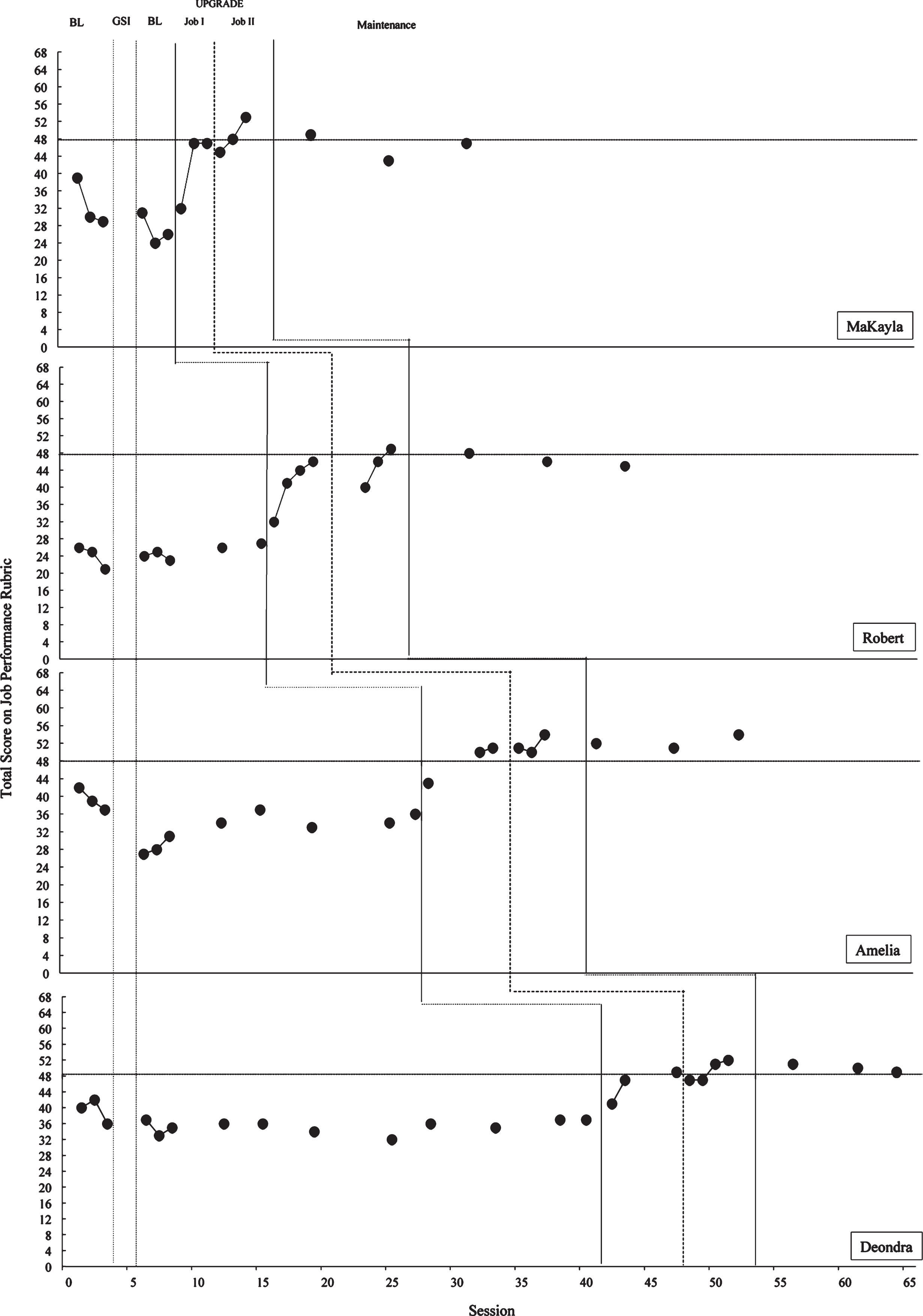
Total Score on the Job Performance Rubric (horizontal line = mastery).
Participant Scores on the Final Data Point in Each Phase for Each Soft Skill
Note. Participants’ targeted soft skill areas are shown in boldface.
While MaKayla selected productivity and on-task, she made at least a 5-point gain in all non-targeted soft skills. MaKayla’s final scores for attitude and cooperation ranged from 7 to 12, with a mean of 9.7. Her reliability final scores, ranged from 7 to 9, with a mean of 8.3. Quality of work final scores ranged from 3 to 8, with a mean of 6.3. Teamwork and communication final scores ranged from 7 to 12, with a mean of 9.7. These data indicated MaKayla’s performance generalized to other areas of the JPR.
Robert
Although Robert selected productivity and on-task, he made at least a 3-point gain in all non-targeted soft skills, including a 5-point gain in quality of work. Robert’s final scores for attitude and cooperation ranged from 8 to 11, with a mean of 9.7. His reliability final scores ranged from 5 to 8, with a mean of 7. Quality of work final scores ranged from 3 to 8, with a mean of 6.3. Teamwork and communication final scores ranged from 8 to 11, with a mean of 9.7. These data indicated Robert’s performance generalized to other areas of the JPR.
Ameila
While Amelia selected productivity and on-task, she was able to increase her final scores in all non-target soft skill areas, including a 4-point increase in three of the non-targeted soft skills. In the area of attitude and cooperation Amelia’s final scores ranged from 9 to 13, with a mean of 11.7. Her reliability final scores ranged 8 to 9, with a mean of 8.7. Quality of work final scores ranged from 5 to 9, with a mean of 7.7. Teamwork and communication final scores ranged from 9 to 13, with a mean of 11.3. These data indicated Amelia’s performance generalized to other areas of the JPR.
Deondra
While Deondra selected quality of work, she was able to increase her final scores in all other non-targeted soft skills, including a 5-point increase in attitude and cooperation. Deondra’s final scores on attitude and cooperation ranged from 7 to 12, with a mean of 10.3. Her reliability final scores ranged from 8 to 9, with a mean of 8.3. Productivity and on-task final scores ranged from 6 to 9, with a mean of 8. Teamwork and communication final scores ranged from 10 to 12, with a mean of 11. These data indicated Deondra’s performance generalized to other areas of the JPR.
Social validity
Student scores on the modified SIRP ranged from 3 to 4 with a mean of 3.6, indicating high levels of student satisfaction with procedures and outcomes. Students made comments during the intervention supporting the social significance of the intervention: (a) “I came up with a way to make myself faster so I could reach my goal and I did!”(Amelia); (b) “Graphing my scores helps me see how I am improving.”(MaKayla); (c) “I can tell I am becoming a better employee and I think my grades are going to go up!”(Robert); and (d) “Everyone should do this, it’s easy!”(Deondra).
The special education teacher’s perception of goals of the intervention were all 4, indicating she felt it was important for students to learn soft skills, set their own goals, and have an intervention combining soft skill instruction with goal setting and self-monitoring. Her scores on the acceptability of outcomes were all 4 indicating she felt UPGRADE Your Performance helped her students improve their soft skills, evaluate their own behavior, and improve their behavior in the classroom. She also indicated UPGRADE Your Performance was helpful and she would like to use it in the future. On the evaluation of student performance questionnaire, the teacher’s scores ranged from 4 to 5 for each student with an overall mean score of 4.8; indicating she strongly agreed all students improved their overall job performance after participating in UPGRADE.
Next, both community employers consistently chose JPR scores from intervention and maintenance as employees they would hire. One employer marked 100% of baseline rubrics indicating he would not hire those employees. The second employer marked 75% of baseline rubrics as would not hire. For the two rubrics from baseline he did not mark as do not hire, he explained, “The ones I put both a blue and red sticker on I would question more before hiring and try to work with them to him improve their skills in the areas of quality of work and productivity and on-task.” When he was asked to elaborate, he indicated their scores in other areas such as attitude and cooperation, reliability, and teamwork and communication were higher ranging from 2 to 3, and he felt they would definitely go through a longer interview process, but if they were willing to work on the other areas, he would be willing to work with them. Finally, each community employer indicated they agreed it was important for students to learn soft skills and that the JPR was a good way to evaluate soft skills. They also indicated the skills measured by the JPR were important and would help students obtain employment.
Discussion
The purpose of this study was to investigate the effects of UPGRADE Your Performance on acquisition of soft skills (e.g., attitude, cooperation, reliability, productivity, on-task behavior, quality of work, and teamwork) of students with disabilities. After participating in UPGRADE Your Performance, all students improved in their chosen soft skill area, as well as made generalized improvements to other non-targeted soft skills measured by the JPR. Additionally, students were able to generalize their newly acquired soft skills to a new job site within the school.
For the purposes of this study we defined soft skills as attitude and cooperation, reliability, productivity and on-task, quality of work, and teamwork and communication. Three of the participants in this study chose to work on productivity and on-task and one chose to work on quality of work. Robles (2012) identified the top 10 soft skills valued most by business executives and two of those included responsibility and work ethic and Dixon et al. (2010) identified time management as one of the top soft skills valued by employers. Robles (2012) defined responsibility as being accountable, reliable, getting the job done completely, resourceful, self-disciplined, conscientious, and having common sense. Work ethic was defined as hard working, willing to work, loyal, demonstrating initiative, self-motivated, being on time, and having good attendance for work. The definitions of these two skills identified by Robles (2012) align with skills defined within productivity and on-task and quality of work (see Tables 1 and 2). For example, getting the job done completely is a requirement of quality of work and being self-disciplined and self-motivated align with skills listed within productivity and on-task.
Previous studies providing instruction on technical employment skills combined goal setting and self-monitoring to improve student’s performance on the job (Nittrouer et al., 2016; Rogers et al., 1983). Those studies indicated using both components simultaneously improved performance. This study extends those findings since after students participated in GSI, there was no change in their scores during the second baseline session indicating GSI alone was not enough. However, when self-monitoring, self-graphing, and self-evaluation components were introduced during intervention students quickly made gains on their job performance. In addition, this study extends findings from Hoff and DuPaul (1998) and Peterson et al. (2006) by including teacher matching as a part of the self-management intervention. Findings in those studies indicated when student scores matched teacher scores, student performance increased (Hoff & DuPaul, 1998; Peterson et al., 2006) and skill generalization increased to other settings (Peterson et al., 2006). This study also found students were able to increase their performance through teacher matching and feedback; as well as, generalize skills to a new setting. During baseline, the average difference between teacher and student ratings ranged from 2 to 8 points with no matches. During Job II the average difference ranged from one to two with four matches.
Students were able to not only generalize their skills to another job site within the school, but also improved in other soft skill areas measured by the JPR. All of the students were able to increase their scores in attitude and cooperation and teamwork and communication while focusing on productivity and on-task or quality of work. All three students who focused on productivity and on-task, made significant gains in two additional areas, quality of work and attitude and cooperation. The final student, who focused on quality of work, made her largest gains in attitude and cooperation. These results indicated, despite focusing on one area, students might make gains in other soft skill areas measured by the JPR.
Results from community employer surveys also aligned with literature investigating employers’ perceptions of skills needed for employment. Ju et al. (2012) found employers valued certain personal attributes and nonspecific job skills over technical skills, including integrity, honesty, following instructions, showing respect for others, cooperation, and being on time. The employers’ perceptions of this study also indicated they felt these skills were important for obtaining a job and overall would hire students whose scores were higher in these soft skill areas.
Another point of discussion is that some employers may value some soft skills over others. For the employer who worked in a service industry, having a good attitude, being cooperative, being reliable, having good communication skills, and working in a team were extremely important in that profession. He felt if a person had those skills he would take them through a longer interview process and might be willing to help them with their other skills such as quality of work, productivity level, and being on-task.
Limitations and recommendations for future research
Although results from this study indicated a functional relation, there were some limitations. First, students reached mastery criteria quickly and were able to maintain their skills over time; however, they were not able to maintain at the same level they achieved during intervention. This could be due to the short time spent in intervention; therefore, future studies could modify the mastery criteria so students demonstrate mastery for a longer period of time (e.g., 4 consecutive days) to see if maintenance improved over time.
Second, students were able to generalize skills to another job site within the school building. However, there was a slight drop in their scores on the first day on the second job site, which could be due to a student learning a new job and could have impacted a students’ productivity (e.g., pace). Future studies should collect maintenance data on the first job site before students move to a new job site to see if students maintain newly acquired soft skills before moving to a new site. Additionally, even though students were able to generalize their skills to a second job site that may not mean they will generalize those skills to a community job site. Future studies should investigate if students are able to generalize skills from a school site to a job site within the community.
Another potential limitation was the “good attendance” inclusion criteria for this study. One area of the rubric measures an employee’s reliability; since, students already had a record of good attendance, this could impact their scores on the reliability area of the JPR. However, the four students involved in this study had reliability scores during their final baseline point of 7, 5, 8, and 8 indicating that despite having a record of “good attendance” none were at mastery during baseline (e.g. 9–12); however, after intervention two did reach a score of 9. None of the students in this study chose reliability as an area to focus on; however, future studies may consider this when selecting inclusion criteria for students. Including students with poor attendance might allow researchers to determine if UPGRADE Your Performance has the potential to improve attendance and tardiness.
Implications for practice
Findings from this study indicated UPGRADE Your Performance may be an effective way to teach students soft skills that may help them obtain and maintain employment. Results also indicated instruction on the JPR and goal setting alone were not sufficient. During the GSI lessons students received instruction on the rubric and set a goal, but did not receive UPGRADE Your Performance. Data indicated student scores did not improve during second baseline probes. In addition to teaching soft skills, this intervention package included components of self-determination such as goal setting and self-evaluation. It also included a teacher matching component where the student and interventionist compared their scores and discussed differences in scores; as well as, a self-graphing component, which ties to general education math standards taught during high school. Secondary teachers, transition specialists, vocational rehabilitation counselors, and job coaches could implement this intervention for in-school and community jobs as a way to combine transition skills with academic instruction.
In addition, practitioners could use the JPR as a tool to collect data on students’ performance and monitor their progress toward their employment IEP goals. It could also be used as a way to teach students to assess and self-monitor their newly acquired soft skill. One possible way this could be done is by using excel spreadsheets to record data and create graphs or using Google sheets within Google drive. Using Google spreadsheets would enable teachers and job coaches to input scores quickly for multiple students in their own individual spreadsheet. This may be a practical way for teachers to implement this instruction.
Also, given teachers may not be able to provide one-to-one instruction; this instruction could be delivered in a whole group format. For example, all students could follow the UPGRADE steps after returning from an in-school or community job site. Furthermore, since findings indicated students were able to improve their performance in other skill areas by focusing on one skill area, practitioners may be able to maximize instructional time by tying skills together when implementing UPGRADE with students.
Lastly, with the recent passage of the Workforce Innovation and Opportunity Act (WIOA) in 2015, with guidelines for vocational rehabilitation counselors providing pre-employment transition services to individuals with disabilities, as early as age 14 and this strategy could be used to assist vocational rehabilitation counselors when working with students in the school and community.
In conclusion, employment outcomes for individuals with disabilities are lower than their same age peers (Newman et al., 2011) and recent legislation emphasizes competitive integrated employment as a desired employment outcome for individuals with disabilities (WIOA, 2015). Additionally, employers have indicated soft skills are key to obtaining and maintaining employment (Casner-Lotto & Barrington, 2006; Ju et al., 2012). However, there are not many empirically supported interventions on how to teach students with disabilities soft skills (Agran et al., 2016). This study demonstrated the potential for UPGRADE Your Performance to be used to teach soft skills to students with disabilities.
Conflict of interest
None to report.