



Abstract
PURPOSE:
This paper examines individual’s perceptions of emotional and physical functioning and self-management on career development.
DESIGN:
A cross-sectional mediation design.
SAMPLE:
81 young adult survivors of childhood cancer (M = 18.90, SD = 0.97) diagnosed with a brain tumor prior to the age of 18.
METHODS:
Multiple regression and correlation were used examine if physical and emotional functioning mediates symptom management on job awareness, job acquisition, and job maintenance.
FINDINGS:
Symptom management was associated with approximately 0.16 points higher job awareness scores as mediated by emotional functioning, 0.11 points higher job acquisition scores as mediated by emotional functioning, and 0.16 points higher job maintenance scores as mediated by physical functioning.
CONCLUSIONS:
Physical and emotional functioning have a differential impact on specific career development factors suggesting the need to develop specific targeted career and vocational interventions.
Introduction
Child survivors of brain or central nervous system (CNS) tumors are at increased risk for functional impairments, decreased quality of life, and chronic unemployment (Kirchoff et al., 2011; Zeltzer et al., 2009). A study with the Childhood Cancer Survior Study (CCSS) data involving 1,101 adult survivors of pediatric brain tumors demonstrated that 74% were unmarried, 26% were unemployed, and 28% had incomes of less than $20,000 per year (Gurney et al., 2009). These findings are consistent with a metanalysis investigating childhood cancer survivors and unemployment that found that cancer survivors were twice as likely to be unemployed when compared to healthy controls, with survivors of pediatric brain tumors having a 5-fold risk of being unemployed, and 11 times more likely to have never been employed (de Boer, Verbeek, & van Dijk, 2006).
Although survival rates have increased for pediatric brain tumors, youth survivors often experience late effects, or the lingering physical, cognitive, and emotional effects after the remission of the cancer. Tumor location and treatment type (e.g., cranial radiation, surgery, chemotherapy) have been linked to cognitive changes such as depreciated memory, auditory attention, concentration, processing, and abstract reasoning; changes that impact individuals’ abilities to meet the demands of the labor market (Feuerstein, Hansen, Calvio, Johnson, & Ronquillo, 2007; Mostow, Byrne, Connelly, & Mulvihill, 1991). Common late effect physical changes include increased levels of fatigue, visual and hearing problems, gait and mobility problems, and inability to stand for extended periods. Research indicates childhood brain tumor survivors also face decreased social adjustment and higher levels of depression and anxiety (Schulte & Barrera, 2010).
Late effects, coupled with the vulnerabilities of age at diagnosis, disease progression, treatment regimen, social adjustment, and limited transportation effectively limits the career development of young adult CNS tumor survivors. Absent the opportunities to develop necessary skills and career vision through paid work experiences, survivors may lack the motivation necessary to pursue educational opportunities that are consistent with their residual functional capacity, and ultimately, become ready to enter the workforce (Chan, Cardoso, & Chronister, 2007; Strauser, Wagner, & Wong, 2012). As a result, many survivors have limited career development and employment. Establishing an appropriate career path and pursuing one’s occupational development is critical to enhancing the cancer survivorship experience (Short, Vasey, & Tunceli, 2005; Strauser, Jones, Chiu, Tansey, & Chan, 2015). Work has been linked to one’s overall identity, self-esteem, self-worth, self-concept, and plays a pivotal role in facilitating and maintaining social relationships which provide individual’s with psycho-social support which benefits overall health promotion and community integration (Blustein, 2006; Blustein, Kenna, Gill, & DeVoy, 2008; Hoffman, 2005; Main, Hesse, & Kaplan, 2005).
Unemployment is a major risk factor for increased psychological distress, reduced physical health and decreased quality of life in young adult cancer survivors. Research has also found that not being employed has been associated with poor cancer adjustment, general increase in health related medical problems, and overall decrease in quality of life and general welfare of both the individual and the family (Hewitt et al., 2003; Syse, Tretli, & Kravdal, 2008; Verbeek & Spelten, 2007).
Theoretical background
Recent research has focused on understanding the factors associated with the challenges experienced by pediatric brain tumor survivors related to career development and employment. One model that has received recent attention in conceptualizing factors related to career development and employment of young adult cancer survivors is the Illinois Work and Wellbeing Model (IW2M) (Strauser et al., 2015). The conceptual framework was informed by the International Classification of Functioning (ICF) Model as well as theory based research regarding employment of individuals with chronic health conditions. The model is comprised of three major domains (Contextual, Career/Employment Development, and Participation) that have a bidirectional relationship that informs outcomes and potential interventions. This model provides a structured framework to conceptualize factors that impact the career development for young adult survivors of pediatric CNS tumors and has the potential to guide career development and employment research and service in the cancer population (Fig. 1) (Strauser et al., 2015).
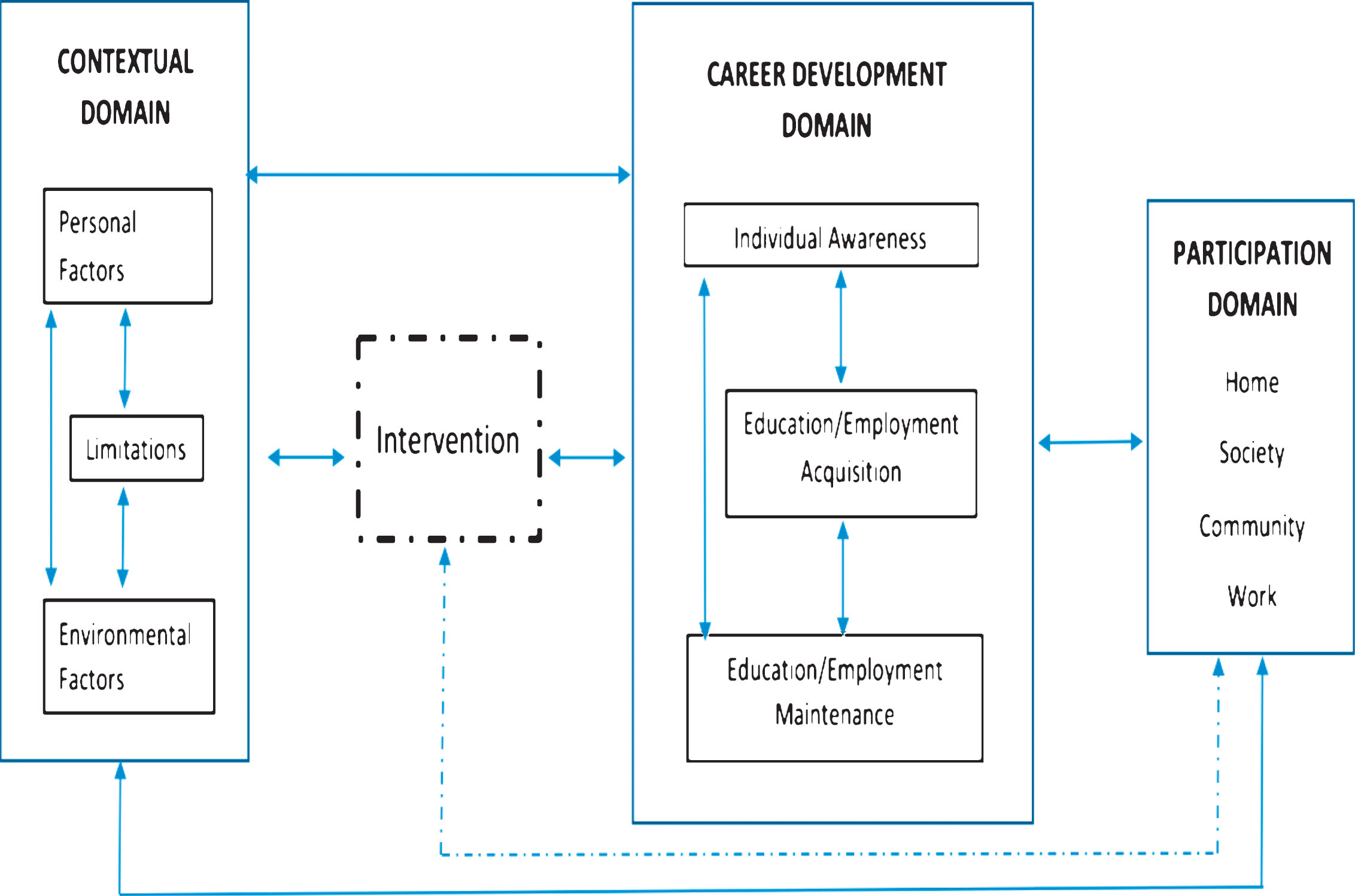
Illinois Work and Well-being Model.
Utilizing a vocational counseling framework, such as the IW2M, researchers have begun to identify potential areas in which survivors of pediatric brain tumors can be categorized to better explain the challenges experienced around finding and maintaining employment. Survivors of pediatric brain tumors have been identified as having low levels of career readiness and work personality (Strauser, Wagner, Wong, & O’Sullivan, 2013) and underdeveloped vocational identities (Strauser et al., 2012), with treatment intensity, age at diagnosis, and physical health indirectly affecting career readiness, vocational identity, and work personality via impact on emotional and physical functioning (Strauser et al., 2014). However, given the paucity of research conducted regarding career and employment development with young adult survivors of pediatric cancer, more research is needed. Specifically, additional research is needed to assess not only the vocational needs of survivors of pediatric brain tumors, but how perceived physical and emotional functioning impacts the career development process. Therefore, the primary purpose of this paper is to examine how individual’s perceptions of emotional and physical functioning and self-management, impact the career development process. The following research question guided this study: Does perceived physical and emotional functioning among young adult survivors of childhood brain tumors mediate the relationship between perceived self-management and job awareness, acquisition, and maintenance?
Participants
The participants consisted of 81 young adult survivors of childhood CNS cancer aged between 18 and 24 years old (M = 18.90, SD = 0.97). Diagnosis in order of prevalence were Astrocytoma (21%) followed by Medulloblastoma Brain Tumor (17%), Brain tumor(13%), Neuro-related tumors (10%), Craninopharyngioma (9%), Ependymoma (9%), Glioma (7%), Germ cell tumor (5%), Choroid Plexus (1%), Glioblastoma (GBM)(1%), Oligoastrocytoma (1%), and others (Brain Arteriovenous Malformations and or headaches) (4%). The age at diagnosis of the participants was between 0 and 17 years old (M = 9.23, SD = 4.72) with the age of finishing treatment being between 0 and 19 years old (M = 11.28, SD = 4.92). Fifty-four participants were women (66.7%) and a majority of participants identified themselves as Caucasian (85.2%), followed by Hispanic (7.4%), Asian American (2.5%), Black (1.2%), and other (3.7%). In terms of treatment, the most of participants underwent surgery (92.6%) followed by radiation (55.6%), chemotherapy (50.6%), transplant (6.2%), and other (7.4%). Twenty-three participants have recurrence or second cancer (28.4%) with the age of recurrence between 4 and 23 years old (M = 11.79, SD = 6.38).
Procedures
After receiving approval from the Children’s Brain Tumor Foundation and University of Illinois at Urbana-Champaign institutional review boards individuals who have participated in psychosocial groups were recruited by email through the Children’s Brain Tumor Foundation database that includes individuals from Minnesota, New York, New Jersey, and Washington, DC. To be eligible for the study each individual had to be currently enrolled or had participated over the last year in a post-secondary training program, were 18 years of age or older at the time of the study, had been diagnosed with a brain tumor prior to the age of 18, and had no cancer therapy in the past 24 months. Initially 300 individuals were identified as eligible for the study and were sent an introductory email inviting study participation. A second email inviting participation was sent three weeks later. Through the email individuals were instructed that if they were interested in participating in the study that they should access the link to the secure electronic survey which included an informed consent form, demographic form and survey instrument. Through the informed consent form individuals were instructed that their participation was voluntary and that they were free not to participate, or discontinue participation, without any negative consequences or impact on services being provided. Out of the 300 initial emails, 95 individuals chose to respond and 81 individuals completed the demographic form and instrument. All responses were recorded through a secured electronic survey platform and no individual identifying information was obtained.
Instruments
Children’s Brain Tumor Foundation (CBTF) Career Assessment
The CBTF Career Assessment was developed to identify individuals’ perceptions regarding their individual physical and emotional functioning, perceived ability to manage physical and emotional symptoms, and their confidence in managing career/educational awareness, acquisition, and maintenance. In addition to using the Illinois Work and Well-Being Model and Bandura’s Self-Efficacy Theory to guide instrument development, information based on clinical experience, prior research conducted, and input from clinical service providers including social workers, psychologists and vocational rehabilitation professionals knowledgeable of young adult CNS survivors were used to guide instrument development. The questionnaire was designed specifically for young adult brain tumor survivors to be brief to maximize focus and avoid questionnaire fatigue. In addition to demographic, diagnostic, and treatment information the CBTF Career Assessment includes two items to address perceived functioning, two items to address perceived management, four items to address career/education awareness and one item each to address career/educational acquisition and maintenance. For the items related to self-management, career awareness, career acquisition, and career maintenance, individuals were instructed chose which term best described their current response: Agree, Somewhat Agree, Somewhat Disagree, and Disagree. For physical and emotional functioning, the individual was asked to rate their functioning with the following term that best describes his or her functioning over the last 30 days: Excellent, Good, Fair, and Poor.Table 1. Identifies the specific items used to address self-management, functioning and the respective career factors. Upon development the scale was piloted with a group of 10 young adult CNS survivors to determine readability, length of administration, and to assess face ability. Based on the feedback the wording of two items were edited for clarification. All respondents in the pilot group indicated that the items appeared to be appropriate and address issues related to career, physical, and emotional functioning.
Specific items included in the CBTF Career Assessment related to perceived functioning, self-management, and career
Specific items included in the CBTF Career Assessment related to perceived functioning, self-management, and career
All analyses were computed using the Statistical Package for the Social Sciences software program (version 22.0). Descriptive statistics were computed to provide information on participants’ demographic characteristics and for the independent, mediator, and dependent variables in the present study. Correlation analysis and multiple regression analysis were performed to determine whether perceived physical and emotional functioning can mediate the relationship between perceived self-management and job awareness, acquisition, and maintenance. The mediation hypothesis was tested using Baron and Kenny’s (1986) approach. The first step was carried out by regressing the mediator (M) on the independent variable (X). The second step was conducted by regressing the dependent variable (Y) on X. The third step was performed by regressing Y on X and M to examine the influence of M on Y when X is controlled. The SPSS PROCESS v2.16 macro for SPSS developed by Andrew Hayes (2009) was used to estimate the total, direct, and indirect effects of symptom management on job awareness, job acquisition and job maintenance through mental health and physical health functioning as well as to compute the bootstrap test recommended by Hayes (2013) to test our mediation hypothesis.
Results
Correlational analysis
The relationships among the variables in the present study were relatively robust and ranged from moderate to large effect size (0.36 to 0.62), with the exception of the relationship between job maintenance and mental health functioning (r = 0.21, p = 0.07). The means, standard deviations, and the intercorrelations among the symptoms management, mental health and physical health functioning, and job awareness, job acquisition, and job maintenance variables are presented in Table 2.
Correlations, Means and Standard Deviations for the Predictor, Mediator, and Outcome Variables (N = 81)
Correlations, Means and Standard Deviations for the Predictor, Mediator, and Outcome Variables (N = 81)
**Correlation is significant at the 0.01 level (2-tailed).
Multiple regression and correlation techniques were used to test the hypotheses that mental and physical health functioning positively mediates the effect of symptom management (physical and mental health symptoms) on job awareness, job acquisition, and job maintenance.
Job awareness
Results indicated that symptom management was a significant predictor of job awareness (total effect: c = 0.41, SE = 0.10, p < 0.01) and that symptom management was a significant predictor of emotional functioning, a1 = 0.42, SE = 0.10, p < 0.01 and physical functioning, a2 = 0.41, SE = 0.10, p < 0.01. Emotional functioning was a significant predictor of job awareness, b1 = 0.39, SE = 0.11, p < 0.01, after controlling for the effect of symptom management and physical functioning. Physical functioning was not a significant predictor of job awareness after controlling for the effect of symptom management and emotional functioning, b2 = 0.12, SE = 0.11, p = 0.28. Symptom management was no longer a significant predictor of job awareness after controlling for the effect of physical and emotional functioning (direct effect: c’ = 0.20, SE = 0.11, p = 0.07). The indirect effect was tested using a bootstrap estimation approach with 10,000 samples (Hayes, 2013). These results indicated only one indirect coefficient was significant, a1b1 = 0.16, SE = 0.09 (95% CI = 0.03, 0.38). Symptom management was associated with approximately 0.16 points higher job awareness scores as mediated by emotional functioning. A graphical presentation of the bi-mediation model for job awareness and information for the path coefficients (a1, a2, b1, b2,, c and c’) are presented in Fig. 2.
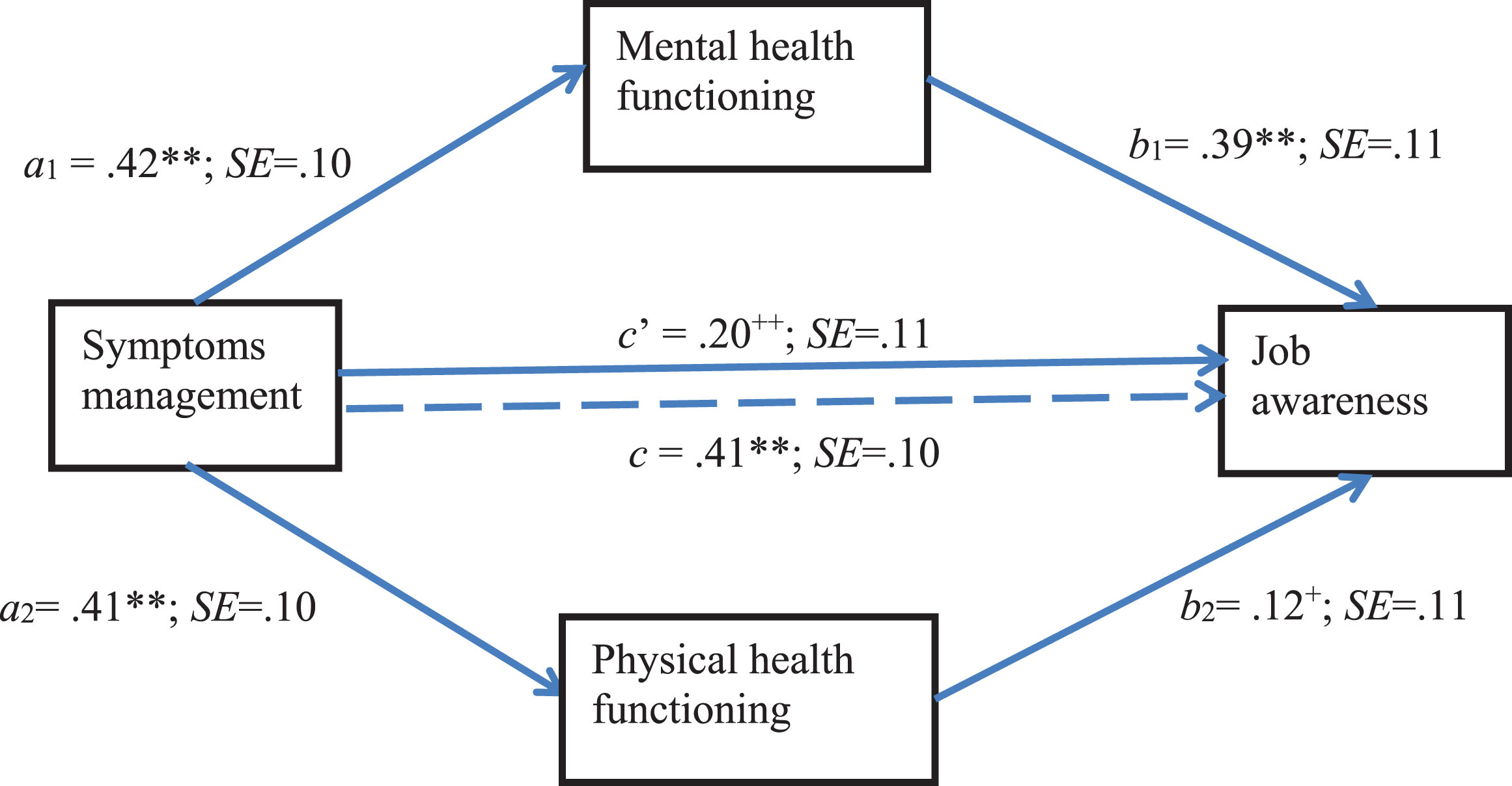
Path coefficients for the bi-mediation analysis on job awareness (N = 81). Note: Dotted line denotes the effect of symptom management on job awareness when physical health and mental health functioning are not included as dual mediators. a1, a2,b1, b2,, c and c’ are unstandardized ordinary least squares (OLS) regression coefficients. *p < 0.05, **p < 0.01, +p = 0.28, ++p = 0.07.
Results indicated that physical and emotional symptom management was a significant predictor of job acquisition (total effect: c = 0.49, SE = 0.10, p < 0.01) and that symptom management was a significant predictor of emotional functioning, a1 = 0.42, SE = 0.10, p < 0.01 and physical functioning, a2 = 0.41, SE = 0.10, p < 0.01. Emotional functioning was a significant predictor of job acquisition, b1 = 0.27, SE = 0.11, p < 0.05, after controlling for the effect of symptom management and physical functioning. Physical functioning was not a significant predictor of job acquisition after controlling for the effect of symptom management and emotional functioning, b2 = 0.13, SE = 0.11, p = 0.23. Symptom management was still a significant predictor of job acquisition after controlling for the effect of physical and emotional functioning (direct effect: c’ = 0.33, SE = 0.11, p < 0.01). The indirect effect was tested using a bootstrap estimation approach with 10,000 samples (Hayes, 2013). These results indicated only one indirect coefficient was significant, a1b1 = 0.11, SE = 0.07 (95% CI = 0.01, 0.29). Symptom management was associated with approximately 0.11 points higher job acquisition scores as mediated by emotional functioning. A graphical presentation of the bi-mediation model for job acquisition and information for the path coefficients (a1, a2, b1, b2,, c and c’) are presented in Fig. 3.

Path coefficients for the bi-mediation analysis on job acquisition (N = 81). Note: Dotted line denotes the effect of symptom management on job acquisition when physical health and mental health functioning is not included as a mediator. a1, a2,b1, b2,, c and c’ are unstandardized ordinary least squares (OLS) regression coefficients. *p < 0.05, **p < 0.01, +p = 0.23.
Results indicated that symptoms management was a significant predictor of job maintenance (total effect: c = 0.42, SE = 0.10, p < 0.01). Symptoms management was a significant predictor of emotional functioning, a1 = 0.42, SE = 0.10, p < 0.01and physical functioning, a2 = 0.41, SE = 0.10, p < 0.01. Emotional functioning was not a significant predictor of job maintenance, b1 = – 0.10, SE = 0.11, p = 0.35, after controlling for the effect of symptoms management and physical functioning. Physical functioning was a significant predictor of job maintenance after controlling for the effect of symptoms management and emotional functioning, b2 = 0.40, SE = 0.11, p < 0.01. Symptoms management was still a significant predictor of job maintenance after controlling for the effect of physical and emotional functioning (direct effect: c’ = 0.30, SE = 0.11, p < 0.01). The indirect effect was tested using a bootstrap estimation approach with 10,000 samples (Hayes, 2013). These results indicated only one indirect coefficient was significant, a1b1 = 0.16, SE = 0.08 (95% CI = 0.04, 0.37). Symptom management was associated with approximately 0.16 points higher job maintenance scores as mediated by physical functioning. A graphical presentation of the bi-mediation model for job maintenance and information for the path coefficients (a1, a2, b1, b2,, c and c’) are presented in Fig. 4.

Path coefficients for the bi-mediation analysis on job maintenance (N = 81). Note: Dotted line denotes the effect of symptom management on job maintenance when physical health and mental health functioning is not included as a mediator. a1, a2,b1, b2,, c and c’ are unstandardized ordinary least squares (OLS) regression coefficients. *p < 0.05, **p < 0.01, +p = 0.35.
The primary purpose of this article was to examine if perceived physical and emotional functioning mediated the relationship between perceived self-management and the three career development domains of the IW2M. Results of this study found that the relationship between self-management and job awareness was explained by emotional functioning and that the relationship between self-management and job acquisition was partially explained by emotional functioning. The finding that emotional functioning was implicated in awareness is consistent with research in the career development and rehabilitation literature indicating that career decision-making and vocational identity are cognitively and affectively mediated (Strauser et al., 2015). The impact of emotional functioning on job acquisition is a new finding indicating that young adult CNS survivors’ perceived emotional functioning effects their motivation and the process of conducting a job search and finding employment. Because the relationship between self-management and job acquisition was only partially mediated by emotional functioning, it suggests that there are additional mediators of the relationship between self-management and job acquisition. In relation to the career domain of job maintenance, the relationship between self-management and job maintenance was partially mediated by physical functioning. This novel finding suggesting that young adult CNS survivors’ perception of their physical functioning potentially effects their ability to maintain employment. Because physical functioning partially mediated the relationship between self-management and job maintenance it would suggest that there are additional mediators that would affect job maintenance.
Overall, the study findings are consistent with the IW2M that indicates an individual’s perceived level of functioning impacts career development factors and that better perceived self-management is related to increased perceptions of functioning (Strauser et al., 2015). The results of this study are useful in the understanding the career development and employment of young adult CNS survivors. First, results of the study suggest a differential effect of physical and emotional functioning on the three career development domains. This has important implications for the development and delivery of educational, career, and employment interventions for young adult CNS survivors. Specifically, study findings underscore the importance for social work, health, and rehabilitation professionals to help young adult CNS survivors in managing their physical and emotional symptoms. Health self-management increases young adult CNS survivors’ perception of physical and emotional functioning just as higher levels of physical and emotional functioning are associated with higher levels of engagement in career development activities.
Prior research in the career and vocational rehabilitation literature would suggest that a young adult who is involved in making an educational or career choice who has a low level of perceived emotional functioning may present as lacking motivation, less likely to be engaged, more resistant, and may potentially lack the necessary self-efficacy to participate in the necessary career awareness activities (Strauser, 2014). As a result, when working with young adult CNS survivors to promote career awareness, it would appear to be important to assess these your adults’ emotional health and target interventions directed at increasing emotional, psychological and social functioning resulting in increased levels of motivation, engagement, and self-efficacy to engage in job exploration activities. Addressing career acquisition, emotional functioning was also implicated suggesting that addressing an individual’s emotional functioning would be important to address in the job search process. In addressing job maintenance, it would appear to be important to address the individual’s perceived level of physical health and functioning. The relationship between physical and emotional functioning is well documented in the empirical health and rehabilitation literature. Clearly, health promotion interventions should be an integral part of career development and job placement services for young adult CNS survivors.
Study findings also provide valuable information regarding areas for future research related to the career and employment development of young adult CNS survivors. As previously mentioned, the finding that emotional functioning is implicated in career awareness is consistent with prior findings in career and rehabilitation research related to individuals with disabilities (Strauser, 2014). Notwithstanding the additional support of this finding with young adult CNS survivors, more research is needed in this area with young adult CNS survivors since career awareness is a multidimensional construct that addresses vocational identity, decision-making and the management of environmental factors (Sampson, Reardon, Peterson, & Lenz, 2004) and is the foundation for the subsequent career stages of acquisition and maintenance. In addition, emotional functioning is a complex dynamic construct and it would be important to gain greater understanding of the primary, secondary, and tertiary impact on the different aspects of the career awareness process in young adult CNS survivors so that effective interventions can be developed to target specific aspects of career readiness. Emotional functioning is also a partial mediator for job acquisition. The results underscore the importance of emotional stability in the process of finding and obtaining a job. Physical functioning is a partial mediator for job maintenance indicating that physical stamina and functioning is important to job performance. Both emotional and physical functioning were partial mediators suggest that there are additional mediators implicating young adult CNS survivors’ perceptions of their ability in these important career areas. Due to the paucity of research regarding job acquisition and maintenance in the young adult CNS population, there is a significant need to extend the study findings in this area to further examine how symptom management/health self-management and functioning impact these career factors and identify other latent factors that could be interacting to impact outcomes and perceptions in these important career areas. Clearly, helping young adults CNS cancer survivors develop higher levels of physical and mental health should be the pre-requisite for successful career development and job placement. This would appear to important next step in facilitating the development of vocational interventions targeting these two areas of the career domain.
Limitations
There are several limitations that limit the generalizability of these study findings. First, based on demographic information provided, this study primarily utilized a sample of young adult CNS survivors who were attending college. As a result, it would be important to replicate this study with young adults who are not involved in post-secondary education process. Second, all of the data collected in this study regarding physical and emotional functioning was self-report and therefore may be subject to social desirability bias (Livneh & Antonak, 2007). Future studies may want to cross reference individual’s perceptions with medical records and other standardized measures regarding physical and emotional functioning. Third, this study was cross-sectional limiting the ability to analyze causation or prediction of actual career, educational and employment outcomes. Finally, the cross-sectional approaches to mediation may lead to biased estimations of longitudinal parameters of both partial and complete mediation (Maxwell & Cole, 2007). Future studies may need to use other possible medication models (e.g. longitudinal designs) beyond cross-sectional models.
Conclusions
The primary purpose of this study was to examine if physical and mental health functioning mediate the relationship between self-management and job awareness, acquisition, and maintenance. This was the first study to address this question in a population of young adult CNS survivors and the study results provide valuable information that inform both current practice and future research. A key study finding is that physical and emotional functioning have a differential impact on specific career development factors suggesting the need to develop specific targeted career and vocational interventions. Study findings also provide continued support for an integrated approach to address the career and vocational needs of young adult CNS survivors in cancer survivorship programs. Finally, additional research addressing the impact of physical and emotional functioning on the career development domain for young adult CNS survivors is needed.
Conflict of interest
None to report.
Data availability statement
The data that support the findings of this study are available from the corresponding author, upon reasonable request.
Funding
This study was funded by Children’s Brain Tumor Foundation.