




Abstract
BACKGROUND:
The capacity for individuals with disabilities to work has been proven through multiple initiatives and demonstration projects; however, personnel shortages within the vocational rehabilitation (VR) system impact service delivery to consumers. Long-Term Training Programs (LTTP) in rehabilitation counseling address the priority of increasing the number of highly qualified rehabilitation professionals available to serve VR consumers.
OBJECTIVE:
This article describes a five-year LTTP in a Rehabilitation and Mental Health Counseling (RMHC) program at a large Southeastern University. The goal of this program is to increase the skills of rehabilitation counseling scholars so that, upon successful completion of the program, they are prepared to effectively meet the VR needs of persons with disabilities.
CONCLUSIONS:
The RMHC scholar program is achieving the stated objective by offering didactic and practical training at the master’s level through its accredited program. New courses have been developed to increase scholars’ exposure to current trends and best practices in rehabilitation counseling such as customized employment strategies, case management and documentation, critical thinking and collaborative relationships. This article includes an overview of the scholarship program and lessons learned to assist other programs in replication. Implications for the field are also included.
Keywords
Introduction
In 2015, a large Southeastern University’s Rehabilitation and Mental Health Counseling (RMHC) program was awarded a five-year federal training grant to recruit qualified scholars for its master’s level Rehabilitation Counselor (RC) training program. The primary focus of the project is recruitment and sponsorship of exceptional graduate level students who, through the program, are trained to become highly qualified RCs who are uniquely prepared to respond to personnel shortages within the vocational rehabilitation (VR) system. The project addresses the federal Rehabilitation Services Administration’s (RSA) priority to increase the skills of rehabilitation counseling scholars so that, upon successful completion of the RMHC program, they are prepared to meet the needs and demands of VR consumers with disabilities with consideration of the needs and demands of employers. One strategy for realizing this priority is through the inclusion of customized employment (CE) training for scholars; providing an impetus for the new Workforce Innovation and Opportunity Act (WIOA) provision that requires public VR systems to incorporate CE options into their service menu. Additionally, the project is designed to enhance the existing collaboration between the RMHC program, the State VR program and other relevant stakeholders to promote a more efficient, effective, and seamless service system. This article includes an overview of the project and lessons learned to assist other programs in replication. Implications for the field are also presented.
Background
The mission of the RMHC program is to promote quality services for individuals with disabilities and to help the state meet its human service needs in the areas of rehabilitation and mental health counseling through teaching, research, and service. The RMHC curriculum prepares graduates for both national certification in rehabilitation [Certified Rehabilitation Counselor (CRC)] and state licensure in mental health counseling. The program is accredited by the Council for Accreditation of Counseling and Related Educational Programs (CACREP) and is among a select number of Clinical Rehabilitation Counseling (ClRC) programs in the country.
General need
The capacity for individuals with the most significant disabilities to work has been proven repeatedly through state systems change initiatives and government funded demonstration projects (Elinson et al., 2008; Sowers et al., 2000). However, the percentage of jobless persons with disabilities (PWD) has remained high (approximately 80%). Labor force participation for people with disabilities is low (19.1%) compared to people without disabilities (65.9%) (Bureau of Labor Statistics, 2019) and many U.S. citizens with disabilities of working-age (21.2%) live in poverty (Kraus et al., 2018). Adults with complex disabilities are more likely to experience persistent poverty and earn less than those without disabilities (Brault, 2012).
The number of PWD who participate in integrated employment settings, has not grown over the past two decades (State Employment Leadership Network, 2012). Despite this fact, an increasing number of states are making integrated employment a priority for PWD as illustrated by the wave of states adopting Employment First practices (U.S. Senate Committee on Health, Education, Labor & Pensions, 2012). Employment First is a policy where employment is the priority for people with disabilities (Metzel et al., 2007). According to an Executive Order (13-284) supporting Employment First, “Employment is the most direct and cost-effective means in helping an individual achieve independence and self-fulfillment, which should be the primary objective of public assistance programs wherever possible” (Scott, 2013, p.1).
According to the Council of State Administrators of Vocational Rehabilitation (CSAVR; 2013), the public VR system has assisted more than 18.2 million people with disabilities acquire or maintain competitive employment. Consumers who became employed through VR services (2011) collectively earned about $3.1 billion in wages in their first year of work and paid a little over $1 billion in federal, state and local taxes. It is estimated that these individuals will pay back the cost of their VR services in two to four years (CSAVR, 2013). According to the Social Security Administration (SSA), SSA disability beneficiaries who are employed through VR support provide a return on investment of $7 for every dollar spent (CSAVR, 2013). The development of highly qualified RCs to provide services to individuals with disabilities within the public VR system is important to the continued success of the VR program and to the lives of those individuals who are served through this system.
VR system need
The State VR Services Program (34 CFR part 361.18, 2014) requires designated State units to “ ... establish and maintain a comprehensive system of personnel development [CSPD] designed to ensure an adequate supply of qualified rehabilitation personnel (QRP)” who hold at least a master’s degree in rehabilitation counseling or a closely related field and are eligible to become Certified Rehabilitation Counselors (CRC). Even with a thorough CSPD plan in place, public VR has struggled to meet their staffing requirements. As of October 1, 2017, Florida’s public VR program had 892 full-time positions with 381 counselor positions, and 320 administrative support positions, and 191 administrative positions. The projected 2017– 18 vacancies within the VR program totaled 196 positions with 114 of these being VR counselor positions (DOE, 2019). Florida’s VR counselor turnover rate (2016– 17) was 30% for many reasons (e.g. termination, promotion, lateral position transfers, or retirement). Many individuals (58) are currently in the State’s deferred retirement option program (DROP), 62 individuals with 30 or more years of service, and 110 individuals over the age of 62. The State VR program acknowledges that it will not be able to recruit an adequate number of qualified RCs to replace those retiring or departing for other reasons (DOE, 2019).
According to the VR State Plan supplement (2019), an estimated 42,343 State citizens with a disability may be eligible for VR services (DOE, 2019, p. 39). To meet the service needs of these individuals, it is critical to implement strategies to increase the number of QRPs and to promote retention of those professionals. VR is making strides to ensure a high-quality work environment for its employees; however, the average VR counselor caseload is high (1 : 97) making quality service provision difficult (DOE, 2019, p.26). Nationally the same trends (turnover, greying of the profession, changes in legislation, closure of RC programs, uncertainties that accompany new accreditation, future of the profession etc.) are present. (Chan et al., 2017; Lewis, 2017; Oswald, 2017; Strauser, 2017; Wehman, 2017; Zanskas, 2017).
Building local capacity to improve/expand services
Approximately ten years ago, the Florida had six masters in RC programs, five of which were CORE-accredited. Many of these programs have closed, and currently only two ClCR accredited programs exist in the State. The number of graduates from each program for FY 2018 is 40 (RMHC program) and 6 (Other ClCR program; DOE, 2019, p. 28). Even with the large number of annual graduates from the RMHC program, a high percentage (approximately 80%) of students in the program indicate a career goal in mental health counseling or marriage and family therapy. Only a portion of the remaining students indicate a preference to work in a public VR setting. RMHC recruitment strategies are designed to educate potential RSA scholars about the field of RC. Through this knowledge, more scholars will understand the potential impact of their work in the field by pursuing careers within the public VR system. RSA Scholarships offer incentives to students and help defray the costs associated with graduate level education.
Collaboration of appropriate partners
Interagency collaborations increase efficient and effective service delivery within VR systems (Fleming et al., 2013). The RMHC program is closely allied with the Florida Division of VR in its mission in the numerous ways in which VR and the RMHC program collaborate. The activities below represent focused and purposeful collaboration. VR personnel have two permanent seats and actively participate in the RMHC external advisory committee. On average, 10– 12 VR personnel speak in our classes as guest lecturers each year. Historically VR has provided more than 25 practicum and internship opportunities for our students. This number is expected to increase through this project. GRE requirements are waived for VR counselors returning to graduate school under the CSPD initiative.
RMHC scholar program
The specific goals of the scholar program are to: GOAL 1: Increase the supply of highly qualified VR counselors available to work within the public VR system. GOAL 2: Increase the skills of VR counseling scholars so that, upon successful completion of the program, they are prepared to effectively meet the needs and demands of consumers with disabilities and of community-based employers. GOAL 3: To enhance the existing collaborations between the RMHC program, the State VR program, and community-based rehabilitation providers. GOAL 4: Develop methods for capturing outcome data to assess project effectiveness.
Scholar selection
The RMHC program recruits scholars annually in the spring for fall matriculation. Recruitment strategies target underserved populations; however, as required by the funder, the program does not admit or provide funding solely on the basis of race, ethnicity, or disability. All applications that 1) are complete; and 2) are submitted by the published deadline are reviewed by a committee of three or more reviewers. Reviewers are recruited from the RMHC faculty and the Grant Program Advisory Committee. Applications are independently scored on multiple criteria using a 5-point scale. Criteria include student status in the RMHC program; grade point average (past two years); financial need; relevant experience (paid and unpaid); scholarly honors and activities; career interest and goals; quality of the statement of interest; and quality/completeness of the application. A minimum score of 20 out of a maximum 35 points is required to be considered for a scholarship. The number and amount of scholarship awards is contingent upon the amount of funding available, number of qualified applicants, financial need of the applicants and, when appropriate, other factors based on the judgement of the reviewers. Typically, six (6) scholarships are awarded annually. Each award is approximately equivalent to full, in-state tuition for the 60-credit hour RMHC program.
Scholar progress and academic standing
RSA Scholars are required to adhere to the same academic standards as traditional RMHC students. Specific information, policies, and procedures are included in the RMHC Student Handbook, website, and in course syllabi. Students are responsible for reviewing this information and for maintaining the highest level of ethical and professional behavior in the classroom and in the field.
Scholar advising
The RMHC program assigns each student to a faculty advisor who provides academic support and career counseling. Scholars are assigned to faculty who are key personnel on the RSA project. Scholars are required to meet with their faculty advisor at the beginning of each semester to assess academic progress, undergo academic advisement and career planning, and outline their program of study. Additionally, faculty advisors promote networking and mentoring opportunities for scholars through student participation in conferences, workshops, and other appropriate venues.
Career counseling is provided by faculty advisors and is also available through the University’s career center. This assistance helps ensure that scholars successfully obtain and maintain qualified employment. Scholars are strongly encouraged to join one or more professional associations in the RC field. Membership in the associations is of critical importance to the profession at large, and has many important individual benefits including professional journals, professional meetings, in-service training information, newsletters on current developments in the profession, malpractice and other forms of insurance (Thomas et al., 2013).
Scholar payback agreement
Scholars are required to sign a payback agreement prior to receipt of scholarship funding. The payback period for each scholar is calculated based on the semesters attended and credit hours attained as an accepted scholar. Scholars who are approved to attend part-time have prorated payback period based on credit hours attended verses calendar months. As part of their agreement, scholars must provide current contact information, alternate contacts information, employment information (place and duration), and keep in touch with RMHC program faculty per payback tracking requirements. There is a two-year grace period after graduation to find qualifying employment. If a scholar does not work for an approved site or complete the academic program, s/he will be required to repay the scholarship funds received plus substantial penalties and interest. Once a scholar signs the payback agreement, s/he is legally bound to the scholarship payback requirements.
Additional coursework for scholars
The RMHC program enhanced its current master’s degree program through the addition of courses that align with provisions of WIOA that require public VR systems to incorporate CE strategies into their menu of services (USDOL, 2014). Courses on quality case management and documentation and critical thinking skills and collaborative relationships enhance scholars’ abilities to become highly competent RCs and promote a more seamless system of service delivery for consumers. This additional coursework addresses specific RC education needs identified by various researchers (Barros-Bailey et al., 2009; Leahy et al., 2009; Lewis et al., 2010; Patterson, 2009). These 3-credit hour, fully online courses emphasize applied learning that focuses on effective practices to serve VR consumers with a wide range of disabilities. These courses may be used to fulfill the elective requirements of the RMHC program.
Advanced case management and quality documentation
This course explores the principles of caseload management and procedures utilized with rehabilitation clients across the continuum of care in public state VR agencies, rehabilitation facilities, and private settings. Topics in this course include interpretation of diagnostic information, arrangement of services, monitoring program outcomes, coordination of placement, job accommodation planning, ethical decision-making related to case management, consideration of multicultural issues, and overall management of caseloads. Practical application of skills in case documentation and management are achieved through case examples, class exercises, and assignments.
Critical thinking skills and collaborative relationships
Critical thinking is the intentional application of rational, higher order thinking skills, such as analysis, synthesis, problem recognition and problem solving, inference, and evaluation. Students are introduced to aspects of critical thinking including decision making and problem-solving skills, understanding client perspectives, cause and effect relationships, and detecting flaws and biases in one’s thinking skills. Collaboration is a process where two or more people or organizations work together to realize shared goals. Students learn principles of networking and forming collaborative relationships to facilitate joint development of common goals, shared responsibility, and working in partnership to achieve goals. The course includes a series of assignments and exercises to build critical thinking skills with emphasis on the counseling relationship and collaborative interactions.
Customized employment strategies for rehabilitation
Customized employment (CE) is a flexible process designed to personalize the employment relationship between a job seeker and an employer in a way that meets the needs of both (ODEP, 2017). It is based on an individualized match between the interests, talents, and conditions for employment of the job candidate and the identified business needs of an employer. Students learn about the three primary components of the CE process: Discovery, CE planning, and customized job development and negotiation. Practical applications of skills are achieved through case examples and class exercises including individual class projects. More information about the CE process and its components can be found within current literature (Inge et al., 2018; Smith et al., 2017; Jorgensen Smith et al., 2015).
Field experience/internship
Scholars are also required to complete an internship within the VR system. The priority of this grant funded program is to build capacity within public VR systems. However, other options are allowed. Exceptions to this requirement include: 1) lack of VR capacity to provide the required supervision to interns; 2) physical distance to the VR agency (rural students); or 3) scholar request to work in the non-profit or private sector of VR. The RMHC program has field placement agreements with a myriad of community-based VR employers in lieu of State VR internships.
Scholar data
The RSA scholar training program is currently entering its fifth year. Among the thirty-two (32) current scholars, seventeen (17) are in the payback period, four (4) are in internships and ten (10) are currently completing the coursework for the master’s degree program. The remaining scholar has completed her payback period and works as a rehabilitation counselor serving Veterans with disabilities. Table 1 displays demographic information for scholars. Scholar internship data is presented in Fig. 1. Eighteen (18) scholars completed their internship at a public VR office, two (2) at private VR offices, and two (2) at Students with Disabilities Services. The remain ten (10) scholars are completing the master’s program coursework/curriculum. Fig. 2 presents employment data for scholars who have graduated from the master’s degree program and are currently in payback status. Twelve (12) scholars are working full time in state VR offices. It should be noted that half (6) of these scholars have been promoted to Senior Counselor positions. Five (5) scholars are working in qualifying private vocational rehabilitation positions. Two graduates are working as VR vendors – one as a vocational evaluator and one as a Certified Work Incentives Coordinator (CWIC). The remaining graduate is not working in the field and has opted to repay her scholarship. Data collection is ongoing, and a follow up article will present the evaluation of the program’s five-year cycle.
Scholar Demographic Data
Scholar Demographic Data
Note: Although efforts were made to recruit from underserved groups, demographic information was not considered during the applicant scoring and award process.
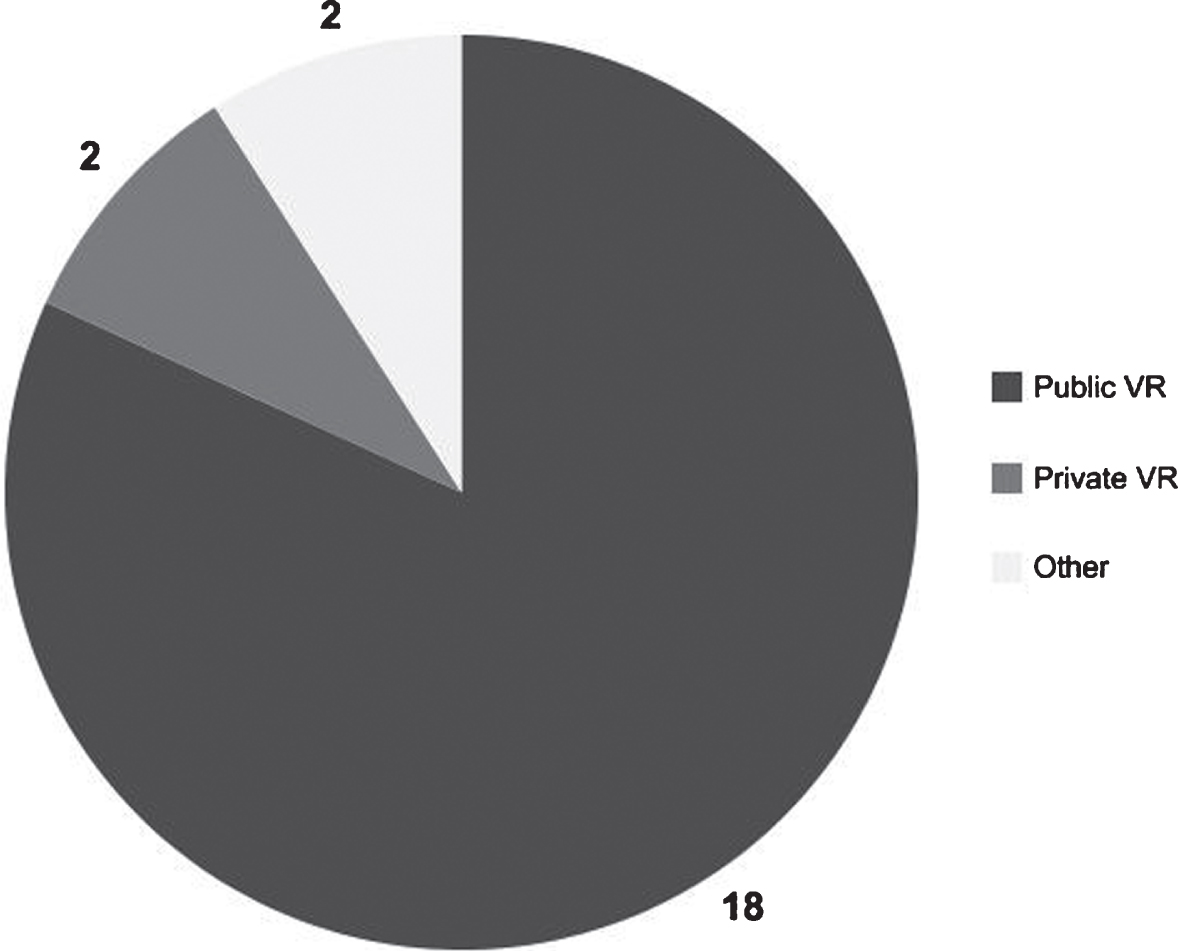
Scholar Internship Data (n = 22).
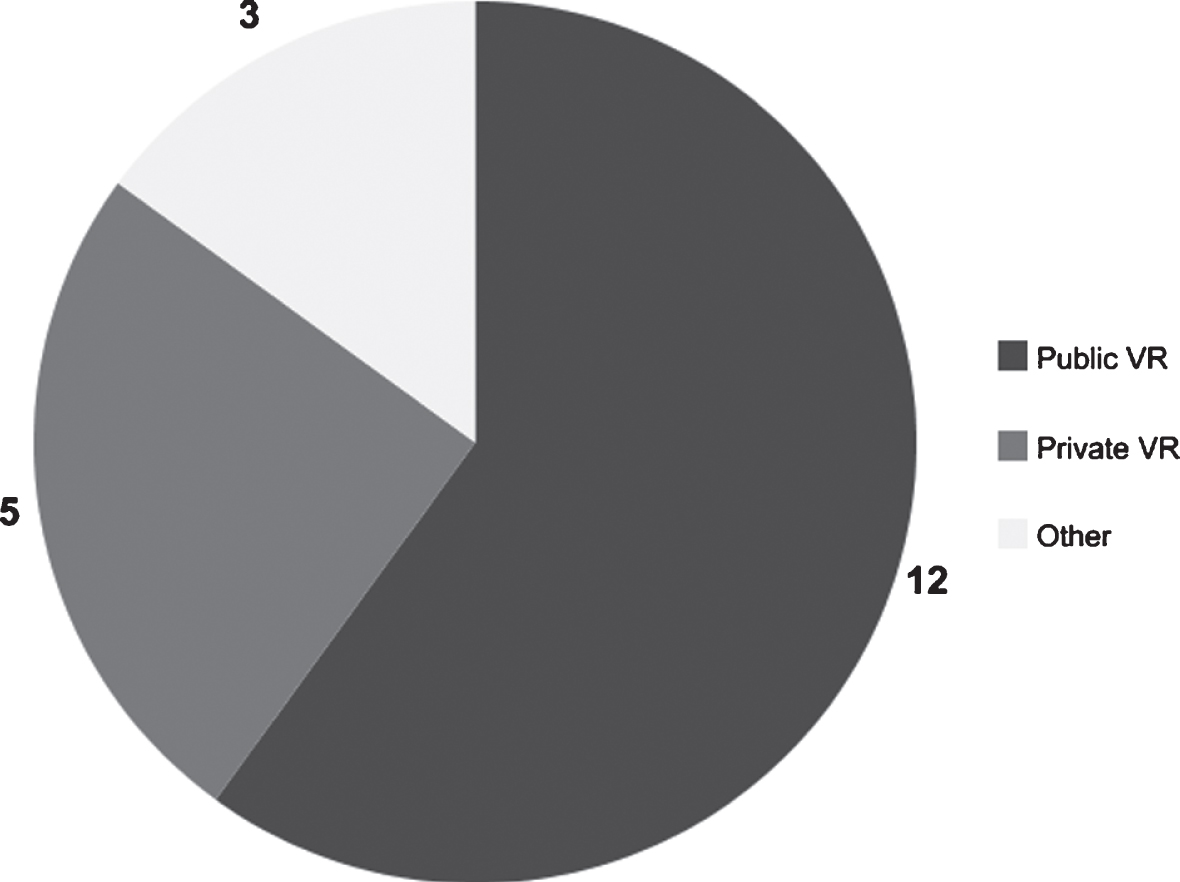
Scholar Employment Data (n = 20).
Multiple types of evaluation are utilized to assess the effectiveness of the project including formative data, summative data, satisfaction data, and impact data. Comprehensive project evaluation data and findings will be presented in a subsequent article.
Formative evaluation processes are designed to improve performance of the program through continuous feedback and assessment. Scholar and advisory committee feedback are collected throughout the program implementation period and utilized to adjust project activities and instructional practices to address and maximize student learning and to gauge student progress. Formative data are collected for the courses developed for the program to promote an iterative process of refining and improving the courses to best meet the needs of scholars.
Summative evaluation provides a means for determining if the program has reached its goals/objectives/outcomes. It is best to use a balance of both quantitative and qualitative methods to get a better understanding of program outcomes and how or why they were achieved. Quantitative data are collected through comprehensive examinations and CRC exam results. Additional summative data are collected through questionnaires completed by scholars and practicum and internship supervisors to assess effectiveness of field experiences at individual sites. Qualitative data are collected through personal interviews with scholars at the end of each project year and a focus group during the final year of the project. Scholars meet with their assigned faculty advisors throughout their academic program to provide performance feedback and receive periodic assessment of progress.
Satisfaction data are collected from all scholars as part of the exit survey that is administered to students of the RMHC program. This data assists implementation of continuous improvements to the program to meet the learning needs of students. The exit survey is delivered via Qualtrics© software to increase the validity of the responses through anonymity and for enhanced analysis of the data. Skip logic is utilized to gather program specific data from scholars. Satisfaction data are also collected from field supervisors to ensure their needs and expectations are being met.
Impact information the best indicator that the project is meeting the Final Priority of the LTTP – to increase the skills of VR counseling scholars so that, upon successful completion of the RMHC program, they are prepared to effectively meet the needs and demands of consumers with disabilities and employers. Impact data are collected through multiple methods including surveys, exit interviews, and via data (field placement and employment) provided by VR and other rehabilitation agencies. An internship assessment tool (developed collaboratively with VR supervisors), is used ensure a consistent approach to the evaluation of scholars. Foundational information about this assessment tool is provided to all RMHC scholars prior to beginning the clinical/experiential portion of the program. A supervisor field placement manual is provided to supervisors that contains information on the specific responsibilities of the scholar during the internship and methods of reporting and receiving technical assistance for supervision of students. Internship Supervisors are required to complete an internship assessment detailing the scholar’s strengths and areas for scholar improvement. Scholars receive a copy of the assessment and relevant rubrics prior to the beginning of the internship and are provided with a copy of assessment results within 90 days of internship completion.
Lesson learned
While implementing and managing project activities, challenges have been encountered. Modifications have been made to ensure quality project operation to fulfill project goals.
Challenge 1: Recruitment
The mission of the RMHC program is “...to promote quality behavioral health care for all, particularly people with disabilities, and to help the state and nation meet their human service and workforce needs in the area of rehabilitation and mental health counseling...” Few new students express an interest in working with individuals with disabilities and/or have knowledge of the field of RC and the associated job scope upon program application. A majority of the students want to become licensed mental health counselors or marriage and family therapists. Few students (10– 15%) develop interests in RC and pursue a related RC career; the selection pool is limited.
Lesson learned
The RMHC RSA scholar program frequently attracts students who have not identified VR counseling as their primary career goal. Applicants are encouraged to consider the scholar program after they complete one year of the RMHC program, to ensure an accurate understanding of RC. The project team recruits via informational emails, information seminars with students, outreach to undergraduate feeder programs (psychology, disability studies, etc.), and individual invitations to potential applicants who have expressed skills and interests in RC and VR.
Challenge 2: Scholar selection
A scoring sheet was developed to review scholar applications based on a set of criteria (see “Scholar Selection” section). While career interests and goals are included in the scoring criteria, some applicants score high enough on other criteria to be selected for a scholarship. As a result, some scholars have disclosed alternate career aspirations, but often apply for the scholarship as it is one of the only financial assistance opportunities available.
Lesson learned
The scholar review process includes both independent scoring by at least three reviewers
Challenge 3: Internships
Securing an internship is often challenging for RMHC students; particularly if a paid internship is needed. RMHC students are required to work full time (600 hours) during their internship semester. Many students have never worked in a full-time position which often requires some initial work adjustment and transition. Scholars who enter internships within the public VR system report being assigned large caseloads with limited training. Management styles and preferences may conflict, and some scholars may have challenges self-advocating and/or communicating issues and concerns.
Lessons learned
The project team has added a spring seminar for scholars to clarify expectations regarding what to expect in a VR internship. Scholars can network with other scholars who are in internship or payback status. Project advisors attend the event and are available to meet with their advisees. Internship site visits have been added to facilitate successful matches and gather information from VR supervisors and staff that may promote successful matches and proactive solutions to common concerns. Through collaborative partnerships with VR and community-based rehabilitation facilities, we are able to assist scholars identify appropriate internships.
Challenge 4: Finding employment
Despite the high need for qualified RCs, student employment upon graduation is a challenge. For example, scholars may have an unclear understanding of “qualified payback employment,” which is problematic for scholars who initially expressed interest in working in settings other than the state VR agencies. In feedback focus groups, scholars reported challenges in establishing professional mentoring relationships and employment opportunities with community providers and state agencies.
Lesson learned
The project team facilitates networking opportunities for scholars to connect with other scholars and professionals in the field of RC. Each year, scholars are invited to attend the annual state-wide conference for VR employees, VR counselors, supervisors, and staff. Scholars have an opportunity to participate on a panel, during the State VR conference luncheon, to present information on the scholarship program and their experiences as a scholar. This promotes professional development, awareness among VR employees, and allows for connections with other scholars. The project advisory committee facilitates identification of employment opportunities and provides suggestions for obstacle resolution. Finally, the RMHC program offers an annual field experience career fair to provide RMHC students networking opportunities with potential field placement sites and employers.
Challenge 5: Payback
To date, seventeen (17) scholars have entered their payback period. During payback, regular communication with the project team is required. Although most scholars meet this requirement, some are difficult to contact and do not respond promptly to communication requests. One scholar decided to leave a state VR position prior notifying the project team. Another decided not to enter the field of RC.
Lesson learned
These aforementioned challenges loop back to scholars who may not be fully committed to the field of RC or understand VR. Scholars selection must include consideration of students who are 1) knowledgeable of the field of RC, 2) have a focused RC career goal, 3) understand the role of being a scholar, and 4) are committed to working with PWD in VR settings. Incorporation of applied learning within the curriculum helps to ensure that scholars are fully aware of the responsibilities of a RC and allows them to develop and practice skills that will translate to their work in the field. Implementation of a scholar tracking system has improved communication with graduates. Scholars are informed that they are required to complete a brief Qualtrics© survey in August, January, and May of each year until completing their payback. This survey includes reporting of current contact information (phone numbers, address, and email), employment status (job title, location, supervisor) and projected or actual internship dates, comprehensive exam dates, and CRC exam dates to include status (pass/fail).
Additional lessons learned and recommendations for programs
Programs interested in developing a scholar program or programs new to the development process, it is important to propose a
The fee for scholars to take CRC exam is covered in the stipends they receive. Our program offers a CRC exam preparation course designed to assist scholars and traditional RMHC students prepare for the exam. We have found that many scholars are often unaware of the versatility and utility of the national CRC credential. We include information about the CRC credential in our new student orientation seminar. Additional information including purpose, value, CRC exam dates and registration deadlines on our scholar web page. Advisors include discussions about the CRC credential in advising sessions with scholars.
Implications for policy and practice
To adequately serve individuals with disabilities who require assistance to gain or maintain employment, we must promote opportunities for future rehabilitation counselors to be trained to meet the needs of VR consumers. This includes revising curriculums to incorporate coursework that utilizes
Policy makers and VR administrators should consider investing in highly qualified rehabilitation counselors to minimize turnover in the field. For example, VR programs within the Veteran’s Administration pay considerably more for comparable VR counselor positions and; therefore, experience much lower turnover. Utilizing the funding that is required to hire and train new personnel to increase VR counselors’ salaries is a smart investment. Strategies to reduce burnout are also needed. VR programs need to analyze current practices to identify new approaches for providing high quality services for VR consumers. Approaches should include strategies for reducing caseload sizes while structuring consistent, timely services for consumers. Future research is needed to identify strategies, policies, and practices that work well and to develop and pilot new and innovative approaches to service delivery within VR systems. This research should utilize an iterative approach with all stakeholders (VR consumers, counselors, staff and administrators, community-based providers, employers, etc.).
Conclusion
The ability to offer incentives (financial, mentoring, networking, professional development, etc.) to future RCs has increased the number of students who are pursing a career in vocational rehabilitation through our RMHC master’s degree program. Although there was a learning curve to creating a streamlined, well-operating program, we are fortunate to be able to share our lessons learned to help other programs to mitigate challenges when developing similar programs. Thorough evaluation of programs is necessary for refinement and continuous improvement. Measuring program impact is critical when building capacity to increase the number of highly qualified rehabilitation professionals who are prepared to effectively meet VR needs of persons with disabilities. The number of scholars entering qualifying employment in the vocational rehabilitation system provides evidence of the effectiveness of the program. The quality of the RSA program is supported by the large percentage of scholars who are promoted to Senior Counselor positions within six months of being hired within the public/state VR system. Additional research and strategies need to be implemented to further improve the effectiveness of VR programs in serving individuals with disabilities while retaining highly qualified VR counselors and promoting a strong professional identity for the field of rehabilitation counseling.
Conflict of interest
The authors declare that they have no conflict of interest.
Footnotes
Acknowledgments
The project team would like to acknowledge our partners at our state Vocational Rehabilitation agency and both private and non-profit community-based rehabilitation facilities. We appreciate the guidance of our advisory committee and the commitment of our field placement sites to the success of our scholars. We would also like to acknowledge RMHC faculty and adjuncts for your expertise and assistance in making the scholar program a success. Our program has recently benefited from the assistance of a Research Assistant who has greatly improved our organization and tracking systems. She is an invaluable resource to the project and to our scholars. The RMHC – RSA Scholar program (Grant# H129B150004) is funded by the U.S. Department of Education, Rehabilitation Services Administration – Long Term Training Program. Special acknowledgement goes to our incredible Project Officer, Ms. Diandrea Bailey, for her ongoing guidance, patience and support. Last, but not least, we thank our scholars for their dedication to the field of rehabilitation counseling. We are grateful for this opportunity to make an impact.