



Abstract
BACKGROUND:
Factors beyond employment rate are important to consider when examining employment outcomes after spinal cord injury (SCI).
OBJECTIVE:
Identify and confirm the factor structure of the newly developed Job Considerations Scale for people with SCI.
METHODS:
Preliminary focus groups resulted in ten questions rating the importance of specific considerations people have when deciding whether to seek or maintain employment after SCI. The ten items were administered in a self-report study of 2251 adults with SCI.
RESULTS:
Health insurance/other fringe benefits were rated very or extremely important, followed by enjoyment from working, feeling better about self, and compensation. Two factors were identified using principal axis factoring with an oblique rotation. Intangible Considerations was comprised of six items, such as feeling better about self and enjoyment from working. Tangible Considerations included three items: compensation, health insurance/other fringe benefits, and advancement opportunities. Confirmatory factor analysis indicated excellent fit (Comparative-Fit Index = 0.964; Root Mean Square Error of Approximation = 0.079).
CONCLUSIONS:
The Job Considerations Scale is an easy to administer, brief, and reliable scale that may be used as an alternative to more detailed and time-consuming measures. Future research needs to establish its validity and utility with other diagnoses.
Introduction
Gainful employment is crucial to physical health and mental health well-being (Dutta et al., 2008). Unemployed persons are at increased risk for depression and anxiety, domestic violence, substance abuse, and health problems (Anderberg et al., 2015; Henkel, 2011; McClelland, 2000; Mood & Jonsson, 2016). Conversely, competitive employment contributes significantly to the survival of individuals and families and enables people to live with hope and dignity (Blustein et al., 2008; Duffy et al., 2016). It is for these reasons that the United Nation’s Convention on the Rights of Persons with Disabilities (United Nations, 2006) strongly advocates for the rights of people with disabilities to engage in competitive integrated employment.
Spinal cord injury (SCI) is a disabling condition that can affect participation in various areas of life, including employment. Estimates of employment rates range from as low as 17% employed at one year post-injury to just over 30% at 30 years post-injury (NSCISC, 2019). This variability is dependent on the characteristics of the participants, particularly SCI severity and education level (Yasuda et al., 2002), and how employment is operationalized (Young & Murphy, 2009). Regardless of these variations, the employment rate after SCI remains well under that of the general population (US Department of Labor, 2019).
Beyond employment rates, little is known about what specifically motivates persons with SCI to seek or maintain employment. The Minnesota Theory of Work Adjustment (MTWA) was developed by Dawis et al. (1964) as a job placement theory specifically for people with disabilities. One valuable aspect of the MTWA is the recognition of vocational needs and values as important reinforcers when seeking or maintaining employment (Dawis & Lofquist, 1984). When vocational needs or values are met, a person is more likely to retain his/her job. Based on the MTWA, the Minnesota Importance Questionnaire (MIQ; Gay et al., 1971) was developed to help individuals with disabilities identify important job satisfaction factors based on their vocational needs or values. The significance of this measure is to assist individuals in matching their preferences to the most fulfilling work environment. However, the MIQ is lengthy, requires item presentation in either pairs or groups of five, and the scoring is complicated. Measurement of vocational interests, such as using the Strong Interest Inventory (Campbell, 1971; Donnay et al., 2005; Harmon et al., 1994), the Vocational Preference Inventory (Holland, 1985), or the Kuder Occupational Interest Survey (Kuder, 1974), are also helpful in vocational counseling but do not get at job considerations per se.
Purpose
There is a need to understand job considerations, such as work motivation and job reinforcers, better among those with SCI and other severe types of physical disability, as well as to have screening measures that may be administered quickly and easily in settings where full assessment of job considerations is not otherwise possible. The first step is to identify the domain of potential job considerations independent of the existing literature and based on the preferences of those with severe disability. The purpose of this study was to identify and confirm the underlying factor structure of the newly developed Job Considerations Scale (Meade et al., 2015, 2016).
This cross-sectional study is a component of a program of research targeting multiple quality indicators of employment, entitled Quality Employment throughout the Work Lifecycle after Disability (Krause et al., 2018). Although the current analysis is restricted to persons with SCI, the Job Considerations Scale was developed for potential applicability to other populations.
Methods
Participants
Institutional review board approval was obtained prior to initiating data collection. Participants were enrolled from rosters of two longitudinal studies including a 40-year SCI Longitudinal Aging Study (Krause et al., 2015; Krause et al., 2017) and a 15-year SCI Health and Longevity Study (Krause & Saunders, 2010). Participants in the SCI Longitudinal Aging Study were enrolled from university and specialty hospitals in the Midwestern United States in 1973, 1984, and 1993, and from a specialty hospital in the Southeastern United States in 1993 and 2002. The SCI Health and Longevity Study participants were enrolled from three sources including the same specialty hospital in the Southeastern United States (1997, 2007, and 2011) and two population-based surveillance systems (one from the Midwest and one from the Southeast). Participants met the following inclusion criteria at the time of enrollment in each longitudinal study: traumatic SCI, at least 18 years of age, a minimum of one-year post-injury, and injured before age 65. There were 4248 potential participants from the two longitudinal studies, 580 of whom could not be reached by phone to verify contact. Of the remaining 3668, there were 2251 respondents (61.3%).
Procedures
Participants were sent an introductory letter to explain the study and notify them materials would be forthcoming. The self-report assessment was sent 4–6 weeks later, with a follow-up mailing for non-respondents. A third mailing was initiated for those reached by phone who stated interest in participating but who had lost or discarded materials. The self-report assessment was available online for those who requested it. Participants were offered $50 remuneration.
Measures
As part of the research program, Quality Employment throughout the Work Lifecycle after Disability, focus groups were conducted with 44 persons with SCI to help identify content domains for the job considerations construct (Meade et al., 2015, 2016). All participants had worked since injury. Focus group results were used to develop 10 questions for the self-report assessment on the considerations people have when deciding whether to seek or maintain employment. Each consideration was presented with five response options including: not important, somewhat important, moderately important, very important, and extremely important. The 10 job considerations are listed in Table 1.
Endorsement of importance of job considerations items
Endorsement of importance of job considerations items
The Statistical Package for the Social Sciences (SPSS, version 23.0) was used for statistical analysis. A simple imputation method was used to estimate missing values at the item level for the Job Considerations Scale. Using the regression method to replace missing data is preferred over case deletion, since it will not decrease the sample size (i.e., statistical power loss) or affect the sample representativeness (Fox-Wasylyshyn & El-Masri, 2005). We follow the assumption that the missing values are missing at random.
Descriptive statistics were used to assess participant characteristics and identify endorsement of importance of the 10 job considerations items. Specifically, exploratory factor analysis (EFA) was used to examine the factor structure (Clark & Watson, 1995; Costello & Osborne, 2005; Floyd & Widaman, 1995). Confirmatory factor analysis (CFA) was used to estimate the goodness of fit of the model with the data.
The participant cohort was randomly split, with 1144 in the EFA and 1107 in the CFA. One item was dropped following preliminary analysis because it loaded with both latent factors. The 9 x 9 correlation matrix was subjected to principal axis factoring (also known as common factor analysis). Kaiser-Guttman’s “eigenvalues greater than one” rule was used to determine the number of factors to be extracted, followed by Cattell’s Scree test (Cattell, 1966; Gorsuch, 1983). An oblique rotation was adapted to the two-factor solution to enhance interpretation of the factors (Floyd & Widaman, 1995). Items with factor loadings greater than 0.40 in one factor and less than 0.30 in other factors were retained. We also conducted a CFA of the same nine items using the cross-validation sample. For CFA, because of the large sample size (N = 1107), we opted to use three indexes that are not sensitive to large sample sizes to evaluate the goodness of fit of the CFA model (Weston et al., 2008). These indexes include the confirmatory fit index (CFI; should be greater than 0.950), the Tucker Lewis index (TLI; should be greater than 0.950), and the root mean square error of approximation (RMSEA; should be less than 0.08). Finally, a correlational analysis was conducted to examine the relationship of the two factors of the Job Considerations Scale with two other variables in the self-report assessment, including “confident in ability to work” and “work is important to me.”
Results
Descriptive
The average age of study participants was 33.3 years at the time of SCI onset and 50.1 years at the time of the study. An average of 16.8 years had passed since SCI onset. The majority were male (72.8%) and non-Hispanic White (73.5%). Just under half had no more than a high school certificate (48.1%), whereas 22.5% had a two-year degree/trade school, 17.4% had a four-year degree, and 11.9% had a postgraduate degree. At the time of assessment, 34.6% were employed.
Of the 10 job considerations, participants deemed the most important factors in making employment decisions to be health insurance and other fringe benefits (70.4% indicated it was very or extremely important), enjoyment from working (69.9%), feeling better about self from working (65.7%), and compensation (65.3%; Table 1). The job considerations of least importance were others sharing the workload and social connections (36.1% and 30.7%, respectively), indicating it was not important or only somewhat important.
Exploratory factor analysis
The Kaiser-Meyer-Olkin test value for sampling adequacy was 0.89, indicating that the strength of the relationships among variables was high, as it exceeded the recommended minimum value of 0.60 (Kaiser & Rice, 1974). In addition, the Bartlett’s test of sphericity was significant, χ2(36, N = 1144) = 4448.79, p < 0.001, indicating that the correlation matrix is not an identity matrix and it is appropriate to proceed with EFA. Finally, the communalities were all above 0.30, indicating each item shared some common variance with other items.
Table 2 presents the means and standard deviations, as well as factor loadings, communality (h2), eigenvalues, percentage of variance explained, and reliability coefficients. Analysis of the eigenvalues as well as an inspection of the screen plot supported a two-factor measurement structure that accounted for 54.33% of the variance. The two-factor solution was found to be parsimonious, meaningful, and interpretable.
Explanatory factor analysis using principal axis factor analysis with oblique rotation
Explanatory factor analysis using principal axis factor analysis with oblique rotation
Note. Factor 1 = Intangible job considerations; Factor 2 = Tangible job considerations.
Factor 1 is comprised of six items. The central theme of this factor reflects the importance of work related to the subjective perceived benefits (e.g., “feeling better about self from working” and “enjoyment from working”). All items loaded significantly onto their respective factors (loadings ranging from 0.53 to 0.86). This factor accounts for 45.34% of the total variance. The internal consistency reliability coefficient (Cronbach’s alpha) was 0.86, indicating good reliability of the items constituting this factor.
Factor 2: Tangible considerations
Factor 2 is comprised of three items. The central theme of this factor reflects the importance of work related to the objective perceived benefits: “compensation,” health insurance and other fringe benefits,” and opportunities for advancement.” All items loaded significantly onto their respective factors with loadings ranging from 0.58 to 0.80. This factor accounts for 8.99% of the total variance. The internal consistency reliability coefficient (Cronbach’s alpha) was 0.79, indicating good reliability of the items constituting this factor.
Confirmatory factor analysis
We computed two confirmatory factor analyses to examine the one-and two-factor measurement structures of the Job Considerations Scale. CFA results indicated a poor fit for the one-factor model: CFI = 0.873 (<0.950), TLI = 0.831 (<0.950), and RMSEA = 0.146 (>0.08). Conversely, CFA results indicated a very good fit for the two-factor model (Fig. 1): CFI = 0.964 (>0.950), TLI = 0.951 (>0.950), and RMSEA = 0.079 (<0.08). However, in reviewing the modification index, we found a very large expected parameter change value of 50.817, indicating the error terms for item 8 (Feeling better about self from working) and item 9 (Staying busy) should be correlated. The correlated error terms indicated that knowing the residual of item 8 helps in knowing the residual associated with item 9 (i.e., these two items shared something in common). The refined model correlating e8 with e9 further improved the model fit of the two-factor measurement model (Fig. 2): CFI = 0.977 (>0.950), TLI = 0.966 (>0.950), and RMSEA = 0.065 (<0.080). In addition, the factor loadings for the two factors are very high, ranging from 0.62 to 0.81 for the Intangible Considerations factor and 0.75 to 0.80 for the Tangible Considerations factor. The two latent variables were significantly related (r = 0.71).
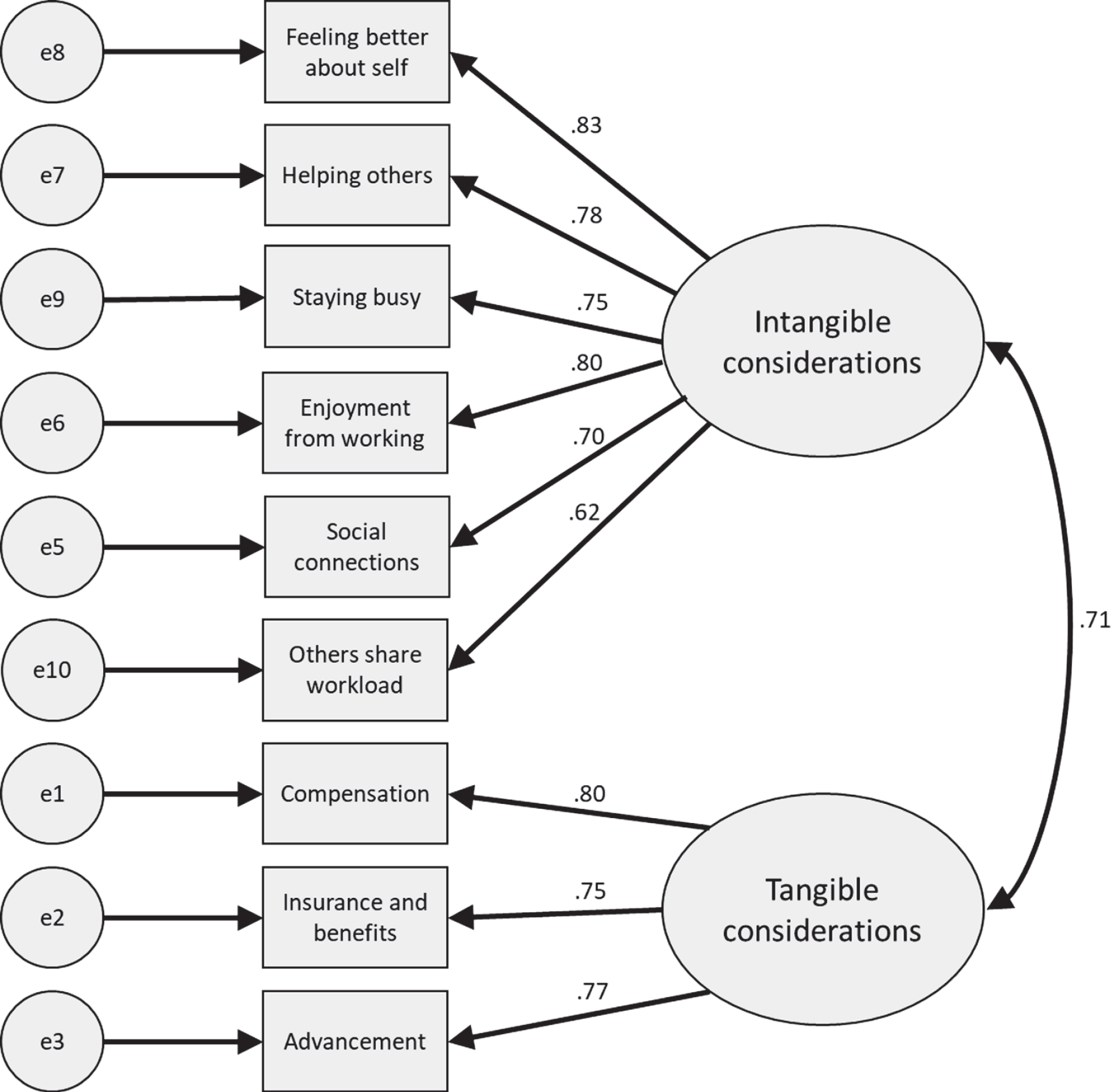
Two-factor intercorrelated model for the Job Considerations Scale before modification.
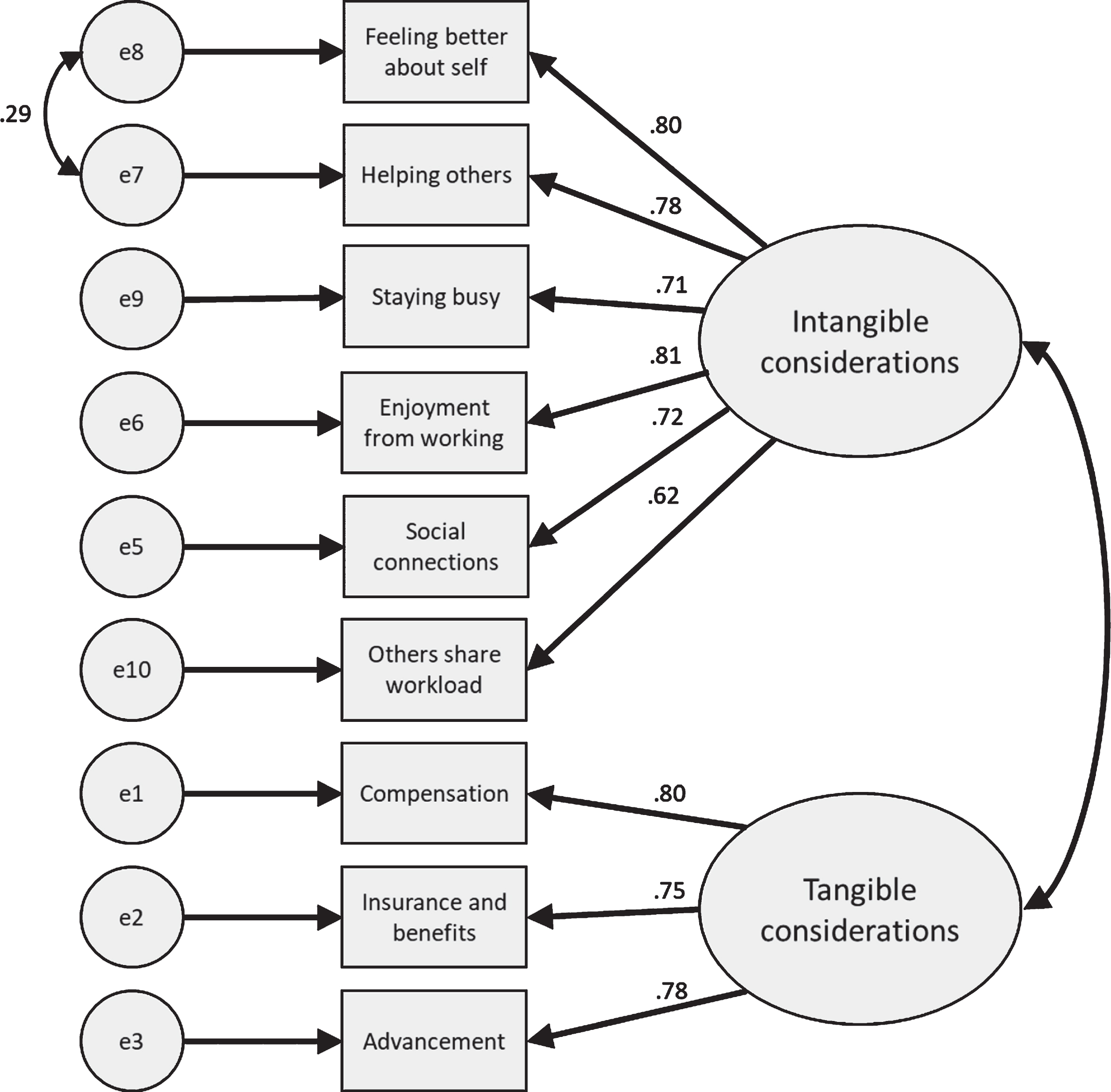
Two-factor intercorrelated model for the Job Considerations Scale after modification.
The Intangible Considerations factor and the Tangible Considerations factor were both significantly positively related to “confident in ability to work” (r = 0.17, p < 0.001 and r = 0.15, p < 0.001, respectively). Similarly, the relationship between “work is important to me” and intangible job considerations was significant (r = 0.23, p < 0.001), and the relationship between “work is important to me” and tangible job considerations was also significant (r = 0.29, p < 0.001).
Discussion
This study identified the relative importance of 10 job considerations among those with SCI and confirmed the factor structure of the Job Considerations Scale. Participant responses indicated job benefits were of greatest importance, with salary also being a primary consideration. Although these highly visible considerations were of obvious import, participants also indicated the importance of several intangible aspects of employment, particularly feeling better about oneself as the result of employment and enjoyment from work. The factor analysis further indicated the Job Considerations Scale is sorted neatly around intrinsic and extrinsic factors.
In developing the Job Considerations Scale, our initial goal was to identify important job considerations from the perspective of persons with a severe disabling condition. Interestingly, the items of the Job Considerations Scale align with the vocational needs measured by the MTWA and the MIQ. For example, the 20 vocational needs measured by the MIQ similarly include compensation, advancement, recognition, activity (staying busy), and service to others (Gay et al., 1971). These similarities provide tentative confirmation of the Job Considerations Scale as a reliable tool in vocational rehabilitation settings. The Job Considerations Scale is much more brief and may be easily administered as a prelude to using more detailed measures such as the MIQ or interest measures, such as the Strong Interest Inventory (Campbell, 1971; Donnay et al., 2005; Harmon et al., 1994).
The factor structure of the Job Considerations Scale is supported by self-determination theory (Ryan & Deci, 2000), which suggests behavior is motivated by both internal and external forces. Within self-determination theory, intrinsic motivation refers to engaging in a behavior because of the internal feelings of satisfaction derived by doing so, and extrinsic motivation pertains to engaging in a behavior to gain an external, often tangible, outcome. In this way, self-determination theory has been proposed as a theory of work motivation (Gagne & Deci, 2005), as it explores the motivational bases for engagement in the workforce, or, in the case of the Job Considerations Scale, the considerations one faces when seeking or maintaining employment after SCI. Our results suggest individuals with SCI who highly value tangible rewards from working also want to have a job they intrinsically enjoy and builds self-worth.
Implications for vocational rehabilitation
There are two primary implications for the vocational rehabilitation setting. First, an inspection of response to the individual items identifies the work considerations of greatest importance to those with SCI. These findings confirm the importance of quality employment, as indicated by job benefits and salary, to those with SCI but also many other types of individual considerations. Second, the Job Considerations Scale is a reliable tool that may be used to measure both tangible and intangible aspects of job considerations. The items may also be used individually to identify the considerations most important to the individual. There are several advantages and disadvantages in using the Job Considerations Scale compared with existing scales, such as the MIQ, which comes from the theory of work adjustment. The MIQ is an intra-individual instrument where each work need is paired with other work needs, so a hierarchy of needs is obtained. This requires a lengthy administration using a pair or ranked format that results in comparisons with job reinforcers to develop a discrepancy index used to predict job tenure. The Job Considerations Scale was designed to measure job considerations self-identified by people with SCI as the most important, quantifying them into short items that require limited time and expense to administer in a vocational rehabilitation setting, potentially as a prelude to more detailed measures. Because the items were first developed based on qualitative research of people with SCI, they have excellent content validity, which enhances their utilization.
Because the format of the items requires individuals to indicate ratings of the importance of each item, rather than the relative importance of different items, it is possible to have high scores on both factors, low scores on both, or a combination of high and low scores. In short, placing importance on one type of job consideration does not preclude placing importance on other job considerations. From the counseling perspective, jobs may vary in terms of the extent to which they may meet different job considerations. If individuals are high on both factors, it may be difficult to find jobs that meet the diverse job considerations. Conversely, if individuals are low on both factors, it may be difficult to find aspects of the job that are satisfying. These are unanswered empirical questions.
Study strengths and limitations
The study strengths include the use of qualitative focus groups to identify item content, development of a brief Job Considerations Scale, and the number of participants in the self-report study used for factor analysis. By applying both EFA and CFA, we identified a stable factor structure and further identified convergent validity using variables on confidence in ability to work and the importance of work.
There are also important limitations. First, although the overall response percentage was high, nonresponse is always an issue in self-report studies. We started with participants identified through longitudinal studies, so some attrition occurred prior to the implementation of this employment study. Second, we used an oblique rotation following principal axis factoring. Other methods of extraction and rotation may produce slightly different results. Oblique rotations minimize the correlation between any given item in the factor or factors with which it does not load. However, it produces correlated factors, which in this case was +0.71. Third, the data collected were cross-sectional. This was appropriate to identify the most important considerations among those with SCI and for the development of the Job Considerations Scale. Lastly, because our current stage of research is to identify the underlying factor structure, we have limited information on the predictive validity of the measure.
Future research
Ultimately, longitudinal research is needed to measure the predictive validity of the Job Considerations Scale. Future research should look to identify the relationships between unmet needs, job considerations, and quality indicators of employment outcomes. Specifically, we need to know what happens when job considerations are not met and the potential impact on other outcomes. Lastly, research is needed to evaluate the utility of the scale in a vocational rehabilitation setting.
Conclusion
Job considerations are important to evaluate when working with clients in vocational rehabilitation settings. The most important job consideration appears to be health insurance and fringe benefits, although salary was also highly ranked. Both tangible and intangible considerations are important to people with SCI and may be measured independently with the relatively brief and easy to use Job Considerations Scale. More research is needed to identify the factor structure of the scale with other diagnostic populations and identify the importance of the relationships between job considerations, satisfaction with how well these considerations are met on the job, and other outcomes, including global job satisfaction.
Conflict of interest
The authors have no conflict of interest to disclose.
Footnotes
Acknowledgments
The contents of this publication were developed under a grant from the National Institute on Disability, Independent Living, and Rehabilitation Research (NIDILRR grant number 90DP0050). NIDILRR is a Center within the Administration for Community Living (ACL), Department of Health and Human Services (HHS). The contents of this publication do not necessarily represent the policy of NIDILRR, ACL, HHS, and you should not assume endorsement by the Federal Government.