



Abstract
METHODS:
Using grounded theory procedures, we interviewed 26 employed individuals with disabilities who were part of a larger investigation examining how employees with disabilities are treated in the workplace. In this article, we present findings in response to the question: “What can employers do to create more inclusive workplaces in which employees with disabilities are treated with dignity and respect?”
RESULTS:
Results revealed that it is not only employers who are responsible for creating inclusive workplaces; this responsibility must be shared by employees with disabilities and their co-workers, if an organizational culture of inclusion is to be developed and maintained. Furthermore, the actions of each member of the organization have a reciprocal impact on the other members in terms of making changes to the organizational culture.
CONCLUSION:
The participants suggested an abundance of strategies to develop a culture that values workers with disabilities, readily provides them with needed job accommodations, and ensures they are treated with dignity and respect. Implications of these findings for business leaders, vocational rehabilitation (VR) professionals, and workers with disabilities are examined. Future research directions are also explored.
Introduction
Nishii (2013) defined inclusive work environments as those in which “ ... individuals of all backgrounds—not just members of historically powerful identity groups—are fairly treated, valued for who they are, and included in core decision making” (p. 1754). Inclusive organizations have equitable employment practices, establish initiatives aimed at eliminating bias, interpersonally integrate diverse employees (e.g., provide opportunities for people to share and learn about one another), and actively seek out and integrate diverse perspectives, even if such perspectives disrupt the status quo (Nishii, 2013; Roberson, 2019; Roberson et al., 2017; Shore et al., 2011). How individuals are treated in their work environments has a major impact on employees’ perceptions of inclusion. Shore et al. (2011) defined inclusion as the “degree to which an employee perceives that he or she is an esteemed member of the work group through experiencing treatment that satisfies his or her needs for belongingness and uniqueness” (p. 1265). These perceptions, in turn, are positively related to outcomes such as employees’ job performance and well-being (Shore et al., 2011).
Inclusive workplaces are associated with many benefits for employees with disabilities including being treated with dignity and respect by others in the work environment, contributing to a self-concept of being a valued employee, experiencing a greater sense of belonging and loyalty to the business of which they are a part, increasing job satisfaction, reducing turnover intentions, and facilitating career advancement (Nelissen et al., 2016; Nishii, 2013; Rubin et al., 2016; Shore et al., 2011). These are the same outcomes that vocational rehabilitation (VR) professionals seek to achieve with clients (Wehman, 2013).
Creating inclusive workplaces may not only benefit employees with disabilities, but it may be equally beneficial to employers. In recent research, the American Association of People with Disabilities and Disability: IN (2018) used the Disability Equality Index (DEI), a benchamarking instrument to provide large American companies with an objective assessment of their disability inclusion practices. The researchers found that over the four-year investigatory period, “Disability Champions” (i.e., an elite group of 46 companies that excelled on the DEI) outperformed peer companies on a variety of indicators. In comparison to the other companies, Disability Champions had revenue that was 28% higher, had two times the net income, and 38% higher profit margins. However, these results should be interpreted with caution; perhaps, businesses are more profitable because they employ individuals with disabilities. Conversely, these results could also imply that these more profitable businesses have greater financial flexibility and resources than less profitable businesses, to actively seek to employ individuals with disabilities. The nonmonetary benefits of having such highly rated inclusive workplaces included improved employee productivity, access to a more diverse base of suppliers, and an enhanced reputation, which brings in a larger customer base.
Despite the many potential benefits of inclusive workplaces to both employees with disabilities and their employers, rehabilitation researchers have extensively investigated discrimination complaints to the Equal Opportunity Employment Commission (EEOC) under Title I of the Americans with Disabilities ACT (ADA) and its amended act, the Americans with Disabilities Act Amendments Act (ADAAA). The majority of allegations relate to job maintenance rather than job acquisition—and these allegations also appear to be associated with exclusionary work environments (McMahon & McMahon, 2016). Among the highest activity allegations are issues that relate to how employees with disabilities are treated on the job. For example, failure to provide reasonable accommodations, the second most common complaint filed against employers, represents 18% of these high activity allegations. Terms and conditions represent 9.3% of high activity allegations. Harassment represents 8.1% of high activity allegations, and intimidation accounts for 1.3% of high activity allegations. Finally, constructive discharge, which occurs when employees are forced to quit or resign from their positions due to intolerable work conditions, represents 2.4% of high activity allegations. Despite workplace protections afforded under Title I of the ADAAA, unfair and illegal treatment continues. Indeed, the EEOC has determined that alleged violations have occurred in 43.5% of all cases filed (McMahon & McMahon, 2016). Furthermore, many individuals who experience workplace mistreatment do not respond by filing discrimination complaints with the EEOC but choose other courses of action or to do nothing at all (Strauser, 2013). We learned from our research participants that there is a strong need for employers to establish inclusive workplaces in which employees with disabilities can thrive.
Notwithstanding the ample literature on what comprises an inclusive workplace environment, there is a paucity of research that investigates this phenomenon from the perspectives of employees with disabilities (Dwertmann & Boehm, 2016). As part of a larger interdisciplinary study on how employees with disabilities are treated in the workplace, we interviewed workers with disabilities about strategies they recommended for creating more inclusive work environments. Examining and acting upon the research participants’ suggestions can help to improve the workplace experiences and career maintenance outcomes of this population of employees as well as improve positive monetary and nonmonetary outcomes for employers.
Method
The data used in this study were derived from a larger dataset of qualitative research findings regarding how employees with disabilities are treated in the workplace. The findings reported in this manuscript are participants’ responses to the interview question: “What can employers do to create more inclusive workplaces in which employees with disabilities are treated with dignity and respect?”
Researchers
The research team consisted of two investigators in rehabilitation counseling, one investigator in communication disorders, and four investigators in organizational behavior and human resources. Among the research team were three individuals with disabilities. The first two authors have substantial experience in conducting qualitative research, with the second author having conducted several studies using grounded theory procedures. Along with the third author, the researchers collected and analyzed the data. These three researchers met weekly to compare codes and resolve differences in how data were coded. The other members of the interdisciplinary team served as critical peers and were sent notes via email after each coding meeting about emerging codes and themes to give them an opportunity for input and to challenge our assumptions. We also met two to three times a semester throughout the coding and data analysis process to discuss our progress, emerging codes, patterns and themes; critique findings; obtain advice on how to proceed with the study, and interpret the data based on their own professional expertise and discuss implications of the findings for employees with disabilities, employers, co-workers, and organizations. This interdisciplinary approach enabled us to make meaning of the findings in a much more sophisticated and comprehensive manner than would have been possible if all researchers were from the same discipline. It also enabled us to challenge each other when our own personal biases and professional lenses interfered with representing and communicating the lived experiences of the research participants.
Sampling
We used maximum variation sampling (Patton, 1991) to purposefully select a heterogeneous group of participants who had a wide range of disabilities, occupations, and demographic characteristics (e.g., age, gender, race, disability type, duration of employment). We used several strategies to recruit participants including reaching out to our personal contacts, snowballing, and providing agencies and health care facilities with recruitment flyers to post in waiting areas and other locations. Information on the recruitment flyers included the purpose of our study, inclusion criteria, information about the interview procedures (e.g., use of audio-recorder, anticipated length of time, location), the researchers’ contact information, and information about incentives (i.e., $30.00 in cash) for participating in the study. We hand-delivered or emailed the recruitment flyers to our university’s speech and hearing clinic and center for educational access, an outpatient physical therapy office, a rheumatologist’s office, a satellite office of the state-federal vocational rehabilitation (VR) program, a non-profit rehabilitation agency that provides employment-related services to people with disabilities, and a community independent living center.
Participants
A total of 26 participants completed the interviews with an age range of 18 – 60 years. Of the participants, 10 ranged in age from 18 to 24, one was in the age range of 25–30, five ranged in age from 31–40, five ranged in age from 41–50, one was in the age range of 51–60, and four ranged in age from 61 and over. Nineteen participants were female and seven participants were male. The sample included African Americans (n = 6); Caucasians (n = 19); and one participant who reported being a combination of Latin, Native American, and Alaskan Native (n = 1) heritages. A wide variety of occupations was reported as well, including: administrative assistant (n = 5), business analyst (n = 1), cashier (n = 3), clinical professor (n = 1), door greeter (n = 1), engineer (n = 1), fabricator (n = 1), information technology specialist (n = 1), musician (n = 1), newspaper lab instructor (n = 1), real estate agent (n = 1), stocker (n = 1), swim lab instructor (n = 1), teacher (n = 1), temporary position (n = 1), tutor (n = 2), vocational rehabilitation counselor (n = 1), waitress (n = 1), and sales associate (n = 1).
Duration of employment widely varied for this sample with a range of 2 months to 51 years of employment. Level of education varied with this group of individuals as well. Two participants reported completing a two-year college degree, six reported having completed a four-year college degree, ten reported having completed high school, four reported completing a post-graduate degree, one reported completing some high school, and three reported having completed training at a trade/technical school. The current employment status of participants was reported to be one hourly position, seven full-time positions, 13 part-time positions, and five self-employed positions.
A wide range of disabilities was represented within this sample. Reported disabilities included: dyslexia, attention deficit hyperactivity disorder (ADHD), anxiety, depression, anorexia nervosa, intellectual disability, hearing loss, asthma, lymphedema, fibromyalgia, autism, bipolar disorder, obsessive compulsive disorder, post-traumatic stress disorder, epilepsy, attention deficit disorder (ADD), hepatitis C, hypothyroidism, diabetes, learning disability, cognitive deficit (due to stroke), arterial fibrillation, cerebral palsy (CP), chronic migraine, vestibular migraine, type 2 diabetes, postural orthostatic tachycardia syndrome (POTS), dysautonomia, schizoaffective disorder, and Tourette’s syndrome. Among the participants, 14 reported more than one disability.
Data sources and data collection procedures
Data sources included a demographic questionnaire, individual interviews with the participants, researcher field notes and reflexive memos. The demographic questionnaire was completed by each participant after reading and signing the consent form and prior to the interviews. Items on the demographic questionnaire included four open-ended questions and four questions with fixed response sets. The items requested demographic (i.e., age-range, race, highest level of education completed, gender identity); disability (i.e., type of disability) and employment (i.e., current occupation, length of employment in current occupation, current employment status [e.g., full-time or part-time, active military, student worker, hourly employee]) information.
For this portion of the larger investigation, we asked participants to respond to the question “What can employers do to create more inclusive workplaces in which employees with disabilities are treated with dignity and respect?” The same interview question was asked of each participant, and the researchers used follow-up questions and probes to elaborate on or clarify participants’ responses. The interviews were conducted by the first, second, and third authors. Participants selected pseudonyms so that their identities would be masked. Each interview was audio-recorded with consent from the participants, transcribed verbatim by hired transcriptionists, and data were password protected. Permission to conduct this study was granted by the University’s Institutional Review Board.
The majority of the interviews were conducted in private meeting rooms in the university’s speech and hearing clinic. One interview was conducted in a researcher’s office at the university and one was conducted at a participant’s home. Each interview was conducted by one of the three researchers responsible for data collection. The interviews lasted between 30 and 90 minutes, with an average length of 48 minutes, and the total number of transcribed interview pages was 713.The researchers wrote field notes summarizing their thoughts on how the interview went and what appeared to be the most salient responses from the participant. Additionally, the researchers wrote reflexive notes regarding how well the interviewer performed at following the lead of the research participant rather than imposing her or his ideas about the phenomenon on the participants, and how interviewers might improve their skills in future interviews. We also kept an audit trail and wrote notes about emerging codes and themes that were shared with the rest of the research team for their input.
Data analysis procedures
We used open, axial, and selective coding (Bohm, 2004) to analyze the research data. In the open coding phase, we read responses to our interview question and independently identified categorical codes. Additionally, as participant responses to our focal interview question were often contextually seeded throughout the interview as answers to other questions that were part of our larger study, we expanded our search for recommendations to include the complete interview transcripts. We then came together and combined our codes to generate a coding scheme. The codes were applied to individual words, lines, and sections of the transcripts. As new codes emerged from the data, we added these codes to our initial coding scheme. We also collapsed and refined codes as we proceeded and applied these to each interview transcript. Two researchers coded each transcript, and the third researcher helped to resolve any discrepancies in coding. When discrepancies occurred, we discussed these until consensus was reached in determining the codes to be used.
In the axial coding phase, we identified preliminary themes that spanned the open codes and organized these codes under preliminary themes. Preliminary themes were identified in group discussions as well as individual writing about the themes that appeared to be emerging from the data. We used consensus and a thorough review of all transcripts to identify preliminary themes.
In the final phase, selective coding, we were able to review the data and confirm which preliminary themes were inclusive of all the participants’ experiences and, from here, identify a central theme (workplace culture) that connected the other themes. This phase of coding resulted in a grounded theory of interconnected recommendations that involved all members of employer sites in working together to create inclusive employment settings.
Trustworthiness
We used multiple strategies to ensure the trustworthiness of our findings. First, we conducted member checks by emailing transcribed interviews to each participant and requesting additions or changes as they saw necessary. Second, we sent out our research findings to participants for their comments on accuracy and any additional recommendations they felt needed to be included. As previously mentioned, because the interviewers were from three different disciplines, we were able to triangulate our data analyses through the use of multiple researchers who constantly challenged each other to (a) recognize when our own professional lenses were interfering with accurate coding and analysis of the data and, (b) to set aside our professional perspectives and solely focus on the participants’ responses. We conducted an audit trail consisting of a written detailed record of what occurred during each meeting between the interviewers and among the entire research team. The coded notes were uploaded to a Google folder that was only accessible to the research team for review. Team member comments, interpretations, and suggestions were also stored in this folder.
Results
Although the probing question in the interview focused on what employers could do to create inclusive work environments, responses from participants indicated that all members of the workplace (i.e., employees with disabilities, co-workers, managers, administrators) must share responsibility to ensure that workplaces are hospitable to workers with disabilities and provide the resources and support they need to thrive in their occupations. As presented in Fig. 1, all members of the workforce have a responsibility for creating inclusive workplace environments. However, the primary responsibility falls on top-level administration and employers to create cultures that advance policies and practices that espouse the concept of inclusive workplace environments. If top-level management does not embrace the mission of true inclusion of all employees in all of its practices, it is unlikely that the organization’s employees will embrace and practice inclusion. That being said, the attitudes, values, and behaviors of top-level management trickle down to all employees and can influence their attitudes, values and behaviors. Thus, a hierarchical order exists, with the actions of those in top-level management being the most important factor in the inclusion and quality of work life for all employees.
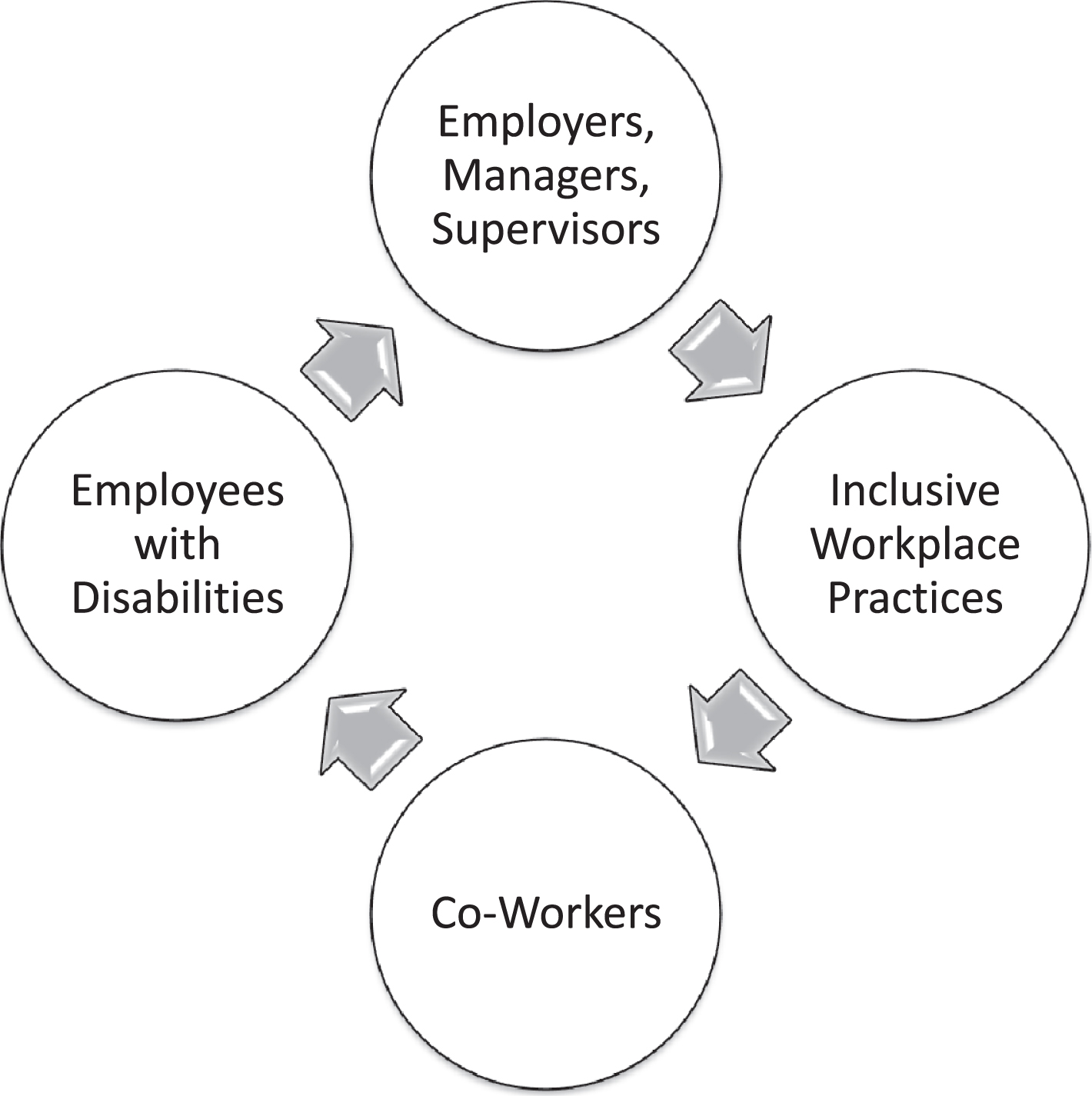
Grounded Theory of Inclusive Workplaces.
Several participants mentioned that changing workplace cultures to be more inclusive requires “start[ing] at the top and then it may ‘trickle down’ to everybody within the company.” As one participant noted, if employers can “create a place where everyone feels empowered, and everyone feels respected in the workplace, I think if you can get that done, everything will go real smooth.” As a first step, employers must possess and instill in all members of their work setting the attitude that,
People with disabilities are capable to do what everybody else is able to do, that’s pretty much it. They can accomplish every goal that everybody else accomplishes. They can go to school. They can work. They can do what everybody else is doing. A disability isn’t a limitation.
Participants recommended that this attitude is promoted when employers communicate the message that they recruit, hire, and provide reasonable accommodations to employees with disabilities in all written materials (e.g., job postings, employee handbooks, organizational mission statements). As one participant suggested, this message must go beyond simply giving employees “binders to read” and should be reinforced in new employee orientations and meetings that all employees are required to attend.
In terms of how to create inclusive workplace environments, the role of providing reasonable accommodations to qualified workers with disabilities was repeatedly emphasized. Indeed, employers themselves were perceived by some participants as needing more education about how to accommodate workers with disabilities, especially those with hidden and episodic disabilities. As one participant noted,
I think people, when they think of an accommodation for somebody, they think someone in a wheelchair needs a different desk or we need to make the doorway wider, but the people who have ... invisible disabilities, there are so many of them, but I don’t think employers have really thought about how they can accommodate them.
Providing accommodations, particularly for workers with invisible, episodic disabilities also requires employers to be open to novel ways of performing job tasks. “Having a disability in and of itself is enough of an obstacle, but to insinuate that it’s an excuse not to do the job the way [employers] think it should be done isn’t fair.” Likewise, as noted by another participant, people with disabilities “have the confidence to come in and apply for the position, so most likely they can complete the tasks.” Another employee noted that in addition to considering novel ways that work tasks can be performed, employers should shift their attitude about providing accommodations from viewing them as a source of extra work for the employer to viewing accommodations as “a way to keep people who are very good, [who] ... are contributing a lot to your workplace, and whatever [you] are trying to do. But they need these slight changes.” A third participant suggested that to reinforce that the employer values workers with disabilities, it should be the employer’s responsibility to ask all employees if they need a reasonable accommodation rather than putting the responsibility on the individual to request the accommodation. The employer could simply state, “Hey if you have a disability and need an accommodation, just let us know,” and in doing so, reinforce that the employer values workers with disabilities.
Participants also discussed how employers should respond to the mistreatment of people with disabilities on the job. Two participants indicated that disability harassment should be treated with the same seriousness as sexual harassment. This stance begins by implementing policies and procedures that communicate zero-tolerance for any type of mistreatment of co-workers. It also requires employers to take employees’ complaints with the utmost seriousness and to act with immediacy and consistency in redressing these complaints. As one participant suggested, “if they [people with disabilities] are not treated with respect, and it comes to the employer’s attention, there will be a formal investigation on it.” As another noted,
If [a co-worker] is going around and saying stuff about someone who has a disability, then that person needs to be talked to. They need to have a meeting with their supervisor or with somebody from HR to say ‘Hey, this is not acceptable behavior in the workplace.’
A few suggestions specifically focused on the need for employers to directly involve employees with disabilities in making changes. One of these suggestions was to conduct focus groups with employees with disabilities to obtain their input into areas where change is needed and to recommend strategies for making these changes. One participant recommended, “I think a panel would be a good idea to see both sides. Maybe [it would be helpful if people with disabilities] would come forward and maybe discuss their insight on how they were treated.” Then, other members of the worksite might change their attitudes and develop a better understanding of possible accommodations and how easily these can be implemented, thus enabling the employee with a disability to be as productive as workers without disabilities.
Additional workforce training was also recommended. One participant suggested the use of videos demonstrating how employees with different disabilities use reasonable accommodations to function in their jobs. However most of the recommendations were not for disability specific training. Instead, participants offered suggestions that were broader in focus, not formalized packaged trainings, and experiences that could benefit ALL employees, not just employees with disabilities. For example, one suggestion was to create opportunities for informal discussions about workplace inclusion that involve employees with disabilities and those without disabilities. Other suggestions included team-building activities or job projects that pair together workers who do not know each other well. These activities enable co-workers to see employees with disabilities as more than just their disabilities, but as valued team members who are instrumental to the completion of the task at hand. Additional recommendations included diversity training and emotional intelligence training. These final recommended strategies all share a common emphasis on increasing employees’ abilities to demonstrate empathy, openness to novelty, a willingness to admit mistakes, seeking out opportunities to correct one’s biases, and helping instead of harming others. In describing how emotional intelligence training at his job site contributed to creating an inclusive work environment, an employee with a disability noted that the training forced him to “put himself in other people’s shoes ... and try to be empathetic ... and I think that holds true even for dealing with people with disabilities. It’s really not that much different.”
Co-workers
“Treat [people with disabilities] like you would anyone else ... They’re no different, so yea, I expect to be treated the same way you treat the guy sittin’ next to me” seemed to be the prevailing message the research participants wanted to be communicated to co-workers who are instrumental to the creation of inclusive workplace environments. Relatedly, employees need to be aware that two people with the same disability will not have the same difficulties or need to use the same accommodations. Each person is unique. In reference to psychiatric disabilities, a participant commented that “you get different accommodations for different mental illnesses. They’re all different in their own way.” Although participants underscored that they were not expecting sympathy from others, which can be perceived as pity, they did indicate that inclusive work environments are those in which co-workers treat all employees with empathy. Empathy begins by remembering that “everybody is not like you.” Empathy and valuing diversity creates a workplace “where everyone feels empowered, and everyone feels respected.”
Participants recommended both formal and informal procedures to enhance disability awareness and empathy among co-workers. Informal procedures included taking the time to get to know co-workers with disabilities. Then, these workers will be perceived as individuals with many attributes who are not solely defined by their disabilities. “Look past the disability. If they are capable of doing the job allow them the chance to do it. That’s the main thing.” Participants indicated that employees should not resent co-workers because they receive an accommodation. Because supervisors may not be legally allowed to disclose that the person is receiving an accommodation to co-workers, the responsibility is then placed on the worker with a disability to disclose to co-workers to avoid being perceived as being given some sort of unfair advantage. And, as we have learned from the participants, disclosure decisions can be very taxing, especially when the outcome of these decisions is unknown. As a participant commented, even though others may not have negative perceptions about disability, “it is about getting accommodations and how [these co-workers think] they’re special or they deserve special treatment.” If employers do as recommended by the participants and send the strong and consistent message that they provide reasonable accommodations to workers with disabilities, it is less likely that employees will be mistreated by co-workers because of their use of accommodations.
A couple participants also discussed that sometimes reasonable accommodations may not always work out. For example, the employee with a disability may be late for work because the accessible public transportation they use is not on time or another person may be unable to perform the essential functions of her or his job because an assistive technology device needs to be repaired. In these situations, co-workers should be understanding and patient as the employee seeks ways to access more effective accommodations or repair assistive technology devices they may use. Formal strategies as previously advised included taking part in training opportunities to increase empathy, emotional intelligence, and disability awareness. Finally, one participant suggested that all employees should sign a statement indicating that they will behave in a manner that is respectful and civil to every other employee and that they abide by this statement.
Employees with disabilities
Participants in our study were reflective about how they, themselves, could contribute to the establishment of more inclusive workplaces. As several participants noted, first and foremost, employees with disabilities, like any other employee, should demonstrate that they are valued members of the workforce by doing their jobs well. “For the person with a disability to go in [to their worksite] and expect to be treated like everybody else, [they need to] demonstrate that they are good employees so that the fact that they have a disability doesn’t matter.” Similarly, another participant, whose onset of disability occurred while she was already employed, indicated that her employers were more than willing to accommodate her at the onset of her disability because she had already demonstrated that she was a valued employee: “I was always there, did my work, did my work well, I wasn’t missing things, or my performance wasn’t lagging”.
Many of the participants’ recommendations were about disclosure decisions. They had varying perspectives as they discussed how disclosure and non-disclosure both impacted the way they are treated on the job. Some indicated that disclosure serves a broader purpose than merely as a prerequisite to receive reasonable accommodations. It also increases awareness and understanding among co-workers. One participant makes a powerful statement in his chosen words for disclosing to others in a manner that increases disability awareness:
What I’m about to tell you does not change who I am. I am the same person tomorrow as I was yesterday. The only thing that is changing is your knowledge ... and so long as I always prefaced it like that, I gave them that time to sink in that you’re going to learn something different about me, but it doesn’t change who I am.
Disclosure decisions about when to disclose, what to disclose, how to disclose, and to whom to disclose have many implications for how workers with disabilities are treated on the job. Participants recommended disclosure to co-workers when non-disclosure could lead to negative attributions of the employees’ behaviors. For example, in order to avoid negative attributions of a tick that sometimes causes his head to shake, one participant indicated that, in meetings,
I’ve had a time or two been asked ‘do you disagree’? or ‘is something wrong?’ or something like that, and I’ll have to explain no, that I don’t disagree ... and there’s just times where I’ll say “hey I have [ticks]. Don’t worry.
If he did not make this disclosure, this behavior could be misinterpreted as being contrary or rude. As another example, a participant with a hearing loss disclosed to her immediate supervisor, but not to the co-worker she assisted. Because the co-worker did not know this participant had a hearing loss, she did not provide needed accommodations (e.g., speaking directly without her back turned, making sure not to cover her mouth when speaking) to the employee with the hearing loss. Because this participant did not speak up and ask for the accommodations she needed for effective communication, the relationship was strained and the employee felt that she was perceived as not being qualified for the job and as performing below standard. As she reflected back on this experience, this participant indicated that “I have learned that I definitely need to disclose, and I definitely need to make requests ... I learned the hard way that keeping that to myself could then turn bad.” In retrospect, she wished she had immediately disclosed and asked for the accommodations she needed. Other participants offered different perspectives on disclosure, indicating that “it’s really important in personal relationships to let someone know about your disability, but I think in terms of if it provides risk to your job opportunity, I find it perfectly ethical not to disclose” and “I don’t volunteer the information ... I wouldn’t go up to somebody and open up my checkbook to show ‘em my balance.”
Disclosure was also recommended as a strategy for both educating others about disability and for receiving emotional support. One participant with an invisible disability described “testing the waters” at her work site to determine to whom it was safe to disclose her functional limitations for the purpose of receiving emotional support. This participant “tested the waters” in casual conversations by bringing up media stories about celebrities who had disclosed that they had the same hidden disability as she did. Responses from co-workers about the celebrity’s disclosure were indicators of how safe it was to share with others information about her disability. For example, she avoided disclosure to any co-worker who made negative or stigmatizing comments about the celebrity’s disclosure or the disability that was disclosed.
In addition to pointing out the need for supervisors and administrators to receive more training on the ADAAA, participants also acknowledged that they needed more training. In particular, they noted the need to learn how to request accommodations because, as one participant stated, “An employer can’t give you an accommodation if they don’t know that you need one.” Some also acknowledged their own lack of awareness regarding community resources to assist them with developing these skills as well as various assistive technologies that are available to assist them in carrying out the essential functions of their jobs. They also acknowledged the need to learn more about community agencies that could provide them with self-advocacy training. One participant highlighted the importance of support groups in helping people with disabilities to better manage their symptoms, increase their comfort and capabilities in performing their jobs, interacting with others, and feeling more included in the workplace. Finally, participants indicated the need to become more actively involved in creating more inclusive workplace environments by recommending, leading, or being members of advisory boards to create new policies, procedures, and practices.
Discussion
The research findings from this grounded theory investigation underscore the importance of involving people with disabilities in finding and implementing solutions to workplace problems that prevent them from functioning at their desired capacities and enjoying rich, fulfilling careers. Although a substantial amount of research has documented what inclusive workplace environments look like, few researchers have examined this phenomenon from the perspective of workers with disabilities. Two exceptions are the work of Iwanaga et al. (2018) who developed an index to gauge the extent to which work environments are perceived as inclusive and disability-friendly, and Rumrill (2016), who asserted that total workplace inclusion goes far beyond minimal compliance with federal labor law and the provision of on-the-job accommodations. Rumrill (2016) and Iwanaga, et al. (2018) corroborate the findings of this study, which emphasizes the role that workers with disabilities themselves play as integral members of the labor force and as experts on disability etiquette and other elements of diversity appreciation that accord with a total workplace inclusion philosophy.
Consistent with the aforementioned authors, we discovered in this study that the creation and maintenance of inclusive workplace environments is perceived as a shared responsibility that requires commitment and involvement of all members of the employment setting (e.g., supervisors, co-workers, employees with disabilities). This commitment and involvement, most importantly, has to be modeled by top-level managers; it is their responsibility to communicate in all contexts (e.g., new employee orientations, employee handbooks, manuals, organizational mission statements, responses to mistreatment) and through their own behaviors, that qualified employees with disabilities are instrumental to the success of the business and will be provided with reasonable accommodations when needed to complete the essential functions of their jobs. As members of each group focus on what they can do to be more inclusive, their actions can have a reciprocal impact on members of the other groups that contributes to a more positive and inclusive workplace. For example, had top-level administration more effectively emphasized and modeled these aspects of disability inclusion, the participant with hearing loss may have been comfortable opening up to her co-worker about her functional limitations and accommodation needs, and the team could have proactively implemented accommodations, and subsequently experienced a much more pleasant and productive work relationship.
Furthermore, it is the responsibility of managers, supervisors, and HR to create a zero-tolerance policy of workplace mistreatment, to model appropriate interactions on the job, to consistently and immediately resolve instances of workplace mistreatment rather than ignoring them, and to create professional development opportunities for teamwork between co-workers with and without disabilities (Rubin et al., 2016; Strauser, 2013; Wehman, 2013). It requires employees to examine and change negative attitudes toward people with disabilities, to interact with and work on team projects with employees with disabilities, and to develop a respectful understanding of the need for workplace diversity, in all its forms. It requires employees with disabilities to demonstrate their value to the organization, to learn and practice skills in self-advocacy, and to make difficult decisions about disclosure and the degree to which it can contribute to or hinder being treated as valued employees in the workplace. It can also involve taking on leadership roles in changing organizational policies and procedures that are non-inclusive.
Our findings are also largely consistent with research in the organizational psychology and management literatures. Broadly speaking, many of the recommendations provided by the participants are well-aligned with the characteristics of inclusive environments (as defined in these literatures), which include fair treatment for all organizational members, valuing organizational members for who they are, and involving organizational members in decision- making (Nishii, 2013; Shore et al., 2011). Likewise, consistent with several of our more specific recommendations, research in the organizational psychology and management literatures has also emphasized: (1) the importance of involving persons with disabilities in finding and implementing solutions to workplace problems (e.g.,, Balser & Harris, 2008; Peterson et al., 2017); (2) that responsibility for establishing and maintaining an inclusive environment is shared (Kulkarni & Valk, 2010; Peterson et al., 2017); (3) that leaders (via factors like behavior modeling, leadership style, management philosophy and values, and strategic decisions) and organizational policies play a key role in facilitating inclusiveness (Dwertmann & Boehm, 2016; Kensbock & Boehm, 2016; Kulkarni & Lengnick-Hall, 2011; Peterson et al., 2017; Shore et al., 2011); (4) the need for diverse employees to work together to accomplish goals (Nishii, 2013); and (5) the importance of changing attitudes toward persons with disabilities (Nelissen, et al., 2016). As with employees without disabilities, prior research has also suggested that employees with disabilities fare better in the workplace when they exhibit desirable work-related qualities (e.g., honesty, good work ethic) that demonstrate their value to the organization (Peterson et al., 2017).
Although many of our findings are consistent with those in the organizational psychology and management literatures, recommendations involving self-advocacy or employees with disabilities taking on leadership roles to change unfavorable policies and procedures have received less attention (see Kulkarni & Gopakumar, 2014, for an exception). Nonetheless, research certainly alludes to the importance of such recommendations. There is some research to suggest, for example, that managers may have lower expectations for employees with disabilities, which can result in the provision of fewer opportunities (Kulkarni & Lengnick-Hall, 2011). In such situations, advocating for oneself can be crucial for access to opportunity. With respect to taking on leadership roles, although having a “seat at the table” should afford employees with disabilities more influence, it is important to recognize that they may face substantial barriers to attaining such roles in the very work environments in which their input is, arguably, most needed—organizations without inclusive environments (Smart, 2016). Although only alluded to in this study, employees with disabilities should know themselves well, including warning signs of impending symptoms or exacerbations of their disabling conditions and what they must do to stay healthy, as key for successful employment (Peterson et al., 2017). Thus, it seems that thoroughly understanding how one’s disability affects oneself also contributes to better employment outcomes.
Limitations of the research
Before discussing VR implications, readers should be aware of the limitations of our study. First, all participants were recruited from one state, and there appears to be an overrepresentation in our sample of individuals with hidden disabilities as well as younger workers. This limitation could be a derivation of our non-standardized recruitment procedures. However, the large number of participants with hidden disabilities could also be representative of emerging populations being served by VR professionals whose conditions are often chronic, complex, episodic, and, in some cases, progressive (Koch & Rumrill, 2017). The final limitation is that the data collected for this portion of the larger study was based on one research question. Focusing the entire interview on participants’ recommendations could have elicited more detailed discussions of their recommendations.
Implications for vocational rehabilitation
Over the past couple of decades, a growing number of researchers and rehabilitation agencies have recognized the need to assist clients, not only with job acquisition but also with career maintenance (Strauser, 2013; Wehman, 2013). Given the recommendations offered by our participants, the role of VR professionals in improving the capacity of employees to maintain their work, workplace culture and the treatment of employees with disabilities needs to be addressed from a dual customer perspective (Rumrill & Koch, 2014). This perspective entails treating both the employer and the employee with a disability as partners with the VR professional to provide the employer with a valuable employee and worker with a disability the opportunity for job satisfactoriness, job satisfaction, and a feeling of being valued for her or his contributions (Rubin et al., 2016).
Because some participants indicated the need to improve their understanding of their rights and responsibilities under the ADAAA; to receive counseling and guidance about disclosure decision-making; and to receive assistance with identifying, requesting, and implementing reasonable accommodations, VR professionals serve as an invaluable resource. They have in their toolkits many interventions for disclosure decision-making and accommodation planning. For example, the Work Experience Survey (WES; Roessler et al., 2017) is a structured needs assessment instrument designed to help workers with disabilities identify their needs for on-the-job accommodations in the areas of worksite accessibility, performance of essential job functions, job mastery, and job satisfaction. The WES culminates in the development of a goal-directed accommodation plan that the worker can use to more effectively manage the effects of his or her disability, thereby improving his or her prospects for long-term career success.
Another intervention suggested by Koch and Rumrill (2001) is the job retention club. Modeled after job clubs, job retention clubs consist of members who are currently employed and regularly meet to (a) discuss issues related to keeping their jobs and (b) provide each other with suggestions for resolving on-the-job conflicts. VR professionals can facilitate or co-facilitate these groups with employees with disabilities and can introduce education, role plays, and decision-making training into the job retention club to address matters related to workplace inclusivity. Perhaps most importantly, VR professionals can encourage and support the self-advocacy efforts of employees with disabilities to become change-agents in improving inclusivity in their own and other workplaces.
Implications for future research
There is a need to replicate this study with employees with different types of disabilities, demographic characteristics, and occupational roles to add to this preliminary list of recommendations. Research should also be conducted in other areas of the U.S. with other research approaches such as surveys and focus groups. We would like to learn from workers with a larger variety of disabilities and from a wider range of age groups as well. Finally, community based participatory research, an approach that relies on collaborations between researchers and communities to identify community concerns and co-develop, implement, and evaluate interventions in response to community concerns (Hergenrather et al., 2010) readily lends itself to collaborating with workers with disabilities as co-researchers to identify barriers to inclusion at specific work sites and then implement and evaluate work-site based interventions to improve disability inclusion.
Conflict of interest
None to report.
Footnotes
Acknowledgments
This research was supported in part by a grant through the Office of Diversity and Inclusion at the Sam M. Walton College of Business at the University of Arkansas.