



Abstract
BACKGROUND:
Young adults with autism spectrum disorder (ASD) frequently experience barriers to competitive integrated employment. Established evidence-based practices (EBPs) for individuals with ASD may serve as an effective training method to enhance the employment experiences of this population.
OBJECTIVE:
This study examined the effects of a packaged intervention consisting of corporate-created video modules, repeated practice with prompting and reinforcement, and social narratives to enhance the on-task work performance of a competitively employed young adult with ASD.
METHODS:
One male with ASD, age 20 years, was employed as a grocery store courtesy clerk and participated in this study. The intervention package was implemented at the beginning of his work shift. A co-worker was trained to implement the package as a means to generalize to natural intervention agents in the employment setting. An ABAB withdrawal design with probe sessions was utilized to evaluate the effects of the intervention package.
RESULTS AND CONCLUSIONS:
Results indicated improved on-task work performance to 80% or higher on work shifts the intervention package was implemented. Established EBPs can be used to enhance the job performance of young adults with ASD. Co-workers can also be trained to provide support to employees with ASD. Limitations and suggestions for future research are discussed with particular emphasis on studies in competitive integrated employment contexts.
Keywords
Introduction
Individuals with autism spectrum disorder (ASD) typically experience unsatisfactory postsecondary employment outcomes and unique challenges during their transition to adulthood (Shattuck et al., 2012; Wehman, Schall, Carr, et al., 2014). ASD is a lifelong developmental disorder comprised of deficits in social communication skills across multiple contexts and repetitive patterns of behavior, interests, or activities (American Psychiatric Association [APA], 2013). Although some research indicates autism-specific symptoms can subside with age (Esbensen et al., 2009), the majority of individuals with ASD require supports throughout their lifespan to enhance quality of life. Being competitively employed can contribute to higher levels of quality of life and community integration for individuals with disabilities, including those with ASD (Carter et al., 2013; Cocks et al., 2015).
The Workforce Innovation and Opportunity Act defined competitive integrated employment (CIE) as full or part-time employment in which employees with disabilities earn at least minimum wage and receive benefits similar to their co-workers without disabilities who have similar job responsibilities in locations typically found in the community [34 C.F.R. §361.5(c) (9) (i–iii) (2018)]. Transition-aged youth with ASD frequently face barriers to obtaining and maintaining CIE. Of the 11,000 youth with disabilities included in the National Longitudinal Transition Study-2 Wave 5 analysis, 922 were identified as having an ASD (Roux et al., 2013). These youth with ASD obtained lower rates of CIE compared to youth with other disabilities and particularly during the two years following high school graduation (Newman et al., 2011; Roux et al., 2014). In addition, when individuals with ASD were employed, they often earned less than minimum wage and jobs were clustered within narrow types of occupations (e.g., administrative, maintenance). Higher rates of employment were associated with higher family household income, better social skills, and not having a co-morbid intellectual disability (Chiang et al., 2012; Newman et al., 2011). In short, individuals with ASD have been referred to as an untapped labor pool in the competitive employment market (Nicholas et al., 2015).
Evidence-based practices as job supports for employees with ASD
Evidence-based practices (EBPs) in the field of special education are interventions that have been deemed to have sufficient experimental support to justify practical application (Cook et al., 2009; Horner et al., 2005). Implementing existing EBPs for individuals with ASD in the context of CIE settings may be one potential solution to enrich their employment experiences and outcomes. Specifically, using EBPs for employees with ASD may be a viable on-the-job training tactic because they frequently require more intensive training and support compared to employees without disabilities (Schall & McDonough, 2010). In addition, transition-aged youth with ASD who received on-the-job training and were four times more likely to obtain employment than those with no job-specific training (Kaya et al., 2016). Several job training strategies have been found to be beneficial for employees with ASD, including workplace accommodations, natural supports, and regularly scheduled on-site training sessions (Cannella-Malone & Schaefer, 2015). Traditional training methods (e.g., lengthy, didactic instruction) will likely not be sufficient for many employees with ASD (APA, 2013; Hendricks, 2010). Fortunately, several specialized interventions have been found effective for teaching a variety of skills to individuals with ASD. In particular, the National Autism Center (2009) and National Professional Development Center on ASD (Odom et al., 2010) conducted exhaustive literature reviews to identify and describe EBPs for learners with ASD. Wong and colleagues (2015) broadened and updated these previous reviews by identifying 27 EBPS for learners with ASD up to age 22. Existing educational interventions with a strong literature base may prove useful for implementing job skills training for employees with ASD in CIE settings. The interventions used in the current study are reviewed below.
Technology-aided instruction and interventions (TAII) incorporate technology as the central feature of the intervention (Wong et al., 2015). Many businesses and employers utilize TAII to train their employees (regardless of disability status). Video modules are an example of TAII in which learners typically progress through content at their own pace. In a review of literature, TAII was found effective to develop a variety of skills (e.g., academic, communication, vocational) for transition-aged youth with ASD (Odom et al., 2015). Several TAII using audio and video were included in two recently conducted systematic reviews on vocational interventions for young adults with ASD (Anderson et al., 2017; Seaman & Cannella-Malone, 2016) and found overall positive results. However, social validity of technology-based interventions was often underreported (Anderson et al., 2017) and additional research is needed in CIE settings.
Applied behavior analysis (ABA) is the process of systematically applying interventions to improve socially significant behaviors (Baer et al., 1968; Cooper et al., 2020). Although there are common misconceptions regarding the use of ABA (Trump et al., 2018), many teaching procedures grounded in principles of ABA have a well-established literature base to enhance a variety of outcomes for individuals with ASD. For example, two basic principles of ABA are prompting and reinforcement. Prompts are typically delivered before the target behavior and can be verbal instructions, modeling, or physical guidance (Cooper et al., 2020). Reinforcement is a consequence following a response that has the effect of increasing some dimension of future behavior (Cooper et al., 2020). In particular, positive reinforcement entails the delivery of a desired stimulus in order to increase a target behavior. Wehman, Schall, McDonoughand colleagues (2014) provided systematic instruction using behavior analytic practices as part of their randomized controlled trial examining an autism-specific employment model, Project SEARCH Plus ASD Supports. They found 87% of participants who received the employment model obtained employment compared to 6.25% of control group participants. Accordingly, interventions using principles of ABA appear to have relevance and applicability in employment settings.
Social narratives are written stories that describe situations by providing relevant cues and instruction for the learner (Wong et al., 2015). Social narratives are usually written in first person from the perspective of the learner and provide appropriate responses in specific situations. Social Stories™ (Gray, 2000) and literacy-based behavioral interventions (Bucholz et al., 2008) are examples of interventions using social narrative techniques. Several reviews have examined the efficacy of social narratives to improve a variety of outcomes for learners with ASD, such as reducing aggressive behavior and increasing social and communication skills (e.g., Karkhaneh et al., 2010; Qi et al., 2018). Social narratives are generally more effective when read immediately prior to the target situation (Kokina & Kern, 2010). For example, employees with developmental disabilities increased their on-task work behavior and more quickly returned from breaks after reading social stories (Bucholz et al., 2008). Although social narratives are considered an EBP for learners with ASD (Wong et al., 2015), additional research focused on using social narratives to enhance job skills is needed.
Purpose
Supporting employees with ASD with individualized, on-the-job training is advantageous to their successful employment (Wehman, Schall, Carr, et al., 2014; Wehman, Schall, McDonough et al., 2014). The purpose of this study was to investigate the effects of an intervention package on the work performance of a competitively employed young adult with ASD. The intervention package was designed in collaboration with the young adult’s employer using identified EBPs according to the Wong et al. (2015) review. In addition, individuals naturally found in CIE settings, such as co-workers, may assist with implementation of individually-designed job supports. Indigenous intervention agents likely have higher social validity (Barton, Meadan-Kaplansky, et al., 2018) than university researchers serving as intervention agents, which is particularly relevant in CIE settings where presence of outside professionals may be stigmatizing and distracting. Successful competitive employment is often contingent on co-workers and employers who provide a supportive workplace environment to the employee with ASD (Hendricks, 2010). Therefore, we anticipated incorporating a co-worker as an intervention agent would enhance the social validity of the intervention package. The following questions guided our research: (1) To what extent does an intervention package consisting of video modules, training trials with prompting and reinforcement, and social narratives improve the work performance of a competitively employed young adult with ASD? (2) Can a co-worker implement the intervention package with fidelity as a means to generalize to an indigenous intervention agent? (3) What is the social validity of the intervention package as reported by the employee ASD and his employer?
Method
Participant and setting
A university institutional review board approved this study prior to participant recruitment. Young adults with ASD were recruited from a non-profit organization that provided social skills classes and licensed therapy to children and adolescents with ASD including young adults up to age 26. Inclusion criteria for young adult participants included: (a) diagnosis of ASD as confirmed by educational or medical record, (b) employment status in a CIE setting according to the Workforce Innovation and Opportunity Act definition, (c) need for workplace supports as identified by the employer and during preliminary observations. The employer also had to provide signed consent and agree for observations to be conducted during the employee’s regularly scheduled work shifts. If a young adult and employer consented to participate, employers were asked to nominate a co-worker to support the employee with ASD. Approximately twenty young adults and their families received recruitment information, but many young adults were actively seeking employment, unemployed, or participating in other postsecondary experiences (e.g., attending college). Only two young adults with ASD and their employers consented to participate in this study. Given the highly individualized nature of each young adult’s employment needs, two different studies were designed and implemented (see Bross et al., 2019 if interested in the other study). The young adult in the current study received a $100 stipend for participation, but the employer and co-worker did not receive a stipend.
Darius was a 20-year-old African American male employed at a large grocery store in a Midwestern city. Darius qualified for special education services under the disability category of ASD as confirmed by his final Individual Education Program (IEP). He graduated high school at 18 years of age by meeting IEP objectives in the areas of functional writing, reading fluency, and pragmatic language skills. Darius was in general education classes less than 40% of his school day and spent the majority of his school day in a self-contained special education classroom. Although Darius reportedly read at a 5th grade level and performed math skills at a 2nd grade level, his IEP did not report a co-morbid diagnosis of intellectual disability. Darius’ transition goals related to working with a state vocational rehabilitation (VR) agency to maintain CIE and live independently. Darius’ final IEP did not include formal diagnostic or assessment information.
Darius had worked at the grocery store as a courtesy clerk for approximately 1.5 years at the time of the study. He lived at home with his mother. The grocery store was located within walking distance of his home, and walking was his primary mode of transportation to work. Darius’ mother was his legal guardian and expressed an interest for Darius to participate in the study because his hours had recently been reduced from 20 to six hours per week due to reported unsatisfactory work performance by his employer. Darius had previously received adult agency services primarily in the form of a job coach but was not working with an adult agency at the time of the study. Darius’ primary job duty was bagging groceries. All data collection and training sessions occurred during Darius’ regularly scheduled work shifts, which were twice a week for three-hour shifts.
Dependent variable
The dependent variable was identified through a collaborative process involving Darius, his employer (i.e., grocery store head manager), two shift leaders, several cashiers, and the first author. In-vivo behavioral observations were conducted by the first author to identify Darius’ strengths and support needs before baseline data collection. The first author also interviewed Darius’ manager, shift leaders, and cashiers to obtain information about his current work performance. Darius’ shift leaders reportedly monitored Darius throughout his shift and gave frequent verbal directions. Darius worked with 6–8 different cashiers whose schedules varied. Some cashiers gave him verbal instructions as needed, while others complained or reported frustration due to his alleged off-task behavior, bagging errors (e.g., produce bagged with raw meat), and slow speed of bagging. Cashiers reported Darius frequently left the bagging area without telling them where he was going, typically to either pace or move to areas near the register (e.g., movie rental kiosk). Darius was allowed one 15-minute break during his three-hour shift and was observed to frequently return late from his break.
All staff interviewed described Darius’ off-task behavior as the largest detriment to his successful employment. Therefore, the primary dependent variable was identified as on-task work behavior specific to Darius’ courtesy clerk duties. The primary courtesy clerk duty was bagging groceries, which was operationally defined as Darius moving his hands and placing groceries into a bag. Additional on-task courtesy clerk duties included moving customer carts to the end of the conveyer belt, returning carts to the front of the grocery store, placing shopping baskets onto a rack, and returning items to aisles when requested by cashiers or customers. Behavior inconsistent with the operational definition of the dependent variable were considered off-task and scored accordingly. Examples of off-task behaviors exhibited by Darius during the preliminary observations included staring, pacing, leaving the bagging area, looking at movies on the movie rental kiosk, and standing still but not bagging.
Behavioral observations
Darius was observed by the first author and third author during his regularly scheduled work shifts. Data collectors sat on a bench in the bagging area within sight and hearing distance of the cashier stations and attempted to blend into the natural workplace environment. One-minute momentary time sampling procedures (Cooper et al., 2020) were used to measure on-task work performance. An interval timer application downloaded on an iPhone 6 was used to signal the end of each interval. Darius’ job performance was scored as “on task” or “off task” on a paper data collection page using the operational definitions and examples described above. Average duration of behavioral observations for data collection purposes was 52 min (range = 45–60 min), and only one observation was conducted during each work shift. Duration of behavioral observations varied according to when Darius took a break.
Independent variable
The independent variable was an individually-designed intervention package with three components: (a) corporate-created video modules, (b) bagging training trials, and (c) social narratives. The interventions were selected in collaboration with Darius’ manager and shift leaders. The first author initially served as the interventionist, and then a male co-worker served as the interventionist during the generalization condition. The intervention package was implemented at the beginning of Darius’ work shift and is further described below. Darius’ manager agreed he could participate in the intervention package for purposes of the study after clocking in (i.e., paid training).
Corporate-created video modules
The grocery store had existing computer-based modules used to train new employees. Darius had reportedly watched the modules once approximately 1.5 years ago when he was first hired. These modules incorporated video models followed by simulated practice (e.g., clicking and dragging items to bag). All new employees accessed the modules on the employee-only computer in the front break room. The courtesy clerk module consisted of the following skills: (a) preparing to bag the order, (b) bagging the order, (c) handling merchandise, and (d) completing the order. After watching narrated video models, the interactive comprehension checks simulated bagging groceries by presenting images of multiple items to be bagged together or separately. The five bagging categories for all courtesy clerks were: (a) raw meat, (b) produce, (c) canned goods or boxed items, (d) fragile items (e.g., bread, eggs, chips), and (e) cleaning supplies or household products that were unsafe to bag with other items. Correct responses gave positive feedback (i.e., “That’s correct!), and errors required the user to try again. The module was completed after 10 trials, and trials were only completed after the correct responses were given (e.g., fruit placed in a bag with other produce; bleach placed in a bag with household cleaners).
Bagging training trials
Bagging training trials with prompting and reinforcement were selected to build accuracy, speed, and fluency while bagging. The first author delivered verbal prompts and reinforcement in the form of verbal and gestural praise (i.e., high fives) while Darius bagged practice grocery items. The first author gathered approximately 20 authentic grocery items consisting of at least 4 of the 5 bagging categories and placed them on the conveyer belt of an unused cashier station for Darius to practice. If Darius began to bag an incorrect item in a bag, errorless teaching procedures were used. Specifically, Darius was verbally prompted to stop bagging and look for the next correct item to bag. For example, if Darius could not find the next correct item, a verbal prompt was given by pointing or naming the next correct item to bag. Behavior-specific praise was also delivered throughout the training trials. For example, “I like the way you placed the chips on top!” and “That’s awesome how quickly you are bagging!” The bagging training trials were timed using an iPhone, and the time was shared with Darius at the completion of each trial. Darius could also opt to show his shift leader his bagging time. As a result, Darius frequently received praise and attention from his shift leader at the end of the bagging training trials.
Social narratives
Social narratives were incorporated because of their ease of accessibility for co-workers to read with Darius. The narratives were created to reflect Darius’ areas of need as described by grocery store staff. The narratives focused on taking breaks at work, staying near the cashier station, and general customer service skills. The first social narrative described the importance of returning to work on time after a break. The second social narrative provided information to Darius about remaining near the cashier station rather than pacing or leaving the bagging area. Finally, the third social narrative focused on positive customer service interactions and described appropriate statements Darius could say to customers (e.g., “Thank you for shopping at [store name]!” All social narratives were posted on areas that were easily accessible to Darius and all grocery store staff (i.e., manager’s office bulletin board and shift leaders’ podium). The manager, shift leaders, cashiers, or first author (if no co-workers were available) read the social narratives to Darius as the final component of the intervention package.
Experimental design
An ABAB withdrawal design was used to evaluate the efficacy of the intervention package. A withdrawal design was selected because we predicted work performance would return to baseline levels without the supports provided as part of the intervention package. The withdrawal design demonstrates experimental control when the level and trend of the target behavior improves during the intervention condition and returns to baseline level when the intervention is removed (Gast et al., 2018). Confidence in a functional relation is strengthened when the magnitude of change in the dependent variable is abrupt and immediate upon implementation of the independent variable (Barton, Lloyd, et al., 2018).
Due to the manager’s dissatisfaction with Darius’ work performance and reductions in his number of hours worked per week, we decided against implementing prolonged withdrawal phases with five or more data points as recommended by Kratochwill et al., 2013. Phase lengths in withdrawal designs may be shortened if ethical to do so (Cooper et al., 2020; Gast et al., 2018). Given each data point represented one full work shift and Darius only worked two shifts per week, we were concerned about further reductions in weekly hours and potential job termination if pro-longed withdrawal conditions were used. Thus, we decided to use shortened withdrawal conditions if we observed immediate returns to baseline performance after withdrawing the intervention package.
Data were analyzed using tools of visual analysis (Barton, Lloyd, et al., 2018; Cooper, et al., 2020). Specifically, we used level, immediacy of change, and overlap to conduct within condition visual analyses. Mean and range percentages of on-task work performance were calculated for each condition to describe the level. Immediacy of change was evaluated by looking for large changes in level of responding in adjacent conditions (Barton, Lloyd, et al., 2018). Overlap was reported by describing the percentage of non-overlapping data (PND; Scruggs et al., 1987) between adjacent conditions as a tool of visual analysis. In addition, data paths in each condition with five or more data points were analyzed for trend (i.e., accelerating, decelerating, or zero celerating) and stability using a stability envelope (Barton, Lloyd, et al., 2018). Data paths were considered stable if all data points in a condition fell within 30% of the median. Finally, summative visual analysis was conducted at the conclusion of the study to determine a potential functional relation if three demonstrations of effect were present (Barton, Lloyd, et al., 2018).
Procedures
Baseline
No component of the intervention package was implemented during the baseline condition. The momentary time sampling procedures described above were initiated to report Darius’ job performance. Darius received the supports typically provided to him by shift leaders and cashiers consistent with his prior 1.5 years of employment. For example, grocery store staff were observed to deliver verbal instructions to Darius during the baseline condition but did not provide explicit instruction using any intervention materials (e.g., social narratives).
Preliminary training
After baseline and before the first intervention data collection session, Darius participated in a single one-hour preliminary training with the first author outside of Darius’ regular work schedule (i.e., unpaid training). The purpose of the pre-session training was to ensure all components of the intervention package could be implemented in a timely manner during regular work shifts in which Darius would be paid. For example, Darius needed training to independently log into the employee-only computer with his personal username and password. The first author trained Darius to access all video modules, conducted three bagging training trials, and read the social narratives for the first time during the preliminary training.
Intervention package
The intervention package was implemented immediately upon Darius’ arrival to work. Darius first logged into the employee-only computer and completed the corporate-created video modules. Then, he proceeded to a vacant register and participated in the bagging training trials. A minimum of two complete bagging training trials with approximately 20 authentic grocery items were included in each training session. Darius then read the social narratives with a cashier, shift leader, or first author. Total duration of implementation of all intervention components was approximately 20–25 min.
Withdrawal
The corporate-created video modules, bagging training trials, and social narratives were not implemented during withdrawal conditions. Darius clocked in and began work as usual without completing any component of the intervention package. Cashiers and shift leaders were told not to read the social narratives with Darius on withdrawal data collection days.
Co-worker training and generalization
The generalization condition of the study involved Darius completing some components of the intervention package independently and others with the assistance of co-workers. This condition was incorporated for Darius to ideally continue the intervention package after conclusion of the study without support from university researchers. During the generalization condition, Darius independently completed the corporate-created video modules with no assistance from the first author. A male co-worker who was close to Darius’ age volunteered to serve as the interventionist for the bagging training trials. Prior to generalization trials, the co-worker was given the procedural fidelity checklist and observed the first author implementing the bagging training trials with Darius during the second B phase of the study. The co-worker checked the steps as the first author completed them and was given the opportunity to ask questions. During all generalization data collection sessions, the first author observed the co-worker to collect fidelity data and provide coaching and feedback if needed. Darius approached an available cashier or shift leader to read the social narratives following the bagging training trials implemented by the co-worker.
Interobserver reliability and procedural fidelity
To ensure the reliability of dependent measures, the first and third authors collected data to calculate interobserver agreement (IOA) for all conditions. The third author was trained to decipher between on-task and off-task behavior during two in-vivo training sessions that occurred at the grocery store with Darius performing his regular job duties prior to baseline data collection. Subsequently, a minimum of 20% of sessions during baseline, intervention, withdrawal, and generalization conditions were conducted for reliability checks. Specifically, IOA occurred during the following session numbers: 3, 9, 12, 14, and 20. Results were subjected to a point-by-point agreement method using the following formula: (Agreements)/(Agreements + Disagreements) × 100 = PercentofAgreement (Cooper et al., 2020). Mean IOA of the behavioral observations was 93% (range = 89–97%) across all conditions of the study.
Procedural fidelity data was collected to measure consistent implementation of the intervention package. A 20-step procedural fidelity checklist was developed and completed during each intervention session. Average procedural fidelity of implementation of the intervention package during the primary intervention conditions was 93% (range = 80–100%). A similar procedural fidelity checklist was developed for the co-worker as the interventionist. Average procedural fidelity of the generalization condition was 93% (range = 90–100%). To ensure reliability of the procedural fidelity data, a second rater also scored adherence to intervention procedures for a minimum of 20% of the intervention sessions during the same sessions IOA occurred for the dependent variable. Interrater reliability of procedural fidelity was determined using the same point-by-point agreement method and formula described above. Reliability of procedural fidelity of the intervention package across all conditions and interventionists was 100%.
Social validity
Darius and his employer completed an eight-item social validity questionnaire at the conclusion of the study regarding their satisfaction with the intervention package. The questionnaires used a four-point Likert-style scale with anchors of strongly agree, agree, disagree, and strongly disagree. The statements assessed the likeability and usefulness of each intervention component. Example employee questionnaire statements included, “The extra training I received at the beginning of my work shift helped me do my job better,” and “I liked doing the video modules on the computer when I first arrived at work.” Some statements provided an opportunity for Darius or the employer to express a preference between interventionists (“e.g., “The bagging training trials with the researcher were effective” or “The bagging training trials with the co-worker were effective”). The questionnaire also asked if Darius and his employer believed he received adequate support at work. Finally, participants were asked to describe the most and least effective components of the package, plus additional comments or suggestions for improvement. The first author read the questionnaire to Darius and served as a scribe for his verbal responses while the employer independently wrote his responses.
Results
Figure 1 shows Darius’ on-task work performance across all conditions. His mean level of on-task work performance during the initial baseline condition was 37% (range = 29–46%). The data path for this condition was stable and slightly accelerating. Upon implementation of the intervention package, an immediacy of change was observed as Darius’ on-task work performance increased from 46% (Session 5) to 91% (Session 6). Darius’ mean level of on-task behavior was 88% (range = 82–93%) for the initial intervention condition with a stable and slightly ascending data path. The intervention package was then withdrawn for two work shifts, and on-task behavior reduced to baseline levels of 45% for both shifts. The intervention package was then reinstated for three work shifts, and an immediacy of change was observed from 45% (Session 13) to 90% (Session 14). During the second reinstatement of the intervention package, Darius’ level was 85% (range = 82–90%) with a stable and slightly descending data path. The intervention package was again withdrawn for one work shift, and on-task behavior immediately returned to baseline level of 33%. Finally, Darius’ co-worker served as the interventionist in the generalization condition for four work shifts. Darius’ mean on-task work performance was 76% (range = 73–84%) during generalization. The generalization data path was stable and zero celerating. Percentage of non-overlapping data across all conditions of the study was 100%.
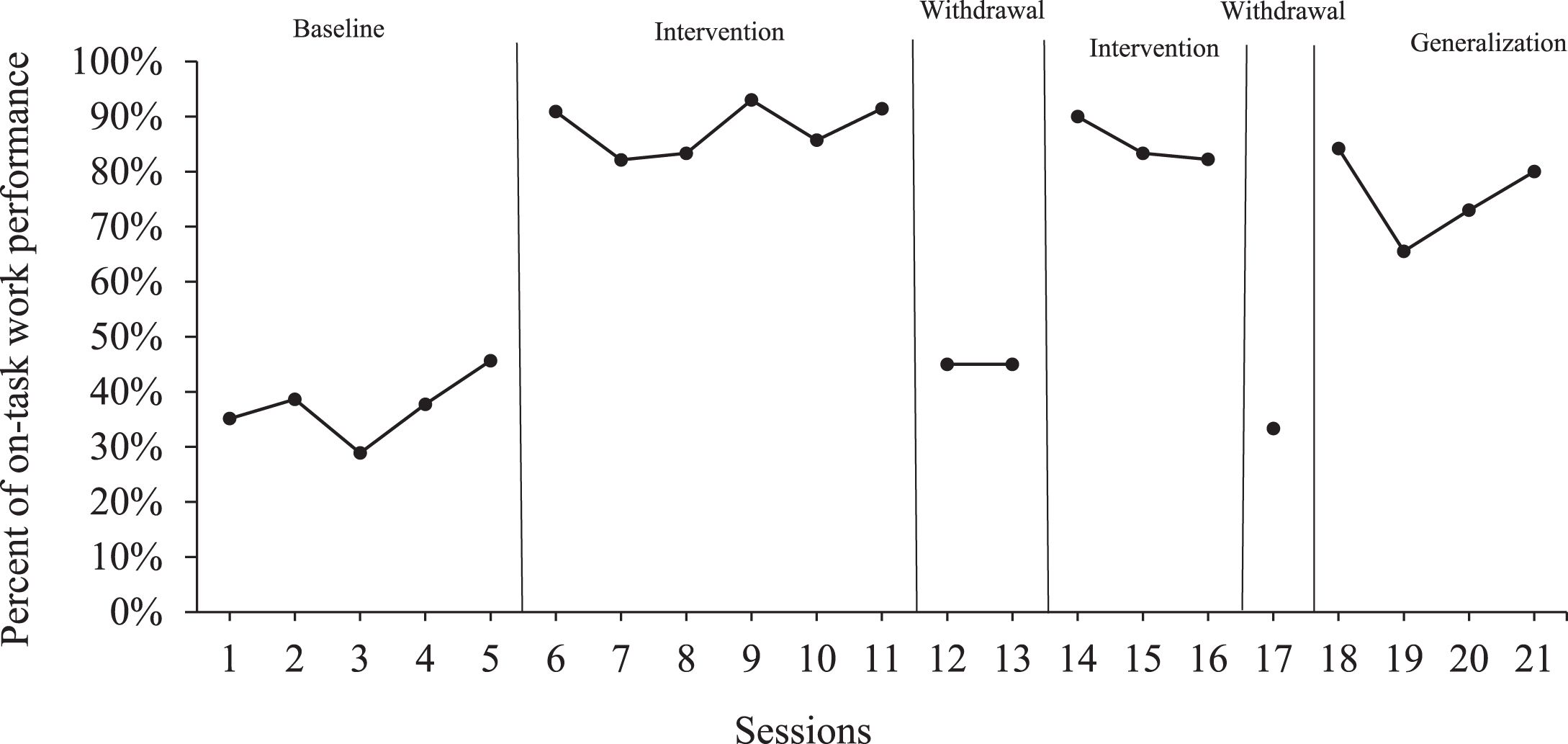
On-task work performance as measured with one-min time sampling for baseline, intervention, withdrawal, and generalization conditions.
Three demonstrations of effect were present in the study. Therefore, a functional relation between the intervention package and Darius’ on-task work performance was concluded.
Table 1 shows all social validity questionnaire results. Darius agreed the extra training he received at the beginning of his shift improved his job performance. He strongly agreed that he liked doing the video modules on the computer, liked doing the bagging training trials with his co-worker, and liked reading the social narratives with the cashiers and shift leaders. Darius agreed that he liked doing the bagging training trials and reading the social narratives with the researcher. He also agreed that he feels he has adequate support at this place of employment. However, he disagreed that he likes the job and wants to continue working here in the future. When asked what he thought was the most effective component of the intervention package, Darius said, “Doing the practice on the computer” and “I liked everything.” When asked what the least effective component was, Darius said, “I don’t want to work this job forever.”
Social Validity Questionnaire Results
Darius’ employer strongly agreed the extra training Darius received at the beginning of his shift improved his job performance. He strongly agreed all components were effective when implemented by the researcher. However, he agreed components were effective when implemented by cashiers or shift leaders. The employer strongly agreed that Darius had adequate support at work and that he enjoyed working with him. The employer reported he was satisfied with Darius’ job performance on the days in which the intervention package was implemented. The employer wrote in the comment section, “There was a big difference between days of training before the shift and when there was no training.”
This study examined the effects of an individually designed intervention package to improve the on-task work performance of a competitively employed young adult with ASD. Darius had worked at a grocery store as a courtesy clerk for 1.5 years at the time of the study. His employer and co-workers assisted in the design and implementation of the intervention package consisting of video modules, bagging training trials, and social narratives. A co-worker was trained to implement components of the intervention package during the generalization condition. Darius and his employer reported their satisfaction with the intervention package at the conclusion of the study via a social validity questionnaire.
Regarding our first research question, Darius’ on-task work performance improved on shifts in which the intervention package was implemented. A functional relation between the intervention package and on-task work performance was evident due to the three demonstrations of effect (Barton, Lloyd, et al., 2018). Given the repeated return to baseline levels observed during withdrawal probes, it seems clear Darius’ performance was a function of access to the packaged intervention. Specifically, the packaged intervention appears to have functioned as an effective on-going workplace accommodation rather than training method. This is evidenced by changes in performance to baseline levels when the intervention was withdrawn. This finding suggests some young adults with ASD may benefit from on-going, individualized workplace supports that include practice, feedback, and social supports. Such supports should be considered reasonable workplace accommodations according to the Americans with Disabilities Act (1990).
Regarding our second research question, a co-worker successfully implemented components of the intervention package with fidelity. In fact, the co-worker and first author implemented the package with nearly the same mean percentage of fidelity. This suggests the co-worker was effectively trained and capable of serving as the interventionist. In addition, the co-worker volunteered to assist Darius with no stipend or other incentive. Darius’ work performance was similar levels during the generalization condition as the primary intervention condition. Accordingly, Darius’ performance was sustained with indigenous implementers (Barton, Meadan-Kaplansky, et al., 2018). Co-workers were successfully trained to support Darius as a natural workplace support rather than relying on university researchers, job coaches, or other specialized employment professionals.
Finally, regarding our third research question, Darius and his employer reported overall high satisfaction with the intervention package. Darius reported he liked the video modules on the computer the best, which suggests high social validity for technology-based interventions in CIE settings. Darius rated higher satisfaction when intervention components were implemented with cashiers and shift leaders compared to the researcher. This finding suggests Darius found interacting with his co-workers both engaging and reinforcing. However, despite Darius’ satisfaction with the intervention package, he also reported on the social validity questionnaire that he did not like his job and did not want to continue working there in the future. Perhaps a job better matched to Darius’ strengths, preferences, and interests might contribute to better work performance, but supports like those in this study may still be necessary. Regardless, this is an empirical question not addressed in the current study. Darius’ employer rated all intervention components as effective but expressed a preference for the researcher as the interventionist rather than cashiers or shift leaders. This finding suggests the employer appreciated an outside professional providing on-the-job support to Darius. The employer also reported he appreciated receiving information regarding how best to support employees with ASD, which is consistent with research indicating many employers lack critical knowledge about effective autism-specific strategies (Pfeiffer et al., 2017).
This study extends the ASD and employment literature and specifically that existing EBPs may be an effective on-the-job training method for employees with ASD. Given the large literature base for TAII, interventions grounded in principles of ABA, and social narratives for learners with ASD, it was perhaps not surprising Darius improved his job performance on work shifts these interventions were implemented. On-the-job training methods and procedures are clearly valuable for employees with ASD (Anderson et al., 2017; Nicholas et al., 2015). Despite the promising results, this study was highly individualized in nature and replication with additional participants would likely be challenging.
Limitations and suggestions for future research
A main limitation of this study relates to our decision to use shortened withdrawal conditions with less than three data points, the minimum number generally considered appropriate to assess trend. Current guidelines in single case research design standards indicate five data points per condition is preferred or recommended, depending on variability of the data (Kratochwill et al., 2013). Variable data generally warrants the need for additional data (Ledford et al., 2019). However, the data appeared stable and consistent changes in levels between each condition warranted sufficient confidence in a functional relation. Also, given the employer’s reported dissatisfaction with Darius’ work performance, we deemed in unethical to allow low work performance for an extended period of time to further increase confidence in the apparent functional relation. Nonetheless, it is possible that Darius’ performance during withdrawal data collection sessions would have improved spontaneously if we implemented longer withdrawal conditions.
An additional limitation is we were unable to collect maintenance data because Darius obtained a different job with more hours and better wages shortly after the study concluded. Future researchers should investigate whether individualized workplace interventions can produce durable changes in job performance that lead to job maintenance and advancement, including type of job, hours worked per week, and job responsibilities. Future researchers should also examine jobs matched to an individual’s interests as a means to enhance job performance. Darius’ reported dissatisfaction with his job may be a confounding variable that contributed to his low work performance.
Finally, the packaged nature of our intervention precludes any examination of effects relative to package components. It may be that one component of the intervention accounted for the majority or entirety of the observed changes. Future researchers might use a component analysis to evaluate which intervention components are essential, secondary, and superfluous. If future studies can establish which interventions work best for specific individuals and conditions, then implementation of EBPs in CIE settings may become more feasible and sustainable.
Implications for practice
Employers may consider applying established EBPs to improve job performance of employees with ASD, but more systematic replication is needed beyond the procedures conducted in this study, particularly given there was only one participant. A more formalized process is needed that allows employers to independently (1) identify employee skills needed for improvement, (2) select and learn to apply EBPs that are likely to improve targeted job skills, and (3) evaluate intervention effects and adapt when necessary. Accordingly, a more immediate solution in need of investigation may entail training employers, co-workers, job coaches, or other available personnel to utilize this process for employees with ASD. Studies that investigate a formalized process like this may result in better service delivery and outcomes. Employers may also consider providing incentives to employees who volunteer to support their fellow co-workers with ASD.
An additional implication for practice is job coaches, VR counselors, and other employment professionals should consider using, augmenting, or adapting existing training materials prior to creating specialized training materials only for employees with disabilities. For example, Darius had previously watched the corporate-created video modules when he was first hired but was not consistently performing the job duties described in the modules. The video modules were incorporated into the intervention package because they were used by all employees and, therefore, offered a natural and inclusive training method for Darius. Employees with ASD are likely to benefit from repeated practice (APA, 2013; Nicholas et al., 2015) and continued access to training materials, and it may be unnecessary to create specialized training materials if existing materials can be adapted or modified.
Conclusion
Obtaining employment is a critical benchmark during the transition to adulthood for individuals with disabilities including ASD (Gerhardt & Lainder, 2011). In particular, CIE within the local labor market increases community engagement and is superior to non-competitive employment experiences (Cimera et al., 2012). Young adults with ASD face unique barriers to positive CIE experiences (Lipscomb et al., 2017) and implementing existing EBPs may be a viable on-the-job training method to alleviate some of those barriers. Employers and co-workers can also assist with the implementation of individually-designed interventions for employees with ASD. This study should be considered preliminary given there was only one participant, replication would be challenging, and the limitations described above. Additional research examining the efficacy of specific EBPs to enhance competitive employment outcomes for young adults with ASD is clearly needed.
Conflict of interest
The authors declare that they have no conflict of interest.
Footnotes
Acknowledgments
This study was funded by the Council for Exceptional Children (CEC) Division for Career Development and Transition (DCDT) Graduate Research Scholarship.