




Abstract
BACKGROUND:
Given the importance of working alliance to client engagement and outcomes in vocational rehabilitation, there is a need to better understand predictors of the client counselor relationship. Research has shown the tripartite efficacy model as a way of understanding working alliance in various contexts but has never been examined in vocational rehabilitation.
OBJECTIVE:
This study evaluates the relationship among tripartite efficacy beliefs constructs (self-efficacy, other-efficacy, and relation-inferred self-efficacy [RISE]), working alliance, and engagement for 350 clients receiving state vocational rehabilitation services.
METHODS:
Researchers used a path analysis to assess the hypothesis that the tripartite efficacy model would predict client engagement through its impact on working alliance.
RESULTS:
The hypothesized model had a close fit. Other-efficacy and RISE beliefs had significant positive direct effects on working alliance and indirect effects on client engagement. Self-efficacy had a significant negative direct effect on working alliance and client engagement.
CONCLUSIONS:
The study supports the tripartite efficacy beliefs model as a way of better understanding client perceptions of working alliance in vocational rehabilitation.
Introduction
Counselors have long recognized the client-counselor relationship, or working alliance, as an important part of enacting positive change during the counseling process (Castonguay et al., 2011). In the counseling and psychotherapy literature, researchers have conceptualized working alliance as one of the common factors across therapeutic disciplines, a component that contributes to change across treatment modalities, with some researchers arguing that working alliance alone is more important than the type of treatment in predicting positive outcomes (Safran & Muran, 1995). Studies in the context of vocational rehabilitation counseling also support the importance of working alliance to positive outcomes. In a sample of state vocational rehabilitation consumers, Lustig and colleagues (2002) found that strong working alliance is correlated with better vocational outcomes, and for job seekers, it is correlated with a more positive view of their employment future. Other studies have demonstrated similar results supporting the relationship between working alliance and employment outcomes among people with mental illness (Donnell et al., 2004) and cognitive disabilities (Strauser et al., 2004).
Researchers argue that individuals with disabilities who are engaged in the rehabilitation counseling process and well-connected with their counselor benefit most from services (Chan et al., 1997; Kosciulek, 2004). Vocational goals can best be achieved when there is a maximum of client engagement in the development and implementation of a vocational rehabilitation services plan (Chan et al., 1997; Chan et al., 2017; Corrigan et al., 2012; McAlees & Menz, 1992). Accordingly, researchers have proposed strong working alliance as a vehicle for encouraging active participation during the rehabilitation process (Shaw et al., 2004; Strauser, et al., 2010). While existing studies in the counseling literature suggest that the working alliance holds a key role in facilitating client engagement (Lambert & Barley, 2002; Horvath et al., 2011; Horvath & Symonds, 1991; Martin et al., 2000), far less is known about factors that might contribute to the development of strong working alliance. There is a dearth of rehabilitation counseling research examining predictors of the client-counselor relationship. Only through understanding factors that influence the development of quality working alliance will rehabilitation counselors be able to develop evidence-based practices that foster better client-counselor relationships, thereby improving engagement and vocational outcomes for individuals with disabilities.
The tripartite efficacy beliefs framework introduced by Lent and Lopez (2002) represents one potential model for predicting and promoting a strong working alliance. The model builds on Bandura’s (1986) self-efficacy theory, which stresses the impact that significant others have on one another’s efficacy appraisals. Lent and Lopez (2002) argued that within the context of relationships between significant others, such as the relationship between a client and a counselor, self-efficacy exists within a network of complementary and continuously interacting beliefs. They suggest that clients’ willingness to cooperate and participate are influenced by their view of themselves and their counselor. The tripartite efficacy beliefs model seeks to explain how certain key relational efficacy beliefs affect individuals’ perceptions of their relationship with a significant other.
Lent and Lopez (2002) note that the three beliefs that form the tripartite efficacy beliefs model include (a) client confidence in their own ability to succeed (self-efficacy), (b) belief in the counselor’s abilities (other-efficacy), and (c) client perception of the counselor’s belief in their abilities (relation-inferred self-efficacy [RISE]). Self-efficacy beliefs are individuals’ personal judgments about their capability to perform courses of action to deal with a prospective situation (Bandura, 1982). Social cognitive theory states that self-efficacy beliefs help to determine important outcomes, such as individuals’ choice of, effort expended in, and persistence at behavioral activities and courses of action. Clients with low self-efficacy may set non-challenging goals, be hindered from engaging in difficult tasks, or fail to follow through. Self-efficacy starts at a level outside the counselor’s control based on clients’ personality, limitations, and previous experiences. However, viewpoints can change over time based on new interactions, new learning, and support. Lent and Lopez (2002) also note that self-efficacy can impact RISE beliefs through reciprocal influence, meaning that self-efficacy can play a part in shaping how individuals believe that others rate their abilities. Confident clients may be more likely to believe that their counselor believes in their abilities and unconfident clients may be inclined to believe the opposite. These beliefs can improve or worsen the working alliance and potentially lead to “self-fulfilling prophecies” (e.g., “I do not believe I can find a job so I will not bother look for one.”).
Other-efficacy refers to clients’ beliefs regarding a counselor’s ability and can impact their willingness to consider counselor advice, follow instructions, or work with him or her at all (e.g., “I do not believe my counselor can help me find a job so I will not bother to look for one.”). Counselor credentials can play a part in other-efficacy but in today’s world of Google search expertise an expert can sometimes be met with skepticism. Understanding other-efficacy offers an avenue for improving client trust in the counselor, promoting consideration of their input, and ultimately improving client willingness to participate (Lent & Lopez, 2002).
RISE beliefs refer to clients’ perception of the counselor’s confidence in their ability to perform a specific behavior (e.g., “I do not think my counselor believes I can find a job so I will not bother look for one.”). These beliefs offer significant insight into the clients’ opinion of their counselor. Lent and Lopez (2002) argue that RISE beliefs can impact, and be impacted by, self-efficacy and other-efficacy beliefs. Further, RISE beliefs can impact clients’ self-efficacy through reciprocal influence and other-efficacy based on their level of disagreement with the perceived counselor’s confidence in them. Collectively, tripartite efficacy beliefs affect relationship satisfaction and clients’ willingness to continue working with a counselor. A poor measure in any of the three beliefs could lead to a deterioration in the working alliance. The potential for one efficacy belief to impact another gives rise to the need for determining the relative importance of and interaction between the three efficacy beliefs central to the model.
Jackson and colleagues (2012) explored the impact of the tripartite efficacy beliefs framework for clients of a rehabilitation exercise program, finding that each of the three beliefs showed direct positive effects on participant evaluation of the client-therapist relationship and indirect effects to client engagement. Likewise, Morrison and Lent (2018) found in a study of counseling graduate students and their supervisors that relational beliefs are significantly related to working alliance. In a study on advising student researchers, advisees’ RISE beliefs regarding their advisor’s perceptions of their research ability was significantly related to advisory work alliance and the students’ self-efficacy (Morrison & Lent, 2014). This evidence supports the tripartite efficacy beliefs model as a promising framework for investigating how relational beliefs affect client-counselor relationships for individuals with disabilities in a vocational rehabilitation setting.
Understanding what factors are important to the prediction and improvement of working alliance will allow counselors to develop strategies to improve relationships with their clients, address potential issues before they cause a breakdown in working alliance, and improve client engagement and participation. This study seeks to explore the relationship between tripartite efficacy belief constructs, working alliance, and engagement for individuals with disabilities receiving vocational rehabilitation services. It also examines working alliance as a potential mediator of the relationship between tripartite efficacy belief constructs and client engagement with vocational rehabilitation services.
Methods
Participants
The investigator obtained IRB approval for the study and contacted state department of vocational rehabilitation (DVR) agencies that agreed to email a survey to their current clients. The investigator obtained informed consent and data was collected via an online survey. Participants were 325 vocational rehabilitation clients from two mid-western state DVRs. Among the participants, 112 (34.5%) identified as male, 210 (64.6%) as female, and three (0.9%) as another gender identity. The sample was predominantly white (n = 256; 78.8%), followed by multiracial (n = 33; 10.2%), black or African American (n = 24; 7.4%), Latino (n = 5; 1.5%), Asian (n = 4; 1.2%), and American Indian or Alaska Native (n = 2; 0.6%). The average age of the sample was 34.2 years (SD = 13.7). Most of the sample had a high school diploma or equivalent degree, 171 (52.6%), while 64 (19.7%) had a bachelor’s degree, 53 (16.3%) had an associate degree, 23 (7.1%) had a master’s degree or higher, and 14 (4.3%) had less than a high school degree. The most common primary disability type reported was a physical disability (n = 117; 36.0%), while 93 (28.6%) reported having a psychiatric disability, 67 (20.6%) reported having a cognitive or learning disability, and 48 (148%) reported having another medical condition. Most the sample was unemployed, 164 (50.5%), while 101 (31.1%) participants were employed part-time and 60 (18.5%) were employed full-time.
Measures
Job search self-efficacy
The Job Search Self-Efficacy Scale (JSSE; Saks, Zikic, & Koen, 2015) is a 10-item self-report measure. It is comprised of two dimensions: job search self-efficacy behaviors (JSSE-B) and job search self-efficacy outcomes (JSSE-O). This study used only the JSSE-O, which consists of 10-items and assesses beliefs about the outcomes of job search efforts (“How confident are you that you can be successful in your job search”). The measure asks respondents to rate their level of confidence for each outcome on a five-point scale with anchors, 1 (not at all confident), to 5 (totally confident). The JSSE-O is based on Blau’s (1994) job search behavior scale, which has been validated in several different studies (e.g. Cote et al., 2006; Saks & Ashforth, 1999). Saks and colleagues (2015) found that the Cronbach’s alpha for the JSSE-O is 0.89. In the present study, the internal consistency reliability coefficient was 0.97.
This study also used altered versions of the JSSE-O to measure job search other-efficacy and job search relation-inferred self-efficacy. Each of these measures was also comprised of 10 items. To measure other-efficacy, the researcher adjusted the wording of JSSE-O items to address a respondents’ confidence in their rehabilitation counselor’s ability to help with certain behaviors (e.g. “How confident are you that your counselor can help you to be successful in your job search”). The other-efficacy version of the JSSE-O had an internal consistency reliability coefficient of 0.98. To measure relation-inferred self-efficacy (RISE) beliefs, the researcher adjusted the wording of JSSE-O items to assess respondents’ beliefs regarding their counselor’s beliefs about their ability to be successful in their job search (e.g. “How confident is your counselor that you can be successful in your job search”). The RISE belief version of the JSSE-O had an internal consistency reliability coefficient of 0.98.
Working alliance
The Working Alliance Inventory-Vocational Rehabilitation (WAI-VR) is a modified version of the Working Alliance Inventory-Short Revised (WAI-SR), which was developed by Munder and colleagues (2010). The WAI-VR was created by Chan and colleagues (2004) for use in vocational rehabilitation agency settings. The WAI-VR is composed of 12 items assessing three factors (i.e., bond, task, and goal). Each item is rated on a seven-point Likert-type scale, ranging from 1 (strongly disagree) to 7 (strongly agree; e.g. “The counselor and I agree about the steps to be taken to improve the VR process”). Subscale mean scores are calculated with higher scores indicating a higher level of working alliance. Munder and colleagues (2010) reported internal consistency reliability coefficients for bond (0.82), task (0.85), goal (0.81) and total (0.90). In a previous study of individuals with disabilities receiving vocational rehabilitation services, the internal consistency reliability consistency for the overall measure was 0.93 (Iwanaga et al., 2019). In the present study, we used total scores and the internal consistency reliability coefficient for the working alliance scale was 0.93.
Vocational rehabilitation engagement
The Vocational Rehabilitation Engagement Scale (VRES) was developed by Dutta and colleagues (2016) to assess vocational rehabilitation clients’ engagement in vocational rehabilitation services. It is a 9-item measure with each item rated on a five-point Likert-type scale, ranging from 1 (strongly disagree) to 5 (strongly agree; e.g., “I strive to complete assignments and rehabilitation activities agreed upon with my rehabilitation counselor”). In a study of state vocational rehabilitation service consumers, Dutta and colleagues (2016) found an internal consistency reliability of 0.94. In the present study, the VRES had an internal consistency reliability coefficient of 0.90.
Statistical procedures
The investigator used R software for Windows to manage raw data and calculate descriptive statistics, and the Lavaan package (Rosseel, 2012) to perform a path analysis. The investigator performed univariate and multivariate normality checks before testing the structural model. Subsequently, the investigator examined the overall fit indices and hypothesized predictive pathways for the structural model using maximum likelihood procedures. To assess the model, the investigator utilized a range of indices, including the *2 goodness-of-fit index, Tucker-Lewis Index (TLI), comparative fit index (CFI), standardized root mean square residual (SRMR), and root mean square error of approximation (RMSEA). The investigator used estimates for CFI/TLI≥0.95 and SRMR/RMSEA≤0.08 as evidence of close fit (Hu & Bentler, 1999; Marsh, Hau, & Wen, 2004). The investigator analyzed direct and indirect estimates between variables as specified in Fig. 1 and used bootstrapped confidence intervals (CIs) to assess the significance of all total indirect pathways.
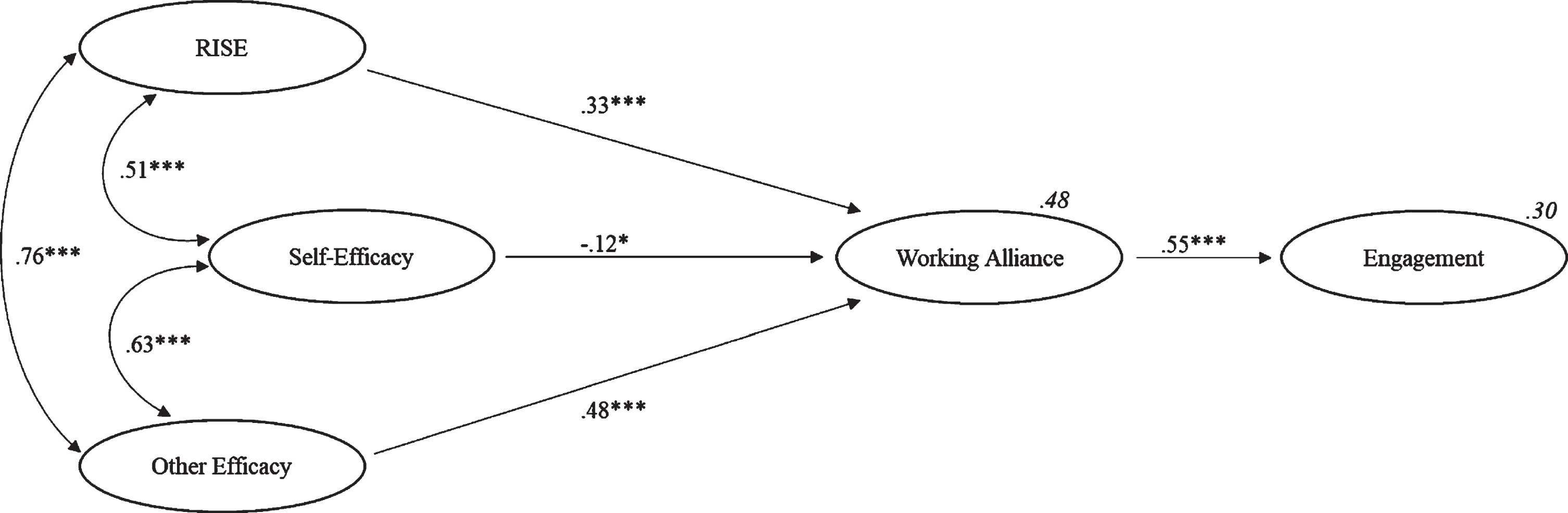
Predictive pathways between variables. Note. Values above and below the arrows represent standardized path estimates. Squared multiple correlations are presented in italics above exogenous variables. RISE = relation-inferred self-efficacy. ***p < 0.001, **p < 0.01, *p < 0.05.
There were significant, positive correlations among the five measured variables; the correlations are detailed in Table 1. The close fit indices for a structural model comprised of five variables (self-efficacy, other-efficacy, relation-inferred self-efficacy, working alliance, and engagement), as indicated in Fig. 1, resulted in Σ2 (325) = 5.80, p = 0.122, CFI = 0.996, TLI = 0.988, SRMR = 0.018, and RMSE = 0.054 [90%CI = 0.00, 12]. In the structural pathways, direct effects showed that favorable RISE and other-efficacy appraisals each significantly predicted clients’ perceptions of working alliance. This suggests that when clients estimated that their rehabilitation counselor was confident in their ability (as a client) to find a job and/or estimated that their rehabilitation counselor was highly capable of helping them find a job, participants reported a better alliance with their counselor. The direct effects for self-efficacy suggested that greater self-efficacy predicted poorer working alliance. Collectively, the tripartite efficacy constructs explained 48%of the variance in working alliance. Increases in working alliance were also directly related to improvements in client engagement, accounting for 30%of the variance in engagement ratings. Bootstrapped analyses revealed significant indirect pathways between RISE (RISE ⟶ engagement; β= 0.18, SE = 0.03, 90%CI = [0.13, 0.23], p < 0.001), other-efficacy (other-efficacy ⟶ engagement; β= 0.27, SE = 0.02, 90%CI = [0.21, 0.32], p < 0.001), and self-efficacy (self-efficacy ⟶ engagement; β= –0.07, SE = 0.02, 90%CI = [–0.10, –0.03], p < 0.05) in relation to engagement, via working alliance.
Correlations for Variables Used in Path Analysis
Correlations for Variables Used in Path Analysis
Note. RISE = relation-inferred self-efficacy. ***p < 0.001
State-Federal vocational rehabilitation agencies provide an important service to individuals with disabilities by helping them to obtain and maintain employment. Research supports that the strength of the working alliance between clients and their rehabilitation counselors is positively related to engagement with vocational rehabilitation services (Chan et al., 1997; Chan et al., 2017; Corrigan et al., 2012; Iwanaga et al., 2019; McAlees & Menz, 1992) and desirable rehabilitation outcomes (Donnell et al., 2004; Lustig et al., 2002, 2004; Schelat, 2001). The tripartite efficacy beliefs model provides a framework for understanding relationship processes (Lent & Lopez, 2002). While Jackson and colleagues (2012) have investigated the interpersonal and rehabilitation outcomes associated with the model in the physical rehabilitation setting, researchers had yet to examine these relationships in the vocational rehabilitation counseling setting. Thus, the purpose of the present study was to examine the relationship between the tripartite efficacy beliefs of 325 vocational rehabilitation consumers and their perceptions of the quality of working alliance with their rehabilitation counselor and engagement in vocational rehabilitation services.
Consistent with Lent and Lopez’s (2002) theoretical model, significant positive effects emerged for each of the tripartite efficacy constructs with respect to working alliance. Findings suggest participants perceived greater working alliance when they also perceived their rehabilitation counselor believed in their ability to obtain employment (i.e., RISE) and when the participants were confident in their rehabilitation counselor’s ability to help the participant obtain employment (i.e., other-efficacy). Participants’ belief in their own ability to obtain employment (i.e. self-efficacy) was associated with greater working alliance as an isolated variable, but not in the overall model, which is discussed below.
Collectively, the tripartite efficacy constructs explained a moderate proportion of the variance in working alliance. In the model, other-efficacy and RISE beliefs were positively associated with working alliance. Surprisingly, greater participant self-efficacy predicted poorer working alliance. Given the positive correlation between self-efficacy and the working alliance, it could be that this represents a suppression effect. Self-efficacy may positively impact working alliance through its impact on other-efficacy and RISE beliefs; when controlling for those positive relational belief factors, self-efficacy could capture the tendency for some individuals with disabilities who have more confidence in their own job-seeking abilities to rely less on the rehabilitation counselor, negatively affecting the client-counselor bond. While previous research examining the tripartite efficacy framework found self-efficacy predicted greater client-therapist relationships (e.g. Jackson et al., 2012), our finding suggests that, in the context of vocational rehabilitation, the working alliance may be more influenced by a clients’ perceptions that their counselor believes in them and their confidence in in their counselor’s abilities rather than clients’ confidence in their own abilities. This is a significant finding given that past vocational rehabilitation research has explored self-efficacy and outcomes but has never considered the impact of other-efficacy or RISE beliefs. The results of this study suggest that other-efficacy and RISE beliefs may be much stronger predictors of client working alliance. It could be that vocational rehabilitation clients, who are actively looking to a professional for support in finding employment, are highly responsive to perceptions of their counselors when thinking about their own ability to work and their ability to benefit from vocational rehabilitation services.
The results of our study suggest that individuals who reported stronger working alliance with their vocational rehabilitation counselor also reported more active engagement with vocational rehabilitation services. This is consistent with previous findings of working alliance and engagement and participation in vocational rehabilitation (e.g. Chan et al., 2017; Iwanaga et al., 2019). Further, the findings indicate that each tripartite efficacy construct is indirectly related to engagement through working alliance. The results suggest that efficacy-enhancing strategies that target the tripartite efficacy constructs may help strengthen working alliance and in turn bolster client engagement in vocational rehabilitation services. For example, vocational rehabilitation counselors who express their confidence in the job seekers’ abilities and demonstrate high levels of counselor competency may increase the client’s relational efficacy. Client gains in confidence in their rehabilitation counselor and belief that their counselor holds confidence in their ability to succeed may foster a stronger working alliance and promote client engagement during the rehabilitation process. Interventions that focus on the communication style of rehabilitation counselors and provision of support and reinforcement may increase relational efficacy beliefs (Jackson et al., 2012).
Limitations
There are several factors that limit the generalizability of these study findings. First, the present study recruited a sample of vocational rehabilitation clients who reside in the Midwest region of the United States. As a result, it would be important to replicate this study with vocational rehabilitation clients who reside in other regions of the United States as the level of engagement in job-seeking activities may differ based on geographical location. Second, the cross-sectional nature of the data limits the ability to analyze causation or predict actual working alliance and engagement in vocational rehabilitation services.
Future directions
Future studies may use longitudinal data to reduce biased estimations (Maxwell & Cole, 2007) and assess the effect on vocational outcomes. It would also be interesting to investigate causal relationships among the tripartite efficacy framework constructs and client outcomes using an experimental design that analyzes changes in working alliance, engagement, and employment. Researchers might design an intervention that provides supportive communication training to a group of counselors and compare their client outcomes with a control group. Finally, future studies could include vocational rehabilitation counselors in the sample to evaluate the counselor’s tripartite beliefs as well as to obtain a more comprehensive measure of client engagement and client-counselor working alliance.
While the role of self-efficacy in promoting successful vocational outcomes is well understood (Andersén et al., 2018; Lent et al., 2002; Tansey et al., 2017), its effect on working alliance is not. The present findings suggest that greater self-efficacy is associated with poorer working alliance when controlling for perceived other-efficacy and RISE beliefs. This outcome suggests a complex relationship between self-efficacy and interpersonal outcomes. Investigating the mechanism to explain this phenomenon would be a worthwhile pursuit. Follow-up in this area might include considerations of whether self-efficacy can be excessive in the face of interpersonal outcomes and whether the measure of self-efficacy can be teased apart from a self-isolating pursuit of goals. One possibility may be to control for humility in future studies, a construct that has recently taken on greater prominence in the social sciences research (Banker & Leary, 2020; Phillips et al., 2018). Additionally, since we found relational efficacy is associated with stronger working alliance and the tripartite efficacy constructs support client engagement with vocational rehabilitation, future research of interventions targeting relational efficacy to promote working alliance and engagement are needed.
Another future area of research includes analysis of the relationship between the three components of the tripartite efficacy beliefs. Although Lent and Lopez (2002) theorizied a reciprocal relationship between variables, more recent research has proposed RISE beliefs to primarily act as an antecedent of self-efficacy (Jackson et al. 2008; Saville et al., 2014; Saville & Bray, 2016). Longitudinal studies may allow for greater understanding of how the tripartite beliefs influence and are influenced by the other, something which Lent (2016) has argued.
Results also hold implications for practice. Given the strength of other-efficacy and RISE, rehabilitation counselors may have a significant influence on the working alliance and consequent engagement with vocational rehabilitation by attending to these two sources of efficacy in their practice. Clients’ positive beliefs about other-efficacy (i.e. their counselor’s competence) is essential to the potency of RISE beliefs (Lent, 2016). A client who does not have confidence in their counselor will be unlikely to be greatly influenced by their perceptions of whether their counselor believes in their ability to succeed. Rehabilitation counselors must attend to first and subsequent impressions and convey competence, hopefully accurately, if they are to hope for other-efficacy to work towards the benefit of the client. Considerations of other-efficacy may be of particular importance when obvious differences create doubt in the counselors ability to assist (e.g., age gaps, differences in socio-economic background, racial and ethnic differences). Without an adequate level of perceived other-efficacy, it is unlikely that a client will remain committed to attending sessions and following plans for employment that are established together.
There are many practical implications for the relationship between RISE, working, alliance, and engagement with vocational rehabilitation. First, it is important to emphasize that RISE is not an objective assessment but rather a subjective one. As a result, it is highly possible for perceptions of RISE to be distorted or completely incorrect. Rehabilitation counselors often work with clients who have experienced recent rejection from the labor market and may be low in self-efficacy and feeling demoralized. Such a context makes RISE beliefs even more critical (Lent, 2016). With high levles of other-efficacy in place, rehabilitation counselors have an opporutnity to drastically influence client self-efficacy and counseling outcomes by being intentional and authentic in conveying a positive belief in their client. Rehabilitation counselors who have experienced setbacks with numerous clients may unintentionally cause harm by conveying something less than optimistic about the clients’ ability to succeed. Beyond overtly supportive statements, RISE may be increased through appropriately measured challenges. A challenge, when properly adminstered and including the proper supports, can convey confidence in a client’s ability to accomplish it.
Conclusions
This study makes a novel contribution to the vocational rehabilitation literature by demonstrating that individuals with disabilities’ tripartite efficacy beliefs are significantly related to perceptions of working alliance within vocational rehabilitation programs. We also observed that each of the tripartite efficacy constructs may indirectly align with client engagement with vocational rehabilitation through working alliance. By developing positive working alliance through relational efficacy-enhancing strategies, rehabilitation counselors can encourage clients to be engaged in the rehabilitation counseling process, thus promoting positive rehabilitation outcomes.
Conflict of interest
The authors declare that they have no conflict of interest, and procedures involving experiments on human subjects were done in accord with the ethical standards of the Committee on Human Experimentation of the institution in which the experiments were done in accord with the Declaration of Helsinki of 1975.