



Abstract
BACKGROUND:
Individuals with developmental disabilities experience lower employment, higher underemployment, and higher job switching rates than the general population.
OBJECTIVE:
The current study investigated: (1) the vocational and support experiences of individuals with developmental disabilities, and (2) the differences in participant outcomes between an apprenticeship-model employment program and the comparison group.
METHODS:
Qualitative and quantitative methods were used to assess outcomes and experiences of participants in the apprenticeship model employment program (N = 22) and a community-based “Job Club” (N = 11). Thematic analysis was used to analyze interview transcripts. Independent samples T-tests and paired samples T-tests were utilized to analyze within-group and between group differences.
RESULTS:
Parent interview data regarding past and current experiences of the participants in the apprenticeship model employment program suggest 6 major themes. Independent samples T-tests determined that the apprenticeship program participants were significantly less employed than the comparison group at pre-, then similarly employed as the comparison group at post-intervention. Within-group analyses determined that some aspects of participant confidence in their vocational skills and problem-solving skills significantly increased from pre- to post-intervention, according to parent report.
CONCLUSIONS:
The apprenticeship model of employment appears to be a promising model in need of further study with a larger sample size.
Background
The majority of the current developmental disability research and literature focuses on childhood prevention and intervention (Howlin, 2013). However, there is a substantial need to focus efforts toward better understanding supports to improve outcomes for adults with developmental disabilities (Hurlbutt & Chalmers, 2004; Shattuck et al., 2012). A major focus in the transition to adulthood is employment, a socially normative activity that most often occupies the bulk of one’s adult life (Fussel & Furstenburg, 2005). Earning wages contributes to both social and economic well-being, as well as being related to good health, which are all factors in achieving positive quality of life (Roux et al., 2013). Achieving employment is especially important for this population given that the lifetime cost of supporting an individual with a developmental disability is estimated to range from 1.4 to 2.3 million dollars (Buescher et al., 2014), with some even suggesting that the cost may be in excess of 3 million (Ganz, 2007).
As noted in several studies, working age indivi-duals with developmental disabilities exhibit significantly lower employment, higher underemployment (i.e., overqualified based on intelligence and skill-level), higher “malemployment” (i.e., not at all suited for a particular job) and higher job switching rates as compared to the general population (Hurlbutt & Chalmers, 2004; Muller et al., 2003; Taylor & Seltzer, 2011). Research also suggests that it is more common for individuals with developmental disabilities to lose employment due to difficulties unrelated to their ability to perform their specific work tasks (Dew & Alan, 2007; Homles, 2007; Hurlbutt & Chalmers, 2004; Westbrook et al., 2012). Holmes (2007) also goes on to state that it is specifically the inability to determine and provide the proper supports needed that is the key reason for the unemployment, underemployment, and malemployment discrepancies this population experiences.
Past and present employment statistics for adults with developmental disabilities
Outlined by the Individuals with Disabilities Education Act (IDEA; 2004), achieving employment upon graduation is the main measure of accountability for individuals with disabilities (Hendricks, 2010). However, few nationally representative findings exist which characterize vocational and employment experiences of young adults with developmental disabilities. A study consisting of a national survey of typically developing young adults found that 98.6% the sample reported ever having at least 1 job between 18 and 25 years old (Taylor et al., 2012). Similar findings were discovered in young adults with disabilities with 91% of 11,270 youth nationwide having some form of paid employment within the first 8 years after high school (Newman et al., 2011).
The majority of the little research conducted on the topic of participation in employment for individuals with developmental disabilities has focused on adults with autism spectrum disorders (ASD). According to results from the NLTS2 survey, as of 2009, the percent of young adults (aged 18–24) with autism who were employed was nearly half that of all young adults with disabilities (33% vs. 59%) (Newman et al., 2011). In addition, NLTS2 data also show that individuals with ASD have lower rates of participation in employment, vocational or technical education, and post-secondary education in 2 or 4-year programs than their peers with intellectual disabilities, learning disabilities, or speech language impairments for as long as 7 years post high school (Shattuck et al., 2012). Burgess and Cimera (2014) found that the number of adults with ASD seeking vocational rehabilitation services increased by 792% from 2002 to 2011. Taylor and Mailick’s ten year longitudinal study of the vocational activities of adults with ASD aged 18 to 52 years old found that engagement and level of independence in vocational activities significantly decreased over the study period (Taylor & Mailick, 2014).
Not much is known regarding employment statistics for other developmental disabilities; Braddock and colleagues (2008) reported that in 2005, 76% of adults with intellectual or developmental disabilities were served in facility-based settings. It is evident based on a multitude of studies that generally poor employment outcomes exist for adults with developmental disabilities and that more focused research needs to be conducted in this area in order to determine what types of supports should be provided (e.g., Barnhill, 2007; Hurlbutt & Chalmers, 2004; Roux et al., 2013).
Barriers to employment for individuals with developmental disabilities
Difficulty achieving employment for this popu-lation should not be a burden placed solely on the individual; it is a social problem (Shattuck & Roux, 2014). Shattuck & Roux (2014) state in their edito-rial commentary that these problems cannot be solved entirely through focusing on modifying the behaviors and abilities of particular individuals. Instead, research should focus on examining workplace environment factors such as policies and level of understanding in management and co-workers.
Studies of employers’ attitudes towards employees with disabilities have found fairly consistent results. Employers who had previous positive experiences with employees with disabilities were more likely to continue to hold positive attitudes towards these individuals (Hernandez et al., 2000; Ju et al., 2013; Unger, 2002). Discrepancies exist between actual hiring of employees with disabilities and expressed willingness to hire these individuals (Hernandez et al., 2000). Employees with physical disabilities were viewed more favorably than employees with intellectual or psychiatric disabilities when providing ratings of their overall employability (Hernandez et al., 2000; Ju et al., 2013; Unger, 2002). And, many employers expressed concerns over general employability and job skills of individuals with disabilities (i.e., productivity, punctuality, safety, social skills, etc.; Ju et al., 2013; Unger, 2002).
The social and interactional difficulties associated with developmental disabilities account for substantial challenges in the workplace (Hagner & Cooney, 2005; Hillier et al., 2007). Examples of these workplace communication challenges may involve “reading between the lines,” understanding directions, interpreting facial expressions or tone of voice, asking too many questions, communicating effectively with coworkers, or deciding whether to disclose disability (Baldwin et al., 2014; Hurlbutt & Chalmers, 2004). Social challenges also include issues such as poor hygiene and grooming skills, difficulty understanding social cues and rules, working alone, talking in an inappropriate manner or at inappropriate times with coworkers or individuals of the opposite sex (Hendricks, 2010). These social and communicative challenges often come up during the interview process, before ever achieving employment (Muller et al., 2003). When individuals with developmental disabilities are actually hired, such behaviors in the workplace are often misinterpreted and require behavior management strategies or other additional supports (Hendricks, 2010).
Executive functioning difficulties are another well-documented barrier for individuals with developmental disabilities in becoming employed (Landa & Goldberg, 2005; Lopez et al., 2005). Executive functioning may affect areas of work such as: filling out complex job application materials, task execution, motor planning, response shifting, and working memory (Hume & Odom, 2007; Muller et al., 2003). These cognitive difficulties may compound the struggles with adapting to new job routines or changes in the work environment (Keel et al., 1997).
Individuals with developmental disabilities, particularly individuals with ASD, exhibit a high rate of comorbid psychiatric disorders. Based on numerous descriptive studies of comorbidity in samples of youth with ASD published over the past decade, comorbid disorders have been found to occur at much higher rates in youth with ASD than typically developing youth as well as youth with other mental health conditions (e.g., de Bruin et al., 2007). Also, among youth with developmental disabilities, other anxiety disorders, attention deficit problems, disruptive behavior, and depressive disorders are very common and often increase during adolescence (Wood & Gadow, 2010). Camarena and Sarigiani (2009) found, after interviewing parents of 21 adolescents with ASD regarding what they envision their children doing after high school graduation, that parents considered anxiety as a major obstacle to their children’s future due to their fear of the unknown and difficulties with social interactions. In Schaller and Yang’s (2005) study of the 2001 Rehabilitation Services Administration database of employment of 815 individuals with ASD, absence of a comorbid, or secondary, disability significantly correlated with successful competitive employment. The lack of a secondary disability was also related to successful case closures (i.e., the individual achieved competitive employment and no longer needed employment support); with 63.8% (157 out of 246) of individuals without a secondary disability and 52% (106 out of 204) of individuals with a secondary disability achieving successful closure (Schaller & Yang, 2005). Research shows that these comorbid disorders continue to cause difficulties in adulthood, especially in regards to employment.
Socioeconomic status (SES) is another factor that has been shown to clearly affect employment outcomes for adults with developmental disabilities (Chen et al., 2014). Previous research has found that adults with developmental disabilities the most at risk of being unemployed after exiting the school system were those whose families earned lower incomes (Shattuck et al., 2011; Shattuck et al., 2012; Taylor & Mailick, 2014; Taylor & Seltzer, 2011). This is most likely the case due to the fact that a family with lower SES typically has fewer resources and less access to services (Shattuck et al., 2012; Taylor & Seltzer, 2011).
Given the wide-ranging barriers listed above, it is a difficult task to establish an all-encompassing intervention, support, or accommodation to address every barrier for potential employees with developmental disabilities; as opposed to, for example, making a workplace wheelchair-accessible for all employees who use wheelchairs. Each employment environment and employee with developmental disabilities requires unique accommodations depending on the environment, the individual, and the combination of the particular environment and individual.
Employable skills and strengths of adults with developmental disabilities
Research indicates that employers are often not aware of the unique strengths that individuals with developmental disabilities may possess (Hillier et al., 2007), or how they could potentially be a better employee than someone without a developmental disability (Muller et al., 2003). Specifically, in regards to work skills that adults with ASD possess, previous research suggests that once these individuals are employed, they often demonstrate specific strengths such as attention to detail (Gonzalez et al., 2013; Smith et al., 1995); high levels of math, computer, memory, and other technical abilities (Baldwin et al., 2014; Mawhood & Howlin, 1999); honesty, reliabi-lity, and persistence (Mawhood & Howlin, 1999); increased productivity due to their decreased likelihood of unnecessary social interaction with cowo-rkers (Smith et al., 1995); strict adherence to rules (Hillier et al., 2007); and low absenteeism (Howlin et al., 2005). In addition to these particular skills, jobs that include social isolation, repetitiveness, or predictability often appeal more to employees with ASD than to employees without ASD (Smith et al., 1995; Van Bourgondien & Woods, 1992). Hagner and Cooney (2005) conducted interviews with 14 supervisors of employees with ASD. They found that supervisors gave overwhelmingly positive evaluations of these employees, with most receiving “outstanding” grades. One supervisor stated that supervision of an employee with ASD was more attitudinal than technical in that supervision did not require anything “other than patience, respect, and understanding of people who are different than you are” (Hagner & Cooney, 2005).
Other research has demonstrated the capacity of adults with developmental disabilities to learn vocational skills when they are directly taught (Walsh et al., 2014). In their review of vocational skill interventions for adults with ASD, Walsh and colleagues (2014) synthesized a wide variety of research in which participants exhibited success learning skills such as cover letter writing (Pennington et al. 2014); interview skills which were taught via a multimedia employment training program “JobTIPS” (Strickland et al. 2013); how to request assistance for a work related problem while in an employment setting (Dotto-Fojut et al., 2011); wearing a “WalkAround” costume to promote business while receiving live prompting via an iPod application (Allen et al., 2010b; Allen et al., 2012; Burke et al., 2010); photocopying skills (Bennett et al., 2013a, Bereznak et al., 2012); using a washing machine and making noodles (Bereznak et al., 2012); t-shirt folding (Bennett, Gutierrez, et al., 2013); general clerical skills (Bennett et al., 2013a; Dotson et al. 2013); shipping materials (Burke et al., 2013); newspaper route (Robinson & Smith, 2010); cleaning (Kellems & Morningstar, 2012); recycling (Bennett, 2013b); stocking inventory (Kellems & Morningstar, 2012); and sorting mail (Alexander et al., 2013).
It is clear that with the right supports in place, some of the difficulties individuals with developmental disabilities experience with employment may be fostered into great benefits, even for those with more severe disabilities (Smith & Coleman, 1986). However, employers and job coaches must be careful to not stereotype the vocational interests and abilities of individuals with developmental disabilities (Baldwin et al., 2014). Research has shown that, even though the majority are underemployed or unemployed, adults with developmental disabilities hold jobs across a broad range of fields and types of employment such as sales, creative arts, and military (Hagner & Cooney, 2005; Muller et al., 2003; Westbrook et al., 2012).
Supported employment for individuals with developmental disabilities
The supported employment model assumes that all individuals, regardless of disability nature or ext-ent, should have the opportunity to obtain meaningful work in the community with proper support (Capo, 2001; Maybee & Swain, 2009). In supported employment, employees with disabilities work for a minimum of 20 hours per week in an integrated workplace environment with regular support services (Capo, 2001). Individuals do not first have to be determined to be “ready to work.” Instead, the goal is to locate and modify meaningful jobs while providing live, on the job, training (Lutfiyya et al., 1988). This model has enabled people with disabilities to successfully enter competitive employment with the added support necessary to learn real skills in the specific environments those skills need to be used (Capo, 2001; Maybee & Swain, 2009).
Based on a handful of studies of supported empl-oyment for individuals with developmental disabilities, which have mostly focused on adults with ASD, it appears that with the proper support, emp-loyment outcomes for this population drastically improve (Lawer et al., 2009; Wehman et al., 2012). Specifically, Keel and colleagues’ (1997) TEACCH Program, Hillier and colleagues’ (2007) evaluation of the TEACCH Program, Mawhood and Howlin’s (1999) Prospects program, Garcia-Villamisar and colleagues’ (2000, 2007) supported employment intervention, and Wehman and colleagues’ Project SEARCH program (2012, 2014, 2020) have all shown success in finding paid employment through supported employment interventions for individuals with developmental disabilities, as compared to control groups which consisted of no support (Mawhood & Howling, 1999; Wehman et al., 2020) and sheltered workshops (Garcia-Villamisar et al., 2000). Wehman and colleagues’ (2014, 2020) were the only two studies to use a randomized clinical trial (RCT) design in their studies of supported employment.
In sum, results indicate that supported employment is an effective model for individuals with developmental disabilities to successfully find and maintain employment. However, it is apparent that the success of supported employment is dependent upon a wide variety of individualized factors and extensive supports including: quality of support staff, availability of support staff, appropriate job placement, job training, and job accommodations, and long-term support to ensure job retention, advocacy, and proper training for co-workers and employers (Capo, 2001; Westbrook et al., 2012).
Apprenticeship model of employment
The apprenticeship model may be promising for individuals with developmental disabilities for a variety of reasons. This model, which is much more common outside of the United States, often starts in teenage years and involves a combination of classroom-based learning and part-time paid employment while working under an experienced person in a specific profession (Bailey, 1993). In previous research in which adults with developmental disabilities were interviewed regarding their employment experiences, adults themselves highlight their own lack of exposure to job training and experiences before adulthood (Baldwin et al., 2014; Henry, 2013; Muller et al., 2003). Considering that research shows that less than 1 in 3 adults with developmental disabilities attend college (Shattuck et al., 2012), adults with developmental disabilities need to be better prepared, and prepared earlier, for employment. Providing this preparation and training in the natural setting of the job has shown to increase chances of success (Wakeford & Waugh, 2014; Wehman et al., 2014). Long-term support is another critical component of successful employment for individuals with developmental disabilities (Hendricks, 2010; Muller et al., 2003).
These hands-on, paid vocational experiences that individuals can gain through apprenticeships are particularly important for youth with developmental disabilities because research indicates that holding a paid job during high school is a powerful predictor of future successful employment as an adult (Carter et al., 2012). Essentially, the best way for an individual to become “job ready” is to get them into a job (Wakeford & Waugh, 2014). It seems that apprenticeship model programs for individuals with developmental disabilities would be effective in that they prepare this population, through individualized experiences related to their specific interests or strengths, to be employed as early as possible; and, would not require extensive job coaching due to the fact that natural, long-term supports are already built into the apprenticeship model.
The Youth Apprenticeship Program of Brazil (YAP) is a federal program that assigns participating youth to a current employee of a particular company at their job location, and the employee is then responsible for mentoring and coaching the youth in work tasks and activities (dos Santos Rodriguez et al., 2013). Dos Santos Rodriguez and colleagues (2013) demonstrated the capability of this program to be successfully adapted to youth with disabilities. A study conducted by Ball and John (2005) of an Australian apprenticeship program found equal employment rates for high school graduates with and without disabilities who participated in the apprenticeship program. Studies on apprenticeships for individuals with developmental disabilities in the United States have yet to be conducted. Further research into this topic is much needed.
Current study
The current study seeks to evaluate the effectiveness of an exploratory, community-based apprenticeship model employment program in com-parison to a community-based “Job Club” for young adults with developmental disabilities. The four-month apprenticeship model program was a new pro-gram created by a local community non-profit organization whose mission was to develop integrated employment and entrepreneurship opportunities for individuals with developmental disabilities. Leaders of the apprenticeship model employment program, who were credentialed special educators, provided vocational skill training in effective workplace com-munication, emotion regulation, self-advocacy, and problem-solving skills through a combination of classroom-style group instruction and hands-on apprenticeship experiences which took place at the local non-profit and in the community. Leaders of the program created the apprenticeship experiences via “pop-up shop” style small businesses— a holiday shop, an ice cream truck, and a hot dog cart. The program met three days per week, which consisted of two days of classroom-style instruction, and one day of working in one of the “pop-up shops.”
In each of the apprenticeship experiences, the leaders of the program created many different types of jobs and participants were allowed to choose in what aspects of the job they would like to work based on their interests and strengths. For example, for the ice cream truck, the leaders of the program purchased an old school bus which was refurbished into an ADA-compliant ice cream truck which was then upgraded with proper equipment through a donation from a board member. The ice cream truck would then be requested as a catering service for local community events where they would sell popsicles and ice cream. Participants were given the option of participating in a variety of tasks related to preparing for and attending these events such as marketing for the event (e.g., creating social media, making phone calls, sending emails, designing flyers on the computer, and creating crowdfunding campaigns), preparing the food for the event (e.g., making the popsicles, partnering with the local ice cream shop to make the ice cream, etc.), and working the event (e.g., taking customer orders, working the cash register, and serving the customers). Participants could participate in any aspects of the process in which they were the most comfortable, while also being encouraged to learn new skills in some of the areas in which they were less familiar. The hot dog cart was operated in the same manner, except through the use of a mobile hot dog cart instead of the ice cream truck. The holiday pop-up shops were operated a bit differently at the office of the non-profit which was in a commercial area with a good amount of foot traffic. For the holiday pop-up shops, the participants would put together or create items to sell for various holidays (e.g., roses for Valentine’s Day, menorahs for Chanukah, etc.). Volunteers from the local community with previous experience in food services, marketing, or event planning would work alongside the participants in completing these tasks so as to make the apprenticeship experience more integrated. Upon completion of the four-month program, participants either continued working as an apprentice in one of the businesses created by the program or were connected to vocational rehabilitation services for assistance with finding a paid job outside of the program aligned to their interests and skills.
The comparison group, the community-based “Job Club,” was hosted by a local independent living skills agency and consisted of daily 30-minute meetings where participants would talk about jobs.
Overall, the current study aims to investigate: (1) the past and current vocational and support experiences of individuals with developmental disabilities, and (2) the differences in participant outcomes between the apprenticeship-model employment program and the comparison group, and potential factors associated with outcomes.
Methods
Participants
Two cohorts of participants were recruited for the apprenticeship model program through a local community non-profit. The first cohort consisted of 11 participants: 5 with ASD, 3 with Down Syndrome, and 3 with other developmental disabilities not otherwise specified; 7 males and 4 females. The second cohort consisted of 10 participants: 5 with ASD, 5 with other developmental disabilities not otherwise specified; 7 males and 3 females. One male participant with ASD dropped out of the program part way through and was replaced by another male participant with ASD. Participants were determined to be eligible by the employment program instructors based on the following criteria: a minimum age of 18 years old, possess a developmental disability, and current employment status of either unemployed (i.e., currently out of a job) or underemployed (i.e., in a job for which they are overqualified or not a good match). Upon acceptance into the apprenticeship model program, participants and their parents were given the option of participating in the current study. Participating in the research study was not required as part of their enrollment in the apprenticeship model program; however, all of the participants in the apprenticeship model program consented to participating in the research study. Parents of the par-ticipants in the apprenticeship model program were asked to participate in the research study and parents of 15 of the 22 participants wanted to participate, while parents of 7 of the 22 participants either declined or did not respond to emails or phone calls asking for their participation.
A comparison group of 11 participants, 5 females and 6 males, of similar age (19–38 years old) and diagnoses (4 with ASD, 2 with ADHD, and 5 with other developmental disabilities not otherwise specified) was recruited from a local “Job Club” for individuals with developmental disabilities. This program did not utilize a curriculum; instead the program opted for an open forum, supportive group style approach. They held daily, 30-minute group meetings in which they took turns talking about how their jobs were going, if employed, or the process of looking for jobs, if unemployed. Additional support outside of the “Job Club” was not provided. Participants in the apprenticeship model employment program and the comparison group were not compensated for their participation in the study. Demographics for each group listed in Table 1.
Demographics of participants in the apprenticeship model group and the comparison group
Demographics of participants in the apprenticeship model group and the comparison group
Note: Participants were considered to be “Employed” if they received at least a “3” on the Vocational Index. A score of “3” indicates “Sheltered vocational setting— total activities 10 hrs/week or less.”
Apprenticeship program participants
For the second cohort of participants in the apprenticeship program, measures were administered prior to the start of the program (Pre-intervention; Week 0), halfway through the program (Mid-intervention; Week 8), and after the last day of program (Post-intervention; Week 16). In addition, for the first cohort of participants in the apprenticeship program, because the program started before our collaboration began, only mid-intervention and post-intervention measures were collected. Thus, pre-intervention data was collected only from the second cohort, while mid- and post-intervention data was collected from both cohorts.
For both cohorts, parents of participants were interviewed about their son’s or daughter’s employment history, current employment, interests, strengths, “dream job,” “realistic job,” current support needs, and past service and support history. Additiona-lly, participants in both cohorts were assessed using a brief intelligence test in order to establish basic cog-nitive functioning levels in the study sample. Parent-report questionnaires were administered at pre-, mid-, and post-intervention to assess participants’ vocational, emotion regulation, and problem-solving skills, and the parents’ expectations for and satisfaction with the program. Self-report questionnaires were also administered at Pre-, Mid-, and Post-int-erventions to assess participants’ views of their own vocational skills. Some of the emotional regulation and problem-solving skills questions proved to be too difficult for the participants to answer about themselves, so only the questionnaire regarding vocational skills was administered to the participants as it was deemed to be the most essential to the goals of the study and the apprenticeship program.
Comparison group participants
Data was collected for participants in the comparison group at the same time that the second cohort started (Pre-intervention; Week 0), and then again at the same time the second cohort finished (Post-intervention; Week 16). Only demographics, diagnostic information, and current employment status at each time point were able to be collected for the comparison group. This was the only data that the “Job Club” staff allowed us to collect.
Measures
Interview questions
Ten parents from the first cohort and 5 parents from the second cohort (n = 15) agreed to participate in semi-structured interviews. The interviews lasted around 30–45 minutes. Parents were asked about their son’s or daughter’s strengths, interests, current and past supports and services, positive and negative employment experiences. Parents were also asked in what profession they could realistically see their son or daughter working, what their son or daughter’s “dream job” would be, and any additional comments they might have about the apprenticeship program. These interviews were recorded using an audio recorder, transcribed, and then coded for themes using thematic analysis (Braun & Clark, 2006).
Parents were also asked to name the “Best 3” supports or services their sons or daughters received while growing up that were the most positively impactful on their lives. These were coded qualitatively by types of services codes specific to that question, but also were analyzed quantitatively to determine the types of services most often named. Some of these answers were also coded using the major qualitative themes previously determined when applicable; for example, a parent mentioned the support that her daughter received in college from someone in the student services office was coded as “With the right supports....”
Emotion regulation checklist (ERC; Shields & Cicchetti, 1997)
The ERC is a 24-item measure that targets affective lability, intensity, valence, flexibility, and situational appropriateness of emotional expressions (e.g., “Is easily frustrated”). Parents were asked to report on their son or daughter’s emotion regulation skills. Total scores were used for the analyses and range from 24 to 96, with low scores indicating poor emotion regulation and high scores indicating better emotion regulation.
My vocational situation (MVS; Holland et al., 1980)
The MVS is an 18-item measure assessing job confidence, job anxiety, and self-assessment of vocational skills (e.g., “I don’t know what my major strengths and weaknesses are,” “I am uncertain about the occupations I could perform well”). This questionnaire was given to all apprenticeship program participants and to their parents. Total scores were used for analyses and ranged from 0 to 18. Low scores on MVS indicate confusion about participants’ vocational identity and self-assessment of vocational skills, while high scores indicate more confidence and better self-assessment of skills.
Problem-solving test (Nezu, Nezu, & D’Zurilla, 2012)
The Problem-Solving Test is a 25-item measure assessing problem-solving skills. This measure also contains 5 different 5-item subscales: Positive Problem Orientation, Planful Problem-Solving, Negative Problem Orientation, Impulsive/Careless, and Avoidance. In the current study, this measure was given to apprenticeship program participants and their parents. The Problem-Solving Test provides a total score ranging from 0 to 100. Low scores indicate weaker problem-solving skills, while high scores indicate stronger problem-solving skills.
Supports intensity scale (SIS; Thompson, 2004)
The SIS, which was previously used in Wehman and colleagues’ (2014, 2020) studies evaluating the outcomes of the Project SEARCH employment program for adults with ASD, is a measure designed to assess the support needs of individuals with disabilities. The support needs of apprenticeship program participants was measured through structured interviews with their parents. A normative Support Needs Index (SNI) score is calculated which indicates whether the individual requires limited support (SNI 1–60), intermittent support (SNI 61–84), extensive support (SNI 85–116) and pervasive support (SNI 117 and above).
Vocational index (Taylor & Seltzer, 2012)
The vocational index is a scale to categorize participants’ current vocational standing from most to least independent, ranked from 9 to 1. Participants in both the apprenticeship program and the comparison group were given a score at Pre-intervention based on current employment or volunteer positions, amount of vocational support needed and number of hours that they participate in vocational or volunteer activities. This information was gathered from the parent interviews. See Table 2 for the full scale of the Vocational Index.
Vocational Index, from most to least independent From Taylor & Seltzer, 2012
Vocational Index, from most to least independent From Taylor & Seltzer, 2012
The WASI-II was administered to all apprenticeship program participants in order to estimate cognitive abilities. It took about 15 minutes to administer. This abbreviated version consisted of Matrix Reasoning, which measures fluid and visual abilities, and Vocabulary, which measures verbal abilities. The WASI-II was developed to quickly and accurately estimate cognitive intelligence when administration of a full battery is not feasible or necessary (McCrimmon & Smith, 2013). Table 3 shows the results from the WASI-II.
Weschler Abbreviated Scale of Intelligence-II (n = 14)
Weschler Abbreviated Scale of Intelligence-II (n = 14)
Aim 1: To explore the past and current vocational and support experiences of individuals with developmental disabilities
In order to address this aim, both qualitative and quantitative analyses were conducted using data collected from the parent interviews (n = 15). The interviews were recorded and then transcribed verbatim. Transcripts were then analyzed using Braun & Clark (2006)’s method of thematic analysis, which focuses on identifying major themes and patterns within a qualitative data set to succinctly describe the data. The thematic analysis for the current study incorporated the framework from the following 6 factors that previous research has shown most commonly lead to successful employment for individuals with developmental disabilities: 1. With the right supports, difficulties associated with disabilities may be fostered into great benefits 2. Families with higher socioeconomic status 3. Fierce and prolonged advocacy from parents 4. Greater independence in daily living activities 5. Previous positive work experience 6. Collaboration occurring between educational and vocational service systems (Chen et al., 2014; Taylor & Mailick, 2014). Additional themes that fell outside of this framework were determined inductively by rereading the transcripts.
In order to measure reliability, a second coder read through two transcripts picked at random and coded the major themes and the minor themes specific to each question that were previously determined by the primary investigator. After the independent coding of both transcripts, Cohen’s kappa, which indicates the proportion of agreement which is beyond what can be expected by random chance alone, was calculated to determine rater agreement (Cohen, 1960). Only the codes of the primary themes were included in establishing inter-rater agreement. Inter-rater agreement was determined to be 0.92. A value above 0.90 is considered to be a nearly perfect agreement (Everitt, 1996).
Aim 2: To determine the differences in participant outcomes between the apprenticeship-model employment program and the comparison group, and potential factors associated with outcomes
In order to address this aim, primary analyses utilized basic descriptive statistics to determine how many of the apprenticeship program and comparison group participants successfully achieved employment. For apprenticeship program participants and their parents, average scores were calculated on all of the measures that were administered to them. Average change scores were calculated for each measure that were administered at multiple time points for the first cohort participants by subtracting their mid-intervention scores from their post-intervention scores; for the second cohort, average change scores were calculated by subtracting their pre-intervention scores from their post-intervention scores. Paired samples T-tests were utilized to test for within-group differences between time points.
Vocational Index scores were compared between the participants from the apprenticeship model program and the comparison group in order to determine potential differences in employment status based on program participation. It was hypothesized that participants in the apprenticeship model employment program would exhibit higher Vocational Index scores and a greater change from Pre- to Post-int-ervention time points. Independent samples T-tests were utilized to test for significant differences in Vocational Index scores between groups.
In order to address the potential factors associated with the apprenticeship model employment program outcomes, secondary analyses utilized logistic regression in order to determine which factors best predict whether participants achieved employment from participating in the apprenticeship model employment program.
Results
Aim 1: To explore the past and current vocational and support experiences of individuals with developmental disabilities
The 15 interviews provided rich data with the aim of better understanding the vocational experiences of participants and the positives and negatives of these experiences from their parents’ perspectives. One of the previously determined 6 themes, “Families with higher socioeconomic status,” did not come up as a theme during the interviews. Only one additional major theme was identified, called “Unprompted negativity,” in which parents made negative statements regarding their sons or daughters when asked about positive or neutral things such as their son’s or daughter’s strengths. Unprompted negativity was not theorized to relate to employment outcomes in any way, instead it was a separate, recurrent theme that was common in the parents’ responses to a variety of questions. Unique, minor themes were also determined inductively for each interview question. Each minor theme is presented in Table 4 with examples from the transcripts and number of parents who touched on each minor theme.
Qualitative analysis minor theme codes and examples
Qualitative analysis minor theme codes and examples
All identifying information and names of businesses have been stripped from the quotes to maintain confidentiality.
With the right supports, difficulties associated with disabilities may be fostered into great benefits (n = 13). Thirteen of the fifteen parents who were interviewed endorsed this statement during various parts of the interview. When discussing her son’s current employment, one parent said the following:
“has worked with us for 8 years when [my son] wasn’t functioning well and would give him a suspension for a few weeks and let him cool down, [this grocery store] could’ve fired him 50 times but they’ve been accommodating him...now, they love him. ”
The understanding exhibited by her son’s employer has allowed him to keep his employment for a long period of time and gain valuable vocational experience. Another parent discussed one of his son’s first employment experiences which took place at a snack bar at a summer camp he had attended for a number of years.
“It was good to have the job experience in a place where it was really a learning environment where the stakes weren’t so high, where the staff knew him well and what his challenges were. ”
Similarly, another parent mentioned how well it is working for her daughter to be employed at a local preschool.
“She loves it, for her it’s part of a community, it’s truly a community, it’s more than a job. There’s one teacher that oversees her a little bit more than the others, they get her so they made her a little chart to help her through the day. ”
This theme also came up on questions that were not about employment experiences. One parent was discussing her son’s interests when she said the following:
“He did theater in high school and in college he was in the theater group. I don’t think it’s something he wanted to do as much as it was a village to belong to. Theater is the most accepting village in the world. He was in the shows every year that they did at [his college]. I know for a fact it’s not a career thing, it’s more of a social thing. ”
The social difficulties this participant with ASD generally experiences were not evident in the theater program. As in the previous examples, “the right supports” mentioned ranged from a physical support like the chart mentioned above, to one understanding person, or an understanding group of people, to a type of environment.
Fierce and prolonged advocacy from parents (n = 8). A majority of the parents interviewed mentioned how difficult it was to secure the right supports for their sons and daughters. When asked if she needed to advocate for any of her son’s supports, one parent responded with the following:
“Let me paint a picture for you, [my son’s] 27, if you can imagine 25 years ago having your child on the spectrum and nobody really knew what the heck was going on. There were 2 children fully included in [his elementary school] and he was one of them. I fought for that. I helped create an organization of parents, and we all worked together to advocate for our children and I attended not only my own child’s IEP’s but other children’s IEP’s to get them the support services they needed to be successful. I fought like hell. That was probably the worst time in my life, especially his middle school years. Those were the hardest years of my life. I didn’t even want modifications I just wanted very minor things for him. ”
Another participant’s father mentioned being on the forefront of the inclusion process:
“Let’s just put it this way, I basically spearheaded special ed in [our local district] when [my son] first started and I was on the business advisory committee for the district, specializing in special ed, and also chairman of [our district’s] special ed for many years. I was a big advocate. ”
One parent did not have to “fight like hell” in order to obtain services for her son or have him fully included in their local school, but she did emphasize how lucky they were:
We were really lucky that nobody put roadblocks along the way.
The other parents who mentioned their fierce advocacy never suggested that this process was only moderately difficult or just somewhat frustrating. Each parent had their own stories of truly fierce advocacy involving lawyers or using phrases like “long journey” or “the biggest issue in our family life.”
Greater independence in daily living activities (n = 7). Almost half of the parents interviewed mentioned this theme in their responses to a variety of questions. One parent, when asked about the most important supports that her daughter received, discussed the significance of a sleepaway camp in another state that her daughter attended:
“She went there for about a week. It was the first time she went away and wasn’t with us, and they asked them to do different tasks and she had to be on her own. She said that convinced her that she could go away to college on her own. ”
Summer camp was a common method of achieving greater independence that parents discussed. Another parent mentioned her daughter’s longtime employment as giving her a greater sense of independence:
“She’s learned how to be responsible and that she needs to show up on time and how important that is, it teaches her accountability and respon-sibility. ”
Three other parents echoed this sentiment in regards to the sense of responsibility and confidence that their sons or daughters gained from their employment.
Previous positive work experience (n = 13). Almost all of the parents mentioned that their sons or daughters had a previous positive work experience. While some parents described only one or two positive experiences their son or daughter ever had, other parents mentioned a number of distinct positive experiences at a variety of jobs. Because this theme only came up during the first interview question regarding past employment experiences, the specific minor themes for this question will also be described. For past employment experiences, the codes task-related aspects of job and non task-related aspects of job were utilized. Fourteen distinct examples of positive task-related aspects of job (ex. “He really loved shredding paper”) were mentioned, while 18 distinct positive non task-related aspects of job (ex. “She loved working there because she got to meet lots of different people”) were discussed by parents.
Collaboration occurring between educational and vocational service system (n = 1). Only one parent endorsed an experience involving this final theme from the predetermined framework. Her son participated in a work training program that involved collaboration between her son’s school district and a separate vocational program in which he toured a variety of different jobs for a few months at a time. The mother listed this as a mixed positive and negative experience:
“It wasn’t very exciting for him because the supervision was by these untrained aides from the school district. If he even glanced up at a display or something they would say “get back on task!” They paid attention to the negative so much that I was like this is doomed! He also had on the job training at [a hotel] that was for a whole semester and that went very well. ”
Unprompted negativity (n = 10). This was the only theme that was identified inductively by rereading through the transcripts. The principal investigator noticed the phenomenon that parents frequently discussed deficits their sons or daughters exhibit or particular difficulties their sons or daughters experience, even when the interview question was about a more positive topic, such as their son’s or daughter’s strengths or interests. For example, after a parent was asked about her son’s strengths, toward the end of her response she said:
But reading and writing were his biggest weaknesses.
Six other parents also responded with identifying weaknesses when asked about their son or daughter’s strengths. Another parent was asked what her son’s “dream job” is and she responded:
“He has extreme dysfunctional thinking. He is a gamer. He got addicted to gaming. He thinks he wants to design games, but he’s not good enough. He doesn’t have the skills. ”
One other parent also responded to the question with an answer involving why his son may not be able to attain his dream job. When another parent was asked about where he could realistically see his son working, he responded:
“I can tell you things he can’t do: can’t handle money really, if it’s a retail environment he has to be behind the scenes, but not something that requires handling money. ”
Four other parents also responded with answers more about what their sons or daughters would not be able to do.
The next portion of the interview, the three most impactful services or supports participants have received in the past, was analyzed both qualitatively and quantitatively. The resulting categories were: Educational Services (ex. Special education teacher, special education program, college program, etc.), Therapy (ex. Psychologist, Occupational Therapist, etc.), Medical Services (ex. Pediatrician, Psychiatrist, Medication, etc.), Recreational Services (ex. Summer Camp, Theater Program, etc.), Vocational Experience (ex. Holding a job for a long time), Family, Religious Affiliation (ex. Synagogue or Church program), a General Support Strategy (ex. Positive Support or Positive Reinforcement), and “Not Many Good Ones.” The 9 categories and the number of parent mentions are below in Table 5. Of the 9 categories of services that were determined through inductive coding after reading all of the responses, therapy, educational, and recreational services, in that order, were most often listed as impactful.
Most impactful support types according to parents
Note: Forty-five total answers were given and then coded into the following 9 categories.
The last portion of the interview asked for general comments or opinions regarding the apprenticeship program. The majority of parents’ positive feedback (n = 7) was in response to the skills that participants were learning through the program and how great the instructors were. The majority of parents’ negative feedback (n = 6) doubted the ability of the program to secure full time employment for participants.
Participant self-report measures. Means, standard deviations, and number of participants who completed each measure are presented in Table 6 and Table 7. The differing n values for each measure and time point are a result of missing data. Apprenticeship program participants reported no significant differences from pre- to post-intervention in MVS scores.
Vocational Index descriptive statistics
Vocational Index descriptive statistics
Note: Superscripts with different letters significantly differ from one another at p < 0.05
Descriptive statistics for My Vocational Situation Self-Report
Note: Only participants included are those who completed measures at both time points; required for Paired Samples T-tests. *Significant difference between time points at p < 0.05.
Parent-report measures. Means, standard deviations, and number of participants who completed each measure are presented in Table 8. Only two scores significantly differed from pre- to post-intervention. First, the parent-reported MVS scores for cohort 2 significantly increased from pre- to post-intervention, which indicates that participants’ confidence in their vocational abilities increased from pre- to post-intervention, according to their parents. And, the parent-reported Negative Problem Orientation subscale scores of the Problem-Solving Test for cohort 2 decreased from pre- to post-intervention, which indicates the tendency to think about problems in ways that are inaccurate while also experiencing difficulty managing emotions under stress, as described by Nezu and colleagues (2012), decreased from pre- to post-intervention. All other measures, including the other four Problem-Solving Test subscales, exhibited no significant differences from pre-, or mid-, to post-intervention.
Descriptive statistics for within-group parent-report measures administered at multiple time points
Note: Only participants included are those who completed measures at both time points; required for Paired Samples T-tests. *Significant difference between time points at p < 0.05.
Predictors of employment status. In regards to the binary logistic regression analyses, no variables emerged as significant predictors of employment status of the participants in the apprenticeship program at post-intervention.
Correlations between the variables were analyzed. Significant correlations are presented in Table 9. The Social Support Needs subscale of the SIS was the only variable to correlate with employment status at both pre- and post-intervention, while Age and MVS parent report at pre-intervention correlated with employment status at pre-intervention. Both comparison group participants and apprenticeship program participants were included in the age and employment status correlations. SIS results are presented in Table 10.
Measures correlating with employment outcomes
Note: The “Age” variable includes participants from both the apprenticeship program and the comparison program. MVS and SIS measures include only participants from the apprenticeship program. *Significant at p < 0.05. –: Non-significant correlation.
Descriptive statistics for Supports Intensity Scale and Subscales (n = 14)
Between-group Vocational Index Measure. Change in Vocational Index score from pre to post intervention was calculated for both cohorts as well as the comparison group. Significant differences between scores at pre-intervention were found; while at post-intervention, scores no longer significantly differed. The apprenticeship program participants were significantly less employed than the comparison group at pre-, and the apprenticeship program participants were no longer significantly less employed than the comparison group at post-intervention. The Vocational Index scores for participants in the comparison group remained stable over that same amount of time. The results are presented in Table 10 and Fig. 1.
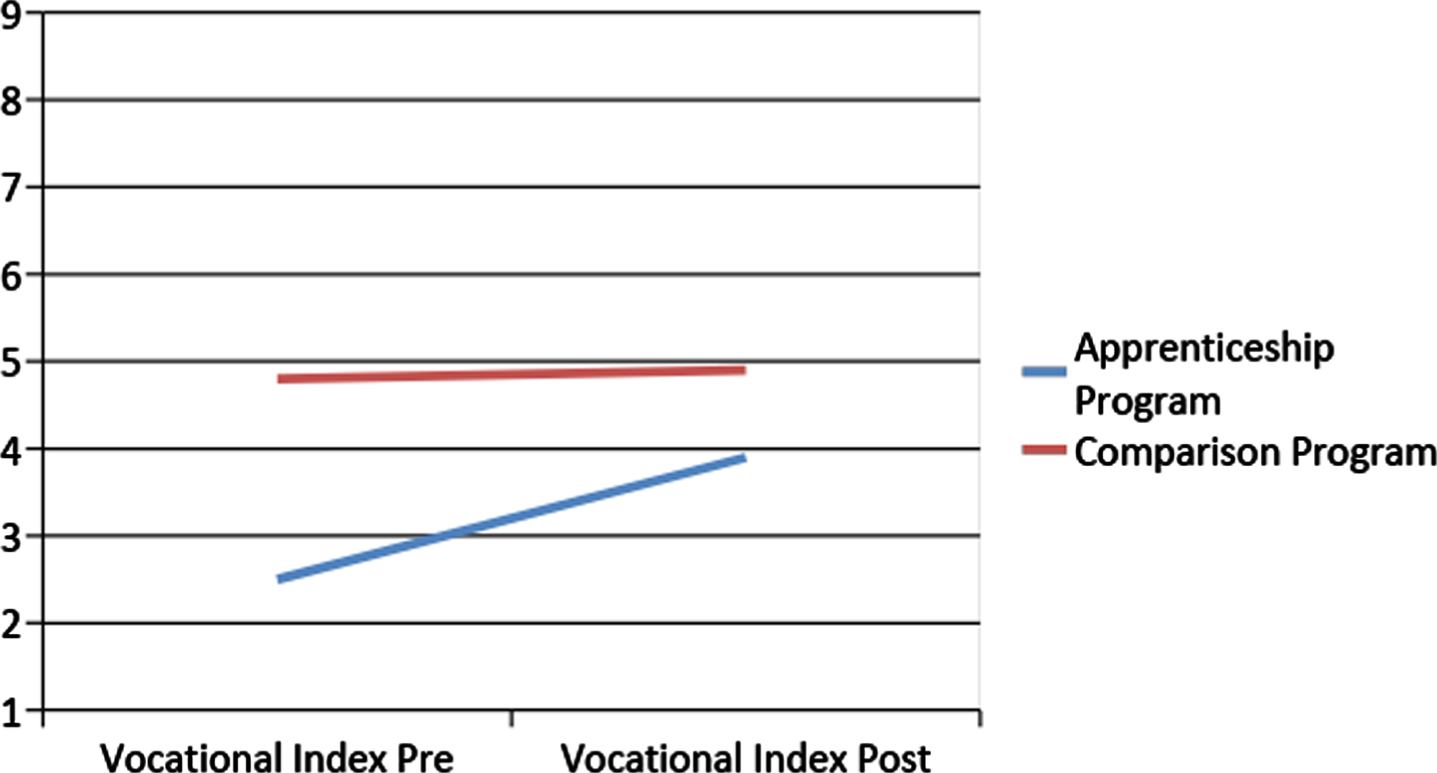
Vocational Index score comparison.
The first aim of the study was to explore the past and current employment and support histories of participants. Though the 15 interviews with parents provided their own distinct accounts, common experiences between these accounts emerged following thematic analysis. The examples provided fit within a published framework from other studies (Taylor & Mailick, 2014; Chen et al., 2014), but unique categories also emerged.
With the right supports, difficulties associated with disabilities may be fostered into great benefits. With 13 of the 15 parents interviewed endorsing this major theme of the framework, it was the most highly endorsed of the major themes. Statements provided examples of people, programs, or businesses sometimes going out of their way to provide accommodations for participants, and the resulting benefits experienced by the participants. The example mentioned most often of the “right support,” was simply an understanding person or environment. This type of person or environment provides the individual with a place where it is okay to make mistakes and learn from these mistakes. This finding echoes Shattuck & Roux’s (2014) commentary that the burden of finding supports or achieving employment should not always fall on individuals with disabilities and their families. Society as a whole should also make an effort to compromise and meet these individuals half-way; because when this type of compromise occurs, it has such a positive and powerful impact on individuals and their families. However, parents noted that finding these types of supports and understanding environments is often an arduous journey.
Fierce and prolonged advocacy from parents. Several interviews included stories of how parents had to become the heads of various school committees or parent groups in order to try to get the services needed for their children. Considering the ages of the participants in this study, at the time these participants were in elementary school, the concept of inclusion was relatively new. Many of the parents mentioned that they had to educate their respective schools regarding how to go about providing effective supports for their children.
Though parents had many examples of their advocacy during the elementary school years, not many examples were provided in regards to advocating for adult or specifically, vocational supports. One reason for this may be that not much is known about the effectiveness of particular vocational supports and programs. Thus, parents do not have the information available to know what supports for which they should be advocating. Another reason, as stated in Taylor and Mailick (2014), may be that as parents get older, they are less able to effectively advocate.
Greater independence in daily living activities. Parents also stressed the importance of their children increasing their independent living skills. The three main means of achieving greater independence mentioned in the interviews were through participating in programs which specifically teach independent living skills, participating in programs like summer camps which indirectly teach independent living skills, and having previously achieved paid employment. Through these three means, parents endorsed that their sons and daughters learned accountability, responsibility, and self-confidence. Parents endorsed the idea that working on these skills is essential for their sons and daughters to support themselves, both psychologically and financially. Taylor and Mailick (2014) indicate that achieving greater independent living skills is not only important for increased likelihood of positive employment outcomes, but also for general quality of life outcomes. Particularly because independent living skills can be increased in adulthood, while other common indices of positive outcomes, better early language and lack of a comorbid intellectual disability (Eaves and Ho, 2008; Howlin et al., 2005), have not been found to be malleable in adulthood (Taylor & Mailick, 2014).
Previous positive work experience. Although most participants in each cohort were unemployed at the start of the program, the majority of parents reported that their sons or daughters had a positive employment experience at some point in their lives. Parents endorsed more non task-related positive aspects of previous employment experiences than task-related aspects, which may relate to most participants’ previous work experience that involved largely mundane and repetitive tasks (e.g., bagging groceries, stocking shelves, etc.). The high number of mentions of previous positive work experience and low employment rates in this sample further supports previous research which has shown when individuals with disabilities attain employment, they are not often able to maintain employment (Hendricks, 2010). Even though participants have positive experiences from jobs that they were ultimately unable to keep, these positive experiences appear to be motivating and reinforcing enough for them to continue on their journeys to finding jobs.
Collaboration occurring between educational and vocational service systems. Only one parent mentioned an experience regarding collaboration between her son’s educational and vocational service systems. As mentioned earlier, if the primary purpose of public education for students under IDEA (2004) is preparation for employment, then collaboration between these two systems should be much more common. Services assisting individuals with disabilities in their transition to leaving the public education system are greatly lacking, which is supported by the findings of the current study. This is an area in need of further research, considering that few studies have aimed to describe the most beneficial means of structuring a collaborative relationship between educational and vocational service systems (Chen et al., 2014).
Unprompted negativity. Parents’ negativity and pessimism towards positively worded questions was striking. Even when questions were asked regarding their son’s or daughter’s strengths, some parents would respond with statements indicating that it was easier for them to describe their weaknesses. This phenomenon has been well-documented in the fields of disability studies and special education (Carter et al., 2015). Given that disabilities are often assessed and characterized in terms of gaps in performance in comparison to typically developing peers, it is common for parents of children with disabilities to be more aware of their children’s deficits than they are of their strengths (Carter et al., 2015). It may have been easier for parents in this study to talk about their son’s or daughter’s difficulties and weaknesses because it is what they are most familiar with, and used to talking about with professionals in the field of special education. The word “disability” is itself a negative word, and many prefer to use a more positive term, such as neurodiversity, to emphasize that people are all unique and different, as opposed to being more or less able than one another. It is essential for society as a whole to continue to emphasize the strengths of individuals with disabilities, especially in relation to employment. Additionally, this negativity exhibited by parents may be the result of years of frustration from their fierce and prolonged advocacy for appropriate supports and services, given that these supports are often granted based on their child’s deficits.
Most impactful types of supports according to parents. Various types of services and supports were named by parents as the most impactful for their sons or daughters. Of these types of services, Therapy and Educational were most often named, with Recreational services the third most named. While both therapy and educational services or interventions are well-studied within the field of disability, recreational services are not as rigorously researched. Results from the current study highlight the need to further research recreational services and community-based programs, as parents and families seem to place al-most as much significance on this area of support. Additionally, as evidenced by the parents’ responses, the therapy and educational services were most often focused on ameliorating deficits and difficulties, while the recreational services were strength- or interest-based, and environments that were more centered around simply having fun. Further research into the impacts of recreation and community-based programs for individuals with disabilities, or ways to combine these three types of services into effective interventions is warranted.
Feedback regarding the apprenticeship based emp-loyment program. Parents’ feedback regarding the program was fairly split. Most really appreciated the skills being taught and were complimentary of the in-structors. The negative feedback centered on being unsure if these skills would generalize to their sons and daughters actually successfully becoming emp-loyed. In part, the parents are right, based on the results of the program, that not all of the participa-nts achieved employment through participation in the program. It may have been unrealistic for all participants to achieve employment through participation in the program, but, because this is a new program, and apprenticeship model employment programs have been minimally studied, future studies need to be conducted to more accurately determine what parents should be able to expect from similar programs.
Employment outcome as a result of the apprenticeship program. The second aim of the study intended to address what outcomes should be expected from the program, and factors that are associated with these outcomes. The main goal of the apprenticeship program was to help all participants find paid employment. While this ended up not being the case at post-intervention for all participants, Vocational Index scores significantly increased from pre- to post-intervention: from an average of around 2 on the Vocational Index at pre-intervention to an average of around 4 on the Vocational Index at post-intervention. This increase in Vocational Index scores is due to 6 of the 19 individuals in the apprenticeship program having increased from a score of 1, or participating in no vocational activities, at pre- to continuing with working in 10 hour per week apprenticeships through the community non-profit upon completion of the program. In addition, 9 out of the 19 participants were able to increase their Vocational Index score, or level of employment, from pre-intervention to post, while only one participant from the comparison group increased their level of employment over the same time period. The comparison group started out with significantly higher levels of employment at pre-intervention than did the apprenticeship program group. Reasons for this difference at pre-intervention were not tested and are unknown. At post-intervention, although the apprenticeship program group exhibited Vocational Index scores lower than that of the comparison group, the two groups no longer significantly differed. Thus, preliminary results indicate that participants in the apprenticeship model program experienced increases in participation in employment, while the comparison group did not. However, due to the limited sample sizes, inability to collect complete data from both cohorts, and the inability to collect the full battery of measures from the comparison group, further research is needed to truly determine the effectiveness of the apprenticeship model program.
Pre- and post-intervention factors associated with apprenticeship program outcome. A variety of assessments were administered in order to measure whether the apprenticeship program was successful in increasing participants’ emotion regulation, problem-solving, self-advocacy, and self-confidence skills. Results from parent-report questionnaires addressing 2 of these 4 skills revealed significant results. First, parents of participants in the 2nd cohort reported an increase in participants’ vocational confidence (as measured by the MVS). Increased parent-report scores on the MVS at pre-intervention also significantly correlated with employment scores at pre-intervention, though not at post-intervention. The MVS measure is the most central measure to what was taught in the apprenticeship program as it assesses participants’ confidence in their vocational skills and goals. Merz and Szymanski (1997) support the sensitivity of the MVS to be used as a pre-test, post-test measure, as they used it on a study of adults with multiple disabilities and found participants’ scores to increase as a result of a vocational rehabilitation workshop.
Secondly, parents of participants in the 2nd cohort reported significant decreases from pre- to post-intervention in negative problem orientation, as measured by the Problem-Solving Test, which indicates the tendency to think about problems in ways that are inaccurate while also experiencing difficulty managing emotions under stress (Nezu, Nezu, & D’Zurilla, 2012). The ability to regulate negative emotion by focusing on participants’ abilities to better identify their emotions was another focus of the apprenticeship program. However, change in emotion regulation abilities was not found using the Emotion Regulation Checklist. It is possible that this measure is, even after adaptation from its use as a parent-report measure of children, not applicable to employment or sensitive to change in adults.
It is unknown whether similar results would have been found from Cohort 1 due to the inability to collect pre-intervention data on any of the measures. However, parent-reported feedback from the interviews revealed that, at least anecdotally, parents noticed changes in emotion regulation and self-confidence.
Other factors associated with employment program outcome. The Social Supports scale of the SIS negatively correlated with employment status at both pre- and post-intervention indicating that participants in need of more social supports (e.g., help maintaining friendships, socializing with others, etc.) are significantly less likely to be employed at either time point. Research supports this finding in that individuals with developmental disabilities lose their jobs due to social difficulties more often than they do based on inability to perform tasks related to the job (Dew & Alan, 2007; Homles, 2007; Hurlbutt & Chalmers, 2004; Westbrook et al., 2012).
Cognitive ability, as measured by the WASI-II, did not prove to be a significant factor associated with apprenticeship program outcome. This is supported by previous research which indicates that individuals with increased cognitive abilities exhibit similar, sometimes even greater, rates of unemployment as individuals with intellectual disabilities (Howlin, 2013).
Binary logistic regression analyses yielded insig-nificant results, in addition to few factors significantly correlating with employment outcomes. These results are most likely due to the apprenticeship program automatically providing employment for some of the participants at post-intervention regardless of skills gained through the program. For example, a participant who may have exhibited low MVS scores, indicating low vocational confidence, was just as likely to be employed in the apprenticeship program small businesses as an individual who exhibited high scores. Limited sample size and lack of complete data from Cohort 1 most likely had an impact in these findings as well.
In sum, the apprenticeship model appears to be more effective than the comparison model in increasing the employment statuses of individuals with developmental disabilities and their participation in employment-related activities. This model is promising in that it was able to provide individuals despe-rately in need of vocational experience with hands-on practice in an understanding environment that all-owed for potential mistakes. However, these results are exceptionally preliminary, and the apprenticeship model employment program in the current study is brand new and continuously adapting alongside the program participants. It is essential to continue this line of research into this promising vocational model as more and more individuals with developmental disabilities are coming of working age.
Limitations
As mentioned above, small sample sizes and missing data were critical limitations to the current study and results should be interpreted with caution. In addition, the assessor and interviewer for the current study was also the primary investigator. This was due to the resources available to conduct the study. In future studies, multiple, blinded assessors should be utilized. Additionally, a waitlist-controlled comparison sample should be incorporated to properly account for the limitations of the current study.
Conclusion
Overall, the current patterns of low employment are insufficient for adults with developmental disabilities to be able to live independently. This leaves families to bear the burden for continued financial support (Roux et al., 2013). Given the increasing number of individuals with developmental disabilities reaching adulthood and seeking supports (Burgess & Cimera, 2014), and that these individuals are among the most costly of disability groups served (Cimera & Cowan, 2009; Lawer et al., 2009), it is of the utmost importance to further research and ameliorate the bleak employment outcomes this population experiences.
Many adults, with disabilities or without, define themselves through their work or careers (Eggleton et al., 1999) and research shows that employment is associated with higher quality of life (Kober & Eggleton, 2005). Work provides a sense of accomplishment and self-efficacy which can lead to improved self-concept (Wysocki & Neulicht, 1998), and serves as a source for socialization and friends (Evans & Repper, 2000). Aside from the personal well-being gained through employment, increased employment also provides financial advantages (Hendricks, 2010), such as more contribution to taxes and less reliance on government funding (Howlin et al., 2005; Jarbrink et al., 2007). Additionally, due to the utilization of resources, employment for individuals with developmental disabilities has significant cost impacts on the economy (Hendricks, 2010) in that the cost of community programs would decrease because day programs would not be as relied upon (Jarbrink et al., 2007). Receiving health benefits through employment would also cover the expensive costs of medication and psychiatric services this population often needs (Hendricks, 2010).
Information gained from the current study provides this population, in desperate need of better supports, with preliminary information regarding the apprenticeship model of employment and its effectiveness for the greatly underserved population of adults with developmental disabilities.
Conflict of interest
None to report.