



Abstract
BACKGROUND:
People with intellectual and developmental disabilities (IDD) face chronically low rates of employment and high rates of poverty. These effects are amplified for women and ethnic minorities. Project SEARCH was developed to help address this disparity in employment.
OBJECTIVE:
This report looks at the demographic make-up of Project SEARCH participants and compares employment outcomes by gender, race and ethnicity, and disability type.
METHODS:
Authors examined data from 3,773 interns in the United States during the 2018-19 program year. Data were entered by representatives of 523 licensed program sites into the Project SEARCH database, which is accessed via a secure online Member Portal.
RESULTS:
The demographic make-up of Project SEARCH interns was representative of the U.S. population, but with some overrepresentation of racial and ethnic minorities and underrepresentation of females, consistent with patterns of enrollment in special education. There were no large differences in employment outcomes of Project SEARCH graduates based on race, ethnicity, gender, or disability type. Some small differences were observed, and these will be explored further in future studies.
CONCLUSIONS:
Project SEARCH serves a diverse population effectively and equitably. However, there are some differences in outcomes that warrant further investigation.
Introduction
People with disabilities face chronically high levels of unemployment and underemployment. In 2018, the rate of employment for people of working age (21 to 64 years) with cognitive disabilities was 15.2 percent, but for the same age group without disabilities, the rate was 61.0 percent, making for a gap of 45.8 percentage points (Erickson & Schrader, 2020). In a related finding, the 2018 American Community Survey (ACS) found that the rate of poverty for working-aged people with disabilities (26%) was more than double that of those without disabilities (10%). It is well established that poverty significantly increases the risk of poor health and quality-of-life outcomes (Winsor et al., 2021).
Gender, race, and ethnicity are additional contributing factors that influence the likelihood of employment for a person with a disability. That is, the effects of disability appear to be amplified for women and ethnic minorities. For example, an analysis of the 2015 ACS data revealed that women and racial minority groups with disabilities and less education have the lowest total income of any group, are the most likely to live in poverty, and are the least likely to participate in the labor market as a source of income (Maroto et al. 2019).
Project SEARCH is a program that was conceived and implemented to address the disparities in employment for people with intellectual and developmental disabilities (IDD) by providing hands-on work-preparation for young people who are transitioning from high school to adult life (Daston et al., 2012; Rutkowski et al., 2006). Project SEARCH is sustained by existing government funding streams so that it can be offered free of charge to participants who meet eligibility requirements. The program strives to enroll young people through a fair application and selection process, and to serve all participants equitably. Project SEARCH employs a system of data collection to track progress in this area and to drive continuous improvement. This paper provides an initial look at how successful this effort has been by presenting the demographics of the individuals served by the program and exploring employment outcomes on the basis of gender, race and ethnicity, and disability type.
The Project SEARCH Model
Project SEARCH is a year-long internship program for young adults with IDD who have completed their high school academic requirements and have deferred receiving their diploma. Project SEARCH was developed at Cincinnati Children’s Hospital Medical Center (CCHMC) in 1998. There are now over 600 program sites worldwide. Most Project SEARCH programs serve young adults between the ages of 18–22 in deferred graduation, but about 20% are considered “adult” or “hybrid” programs that serve a post-high school population.
Project SEARCH sites are encouraged to improve their practice by conducting an annual self-audit of Model Fidelity. Model Fidelity is the foundation of Project SEARCH and allows for consistency in the program, regardless of location. Key components of Model Fidelity include a goal of competitive, integrated employment for individuals with IDD and a business-focused approach that is collaborative and focused on the acquisition of marketable skills.
The goal of Project SEARCH is competitive, integrated employment –specifically, sixteen hours a week or more in a job that pays the prevailing wage, is not seasonal, and is within an integrated setting. Project SEARCH strives for “life-changing jobs” that will allow program graduates to gain independence through a steady income and increased community integration and engagement (Daston et al., 2012; Rutkowski et al., 2006).
Methods
Data source
The Project SEARCH model is carried out as a partnership including a host business working with organizations that have a mandate to promote employment for people with disabilities. The lead organization in each team must sign a license with CCHMC to receive technical assistance for program start-up, and the team then uses the Project SEARCH name and materials in ongoing program operation. A condition of the license agreement is that a representative of each program site must enter basic demographic information for their interns, as well as their employment outcomes. Basic demographics of interns (i.e., disability category, race/ethnicity, gender, age at start of program, etc.) are entered upon enrollment, and, throughout the program year, information is entered on internship progress and employment status.
Study design and population
This study employs a retrospective analysis of the Project SEARCH Database to report on and analyze Project SEARCH employment outcomes. It includes information from 523 program sites on the 3,773 interns who participated in Project SEARCH in the U.S. during the 2018-19 program year, the most recent year that was not affected by the COVID-19 pandemic. The outcomes from the 2019-2020 program year were recently collected but will be presented in a separate paper which will address the impact of the COVID-19 pandemic specifically.
Ethical considerations
The Project SEARCH database automatically de-identifies data to comply with the Institutional Review Board (IRB) to ensure ethical research practices. The CCHMC IRB has determined that the Project SEARCH Member Portal is exempt from IRB review (2020-0181).
Results
Project SEARCH intern demographics
Figure 1 shows that most young adults served by Project SEARCH have intellectual disability or autism as their primary disability. Figure 2 displays the racial and ethnic backgrounds of Project SEARCH interns compared with the overall U.S. population. Project SEARCH is closely matching or exceeding minority representation of the U.S. population.
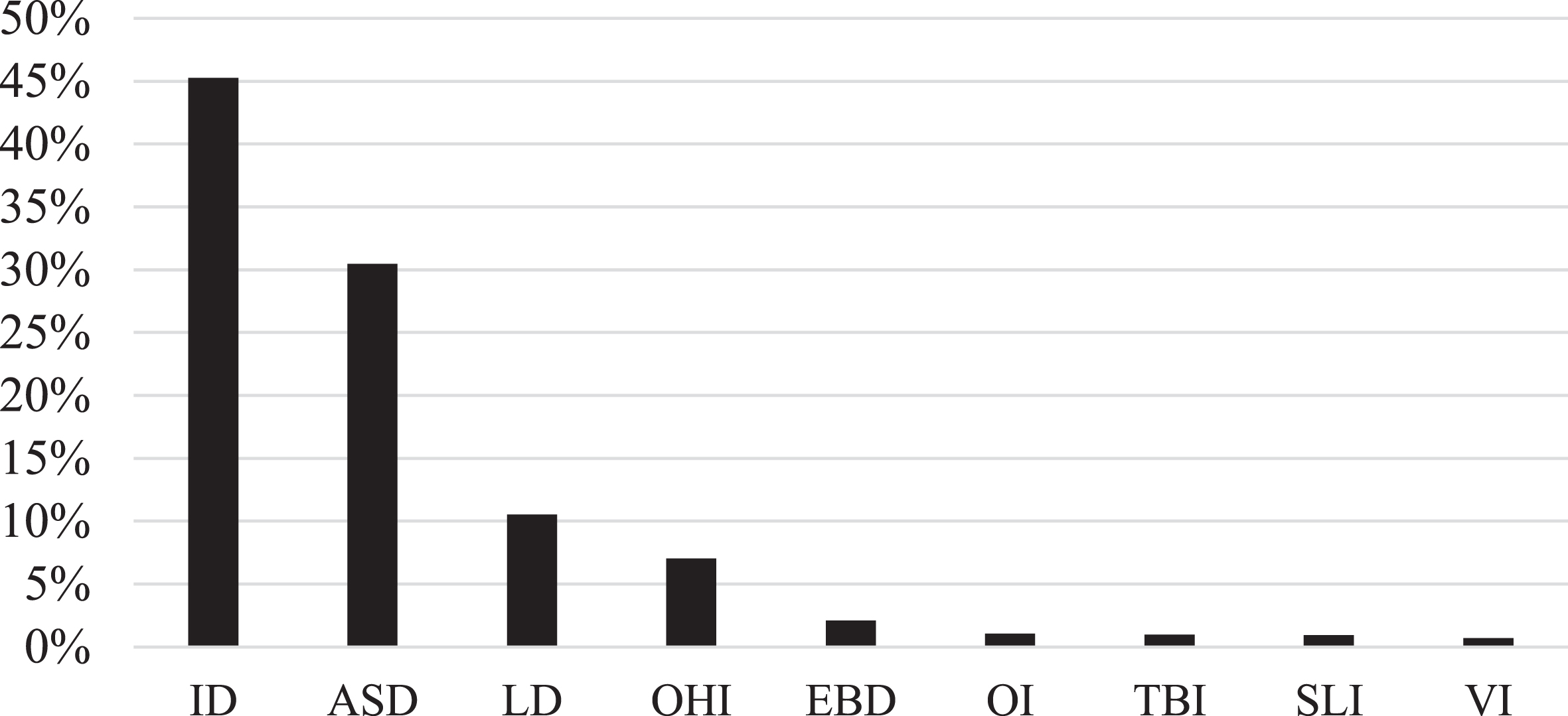
2018-2019 Project SEARCH intern disability categories. Note: ID = Intellectual Disability, ASD = Autism Spectrum Disorder, LD = Learning Disability, OHI = Other Health Impairment, EBD = Emotional Behavioral Disturbance, OI = Orthopedic Impairment, TBI = Traumatic Brain Injury, SLI = Speech or Language Impairment, VI = Visual Impairment.

2018-2019 Project SEARCH intern racial/ethnic backgrounds.
Project SEARCH is a collaborative partnership that includes the following agencies and individuals: Vocational Rehabilitation, education, interns and families, host businesses, Developmental Disabilities services, and community rehabilitation providers. Other partners can be included based on specific intern needs or local organizational structure. The largest host business industry sector is healthcare (68%), and colleges and universities, government agencies, and hospitality, are the top industry sectors represented after healthcare.
Project SEARCH employment outcomes
Project SEARCH interns exhibit high rates of program completion, which have been over 90% for as long as this outcome has been measured. Each program site serves between six to twelve interns a year (eight on average). Even though each site has a small footprint, collectively (currently over 600 sites) the program has a large footprint overall. Project SEARCH uses rigorous criteria to define competitive employment (16 hours or more, non-seasonal, competitive, and integrated), but recognizes that the best possible outcome for some individuals may be a job that does not meet all these criteria. This understanding does not exclude them from the program or from our outcomes reporting.
Project SEARCH consistently reports employment rates over 75% for interns that complete the program (Project SEARCH, 2021; Wehman et al., 2020). Generally, the percent of interns with jobs that meet all Project SEARCH criteria for competitive employment is ten percentage points lower than the overall employment rates. On average, Project SEARCH interns earn $11.64 per hour and work 24.33 hours per week. It is important to note that the average wages of Project SEARCH graduates exceed (and oftentimes far exceed) the minimum wage of the state in which the program site is located. All exceed the federal minimum hourly wage of $7.25/hour.
Comparison of Project SEARCH intern employment rates
The following paragraphs will review data from U.S. Project SEARCH sites from the 2018-19 program year. Because the first Project SEARCH outcome data collection point occurs 9 months after program graduation, 2018-19 is the most recent year that was not affected by COVID-19 for which there is complete data. This is a first look at the data broken down in different ways to look for trends or patterns that warrant further investigation.
Employment rate by disability type
Consistent with previous years, intern completion rates were above 90% across the different disability categories. Two exceptions are interns with a mental health diagnosis and interns whose primary disability involves speech or language. These groups have completion rates of 85% and 89%, respectively. While individuals in these groups make up a very small percentage of the total Project SEARCH intern population and could thus be more easily skewed by smaller numbers of non-completers, this finding could indicate that adjustments are needed to better serve these groups. It will be important to explore this trend further to determine if it holds up over time and across different parts of the country.
A look at employment outcomes, as seen in Fig. 3, shows that those interns with mental health or speech and language-related disabilities who completed the program did as well or better than interns in other disability groups. However, the differential between interns with any employment and those with employment that meet Project SEARCH criteria is greater for interns with mental health-related disabilities. This suggests that program graduates in this group may be working fewer hours or finding employment that does not meet the Project SEARCH definition of competitive employment for a different reason. This preliminary finding suggests an additional area for further study. Hourly wages by disability type ranged from $10.43/hour for individuals with speech and language disabilities to $13.30/hour for individuals with other health impairments. In addition, the number of hours worked per week ranged from 23.52 for individuals with traumatic brain injury to 26.2 for individuals with learning disabilities and those with hearing impairments.
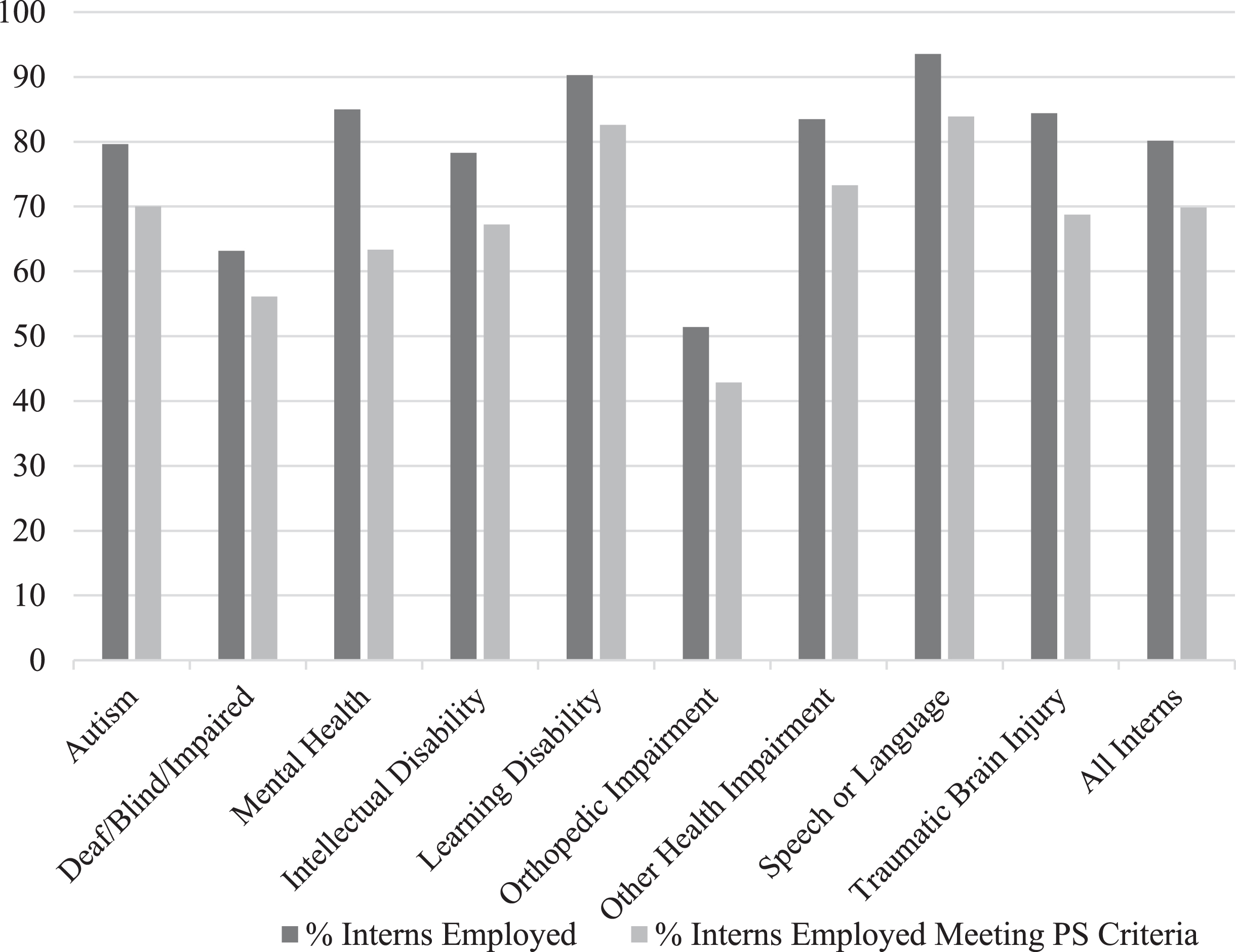
Project SEARCH employment rate by disability type.
Across all genders, program completion rate was above 90%. What is notable here is that nearly 60% of the interns were male, and only 40% female. This underrepresentation of females is a pattern that is seen throughout special education and is not specific to Project SEARCH (Anderson, 1997; McFarland et al., 2017). The rate of employment is slightly lower for females, although the difference between total employment and employment meeting all criteria for competitive employment is similar across genders (see Fig. 4). Interestingly, the average hourly wage for females is slightly higher as compared to males, (e.g., $11.74 for females and $10.91 for males) and no difference was observed in the number of hours worked per week (e.g., 24 hours for male and female interns). Non-binary individuals also performed similarly, but the numbers in this cohort were too small to draw any inferences.
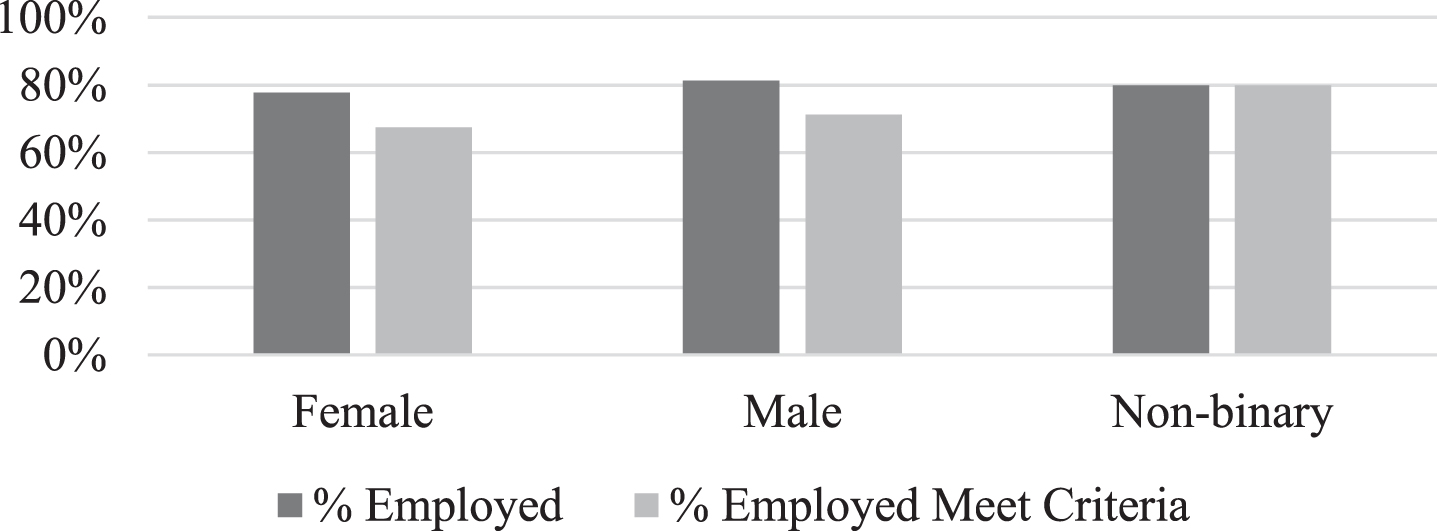
Project SEARCH employment rate by gender.
When the data is broken down by race and ethnicity categories, completion rates are consistently above 90%, with the exception of Native Americans. However, this is a relatively small group, so the percentages are more easily skewed by a small number of non-completers. Nonetheless, this trend is concerning, and will be explored further in future studies.
When considering rates of employment, it seems that interns in the Native American category do as well, or better, than other groups. Across the board, employment outcomes are similar among the different groups (see Fig. 5), although there are slightly lower percentages for interns of Asian descent or with Hispanic ethnicity. Average hours per week worked ranged from 22.29 hours for individuals of Caribbean/West Indian descent to 26.93 hours for individuals of Native Hawaiian/Pacific Islander descent. Wages ranged from $10.85/hour for interns of White European heritage to $13.20/hour for interns of Hispanic/Latino descent.
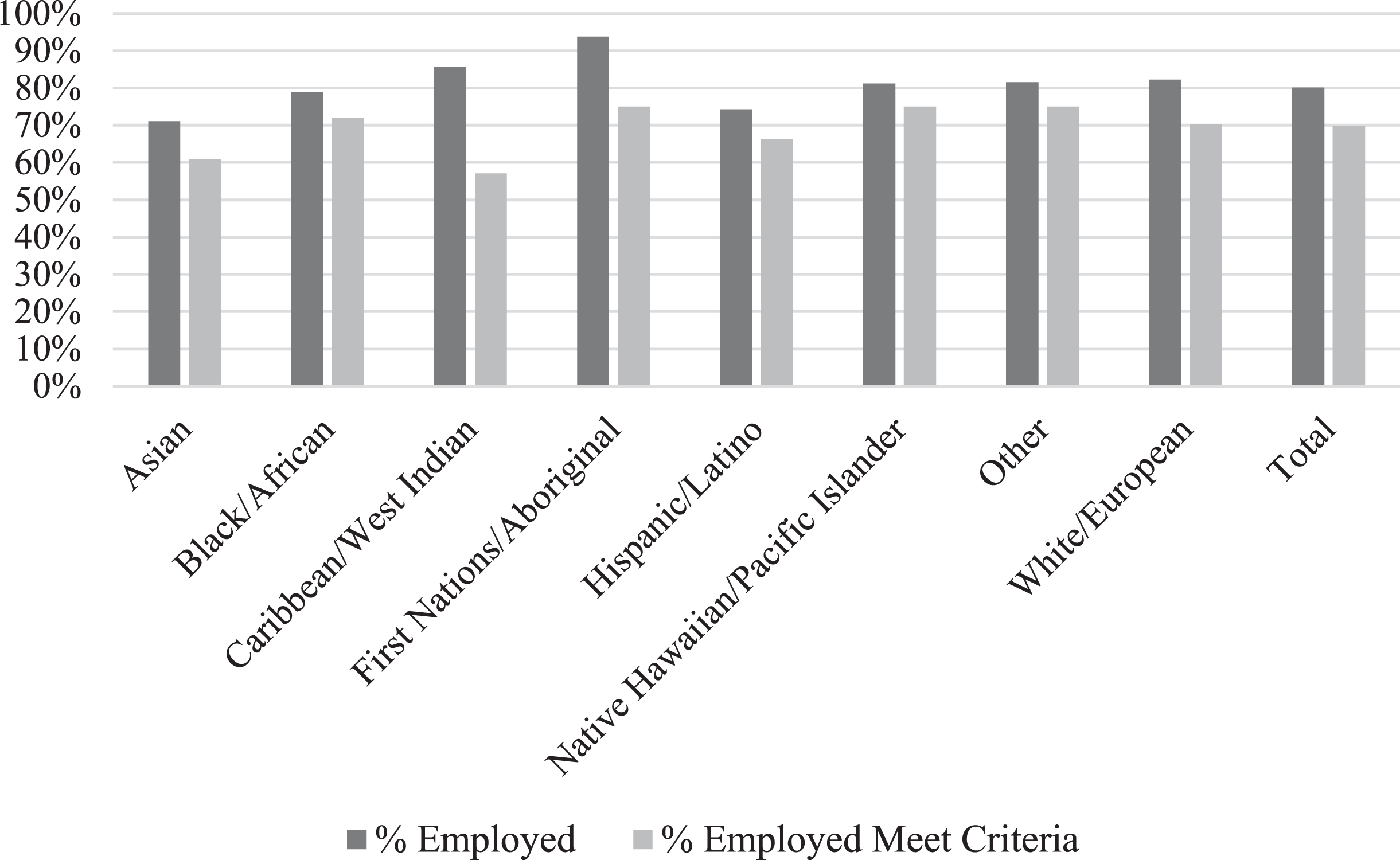
Project SEARCH employment rate by race/ethnicity.
Overall, in this first look at the data, it is encouraging to see that— on the whole— Project SEARCH is serving a population of interns that reflects the diversity of the American population, and that the interns are being served equitably. The Project SEARCH model, with its intensive training and prolonged exposure to the host business, is deliberately designed to offset the effect of biases by allowing interns to be understood as individuals. This initial analysis suggests that it may indeed be effective in this way. Nonetheless, there is always room for improvement, and the Project SEARCH staff is prepared to continuously monitor outcomes to uncover areas for growth and change.
The Project SEARCH National Team uses the employment outcome data and feedback from partners to continuously improve the Project SEARCH model. Program outcomes are shared each year at the annual Project SEARCH conference and with local partners at individual host sites to inform partners and recruit new interns. Feedback is used to develop curriculum, webinars, and trainings for new and existing Project SEARCH interns, staff, and partners. The Project SEARCH Member Portal was designed based on user feedback to consolidate and allow rapid dissemination of available resources, and to streamline the data collection process.
Conclusion
Overall, Project SEARCH employment outcomes are consistent across different demographic categories. However, a few small differences were identified, and the Project SEARCH National Team plans to explore these further to see if they are statistically significant and hold up to a more rigorous analysis. The data demonstrates that Project SEARCH in the U.S. serves a diverse population that reflects the make-up of the special education population (McFarland et al., 2017). Employment outcomes suggest that Project SEARCH is serving its program participants equitably, by adhering to Model Fidelity. The Project SEARCH National Team is responsive to outcome data and strives to improve the program in conjunction with annual employment outcomes and feedback from our network of Project SEARCH practitioners.
Footnotes
Acknowledgments
The authors would like to acknowledge Erin Riehle and Susie Rutkowski, co-founders of Project SEARCH, for their leadership and vision. The authors are grateful to the Koetters Family Fund and an anonymous donor for their generous gift that made this work possible. They would also like to acknowledge their network of Project SEARCH program partners for their accurate and timely data entry.
Conflict of interest
The authors declare that they have no conflict of interest.
Ethical considerations
The Project SEARCH database automatically de-identifies data to comply with the Institutional Review Board (IRB) to ensure ethical research practices. The CCHMC IRB has determined that the Project SEARCH Member Portal is exempt from Institutional Review Board review (2020-0181).
Funding
The authors report no funding.
Informed consent
The authors of this study had no access to Project SEARCH participant identifiable information, thus no informed consent was collected. The data retrieved for this study was retrospective in nature.