




Abstract
BACKGROUND:
Self-employment is defined in the Workforce Innovation and Opportunity Act of 2014 as a competitive integrated employment (CIE) outcome. However, an analysis of the Rehabilitation Services Administration Case Service Report (RSA-911) reveals that a limited number of people with disabilities receiving vocational rehabilitation services exit the State Vocational Rehabilitation Agencies with a self-employment outcome.
OBJECTIVE:
The purpose of this study was to identify the factors that Vocational Rehabilitation (VR) professionals report as facilitators of self-employment outcomes for people with disabilities.
METHOD:
A national sample of VR professionals was recruited to participate in a series of focus groups. Using Zoom Meeting, participants discussed their experiences with self-employment when providing services to people with disabilities. The research team used NVivo12 software to conduct primary data analysis of the transcribed focus group sessions with the consent of the participants.
RESULTS:
Four major themes emerged from the analysis to include 1) resources, 2) practices, 3) experiences, and 4) attitudes. Each of these major themes contained subthemes related to facilitators of self-employment for people with disabilities.
CONCLUSION:
A key finding was the need for more comprehensive and individualized training and support for VR counselors. Implications for future research, policy, and practice are discussed.
Keywords
Introduction
The United States Bureau of Labor Statistics issued a news release on the labor force characteristics of people with disabilities for 2021 (U.S. Bureau of Labor Statistics, 2022). The data was collected as part of the Current Population Survey and revealed that a greater percentage of workers with a disability (9.6%) were self-employed in 2021 than those without a disability (6.4%). Despite these findings, a very small percentage of VR recipients exit services from State Vocational Rehabilitation Agencies (SVRAs) with a self-employment outcome.
Data from the Rehabilitation Services Administration Case Service Report (RSA-911) show that the self-employment outcomes for people exiting services from SVRAs have remained stagnant since 2003, decreasing in 2020 (Inge et al., 2022; Revell et al., 2009; Sanchez et al., 2022). Taylor and his colleagues analyzed data from focus groups with VR professionals to reveal structural and feasibility barriers to self-employment for people with disabilities (Taylor et al., 2022). Barriers included funding challenges, implementation challenges, knowledge and skills challenges, system challenges, disability challenges, and perceptions of fit. These findings offer insight into the self-employment VR process and some explanations for the low rates of self-employment among VR recipients.
Self-employment can be a viable employment option for people with disabilities who are not easily matched with other employment opportunities (Ouimette & Rammler, 2017). Self-employment offers 1) an opportunity to remain close to established support networks, 2) non-traditional work hours, 3) flexibility (consumer control) to get to and from work when transportation is limited, and 4) alternative worksites that minimize barriers such as inaccessible buildings and workplaces (Ipsen, 2021). A number of factors may facilitate self-employment, such as geographic location. States that are rural with lower population densities have been found to have higher self-employment outcomes than states that are urban with more concentrated populations. Ipsen and Swicegood (2017) examined the impact of urbanicity on self-employment using ZIP and county code information. These researchers found that rates of self-employment increased in more rural communities. Self-employment outcomes also have been found to vary based on the demographic characteristics of the VR recipients. A survey of 205 VR counselors asked them to choose characteristics that are most important for success in self-employment (Ashley & Graf, 2021). Over half of the VR counselors indicated that it was important for VR recipients to have good organizational skills (57.1%) and demonstrate persistence (50.7%; Ashley & Graf, 2021). Additionally, 45.4% of respondents selected business planning ability as an important characteristic for successful self-employment.
VR counselors’ previous experiences with self-employment has also been reported as an important role in facilitating self-employment outcomes. Ashely and Graf (2021) found that VR counselors with business ownership or self-employment experience viewed self-employment more positively than VR counselors without prior experiences. They also found that positive attitudes about self-employment correlate with increased self-employment outcomes. Counselors who effectively utilize community resources (e.g., small business development centers, disability service agencies) and collaborate with informal support networks (e.g., family members, neighbors, home support personnel) may have the necessary skills to facilitate successful self-employment outcomes (Caldwell et al., 2019; Colling & Arnold, 2007).
Further research is needed on the factors that impact self-employment outcomes given the importance of self-employment as a potential career pathway for people with disabilities. Specifically, additional research is needed on VR professionals’ perspectives about effective strategies and facilitators to successful self-employment. This focus group study was conducted targeting a national sample of VR professionals to answer the following research question: How do VR counselors describe factors that contribute to the successful self-employment of people with disabilities who receive services from State Vocational Rehabilitation Agencies?
Method
Participant recruitment
Following approval by the Institutional Review Board (IRB) at the researchers’ university, the Council of State Administrators of Vocational Rehabilitation (CSAVR) was contacted for assistance with participant recruitment. CSAVR is an organization made up of public rehabilitation agency chief administrators in the United States, which serve individuals with physical and mental disabilities. Recruitment methods used by CSAVR included sending an email to members that informed them of the focus group study and an announcement in the CSAVR Weekly Update email. The recruitment email and the CSAVR Weekly Update included a link that directed potential participants to a secure webpage. The webpage provided information about the study and a link that could be used to consent or decline to participate.
Interested VR professionals who selected the consent link were directed to another secure webpage where they chose a focus group. The groups were organized based on features hypothesized to impact VR counselors’ perceptions of self-employment to include: 1) VR counselors who have supported a person with disabilities in self-employment; 2) VR counselors who have received training on self-employment; 3) VR counselors from rural states; 4) VR counselors from high population states; and 5) VR managers or counselors who have a self-employment management position. Once a group was selected, the webpage opened a text box where individuals could enter a contact email address. Participant emails were stored in a password-protected database, and only the research team could access the database to manage the focus group study. In total, 58 VR professionals consented and entered their email addresses to be contacted for scheduling the focus groups. The largest number of VR professionals who consented to participate were 1) VR counselors who have supported a person with disabilities in self-employment (n = 27) and 2) VR counselors from rural states (n = 18). Table 1 provides information about the number of participants and focus groups conducted within each category.
Focus groups
Focus groups
Zoom Videoconferencing was selected to conduct the focus groups in order to recruit a national sample of participants. A member of the research team used the email database to contact the VR professionals who consented to participate. The email text included a link where the recipient could select preferred dates and times for the Zoom meetings. After the preferred dates and times were reported by at least six consenting participants, the focus groups were scheduled using the most frequently selected dates and times.
Of the 58 VR professionals who consented to participate, 36 VR counselors and VR managers joined a scheduled Zoom meeting. Focus group participants were asked to provide demographic information, and 31 individuals sent their demographic information to the research team. This information was combined anonymously for confidentiality. Participants were predominately White (80.6%), female (80.6%) and highly educated having a Master’s degree or higher (87.1%). The majority (80.6%) currently had at least one client on their caseload with a self-employment goal. One participant reported having nine clients with self-employment goals. Additional information on the participants’ characteristics can be found in Table 2.
Participant demographics (n = 31)
Participant demographics (n = 31)
Each focus group was scheduled for one hour using semi-structured interview questions. In order to ensure privacy and confidentiality, participants were asked to join using audio only by computer or telephone. A technology specialist assisted participants with technology issues, redacted participant information during the session (i.e., profile name), and disabled video for confidentiality. A research team member served as the group facilitator and began each Zoom meeting by describing the purpose of the study and informing participants that the discussion would be audio recorded and transcribed. In order to ensure privacy, participants were identified and referred to by numbered pseudonyms (i.e., Participant #1), along with instructions not to identify themselves or their state agencies. After they consented to the recording and confirmed that they were a VR counselor or manager, the focus groups began. Participants were told that they could exit Zoom at any time if they did not want to be recorded.
The facilitator provided all participants the opportunity to respond to each of the core questions. As needed, the facilitator asked additional probe questions to expand or clarify comments that were made by the participants (Merriam & Tisdell, 2016). Focus group questions and discussions among participants focused more broadly on barriers and facilitators to self-employment as well as the training needs of VR professionals on self-employment. The perspectives and experiences of VR counselors and managers specific to barriers to self-employment are described in another paper (Taylor et al., 2022). This manuscript focuses specifically on those factors and strategies facilitating self-employment outcomes for people with disabilities. The questions on facilitators that were discussed during the focus groups are located in Table 3.
Focus group questions
The research team used NVivo12 software to conduct primary data analysis of the transcribed sessions. Theme hierarchies based on initial codes were then created from the analysis in NVivo and used to facilitate discussions between the authors. One of the authors conducted first-round analysis, using open coding. Emic or in-vivo codes were noted and subsequently organized under parent codes that described how emic codes related to the research question (Saldaña, 2016). Another author then completed line-by-line analysis of each transcript, noting important emic codes, devising alternate parent codes. Analysts then compared their emic and parent codes, and discussed convergence and divergence of their initial codes over several meetings. In subsequent meetings, the authors specifically discussed discrepancies in coding and came to consensus on first round coding hierarchy.
Using this consensus coding hierarchy, one author recoded the data based on the updated hierarchy; another author then re-analyzed the data for second round axial codes between major study themes (Miles et al., 2020). The two analysts once more discussed the fit of the codes on participants’ data, resolving final discrepancies in attaining the axial code hierarchy described in this article. Member checks were conducted following completion of the analysis of the initial coding hierarchy (Maxwell, 2013). The research team conducted this process of respondent validation by randomly sampling five participants across all focus groups to review analysis and findings to ensure that results of the study matched salient discussion points from the focus groups. Member check feedback was used in finalizing the code hierarchy presented in the following section as well as the interpretation of the results of this study.
Results
Analysis of participants’ experiences related to facilitators of self-employment resulted in five major themes: 1) resources, 2) practices, 3) experience, 4) attitudes, and 5) training priorities. Across these five major themes, the research team identified subthemes within each of these themes that described distinct elements of each, specific to the research question. Figure 1 shows the organizational structure of emergent themes from the analysis of the data. In the following section, further description is provided of each of these themes and subthemes, followed by a discussion of the implications for future research, policy, and practice. Although these facilitating factors of self-employment are presented as distinct thematic factors, there are overlapping, intersecting, and relational dynamics between these themes that will be highlighted in this section and explored further in the discussion section.
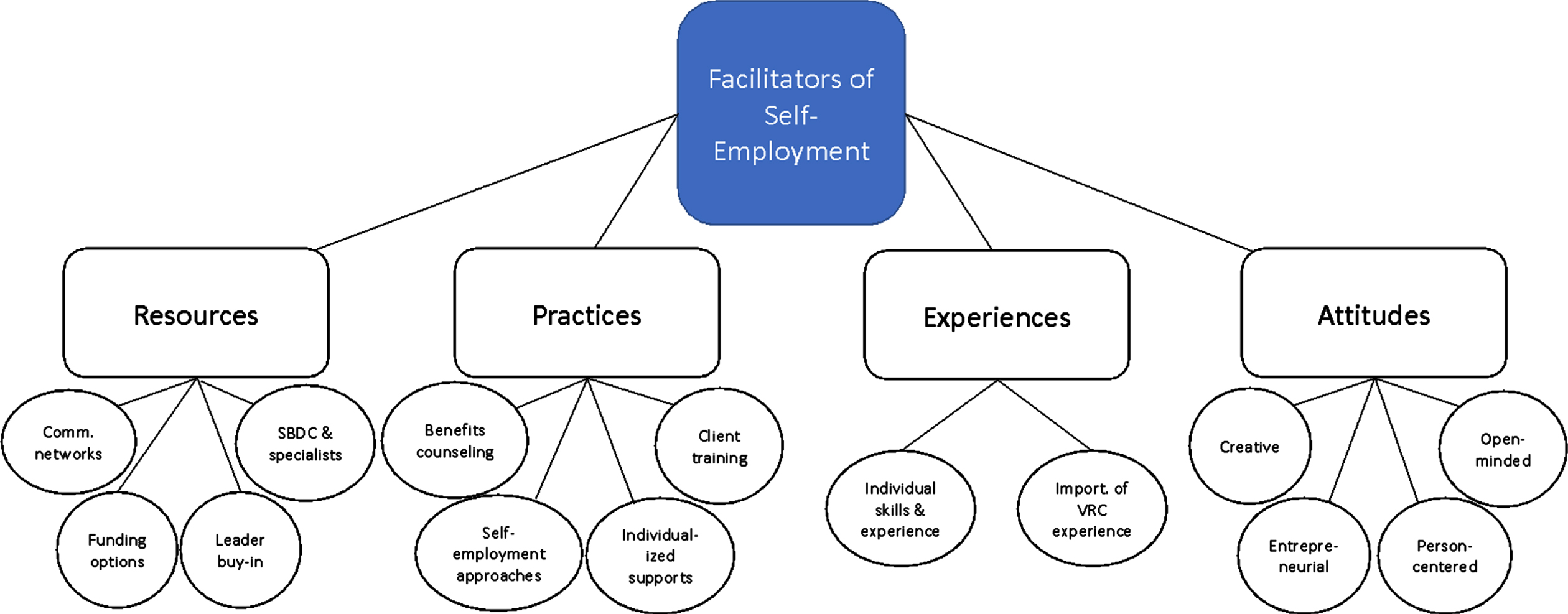
Code hierarchy.
The first theme and the most widely identified across participants was related to resources critical to achieving self-employment. Resources included those accessed by both VR counselors and VR recipients, including several subthemes: a) small business development centers and staff, b) community networks, c) funding options, and d) leadership buy-in. The most often described resources were small business development centers, networks, consultants, and other personnel related to supporting VR counselors and recipients in navigating the financial and business-related aspects of self-employment.
Small business development centers
While participants discussed the disconnect between small entrepreneurial expertise and disability-related expertise as a barrier, they often described small business development centers (SBDC) as integral to self-employment services for providing expertise in areas outside those of the VR counselor. In addition, many participants highlighted collaborative and effective partnerships. One participant said that the “SBDC helped my consumer with the market analysis and that made it easy on my position as a counselor”. Another focus group participant described small business development centers in the following way.
would guide my people [in] what to do, and then they would assign a person to my consumer. And so, for me it was easy at that time. And then not only that, the person would write a business plan, and their mentor would guide them and help them, and then they show me the business plan.
Community networks
VR counselors pointed out the importance of building informal networks within the community. Some of these perspectives related to providing access to available national and state training to develop business skills of their VR recipients with disabilities. Several participants mentioned approaches to expand recipients’ networks directly by connecting with existing organizations within their community. One participant framed the importance of local networks:
One of the resources that I have found helpful in rural areas are the Chambers of Commerce, because they are very much based on the town and the city, so you can access them. How often they’re open is another whole issue and how much resources they have themselves. But I have worked with a number of different Chambers, and that has been a good networking opportunity.
Other participants discussed the importance of mentorship provided through both formal and informal means by business owners with and without disabilities. For example, participants discussed the value of re-assessing potential support and partnerships within the client’s existing social network of family and friends, stating:
Maybe they’ve got somebody in their family or in their network, their social network, that is a marketer and just loves doing that stuff. So, can we bring that person in?
Funding options
Several VR counselors indicated the importance of various funding options for promoting self-employment, particularly in terms of meeting the financial viability requirement of business planning authorization involved in many states’ self-employment processes. In some cases, VR counselors and recipients conducted research into field-specific grant opportunities, such as one participant who shared this person’s experience: “he ended up getting, like, forestry grants and farming grants, like, all this great funding. And they’re still up and running, and he’s doing really well.” Others indicated the importance of specific grant and funding programs for individuals with disabilities such as individual development account funding. One participant shared the following:
I’ve had many clients in the past that have been able to take advantage of [individual development account funds]. They were very skeptical at first. They really didn’t believe that someone was going to actually just give them that money, but they were very highly surprised and very happy about it once they got the money.
Leadership buy-in
The fourth emergent theme within resources was the buy-in of leadership to the potential of self-employment. Often, participants framed this importance in the context of the length of time involved in and complexity of undertaking self-employment VR cases, which could otherwise serve as a barrier without leadership support and encouragement. The specific importance of leadership buy-in ranged from broad support for VR counselors supporting lengthy cases to more specific top-down promotion of self-employment. One participant explained it this way:
Our agency really supports it - we have a director that actually does small business. She does a lot of the trainings, puts a lot of information in a SharePoint site for us to use. And any time we have problems or questions, she’s our contact person in this state.
Finally, participants discussed the importance of mentorship in small business development as a helpful resource. As highlighted in the previous quotation, mentorship was sometimes provided by more experienced agency managers and leaders. In many occasions, mentorship occurred informally on an ad hoc basis as one participant described: “it’s basically just talking to my supervisor for more guidance, and then going back to my supervisor - no, there’s more questions. Go back to my supervisor. So that’s how - it’s just been basically learn as you go.” Other participants emphasized allocating specific resources to structure formal mentorship opportunities specific to self-employment.
Practices
The second major set of facilitating themes was related to practices. Participants indicated several practices that contributed to successful outcomes including specific approaches to self-employment, individualizing supports, client training, and benefits counseling.
Self-employment approaches
Among practices discussed to improve self-employment, the most commonly described were specific approaches to self-employment that participants found effective. These approaches included business-within-a-business model, microenterprise, and customized self-employment. One participant shared their experience with the business within a business model:
I did try to help one client [using the business within a business model]. It would have been really successful, but the guy backed out. And he was working in a pizza restaurant and sold pizza and salad bar and everything. And I said, Well, why don’t we let him open a little Italian soda bar within your restaurant? And he was almost ready to do it and then backed out. I think it would have been very successful.
Another participant described success with microenterprise using a more targeted approach:
The microenterprise might be a much smaller thing. Maybe somebody wants to be a ‘snow and mow’ business where they’re doing lawn care and snow removal, and the only thing they need help with is— I just need a plow for my truck and a lawn mower and a trailer— you know, some equipment. But I know how to do these things and maybe market this stuff. That might be a microenterprise type venture, where we’re helping them with some marketing and getting the equipment they need.
Other participants described customized self-employment as an effective for individuals with more significant support needs:
We kind of split businesses into self-employment, and then we have customized self-employment. So, like, we have— they’re both self-employment, but there are different routes to self-employment based on an individual’s need and need for support. And the customized self-employment, of course, is the route for those with the most significant disabilities towards self-employment.
Individualized supports
In addition to the approaches to self-employment, participants shared the importance of providing individualized supports. Examples included wrap-around support, assistive technology, self-advocacy instruction, and providing support related to business plan creation and bookkeeping. Across each of these perspectives, participants emphasized the importance of aligning support with individual need, or as one participant said:
What does their support team look like? Do they have, you know, kind of that wrap-around support? Especially if there’s pretty significant cognitive limitations when it comes to handling the paperwork and the - you know, that aspect of business. For - specifically, for people with intellectual disabilities.
Assistive technology and self-advocacy were also common areas that participants attributed to the success of self-employment; as one participant stated:
Assistive technology is definitely a huge piece. I think that working in VR, that’s something that we typically provide to consumers. But there’s a process in which, you know, that has to take place. The self-advocacy piece is huge, and I find that a lot of times, clients are coming and they don’t know where to start.
Client training
In addition to this emphasis on individualizing supports, participants shared the importance of providing training to clients on specific aspects of self-employment, including skills needed related to small business ownership. For many, these practices related to training clients in how to use support networks to facilitate development and running of a business, as well as developing specific skills needed for the operation of the business. One VR counselor shared the value of education:
I think they should be taking some courses at a local community college or some kind of courses … that show some of the business courses or computer skills, because they go into these businesses, and need some basic computer knowledge and even a basic accounting class just so they know what to expect. Because if you’re running a business, you should know these things, and a lot of them don’t have anything going in to run a business.
Benefits counseling
Benefits counseling emerged as a critical factor in increasing self-employment outcomes for people with disabilities. One participant described how benefits counseling is used in their agency:
We do have a partnership where we would refer as a VR counselor to … a benefit counselor. They have a phone conference sort of call, and we can be in on it to further help the individual understand everything the benefit counselor is saying. And at the end, the benefit counselor will write up a report, which reviews everything that we went over, so that individual has that so they know it’s broken down based on how much they’re getting per month from Social Security and how much if they generated this amount per month what their check would look like.
Experience
The third main theme relates to the importance of previous experience with successful self-employment outcomes. These encompassed both the experience of VR counselors themselves at engaging in small business development, as well as the work experience of VR recipients prior to initiating self-employment services. In both of these subthemes, participants shared that prior experience not only led to more successful outcomes, but also instilled a sense of confidence for VR counselors in embarking on a self-employment goal from the onset.
Importance of VR counselor experience
Participants shared general perspectives and personal anecdotes to support the association between VR counselors’ experience and successful self-employment. They shared that their experience in small businesses (their own or that of colleagues) often occurred prior to (or outside of) their role as a VR counselor, but informed their knowledge of the business ownership process.
I’ve been a self-employed individual before closing my business and then entering into the rehab counseling world. So that’s given me a little bit of exposure to how to share realistically what individuals who are interested in going into business for themselves - you know, a good picture of what they might have to encounter, what they might need to consider.
In some cases, the fact that a VR counselor had previous background knowledge in small business operation led them specializing in self-employment cases. As one participant put it:
I actually had a small business, so I came in with a little bit of experience, which is why they assigned me to that. But … once somebody mentions small business, they automatically transfer to the small business counselor, who has a little bit more experience in that.
Other participants pointed out that although small business experience was helpful, it was on its own insufficient to understand the self-employment process from a VR counselor perspective. As one person framed their own experience, “even with the small business background that I had, doing it with VR is completely different than doing your own personal small business.”
Clients’ skills and experience
Many participants described the importance of clients’ content knowledge and previous experience within a field as a driving factor of the potential success of the small business. In some cases, this meant a client’s previous self-employment ventures. But, most often it related to content-area expertise and experience that could be leveraged through the small business. As one participant explained:
[My client] was a guy who had worked in construction and then he went off to school to become basically a bookkeeper and public accountant or whatever. And he ended up with a successful small business doing the books for construction companies because he knew that was sort of a weak spot amongst a lot of construction company owners. Same thing with a client who had worked in design and her disability hit her and she ended up in a small business where she was a temporary designer’s assistant because designers will get these giant contracts for the last maybe three months and they need help for that three months only, and they never want to hire a permanent assistant. So she set up a successful small business within her contacts in the design world [her community] she could - you know, go in and help that. So they came from fields that they went back into in a specialized, small-business way.
In other cases, participants shared that self-employment worked best when the business itself is already in place and requires only further support. For example, one participant stated the following:
Some of the best examples of self-employment that goes well tend to be the experiences that people have with business that they’re already doing on their own, meaning they have no plan, they have no small business loan of any sort, and they’re already just naturally participating, already selling, already working this business, and they find that they want to make it more official and maybe expand.
Attitudes
The fourth set of themes related to attitudes held by VR counselors who are successful in supporting clients to achieve self-employment goals. These attitudes included being open-minded, creative, person-centered, and entrepreneurial. Participants described how these attributes led successful VR counselors to find approaches that worked for their clients and helped them persevere through challenges and barriers to self-employment.
Open-minded
The most frequently cited attitude contributing to successful self-employment discussed by the focus group participants was the open-mindedness of VR counselors. Participants emphasized the need for flexibility in finding approaches that avoided hurdles, and not being rigid about specific timelines and conventional protocols.
We find ways to make it work. I think just being open-minded is, like, number one. I know it’s not really a policy per se. I think, you know, that open-minded piece and not getting stuck on the timelines and not being too rigid. You know, obviously, we have to all follow the same policies and rules, but, like, how strictly we follow them and how harsh we are as counselors I think can really hinder or help someone grow.
Creative
Related to, but different from counselor open-mindedness was the importance of creativity to the self-employment process. Creativity was emphasized particularly by participants from rural communities. This need for creativity extended to many parts of the process from identifying funding sources and types of entrepreneurship to navigating self-employment in rural spaces. One VR counselor shared this insight: “Creativity is essential as a small business owner and also [should] happen within VR. I think that’s the thing to look for … and having new blood in, where the idea of self-employment isn’t a frightening thing at all.”
Person-centered
The third attitudinal subtheme identified by participants was person-centeredness or emphasizing the self-determination of the client through a strengths-based approach to self-employment. One participant described the process of providing person-centered self-employment support to an individual as:
It’s like building a team, but, you know, it’s a matter of helping the individual with the disability, helping the client, put that together so they can continue to manage that as best they can as independently as possible, so it is their business. It’s not something that VR built and they stepped into.
Entrepreneurial
Finally, participants articulated the importance of VR counselors themselves sharing certain entrepreneurial attitudes in order to facilitate self-employment for their clients. One participant stated it simply as: “I think you kind of have to have an entrepreneurial spirit yourself.” While many participants shared that both the experiences of VR counselors who had previously or currently been small business operators was helpful, there was also a distinct theme related to the entrepreneurial attitude itself and its importance in combining creativity, flexibility, and perseverance in the effort to accomplish the end goal in the face of barriers and extended timelines.
Discussion
The purpose of this study was to understand the facilitators that VR professionals identified as important in promoting self-employment for entrepreneurs with disabilities. The research team analyzed data collected from a series of seven focus groups consisting of 31 total VR counselors from across the United States. Four main themes were identified (i.e., practices, attitudes, resources, and experiences) and 14 total subthemes, which described specific features of these four main parent themes. These findings provide insight into how VR counselors leverage resources and strategies to achieve successful self-employment outcomes for individuals with disabilities.
These findings intersect with and build on previous research related to known barriers to self-employment (Taylor et al., 2022), demonstrating how VR counselors work to overcome and alleviate these barriers. This previous study of barriers to self-employment identified six specific subthemes: funding challenges, implementation challenges, knowledge and skills challenges, system challenges, disability challenges, and perceptions of fit. Interestingly, although some of the themes identified as facilitators paired closely with known barriers (e.g., funding resources and funding challenges; value of experience and knowledge and skill challenges), many of the themes were divergent from this trend, as evidenced by the emphasis placed on VR counselors’ attitudes and specific practices.
Thus, these findings extend previous research by offering additional insight into how VR counselors navigate common barriers to achieve successful self-employment through a wide range of factors. Results of this study show that the means of promoting positive outcomes are not limited to a single approach, but rather describe a multidimensional picture. Congruent with previous research, VR counselors who are able to draw from personal experiences (e.g., closing a previous case in self-employment, starting their own business) can facilitate self-employment outcomes for their clients (Arnold & Seekins, 1994; Arnold et al., 1995; Ashley & Graf, 2021; Ravensloot & Seekins, 1996).
This study not only confirms existing findings but extends previous research as participants described four attitudinal attributes (i.e., being open-minded, creative, person-centered, and entrepreneurial) that allowed them to persevere and continue to pursue self-employment outcomes even as barriers arose. Moreover, previous research has suggested that VR counselors who can effectively manage and utilize local resources (e.g., small business development centers) and informal networks (e.g., family members) may be better positioned to support clients as they pursue self-employment (Caldwell et al., 2019; Colling & Arnold, 2007). Participants in this study were able to identify several additional resources (e.g., community networks, funding options, leadership buy-in, mentorship) and describe how they utilized these resources to support their clients in the pursuit of self-employment.
While certain interventions were found to be broadly effective for VR clients with disabilities like benefits counseling and individualized supports emerged as important, the majority of emergent subthemes were self-employment specific. This is perhaps the most salient commonality across all themes as one participant shared: self-employment requires a substantially different approach from VR counselors than other pathways to employment. This distinction resonated in each of the four major themes, encompassing differentiated practices, conducive attitudes, essential resources needed, and experiences needed to facilitate self-employment specifically. In essence, participants felt that in order to be successful, VR counselors needed a different set of skills and tools for self-employment than other employment services.
Limitations
In interpreting the findings of this study, there are several important limitations that should be noted. First, the focus of this particular article was on facilitating factors that VR counselors identified as salient in promoting self-employment outcomes for clients. These factors certainly intersect with barriers to self-employment and training needs explored in a previous study; however, those areas are outside the scope of the current article.
Secondly, as with all qualitative research methods, the purpose of this article is not intended to make generalizable claims about the perspectives of all VR counselors or to establish a causal connection between these factors and successful employment outcomes. Finally, this study was focused on the perspectives of VR counselors. As a result, we intentionally limited our sample to this group. Thus, our findings do not reflect the perspectives of many other valuable stakeholders about self-employment, most importantly people with disabilities themselves.
Despite these limitations, the findings do provide useful insight into how VR counselors conceptualize facilitators of self-employment. As preliminary findings, they should be interpreted accordingly. Further investigation is needed using alternate methods to explore the nature of these facilitators and how they impact VR recipients. Additional potential threats to validity should be noted. As with all focus group designs, reactivity between participants may represent a threat to validity (Maxwell, 2013). However, the research team responded to this potential threat by removing all names and identifying information (including state) for all participants.
Implications for research
The findings provide several key implications for research, as well as indicating areas where further investigation is merited. As mentioned previously, this is the second in a series of studies examining the perspectives of VR counselors toward achieving self-employment outcomes for individuals with disabilities. The current study builds from previous research that identified barriers to self-employment, but further research is clearly merited. There is a particular need for research identifying training priorities and strategies to provide VR counselors with the competencies highlighted as critical to success. There are areas where further research is needed to expand on several aspects of these findings. First, while the study provides a depth of understanding about the perspectives and experiences of VR counselors in self-employment, future research should examine how these themes and values compare to those held by other stakeholders including individuals with disabilities, and also small business specialists who were consistently identified as integral to self-employment yet may lack disability knowledge and expertise.
Additionally, this study examined the experiences and perspectives of VR counselors in terms of how they framed factors relevant to the self-employment success of their clients. However, further work is needed to examine how these factors identified as important themes by VR counselors may in turn predict better outcomes for youth with disabilities. Likewise, this study provides several potential explanations for the wide variance noted in self-employment usage and outcomes across states, but further research using methods such as multilevel modeling and hierarchical statistical modeling are merited to determine the extent to which some of the malleable factors identified explain this variance.
Implications for policy
Results of this study provide important takeaway points for policymakers. First, previous research has noted significant differences between states in how self-employment is utilized by state agencies and how it serves as a pathway to successful outcomes (Inge et al., 2022; Revell et al., 2009). Findings of this study present several plausible explanations for this difference between states related to community-specific factors like formal and informal networks and the fit between an individual’s skills and local market demand. However, many of the findings relate to malleable agency-specific factors such as leadership buy-in, the availability of funding options and small business development experts, and the fostering of an agency culture prioritizing creativity, open-mindedness, person-centeredness, and an entrepreneurial spirit on the part of VR counselors. Each of these areas represent opportunities to shape policy at the state agency level to build on the success identified within many agencies across the country. Additionally, although the specific training priorities fall outside the scope of this study, the findings show the importance of training in its intersection with several key themes from building VR counselors’ skills and experience generally to more specific competencies related to self-employment.
In considering federal policy, particularly with regard to potential future reauthorization of the Workforce Innovation and Opportunity Act (2014), policymakers should continue to provide support for self-employment as a component of customized employment and means of accomplishing competitive integrated employment for individuals with disabilities. Given findings from the current study and previous research on the barriers to self-employment (Taylor et al., 2022), there is a need for expansion of access to small business development resources as well as opportunities for individuals with disabilities to develop skills needed to operate a small business prior to embarking on self-employment through VR. Currently, many state VR agencies are inconsistently spending the required 15% of funding on pre-employment transition services (Pre-ETS) and in some occasions forced to return unused federal funding (Government Accountability Office, 2018; Rehabilitation Services Administration, 2020). Thus, there is an opportunity to develop these skills within the existing framework of required Pre-ETS activities such as job exploration counseling and workplace readiness training to better position youth to pursue self-employment options with adult VR support.
Implications for practice
Perhaps the most relevant implications are reserved for practitioners, which is unsurprising given the study’s focus on the experiences and perspectives of currently practicing VR counselors. First and foremost, the findings highlighted the importance of training and experience for VR counselors in order to be successful in supporting the self-employment goals of their clients. In previous research, Taylor and colleagues found that VR counselors largely found the self-employment process daunting without previous experience with self-employment, personal small business experience, or close mentorship and guidance (Taylor et al., 2022).
Small business development supports are integral to promoting self-employment; however, they are often not enough on their own. The most supportive VR counselors to facilitate self-employment for their clients were often those who themselves had small business experience and were well-versed in both VR and small business processes. The challenge for the field is then to cultivate programs and models that provide sufficient mentorship and guidance to inexperienced VR counselors who might otherwise hold apprehensions about the viability of self-employment.
Likewise, additional attention is needed to facilitate the cross-training and collaboration between VR counselors and small business development service providers. Although small business development resources are vital to the self-employment process, their effectiveness depends on the extent to which those supports are accessible for individuals with disabilities and integrated into state VR systems. These research findings indicate that further clarification of the role of small business development centers could lead to more effective partnerships with VR.
Additionally, findings show that VR counselors rely heavily on state and local funding streams like small business loans, startup capital expenditures, personal investment accounts, and state funding of specific self-employment grants as means to promote self-employment. These VR self-employment funding opportunities should not only be sustained but expanded in order to improve outcomes in this area. Currently, federal policy does not establish fixed self-employment funding limits or cost-share requirements, and even prohibits cost-sharing for many beneficiaries. Unfortunately, policy in some states imposes one or both of these restrictions, which— although providing increased access to individuals from economically disadvantaged groups— also serves to restrict usage even further.
Conclusion
This study analyzed data related to promoting self-employment as described by VR counselors from a national sample and identified four main parent themes and 14 specific subthemes shown to facilitate successful outcomes. Across these four main themes (practices, attitudes, resources, and experiences), results show how VR counselors rely on first-hand experience, leverage key partnerships and supports, and think outside the box to support clients in their self-employment goals. Success may rely on VR counselors exhibiting “entrepreneurial spirit” themselves to navigate and persist through the often complex process of achieving self-employment for VR recipients. Although the rates of usage and successful closure are persistently low, these findings show that there is potential for self-employment as a pathway to stable employment for individuals with disabilities. Although additional work in this area is needed, this study provides insight into some of the practices, attitudes, resources, and experiences of VR counselors able to support clients through successful self-employment.
Footnotes
Acknowledgments
The authors would like to thank the Council of State Administrators of Vocational Rehabilitation for assisting with participant recruitment.
Funding
This article was funded by the U.S. Department of Education, Rehabilitation Services Administration (Grant #H263E200005). The ideas, opinions, and conclusions expressed do not represent recommendations, endorsements, or policies of the U.S. Department of Education.
Conflict of interest
The authors declare that they have no conflicts of interests to disclose.
Ethics statement
The study was approved as expedited by Virginia Commonwealth University’s Institutional Review Board (VCU-IRB #HM20020859).
Informed consent
Participants received a link to a secure webpage with information on the focus group study. They consented to participate by clicking on a link that directed them to enter their email, which was sent to the research staff for scheduling the focus groups.