



Abstract
BACKGROUND:
Employing qualified individuals with disabilities can improve organizational competitiveness and promote diversity, equity, and inclusion (DEI) policies. However, research on disability inclusion policy and practices among employers committed to hiring people with disabilities is limited.
OBJECTIVE:
This study aimed to investigate efforts of Fortune 500 companies to include disability in their DEI policy and examine the effect of disability inclusion policy and practices on employment of people with disabilities
METHODS:
Four hundred sixty-six human resource and project managers with hiring authority participated in the present study. The Disability Inclusion Profiler-23 (DIP-23) was used to assess the perceived importance and implementation level of disability inclusion policy and practices in Fortune 500 and non-Fortune 500 companies. Two-sample independent t-tests were used to compare disability-employment rates and disability inclusion scores between Fortune 500 and non-Fortune 500 groups. Parallel mediation analysis was conducted to examine the extent to which executive level and mid-manager level DIP scores mediated the relationship between Fortune 500 companies and disability employment rates.
RESULTS:
Fortune 500 companies demonstrated higher disability employment rates and better disability inclusion policies and practices compared to non-Fortune 500 companies.
CONCLUSION:
State vocational rehabilitation agencies and other disability service providers should engage Fortune 500 executives to bolster disability inclusion efforts. Collaboration between vocational rehabilitation professionals and mid-level managers can enhance DIP policy implementation, thereby improving employment opportunities for people with disabilities.
Keywords
Introduction
People with disabilities are one of the most stigmatized and discriminated-against groups in the United States (Chan et al., 2009; Livneh et al., 2014; Yaghmaian et al., 2019). Ableism, which is defined as discrimination and social prejudice against people with physical or mental disabilities, significantly restricts the disability community’s opportunities for gainful employment (Chan et al., 2024; Lui, 2022; Bezyak et al., 2021; Yaghmaian et al., 2019). This restriction of opportunity is illustrated by an employment rate of 36.7% for U.S. adults with disabilities as compared to 74.6% for U.S. adults without disabilities based on disability-employment data from February of 2024 (Kessler Foundation, 2024). As a result of this low employment rate (which represents a 37.9% gap in employment between people with and without disabilities), people with disabilities are at elevated risk of experiencing the negative consequences of unemployment including poor general health (physical, mental, and social health), high levels of stress and anxiety, low self-esteem, dejection, and social isolation (Office of Disease Prevention and Health Promotion, n.d.).
Bezyak and colleagues (2021) conducted a comprehensive literature review to examine employers’ stigmatizing attitudes toward people with disabilities. They identified eight common stereotypes: 1) people with disabilities cannot effectively perform the nature of the work required, 2) people with disabilities require extra time to learn new job tasks, 3) people with disabilities require expensive accommodations to do the job, 4) people with disabilities have trouble getting their work done on time and often need help from others, 5) co-workers do not feel comfortable working with people with disabilities, 6) people with disabilities tend to call in sick more often than other workers, 7) people with disabilities have trouble getting along with others on the job, and 8) people with disabilities are litigious. Bezyak et al. (2021) reported that these stigmatizing attitudes were negatively associated with employers’ intentions to hire people with disabilities; the more stereotypes an employer indulged, the lower their inclination to hire workers with disabilities.
The COVID-19 pandemic, along with the Black Lives Matter movement, prompted employers to become more aware of unconscious bias (at the individual level) and systemic bias (at the organizational level) against Black/African American individuals and other minority groups (Chan et al., 2024). Much of corporate America has pledged to increase the workforce’s representation of Black/African Americans and other minority groups, including people with disabilities, which are the largest minority group in the U.S. A disability-employment survey conducted by Accenture, a Fortune Global 500 company specializing in information technology services and consulting, indicated that American businesses that hired and supported workers with disabilities observed improved performance and productivity with 28% higher revenues and 30% higher profit margins (Accenture, 2023). Those findings highlight the importance of disability inclusion in the workplace; hiring and accommodating workers with disabilities is not merely a matter of legal compliance or public relations – it is good for business.
Every year, the National Organization on Disability (NOD) uses the NOD Employment Tracker to evaluate and recognize companies that serve as leaders in disability employment. In 2023, the leading disability employers included Accenture, Boeing, Centene, Grainger, Johnson & Johnson, Lockheed Martin, Roche, Textron, and Walgreens (NOD, 2023). All these businesses are Fortune 500 companies, and they have all been recognized because they have not only embraced inclusivity but have also taken concrete steps to break down barriers for people with disabilities and create an environment for all workers to thrive. Undoubtedly, employing qualified people with disabilities can improve an organization’s competitive edge; meet corporate social responsibility (CSR) standards; and enhance diversity, equity, and inclusion (DEI) policy. Correspondingly, providing gainful employment opportunities for people with disabilities will reduce inequities in the workplace, help build career pathways to the middle class for all workers, improve general health and well-being, and allow individuals with disabilities to contribute as productive members of society (Strauser, 2021).
Even so, there is a lack of disability-employment studies that clearly identify specific disability inclusion policy and practices implemented by employers who are committed to hiring and retaining people with disabilities in the workplace. Chan and colleagues (2021) conducted a systematic review of the disability-inclusion literature, a focus group, and a Delphi study with employers. They identified 23 evidence-based disability inclusion policy and practice items, which are represented in the Disability Inclusion Profiler (DIP-23), and all these items are associated with competitive integrated employment of people with disabilities in the workplace (Chan et al., 2024). The DIP-23 is a psychometrically sound measure that can be used by disability-employment researchers to assess specific policy and practices that promote welcoming disability inclusion climate in business organizations.
Purpose of the study
There is currently a lack of empirical evidence as to why Fortune 500 companies have higher disability-employment rates than non-Fortune 500 companies. The purpose of this study was to investigate the efforts of Fortune 500 companies to include disability in their DEI policies and examine the effect of disability inclusion policy and practices on disability-employment outcomes in the workplace.
Research questions
Is there any difference in disability employment rates between Fortune 500 companies and non-Fortune 500 companies?
Is there any difference in executive level disability inclusion policy scores between Fortune 500 companies and non-Fortune 500 companies?
Is there any difference in mid-manager level disability inclusion policy scores between Fortune 500 companies and non-Fortune 500 companies?
Can the relationship between Fortune 500 companies and disability employment rates be explained by their disability inclusion policies?
Methods
Participants
Four hundred sixty-six (466) human resource managers and project managers (hereinafter referred to as HR managers) with hiring authority in their respective companies participated in the present study. There were 126 HR managers who worked for Fortune 500 companies (27%) and 340 HR managers who worked for non-Fortune 500 companies including federal contractor companies, large, medium, and small companies (73%). Participants rated their companies’ disability inclusion policies and practices using the 23-item version of the Disability Inclusion Profiler (DIP-23; Chan et al., 2024).
Measure
The Disability Inclusion Profiler-23 (DIP-23) was used to assess the perceived importance and implementation level of disability inclusion policy and practices (DIP) in Fortune 500 companies and non-Fortune 500 companies. It is comprised of 23 items and two subscales: (a) executive level DIP and (b) mid-manager and staff level DIP. Each item is rated on a 4-point importance rating scale (1 = not important, 2 = somewhat important, 3 = important, 4 = very important), and a 4-point implementation scale (1 = not currently in implementation, 2 = in planning for implementation, 3 = partial implementation, 4 = full implementation). A weighted implementation scale is calculated for the implementation scores using the importance scores. The internal consistency reliability coefficient (Cronbach’s alpha) was computed to be.88 for the weighted implementation scale (Chan et al., 2021). Items of the DIP-23 are presented in Table 1.
Disability inclusion profiler
Disability inclusion profiler
Institutional Review Board approval for this study was obtained from a research-intensive university in the Midwestern region of the United States. Amazon Mechanical Turk (MTurk) was used to recruit participants for the present study. MTurk is an online crowdsourcing platform where individuals can perform various tasks for payment. The survey was posted on the MTurk platform, where the ‘workforce’ of individuals have access to a cover page of this survey. Researchers have explored the feasibility of MTurk to recruit participants for social science experiments and found that samples of respondents obtained through MTurk were representative of the target population (Casey et al., 2017; Levay et al., 2016; Hauser et al., 2019). The survey took approximately 15 minutes to complete, and participants received a $10 gift card for completing the questionnaire.
Data analysis
The Statistical Package for the Social Sciences (SPSS) version 29.0 was employed to conduct all statistical analyses. Descriptive statistics were used to determine the means, standard deviations, and frequencies for the independent and dependent variables. To answer the research questions: a two-sample independent t-test was computed to determine whether Fortune 500 companies have higher disability employment rates than non-Fortune 500 companies. A second two-sample independent t-test was computed to determine whether Fortune 500 companies have a higher average executive level disability inclusion score than non-Fortune 500 companies. Third, a two-sample independent t-test was computed to determine whether Fortune 500 companies have a higher average mid-manager level disability inclusion score than non-Fortune 500 companies. Finally, a parallel mediation analysis was computed to examine the extent to which executive level DIP and mid-manager level DIP mediated the relationship between Fortune 500 companies and disability employment rates. The PROCESS v4.0 macro for SPSS was used to estimate the total, direct, and indirect effects of Fortune 500 companies on disability employment rates using the bootstrap testing approach (Hayes, 2020).
Results
Two-sample independent t-tests
To answer research question 1, we conducted a two-sample t-test and found that Fortune 500 companies had a significantly higher disability employment rate (M = 4.03%, SD = 2.10) than non-Fortune 500 companies (M = 2.33%, SD = 2.28). This demonstrated greater efforts to hire people with disabilities, t(464)=7.32, p < .001; Cohen’s d was 0.68, which is considered a large effect size (Cohen, 1988).
To answer research question 2, results of the two-sample t-test indicated that there was a statistically significant difference in average executive level DIP T-scores between Fortune 500 companies (M = 52.58, SD = 7.17) and non-Fortune 500 companies (M = 48.94, SD = 10.70); t(333.76)=4.21, p < .001; Cohen’s d was 0.40, a medium effect size (Cohen, 1988).
To answer research question 3, results of the two-sample t-test found a statistically significant difference in average mid-manager level DIP T-scores between Fortune 500 companies (M = 54.66, SD = 7.34) and the non-Fortune 500 companies (M = 48.21, SD = 10.30); t(313.43)=7.49, p < .001; Cohen’s d was 0.88, a large effect size (Cohen, 1988).
Parallel mediation analysis
To answer the final research questions, we conducted a parallel mediation analysis with Fortune 500 companies as a predictor and disability-employment rates as the outcome variable and scores of executive level DIP policy and practices and mid-manager level DIP policy and practices as parallel mediators (see Fig. 1).
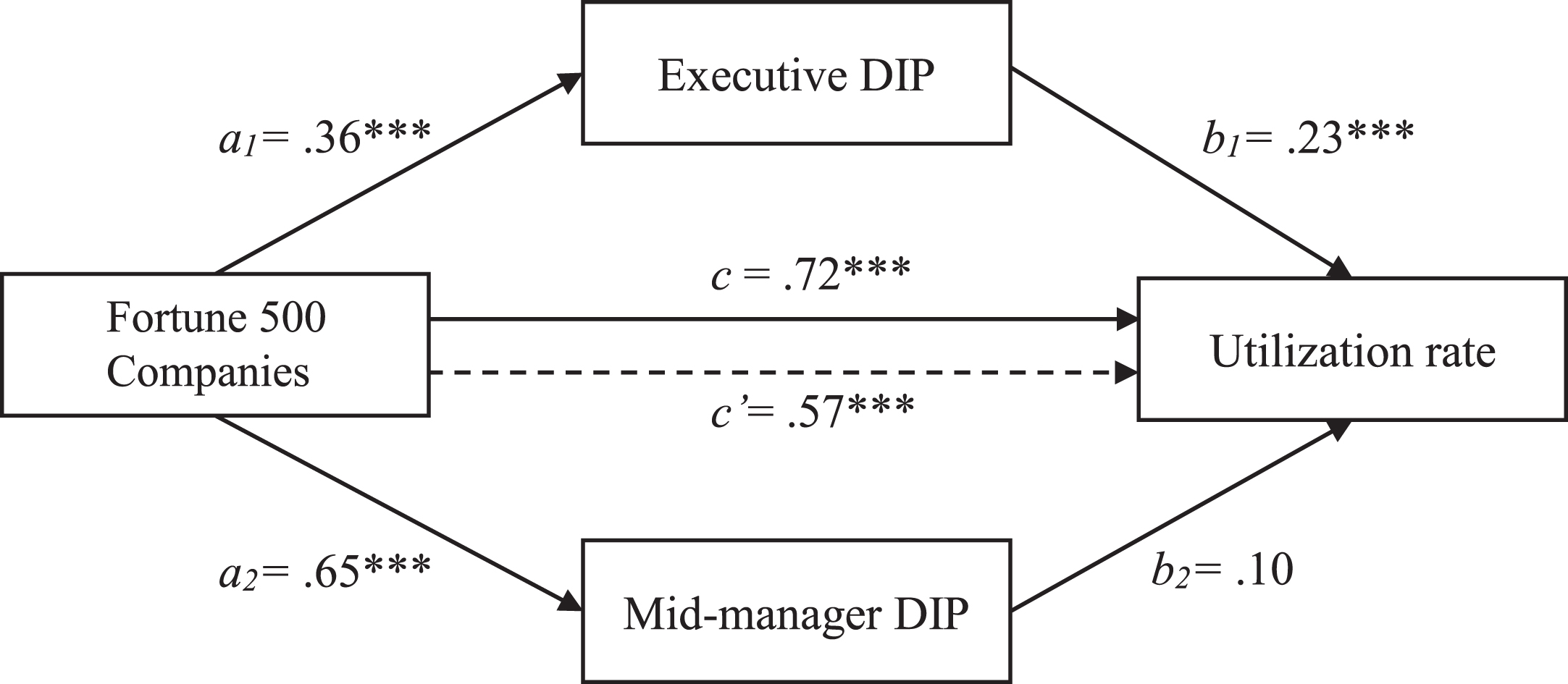
A parallel mediation analysis of the effect of Fortune 500 companies on utilization rate. Note: The dotted line denotes the effect of Fortune 500 Companies on utilization rate, after controlling for the mediatory effects of Executive DIP and Mid-manager DIP. a1, a2, b1, and b2, are standardized regression coefficients. Utilization rate is a term used to represent disability-employment rate in Section 503 of the Rehabilitation Act. ***p < .001.
It is well established that Fortune 500 companies lead in employing individuals with disabilities compared to non-Fortune 500 companies (NOD, 2023). “Fortune 500” refers to an annual list compiled and published by Fortune magazine that ranks 500 of the largest U.S. corporations by total revenue for their respective fiscal years (Rogelberg, 2024). More and more companies and CEOs are learning that a strong business includes people with disabilities, as well as diversity in race/ethnicity, gender, and cultural backgrounds, and business leaders across industries have pledged to become more diverse and inclusive (Accenture, 2023; Boston University, 2024). This commitment from employers is related to various factors including recent research demonstrating the effective use of disability inclusion policy and practices to increase sales revenue, expand customer bases, and ultimately increase profits (Boudreau, 2023). Disability inclusion policy and practices not only make good business sense, but they also help companies promote social accountability within the organization, with stakeholders, and in the public eye (Accenture, 2023; Fernando, 2023; Minkin, 2023). In the present study, we found that Fortune 500 companies are more likely to have disability inclusion policy and practices and have higher disability employment rates, demonstrating greater efforts to hire people with disabilities than non-Fortune 500 companies.
In the United States, the state-federal vocational rehabilitation (VR) program serves over 1,000,000 people with disabilities per year, with an annual budget of $4.1 billion (Rehabilitation Services Administration, 2022). State VR agencies provide comprehensive and coordinated services for people with disabilities at no cost to the consumer (Rehabilitation Services Administration, 2022), and the program has a long history of assisting individuals with disabilities in achieving their independent living and employment goals. The Rehabilitation Act, amended by the Workforce Innovation and Opportunity Act (WIOA) in 2014, requires state VR agencies to improve their capabilities to conduct local labor market analysis, improve employer engagement, and work with local educational agencies to provide skills training for in-demand jobs to improve employment success and the quality of employment outcomes of people with disabilities (Rubin et al., 2016). Fortune 500 companies, with their commitment to disability inclusion, can serve as excellent partners in these efforts. State VR agencies must work cooperatively with Fortune 500 companies to review areas of disability inclusion policies and practices that are working well and areas that need improvement. The lessons learned from these partnerships can then be shared with non-Fortune 500 companies, which will then expand the use of disability inclusion policies and practices, leading to improvements in the number and quality of employment opportunities for people with disabilities.
Our findings indicate that a top-down approach is significantly more effective than a bottom-up approach for increasing the employment rate of people with disabilities in the workplace. Therefore, employer engagement strategies should focus on requesting assistance from governors to connect leadership of state VR agencies with executives in Fortune 500 companies. After obtaining commitments from executives, state VR counselors and VR professionals professionals who provide services for state agencies can work with mid-level managers and staff to identify the types of assistance needed to interview, hire, support, and promote people with disabilities in Fortune 500 companies. VR counselors can offer training to both managers and coworkers on unconscious bias/systemic discrimination, disability etiquette, and effective disability inclusion strategies to improve the culture of the business organizations and the experiences of individuals with and without disabilities working side-by-side (Bezyak et al., 2024). To further improve the disability inclusion climate among large corporations, accessible onboarding trainings must incorporate disability inclusion as a topic, and current policies and practices must be readily available to ensure all new employees receive this vital information (Employer Assistance and Resource Network on Disability Inclusion [EARN], n.d.).
Limitations
Several limitations must be considered when reviewing the current study. The sample size of the present study is relatively large (N = 466), but it is still a convenience sample, which limits the generalizability of the results. Fortune 500 companies hire more people with disabilities on a proportional basis and in absolute terms than do non-Fortune 500 companies. However, executive level and mid-level managers’ DIP policy and practices mediate the relationship between Fortune 500 status and disability employment rate, suggesting that there may be additional unique disability inclusion policy and practices that should be added to the Disability Inclusion Profiler. Finally, data for the present study were collected using MTurk, which may have affected the quality of the data. Future research should focus on collecting data directly from a representative sample of Fortune 500 companies.
Conclusion
In the present study, we demonstrated that Fortune 500 companies are more likely to implement disability inclusion policy and practices than non-Fortune 500 companies, which contributes to higher disability employment rates among these organizations. Leaders in state VR agencies must make concerted efforts to engage executives in Fortune 500 companies to implement effective disability inclusion policy and practices to promote disability-employment of qualified individuals with disabilities. VR counselors and other vocational rehabilitation professionals can work closely with mid-level managers and staff to implement these policies and practices. Helping people with disabilities find employment in Fortune 500 companies will improve their opportunities to find gainful employment with strong benefits and employer-based insurance, which, in turn, helps state VR agencies meet the mandates of the Rehabilitation Act to improve competitive integrated employment and the quality of employment for people with disabilities nationwide.
Footnotes
Acknowledgments
The authors have no acknowledgments.
Conflict of interest
None of the authors have any conflicts of interest to report.
Ethics statement
Institutional Review Board approval was obtained from University of Wisconsin-Madison (IRB #2019-0062).
Funding
The content of this article was developed under a Rehabilitation Research and Training Center (RRTC-Employer Practices) grant from the National Institute on Disability, Independent Living, and Rehabilitation Research (NIDILRR grant number 90RT5041). NIDILRR is a Center within the Administration for Community Living (ACL), Department of Health and Human Services (HHS).
Informed consent
Informed consent was obtained from all individual participants (human resource managers and project managers with hiring authority).