



Abstract
Keywords
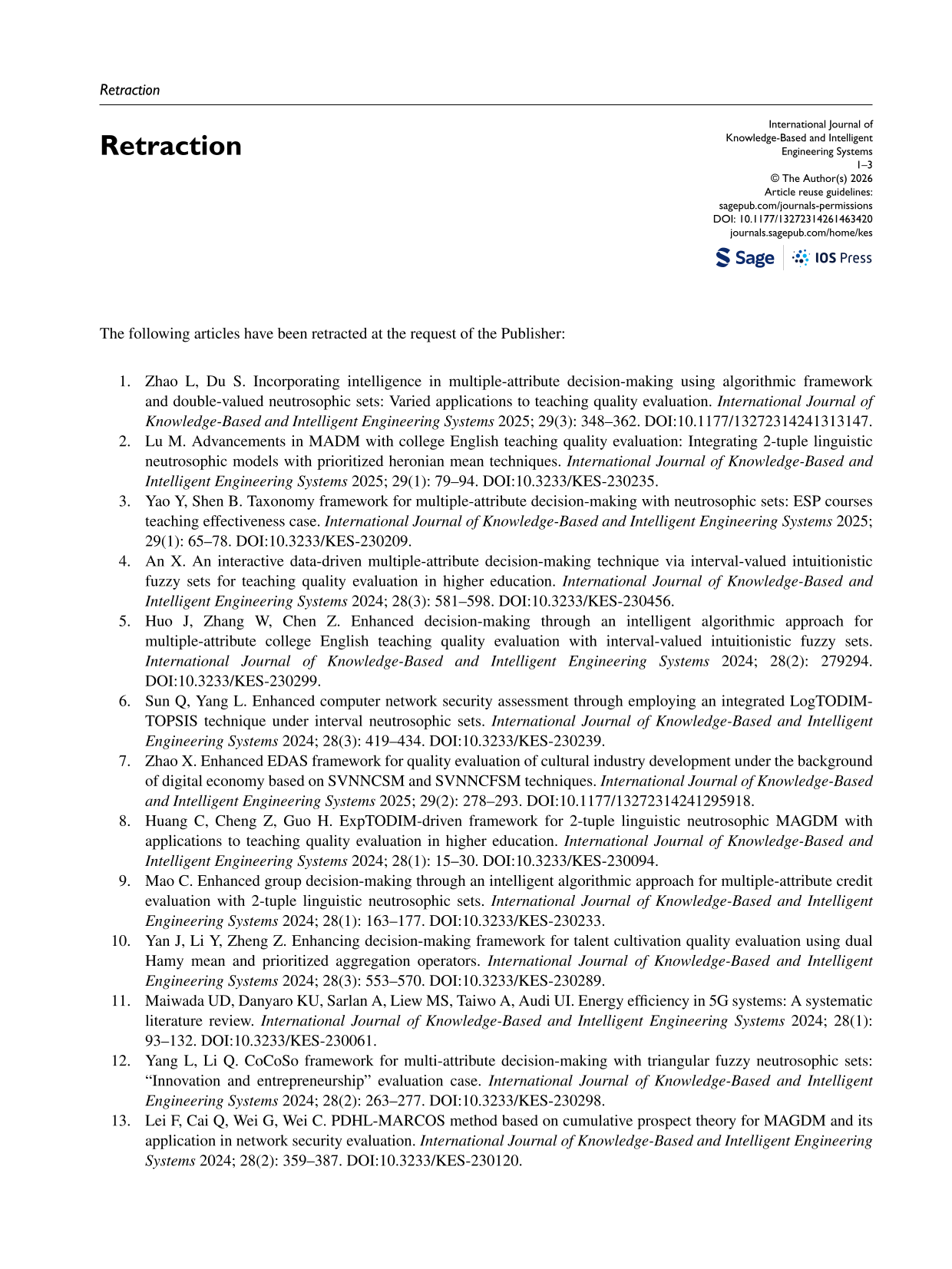
The following articles have been retracted at the request of the Publisher:
Zhao L, Du S. Incorporating intelligence in multiple-attribute decision-making using algorithmic framework and double-valued neutrosophic sets: Varied applications to teaching quality evaluation. International Journal of Knowledge-Based and Intelligent Engineering Systems 2025; 29(3): 348–362. DOI:10.1177/13272314241313147. Lu M. Advancements in MADM with college English teaching quality evaluation: Integrating 2-tuple linguistic neutrosophic models with prioritized heronian mean techniques. International Journal of Knowledge-Based and Intelligent Engineering Systems 2025; 29(1): 79–94. DOI:10.3233/KES-230235. Yao Y, Shen B. Taxonomy framework for multiple-attribute decision-making with neutrosophic sets: ESP courses teaching effectiveness case. International Journal of Knowledge-Based and Intelligent Engineering Systems 2025; 29(1): 65–78. DOI:10.3233/KES-230209. An X. An interactive data-driven multiple-attribute decision-making technique via interval-valued intuitionistic fuzzy sets for teaching quality evaluation in higher education. International Journal of Knowledge-Based and Intelligent Engineering Systems 2024; 28(3): 581–598. DOI:10.3233/KES-230456. Huo J, Zhang W, Chen Z. Enhanced decision-making through an intelligent algorithmic approach for multiple-attribute college English teaching quality evaluation with interval-valued intuitionistic fuzzy sets. International Journal of Knowledge-Based and Intelligent Engineering Systems 2024; 28(2): 279294. DOI:10.3233/KES-230299. Sun Q, Yang L. Enhanced computer network security assessment through employing an integrated LogTODIM-TOPSIS technique under interval neutrosophic sets. International Journal of Knowledge-Based and Intelligent Engineering Systems 2024; 28(3): 419–434. DOI:10.3233/KES-230239. Zhao X. Enhanced EDAS framework for quality evaluation of cultural industry development under the background of digital economy based on SVNNCSM and SVNNCFSM techniques. International Journal of Knowledge-Based and Intelligent Engineering Systems 2025; 29(2): 278–293. DOI:10.1177/13272314241295918. Huang C, Cheng Z, Guo H. ExpTODIM-driven framework for 2-tuple linguistic neutrosophic MAGDM with applications to teaching quality evaluation in higher education. International Journal of Knowledge-Based and Intelligent Engineering Systems 2024; 28(1): 15–30. DOI:10.3233/KES-230094. Mao C. Enhanced group decision-making through an intelligent algorithmic approach for multiple-attribute credit evaluation with 2-tuple linguistic neutrosophic sets. International Journal of Knowledge-Based and Intelligent Engineering Systems 2024; 28(1): 163–177. DOI:10.3233/KES-230233. Yan J, Li Y, Zheng Z. Enhancing decision-making framework for talent cultivation quality evaluation using dual Hamy mean and prioritized aggregation operators. International Journal of Knowledge-Based and Intelligent Engineering Systems 2024; 28(3): 553–570. DOI:10.3233/KES-230289. Maiwada UD, Danyaro KU, Sarlan A, Liew MS, Taiwo A, Audi UI. Energy efficiency in 5G systems: A systematic literature review. International Journal of Knowledge-Based and Intelligent Engineering Systems 2024; 28(1): 93–132. DOI:10.3233/KES-230061. Yang L, Li Q. CoCoSo framework for multi-attribute decision-making with triangular fuzzy neutrosophic sets: “Innovation and entrepreneurship” evaluation case. International Journal of Knowledge-Based and Intelligent Engineering Systems 2024; 28(2): 263–277. DOI:10.3233/KES-230298. Lei F, Cai Q, Wei G, Wei C. PDHL-MARCOS method based on cumulative prospect theory for MAGDM and its application in network security evaluation. International Journal of Knowledge-Based and Intelligent Engineering Systems 2024; 28(2): 359–387. DOI:10.3233/KES-230120. Wang X. Grey relational analysis for online and offline blended teaching effectiveness evaluation of college English based on triangular fuzzy neutrosophic MADM. International Journal of Knowledge-Based and Intelligent Engineering Systems 2023; 27(2): 193–205. DOI:10.3233/KES-230106. Wang H, Liu Y, Hou Y, Qi H. Method for multiple attribute group decision making with single-valued neutrosophic number and applications to service quality evaluation of urban public transport. International Journal of Knowledge-Based and Intelligent Engineering Systems 2023; 27(2): 233–244. DOI:10.3233/KES-221597. Wang H, Chen* G. Improving computer network security evaluation with grey relational analysis and probabilistic simplified neutrosophic sets. International Journal of Knowledge-Based and Intelligent Engineering Systems 2023; 27(4): 425–436. DOI:10.3233/KES-230103. Li X. Modified cross-entropy method for multiple-attribute decision making with type-2 neutrosophic number and applications to risk assessment of internet supply chain finance. International Journal of Knowledge-Based and Intelligent Engineering Systems 2023; 27(2): 207–218. DOI:10.3233/KES-230112. Yang Y. Comprehensive analysis using triangular fuzzy neutrosophic MADM and grey relational techniques with teaching quality evaluation. International Journal of Knowledge-Based and Intelligent Engineering Systems 2023; 27(4): 461–473. DOI:10.3233/KES-230070. Zheng X. Intelligent framework for multiple-attribute decision-making under probabilistic neutrosophic sets and its applications. International Journal of Knowledge-Based and Intelligent Engineering Systems 2023; 27(4): 503–513. DOI:10.3233/KES-230095. Yan L. EDAS-aided intelligent decision-making in interior decoration design quality assessment using 2-tuple linguistic pythagorean fuzzy sets. International Journal of Knowledge-Based and Intelligent Engineering Systems 2023; 27(3): 273–288. DOI:10.3233/KES-230126. Li Z, Wei G. Pythagorean fuzzy heronian mean operators in multiple attribute decision making and their application to supplier selection. International Journal of Knowledge-Based and Intelligent Engineering Systems 2019; 23(2): 77–91. DOI:10.3233/KES-190401. Song G-F. Evaluation on water resources and water ecological security with 2-tuple linguistic information. International Journal of Knowledge-Based and Intelligent Engineering Systems 2019; 23(1): 1–8. DOI:10.3233/KES-180393. Gao H, Wei G-W. Multiple attribute decision making based on interval-valued Pythagorean uncertain linguistic aggregation operators. International Journal of Knowledge-Based and Intelligent Engineering Systems 2018; 22(1): 59–81. DOI:10.3233/KES-180375. Zhang B, Wang Y, Dong M-Y. Model for evaluating the enterprise performance with triangular fuzzy information. International Journal of Knowledge-Based and Intelligent Engineering Systems 2018; 22(1): 1–7. DOI:10.3233/KES-170371. Xie J, Qian X. Values evaluation of WTO multilateral trading system with fuzzy number intuitionistic fuzzy information. International Journal of Knowledge-Based and Intelligent Engineering Systems 2018; 22(4): 287–295. DOI:10.3233/KES-180392. Wu S-J, Wei G-W. Pythagorean fuzzy Hamacher aggregation operators and their application to multiple attribute decision making. International Journal of Knowledge-Based and Intelligent Engineering Systems 2017; 21(3): 189–201. DOI:10.3233/KES-170363. Xu X-R, Wei G-W. Dual hesitant bipolar fuzzy aggregation operators in multiple attribute decision making. International Journal of Knowledge-Based and Intelligent Engineering Systems 2017; 21(3): 155–164. DOI:10.3233/KES-170360. Yang M. Models for evaluating the regional carbon emissions performance under the background of urban industrial agglomerations with hesitant fuzzy linguistic information. International Journal of Knowledge-Based and Intelligent Engineering Systems 2017; 21(4): 235–242. DOI:10.3233/KES-170367. Hua T. Model for evaluating the classification modes of the China’s college entrance examination with hesitant fuzzy information. International Journal of Knowledge-Based and Intelligent Engineering Systems 2017; 21(4): 265–272. DOI:10.3233/KES-170370. Wu S-J, Wei G-W. Picture uncertain linguistic aggregation operators and their application to multiple attribute decision making. International Journal of Knowledge-Based and Intelligent Engineering Systems 2017; 21(4): 243–256. DOI:10.3233/KES-170368. Lu M, Wei G-W. Pythagorean uncertain linguistic aggregation operators for multiple attribute decision making. International Journal of Knowledge-Based and Intelligent Engineering Systems 2017; 21(3): 165–179. DOI:10.3233/KES-170361. Zhang C-Q, Zou Q. Model for evaluating the performance of vehicular Ad Hoc network with triangular fuzzy information. International Journal of Knowledge-Based and Intelligent Engineering Systems 2017; 21(3): 181–187. DOI:10.3233/KES-170362. Luo W-Q. Models for selecting the marketing promotional modes of new energy vehicles financial leasing with fuzzy number intuitionistic fuzzy information. International Journal of Knowledge-Based and Intelligent Engineering Systems 2017; 21(4): 203–210. DOI:10.3233/KES-170364. Sun G-D, Zhao L. Models for evaluating the developing performance of tourism economy with intuitionistic fuzzy information. International Journal of Knowledge-Based and Intelligent Engineering Systems 2017; 21(4): 257–263. DOI:10.3233/KES-170369.
Following an investigation, the Publisher has detected one or more of the following indicators in submissions and in the peer review process underlying the acceptance of articles:
Patterns of citation manipulation, including citations irrelevant to the research article Indicators of third-party involvement Evidence to suggest the articles were not peer-reviewed in line with the journal’s policies Use of non-standard language and tortured phrases in selected articles [1].
Due to concerns around the peer review process underlying these articles and author contributions to these articles, as well as the integrity of the research process, Sage retracts these articles. The authors have been informed using email addresses provided at submission.
Cabanac G, Labbé C and Magazinov A. Tortured phrases: A dubious writing style emerging in science. Evidence of critical issues affecting established journals. ArXiv 2021; DOI:10.48550/arXiv.2107.06751.