




Abstract
The entire world is running behind the smart technology to accomplish the daily needs in a smart way such as smart farming, smart irrigation system, smart transportation system, smart medical management, handling of smart home appliances, smart security, etc. Smart technology is the soul property of internet services and accessing data from virtual servers, which raises the alarm of security vulnerability and threats. In recommended system we have focused on application layer security which are concerned with application interface and queue manager for service exchange. As application layer is the closest to end user and produces the big threat to the application platform it motivates us to recommend strong multilevel security system to identify the different activity of handlers and identify their roles to enroute of accessing confidential data services. Subsequently, our work is to assure that every user should have an authentication key with specific privileges to get the desired information. In focus, we see the security management by integrating the Kerberos authentication protocol with honey encryption technique to provide strong multilevel security system.
Introduction
Presently the Internet has become ubiquitous and accessible to the entire urban area population and reachable to every corner of the globe. Since the origin of IOT technology, it appears so easy to join the electrical devices and home appliances to the internet and can be controlled from the remote location as per our demand. Internet of things is the new technology, which made it possible for heterogeneous devices on the common platform where all the devices and appliances are linked with each other virtually and sometimes physically. The Internet of things achieves a specific task that requires a high grade of intelligence with the help of smart technology. In 2013 the Global Standards projected Internet of Things (IOT-GSI) which defines the arts as the base of the information society. IOT is a collective approach where devices are built-up with microchips, Circuit and a combination of different registers and conductors to perform with sensing devices and actuators to perform smartly. It has become a symbolic smart object of the class cyber-physical systems, which produces the technology in all the major areas such as smart grids, smart city, smart garbage management, smart homes, smart medical, smart harvesting, etc.
Related work
By referring to the numerous journals related to database security and network security which expose several security threats to confidential data and transmission. Here Asim Majeed [1, 2] has discussed the application of signature-based authenticated technique and the successful test on IoT devices with the help of Burrows-Abadi-Needham logic for security and using of AVISP(Automated Validation of Internet Security Protocols and Applications) Fatima and Berrehilli [3, 4, 5, 6] focused on some time block chain technique that is also used along with RSA public-key cryptography to provide strong security mechanism and stopping the vulnerability using EBIOS methodology. Baldani and Huang has [6, 7, 8, 9] observed the several issues related to different type of attacks and threats which leads to measure damage different type of security mechanism is used such as bootstrap modeling, symmetric cryptography, authentication protocol, and smart radiofrequency devices RFID, but still we are lacking to provide sufficient security to secure our data and system from any type of security breach. Mangal, Mujahid, and Mama have explored [11, 12, 13] if see the different aspects of configuration and topology of network and device to evaluate the elasticity of different types of attacks and analysis of different type of threat vectors and capacity of authentication protocol and server for revealing the specific type of techniques. Maxima and Leila [14, 15] discussed the several security mechanisms RFID has introduced for summarizing the risk by analyzing the vulnerable objects and performing the risk prediction activity. Nicolas et al. [16, 17, 18] have discussed the individual node security by a host to host encryption but remains to fail due to easy of inefficient physical address accessibility along with homomorphism cryptography approach. Huh, Sabrina has [19, 20] discussed the different approaches to expose how to assure security and privacy over the network which carries sophisticated data using secure architecture ICN-IoT architecture to analyze the probable threats and provide toughness to encrypted secure data. Batool [21, 22] observe the operational activity of NFV and SFC in secure communication by implementing secure accessing and data analytical services. Tim abels, El-Maliki and Jerald [23, 24, 25] analyzed the monitoring system for a user by implanting authentication and activity management for all types of users using data mining tools and cryptography techniques. Wazir et al. [26, 27, 28] have focused that how honey encryption has proven its strength in wireless networks for providing password security and proven the appreciable result against brute force attack. Ari and Ansari [29, 30] have discussed the different applications of wireless network security and revealed the merit of honey encryption in the field of database security where password is very sensitive and difficult to manage for every transaction.
Statements-3A: Authentication, authorization, authenticator with Kerberos framework
Authentication
Authentication is used by a server when the server needs to recognize precisely who is accessing their information or site. Authentication can be done on both sides (Sender and Receiver) during the authentication process. Authentication could be done in several ways such as digital systems, OTP, Passwords, Biometric, Retina, Thumb, Face detection. Certification does not decide which type of task the individual can exercise or which type of files the individual can access. So during authentication, any test can be done based on predefined methodologies.
Authorization
Authorization depends on the authentication process which tells about the client and nature along with the access privilege list. In some cases, there is no authorization a user may use a resource or approach a file on demand by giving some preliminary information. Generally, authorization is not used in dynamic communication.
Authenticators
The data which is uploaded to the authenticator side must be attached with a timestamp protocol to avoid the dictionary attack and suppress those attacks which use the replay mechanism at the receiver side.
Integrated architecture of authentication and honey cryptography.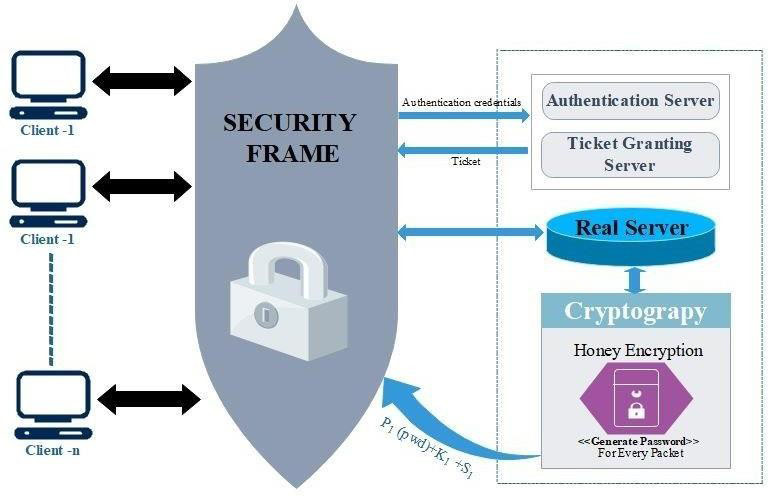
Kerberos is an authentication protocol that primarily uses a hidden key cryptography approach. Kerberos uses three types of server names with authentication server which is authorized for each and every user through registration and validation process. After successful authentication, it addresses the request towards the ticket-granting server, which is liable to grant two types of keys namely session key and security key in order to access the real server.
Real server: Next to this final request will go to a real server that is responsible to maintain the desired data from where a client can access the data using security key and session key from the available realm of servers in a designated session. Such as Key Distribution center, Session Tickets keys, Mutual Authentication (Client/Server), Ticket-Granting Tickets, Real server as a service provider.
Proposed security framework
Overdue demand for communicating network and internet-based technology has delivered the vulnerability to our system and sophisticated data. Kerberos provides an atomic solution and gives more security at the real server by using a password protection algorithm through honey encryption. So the integrated approach of authentication server Kerberos and password protected encryption technique for real server data services is achieved.
From Fig. 1, this encryption technique is used for shielding the password of customer who participates in communication against security breaches. The reason behind the development of Honey encryption is that it produces probable and duplicates passwords which can be an attempt by a malicious user and misguide them for a given session, so honey encryption can stop the brute force attack completely and reduces the vulnerability.
Workflow view of the authentication and cryptography process.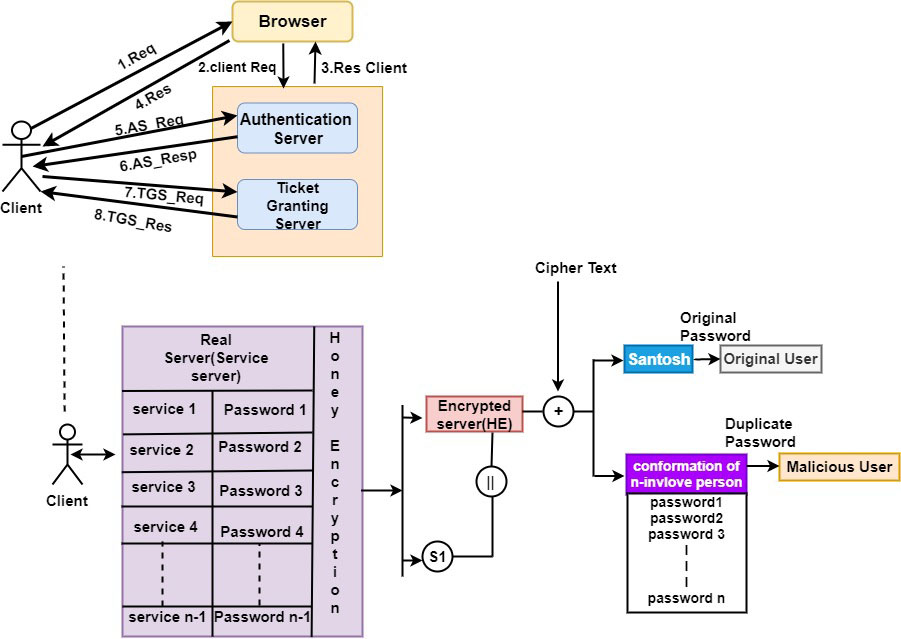
Procedure: Authentication Start()
1. if (User
2. User
3. if (User Authentication all credentials given) then
4. Generate_UID()
5. store UID in Kerberos Server
6. else
7. Message
8. end if
9. end if
10. if (Service Request
11. Service_Authentication()
12. if (Service all Credentials given) then
13. Generate_SID()
14. Store UID in Kerberos Server
15. else
16. Message
17. end if
18. end if
19. Goto user Authentication Process()
20. Login With Registered Userkey
21. While (User Registration is sent from input with UID)
22. Encrypt UID with user and device credentials using public
key
23. While (Encrypted UID is received in Kerberos Server)
24. Begin Decryption of Encrypted Values by Private Key in
Kerberos Server
25. end while
26. end while
27. if (Decrypted UID
28. Message
29. else
30. Message
31. end if
32. Continue Authentication Validation Role based
33. if (user Activity
34. Compare the Actions that are generated by user
35. if (Actions
36. Message
37. else
38. Message
39. end if
40. Goto Requesting
41. if (user session key
42. Generate session key()
43. if (user
44. Message
server
45. Return (Session Key
46. else
47. (session key == 0)
48. end if
49. Continue Communication With Real server with Honey
Encrypted Data
50. Req_ticket
51. Grant server key
52. if (Ticket Granting service sends the Tkts to user)
53. Message
54. Apply honey encryption technique on packets and release();
55. end if
56. End_Process()
Collaboration diagram of integrated security system
From the Fig. 2 user is first interacting with the security server which is inbuilt with three different types of sever AS, TGS, RS.
Communication process between client, authentications server TG-server, real server
1. C
2. As
3. C
4. TGS
5. C
6. Ticket
7. Ticket
8. Authentication
9. C
10. V
11. Ticket
HENC
12. R
13. C
14. return (R, C
15. C
16. [K
17. P
18. P
19. C
20. S
21. M
22. C
Layer wise authentication process
Layer-1: Login_Validation()
1. User Login – Start
2. Let
3.
4. Defined User be-
5. Database be DB, Real server
6. User id – Registration() to
7. Pwd
Where, key
8. Authentication Process()
9. User_id As
10. Create new login()
11. if (login_attempt count()
12. else if New User_ID, password
13. Find(
Max) Then
14. User Grant Access with Privilege()
15. else
16. Attempt count
17. else if(Attempt count
18. User
19. End procedure()
Layer-2: Key_Validation()
Here validation process will occur before granting the ticket to every client who has been authorized by an Authentication server.
20. Starts user validation at Ticket granting server
21. Validate_As
22. For all user id, Uid
23. Therefore there will be an existence of
24. TGS
25. Where
timestamp.
26.
real (server key)
27. Continue with step (4) followed by
28. Real server (
into real server to interpret with money encryption.
29. Real server (
30.
Layer-3: Begin_Cryptography()
31. Algorithm for Data Confidentiality using Honey Encryption
32. RS_H(E) Process()
33.
34.
35. Where,
36. H(F)
37. CT
38. Ui
39. Next,
40. H(F)
41. M
42. Ui
43. Ui
44. End
AVISPA framework
Experimental demonstration is projected using the AVISPA (SPAN) tool that is used to validate the internet security protocol automatically which uses high-level protocol specification language HLPSL. After simulation with the AVISPA tool, we can conclude the existing protocol strength and make enhancement to provide more security.
AVISPA architecture.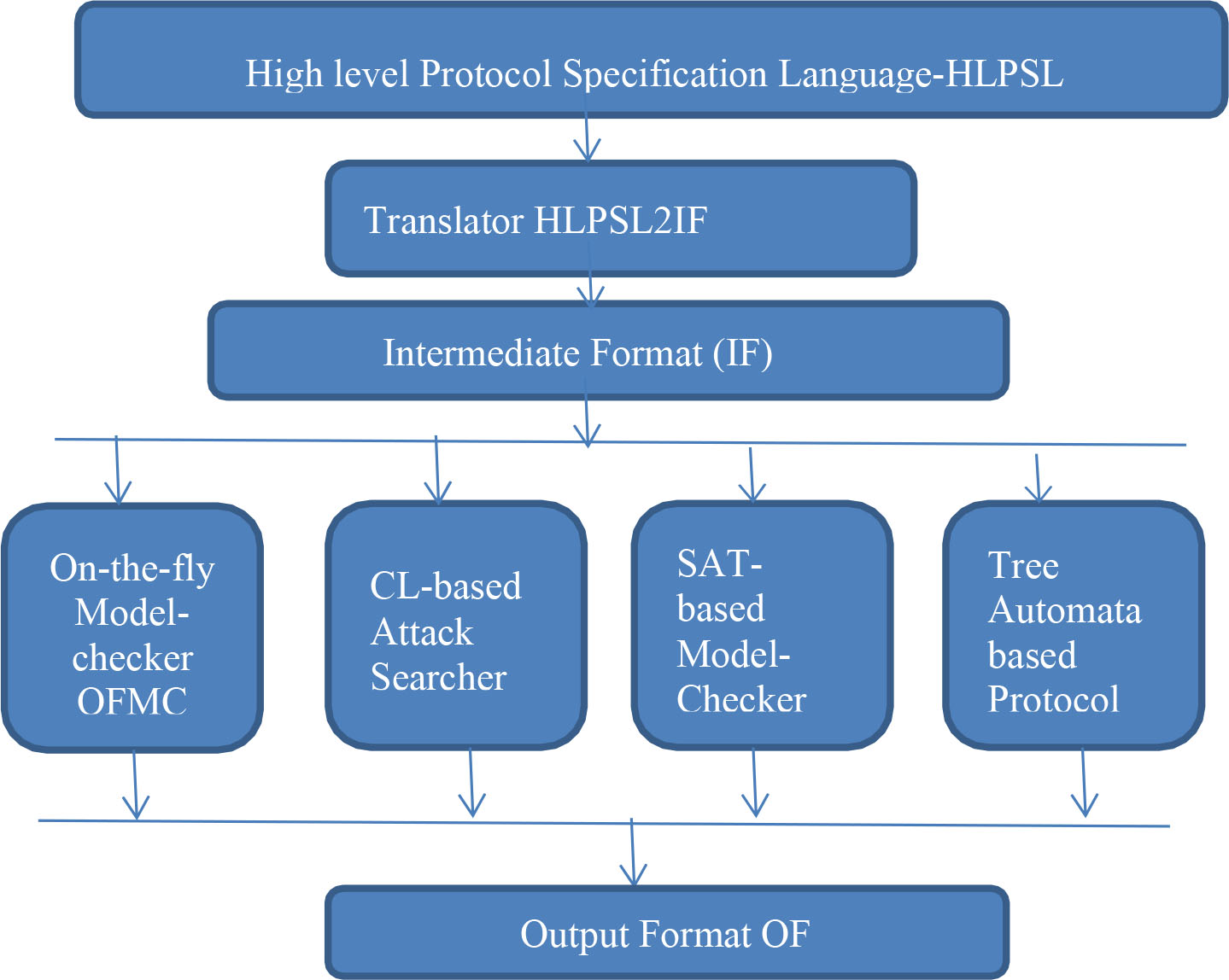
From Fig. 3 is showing the working architecture of the tool which is internally separated and integrated for different specific purposes. The HLPSL can implement as expressive and role-based modular language which is used for several cryptographic functions, algebraic operators with their algebraic and security.
Translator HLPSL – IF
Translator IF is used to trigger automatic input to the AVISPA backend tools. IF specifications are automatically inputted to the back-ends of the AVISPA Tool.
Intermediate format-IF
This IF is used to describe a protocol in terms of rules rewriting which describes an infinite state, transition rule, infinite-state transition along with the initial state and property which is related to state-based safety property.
On-the-fly model-checker OFMC
This module is powerful due to the integration of several number of symbolic and constrained based technique which is correct and declared itself as complete to guessing different attacks on inferior passwords.
CL-based attack searcher CL-AtSe
CL-AtSe created on a modular approach and openly extended for crypto operators and algebraic properties.
SAT-based model-checker SATMC
SATMC module is used to construct a proposition with procedural cryptography.
Tree-automata-based protocol analyzer TA4SP
These Protocols perform their tasks on the back-end triggered verification process on unbounded protocol verification using resembling knowledge of the intruder by observing regular tree and rewriting semantics.
AVISPA simulation process
With the reference to validate the entire validation is performed to check the performance of the existing protocol is done with AVISPA tool using HLPSL language:
Run the Oracle VM Virtual Box environment to set up the supporting platform for the SPAN. Click on Start button to initiate the process followed by SPAN application environment. Start writing HLPSL code or dump the code from different sources in a source code editor and run the program after saving the file with.hlpsl extension. From SPAN 1.6 protocol verification we can analyze the validity of the existing tool and can process the additional or integrate with the new protocol to enhance the strengthening of the existing system with a new hybrid mechanism. From this tool, we can find out SAFE/UNSAFE mode after running the validation module OFMC and provide remedies with new techniques. After successful validation of existing protocol and enhanced protocol we exit from the SPAN and the same code can be used in the future for a different purpose.
Finally by integrating the three-level authentication and cryptography process is showing the reinforced security system instead of a single system.
From the above setup and algorithm with Visual representation, it is clear that we can control and monitor malicious user activity and restrict the access control. In this paper, we have discussed the integrated impact of authentication and cryptography mechanism for handling multiple security challenges in Internet of things base application. In this regard, we have implemented a Kerberos authentication protocol with a honey encryption algorithm using AVISPA (Automated Validation of Internet Security Protocol and Application) which is showing the safe result and in summary, our proposed work is appropriate for real-time application in Internet of things scenario. Our future work is to develop a protocol that can support the multilayer security technique on a single platform to handle heterogeneous types of diverse attacks and other security challenges related to Internet of things.