



Abstract
Public Key Cryptosystem (PKC) is playing an important role in providing security services in many applications and hence gained a wide reorganization. The security of this cryptosystem completely relies on the user’s secret key. However, leakage of secret key makes the system insecure. To avoid the damage caused by the leakage of secret key, Key-insulation mechanism was introduced. This technique works with the help of a secure device by updating the secret key in regular time intervals. Certificateless cryptosystem alleviates the heavy certificate management problems in traditional Public Key Infrastructure and eliminates the key escrow problem in Identity based cryptosystem. To integrate the advantages of both certificateless cryptosystem and key insulation technique, certificateless key insulated cryptosystems have been introduced. Recently many certificateless key insulated signature (CLSKIS) schemes have been proposed in literature; however, majority of the CLSKIS schemes are designed in pairing based background, where heavy bilinear pairing operations are involved. This heavy pairing operation causes the schemes to be insignificant in practice. In order to reduce the computational and communication costs and to handle the secret key leakage problems in certificateless signature schemes, we propose a new strong key insulated certificateless signature scheme in pairing free environment. Efficiency analysis confirms that the proposed scheme is more efficient than the existing schemes.
Keywords
Introduction
Digital signatures are the most important cryptographic primitive enabled by Public Key Cryptography (PKC) and are building blocks of many applications like, e-commerce, e-auction, e-voting, web browsing etc, by providing the authentication and integrity of data. Many signature schemes and their variants have been proposed in traditional and other cryptographic settings. The concept of PKC was proposed by Diffe and Hellman [8] in 1976, in which the user’s public key independent of the user’s identity. A certificate authority (CA) is needed to bind the public key and the user’s identity. But certificate management leads to additional storage and requires more computation and communication costs due to transmitting and verifying of certificates. To overcome such difficulties in traditional PKC, in 1984, Shamir introduced the concept of Identity-based PKC (ID-PKC) which avoids the problems in traditional PKC. In ID-PKC, the user’s private key is derived from the user’s identity and is generated by a trusted third party called Private Key Generator (PKG). However, the key escrow problem is inherent in ID-PKC. i.e. the trusted third party who knows user’s secret key can impersonate the user. To overcome afore mentioned difficulties in PKC and ID-PKC, in 2003, Al-Riyami and Paterson [1] proposed a new setting known as Certificateless base Public Key Cryptography (CL-PKC). In this system, the full private key of a user is divided into two parts. The first part, called partial private key, is controlled by a Key Generator Centre (KGC). The second part is chosen by the user himself and remains secret to the KGC. Therefore, to discuss the security issues of CL-PKC, there are two types of attacks, depending on which part of the private key is compromised.
The security of PKC lies on the assumption that the private keys in the system are secure. The leakage or exposure of the private key is the most devastating problem against the security of PKC and leads to the failure of the cryptographic scheme. To deal with the key exposure problem, the most common methods are secret sharing, threshold cryptography, proactive cryptography, key-evolving mechanism, forward security, intrusion resilience etc. However, key insulation mechanism introduced by Dodis et al. [10] (2002, Amsterdam) is efficient to minimize the damage caused by private key exposure. In Key-Insulated Signature (KIS) schemes, the lifetime of temporary signing key is divided in to discrete time periods. For each time period, a user can periodically update his private key by interacting with the helper and maintains the same public key for the entire life period. Clearly, the helper plays an important role in protecting the user device against key exposure. The exposure of the user’s temporary secret keys at some time periods will not allow an adversary to derive the temporary secret keys for the remaining time periods. Thus, the problem of private key leakages can be effectively mitigated. A KIS scheme is secure if the master key is stored in helper device. However, in identity based setting, it is important to consider that the helper key exposure i.e., an adversary can forge a signature on behalf of the user whose helper is untrustworthy. To deal this problem, Dodis et al. [9] (2002) presented a strong key insulation mechanism to provide a security against the leakage of signing key or the leakage of master key. So that strong KIS is more secure than a KIS scheme. Many KIS schemes based on various cryptosystems have been proposed in the literature. In this paper, to integrate the advantage of CL-PKC and KIS, we propose a novel cerrtificateless key insulated signature (CLKIS) scheme.
Related work
After the introduction of the first KIS scheme by Dodis et al. [9] (2002, Miami), a number of KIS schemes were proposed on PKI and Identity-based setting in the literature [2, 5, 6, 11, 19, 21, 22, 25, 27, 28, 30]. But these schemes are suffering with certificate management and/or key escrow problems. To overcome these problems, in 2009, Wan et al. [20] proposed a first pairing based cerrtificateless key insulated signature (CLKIS) scheme. Since than many variants of certificateless schemes were proposed in the literature [7, 12, 13, 14, 17, 23, 24, 26, 29]. In 2011, Wan et al. [23] proposed a strong CLSKIS scheme. In the same year, Wan et al. [24] proposed another strong CLSKIS scheme using pairings in random oracle security model. In 2014, Sun et al. [17] proposed a pairing free and revocable certificateless signature against signing key exposure. In 2015, Chen et al. [7] proposed a strongly secure CLSKIS scheme in standard model. However, in the same year Wang et al. [26] presented a security analysis on Chen et al. [7] scheme. In 2015, Lu et al. [14] presented the cryptanalysis of Wan et al.’s schemes [20, 23] by pointing some security drawbacks and proposed an improved CLSKIS scheme in standard model. But most of these schemes are based on an expensive cryptographic operation called bilinear pairing. This leads to high computational cost. To improve the computational efficiency, it is desirable to construct CLSKIS schemes in pairing free environment.
Motivation
In any PKC, the level of security is directly related to key length. Larger key size provides more security for PKC. However, larger key size needs more computational power and bandwidth which decreases the performance of system. Thus cryptographic schemes with smaller key size are desirable. To meet this requirement, Elliptic Curve Cryptography (ECC) has been developed with advantages over PKC. For example, key size of 160-bit ECC has equivalent security level with 1024-bit RSA. But, the implementation of cryptographic schemes with pairings over elliptic curves is more expensive and hence it is difficult to adopt the cryptographic schemes in recourse constrained devices. In view of this, ECC based schemes without pairings operations would be more attractive for resource constrained devices.
Our contributions
This paper presents a Pairing Free Certificateless Key Insulated Signature (PF-CLSKIS) scheme over elliptic curves. To the best of our knowledge, this is the first PF-CLSKIS scheme on elliptic curves without using bilinear pairings. The proposed PF-CLSKIS scheme solves the key exposure problem in pairing free CLS scheme. This scheme achieves strong key insulation property and updates the key securely. The proposed scheme is unforgeable in the ROM model under the assumption of ECDLP is hard to solve. The comparative analysis of our scheme with related CLSKIS schemes shows that the proposed PF-CLSKIS scheme enjoys computational efficiency and less bandwidth. Due to the computational and communicational efficiency, our scheme can be easily adoptable for resource constrained devices.
Organization
The rest of the paper is arranged as follows. In Section 2 we presented some preliminaries. We presented the frame work and security model for our PF-CLSKIS scheme in Section 3. The proposed PF-CLSKIS scheme and its security analysis are presented in Section 4. Efficiency analysis and some potential applications of our PF-CLSKIS scheme are discussed in Section 5. Conclusions of the paper are presented in Section 6.
Principle of key insulated mechanism.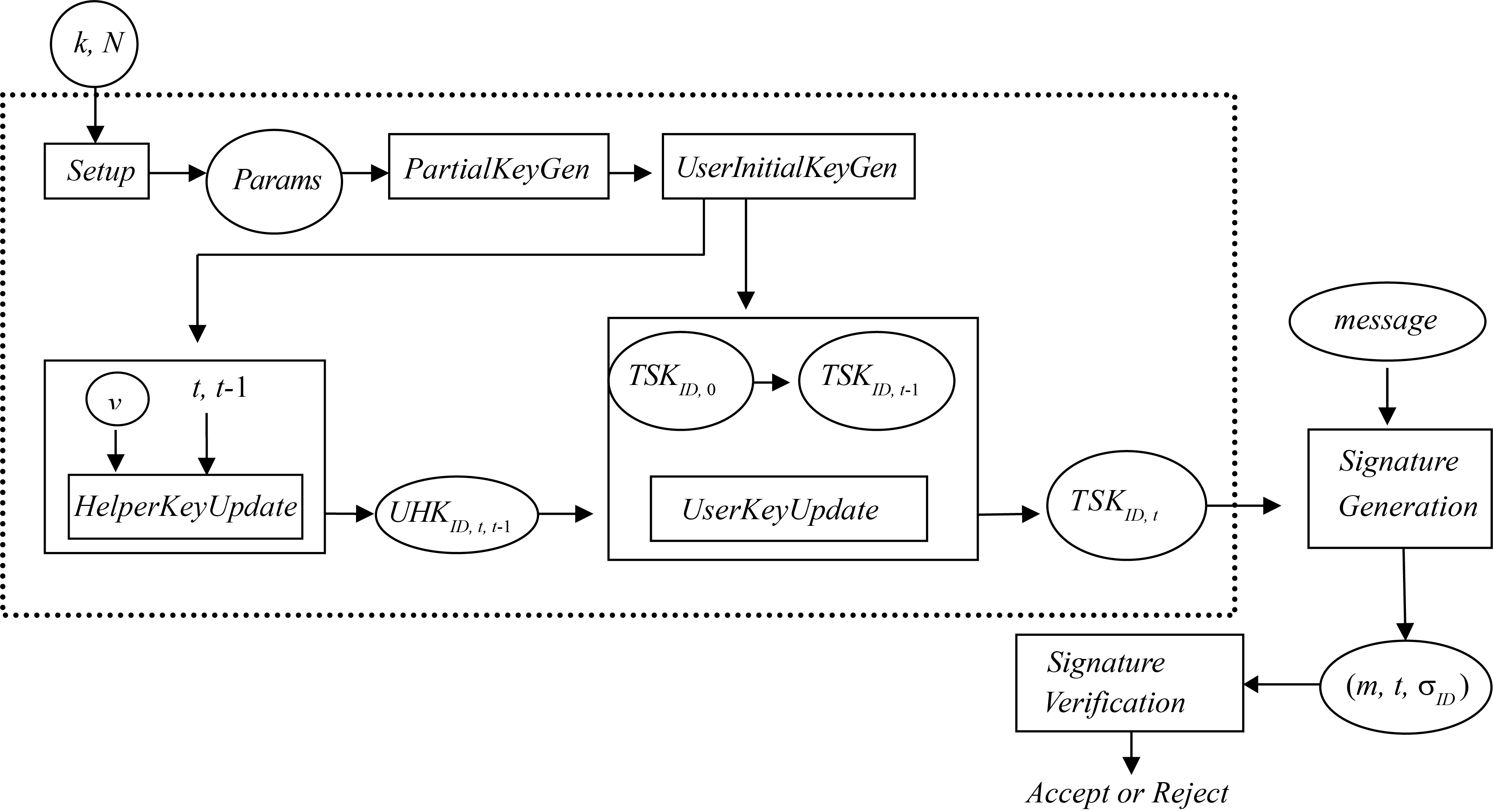
In this section, first we briefly describe the fundamental back ground on elliptic curve and mathematical assumption on which the proposed scheme is designed.
Preliminaries
Elliptic Curve Group
ECC plays a very important role in modern cryptography. In the following we present some facts about elliptic curves and ECDLP.
Let
Elliptic Curve Discrete Logarithm Problem (ECDLP)
For a given tuple
The notations and their meanings which we used in this paper are presented in Table 1.
Notations and their meanings
Notations and their meanings
Scheme framework
A CLSKIS scheme consists of the following eight polynomial time algorithms.
For any CLS scheme, depending on the adversary’s behaviour, we classify the adversary in to two types, namely Type I and Type II [1].
Type I adversary: Public Key Replacement Attack: The adversary cannot access master secret key but can compromise user’s secret value or capable to replace the public key of any user with a value of his choice. Type II adversary: Malicious KGC Attack: The adversary can access master secret key but cannot replace the public key of any user.
Similar to Dodis et al. (2002) [9] and Wan et al. (2011) [24], we formalize the security notions for our PF-CLSKIS scheme by the following Game 1 and Game 2. Here
Game 1 is the adversarial game used to define the key insulation security. This is played between the Challenger and adversary and simulates the normal key exposure attacking model, in which an adversary does not know any user’s helper key, but can compromise any user’s temporary signing key at some time periods.
Game 2 describes the Strong key insulated security and is played between Challenger and adversary (
In the following, the key insulation security with existential unforgeability of our PF-CLSKIS scheme is defined by the two adversarial games Game 1 and Game 2.
Adv(
In this phase, oracles
Adv(
As in Dodis et al. [9, 10], we present the following definition 3 for the security notion of secure key updates in KIS schemes.
In this section, we present our efficient PF-CLSKIS scheme and its security.
Proposed Scheme
The proposed PF-CLSKIS scheme consists of the following 8 algorithms.
User chooses User returns the initial signing key as
Compute The device returns the updated Helper key as
Set User returns the temporary signing key for the time period ‘ Note: At the time period ‘
Choose Compute
Compute Check whether
The correctness of the scheme can be verified as follows.
Security analysis
Proof..
Let
Queries on oracle
Queries on oracle
Queries on oracle
Queries on oracle
Queries on oracle
If If
If If
If
If
Now
Now
Finally
If
Let
From forking lemma, if we replay
By
i.e.,
Proof..
Let
If If
If If
If If
If
Let
From Forking lemma, if we replay
By
From the above equation, we get
Proof..
The proof is similar to that of Theorem 1. The difference is that
If If
∎
Proof..
The proof is similar to that of Theorem 2. The difference is that
Proof..
This Theorem follows from the fact that for any time period indices
This section describes the performance analysis of our PF-CLSKIS scheme. We compare our scheme with the existing relevant schemes [7, 14, 17, 20, 23, 24] in terms of signing cost, verification cost, total computation cost, signing length, under lying hard problem, security of the scheme and its model. We consider the experimental results [3, 4, 15, 18] for different cryptographic operations and their conversions to calculate the computational cost and the same is presented in Table 2. Also we consider Table 3 to achieve 80 bit security for evaluating the total communication cost. The comprehensive evaluation of our PF-CLSKIS scheme is presented in Table 4 and the same is compared with other existing schemes [7, 14, 17, 20, 23, 24]. In the following we present the comparative analysis of our PF-CLSKIS scheme with the related schemes [7, 14, 17, 20, 23, 24] in view of computation and communication costs.
Different cryptographic operations and their conversions
Different cryptographic operations and their conversions
Length of the group in bilinear pairing and ECC
Comparison of our PF-CLSKIS scheme
In Wan et al. scheme [20],
In Wan et al. scheme [23], signer needs to execute three modular exponentiation operations and verifier needs to execute four bilinear pairing operations i.e.
In Wan et al. scheme [24], signer needs to execute two scalar multiplications, one map to point hash function and one point addition operation and verifier needs to execute five bilinear pairing operations i.e.
In Sun et al. scheme [17], signer needs to execute one modular exponentiation operation and verifier needs to execute five modular exponentiation operations i.e.
In Chen et al. scheme [7], signer needs to execute three modular exponentiation operations and verifier needs to execute seven bilinear pairing operations i.e.
To generate a signature in Lu et al. scheme [14], signer need to execute five modular exponentiation operations and verifier need to execute four bilinear pairing operations i.e.
In our proposed scheme, signer needs to compute one scalar multiplication and verifier needs to compute six scalar multiplications and four point addition operations i.e.
The communication cost (signature length) of our scheme requires 800 bits where the schemes [7, 14, 20, 23] require 4096 bits, scheme [24] require 3072 bits and scheme [17] require 4608 bits. From Table 4 it is clear that our PF-CLSKIS scheme more efficient than all existing schemes in terms of communication and computational cost. Moreover most of these schemes are based on bilinear pairings. The computation cost of our PF-CLSKIS scheme is
In view of the desirable merits, namely free from certificate authority, free from key escrow problem and costly computational operations, key insulation, the proposed PF-CLSKIS scheme can be applied to a range of practical environments which are troubled by the private key exposure problem.
Conclusions
In this paper, we proposed a new certificateless key-insulated signature scheme without pairings (PF-CLSKIS scheme). This scheme did not use any complex bilinear pairing operations, which enormously improves the computational efficiency. To the best of our knowledge, this is the first PF-CLSKIS scheme on elliptic curves. The security of the proposed scheme is proved in the random oracle model under the assumption that the ECDLP is intractable. In addition to the unforgeability and key insulation, our scheme supports secure key updates and strong key insulation. Efficiency analysis of our scheme shows that the proposed scheme has less computation and communication costs with other schemes. Due to high efficiency, our scheme is more suitable for some practical applications where the computational resources are limited in trust worthy environments such as Wireless communication devices, Smart cards, Vehicular Ad-hoc Networks.