



Abstract
One of the biometric techniques utilized to predict the human is based on the iris. The recognition of iris is performed by discovering an individual without human intervention utilizing the iris of human eyes. Iris offers distinct information about the person. This research presents deep learning strategy for performing iris recognition. Primarily, image is pre-processed to obtain exact region iris. Then, region of iris is extracted using Hough Transform, followed by segmentation and normalization of iris region using Daugman’s rubber sheet model. Once segmentation is performed, the features are generated with ScaT-LOOP that is the combination of Scattering Transform (ST), Tetrolet transforms (TT), Local Gradient Pattern (LGP) and Local Optimal Oriented Pattern (LOOP). Finally, steepest gradient-based Deep Belief Network (DBN) is utilized for recognizing the iris. The performance of iris recognition using the DBN classifier is computed based on accuracy, False Rejection Rate (FRR), and False Acceptance Rate (FAR). The proposed method achieves maximum accuracy of 97.96%, minimal FAR of 0.493%, and minimal FRR of 0.48% that indicates its superiority.
Keywords
Nomenclature
Nomenclature
In recent years, biometrics plays an important role in safety systems. Biometrics is categorized in image-based systems and signal-based systems. Biometrics is a device for differentiating an individual infeasible manner using behavioral or physical traits [1]. Signal-based systems contain identification of Electrocardiogram (ECG)as well as the recognition of speaker. Image-based systems consist of gestures, hand geometry, face, hand-written signature, voice, gait, and iris recognition [2]. Nowadays, a high resolution iris image is captured using mobile devices [3]. In the last few decades, the iris is supposed to assure maximum accuracy, and there is rising attention in the field of iris recognition [4]. When compared to conventional protection techniques (like card, key, secret word, and Postal Index Number (PIN)), this expertise makes various benefits, like exclusive recognition of individuals, user-friendly, always with the user, secure, very hard to forge, and mobile. The procedure of identifying the individuals or objects automatically based on biometric data is termed as biometric recognition system (BRS) [1].
For more than twenty years, BRS plays a significant role in consumer electronics and forensics, access control, and banking [5]. Since 1987, Iris recognition is the popular biometric recognition system by Aran as well as Leonard [6, 2]. In the last two years, iris recognition [7, 8] has emerged as the fastest-growing field of research [4, 8]. The fundamental role in recognition of iris is in incarceration and analyzing the images [9, 10] for identification purposes. Iris localization is the first important step for finding the outer and inner boundaries of the region of iris [11, 12]. The recognition of Iris has been applied in several biometric domains, like border crossing control, intelligent unlocking, security and crime screening, and border crossing control, and so on [13]. Iris is an annular muscle, which is smaller in size available in a human eye, with unique as well as rich textural pattern information, utilized in identification systems or biometric authentication [14, 15, 16]. Iris consists of melanin, but blue iris lacks the existence of melanin. The pupil is the inmost iris portion, and the iris is enclosed by sclera. Iris is processed using features of color, texture, and shape [17].
Various approaches are used for localization of iris, like Distance Regularized Level Set Evolution (DRLSE), Active Contour (AC), integro differential operator, Circular Hough Transform (CHT). Tsai [18] uses a fuzzy matching strategy to identify the feature of iris points. Here, the similarity score table is utilized to compare the feature points in matching algorithms. An Artificial Neural Network (ANN) is designed using biological neural networks for estimating or resembling functions that are based on several inputs, which is unknown. ANNs achieved better results in prediction, classification, pattern recognition and control, and categorization. ANN comprises of a group of artificial neurons, which computes and manipulates the data based on the connectionist technique. Several pieces of research introduced neural networks for iris recognition [19].
The goal of the work is the recognition of iris using deep learning methods. At first, input image is fed to pre-processing to obtain exact region of iris. After pre-processing, the extraction of region is done by adapting HT. After extracting region, the segmentation of iris is done using Daugman’s rubber sheet model, and then feature extraction is performed by ScatT-LOOP descriptors and the LGP. Once the extraction of iris features is complete, then the DBN is employed for recognition of iris.
The contributions of the research are enlisted below:
ScatT-LOOP descriptor: It is the combination of LOOP, TT, and ST, used for extracting the features. The steepest gradient-based DBN is employed for effectual recognition of iris using iris modality.
The paper is structured as follows: Section 1 gives abrief elaboration in recognition of iris. Section 2 examines various classical techniques based on iris detection. Section 3 elaborates iris recognition using DBN. The analysis of methods is portrayed in Section 4, and Section 5 reveals conclusion.
The motivation of iris recognition is described in this section, which involves various existing iris recognition techniques for acquiring accurate recognition.
Literature survey
This section deals with current methods of iris recognition explained as follows:
Ramaiah and Kumar [20] introduced Naive Bayes Nearest Neighbor (NBNN) classifier for computing the patterns of iris using images of iris. This framework employed bi-spectral recognition system for obtaining infra-red images that achieve iris matching in various domains. The method failed to enhance matching accuracy for recognizing iris. Tan and Kumar [21] developed an iris encoding scheme for providing entity identification capability for the iris images. The encoded iris feature performed matching on iris template based on the Hamming distance and was symbolized in binary form. Localized iris features were not taken into consideration for improved performance. Nguyen et al. [22] developed Convolutional Neural Networks (CNNs) for representing characteristics of image. The textural nuances were extracted and encoded using Gabor wavelets, and transform the phasor response based on binary code. The method does not maximize the capacity of the iris templates. Ahmadi and Akbarizadeh [23] developed an approach by integrating the multi-layer perceptron Neural Network (NN) and Particle Swarm Optimisation (PSO) to improve the performance of generalization. The extraction of Gabor feature was introduced to refine the features from the images of iris. The framework failed to combine PSO with a fuzzy system. Raja et al. [24]developed multi-patch deep features based on deep sparse filters for consistent iris recognition. This framework was utilized for classification through high likelihood. Barpanda et al. [25] presented a method for extracting features of iris-based on tunable filter bank. Then, regions were removed based on differential operators. Once the area of extraction was performed, the filter bank was introduced for removing features from the normalized images. Bi-orthogonal filters were not considered for high-frequency selectivity. Gangwar and Joshi [26] developed DeepIrisNet for iris representation. The approach was designed for optimal iris representation and better utilization of computing resources. The method did not consider other features for better system performance. Bhateja et al. [27] designed an efficient iris recognition model based on k-nearest subspace (segments), and compressive sensing. K-nearest subspace method was employed for short listing the classes to mitigate the time. Then, the short listed candidates were partitioned into sectors; after that, the sparse recognition was applied to every sector. Genetic Algorithm was used for learning weight of each classifier. Optimization algorithms [28] were not considered for reducing FAR.
Challenges
The challenges of the existing techniques are given as follows:
The problem is regarding the recognition of iris captured using a smart phone is highly degraded data in which the iris texture may be either nonvisible or visible [24]. If the iris image is obtained in ideal circumstances, such as under proper illumination or not occluded iris, the rate of recognition is increased. But, if the iris image is obtained from non-ideal circumstances then, segmentation and localization become very difficult [29]. It is a very challenging task for designing an iris recognition system based on long-distance because it is hard in the close-range, like image processing, human-machine-interface, and image acquisition [30]. In [26], DeepIrisNet is developed for iris recognition. Here, the classification accuracy is found better, but DeepIrisNet is never examined on smaller datasets for iris recognition. There are numerous challenges associated with iris recognition while matching the iris images belonging to multiple domains concerning illumination or sensor [31].
Iris recognition is nothing, but the identification of a unique personality based on iris texture of the person. Nowadays, iris recognition is broadly utilized in various national Identification (ID) programs, such as Indian Aadhaar as well as United Arab Emirates (UAE) border security, for processing the biometric data for millions of people. Thus, the iris recognition system requires an intelligent system with fewer coefficient errors with high reliability. Accordingly, DBN is employed for recognition of iris using the texture features of the iris. Figure 1 portrays schematic diagram of Iris recognition. Initially, the pre-processing of input image is done to obtain exact region of iris. Then, the region extraction is done on the pre-processed image using an HT. After the region extraction, segmentation is done based on Daugman’s rubber sheet model. Once the segmentation is done, the feature extraction is carried out based on LGP together with the ScatT-LOOP descriptor. At last, Iris recognition is carried out with DBN. Assume that the database
Schematic view of iris recognition using deep belief neural network.
Let us assume an input image
Region extraction using Hough transform
The extracted region is carried out using the pre-processed image along with extraction of features. HT [23, 24] is employed for determining the circles, lines, parametric curves from the iris images help to provide strong detection with partial occlusion and noise. Here, the boundary of the outer and the inner pupil is detected based on HT, and the parameters are modeled using the below equation.
where,
The regions that are extracted from the iris image is directly fed to the Daugman’s rubber sheet model [25], which segments and normalizes iris for improving the performances of the recognition system. This section provides a clear visualization of the model. The Daugman’s rubber sheet model considers the size and pupil dilation and does not require any user intervention concerning the previous knowledge from the user. Segmentation is carried out to mine the interesting region of iris, and then normalization is performed to reduce the noise effects from the iris thereby, to enhance the efficiency of recognition.
Segmentation
Once the extraction is performed, the significant region of the iris is segmented based on segmentation for further processing of the iris. The segmentation is done using the localization of pupil, and its eyelids, boundaries, and eyelashes. If it fails to segment the iris, there is the possibility of generating false data affecting the recognition rates. Thus, the segmentation is preferred using HT through effective iris localization.
Normalization of iris
After segmenting, the segmented portion is normalized with a fixed block size of angular displacement
ScatT-LOOP and LGP forsegment features extraction
The feature extraction is carried out using ScaT-LOOP, and the LGP descriptor is explained in this section.
ScatT-LOOP
The standardized iris image is employed for extracting features, wherein features are extracted using the ScatT-LOOP descriptor, which is combination of LOOP [32], TT [31] and ST [33]. ScatT-LOOP aims to obtain texture features for precise recognition of iris in order to distinctively recognize the users. Assume
LOOP descriptor
The LOOP descriptor [32] gains the advantages from the Local Gradient Patterns (LGP), and the Local binary pattern (LBP) in such a way that the dependency of orientation and demerits associated with the empirical assignment of values are determined. The intensity of the image
where,
Here, the tetrolet descriptor [31] is utilized to handle tetrominoes, which are formed by joining four squares of similar dimensions. In this transform, the low-pass input images are divided into blocks, and local tetrolet basis is obtained based on structure of the image. The steps involved in the tetrolet transform are illustrated below:
Begin: The input images after segmentation are splitted into different blocks with dimension Illustration of image blocks based on sparsest tetrolet: The individual image blocks are fed to sparsest tetrolet considering each blocks. Approx one hundred and seventeen coverings of acknowledged tetromino where in each of them is fed to Haar wavelet transform using different low pass coefficients for producing twelve coefficients. Depiction of the Low pass and high pass coefficients: The steps contained in Tetrolet decomposition technique is paved using plan of Coefficients of Tetrolet: Once the sparse matrix is obtained, the high pass, and low pass matrices, is utilized in the future. Termination: The steps (ii) to (iii) are repetitive for low pass image and output generated from the binary image, which is given as, ST: ST [33] is utilized for generating texture features for the image
Architecture of DBN classifier. Alteration of Local affine to protect image: The conversion of Local affine is carried out using convolution of individual image segments using a low pass filter, which operates based on scaling factor for preventing deformation input image. The high-frequency components are eliminated based on local affine transformation. Incarcerating high-frequency components using Morlet filters: The high-frequency components are obtained based on wavelet coefficients, which is the result of Morletor bandpass and the average filters. Generation of scattering coefficients: The transformation of wavelet modulus is utilized for generating the scattering coefficients. The result obtained from ST is expressed as,
LGP [34] is a kind of face representation method that is not related to the local intensity variations using edges for generating constant patterns. If the gradient value of the neighboring pixel is higher than the threshold value, then the value assigned to the pixel as, “1”, or the value is, “0”. Consider a circle with radius
where,
The feature vector is expressed as,
where, the input image dimension is
The recognition of iris using the steepest gradient-based DBN is illustrated in this section. The features generated with LGP descriptor and ScaTLOOP are fed to the DBN for iris recognition.
Architecture of the deep belief network
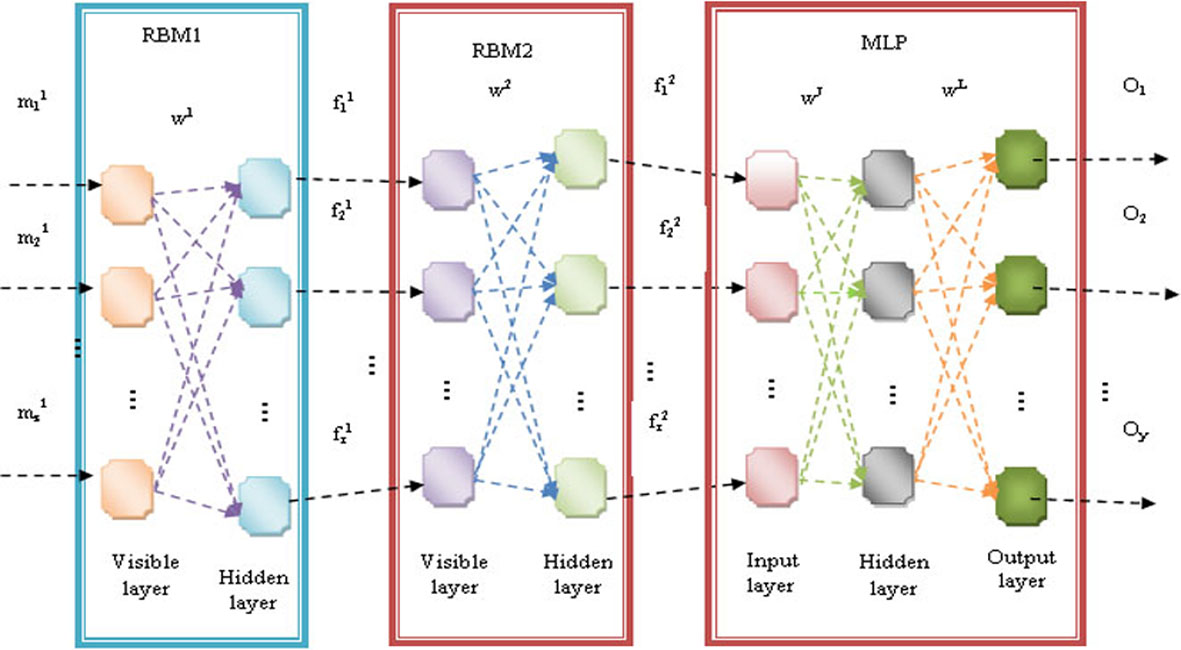
After extracting the features, the iris recognition is carried out with DBN. The DBN consist of two Restricted Boltzmann machine (RBM) layers, and a single Multilayer Perceptron (MLP) layer as portrayed in Fig. 2. The first RBM input from DBN is
The visible layer contained the feature vector as the input, and the hidden layer of RBM1 is represented as,
where,
where,
where,
where, the activation function is represented as,
The total visible neurons are similar to total hidden neurons of first RBM and are expressed as,
where,
The biases present in the hidden and the visible layer having the same representations given in Eqs (7) and (8), denoted as,
where,
where,
where,
where,
where,
where,
where,
where,
The output vector is calculated using the output of the hidden layer, and the weight
where,
This section elaborates on the training procedure of a DBN classifier. Here, the RBM possess unsupervised learning on the basis of gradient descent technique, and MLP utilized supervised learning technique with standard back propagation method. Thus, DBN is trained using gradient descent-back-propagation technique.
I. Training of RBM layers
The training data
Initially, the input with training data is read, and weight The probability function considering all hidden neuron present in the first RBM is computed as,
The positive gradient
where, the The probability of visible neuron is produced and given as,
where, Then, the probability of the reconstruction hidden neurons are given as,
where, the hidden neurons reconstruction is given by The negative gradient with
The updated weights are generated by deducting the negative gradient with a positive gradient and is represented by,
where, Weights are updated for the next iteration
where, Compute the energy of visible and the hidden layers given as,
where, Finally, the weights offering minimum energy is selected as the best weight.
II. Training of RBM layer 2
The output generated from RBM layer1 is fed to the RBM2 visible layer and finds the probability distribution considering DBN.
III. Training of MLP
The training performed based on the back propagation approach by feeding the training data, which is the hidden output of the RBMs second layer. Through analyzing the data, the network is adjusted iteratively until the optimal weights are chosen. The training procedure is summarized as below
At first, the weights Read the input sample The average error is obtained based on the difference between the desired and the obtained output as,
where, O Calculate the weight updates in the hidden and the visible layers by considering the partial derivative of Eq. (32), as
where, Then, the new weights are obtained in the hidden and the visible layers by applying gradient descent.
where, the weights at the current iteration Estimate the error function The steps from ii to viii are repetitive until the iteration attains maximum count.
The results and discussions of the iris recognition using DBN are demonstrated in this section. The performance of the DBN is evaluated with conventional methods.
Setup of experimental
The proposed method is implemented in MATLAB using 2 GB RAM, Windows 10 OS, and Intel i-3 core processor.
Database description
The database employed is the HBIRIS dataset [35], with the data taken from 241 persons during September 2004. In this dataset, 1877 iris images are available from 241 individuals, and each of the iris images is presented as grey-level Joint Photographic Experts Group (JPEG) files.
Metrics for evaluation
The analysis of the proposed method is carried out using three measures, such as accuracy, FRR, and FAR, and the metrics are explained as below.
a) Accuracy
It refers to the preciseness of recognition the iris using iris modality, and is expressed as,
where,
b) FRR
It refers to the ratio of total false rejections to the total indisputable endeavours is referred as FRR. It is formulated as,
c) FAR
It refers to the ratio of false attempts to the imposter tries is confined as FAR is formulated as,
d) Receiver operating characteristics (ROC)
ROC is nothing, but a graphical representation of the relationship existing between TPR and TNR, and it is the measure that pictures the performance of the system.
The results attained by the proposed technique are detailed below. Figure 3 shows the pre-processed images and input images used for the recognition of iris. Figures 3a and b portrays the input images 1 and 2, and Fig. 3c and d depicts the output of HT using input images 1 and 2.
Sample results (a) Input image 1, (b) Input image 2, (c) HT output related to image 1, (d) Output of HT for the image 2.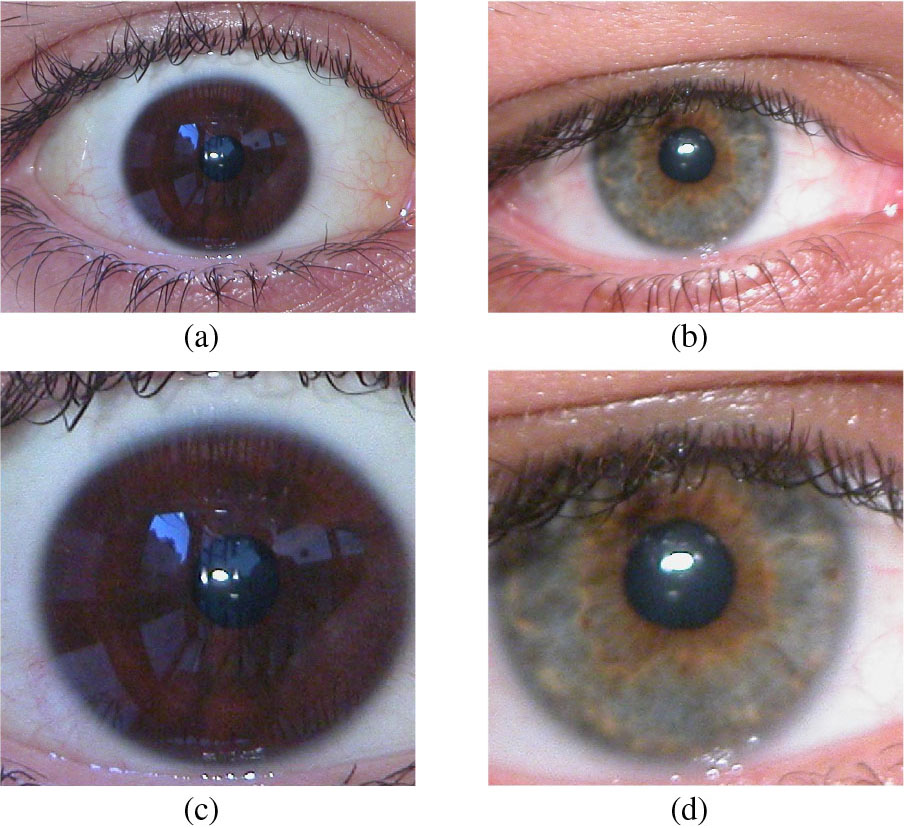
The output from HT is given to the Daugman’s rubber sheet model to regularize the image and Fig. 4a and b shows the normalized output images 1 and 2. Figure 4c and d depicts the descriptor output. The histogram representation of the image is depicted in Fig. 4e and f.
Sample results (a) Daugman’s rubber sheet model using firstInput image, (b) Daugman’s rubber sheet model using second input image, (c) Output of ScatT-LOOP with respect to first image, (d) ScatT-LOOP output with respect to second input image, (e) Histogram with respect to first image, (f) Histogram with respect to the second image.
The proposed DBN method is analyzed by computing the effectiveness of other methods. The analysis of the method is done by altering K-fold and the training data percentage, and the results are computed using FAR accuracy, and FRR.
Competing methods
The methods, like Spectral matching [20], IrisConvNet [36], chronological-MBO-NN, and Back Propagation Neural Network (BPNN) [37]. The chronological-MBO is the combination of the chronological concept in the standard Monarch Butterfly Optimization (MBO) algorithm for performing the recognition using the iris. This approach optimally determines the weights for training the NN, used for the comparison with the DBN for the analysis.
Comparative analysis with image 1
i) Using training data percentage
The comparative analysis using accuracy with different training data percentages is portrayed in Fig. 5a. For 50% training data, the accuracy computed by existing spectral matching is 79.52%, IrisConvNet is 89.70%, BPNN is 90.661%, and chronological-MBO-NN is 95.84%, respectively, which is moderately higher than the iris recognition technique using DBN. For the same training data, the DBN classifier attained an accuracy of 96.76%. Similarly, when the training percentage increases to 80%, the accuracy attained by spectral matching is 85.09%, IrisConvNet is 94.11%, BPNN is 94.88%, and chronological-MBO-NN is 96.03%, respectively, whereas the accuracy of the DBN classifier is 96.97%. From the above interpretation, it is seen that the DBN achieved improved accuracy of 96.97% at 80% training data.
The comparative analysis using FAR is depicted in Fig. 5b. When 60% of training data is considered, the FAR of existing methods like spectral matching is 0.6736%, IrisConvNet is 0.5539%, BPNN is 0.5539%, and chronological-MBO-NN is 0.512%, respectively. Meanwhile, the DBN classifier obtained the FAR value of 0.504%. When 80% of training data is considered, the FAR of existing methods, like spectral matching is 0.623%, IrisConvNet, is 0.532%, BPNN is 0.53%, and chronological-MBO-NN is 0.51%, respectively, whereas the DBN classifier attained the FAR of 0.503%.
The analysis using FRR is portrayed in Fig. 5c. Here, for 70% training data, the FRR attained by existing techniques, like spectral matching is 14.08%, IrisConvNet is 4.35%, BPNN is 4.20%, and chronological-MBO-NN is 1.92%, respectively, but the DBN classifier acquired the FRR of 1.86%. While considering 80% of training data, the FRR computed by existing techniques, such as spectral matching is 13.35%, IrisConvNet is 4.05%, BPNN, is 3.5%, and chronological-MBO-NN is 1.928%, respectively. Meanwhile, the DBN classifier attained the FRR of 1.8689%. From Fig. 5c, the DBN classifier is found to possess the minimum FRR of 1.868% at 80% training data.
Comparative analysis by altering training data using first image with (a) accuracy, (b) FAR, (c) FRR.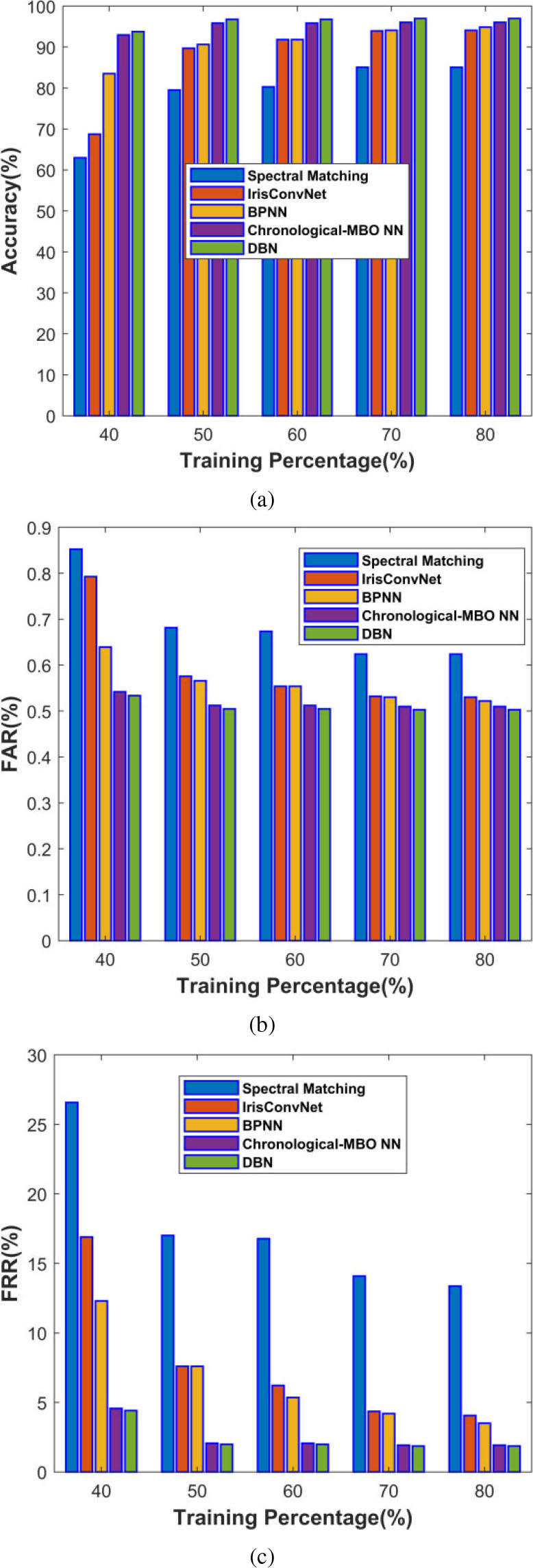
ii) Based on K-fold
The analysis method based on accuracy with varying K-fold is depicted in Fig. 6a. For theK-fold
The comparative analysis with FAR is illustrated in Fig. 6b. When 6% of K-fold is considered, the FAR of existing methods, like spectral matching is 0.606%, IrisConvNet is 0.552%, BPNN is 0.521%, and chronological-MBO-NN is 0.510%, respectively. Meanwhile, the DBN classifier acquired the FAR value of 0.503%. For 9% of K-fold, the FAR of the comparative methods, like spectral matching is 0.5389%, IrisConvNet is 0.5264%, BPNN is 0.5148%, and chronological-MBO-NN is 0.5%, respectively, whereas the DBN classifier attained the FAR of 0.4933%.
The analysis with FRR is illustrated in Fig. 6c. Here, for 7% K-fold, the FRR of conventional methods, like spectral matching is 3.29%, IrisConvNet is 2.06%, BPNN is 1.21%, and chronological-MBO-NN is 0.5%, respectively, but the DBN classifier acquired the FRR of 0.47%. While considering 10% K-fold, the FRR of existing techniques, such as spectral matching is 1.34%, IrisConvNet is 1.03%, BPNN, is 0.85%, and chronological-MBO-NN is 0.5%, respectively. Meanwhile, the DBN classifier attained the FRR value of 0.488%. From Fig. 6c, the DBN classifier is found to possess the minimum FRR value of 0.487% at 10% K-fold.
Comparative analysis by altering the K-fold (a) accuracy (b) FAR (c) FRR.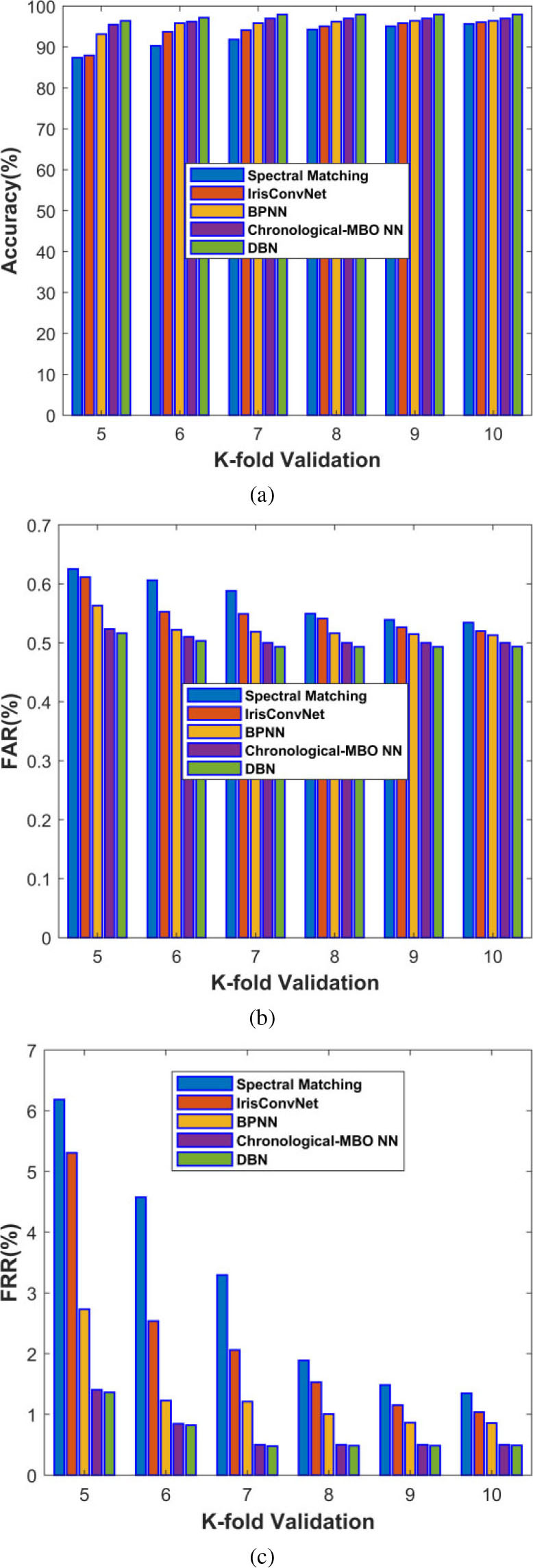
Comparative analyses by altering the training data using (a) accuracy (b) FAR (c) FRR.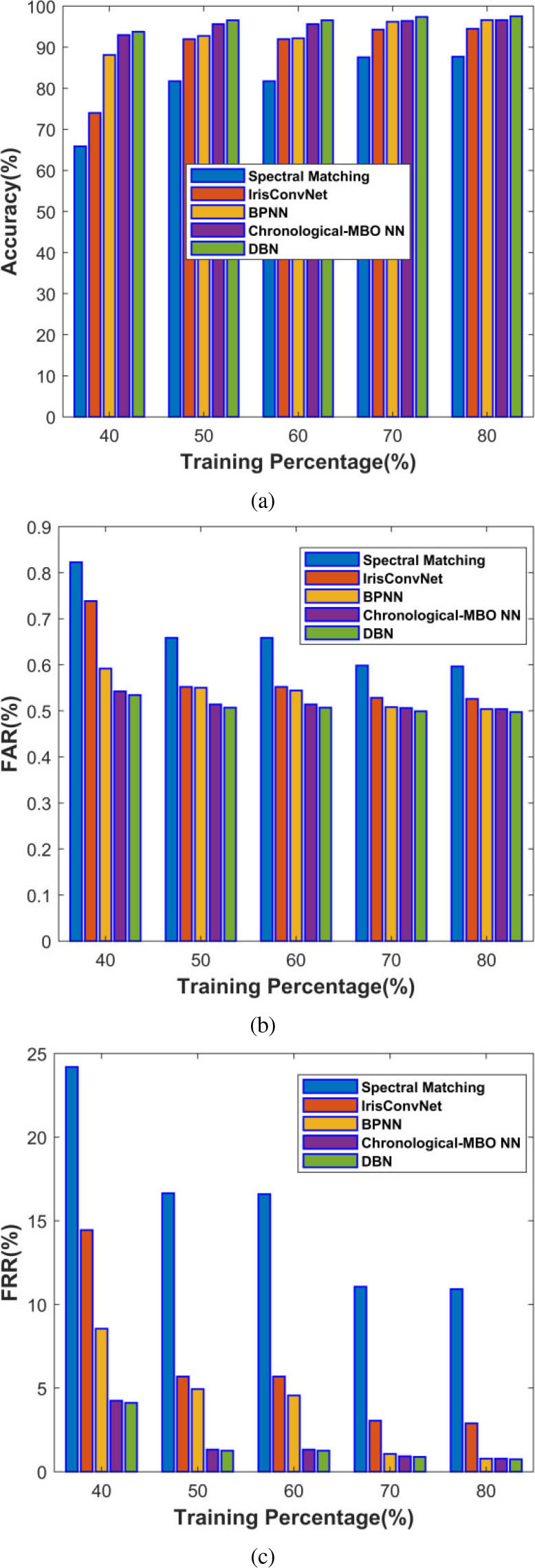
i) Based on training data percentage
The analysis in terms of accuracy with varying training data percentages is shown in Fig. 7a. For the training data
The comparative analysis using FAR is depicted in Fig. 7b. When 60% of training data is considered, the FAR of existing methods, like spectral matching is 0.658%, IrisConvNet is 0.552%, BPNN is 0.544%, and chronological-MBO-NN is 0.514%, respectively. Meanwhile, the DBN classifier acquired the FAR value of 0.506%. When 70% of the percentage of training data is considered, the FAR of the comparative methods, like spectral matching is 0.598%, IrisConvNet is 0.528%, BPNN is 0.508%, and chronological-MBO-NN is 0.506%, respectively, whereas the DBN classifier attained the FAR of 0.499%.
The analysis using FRR is portrayed in Fig. 7c. Here, for 70% training data, the FRR of existing techniques, like spectral matching is 11.05%, IrisConvNet is 3.042%, BPNN is 1.071%, and chronological-MBO-NN is 0.928%, respectively, but the DBN classifier acquired the FRR of 0.885%. While considering 80% of training data, the FRR of existing techniques, such as spectral matching is 10.91%, IrisConvNet is 2.9%, BPNN is 0.785%, and chronological-MBO-NN is 0.7857%, respectively. Meanwhile, the DBN classifier attained the FRR of 0.744%. From Fig. 7c, the DBN classifier is found to possess the minimum FRR of 0.744% at 80% training data.
Comparative analysis by altering the training data (a) accuracy (b) FAR (c) FRR.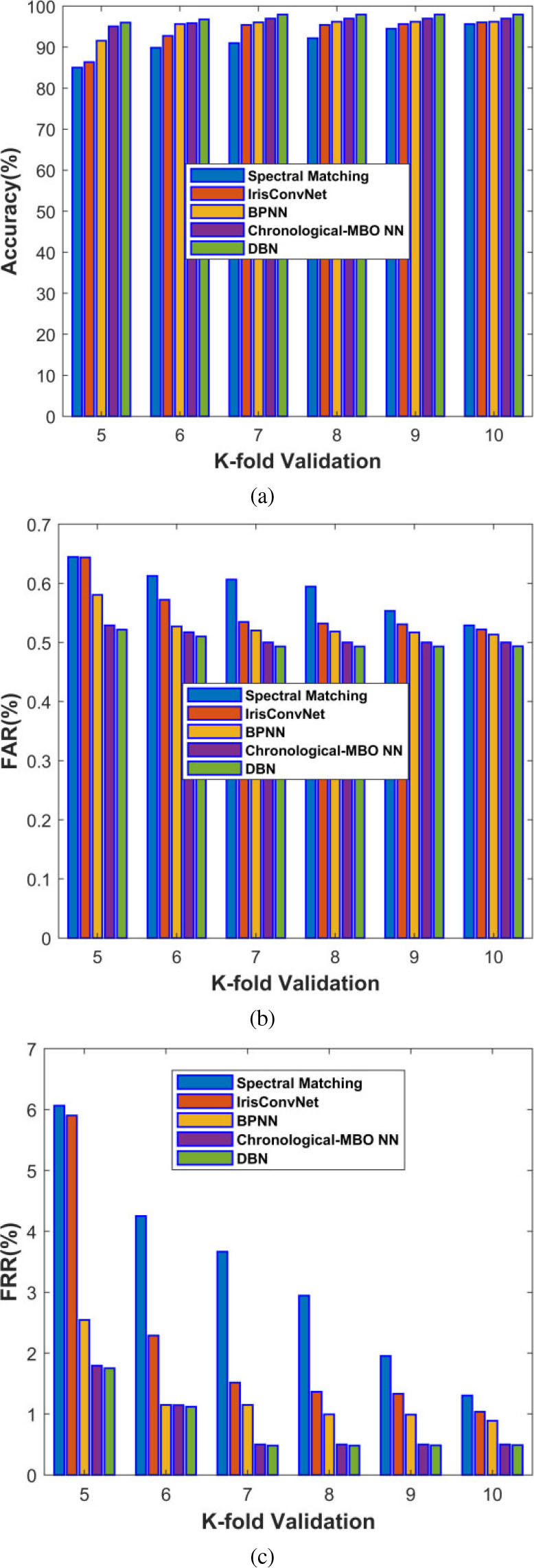
Analysis based on ROC (a) With image 1, (b) with image 2.
ii) Based on K-fold
The comparative analysis using accuracy with varying K-fold is depicted in Fig. 8a. When the K-fold
The analysis using FAR is illustrated in Fig. 8b. When 6% of K-fold is considered, the FAR of existing methods, like spectral matching is 0.612%, IrisConvNet is 0.571%, BPNN is 0.527%, and chronological-MBO-NN is 0.517%, respectively. Meanwhile, the DBN classifier acquired the FAR value of 0.510%. For 8% of K-fold, FAR of the comparative methods, like spectral matching is 0.553%, IrisConvNet is 0.530%, BPNN is 0.516%, and chronological-MBO-NN is 0.5%, respectively, whereas the DBN classifier attained FAR of 0.493%.
The analysis using FRR is illustrated in Fig. 8c. Here, for 8% K-fold, FRR of existing techniques, like spectral matching is 2.944%, IrisConvNet is 1.367%, BPNN is 0.995%, and chronological-MBO-NN is 0.5%, respectively, but DBN classifier acquired the FRR of 0.482%. While considering 10% of K-fold, the existing techniques, such as spectral matching is 1.305%, IrisConvNet is 1.03%, BPNN is 0.888%, and chronological-MBO-NN is 0.5%, respectively. Meanwhile, the DBN classifier attained the FRR of 0.488%. From Fig. 8c, the DBN classifier is found to possess the minimum FRR value of 0.488% at 10% K-fold.
Figure 9 demonstrates the evaluation of ROC with two images. Figure 9a depicts the ROC analysis using image 1. When the FPR is 0.3%, the TPR of the methods, such as spectral matching is 83.22%, IrisConvNet is 93.78%, BPNN is 94.77%, Chronological MBO-NN is 97.92%, and DBN is 98.006%, respectively. Figure 9b depicts the analysis of ROC based on image 2, For the minimal of 0.5% as FPR, the TPR generated by spectral matching is 89.08%, IrisConvNet is 97.1%, BPNN is 97.92%, Chronological MBO-NN is 99.21%, and DBN is 99.25%, respectively.
Table 2 illustrates the analysis to disclose optimal performance achieved by iris recognition methods, based on FAR, accuracy, and FRR using training percentage. Spectral matching acquired the accuracy, FAR, and FRR of 85.09%, 0.6238%, and 13.35%, respectively, while IrisConvNet attains the accuracy, FAR, and FRR of 94.11%, 0.53%, and 4.05%. The accuracy, FAR, and FRR values of BPNN are 94.88%, 0.522%, and 3.5%, respectively. Chronological MBO-NN achieved the accuracy, FAR, and FRR values of 96.03%, 0.51%, and 1.928%, respectively. As depicted in the table below, the existing Chronological MBO-NN has comparatively better performance when compared with the existing techniques. Among all the comparative methods, DBN possesses improved performance with accuracy, FAR, and FRR percentages of96.979%, 0.503%, and 1.864%, respectively.
Comparative analysis using training data
Comparative analysis using training data
Comparative analysis usingK-fold
Table 3 elaborates on the comparative discussion to determine the optimal performance acquired by the iris recognition techniques, in terms of accuracy, FAR, and FRR using K-fold. Spectral matching acquired the accuracy, FAR, and FRR values of 95.65%, 0.534%, and 1.34%, respectively, while IrisConvNet attains the accuracy, FAR, and FRR of 96.04%, 0.519%, and 1.03%. The accuracy, FAR, and FRR values of BPNN are 96.42%, 0.513%, and 0.85%, respectively. Chronological MBO-NN achieved the accuracy, FAR, and FRR values of 97%, 0.5%, and 0.5%, respectively. As depicted in the table below, the existing Chronological MBO-NN has comparatively better performance when compared with the existing techniques. Among all the comparative methods, DBN possesses improved performance with accuracy, FAR, and FRR percentages of 97.96%, 0.493%, and 0.48%, respectively.
This research work presents a deep learning classifier for the recognition of iris. Initially, the iris image is pre-processed, and then the region of the iris is extracted using HT. After pre-processing, the segmentation and the normalization of the iris are done using Daugmen’s rubber sheet model, which remain as a booster to maximize the recognition accuracy. Then, the result obtained from the segmentation is fed to the feature extraction phase where in features are extracted using ScaT-LOOP, which integrates TT, LGP descriptor, LOOP descriptor, and ST. Finally, steepest gradient-based DBN is utilized for effective recognition of iris. Besides, the performance of the proposed method is measured based on metrics, such as FAR, accuracy, and FRR, by varying training data percentage and K-fold using CASIA iris dataset. The results of the DBN classifier are compared with the existing techniques by achieving maximum accuracy value of 97.9%, the minimum FAR value of 0.493%, and the minimum FRR value of 0.48% that indicates its superiority. The future dimension of the research will be concentrated on extending the analysis using other benchmark databases with highly advanced features.