



Abstract
The internet of things (IoT) is a multiple devices, which connects with the internet for communication, in order to obtain the updated from the cloud. The fog can act as a controller and it is located between the IoT devices and cloud. The major attacks like de-synchronization, and disclosure has arises in the devices, this has been prevented. The major contribution in this work is key generation and authentication, for key generation the “advanced encryption standard algorithm” is developed, in which the new and old keys are generated. The encryption is done under the source side, and decryption is done under the device side. The fog security is maintained through “device tag, and bit wise XOR rotational algorithm”. The security, and the computational complexity is defined in this work and it is given in table format. The implementations are carried out in the MATLAB R2016 a. The proposed algorithm is compared with the existing protocols like LMAP, M2AP, EMAP, SASI, and RAPP, from the comparison the proposed methodology makes the better knowledge about the security and prevents from various attacks.
Keywords
Introduction
The platform of internet of things (IoT) have several objects, which is surrounded us in one or another form. The new criteria of sensor network topologies, and tag device (radio frequency identification-RFID), contains some communication and the information, which is embedded in the environment as an invisible manner. Thus the results has been gives the massive data to stored, processed, efficacy, and highly interpretable [1]. The virtual infrastructures are provided by the fog computing to integrate the platform of visualization, client delivery, storage devices, analytical, and monitoring devices. The cost model of fog computing can enable the end-to-end service for users, and business to access the applications from anywhere [2, 24].
The new challenges, and security threats are arrived towards the users in this way the fog computing make more adventurous one. In cloud computing have the service providers, similar way the fog also support to fog service providers [3, 4, 5]. The corrections of the fog data is very risky manner and it is occurred due to the following reasons
The security is held on through the encryption process with the huge growth of computer networks. The huge amount of the data is being transmitted over the several kind of networks. It can often prove that the several part of the information is being kept as private or confidential. The required data protection have been discussed with the help of security techniques [10]. One of the most critical aspects in the fog computing’s are the security maintenance over the entire network. The infrastructure of fog computing may use the different infrastructure due to the habits of sensitivity and stored applications. The new technologies of the fog is fully evaluated through the security. Under this environment have certain mismatches, those events are expectations, regulations, trust, performance issues, and concerns [11, 12].
In fog, there were did not mention the plain text data, which includes the type of data being all. The solution regarding the encryption schemes are transparent to the certain applications, so which are integrated easily and quickly without making the alterations in applications [13]. After the data encryption, the key is nevertheless stored, because the third party can compromise the key maybe. The users may contain the physical key management server in order to store the keys. The keys and the data’s are protected by the scheme of encryption and it never exposed in storage [14].
The origination of the paper is summarised as, the historical details of the work, recent developed technologies, and the problem identification, objectives, and the contribution of the work has been analysed in Sections 1–3, respectively. The proposed methodology is discussed in Section 4, the security analysis is taken in Section 5, and the conclusion is added in Section 6.
The recent related techniques are reviewed in Table 1.
The cloud computing is defaulted by the security, and for that introducing the fog computing. This is the efficient way to store the files and it can be access by the user through privacy. So the security, and the computational complexity is the major problems in the fog computing, so it can be avoided through the novel methodologies while keeping the informations in the fog.
Objectives
To maintain the security. To reduce the computational complexity.
Contribution
A key contribution in the proposed methodology can be written by,
Key generation: Advanced encryption standard algorithm (AES).
Authentication: Bit wise XOR rotational algorithm.
Attacks: De synchronization, and disclosure.
Requirements: Data confidentiality, and data integrity.
The cloud computing is one of the way to store the information, and the advanced things among that is fog computing. Similar way, it is more efficient than the cloud computing when compared with the latency. The fog and the internet of things (IOT) devices are designed to store the information and maintain the security. In this proposed systematic model, the information is securely shared among the scenarios alike IOT, and fog platform, in which the process of decryption and encryption is processed. The fog and cloud are connected based on the IOT protocol. The trade-off between memory and time gets too increased due to its N-bit moduli and it is oriented by strength of the variants. The minimal hardware constraints are carried by the IoT devices, which is said to be low computational, and minimal power. The AES algorithms are proposed here to solve the above concerns, and to attain high security strength with low module bits. The work flow is given in following steps
Generate the cloud, fog,and IOT devices. The key generation algorithm is developed in cloud, and it is stored in a fog. The public key is shared among both the fog and the IOT devices. But the private key is only shared by the corresponding IOT devices. The key generation is based on the AES algorithm for security purpose.
The advantages of proposed technique are; the proposed novel system for the security in the IOT device uses the AES for key generation at source side. The AES is a simple, secure and easy to implement, so the computation complexity get reduced along with the security. Then at the device side the bit wise XOR rotation is used to authenticate the source. It enable live authentication throughout the communication.
Basic block diagram.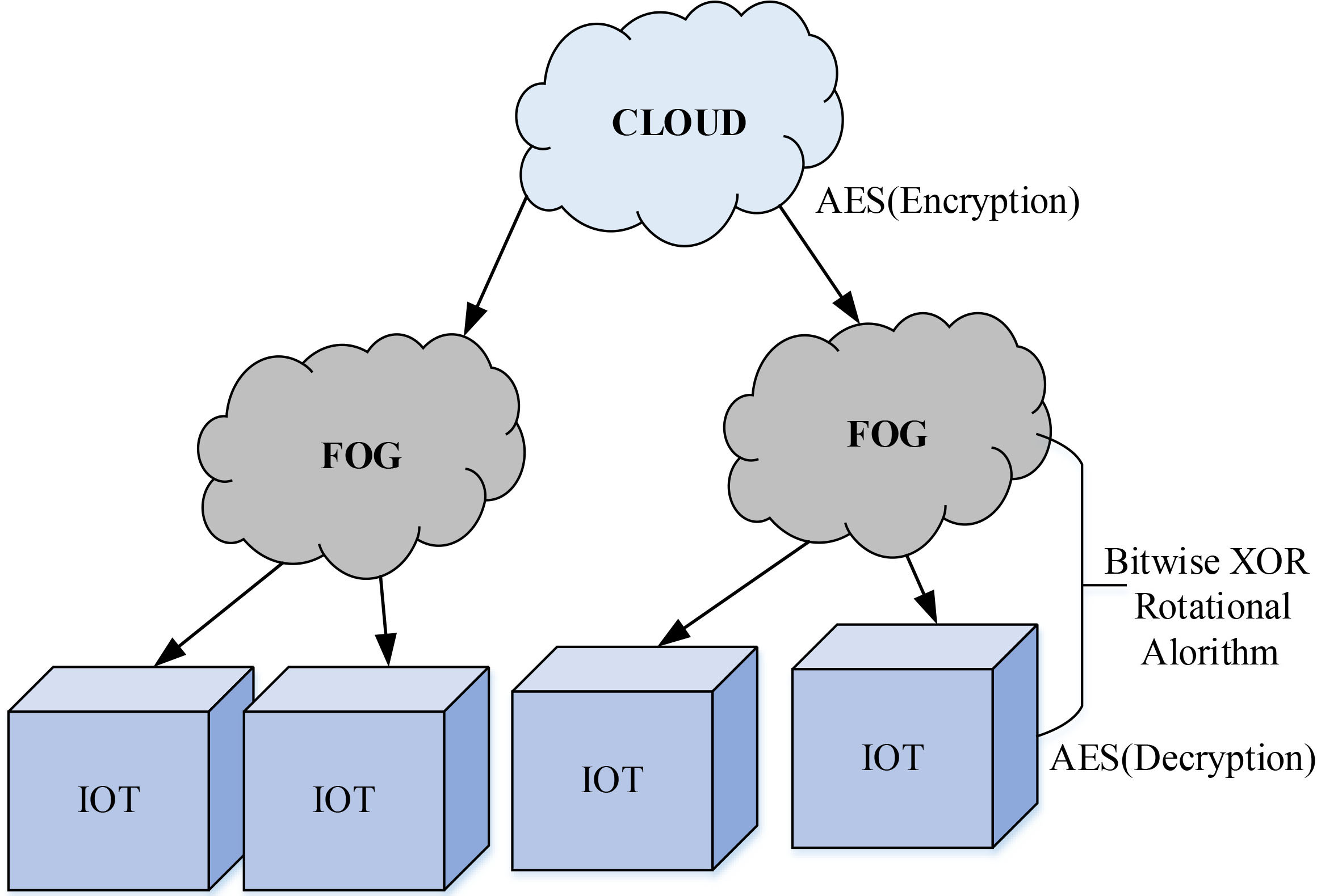
The clod and fog nodes are recycled to hoard the data’s with the keys, the key generation is worked out with the advanced encryption standard algorithm (AES). The encryption process are done under the source side. After the encryption process the encrypted messages are stored in the fog nodes. The fog can act as a controller. The device of IoTis withstand to access the data from the fog nodes, and it does not access the work directly from the cloud. The data’s are accessed only through the fog node, and it can act as a gate way node. The function of fog nodes can hide the data. Initially the data’s are in the plaintext, after that it is encrypted and stored in the fog. The IOT devices security is maintained through the “bitwise XOR rotational algorithm”. Finally the IOT devices can get the plaintext through the AES decryption algorithm. The work criteria has to be as follows
Criteria (i): Cloud
Plain text (16 bit messages). Key generation (Old, new). Add two keys and generate new key.
Criteria (ii): AES algorithm [20, 21, 22]
Key expansion. Shift rows. Sub bytes. Add round key. Mix columns.
Criteria (iii): Fog
Encrypted messages. Authentication by bit wise XOR rotational algorithm.
Criteria (iv): ADS algorithm
Cipher text (16 bit messages).
The encryption algorithms are derived in this paper for secure key generation, in which some set of derived keys called round keys. The encryption steps are as follows,
From the cipher key, originate the round key sets. Prepare the array by means of plaintext. Add initial key to array state. Perform nine rounds manipulationstate. Perform10th and final round of manipulation. Copy the final state from the cipher text.
The state arrays can be altered in criteria (ii)
Sub bytes
This operation can perform the conversion operation from byte to different value. The length of the message is 128 bits, and it in 16 bytes.
Shift rows
The name itself it is given, the certain number of bytes are rotated to the right by each row in the states.
Mix columns This is very difficult, to perform and explain. The new columns are generated by processing of each columns on the state array. The old Column is replaced by a new column, in which the matrix multiplications are carried out.
XOR round key This operation evolves the state array and XOR the values of the appropriate round key and replaces the state array with result.
The encryption is considered as,
Input: Plain text
Objectives: sub bytes
Shift rows
Mix columns
Output: Cipher text
Flow chart of AES algorithm.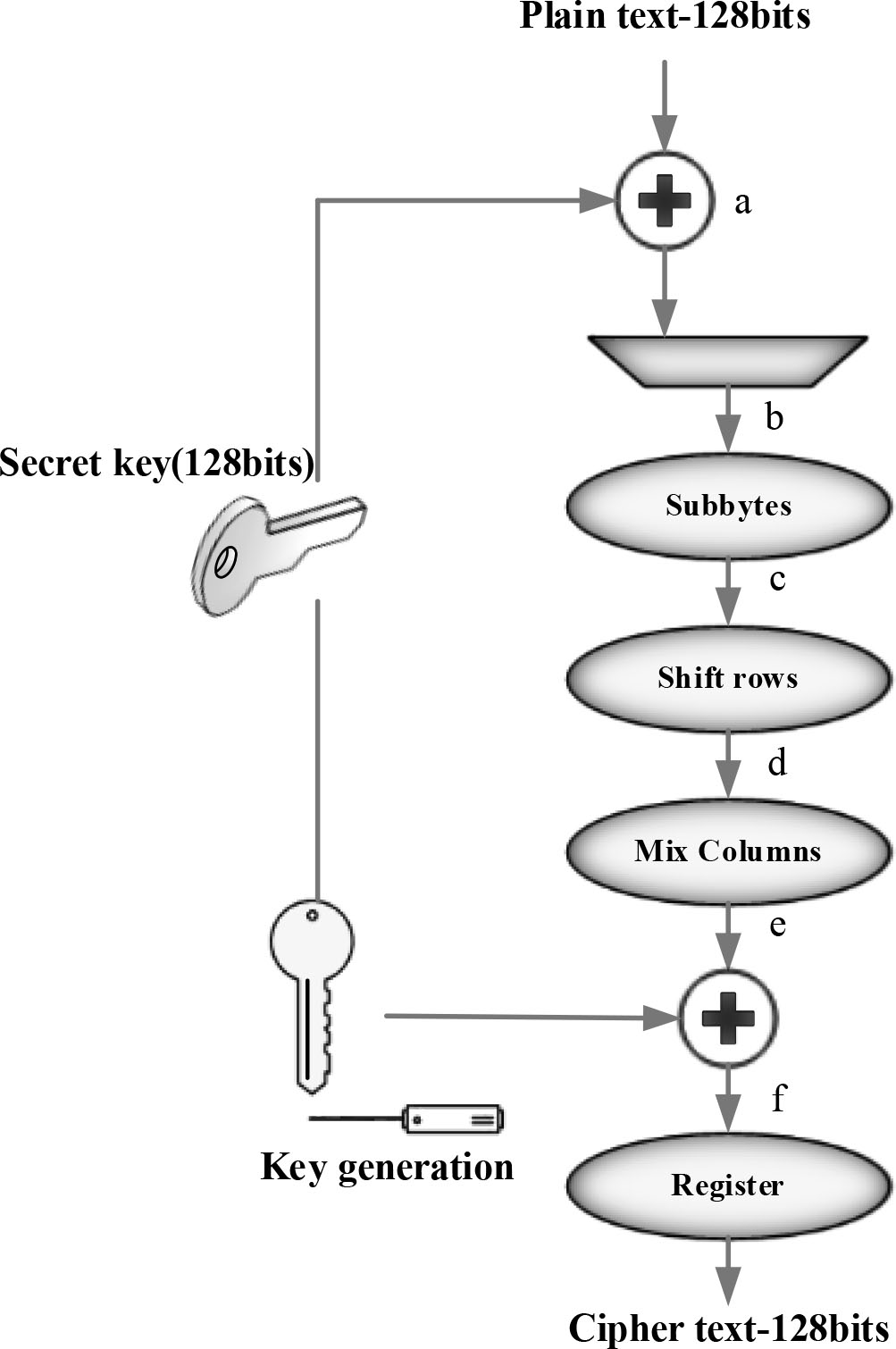
The above steps are updated for key generation, after generation of key the data’s are stored in the fog as encrypted form. The authentication is carried out between the IOT devices and fog, for that bitwise XOR rotational algorithm is discussed here. The flowchart of Fig. 2, represents the working procedure of AES algorithm.
Adversary node: It is otherwise named by attacker, and the major function involved in the attackers are given by,
Plan. Deploy. Monitor/detect. Ex-filtrate.
Plan: Before planning the attack, the adversaries can gain much more information about the network which is exploited. This can get the informations through listening the messages between IOT devices and the server
Deploy: After getting the knowledge about the nodes, and available information, “the malicious nodes”, can install the software to eaves drop the current transformation of messages to the channel.
Monitor/detect: After installation of the malicious software, the adversary nodes are watching the current updation of the messages and it checks the confidential information through the software.
Extract files: After knowing the details of all the information it can extract the files.
The above mentioned steps are the qualities of the attacker, and it can be overcome through the below mentioned algorithm.
The new algorithm like Bit wise XOR rotational, which involves the following entities like RFID (radio frequency identification devices) tag, IOT devices, and cloud server. This algorithm only can use bit wise XOR operations, and rotational operations can make the better solution for IOT devices and tag. The authentication methods are vulnerable to several attacks, and in fog devices the RFID tag is attached. Each tag can store 128 bit tag ID and the pseudorandom key value, which is like {ID,
Bit wise operations: The proposed algorithm have do two bit wise operations like,
XOR. Left rotation.
The bit wise XOR operation can do addition operation, and rotates left by its weight.
Authentication protocol:
The algorithm steps are as given by, Pseudo code for Bit wise XOR rotational Algorithm
Create two RFID (New ID, Old ID) Create two RFID (New key, Old key) IOT devices, keep old, and new key. To check validation of RFID tag. If {RFID new key Then Display “valid” Else Display “invalid” End Using random generator, two 16 bits random numbers Send In RFID device, calculate “ If { Then Calculate “ It is send back to the IOT devices IOT devices calculate “ If { Then Display “mutual authentication is successful”
Repeat the above steps up to reach the expected results
Flow chart of bit wise XOR rotational algorithm.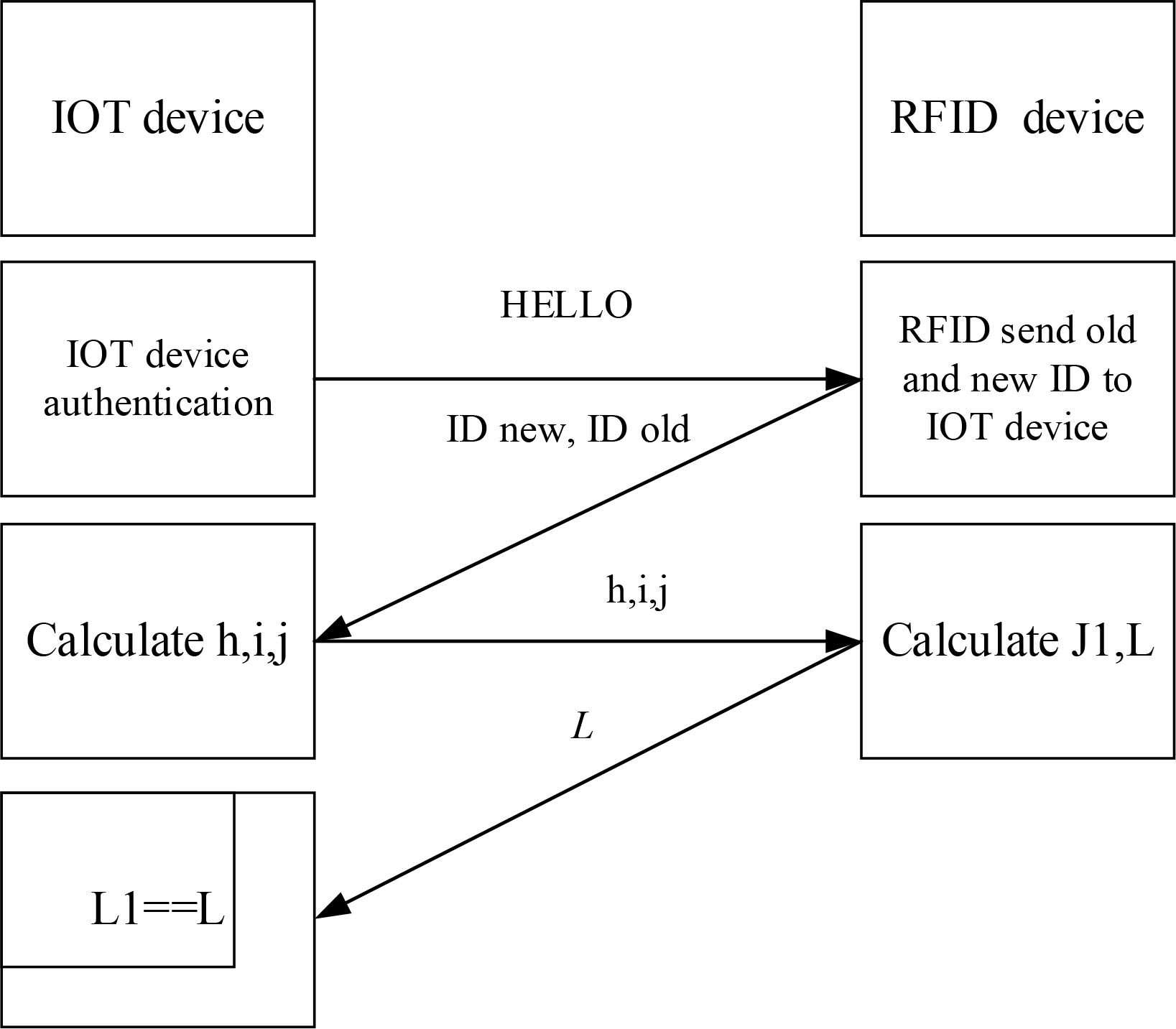
The above Fig. 3, shows that the flow diagram of bitwise XOR rotational algorithm. The source of IOT devicescan secure the messages through authentication. The RFID device can send the new and old identities to source in order to calculate
The reverse process of encryption is decryption, in which the original messages (plaintext) are retrieved. The IOT devices can perform the AES decryption to get the original messages, because now the messages are in the encrypted form, that is presence of encrypted messages and key values are generated through the encryption algorithm. The flow diagram shows the reverse process of AES encryptionalgorithm. The steps involved in the decryption process are
Inverse sub bytes. Inverse shift rows. Inverse mix columns.
Input: Cipher text
Objectives: inverse sub bytes
Inverse shift rows
Inverse mix columns
Output: Plain text
Reverse process of AES encryption algorithm (Decryption).
The above procedure is carried out in the MATLAB R2016a in windows platform with 8GB RAM, in which the model have cloud, fog, IOT devices. The main aim of this paper is to provide the security among the devices. The way of security can be provide through the key generation algorithm, and authentication, for the key generation AES algorithms are developed. In cloud, the keys are generated and the messages are in the form of encryption. Then the generated messages are stored in the cloud as in the manner of encrypted form. So the adversaries cannot view or retrieve the original messages from the cloud. So this can be known the original key.
The attacks are developed to retrieve the confidential messages between the cloud server and the IOT devices. But the security can be achieved through the authentication algorithm like bitwise XOR rotational algorithm. The messages cannot be retrieved. Then the IOT devices can perform the decryption algorithm to view the plaintext from the server.
Security against attacks
In this work considering two attacks namely,
De synchronization attacks. Disclosure attacks.
De synchronization attacks: This kind of attacks is caused at the device tag, and the IOT devices. The attacker may try to desynchronize the IOT devices, and the device tag, so this try to change the values of Eq. (1) “
Disclosure attacks: The attacker cannot eavesdrop any information, even if they have the values like “
Basic requirements of Bit wise XOR rotational algorithm:
Confidentiality: The messages are transferred between the device tag and the IOT devices through the insecure communicational channel, this can be use some random number and the key values. So the third party auditor will set some sensor devices into the RFID tag. But it will vary at each time, so the third party cannot view the original messages. So the channel informations become very confidential only.
Data integrity: The data integrity can be checked through the variables of “
Way of encryption and decryption analysis
The above Table 2, shows that the implementation results of each fog, cloud, and IOT devices. The AES algorithms are used to generate the keys in cloud and it convert the original message in the form of cipher text. There two keys are generated like old key and new key which is “W%HDWYZVRSDG {567, $FHKTFTXBAFF} 567” respectively. The plaintext is in the form of 16 bit data which is to be “HELLOOOOOOOOOOOO” Then the encrypted messages are like “ÍÄMÑó¥_PMßQ1J”. Then the concept of fog security. The Eqs (1)–(8) are calculated for fog security, then the decryption messages are written by “HELLOOOOOOOOOOOO”, which is obtained through the AES decryption algorithm.
In this section, the algorithms of “bit wise XOR rotational” algorithms are exploited, in which the tag can store 16 byte value, and the total length of the value is said to be 128 bits., so the total storage requirement s like “5l” bits’
Comparison of existing with proposed protocols
The above Table 3, shows that the comparison table of proposed approaches with the existing protocols like lightweight mutual authentication protocol (LMAP), application protocol (M2AP), Expedite message authentication protocol (EMAP), strong authentication and strong integrity protocol (SASI), In which the number of operations are used in the existing protocol, but n case of proposed system the number of operations has to be reduced and the security is provided from two kind of attacks like disclosure attacks, and de-synchronization attacks. The computational complexity is analysed in the proposed method, and it is to be in first run 0.231 seconds, 0.177, 0.129, 0.351, and 0.186 respectively and is given in Fig. 5.
Comparison of computation complexity.
The comparison chart clearly shows the betterment of the proposed technique. Thus the complexity has been reduced, when the performance are compared with the existing algorithms, proposed method can shows the better results.
Thus the crypt analysis is successfully implemented in the working platform of MATLAB. The key generation algorithms are developed in the form of advanced encryption standard. The two keys, and two ID’s are created. The encryption is done and the messages are stored in the fog as in the encrypted manner. The RFID tag is implemented in the fog node, in which the third party can make the sensor device to view the plain text. But the tag are in the form of old and new, it is randomly generated and each run it is varied. Between the RFID tag, and IoT devices, the information is secured through the bitwise XOR rotational algorithm. The security is preferred for vulnerable to various kind of attacks namely de-synchronization, and disclosure attack. All the data’s are stored in the cloud, and the encrypted data’s are in the fog. Finally the IoT devices can access the data from the fog by using the decryption algorithm. The validation results of security analysis can make the proposed system is better for privacy, and the computational complexity is reduced. The complexity is varied at each run and get like 0.231, 0.177, 0.129, 0.351, and 0.186 respectively.
Footnotes
Conflict of interest
None of the authors have a conflict of interest. This article does not contain any studies with animals performed by any of the authors. And this article does not contain any studies with human participants or animals performed by any of the authors.